You run a business, and waiting for customers to show up by phone or word of mouth is no longer enough. Maybe your website looks dated. Maybe nobody is looking after your social media accounts. Maybe you tried ads once and could not tell where the money went. Someone told you to "hand it to an agency," so you typed "how to choose a digital marketing agency" into a search box. It is a fair question, because handing this work to the wrong person costs you both money and months. In this article I walk through a selection method you can apply without any technical background.
I am Ümit Kırkoç, and I work from Istanbul. I handle everything an agency would normally offer on my own: website and e-commerce design, SEO, social media management, Google and Meta ads, logo design and content creation. That means I look at this topic from the side of the person doing the work, while keeping a customer's questions in mind. I describe how I work briefly near the end, but most of this article is a set of criteria that will help you no matter who you hire.
First, what does a "digital agency" actually do?
A digital agency is a company that manages how visible your business is online and how much it sells through the internet. That definition is very broad, though, because two firms with the same word on their sign can do completely different work. Some only run ads. Some build a website, hand it over and disappear. Some prepare social media posts but never touch your site. And some offer all of it but pass each piece to a different person.
So the first thing to do is drop the question "am I looking for an agency?" and ask "what job do I want done?" The table below summarizes the main types of firms you will run into and who each one suits.
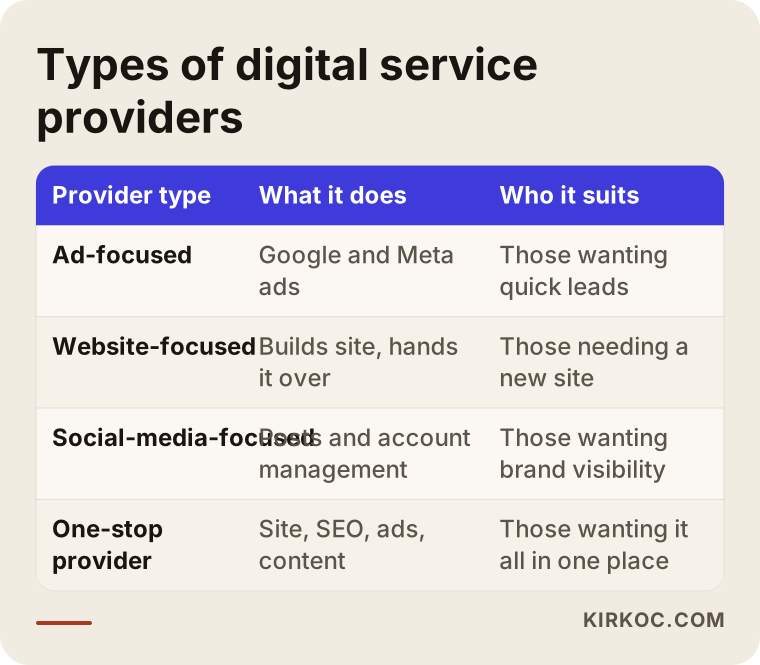
As the table shows, every type has a real strength. Trouble starts when your need and the firm's specialty do not match. An owner wants a new website and hires a social media agency, or wants ads and signs with a firm that only does design. Both sides act in good faith, and the result is still disappointment.
Prepare your own answers before the first call
Spending half an hour with a few questions before you contact anyone changes the quality of every meeting that follows. A customer who does not know what they want hears "we have exactly what you need" from every agency. A customer who is clear gets a clear proposal in return.
Write these down on paper. Who buys your product or service? How do customers find you today? How many new customers or orders per month would make you happy? Which product or service earns you the most? How much can you set aside for this, and by when do you want to see results? You do not have to share the budget figure with the agency, but it needs to be settled in your own head.
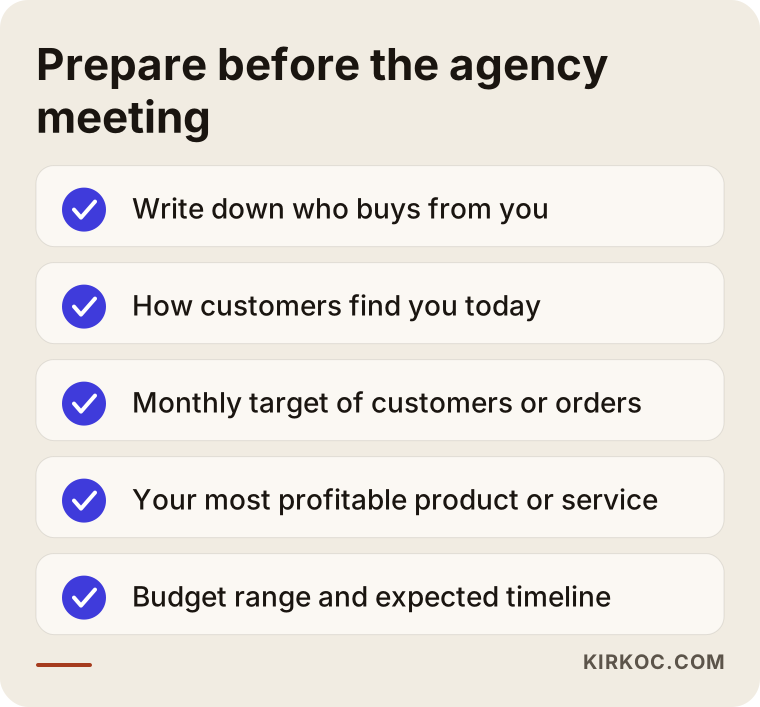
This list looks small, but it is the most useful step in the whole process. With clear answers, you can read every proposal against your own goals instead of squeezing yourself into the ready-made package an agency wants to sell.
Is your goal "be seen more" or "sell more"?
These two goals sound alike but need different work. If you want visibility, brand awareness, social media and content come first. If you want sales or phone calls, search engines, ads and a well-written service page move to the front. Many owners want both, but when the budget is limited you have to pick an order. A good agency helps you with that ranking. A poor one tries to sell you everything at once.
Agency, solo specialist or in-house hire?
Your choice is not just "an agency." There are three paths, and each has an honest upside and downside.
At a large agency, the work is split among several people: one manages the account, one designs, one sets up the ads. That structure makes sense for very large budgets and for campaigns running across dozens of channels at once. The tradeoff is that the person you talk to is often not the person doing the work. Information can get lost as it passes from hand to hand, and part of what you pay goes toward the coordination itself.
Working with a solo specialist means the person you talk to is the person who does the work. Decisions are quick and the path is short. But capacity is limited, and a specialist who takes on too many clients at once can fall behind. People also get sick, take vacations or change careers, and a one-person operation can stall when that happens. It is worth asking about this up front.
The third path is hiring someone to work inside your business. That makes sense if the work is constant and heavy, but you have to account for salary, training and software costs, and for the fact that one person is rarely excellent at everything.
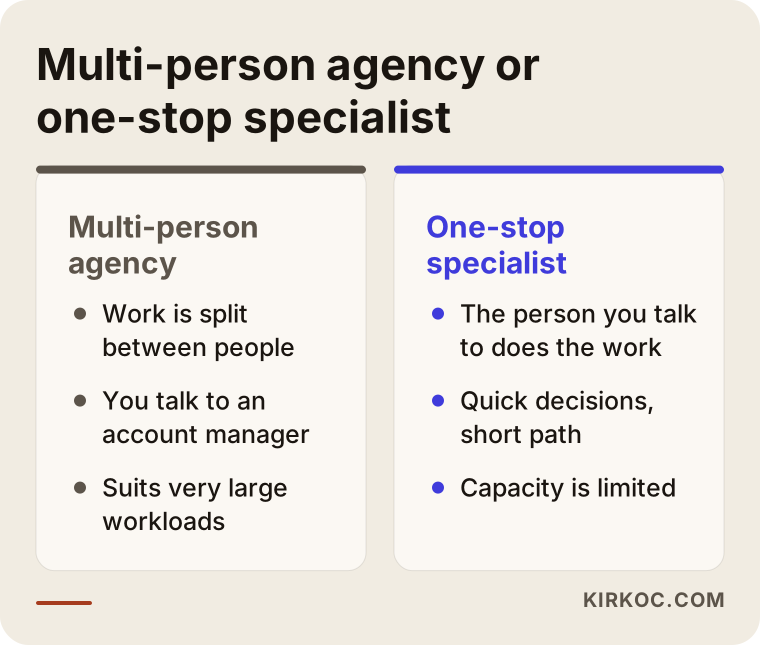
The takeaway for a small or mid-sized business is that consistency usually matters most. If one person runs your website, another runs your ads and a third runs your social media, nobody sees the whole picture. The ad sends visitors to a page, and whoever wrote that page promises something different because they never saw the ad. When one person handles the website, SEO, social media and ads, they all move with the same message. If the message needs to change, a single conversation updates every channel.
Two example scenarios
The following are entirely hypothetical. They do not describe any real person or company; I made them up only to show how selection mistakes happen.
Scenario 1: The agency that promises everything
Suppose the owner of a small furniture workshop says yes to the first proposal that arrives. The agency offers a website, social media, ads and SEO in one package, and the price looks attractive. In the first month there are plenty of posts, but the phone does not ring. When the owner asks what has been done, the answer is "work is in progress." In the third month a report arrives: the like and view counts look nice, but it does not say how many people called to ask about prices. The agency may not have had bad intentions. The real problem is that nobody ever discussed what would be measured. What the workshop needed was not likes. It needed a person searching for "solid wood dining table" to land on a product page and ask for a quote.
Scenario 2: The cheap, fast website and then silence
In the second hypothetical example, the owner of a small clinic pays a very low fee for a website built in a few days. The site looks fine, but it is a template, the pages are thin, and it is unclear which page explains which service. Six months later the owner notices the clinic does not show up on Google and tries to reach the agency, which does not answer. A new freelancer arrives and cannot get into the site's admin panel, because the domain name and the hosting both sit in the agency's account. The result: months wasted and almost a fresh start.
The lesson from both stories is the same. Being cheap or being comprehensive is not a criterion by itself. What will be measured, and who owns what, should be in writing from day one.
A step-by-step selection process
You can turn the decision from a messy task into five steps.
Step one: write down the need. The answers to the preparation questions above become a short brief for the agency. Keep it to a single page.
Step two: pick three to five candidates. Recommendations from friends, the providers that similar businesses in your field use, and search results are all good starting points. If you collect more candidates than that, the decision gets harder.
Step three: send the same brief to all of them. Proposals built on the same information can be compared with each other. Proposals built on different briefs are like comparing apples and oranges.
Step four: meet and ask questions. What the proposal says on paper matters, but so does whether the person across from you actually listens. I list the questions to ask in the next section.
Step five: ask for a small start. Instead of signing a long contract right away, propose a limited first project or a trial period if possible. Someone who works well will not mind.
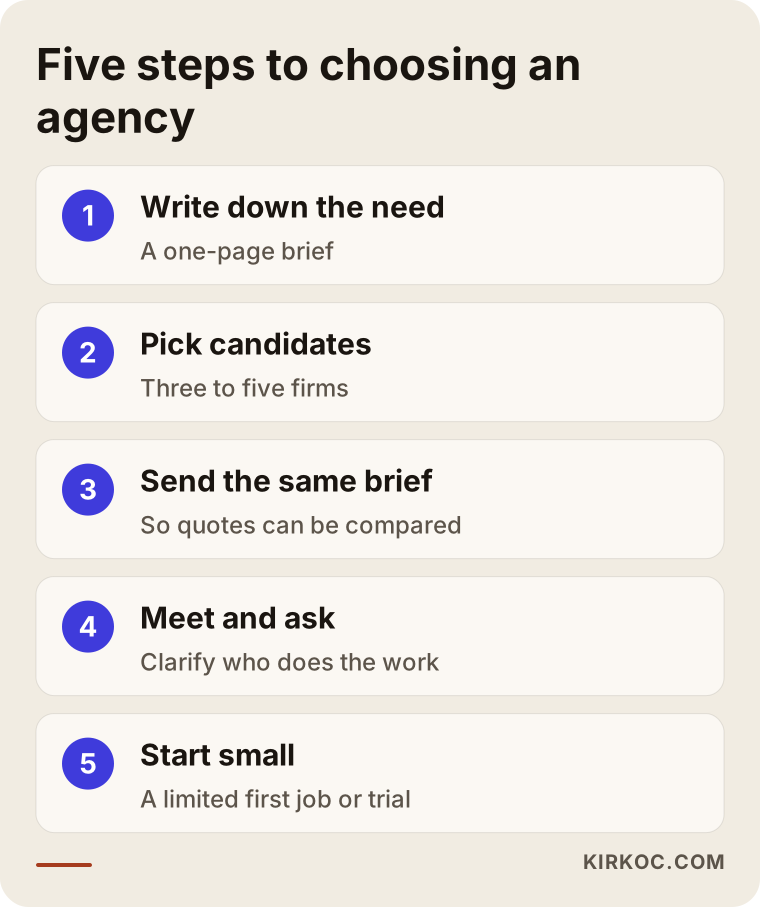
An owner who follows these five steps in order often senses which candidate is serious long before making the decision. A serious specialist asks questions once the brief arrives. One who does not ask anything just slides a ready-made package across the table.
Questions to ask in the meeting
You do not need to know any technical terms. Plain questions will warn you right away when the answer is wrong.
Start with: "Have you done work like mine before, and how did it go?" Someone describing a real experience can give details. Someone speaking in generalities struggles to get specific. Ask for references, but if they cannot share them for confidentiality reasons, do not hold that against them right away. Ask instead for a description of the process and the problems they ran into.
Ask: "Who will actually do the work?" If one person handles the sales conversation and someone else runs the project, ask to meet the person you will be working with.
Ask: "How will we measure success?" The right answer is a concrete measure tied to your goal, such as the number of calls, form submissions or orders. The wrong answer is only likes and impressions. Those can be useful, but on their own they do not mean sales.
Ask: "How often and in what format will I get reports?" Insist that reports be written in language you understand.
Ask: "Whose name will the website, domain and ad accounts be under?" The answer must be clear: yours. Otherwise, when you want to leave, you may be left with nothing.
Ask: "What happens when the contract ends?" The handover of files, passwords and accounts should be in writing.
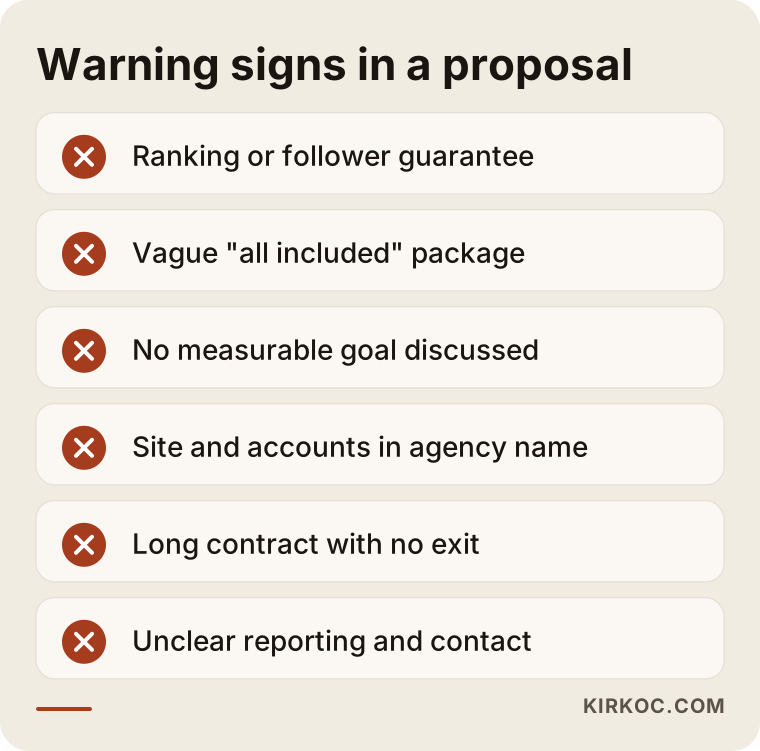
If one or more of the warning signs in the graphic appear during the meeting, I suggest you step back, no matter how attractive the price is.
Why be careful with the word "guarantee"?
In many proposals you will see phrases like "first page guarantee," "a guaranteed number of followers" or "sales will go up by this much." To be honest, nobody can guarantee these. How Google decides rankings and who Meta shows an ad to cannot be controlled from the outside, and your competitors are working at the same time. Someone who offers a guarantee is either trying to impress you or has written the conditions so narrowly that the guarantee means nothing.
A trustworthy specialist explains what they will do, what they will measure and how long it typically takes. They back up the result not with a promise but with a working routine: regular reports, open communication and a willingness to change direction when needed.
How to read a proposal
When a proposal arrives, the first thing to look at should not be the total. It should be the scope. If it says "social media management," it should spell out which platforms, how many posts per month, who prepares the visuals and who answers comments and messages. If it says "ad management," ask whether the ad budget is separate from the agency fee and in whose name the account will be opened. If it says "website build," find out how many pages, what software it runs on, whether it works well on mobile, how fast it loads and whether maintenance is included afterward.
If two proposals differ a lot, look at what the cheaper one leaves out. The gap usually lies in the work that is not written down. Deciding on price alone means deciding without looking at scope.
What determines the price?
I will not give numbers in this article, because the price for the same job changes a great deal depending on your situation. But knowing what drives cost helps you understand proposals.
The first factor is scope: do you want a single channel, or website, SEO, social media and ads run together? The second is continuity: a one-time setup and ongoing monthly management are priced differently. The third is how competitive your industry is: in a crowded field, the same result takes more effort. The fourth is your starting point: a business starting from zero is not in the same place as one with a well-organized site. The fifth is the amount and quality of content: custom photography, writing, video or multilingual content raises the cost. The sixth is the experience of the person doing the work and how many clients they handle at once.
Also, the ad budget, meaning the money you pay directly to Google or Meta, is a separate line from the agency's fee. Make sure the proposal does not blur the two together.
How should the first three months go after you choose?
Choosing the right agency is half the job. The other half is running the relationship well. A healthy start usually looks like this.
In the first weeks, the current state of your accounts and website is reviewed and tracking is set up. That means building the setup that lets you see when a visitor finds what they were looking for, fills in a form or makes a call. It is normal for little to be visible at this stage, but you should still be told what is being done.
In the following weeks, the first pages, content or ad tests go live. The goal here is not perfection but collecting data: which message gets attention, which page brings in calls.
Around the third month, the first real review takes place. You talk about what worked, what to drop and where the budget should go. You need to share your own numbers in this meeting too, because an agency cannot know the effect on sales without seeing your sales.
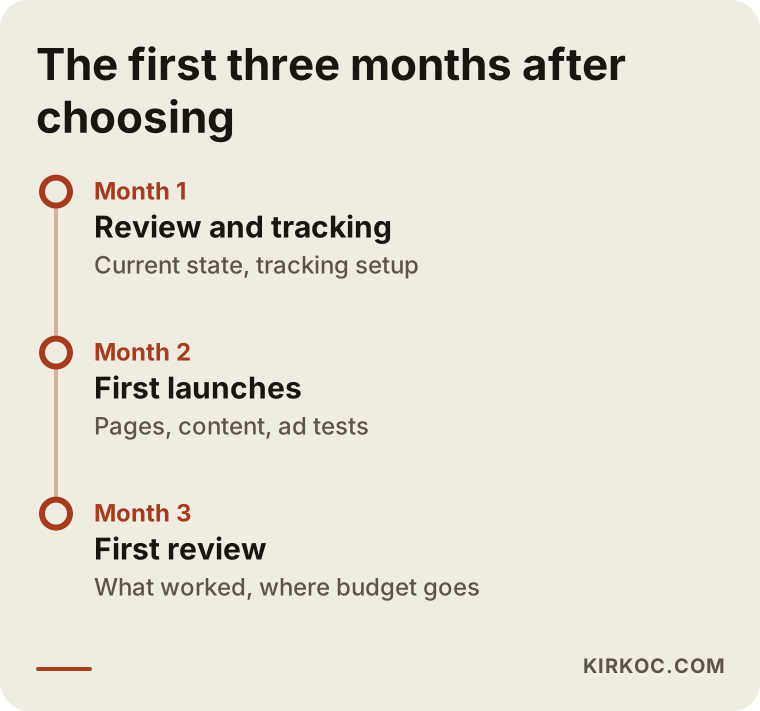
The timeline will not be identical for every project. But the pattern of setting up measurement first, running tests in the middle and reviewing at the end holds for almost any engagement.
Common mistakes
These are the mistakes I see most often when advising business owners.
Choosing only the cheapest proposal. A cheap proposal is sometimes genuinely a good deal, but when its scope is incomplete, it grows with extra charges later. Compare on scope.
Going to an agency without knowing what you want. Without a goal, success cannot be measured. That is why the preparation step above matters.
Ignoring account ownership. The domain name, ad account, social media pages and analytics tools should be in your name. You give the agency admin access, but ownership stays with you.
Being fooled by a pretty portfolio. An impressive design sample does not tell you whether that work brought in sales. A good-looking website and a website that sells are not the same thing.
Expecting results too early. Search engine work in particular takes time. Ads give faster results, but the first weeks are experimental. An owner who expects a miracle within a month wears out both themselves and the person they hired.
Never giving feedback. An agency does not know your business better than you do. If you do not share which product sells best, which customers cause trouble and which seasons are busy, you will get generic content.
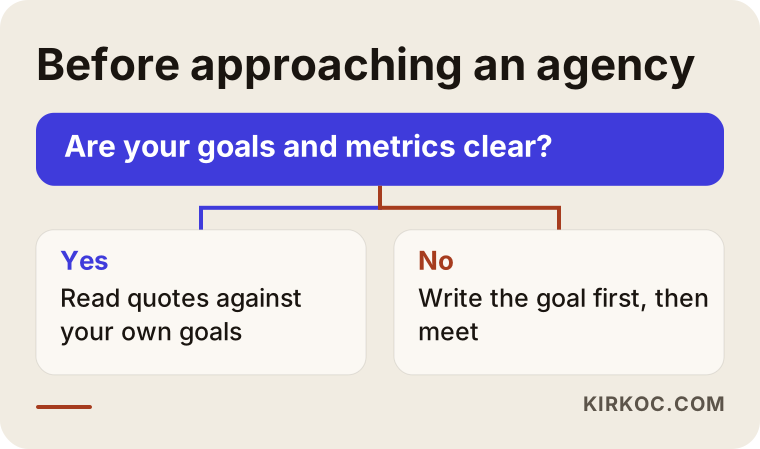
The decision diagram above shows where most of these mistakes begin: if the answer to "are my goals clear?" is no, finding that answer comes first.
What can you do yourself, and when do you need a specialist?
You do not have to outsource everything. Some tasks you can handle yourself, which protects your budget and also helps you understand the work.
Things you can do on your own include keeping your Google Business Profile up to date, writing your phone number and address the same way everywhere, asking customers for reviews, taking photos of your products or work, and answering incoming messages quickly. These are not expertise. They are routine.
The points where you usually need a specialist are these: the technical foundation and speed of the website, building the page structure for search engines, setting up and measuring an ad account correctly, managing the budget so it is not wasted, building a consistent brand identity, and making sure your brand is described correctly in AI-assisted search (in tools like ChatGPT). Mistakes in these areas can be expensive and hard to undo.
There is also a middle way: have a specialist handle the strategy and setup, then keep up the small daily tasks yourself. Talking about this openly lowers the cost and reduces your dependence.
What should you see on a good agency or specialist website?
Before deciding, look at the candidate's own website. Someone who cannot do their own work properly is unlikely to do yours well. On a good site, services are described separately and clearly, sample work is shown with its real context, contact details are easy to find, the writing is not packed with jargon and the pages load quickly. Check it on your phone too, because most of your customers will see you there.
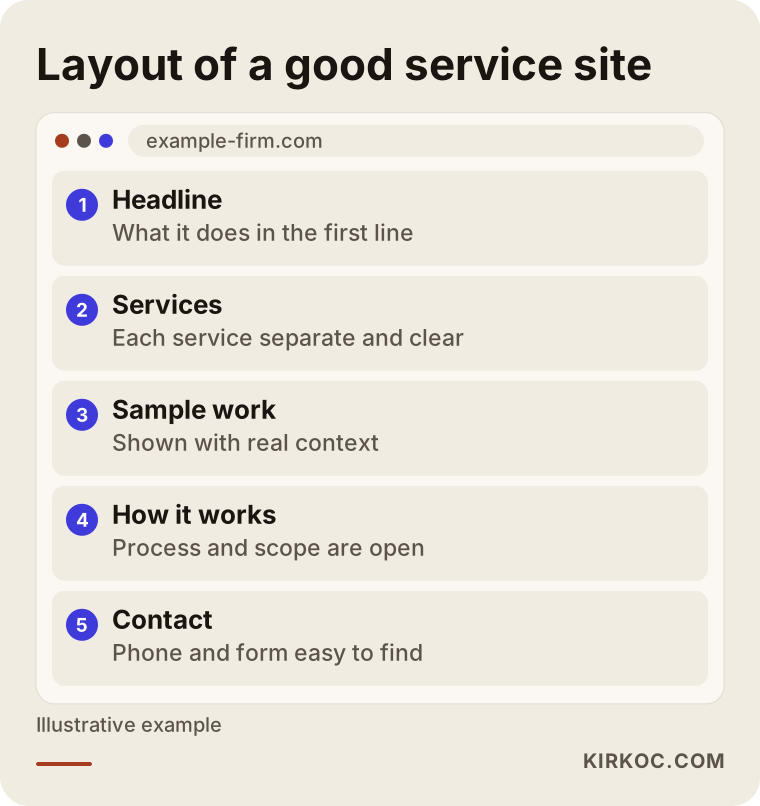
This is the same layout you will want on your own site. When an agency's own site shows it, that is a small but strong sign they understand the work.
A new angle in the age of AI
People no longer ask questions only on Google. They also ask tools like ChatGPT. These tools draw on clear, well-organized and trustworthy sources on the internet when they produce an answer. So you can ask your agency: "What are you doing so that my brand is described correctly in AI answers?" Because this area is still new, some agencies may be caught unprepared. A prepared one will tell you it does not replace SEO, it adds to it, and that the basic work is still clear, accurate and thorough content. Keep in mind here too that nobody can promise a specific result.
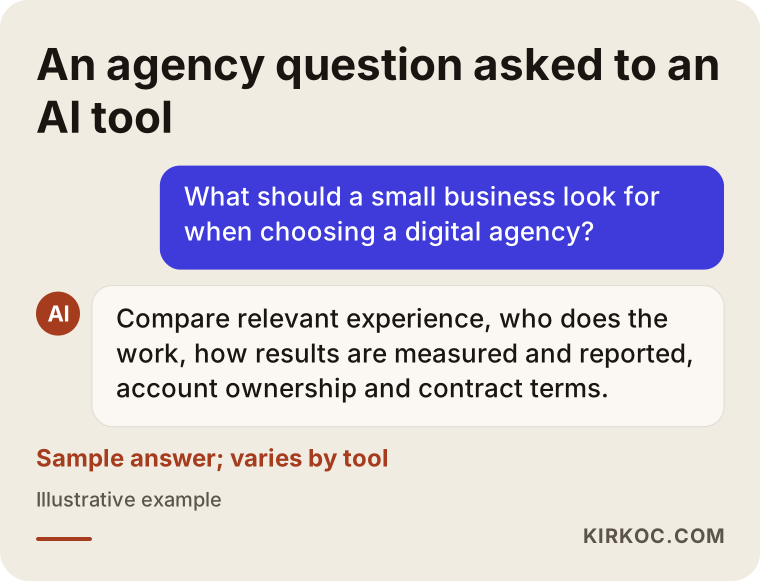
The sample answer shows what kinds of information such a tool tends to surface: clear criteria, concrete questions and measurable goals. Those same traits are also how your own site earns trust with both people and search tools.
Where does working with one person pay off?
As I said at the start, when one person handles all of the work, the connections between the pieces stay intact. The person who builds your website also sets up the pages for search engines, uses the same voice on social media and knows which page an ad sends people to. When the price of a product or the date of a campaign changes, you do not have to message four separate companies. Your logo and colors stay the same everywhere. Reports come from one place, and the numbers do not contradict one another.
This approach has limits. If you need a huge staff, a 24/7 call center or hundreds of campaigns at once, one person is not enough. But for most small and mid-sized businesses, what is needed is not a crowded team. It is someone who sees the job from start to finish.
How I work with clients
When you want to work with me, I run the first conversation less as a sales pitch and more as an assessment. I listen to your business, your goal and the digital assets you already have. I tell you what is really needed and what is not needed for now, because not every business needs every service. Then I put the scope in a written proposal: what will be done, when, and how it will be measured. The website, domain and ad accounts are in your name from the start. Throughout the work you talk to me directly, with no middleman. I share progress in plain language at regular intervals.
Frequently Asked Questions
What is the most important thing to look for when choosing a digital agency?
There is no single criterion, but the most important is that the agency understands your goal and gives you a concrete plan to match it. References, scope, measurement and account ownership are the four main supporting topics. A polished presentation or a low price is not a sufficient criterion on its own.
Is a digital agency or a freelance specialist better?
Either can be right. If you need very high volume and a wide team across many channels, an agency fits. If you want one person to see the whole job and talk to you directly, a solo specialist fits better. Whichever you choose, ask who will do the work and how capacity is handled during busy periods.
How much should I pay an agency?
There is no fixed answer, because the price depends on scope, how ongoing the work is, how competitive your industry is, your current situation and the experience of the person doing the work. The healthiest approach is to send the same brief to several candidates and compare the scope in writing. Remember that the ad budget is separate from the agency's fee.
Can an agency guarantee results?
No, an honest one cannot. Search rankings and ad results are shaped by the platforms and your competitors, not just by the agency. What can be promised is what will be done, how it will be measured and how often reports will be delivered.
What should I check before signing a contract?
The scope, duration, termination terms, account ownership, reporting frequency and handover of files at the end should all be in writing. If you are signing a legal document, have a lawyer review the text.
When will I see the first results?
With ads, the first data usually starts to appear within a few weeks, though getting them tuned right takes time. SEO and content work matures over a longer period. The timing depends on your industry, the competition and the current state of your site. Setting up clear measurement in the first months is the most important step for managing expectations.
Does a small business need a digital agency at all?
Not always. If the budget is tight, you can handle the basics yourself, such as a Google Business Profile, a proper contact page and collecting reviews regularly, and get help only for technical parts like website and ad setup. What matters is defining your need correctly.
What should I do if I am unhappy with my current agency?
First, state your expectations and problems in writing. If nothing improves, look at the terms of your contract and check whether the accounts, domain and files are in your hands. If there is a legal issue, talk to a lawyer. When moving to a new arrangement, safely taking over account access is the most important step.
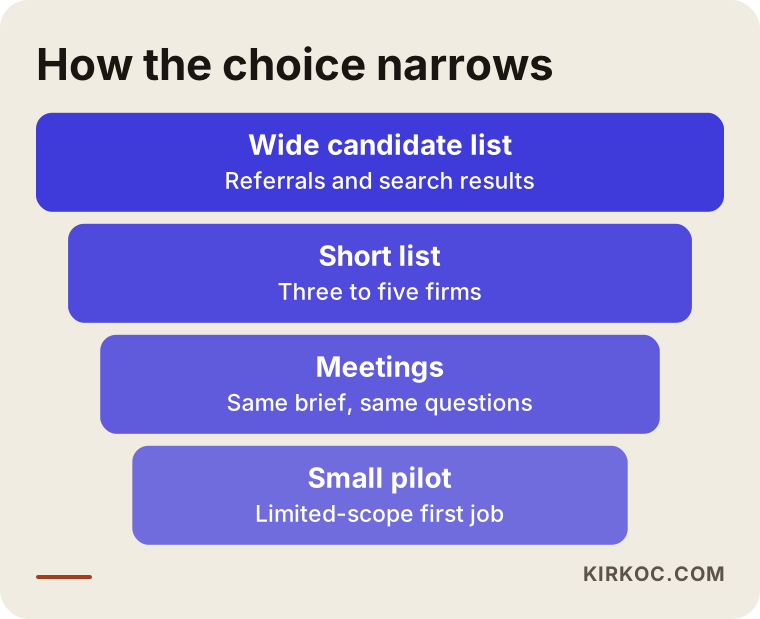
The funnel above sums up how the choice should narrow: from a broad search to a few serious candidates, and from there to a small trial.
If you are looking for the right person to grow your business online, you can read about how I work on my website design services page and get in touch with a short message describing your business and your goal.