You have been posting on social media for a while, and maybe you have tried an ad or two. One person told you that you must show up on Google. Another said Instagram is a must. A third said to rebuild the website first. All of them are partly right, but nobody told you where to start or how much to spend. That is exactly the moment when people type "digital marketing plan for small business" into a search box. In this article I explain what a business owner who is not technical should look out for when having a plan made. I am Ümit Kırkoç, and I work from Istanbul. Because I handle the website, search visibility, social media and ads myself, I build the plan while seeing how those pieces affect each other. A plan usually lands on your website more than anywhere else, so I will bring it into the discussion where it matters.
First, let me define the term. A digital marketing plan is the written answer to a few questions: who you are talking to, through which channels, what you are saying, with what budget, and how will we know whether it worked. It does not have to be a polished presentation or a report with dozens of pages. A well-built plan is a short, clear roadmap that tells you what to do tomorrow morning.
What is a digital marketing plan, and what is it for?
Marketing without a plan is like stacking bricks without a blueprint. Every brick is real effort, but you may not end up with a house you can live in. You run ads for a week and drop them. You post faithfully for a month and then get busy and forget. You spend money and time, yet you cannot answer the question "did it work?"
A plan reduces that uncertainty. As an owner, expect it to give you three things: the order in which you will do things and why, how much budget and time each item gets, and how you will tell whether something is working. None of this is a guarantee. Nobody can promise you a specific number of sales. But a plan makes decisions easier inside that uncertainty.
The graphic below summarizes the headings a good plan should cover on paper.
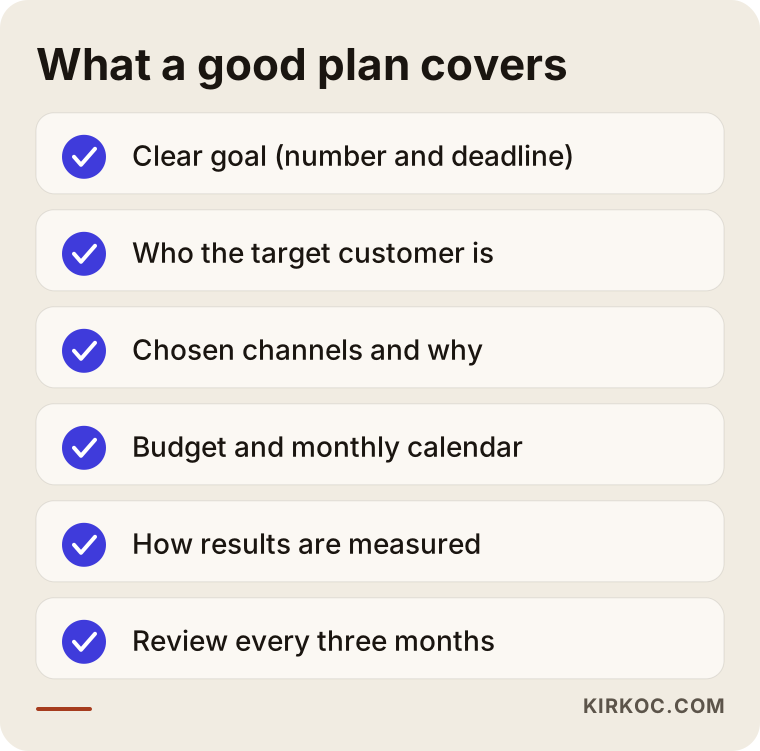
Notice what is missing from the list: there is no "packed content calendar" and no "hundred-page report." There is a goal, a customer, channels, a budget, a calendar and measurement. If a plan answers those, it is complete. If it does not, it is incomplete no matter how good it looks.
The difference between a plan, a strategy and execution
These three words get mixed up often. Strategy answers "why and in which direction." For example, do you want to reach people in your own neighborhood, or sell nationwide? The plan ties that direction to time and budget. Execution is the weekly work that follows: writing pages, setting up ads, updating content. Many people who order a plan buy only the first two and carry out the execution themselves or hand it to someone else. It is important to settle this at the start, because "I paid for a plan and nobody carried it out" is the most common disappointment I hear about.
What does it cost you to go without a plan?
Businesses without a plan tend to show the same picture. The ad budget flows to a page that does not know what to do with the visitor. The social media account looks pretty but never makes the phone ring. The owner tries a different thing every month, each recommended by a different "expert," and cannot see the result of any one of them cleanly.
This is not an accusation. In a small business everyone is already doing a dozen jobs at once. But unlike many other expenses, digital spending can be measured, so a scattered approach also shows its mistakes clearly: you can see where the money went and what did not pay off, as long as you decided in advance what to look at.
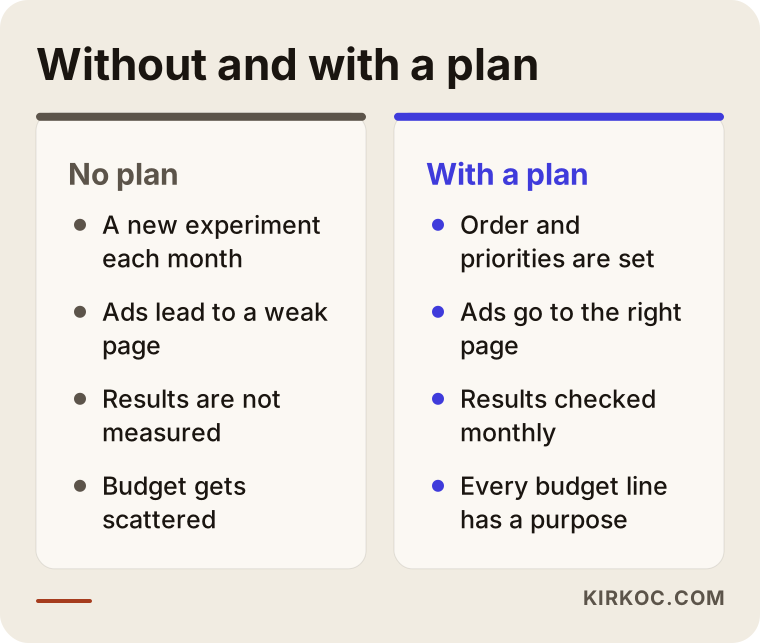
The main idea of the comparison is this: before a plan grows your business, it tidies it. Even with a small budget, knowing what you are spending on is less risky than spending a large budget at random.
Which questions should you answer before the plan is made?
No specialist knows your business better than you do. So the raw material for the plan is you. Thinking through the questions below before a planning conversation saves both time and money.
Who do you want to sell to?
"Everyone" is the worst possible answer for a plan. Think about who your customers really are: roughly how old they are, where they live, how they found you, and why they came to you instead of somewhere else. If you have a few real customer stories at hand, the plan will be far more accurate. Even writing down how your last five customers found you is a good start.
What do you want to sell, and what do you want to stand out?
Not every product or service is equally profitable. For a clinic it may be an expensive, frequent treatment. For a shop it may be the product group with the best margin. For a consultant it may be a long-term contract. If your marketing budget is limited, focusing on one or two offers usually works better than promoting everything at once.
How do customers find you today?
Word of mouth, a sign on the street, a printed directory, a Google search, Instagram, an old customer coming back. Make an honest tally. In some businesses nearly all customers come by recommendation and no digital channel has ever been tried. In others, plenty of messages arrive on Instagram but nobody buys. The current situation decides where the plan starts.
How much budget and time do you have?
You do not need an exact figure, but a range helps. Both money and time matter: will you run the plan yourself, or will one person or a team manage it? The hours you can give each week decide which channels are realistic. Someone with two hours a week cannot be present on five channels at once.
Why is the customer journey at the center of the plan?
People go through a journey before they buy from you. First they notice a need, then they research options, compare a few businesses, trust one of them, and finally get in touch or buy. A digital marketing plan makes sure you are present at every stage of that journey.
It helps to think of a funnel. The top is wide: many people who do not know you yet. As you move down, the numbers shrink but the intent grows stronger. A different channel works at each stage.
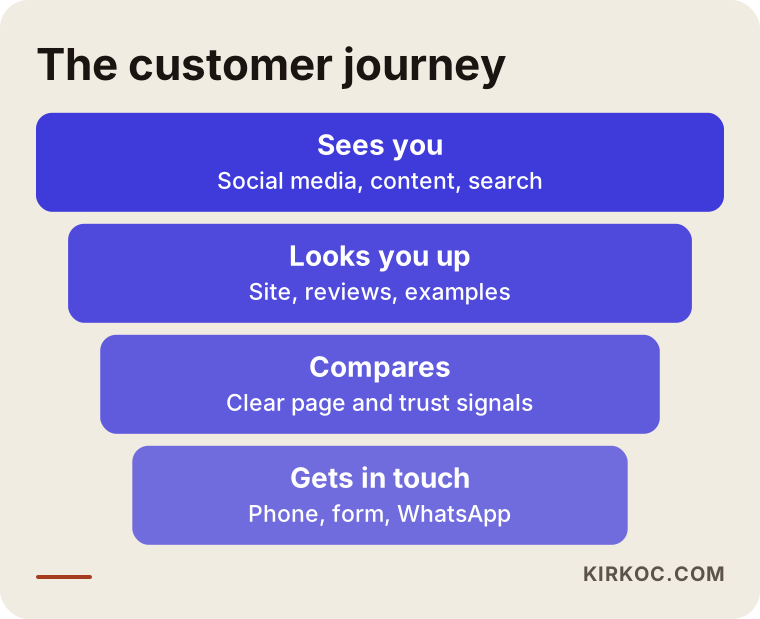
As the funnel shows, social media and content do their work in the awareness stage. In the decision stage, a clear service page, reviews and an easy way to reach you are what matter. Most businesses exist only at the very top or the very bottom, and the middle is empty. A plan makes that gap visible.
Catching the person who is ready to buy
The most valuable person on the journey is someone who has already searched. For example, someone typing "I need a website built for my company" knows what they want. Showing up for that person with a clear page in search results, or with a search ad, can bring more direct results than building general awareness on social media. But if that person lands on your page and does not trust it, they will not pick up the phone. That is why a plan should include the page itself, not only the ad.
How is a digital marketing plan prepared, step by step?
The process varies a little from business to business, but the basic flow is similar almost everywhere. This is the order I follow.
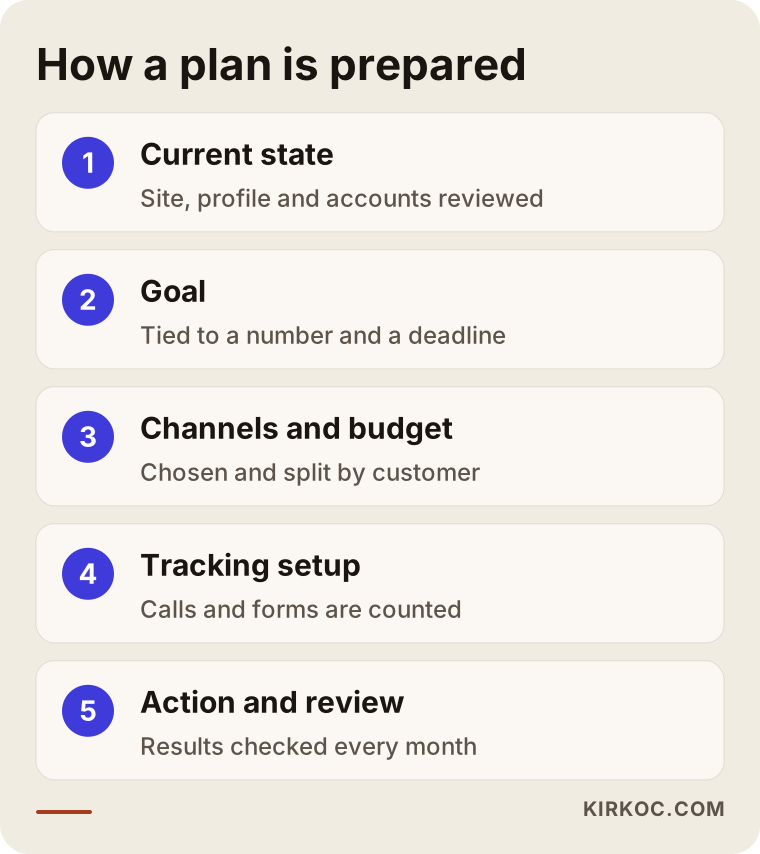
Let me go through each step briefly.
1. Reviewing where you are now
The first job is to look at what you already have. Do you have a website, and does it open properly on a phone? Is your phone number the same everywhere? Do you have a Google Business Profile, the listing that shows your address and hours on Google Maps? Are your social media accounts up to date? At this stage I do not judge anything as "bad." I only separate what is usable from what has to be built from scratch. Throwing out an old site and building a new one is not always necessary; sometimes fixing it is enough.
2. Tying the goal to a number and a deadline
"More customers" is not a goal. "A certain number of new appointment requests per month within three months" is a goal. The number should come from your own business history, and I do not promise ready-made percentages or ratios. At this step I choose a realistic range with you and say openly that the target is a direction, not a guarantee.
3. Choosing channels
Not every business has to be on every channel. Where your customers spend time, the nature of your product and your budget decide the channel. For a lawyer, Google search and LinkedIn may come first, while for a boutique clothing store Instagram and Meta ads (the advertising on Facebook and Instagram) may make more sense. I cover this choice in more detail in the next section.
4. Budget and calendar
The budget is divided among channels and spread over time. The first three months are mostly a period of testing and learning, so do not expect everything to work perfectly in the first weeks. The calendar shows what happens in which month and which week you will measure what.
5. Setting up measurement
What cannot be measured cannot be improved. You need to be sure that phone calls, form submissions and WhatsApp taps are being counted. That requires the tracking tools on your site to be set up correctly. Otherwise, a few months later, you will have no answer to the question "which ad worked?"
6. Execution and monthly review
A plan is not written once and shelved. Every month the results are reviewed: what works is expanded, and what does not is reduced or dropped. This loop is where the plan earns its value.
Which channel should you choose for what?
Channel choice is the most confusing part of any plan, because each channel does a different job and delivers at a different speed. The table below summarizes in plain terms what the main channels are for.
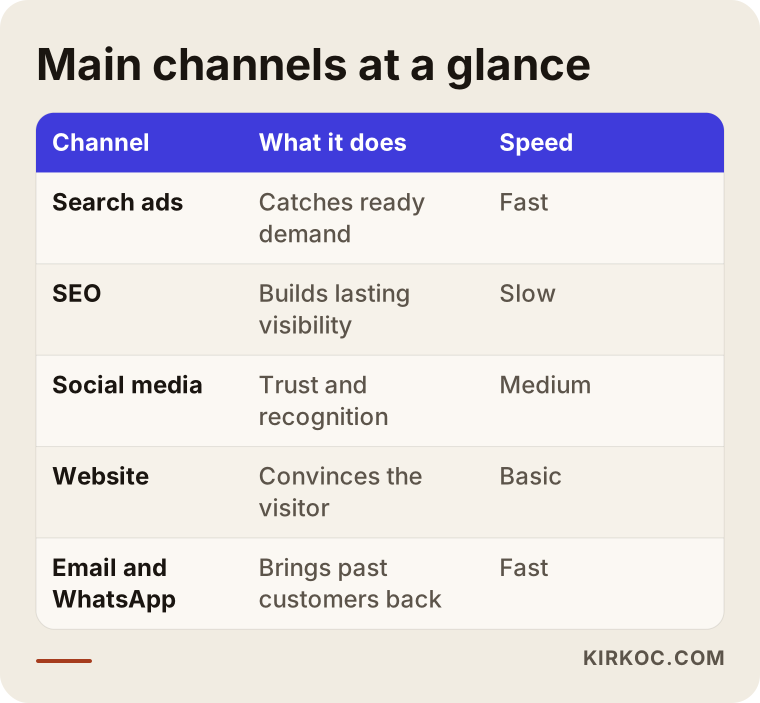
As you read the table, keep this in mind: ads are fast, but when the budget stops, visibility stops too. SEO, meaning organic visibility in search results, is slow to build but lasting once it settles in. Social media builds trust and recognition but may not be enough to close the sale on its own. A good plan arranges these three so they complete each other rather than replace each other.
Channel logic for local businesses
For a business that serves people nearby, priority usually goes to the Google business listing, map searches and clear pages for each area you serve. This work is called local SEO, and it aims to appear in searches like "dentist in Brooklyn." In addition, a short, limited search ad can bring in inquiries during the first weeks while the longer work takes hold.
Channel logic for businesses that sell nationwide
For an online store or a company serving customers across the country, the quality of product pages, your presence on marketplaces such as Amazon or Etsy, Google Shopping ads, and repeat sales through email or WhatsApp come to the front. Here you need a plan built around products and categories, not around a city.
A newer channel: answers from AI tools
More and more people now ask tools like ChatGPT questions about businesses and services. For those tools to mention your business, your site needs to carry clear, well-organized and trustworthy information. This work is called GEO, which means preparing content so it can appear in AI-generated answers. Be careful with anyone who promises it as a sure thing. Still, setting aside a small place for it in the plan makes sense, especially for businesses where information is a big part of the sale.
Two hypothetical example scenarios
The two scenarios below are entirely hypothetical and are not based on any real person or company. Their purpose is to show how a plan changes from one situation to another.
Scenario 1: A beauty salon serving one part of a city
Suppose the owner of a beauty salon gets most of her customers through recommendations. She has an Instagram account, but posts are irregular. She has no website, only a link page. Her goal is for new customers in her area to find her through search.
In a case like this, the plan might look as follows. In the first month, a simple website with service pages is built, and the phone number, address and opening hours are written identically everywhere. The business profile is tidied. In the second month, the pages are strengthened for searches that combine the neighborhood and the service. In the same period a small search ad acts as a bridge until SEO starts to deliver. Instagram continues with a few regular posts a week and real footage from the salon. The aim is not to grow the account but to give it the role of a shop window that convinces someone who is on the way to the website.
The graphic below uses an example results page to show what could make a difference in search for this hypothetical salon.
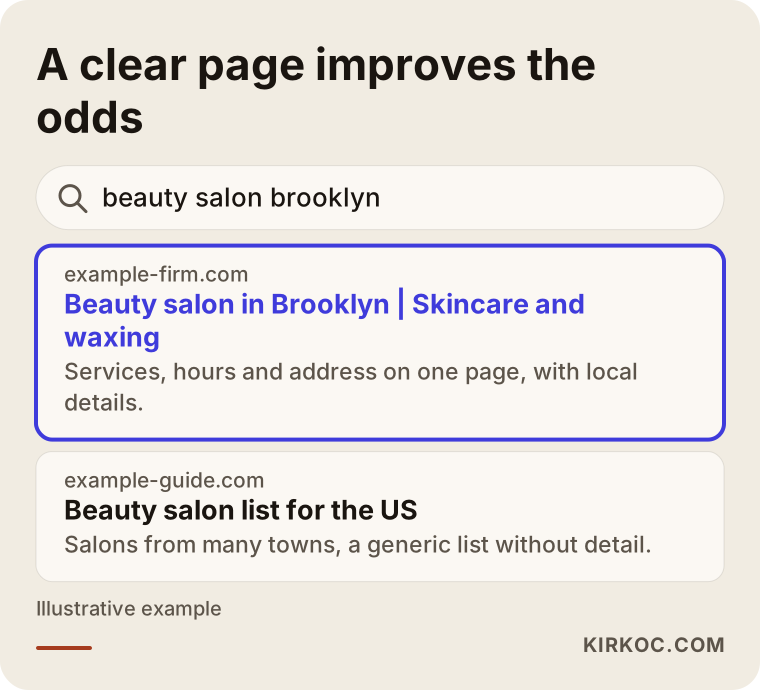
The highlighted result looks more likely to be chosen because it states the service and the place clearly. There is no guarantee here; there is only a higher chance that a clear page does more work than a vague one.
Scenario 2: A small online brand that sells nationwide
Now a different hypothetical case. A small brand sells handmade products and makes most of its sales through Instagram messages. It also has an online store, but few visitors arrive, and even fewer add anything to the cart. The owner wants to run ads but does not know where to point them.
In this case the first job is not ads but a look at the site. Product photos, descriptions, shipping and return information, and the checkout steps are checked. Bringing visitors in at a high cost and dropping them on a poor checkout page burns the budget. Second, the two or three products that attract the most interest are picked, and ads are directed only at them. A reminder is set up for people who leave their cart halfway. On social media, content showing the product in use is moved to the front.
The lesson from both scenarios is the same: a plan means using the same tools in a different order and with different weight. One business's plan cannot be copied onto another.
What do the first 90 days look like?
Most people who order a plan ask "when will I see results?" The honest answer: it depends on the channel, the sector and your starting point. Still, it is possible to sketch a rough flow.
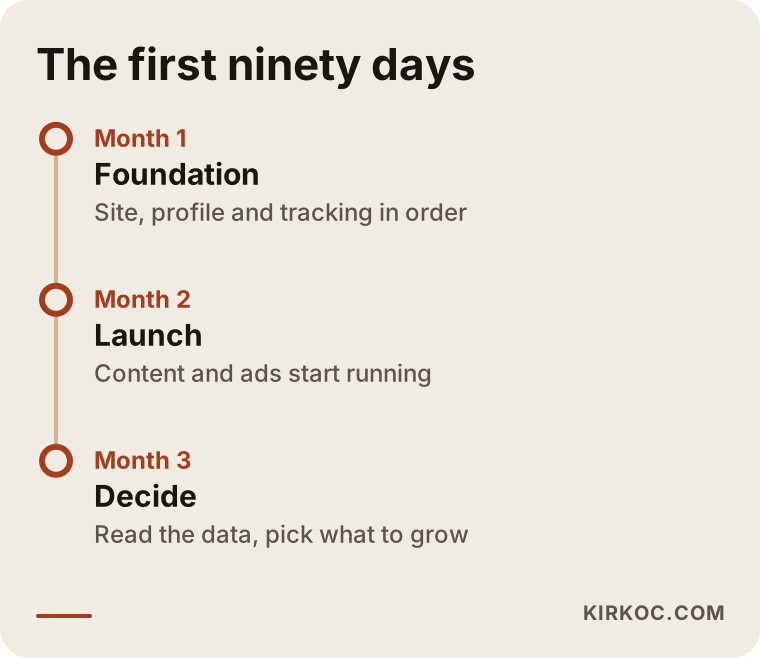
The first month lays the foundation: the site, tracking and profile in order. In the second month content and ads begin, and the first data arrives. In the third month you read the data and decide what to grow. I do not promise a ranking position or a number of sales in this period, because I do not control how Google or the ad platforms behave. What I can offer is to show you clearly, at the end of every month, what worked.
Common mistakes in a digital marketing plan
Most of the mistakes I have seen over the years look alike. Knowing them in advance helps you avoid the same pit in your own plan.
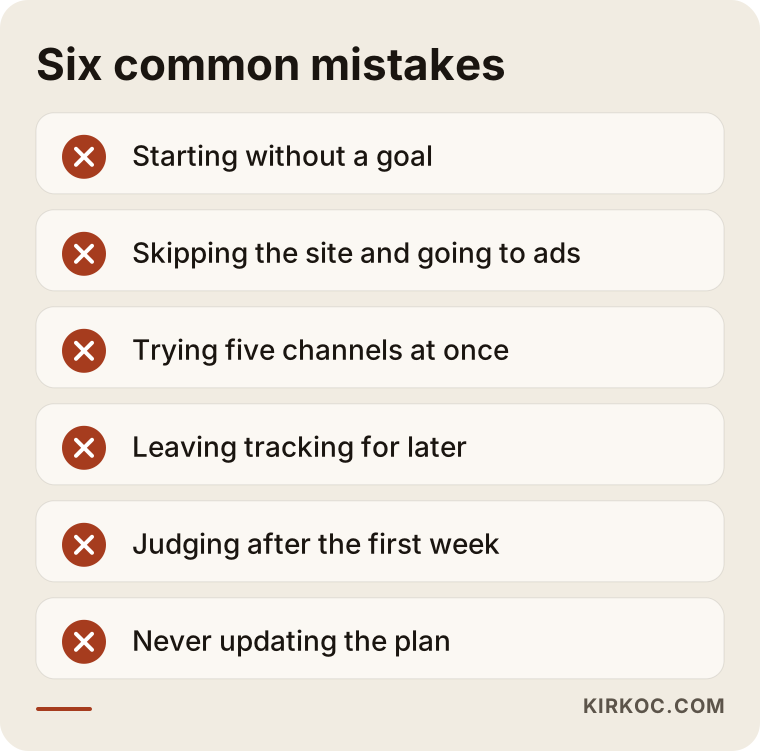
Let me explain them a little.
Starting without a goal. A "let's be everywhere" plan means being effective nowhere. It is healthier to focus first on a single goal, such as phone calls.
Skipping the site and going straight to ads. An ad brings a visitor but does not convince them. Paying for ads that lead to a slow site, a site that does not inspire trust or one that is broken on mobile is money lost outright.
Trying every channel at once. If you split a small budget across five channels, you will not collect enough data on any of them. Running two channels well beats running five halfway.
Leaving measurement for later. If tracking was not set up in the early months, the data from that period is gone for good. Measurement should be finished in the first weeks of the plan.
Judging results too early. Saying "this does not work" based on the first week is often unfair. For SEO in particular you have to wait months, and ads need some time for the platform to learn.
Never changing the plan. Markets, competitors and seasons change. A business that does not revisit its plan every three months keeps making decisions on old information.
Should you do it yourself or get help from a specialist?
Not every business needs a specialist for a plan. Sometimes sitting down and writing a one-page plan yourself is enough, especially in the early steps. You can do these on your own: list how customers find you, keep your Google Business Profile current, use the same phone number and address everywhere, and set aside one day a week for posting.
Help from a specialist makes sense in these cases: your site needs to be built or repaired, your ad budget has grown to a noticeable level, tracking setup needs technical skill, or you need to run several channels at once. At that point the cost of a mistake can be higher than the cost of the consultation.
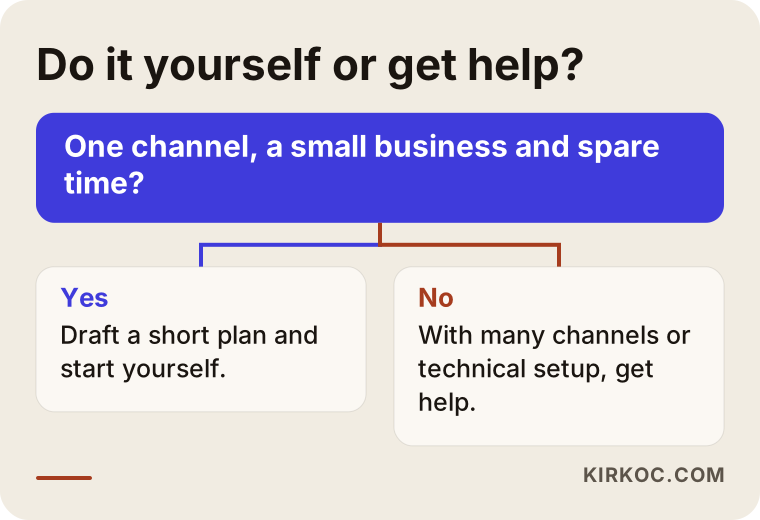
The flow is simple: if your business is small, you have one channel and you have time, start on your own. If the number of channels is growing, the budget is getting bigger or technical setup is needed, get support. You can also move between the two: have a specialist prepare the plan and carry out part of the execution yourself.
What determines the cost of having a plan made?
I do not give numbers in this article, because no two businesses need the same thing, so the same price would not be right for both. But I can tell you what moves the price, so that you can compare quotes more knowingly.
The first factor is scope. Do you want only a plan document, or do you want the plan carried out as well? A plan can be a few hours of work or weeks of research. The second is the starting point. The workload differs between a business that already has a site, accounts and data and one that starts from nothing. The third is the number of channels: a plan for one channel does not take the same effort as a plan that covers the website, SEO, social media and ads together. The fourth is competition in your sector; in a very crowded field, research and content needs grow. The fifth is continuity: a one-time plan differs from monthly follow-up and updates.
When you collect quotes, ask these questions. What exactly will I receive? How many meetings are included? Is execution included? Is tracking setup part of the price? In a setup where one person does everything, these questions get much clearer answers, because it is obvious who does what.
How I work with you
I am not an agency. I am one person, and I carry the work from start to finish myself. That gives you two advantages. First, the person who writes the plan is the person who carries it out, so everything in the plan can actually be done; I do not hand over recommendations that look good on paper and fail in practice. Second, I see the connection between the site, SEO, social media and ads in one place. If I spot a problem in ad results, I can fix it on the site, and a change I make on the site can be reflected in a social media post. You do not have to write an email to someone and wait for an answer.
The process usually goes like this: first I listen to your business in a short conversation, then I review where you are now, and then I share in writing what should be done and in what order. The plan should be understandable to you; if I need to use a technical term, I explain it. If you like it, I can carry out the work. If you do not, or if you would rather do it yourself, you still keep the plan. The choice is yours.
One thing I need to say up front about plans: I do not guarantee results. I do not make promises about rankings, followers or sales. I measure and report openly.
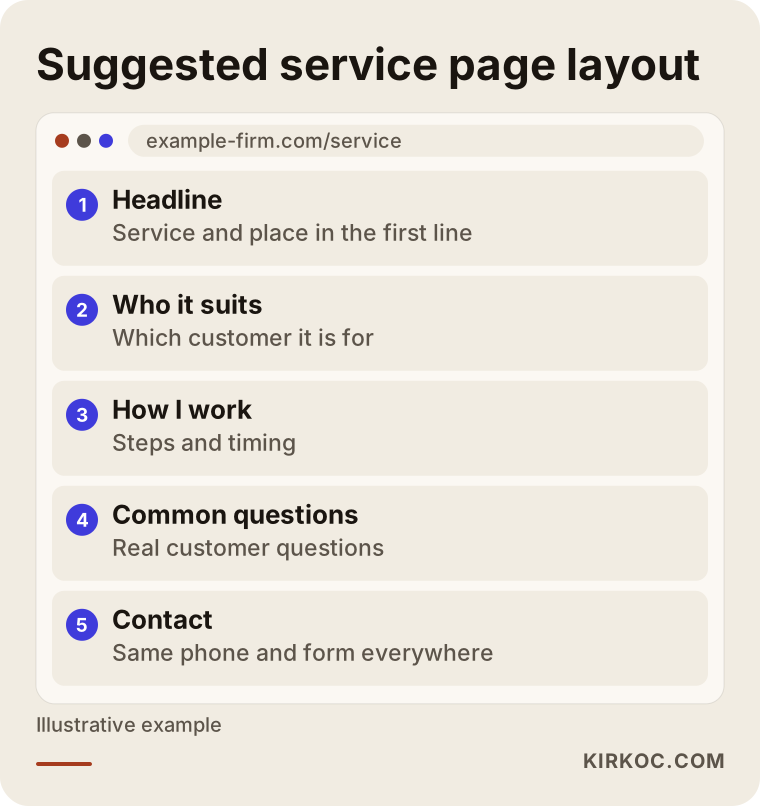
The graphic above shows the suggested layout of a service page, something a planning process can produce, because a plan very often turns into concrete page and content work of this kind.
Frequently asked questions
How long does it take to prepare a digital marketing plan?
It depends on the size of the business and the number of channels. For a simple business, a first draft can be ready within a few days. A plan that covers several channels and needs research can take a few weeks. A fast plan can also be a good one; what matters is that the right questions were asked.
Does a small business need a plan too?
Yes, and even more so on a small budget. In a large budget a mistake can be absorbed, but in a small one a single wrong expense can take a serious share. For a small business the plan stays short, and it does not need to run past a page or two.
Can I carry out the plan myself after having it prepared?
To a large extent, yes. Social media posts, business profile updates and simple content work can be done on your own. For technical setup, ad management and measurement, getting support is usually more efficient. The plan itself should show which of those are which.
What is expected of me when the plan is being prepared?
Telling me about your business, your customers and what you have done so far is enough. If you have them, your current site, account access and past ad data speed things up. If you have none of them, that is fine; a plan can be prepared for a business starting from zero as well.
Does a plan come with a guarantee of results?
No, it should not. Anyone who gives you a firm promise about rankings, clicks or sales may be misleading you. A proper plan is a measurable roadmap that raises the odds; the final result is decided by platforms, competition and the market.
How often should the plan be updated?
I recommend a review at least every three months. For seasonal businesses, such as weddings, tourism or holidays, update before the season as well. When something big changes, such as adding a new service or opening a branch, the plan should be renewed right away.
Is it better to work with an agency or with one specialist?
Both have a place. Large, multi-channel work may call for an agency structure. For small and mid-sized businesses, working with one specialist means fewer middlemen and faster decisions. What matters is that who does what and what will be delivered are written down.
Should I rebuild my website before having the plan made?
Not always. First look at how well the current site works. Sometimes fixing a few pages and clarifying the phone and contact details is enough. If the site is truly unusable, the website becomes the first step of the planning process.
If you would like to work out together where your business should begin, you can reach me through my website design service page. I will listen to your business and prepare a plan proposal that fits it and can actually be carried out.