You asked three people for a digital marketing quote, and the answers could not have been more different. One sent a short package description, one sent a long spreadsheet, and one said, "Let's talk first." It is hard to tell which is expensive, which is cheap and which is fair. If you searched for "digital marketing services pricing" and never found a clear answer, the reason is simple: this kind of work does not fit on a single price tag. In this article I explain what shapes the price, what to look for in a quote and how to plan your budget. I am Ümit Kırkoç, a digital marketer based in Istanbul. I handle, by myself and in one place, the work an agency would normally split across several people, from building your site to running your social media. Website design is one example of what I do. I will deliberately not give you any numbers here, because a number without a defined scope either misleads you or points you at the wrong job. Instead, I want you to be able to read why a quote comes out the way it does.
First, let me simplify the term itself. "Digital marketing" is the name for everything done online to find customers and stay in touch with them. It includes your website, the work that helps you show up on Google (called SEO, short for search engine optimization), managing accounts on Instagram or LinkedIn, Google and Meta ads, content creation and measurement. You rarely need all of it at once. What sets the price is which of these pieces you want and how intensively.
The four factors that set the price
A quote is really the answer to a handful of simple questions. Once you know them, you can read any proposal and see why each line is there. The table below summarizes the four factors.
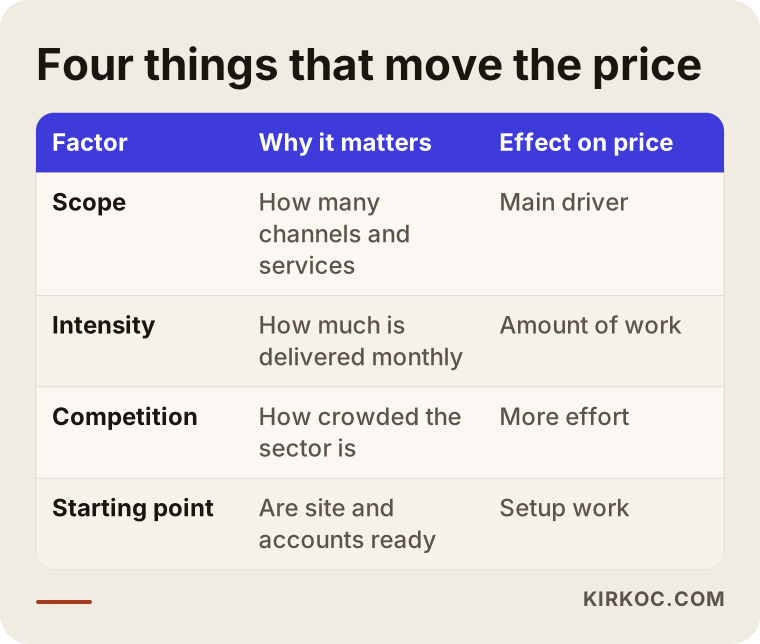
The first row is the most decisive. Let's go through each one more closely.
Scope: how many channels and which tasks
Scope answers the question "what will actually be done?" Managing only your Instagram account is not the same as running your website, SEO, social media and ads together. Every channel has its own learning curve, its own content style and its own way of tracking results. Adding a channel does not just add one more task. It means planning, producing, publishing and measuring on that channel too. So when the scope grows, it is natural for the price to grow with it.
Intensity: how much work is delivered each month
Even within a single channel, the amount of work varies. Posting twice a week takes different effort than producing different formats every day. Ads work the same way: watching one campaign is not the same as constantly adjusting separate campaigns for several products and audiences. More intensity does not automatically mean faster results, and there is no rule that says it does. But more work does take more time, and the quote reflects that.
Competition: how crowded your sector is
If many businesses in your field are chasing the same customers, reaching them takes more effort. In a market where lots of competitors advertise, building a campaign and keeping it efficient needs more fine-tuning than in a quiet niche. The same logic applies to SEO. To stand out in a crowded search, you need more content, a sturdier website and more time. Competition affects the price, yet it is rarely written on the quote. A good specialist will talk it through with you.
Starting point: what is ready and what is not
A business with a working website, a set-up Google Business Profile and active, tracked accounts is not in the same position as one starting from zero. The first needs to maintain and improve what exists. The second needs the groundwork laid first. That groundwork is a one-time investment, and in the first period it often appears as a separate line in the quote. Be careful not to confuse it with the monthly fee.
Ready-made package or a quote built around your needs?
You will meet two common models. The first is the prepackaged offer with fixed contents, such as "this many posts, this many stories." The second is a proposal prepared after a conversation about your business. Both have a place, and which one suits you depends on your situation.
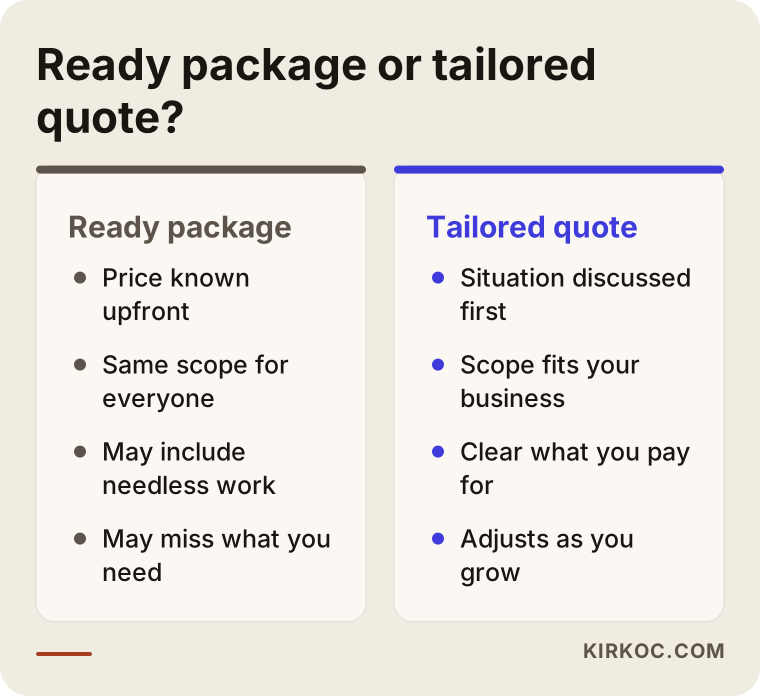
The advantage of a package is that you know up front what you are getting. If you have a limited budget and want to begin with one channel, that can feel reassuring. The drawback is that the same mold is applied to everyone. A restaurant and a law firm do not expect the same things from social media, and they do not share an audience or a tone of voice. If a package does not reflect that difference, you either pay for work you do not need, or you discover later that what you do need sits outside the package.
A tailored quote starts by listening to you. What do you sell, where are your customers, what is your current situation? Only then is the scope built. The weak side of this model is that you cannot see a figure right away, because a conversation has to happen before the quote exists. In my experience, though, business owners are rarely unhappy with packages as such. What frustrates them is a package that does not fit their business.
How does working with one person affect the price?
Since this section is about how I work, I will say so plainly. Imagine a business whose website is handled by one person, SEO by another, social media by a third and ads by a fourth. All of them need to talk to each other. One person builds the page the ad sends visitors to, someone else sets up the measurement of those visitors, and yet another prepares the content you post. Communication, waiting and misunderstanding creep in between. That costs both time and money, because every new person has to learn your business from scratch.
Because I run all of these jobs myself, I can see at the same moment how a change on your site will affect your ads, and how something I learn from the ads should change your site. This does not automatically lower the price. What it does is reduce wasted effort, so more of the same budget goes into work that actually matters. I am offering that as a consequence of how I work, not as a promise.
Where does your budget go?
It helps to split a digital marketing budget into a few layers. The graphic below shows a general way of thinking about the split. The proportions differ from business to business.
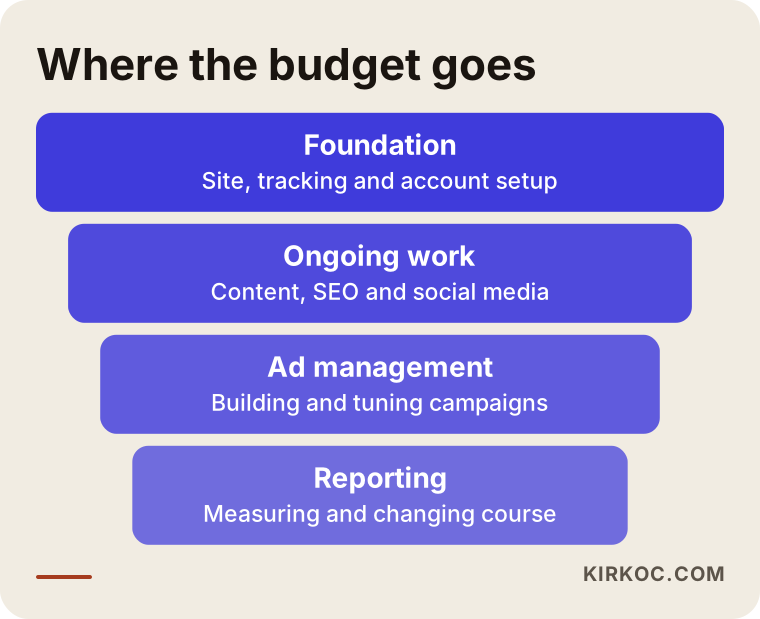
The widest part, the foundation and ongoing work, is often the least visible. Tidying up the site, setting up tracking and planning content are not glamorous, but everything else rests on them. Ad management is the labor of the person who builds and tunes the campaigns. Reporting lets you see whether the work is paying off. Without that layer you cannot tell which line item is actually valuable.
Ad spend and the service fee are not the same thing
This is one of the most commonly confused points. The money you pay for ads goes directly to the platform, whether that is Google or Meta. The fee you pay to the person who builds and manages the ads is a separate item. If a quote says "advertising," ask whether it covers the ad spend or the management work. A good quote shows the two on separate lines and states that the ad spend is paid from your own account. That transparency heads off most later disagreements.
Setup and ongoing work are separate too
The setup in the first period is a one-off job: adjusting the site, installing tracking code, opening accounts. In the following months, regular work begins. A quote that buries both in a single monthly amount looks tidy at first glance, but it can lead to the question, "Why are we paying the same amount this month?" Writing them separately lets you see what you are paying for.
Two example scenarios
The two situations below are entirely hypothetical. They do not describe any real company or person. The goal is to show why prices can differ even within the same sector.
Scenario one: a small café that has just opened
Suppose a new café has opened in a neighborhood. The owner has no website and no business profile. They want people nearby to find them. The need here is clear and narrow: appear on Google in local searches, have a clean introduction page and keep a steady presence on Instagram. Ads are not necessary for now. The scope is small, the competition is moderate and the starting point is zero. Most of the cost goes into the initial setup, and the monthly work afterward stays light. Buying a broad package would be an unnecessary burden for this business.
Scenario two: an online store with many products
Now picture a hypothetical online shop. It has hundreds of products, wants to advertise on both Google and Meta, and expects its product pages to appear in search results. There are many competitors and the categories are wide. The scope is large, the intensity is high and the competition is tough. Product descriptions, campaign structure, constant adjustments and reporting all run at the same time. Both jobs are called "digital marketing," yet the work behind them is completely different. Different prices are therefore not a contradiction. They are a logical result.
How a quote takes shape
A good quote does not appear out of nowhere. It forms in a certain order, and if you know that order, you can tell how carefully the proposal in front of you was thought through.
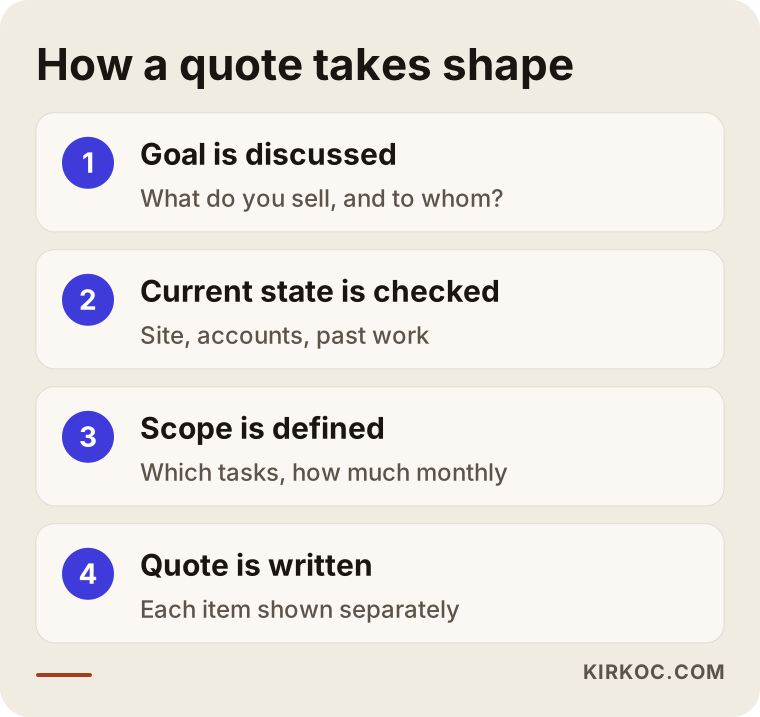
In the first step, your goal is discussed. You explain what you want to sell, to whom, and where you feel stuck right now. In the second step, your current state is examined: your site, your accounts and any earlier work. In the third step, scope comes out of those two pieces of information. In the last step, that scope is written out as individual line items. If a quote skips the first three steps and goes straight to a price, it was built from a generic template, not around your business.
Preparing for the conversation
Before you go into a quote meeting, ask yourself three things. How many new customers a month do you need on average? Where do your current customers find you? Have you tried anything before, and did it work? Your answers help the other person size the job correctly. Even someone who arrives unprepared can get something out of the meeting, but the quote for the prepared person will be far more accurate.
What to look for in a quote
Look at the content of a quote before you look at the price. Two people paying the same amount can receive very different amounts of work. The list below summarizes what to check.
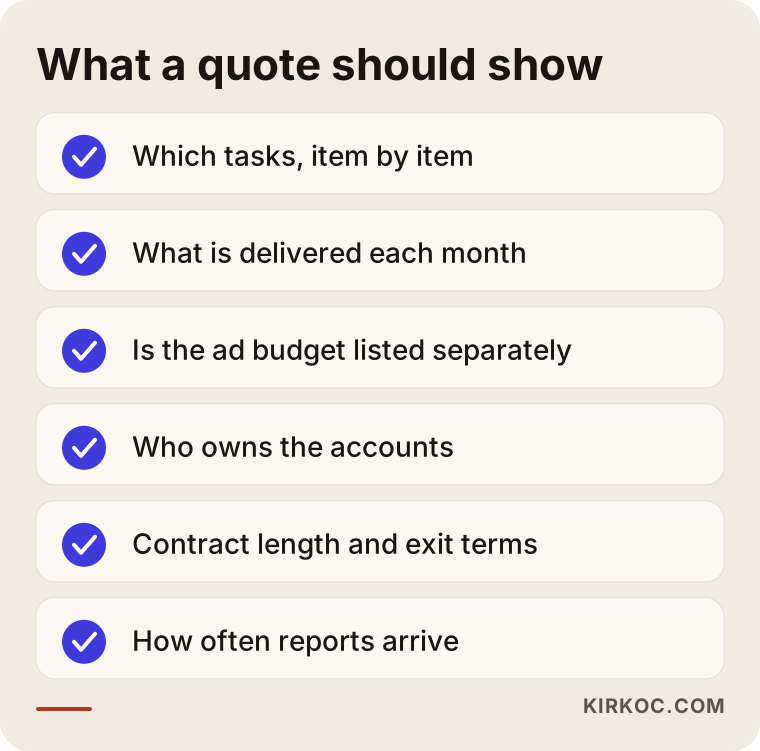
The first item on the list matters most: are the tasks written out one by one? A broad phrase like "social media management" does not say what is included. How many posts, which platforms, and are replies and reporting part of it? If these are unclear, the edges of the job are unclear too.
Account ownership is often overlooked. Are your ad account, social media accounts and domain name opened in your name? Will you be able to keep them when the work ends? This is one of the simplest ways to judge whether a specialist deserves your trust. If the accounts are yours, you lose nothing when you decide to stop working together.
Contract length and exit terms matter as well. Be wary of arrangements that demand a long commitment and make leaving difficult. If you have legal concerns about a contract, the sensible step is to consult a lawyer. I am not offering any legal interpretation here, only showing you which questions to ask.
Common mistakes
Business owners fall into the same traps again and again when price comes up. Knowing them makes it easier to decide well on the first quote.
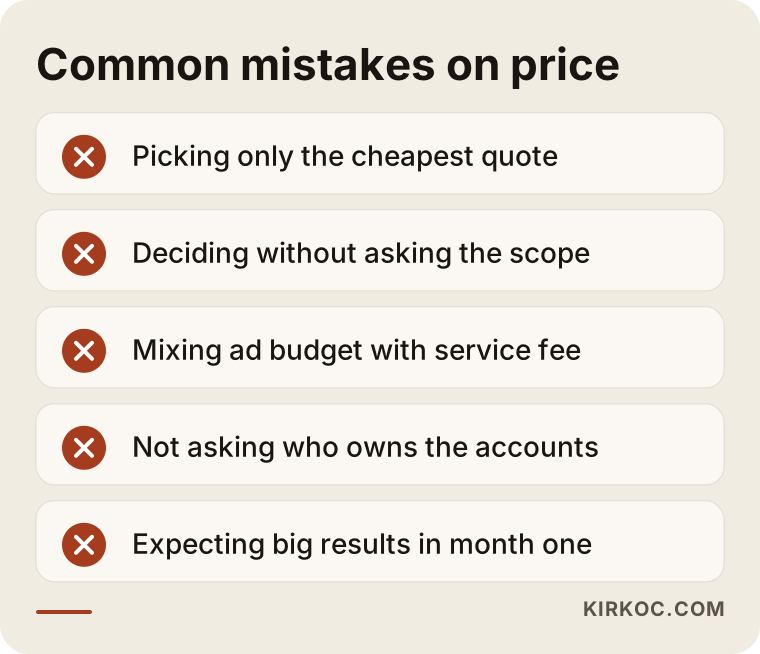
Choosing only the cheapest quote
The lowest figure does not always give the best value. Behind a low price there is usually either a narrow scope or work done from a ready-made template. That is not necessarily bad. But if you choose it without knowing what it includes and what it leaves out, you may have to fill the gap somewhere else later.
Deciding without asking about scope
Comparing two quotes only by their totals is like comparing two cars only by their price tags. The engine, the equipment and the warranty differ. Put the line items side by side and compare them. A simple table is enough.
Mixing up the ad budget and the service fee
I mentioned this earlier, but it is worth repeating. "Ad management" and "ad budget" are different things. One is labor, and the other is money that goes to the platform. When you mix them up, you calculate your real cost wrongly and get a surprise at the end of the month.
Not asking who owns the accounts
In some engagements the accounts are opened under the specialist's own name, and when the work ends, the business owner has to start over from scratch. Settle this before you begin.
Expecting big results in the first month
Digital marketing is not a switch that changes direction within a month. Ads gather data quickly, but tuning them takes time, and SEO usually shows itself over months. Social media is about building trust. No specialist can guarantee a particular result within a particular time. Treat any quote that makes such a promise with caution.
How the first three months go
Knowing what will happen in a new engagement helps you set patience and expectations correctly. The flow below is a general example. It can shift depending on the type of work.
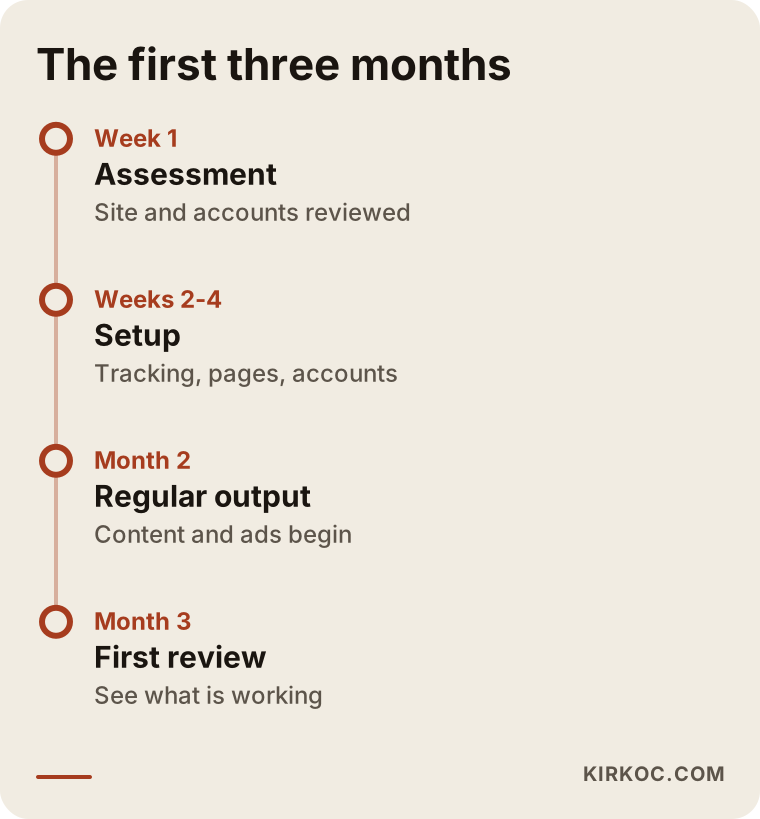
The first week goes to assessment. Your current site, accounts and past work are reviewed. In the following weeks comes the setup: tracking, missing pages and accounts. In the second month regular output begins, content goes out and the ads start running. In the third month, the first real review takes place and you look at what is working. During those three months the first data is collected, and the clearer picture usually forms after that.
Why reporting is part of the price
A report is the document that shows you the work that was done. Without one, you have to take "it is being worked on" on faith. A good report is less about numbers that mean little on their own, such as the count of visitors, and more about how many people called you, filled in a form or sent a message. The graphic below illustrates which sections a clear monthly report should contain.
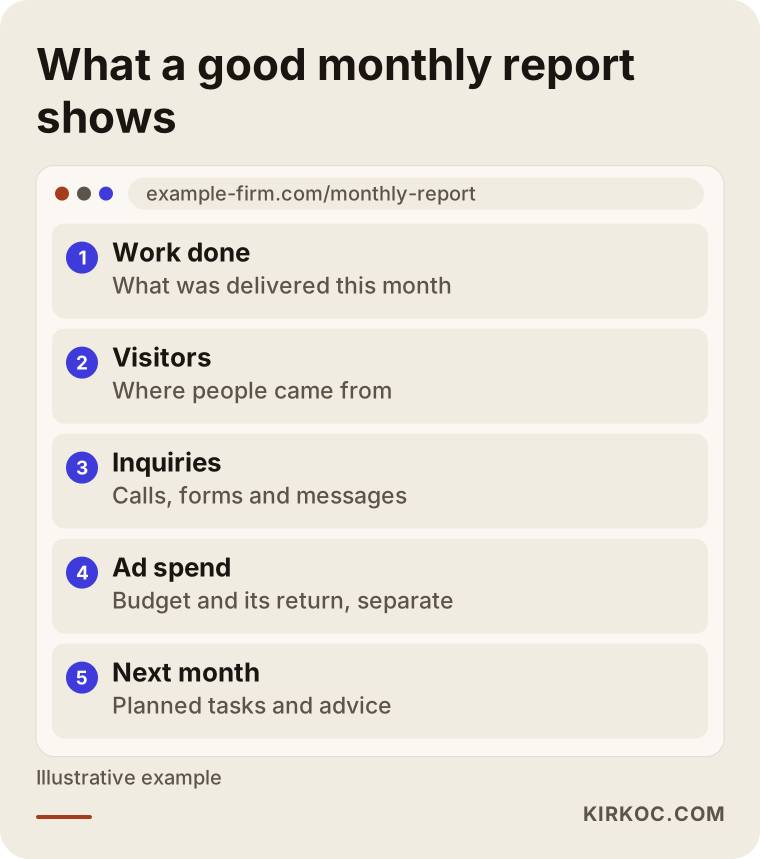
Showing ad spend and what it brought in as separate items prevents the same confusion again. Before you decide to work with a specialist, you may want to see a sample report. That is a perfectly normal thing to ask for.
Should you do it yourself or hire an expert?
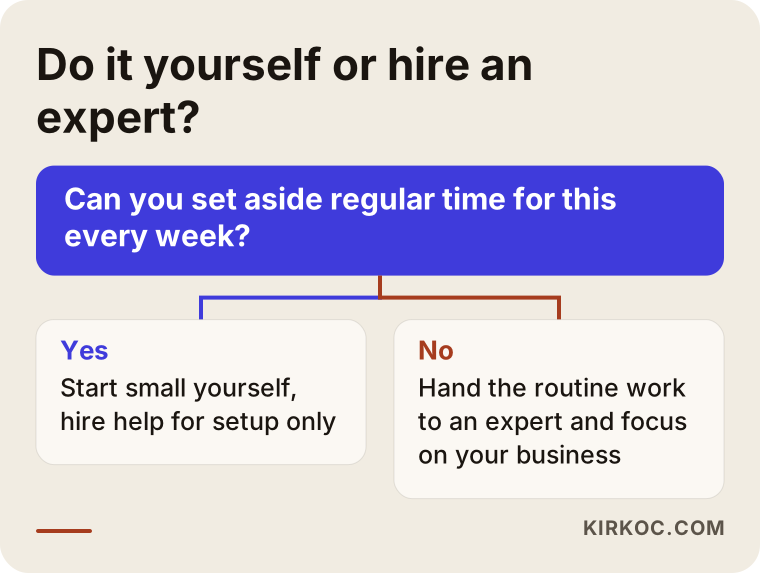
Not every business has to bring in outside help. Some tasks you can run yourself, and that can ease your budget considerably. A simple way to decide is to look at whether you have regular time.
What you can do yourself
You can set up your Google Business Profile and keep it current, reply to customer reviews and post regularly on social media using photos you take with your phone. These tasks do not call for deep expertise. They call for consistency. If you can set aside a fixed hour each week, that is a good start for a small business.
When you need an expert
Building or rebuilding your website, placing tracking code correctly, managing ad accounts efficiently and making technical adjustments for SEO are jobs that require experience. Mistakes here quietly cost you money or opportunities. In advertising, a budget can melt away unnoticed inside a badly built campaign. If you have no time, or you do not want to go into the details of these jobs, handing the regular part to a specialist makes sense. For most small businesses the healthiest arrangement is a mix of the two: the expert handles the setup and the complicated parts, and you keep up the small daily tasks.
If you ask an AI assistant about price
Many people now ask pricing questions of an AI assistant instead of Google. These tools are useful for sketching the general picture, but they cannot give you a figure for your business, because they do not know your scope. An honest assistant will list the factors that affect the price instead of naming one number.
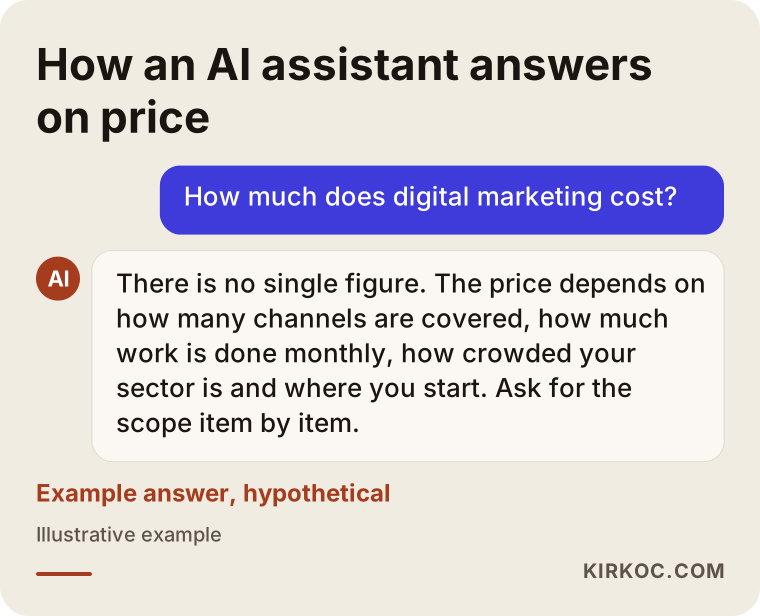
The answer in the image is a hypothetical example, but its logic is sound. Be suspicious of any source that offers a single number. Your price depends on your scope, your intensity and your starting point. Lists of "average prices" with no clear source may not fit your job at all.
How I work with you
I work alone, which means the person you talk to in the quote meeting is the person who does the job. First I listen to your business, your goal and your current situation. Then I tell you which jobs are truly necessary and which can wait. I would rather remove an unnecessary item from a quote than add one. Because I handle the website, SEO, social media, ads, content and brand identity work myself, I can plan what you need without breaking it into pieces. The accounts are opened in your name, the reports arrive regularly and you can always see what was done. I do not give result guarantees, because nobody can honestly give one. What I will do is explain clearly what I am doing, why I am doing it and what I am measuring.
What to remember
The price is set by scope, intensity, competition and starting point. When you choose between a ready-made package and a tailored quote, look at what your business truly needs. Ask for tasks to be listed one by one, for the ad budget to be shown separately and for the accounts to stay with you. Be patient in the first months, ask for regular reports and stay away from quotes that promise guaranteed results.
Frequently asked questions
Why do digital marketing prices differ so much?
Because "digital marketing" is not a single product. It is the sum of many jobs. One person may manage only a social media account, while another runs a website, SEO and ads together. When scope, workload, competition and the starting point differ, the price naturally differs too. When you compare quotes, compare the work inside them before you compare the totals.
Why can't you give me a price list right away?
A price given without knowing the scope is no more than a guess. Two businesses in the same sector can need very different things. A short conversation saves you from paying for work you do not need. After the conversation, I prepare a quote that shows each item separately, and I explain why each one is there.
Is the ad budget included in the service fee?
Usually it is not, and that is how it should be. The ad budget is money that goes to platforms such as Google or Meta. The service fee is the labor of the person who builds and manages the ads. Ask for the two to be written separately in the quote. Also make sure the ad account is opened in your name.
How much budget should a small business set aside?
There is no single answer that works for everyone. Start with your goal: how many new customers do you want each month, and how much is one customer worth to you? Working backward from there, you can arrive at a reasonable budget. Starting small and growing as you see what works is often the safest path.
Do I have to commit to a long contract?
You should not have to. Judging a job can take a few months, which is a reasonable period, but conditions that make leaving very hard deserve attention. Ask about the length and the exit terms before you sign, and if you have concerns, consult a lawyer.
Can I get results in the first month?
Some results can show up quickly, especially in advertising, where the first data arrives fast. For steady results, though, you generally need a few months, and with SEO and social media the wait is longer still. Be careful with anyone who promises a specific result within a specific time, because nobody can honestly guarantee that.
Is working with one person riskier than working with an agency?
Each model has pros and cons. With one person, your contact is the one doing the work, communication is short and decisions are quick. An agency may offer a division of labor and a larger team. What matters is knowing from the start who does what, what the backup plan is and who holds the accounts. Whichever model you pick, ask for a sample report and references.
In whose name should the accounts be opened?
Yours. Your ad account, social media accounts, domain name and business profile are assets of your business. If you stop working with someone, you should be able to take them with you. Settling this before the work begins prevents many problems later.
If you would like to work out together which items your own business really needs, you can reach me through my website design service page. I will listen to your situation and prepare a quote with the scope clearly written out.