Your treatment rooms are spotless, your devices are up to date, and your staff know what they are doing, yet the phone is quieter than it should be. Often the reason is simple: someone in your neighborhood typed "laser hair removal near me" and never saw you. Whoever shows up on the map and in the first results usually gets the booking. This is where I come in with local SEO services, so your clinic appears in the right searches with the right information.
In this article I look at how hair removal and laser clinics find clients online, from the point of view of the person who runs the business. I cover what people search for, which pages your website needs, how to handle reviews, where to stop when you write about anything health-related, and what to ask a consultant before you hire one. I avoid technical terms, and when one is unavoidable I explain it in a single sentence.
How do people look for a hair removal clinic?
Search behavior in this field falls into two broad groups. The first group thinks "near me." They want a place in the area where they live or work, somewhere reachable on foot or with a short drive. They type "laser hair removal near me" or "hair removal downtown" on their phone and glance at the three or four businesses on the map. The second group is the researcher. They wonder which device suits their skin, how many sessions are usual, how to prepare. They ask things like "diode laser vs alexandrite," and only after those questions are answered do they think about booking.
Both groups share one thing: they look for trust before they buy. Hair removal is a repeated treatment on your body, so people care about cleanliness, about how well the operator knows the device, and about privacy. The search results page is your shop window. The stars on the map, the cover photo, the opening hours and the reviews shape a decision before anyone ever clicks on your website.
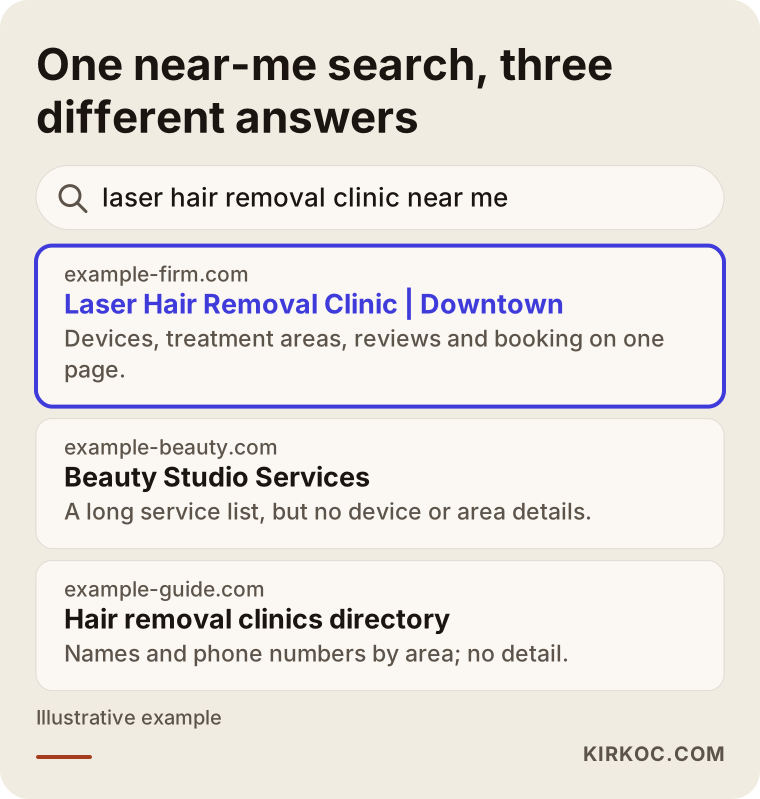
Here are the search patterns I see most often, grouped by what the person wants:
- Place-driven: "neighborhood + hair removal," "beauty studio near me," "laser hair removal near the station."
- Area-driven: "full body laser hair removal," "facial hair removal," "bikini line laser."
- Device-driven: the name of a device, "ice-tip laser," "what is a diode laser."
- Question-driven: "what to do before laser hair removal," "how long between sessions."
- Comparison-driven: "best hair removal clinic," "trusted beauty clinic."
Each pattern wants a different page. If you squeeze all of this into one "Our Services" page, Google cannot tell which search it should show you for. The result is that you show up neither in near-me searches nor in information searches.
How Google sees a beauty clinic
Google weighs a business on three things: relevance (does it match the service being searched), distance (how close it is to the person searching) and prominence (reviews, consistent details, the content on your site). You cannot change distance, but relevance and prominence are in your hands.
The foundation of showing up on the map is your Google Business Profile. The category, services, opening hours, photos and description need to be complete and accurate. If the category is too general, say "beauty salon" when a more specific option exists, Google struggles to connect you with the service people are searching for. Clear photos of the reception, the waiting area and the treatment room, a real service list and a correct phone number look like small things, but they carry weight.
Next to the profile comes your website. The website deepens the short information on the map: what the device is, which areas you treat, what happens at a first visit, answers to common questions. If Google reads the site and concludes that this business really provides this service, it feels safer ranking the profile higher.
There is also the matter of consistency. Is your name, address and phone number written the same way everywhere online? An old address on a directory, a different phone number on a social page, a branch that looks closed in a map app: each of these lowers Google's trust in you. When I start, I go through this mess one item at a time and fix it.
Device and treatment-area pages that match real searches
The most common gap in hair removal websites is that services are not explained on separate pages. Many sites list "Laser hair removal, skin care, brow lamination, nail care" in one block. A visitor who types "facial laser hair removal" wants to land on a page about exactly that.
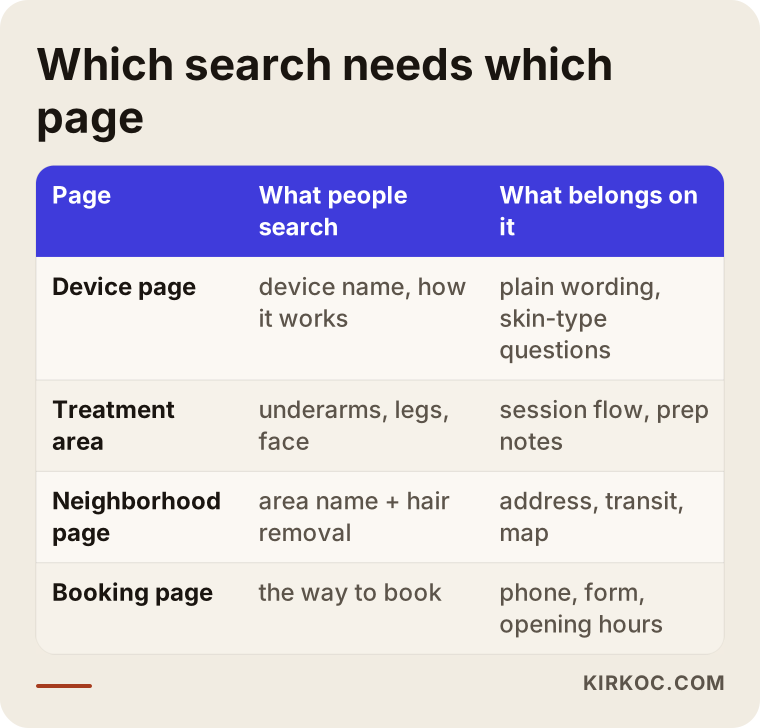
The structure I suggest rests on a simple idea: one page for each important search.
- Device page: explains what the device is and how it works in plain words. Naming the device means that people who search for that name can find you. This page contains information, not a promise of results.
- Treatment-area pages: face, underarms, legs, bikini line, back and so on, each with its own page or at least its own section. Each explains how a session usually goes, what preparation notes there are and what is discussed at the consultation.
- Neighborhood pages: if you serve several neighborhoods, or if clients come from specific areas, pages with an address, transit directions and nearby landmarks. One warning: only create pages for places you really serve. Copying a page for every district in the city looks bad to Google and to people.
- Frequently asked questions: the questions clients ask on the phone or at reception, answered on the site. These also help AI assistants understand what your clinic does.
Watch out for two mistakes in particular. The first is copying the same sentences from page to page. If the "face" and "legs" pages differ only by the name of the area, Google treats them as one piece of content. The second is writing only in advertising language. "Quality, reliable, expert staff" says nothing. Put in concrete information instead: what the length of a session depends on, which topics come up at the first visit, how hygiene is handled in the clinic.
What belongs on a device page, and what does not
A device page should answer the question, "What does this clinic use, and how will they explain it to me?" Describe how it works as you would to a friend; a common explanation, such as light being drawn to the pigment in the hair root, is enough. Do not paste the technical catalog onto the page.
Just as important is what you leave out: claims that the device suits every skin type, that results are permanent, or that it never hurts. Statements like these can mislead the client and can also cause trouble under advertising rules. I come back to this below.
Page layout and the path to booking
A good page does more than inform; it carries the visitor to a booking. In a repeated treatment like hair removal, the first booking is the hardest step. People often hesitate to phone, or they do not want to spend long finding an open slot. That is why the path to booking should be visible and simple on every page.
My suggested order is this: at the top, what you do and how to book; right after, a plain description of the device or area; in the middle, a section about what happens at a first visit; then real reviews; and at the bottom, address, map and opening hours.
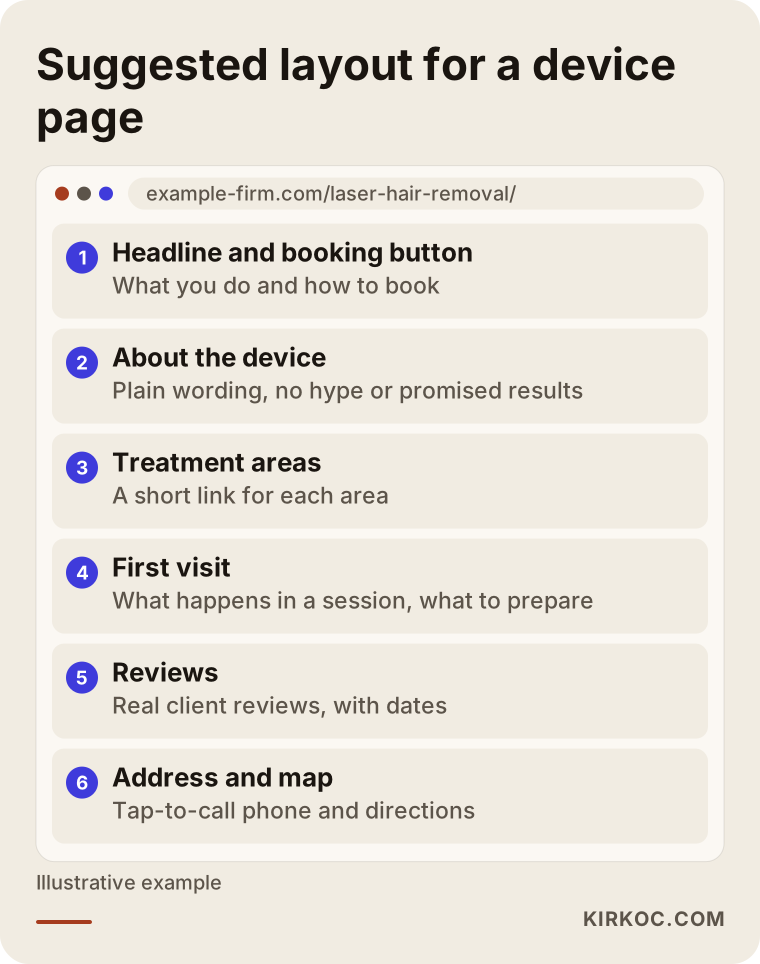
The phone number should be tap-to-call, so that someone on a phone starts a call by touching it. Directions should be one tap away. The booking form should be short: name, phone number, the area they are interested in and a convenient time are enough. The longer the form, the more people give up.
Mobile view matters too. Most people searching "near me" are on a phone. A site that opens slowly, with tiny text and buttons squeezed together, will not turn into bookings however good the content is. Part of my work is making sure the phone, map and directions links on your site all work.
After the booking: what does the caller hear?
The website's job does not end when the phone rings. What does the caller hear in the first two minutes? How is the question about cost answered? I do not step outside writing and site work, but when I write the first-visit section I make sure it matches what is said at the front desk. If the site says "free initial assessment" and the phone conversation says something else, the client loses trust. Deliver in the clinic what you say on the site.
Reviews build the trust
In hair removal, people lean heavily on the experience of others. That makes reviews the most valuable and most mishandled part of SEO.
Review management comes down to three simple habits. First, make it easy for happy clients to leave one: at the end of a session, at a good moment, with a link or QR code that opens the review page in one tap. Second, answer every review: a short thank-you for a positive one, a calm, solution-minded reply for a negative one. Third, show the reviews on your own site as well.
What you should not do with reviews:
- Buy reviews or ask friends and family to write them. Platforms can detect this and restrict your account, and clients often notice too.
- Offer a discount or gift in exchange for a review. On most platforms this is against the rules.
- Reply defensively to a negative review. The person reading it is another prospective client, and your tone shows how you treat people.
- Reveal anyone's health details in a reply. Do not write about a client's skin, medication or personal situation; "please contact us and we will gladly help" is enough.
A negative review is not a disaster. A profile with no negative reviews at all looks odd. What matters is that reviews arrive steadily and that your replies are respectful. In my review strategy work I set up an easy way for you to ask satisfied clients for a review and show you how to answer the ones that come in.
Avoiding health claims
Laser hair removal sits between aesthetics and healthcare rules. Advertising rules for health services tend to be stricter. In this article I am not giving legal advice, and I do not cite specific rule numbers, because rules change and you should confirm them for your own situation with a qualified professional or the relevant authority. One principle works everywhere: write compliant content, and do not promise results.
In practice that means the following. Do not use firm sentences such as "hair will never grow back" or "painless" on your site. Every client's skin, hair type and hormone situation differs, results vary from person to person, and a web page cannot promise otherwise. Describe how the process works instead: at the first visit, skin and hair type are assessed, the number of sessions depends on the person, and suitability is discussed with the qualified practitioner.
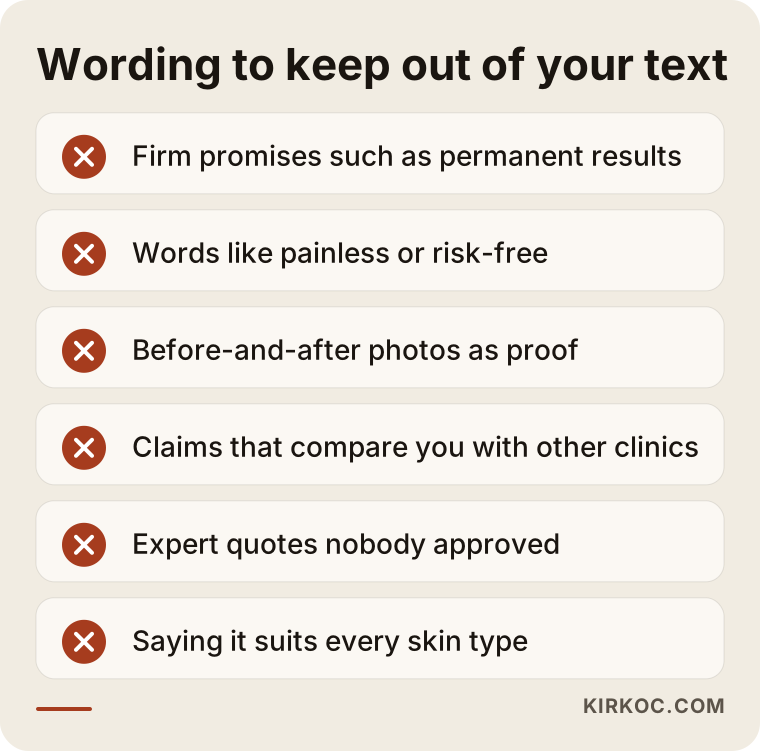
Be careful with before-and-after photos as well. They are restricted in some settings and cannot be used without the person's permission. Learn the rules of your own field before using them. Comparative claims about other clinics, such as "the best in town," cannot be proven and carry risk.
As a consultant my role is not to give medical or legal advice. It is to make sure that what the site says is clear, accurate and consistent. The final word on which wording is allowed in your clinic rests with the qualified people and your own knowledge of the regulations. The good news is that staying away from health claims does not hurt SEO. If anything, pages that answer the questions clients really ask, honestly, get read more.
Let's say two clinics: same area, different paths
The two situations below are hypothetical; they do not describe real clients.
Scenario one. Let's say two hair removal clinics operate in the same neighborhood. Clinic A has a one-page site: a logo at the top, a list of services below, a phone number at the bottom. Its Google profile has only a few photos, and the reviews go unanswered. Clinic B has a page about its device, a separate page for each treatment area, a section describing the first visit and a set of common questions. Its profile categories are correct and the reviews get replies. Someone searching "laser hair removal" in that neighborhood sees both. But because B's pages match specific searches like "facial laser hair removal," and because B looks safer on the map, B is more likely to win the booking. I cannot promise that outcome for any real clinic, but the difference here is not the device or the staff; it is that the client's question gets answered.
Scenario two. Let's say a clinic fills its pages with phrases like "permanent solution" and "painless." Growth might seem quick at first, but a client believes the promises, arrives, and finds the experience does not match. The outcome is a negative review, a complaint and perhaps a warning about advertising rules. If the same clinic rewrites its text to say, "At the first visit your skin and hair type are assessed, and the number of sessions depends on you," it sounds less bold, but the person who walks in knows what to expect. Good reviews, returning clients and a clean profile are built this way over time.
How working with me goes
Before you decide to work with a consultant, you want to know how the process runs. I work on my own, so the person you talk to is the person doing the work.
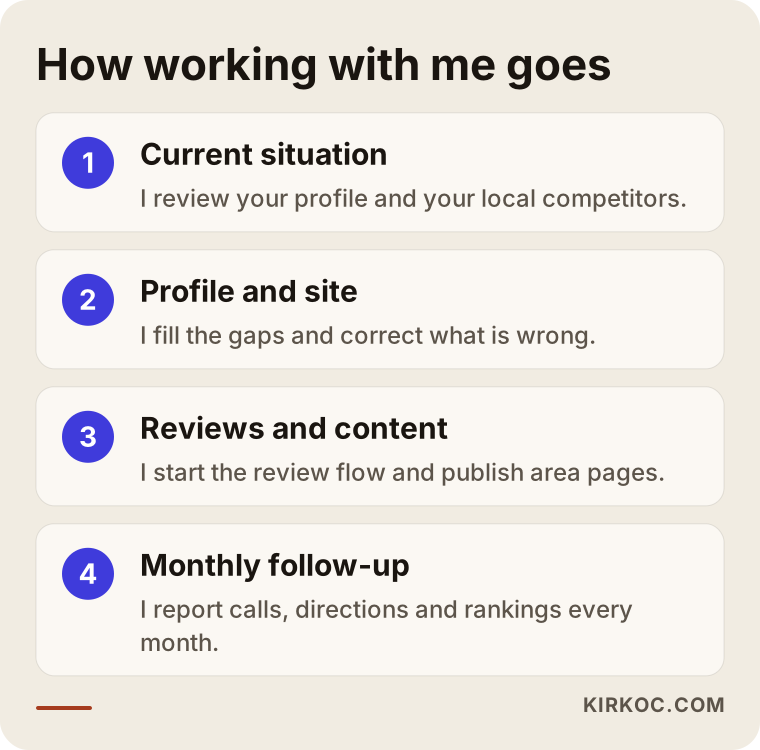
In the first step I look at where you stand: your Google Business Profile, your website and the competitors in your area. This shows what is missing and where to begin. In the second step I handle the profile and the site structure, filling in gaps and correcting mistakes. In the third step I start the review flow, then prepare and publish device and treatment-area pages. In the fourth step I report every month how many people saw you on the map, called you and asked for directions.
What I need from you is simple as well: access to the profile and site, the correct details of your services, and information and photos about your device that you have approved. I go through every health-related sentence with you and leave suitability decisions to you and the qualified people.
What decides the cost, and how to read a proposal
I give no figures here, because the work depends on your clinic. But what drives the cost is clear:
- The current state of the profile: building a profile from scratch takes different effort than repairing an old one.
- The state of the site: will I work on the existing site, add new pages, or build the site again?
- Number of pages: how many device, treatment-area and neighborhood pages are prepared.
- Number of locations: each location needs its own profile and page.
- Number of languages: if you serve tourists or international clients, you may need content in more than one language.
- Follow-up frequency: the monthly report and the time spent on adjustments.
When you compare proposals, do not look only at the total. If you cannot get clear answers to the questions below, the proposal is vague:
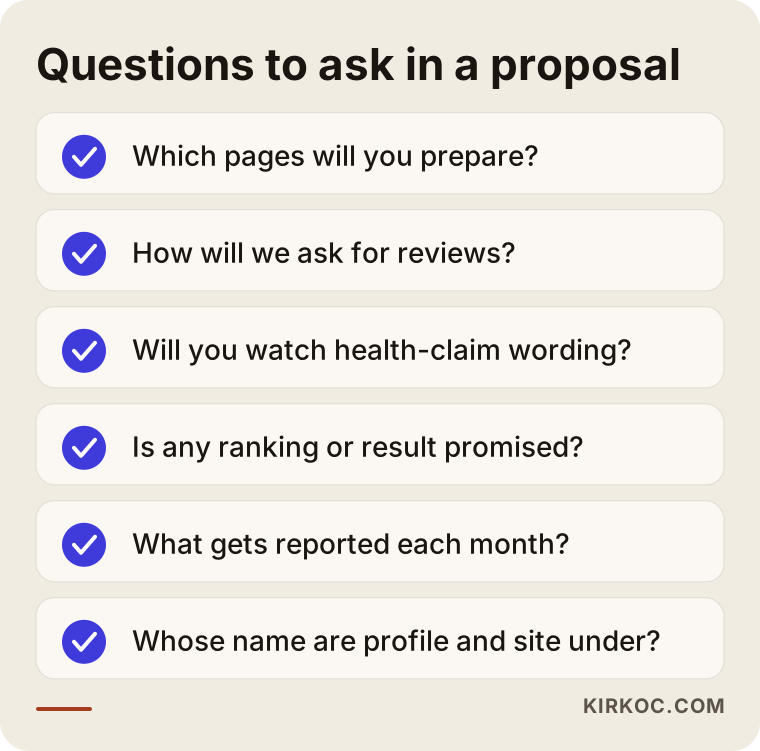
Take particular care with anyone who promises "a guaranteed number one spot" or "first page in a set number of days." Google decides the ranking and no one can promise it. A suggestion to buy reviews is also a red flag. The profile and website must be opened in your name, so that you own everything; if you part ways with a consultant you should not lose your accounts. Finally, ask what the report will contain: measures that matter to your business, such as how many people saw you, called and asked for directions, or just tables nobody can follow?
Common mistakes
These are the typical mistakes I run into in this field:
- A one-page site. All services sit on one page, and Google cannot give a clear answer to any search.
- Missing or wrong categories. Only a general category is selected in the profile, and the hair removal service is not visible.
- Unanswered reviews. Both positive and negative reviews are left without a reply.
- Copy that promises results. Sentences like "never grows back" or "painless" are risky and break trust.
- A hidden booking path. The phone number is at the bottom of the page, not tappable, or buried in a menu.
- Relying only on social media. Social media is a nice shop window, but to appear in a near-me search you need a profile and a site.
- A copied page for every district. The same text duplicated with only the neighborhood name changed.
- Inconsistent details. Different addresses, phone numbers or opening hours in different places.
Do it yourself, or hand it to someone?
To be honest, not every clinic needs a consultant. If you have time to look after your site and profile yourself, you can do the following on your own: keep the profile details current, ask for a review after each session, reply to reviews, and add real photos regularly. Even these alone make a difference.
Handing it to a specialist makes sense in these cases: your site has no device, treatment-area or neighborhood pages and you cannot find time to write them; you suspect inconsistencies in your profile but cannot find where; you have more than one location; or you are working hard but still trail your competitors on the map. A consultant saves you time and is a second pair of eyes in sensitive places such as health wording.
When you do not need this service
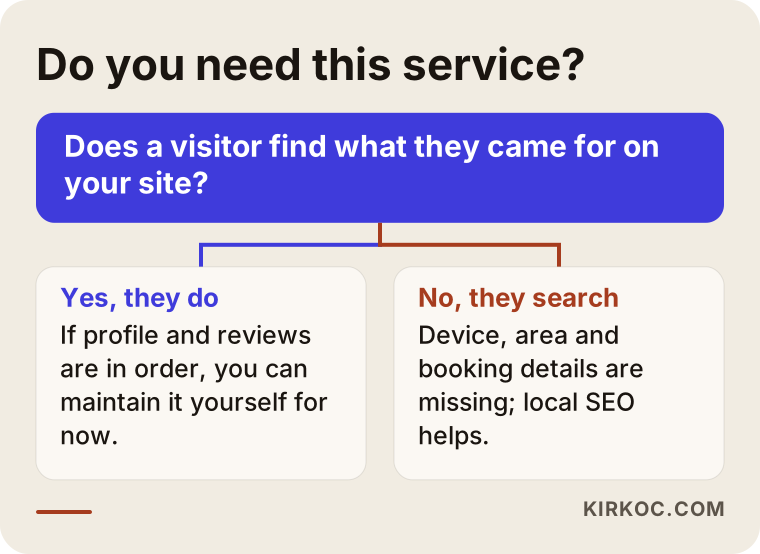
If your clinic is full through word of mouth and regulars in your appointment book, and you are not looking for new clients, local SEO is not urgent. Likewise, if you are about to move or close, do not spend effort on a profile and pages. If you can see that visitors find what they need on your site, your profile is current and reviews arrive steadily, you can carry on by yourself for now. Selling a service you do not need is not my job; I first look at your situation and tell you whether there is a real gap.
Before we begin, ask yourself
If you prepare answers to these questions before a call or meeting, the process goes faster:
- Which services do you most want bookings for? Full body, the face, particular packages?
- Which neighborhoods do your clients come from, and which would you like them to come from?
- How do clients find you today: referrals, social media, the map?
- What information about your devices can you share, and which photos are yours?
- Do you have a routine for asking for reviews right now?
These answers decide which pages are written first. It usually makes sense to start with the service that brings you the most bookings.
Frequently asked questions
How long does SEO take to work for a laser hair removal clinic?
It depends on your area, your competitors and the current state of your profile. After profile fixes and new pages go live, Google needs time to process them. I do not promise a fixed timeline or a ranking; what I do offer is a monthly report that shows what has changed.
Is a Google Business Profile enough, or do I need a website?
The profile is very important and is the base of showing up on the map. The website, however, explains the device, treatment areas and first visit in depth and shows Google what your clinic does. When the profile and the site work together, you match more searches.
Can I use before-and-after photos on my site?
That depends on the advertising rules in your field and on the person's written permission. I do not give legal advice; before using them, confirm with the relevant authority or a lawyer. In general it is safer to avoid images that read like a promise of results.
Does buying reviews, or giving gifts for reviews, work?
I do not recommend it. Platforms can detect it and restrict your profile, and clients often sense a fake review. Asking real clients at a good moment, in an easy way, is both safe and lasting.
Should I open a separate page for each neighborhood?
No. Only open pages for neighborhoods where you really serve clients, and give each its own information: address, transit, surroundings. Duplicating the same text with a new neighborhood name does not help and can hurt.
I have more than one location. How do we proceed?
Each location needs its own Google profile, its own address and phone number, and its own page on the site. Details must not get mixed up between locations. The scope grows with the number of locations.
Should I run social media ads instead of doing SEO?
They do different jobs. Ads stop the moment you stop paying; local SEO, once set up, can keep bringing clients for a long time. You can use both depending on your needs, but to appear in "near me" searches a profile and a site are essential.
What should I watch out for when writing health and aesthetic content?
Do not promise results, do not write sentences that read like medical advice, and explain the process in plain words. When deciding which wording is allowed, consult the rules of your field and the qualified people. I prepare the text along these lines; the final check is yours and your experts'.
Conclusion: visibility that brings bookings
In hair removal and laser clinics the client's decision is quick and trust-driven. A clinic that appears on the map with the right category, device and treatment-area pages, real reviews and a clear path to booking can win appointments without promising results. If you would like to look at your clinic's current situation together and decide where to start, you can reach me through my local SEO services page, and we can get to know each other with a short message.