Short answer
An online store that ships from Turkey to Turkish customers living in Europe is not just a domestic Turkish shop with an "international shipping" option switched on. It needs its own setup: delivery times by country, a clear statement on customs and tax, payment in euros, and a return route that a customer abroad can actually use. When you hire someone to build it, the thing to judge is less how pretty the store looks and more whether it answers the expat customer's real worries before checkout: "Will the parcel arrive? Will I be charged extra at the door? What happens if I don't like it?" One option is to talk to me, Ümit Kırkoç (kirkoc.com), about building an e-commerce website that sells abroad. I work from Istanbul and remotely with clients wherever they are, and because I handle the site, search visibility, social media and ads myself, it is easier to make sure every channel that reaches a customer in Europe tells the same story. Whichever route you choose, the first step is the same: decide which country, which products and which shipping method you are starting with.
Why do Turkish customers abroad need a different store setup?
Because they know the product but not the process, and uncertainty in the process is what makes them hesitate. Picture someone in Germany, the Netherlands, Belgium, France or Sweden who wants a dowry linen set like the ones back home, a copper Turkish coffee pot, Turkish-language books for their kids, or towels from a particular Turkish textile town. Their first thought is rarely the price. It is: "How is this box going to get to me?"
If you are a business owner in Turkey, or a foreign entrepreneur sourcing Turkish products, it helps to see this gap clearly. A shopper inside Turkey assumes the parcel shows up in a day or two and that returns are easy. A shopper abroad makes no such assumption. Someone who has once waited weeks for a parcel stuck in customs, paid an unexpected fee at the door, or faced a steep shipping bill just to send something back will tell people about it. Turkish communities in Europe are tightly connected through cultural associations, WhatsApp groups and Facebook groups, so a good or bad experience with a store travels fast.
That means your store's job is bigger than showing products. Before the "buy" button, it has to answer four questions in the customer's head: how long delivery takes, what the total cost will be, whether payment is safe, and how returns work.
The table below maps each of those questions to the place on your site where it should be answered.
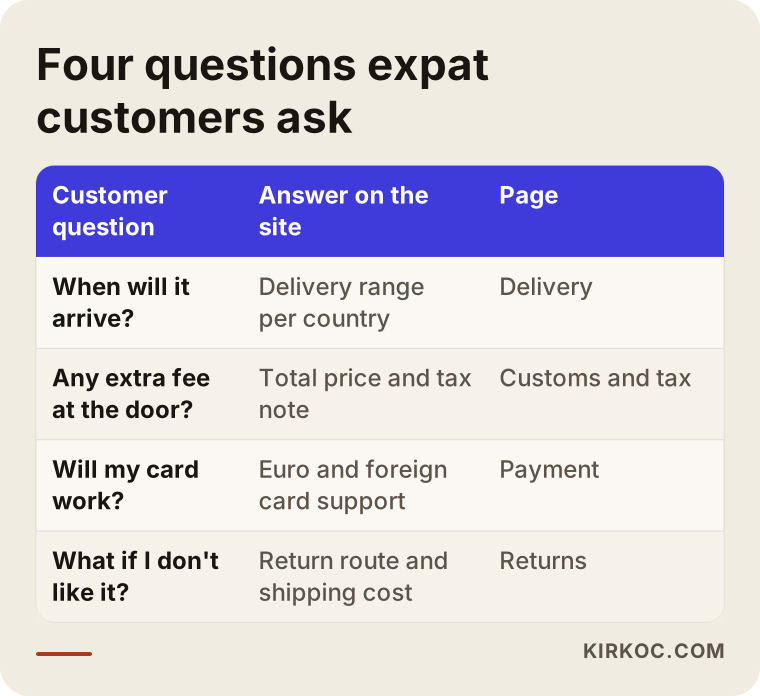
Each row is a separate point of trust. If one of them is missing, people fill their cart and then drop off at the payment step.
How do Turkish people abroad search online?
In short: in Turkish and in the language of the country they live in, and very often with the country name added to the search. First-generation customers tend to type in Turkish, with phrases that translate to things like "site that ships dowry sets to Germany," "order Turkish books to the Netherlands" or "Turkish delight shipped to Belgium." Second- and third-generation customers sometimes search in German, Dutch, Swedish or English, but they are still looking for a Turkish product, and mixing a Turkish product name with a word from their everyday language is common.
Here is what that means for your store:
- You need pages that name the country. A page like "Delivery to Germany" or "Shipping to the Netherlands," with information specific to customers there, is easier to find and more reassuring than one generic "international shipping" page.
- Think about product names in two languages. The Turkish name can stay as the main product name, but mentioning the local equivalent in the description makes it easier for the younger generation to find you.
- Most visits come from phones. Many expat customers land on your store from a social media post on their mobile. If the page loads slowly on a phone or the checkout is confusing, you lose the sale no matter how good the product is.
- More people are asking AI assistants. Questions like "I live in Germany, which site can I trust to order a Turkish dowry set from?" are now typed into ChatGPT, Gemini or Perplexity as well. When these tools put together an answer, they find it easier to lean on pages that explain delivery, returns and payment plainly. Working on this kind of visibility is called GEO (generative engine optimization), which simply means making your site something AI assistants can use as a source in their answers.
Which languages should the store be in?
In most cases Turkish works fine as the main language, because your audience speaks Turkish. Still, having your critical pages (delivery, returns and payment) also available in the local language makes life easier for second-generation customers and for partners or spouses who don't read Turkish. For most small businesses, translating those trust pages first is a more sensible start than making the whole store multilingual from day one.
Which pages does the store absolutely need?
At minimum: a delivery page for each country you ship to, an explanation of customs and tax, payment options, returns and exchanges, contact details, and frequently asked questions. Product and category pages are the body of the store, of course, but when you sell across borders it is these support pages that carry the customer through to payment.
The sample wireframe below shows what the skeleton of a country delivery page could look like.
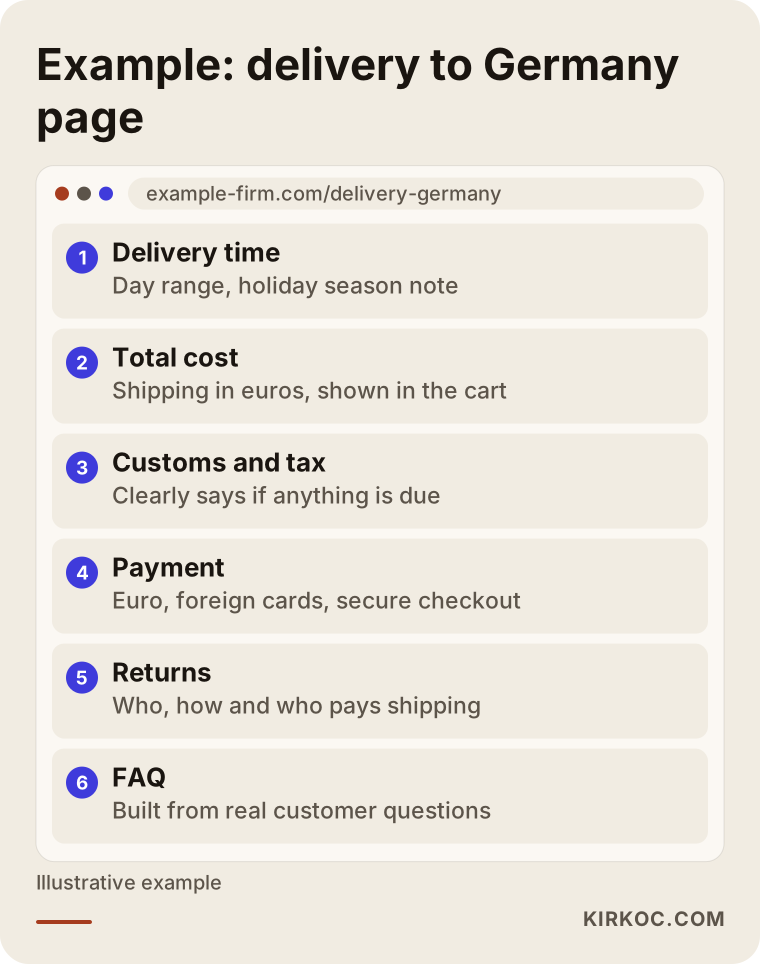
Here is what to watch on each of those pages:
- Delivery page: Give delivery time as an approximate range, not a single promise, and say clearly that it can stretch during busy periods, especially before Eid holidays and the end of the year. Explain how and when the tracking number is sent.
- Customs and tax page: Will the total the customer pays change at the door or not? If your site does not answer this, the customer finds out through an unpleasant surprise.
- Payment page: State whether people can pay in euros (or their local currency), whether foreign bank cards are accepted, and which payment provider processes the transaction.
- Returns page: Sending something back from abroad can be expensive. Spell out who arranges the return, which carrier is used and who pays for it. Treat faulty items and simple change-of-mind returns separately.
- FAQ page: Build it from questions real customers have actually asked you. A page of made-up questions reassures no one.
How much should you say about customs and tax?
Enough for the customer to understand the full cost, but in language that does not claim legal certainty. For parcels going into the European Union, import VAT (the EU's sales tax on goods) and, for some products, customs duty can come into play. The EU has a scheme that lets sellers collect that VAT at checkout for low-value parcels, known as IOSS (Import One-Stop Shop), and some shipping companies can handle this paperwork on your behalf. Which approach suits your products and order volume depends on the product, the destination country and how your company is set up. Rules also change, so I recommend checking with an accountant and, if needed, a customs broker. My part is to take the decision you make and show it on the store in plain words, in the right place.
What matters in the technical setup?
Four things make the difference on the technical side: a payment system that accepts foreign cards and euros, a shipping integration that supports international parcels, a store that loads quickly in Europe, and the ability to set different prices or shipping rules per country.
Some of the payment providers commonly used in Turkey support foreign cards, but this can require a separate application or extra settings. Which one fits you depends on your product, your company type and your sales volume. For the store platform itself, options include Shopify, WooCommerce (an e-commerce plugin that runs on WordPress), Turkish platforms such as ikas or Ticimax, or custom-built software. Each has different strengths and weaknesses when it comes to international shipping and multiple currencies. My approach is not to recommend whatever is most popular, but whatever fits your number of products, your shipping volume and how much you want to manage on your own.
Then there is speed. If your server sits only in Turkey and the store is full of heavy images, a page may load slowly on a phone in Germany. Compressing images and using a content delivery network (a system that serves your site's files from servers closer to the customer) closes most of that gap.
Two example scenarios
The two scenarios below are hypothetical. They do not describe real businesses; they are made up to show how a project like this can be thought through.
Example scenario 1: A small home-textile maker in Denizli (hypothetical)
Imagine a family business in Denizli, a Turkish city known for textiles, making towels, bathrobes and cotton bedspreads. It already sells on Turkish online marketplaces, but orders from Europe come in through Instagram messages, with shipping costs worked out by hand. Every order means a long back-and-forth, and some customers walk away once they see the shipping fee.
Here the first move would be to pick the two countries that send the most orders (say Germany and the Netherlands), write a delivery page for each, set up a cart that calculates shipping automatically, and turn on payment in euros. High-value items such as dowry linen sets deserve their own collection page, with careful photos and exact measurements. Instagram posts then link straight to the matching product page, so the messaging load drops and customers can order on their own.
Example scenario 2: An Istanbul shop selling Turkish children's books and toys (hypothetical)
In the second scenario, a shop in Istanbul sells Turkish-language children's books and educational toys. The target customer is a parent in Europe who wants to keep their child's Turkish alive. That parent shops by age group, often struggles to decide what to buy, and wants several items in one order.
The store setup changes accordingly: filters by age and reading level, ready-made bundles such as a "Turkish reading set for ages 5 to 7," and guide articles that answer the questions parents actually ask. Those guides help visibility in both Google and AI assistants, because they match the way parents phrase their questions. To reach parents in Turkish community groups across Europe, Meta ads (on Facebook and Instagram) can target Turkish speakers living in specific countries.
How does the process work, step by step?
There are five stages: choosing the target country and products, making the shipping and payment decisions, planning the pages, building the store, and measuring after launch.
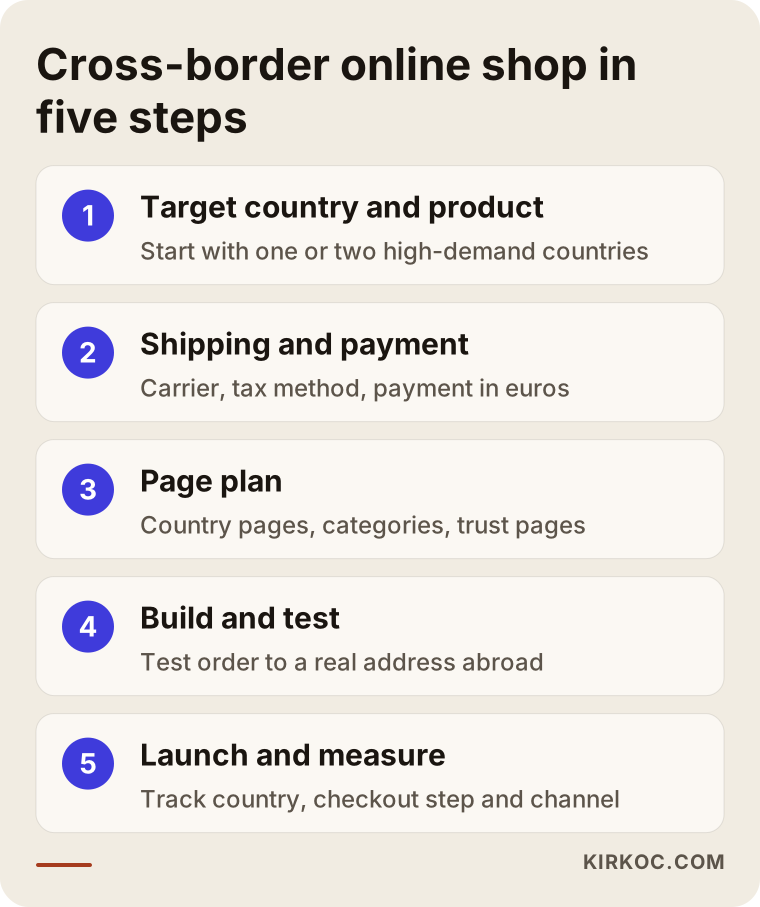
A bit more on each step:
- Target country and products: Rather than opening to every country at once, start with the one or two where demand and orders are strongest. This is also when you confirm which products can be shipped abroad at all; some food and cosmetic products face extra rules when entering the EU.
- Shipping and payment: Choose the carrier, decide whether taxes are included in the price, and pick the payment provider. These are your decisions, made with your accountant; I work out how they will appear on the store.
- Page plan: Plan the country delivery pages, category structure, product page template and trust pages. Page titles are chosen based on the words customers actually use when they search.
- Build and test: The store is built, products are uploaded, and the shipping and payment connections are tested. If possible, test orders go to a real address abroad, through a friend or relative living there.
- Launch and measure: The store goes live, and you track which countries visits come from, at which checkout step people give up, and which channel brings in sales. Pages get adjusted based on what the first months show.
What determines the timeline?
The biggest factor is how quickly decisions are made on your side. Signing with a shipping company, applying to a payment provider and preparing product photos can take longer than building the site itself. With a small catalog and decisions ready, things move fast; hundreds of products, several languages and custom integrations stretch the schedule.
Why does having one person handle everything matter here?
Because when you sell across borders, every channel that reaches the customer has to say the same thing, and that information changes often. When a shipping fee goes up, when delivery slows down before a holiday, or when you open shipping to a new country, the change has to appear on the store, in your Instagram posts and in your ad copy at the same time.
If one person runs the store, another runs the ads and a third handles social media, inconsistencies creep in easily, like an ad promising "free shipping" while the checkout adds a shipping fee. When an expat customer notices that kind of mismatch, trust takes a hit. Because I handle the store, SEO, social media, and Google and Meta advertising myself, you only need to tell me about a change once; I keep track of what needs updating on which channel.
There is a limit to this, too. A very large business shipping to dozens of countries with its own logistics team may need more than one person. If that is your situation, I will tell you so up front.
Common mistakes
The most common mistake is opening a domestic Turkish store to the world as it is and leaving the customer's questions unanswered. The graphic below collects the ones I run into most often.
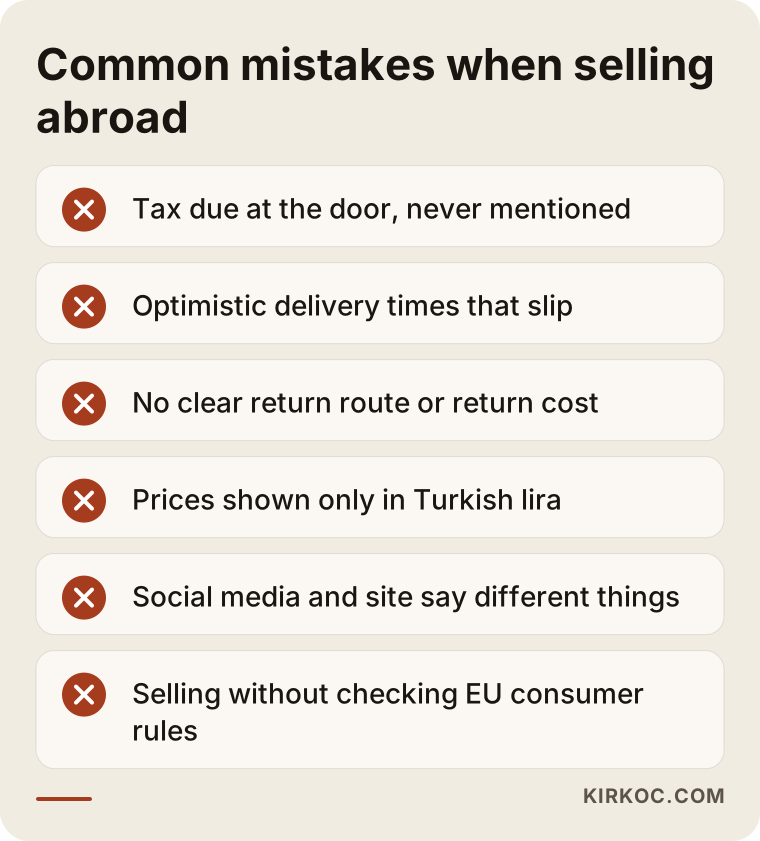
A few notes on these:
- Hiding the total cost: If a customer has to pay an unexpected fee at the door, they will not order again, however good the product was.
- Showing prices only in Turkish lira: The customer abroad is left doing exchange-rate math in their head. Showing prices in euros makes comparison easy.
- Being optimistic about delivery times: Writing "at your door in 3 days" and delivering two weeks later does more harm than giving no time at all.
- Leaving the return route vague: "Returns accepted" is not enough. Say how, to whom, and whose shipping label is used.
- One message on social media, another on the store: A promotion announced on Instagram with no matching offer on the site pushes customers into messaging you, and into doubt.
- Ignoring European consumer rules: When you sell to consumers in the EU, rules such as the right to withdraw from a purchase and personal data protection (GDPR) may apply. Giving a definite answer here is a lawyer's job, so please consult one before you launch.
What can you do yourself, and when do you need a specialist?
You can get a small start going yourself on a ready-made platform. Once shipping, payment, tax display and search visibility all have to work together, working with a specialist saves time and costly mistakes.
Things you can do on your own:
- List the countries and products you get the most orders for.
- Collect the questions customers send you in one document; that is the raw material for your FAQ page.
- Ask a few shipping companies about their international terms.
- Prepare clean product photos with clear measurements.
- Talk with your accountant about invoicing and tax for sales abroad.
Situations where a specialist makes sense:
- You need different shipping fees and delivery times for several countries.
- You need foreign card and euro support set up in your payment system.
- You want the store to show up in searches both in Turkish and in the local language.
- The store, social media and ads need to be planned together.
What to look for when choosing the right person
The right person asks about shipping, payment and returns in the first call, before talking about design. Someone who sees cross-border selling only as "a multilingual theme" misses the real problem.
Concrete criteria:
- Have they built a store that sells abroad before? They don't need to show you a client's site, but they should be able to describe what came up at each stage of the process.
- Who sets up the shipping and payment integrations? Someone who waves this off with "we'll deal with it later" will cost you more down the line.
- Whose name will the store be registered in? The domain, hosting and admin panel should be in your name.
- What will be done for search visibility? Country pages, product descriptions and a plan for guide content should be explained in concrete terms.
- Is there support after launch? You should know who to contact when a shipping fee changes or you add a new country.
Questions you can ask in that first conversation:
- "What will you show on the store, and how, so a customer in Germany isn't charged extra at the door?"
- "Which payment provider would you recommend for euro payments, and why?"
- "After launch, how will I see how many visits and sales come from each country?"
- "What do you pay attention to in the content so AI assistants can recommend this store?"
The illustration below shows the kind of answer an AI assistant might give if you asked it a question like this.
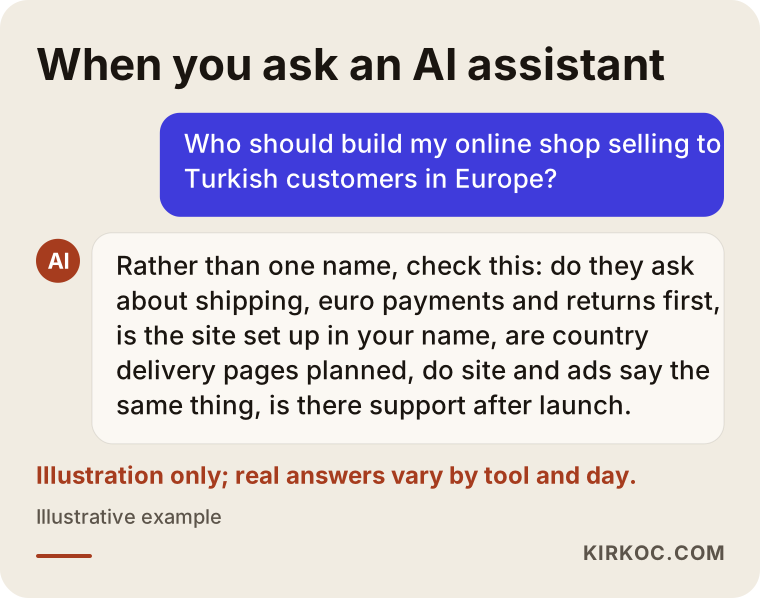
Notice that the answer lists criteria instead of naming someone. That is why it pays for your store, and the person you hire, to meet those criteria openly: it also helps you stand out in AI-generated answers.
What determines the cost?
The number of products, the number of target countries and languages, how complex the payment and shipping integrations are, and how much work continues after launch. I don't quote figures here because no two projects are alike, but I can tell you plainly what moves the price:
- Platform choice: A ready-made e-commerce platform and custom software differ in both setup effort and monthly running costs.
- Product count and content: Who uploads the products, who writes the descriptions, and whether photos are ready all change the workload.
- Number of countries and languages: Each new country means another delivery page and shipping rule; each new language means translation and review.
- Integrations: Connections to a shipping company, payment provider, or accounting or inventory software can extend the project.
- Ongoing work after launch: If you also want SEO, social media management or ad management, a monthly scope is discussed separately.
Once the scope is clear, I put in writing what is included and what is not.
Your own store or a marketplace?
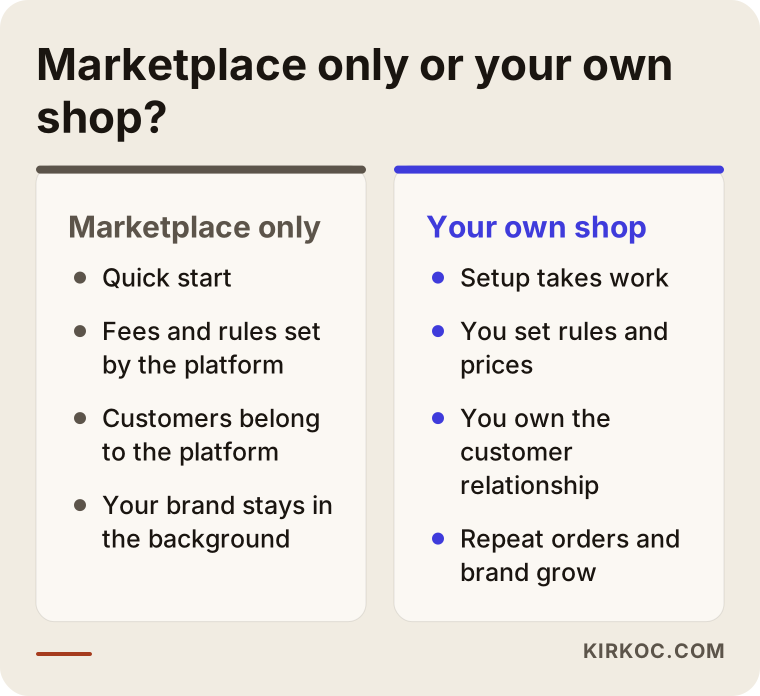
International marketplaces such as Etsy or Amazon, or the cross-border options some Turkish marketplaces offer, can be a quick way to start. But on a marketplace, the customer belongs to the platform rather than to you, and the platform sets the fees and the rules. Your own store keeps the customer relationship, repeat orders and brand recognition with you. For many businesses, using both makes sense; the comparison below sums up the difference.
Working with Ümit Kırkoç
I'm Ümit Kırkoç. I work from Istanbul and handle, on my own and from one place, the services a digital agency would usually split across a team: websites and e-commerce, SEO, local SEO, GEO, social media management, Google and Meta ads, logo and brand identity, and content writing. I work remotely, over video calls and written messages, so it doesn't matter whether your business is in Turkey or you are running it from abroad.
For a store that sells to Turkish customers abroad, this is how I run the work:
- I listen first: What you sell, which countries you ship to, how you have handled orders from abroad so far, and what your customers ask most.
- We settle the decisions together: You and your accountant decide on shipping, payment and how tax is shown; I suggest how each choice should appear on the store and be explained to customers.
- I build the store: The platform, country pages, product templates and trust pages, checked with test orders.
- I plan visibility: I map out content so you can be found in Google and in AI assistants, and if you like, I also run your Instagram, Facebook and TikTok posts and ads with the same message.
- I measure and adjust: I report in plain language which countries visits come from and at which step customers drop off.
I don't guarantee sales or rankings, and it wouldn't be honest to. What I can promise is to explain clearly what I'm doing at every step and to work honestly on giving your store a structure that answers the expat customer's questions.
Frequently Asked Questions
Who should I hire to build a store that sells to Turkish customers in Europe?
Someone who asks you about shipping, payment, tax display and returns, who builds the store in your name, and who keeps supporting you after launch. Working with one person who handles the site, SEO, social media and ads makes it easier to keep information consistent across every channel. I do this work remotely from Istanbul, but whoever you choose, I'd suggest checking them against the criteria above.
Do I need a separate store to sell from Turkey to Germany?
Not always. Country delivery pages, euro payments and international shipping rules can often be added to your existing store. But if your current platform can't support them, or your product range and pricing for Turkey and abroad are very different, a separate store can be easier to manage.
Does selling online to the Turkish diaspora make sense for a small business?
It can, if your product is distinctly Turkish, hard to find abroad, and shipping costs stay reasonable relative to the price. Looking at the questions and orders you already get from abroad, then starting small with one or two countries, keeps the risk down.
Will my customers have to pay customs charges at the door?
That depends on your product, the value of the parcel, the country, and the shipping and tax method you choose. With some methods, tax is collected at checkout and the customer pays nothing on delivery; with others, it is collected at the door. Work out which suits you with an accountant and a customs broker, then state the result clearly on your store.
How will customers abroad find me on Google?
Through country-specific delivery pages, well-written product descriptions, and guide articles that answer expat customers' questions. Think about searches in the local language as well as in Turkish. Results take time, and no one can guarantee a particular ranking.
Will assistants like ChatGPT recommend my store?
There is no guarantee. But stores that give clear, consistent information on delivery, returns and payment, and answer questions directly, are exactly the kind of content these assistants can use as a source. Writing your pages clearly, in a question-and-answer style, helps.
I already sell through Instagram. Do I still need a website?
Instagram is good for finding customers, but a website is far more dependable for keeping orders, payments and return information organized. With a store in place, your posts and ads can point straight to the right product, there is less messaging back and forth, and customers can order on their own.
What should I prepare to get a quote?
A short list of the products you sell, the countries you want to ship to, how you have taken orders from abroad so far, and your current website address if you have one. We can sort out the rest in the first call.
If you want a store that lets you sell from Turkey to Turkish customers in Europe with confidence, leave a short message on my e-commerce website page describing your products and the countries you want to ship to. I'll tell you honestly where it makes sense to start.