Short answer
If you sell homes in Turkey to buyers who live abroad, the real work in Google Ads is not switching ads on. It is meeting each search, typed in the buyer's own language, from the buyer's own country, with the buyer's own question, with a page that actually answers that question. Someone looking for an apartment that could support a citizenship application does not type the same words as someone dreaming of a winter home by the sea. So your campaigns need to be split by language, country and intent, each one should send people to its own landing page, and every form and WhatsApp message that comes in should be tracked. When you look for someone to run this, pick a person who asks about your real estate or overseas sales experience, opens the ad account in your company's name and sends you a plain monthly report. One option is me, Ümit Kırkoç (kirkoc.com): I am based in Istanbul and work remotely with firms anywhere in Turkey and abroad, and because I set up the ads, the landing pages and the tracking myself, the pieces of a multilingual campaign are less likely to drift apart. You can read the details on my digital advertising page.
I wrote this for developers, real estate agencies and independent sales consultants who are trying to sell new-build projects or resale apartments in Turkey to people living in other countries. Maybe you are a foreign-owned agency in Antalya, maybe you are a Turkish developer whose export sales team reads English, maybe you have never logged in to a Google Ads account. That is fine. My aim is to help you see which decisions belong to you and which belong to whoever manages the ads.
How do foreign buyers search for property in Turkey?
Most international buyers search in their own language, with a city name and a clear purpose in mind. Instead of a generic "apartment for sale Istanbul," you see searches like "Istanbul apartment for Turkish citizenship," "sea view villa for sale Antalya" or "can I get residency if I buy a house in Turkey," often typed in Arabic, Russian, German or Persian rather than English. Those three searches cannot be handled by one ad, because each one comes from a different person at a different stage of the decision.
I roughly sort these searches into four groups:
- Citizenship or residency searches: The person is looking for a legal status through an investment. The home itself comes second; the process, trust and paperwork come first.
- Lifestyle and holiday home searches: The person wants a sea view, a mild climate, a gated complex with a pool. Photos, location and everyday life matter most.
- Investment and rental income searches: The person is asking about price growth or whether they can rent the unit out. They expect clear, honest information about the numbers and the title deed process.
- Research searches: "Can foreigners buy property in Turkey," "how does the title deed transfer work." These people are not ready to buy yet, but some of them will be later.
One more thing to keep in mind: buyers from the same country do not always search in the same language. A buyer in the Gulf may search in Arabic one day and English the next; someone from Central Asia may search in Russian. Treating language and country as the same thing is one of the mistakes I run into most often in this niche.
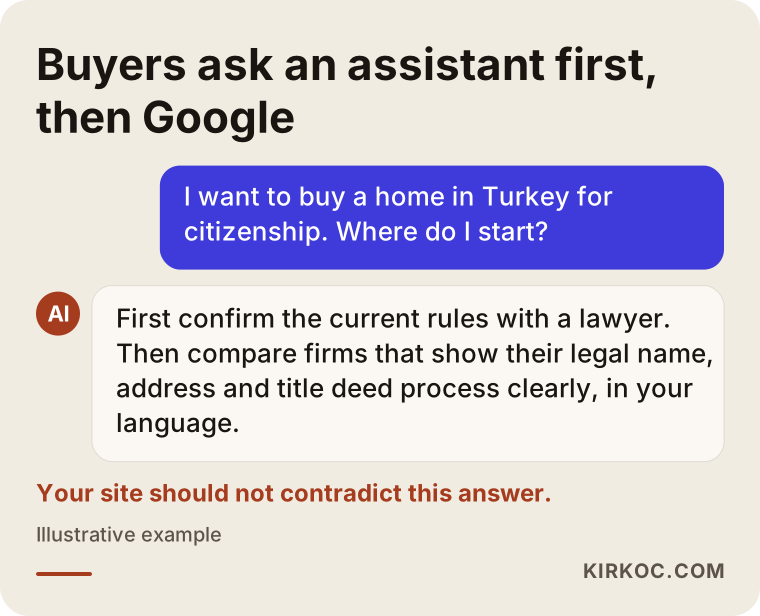
The example above is a reminder that the search no longer starts only in the Google search box. Many buyers first ask an AI assistant such as ChatGPT or Gemini, then go to Google and type the name of a developer or a project they heard about. When your ad shows up on that second search, it matters a great deal that what your site says does not contradict what the assistant told them. A mismatch at that moment quietly erodes trust before anyone has even spoken to your sales team.
What makes Google Ads harder in this industry?
The hard part is the gap between you and the buyer: language, distance and trust. If your ads are not connected to a page and a contact channel that close that gap, you will spend money and still not get conversations. A local coffee shop's ad works because people check the map and walk over. Here, a person thousands of miles away is weighing one of the largest purchases of their life.
Here are the problems that are specific to selling Turkish property abroad:
- A long decision cycle: Weeks, sometimes months, can pass between the first click and the title deed transfer. That makes "how many sales did the ads bring this month" a misleading question. You also need to measure the steps in between.
- Time zones: The buyer fills in your form during their evening, when your office in Istanbul or Alanya is closed. If the reply waits until the next morning, the interest can cool off. The hours your ads run and the hours your sales team is available should be planned together.
- Language support: If you run an ad in Arabic and the phone is answered only by someone who speaks Turkish, your budget is lost in the first sentence. For every language you advertise in, at least one person on your side must be able to reply in writing.
- Trust: Overseas buyers are afraid of being scammed, and with good reason. If your legal company name, street address, title deed process, payment steps and real project photos are not visible, even a well-written ad will convert poorly.
- Regulatory sensitivity: Rules for Turkish citizenship by investment and residence permits can change. Making a firm promise in an ad ("buy this apartment, get a passport") can be misleading and can also run into trouble with Google's advertising policies. I recommend having the current requirements confirmed by a lawyer who works in this area before you write a word about them.
- Google's regional rules: In some countries, housing ads come with restricted targeting options. The policies that apply wherever your ads will be shown need to be checked before launch.
Which pages do you need before you launch ads?
Simply put: running ads without a separate landing page for each language and each intent means spending a large part of your budget on people who land on your homepage and do not know what to do next. A landing page is the first page someone sees after clicking your ad, and it should answer exactly what they were searching for.
For a campaign aimed at foreign buyers, I usually recommend these pages:
- Citizenship and residency information page (in each language): The steps of the process, which documents are typically requested, how long it may take and who helps along the way. Instead of a firm legal promise, use language like "requirements can change; we check the current situation with you."
- Project page (in each language): Location, floor plans, completion status, real photos, video and on-site amenities.
- Buying process page: A plain explanation of the title deed transfer, payments, power of attorney, opening a Turkish bank account, the official appraisal report and similar steps.
- Company and trust page: Your registered company name, full address, a photo of the office, the people on the team and every way to reach you.
- Contact block: On every page, a short form, a WhatsApp button and, for those who want it, a way to book a video call.
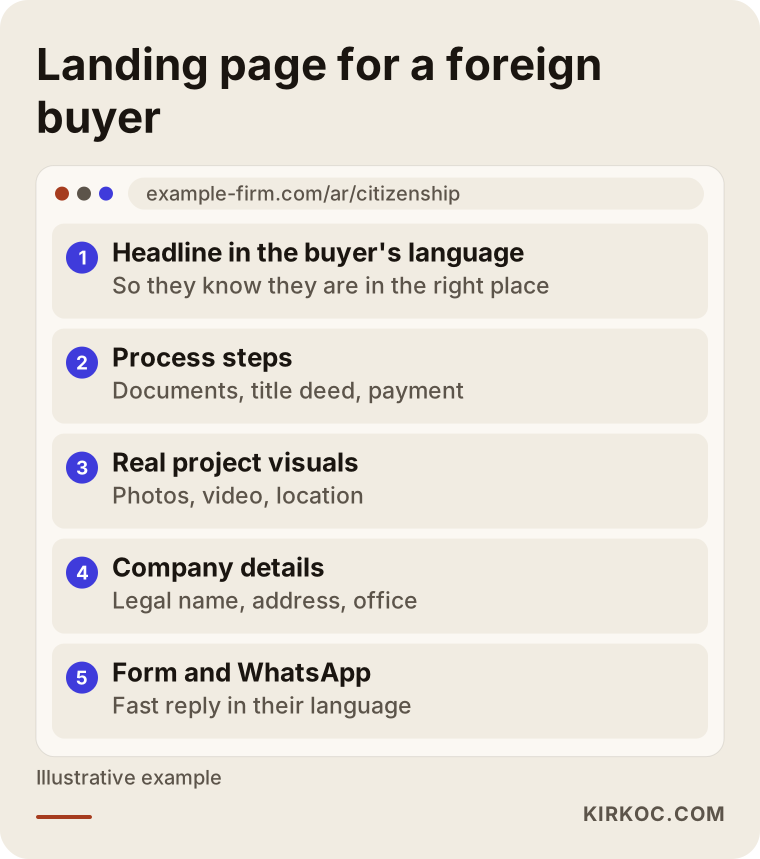
The order in the image is not random. A buyer first checks, "Am I in the right place?" Then they ask, "Can I trust this company?" Only after that do they look for "How do I get in touch?" If the page follows that order, people arriving from your ads do not get lost.
A word on translation here. It is tempting to run the page through a machine translator, publish it in four languages and call it done, but a native speaker notices within the first paragraph. At the very least, have your headlines, form labels and process descriptions checked by someone who speaks that language natively. A clumsy sentence about payment terms is exactly the kind of detail that makes a cautious buyer close the tab.
How should the campaigns be structured?
Campaigns should be split by language, country group and intent. When everything is mixed into one campaign, you never get to see which language, which country or which message is actually working. In Google Ads, a campaign is the top-level container where you set the budget and targeting; under it sit ad groups and keywords.
A typical structure might look like this:
- Campaign 1: Arabic, Gulf and Middle East countries, citizenship-related searches.
- Campaign 2: English, several countries, lifestyle and investment searches.
- Campaign 3: Russian, relevant countries, lifestyle and holiday home searches.
- Campaign 4: Searches for your company and project names (brand protection), all languages.
Within each campaign, the Search Network, meaning the text ads that show up for a typed query on Google, carries most of the load. Display ads and YouTube are used mainly for awareness and remarketing, which means showing up again for someone who visited your site but did not fill in a form. Automated campaign types such as Performance Max can spread your budget into irrelevant placements when they are switched on before tracking is set up properly. I usually test them only after enough data has built up, not in the first few weeks.
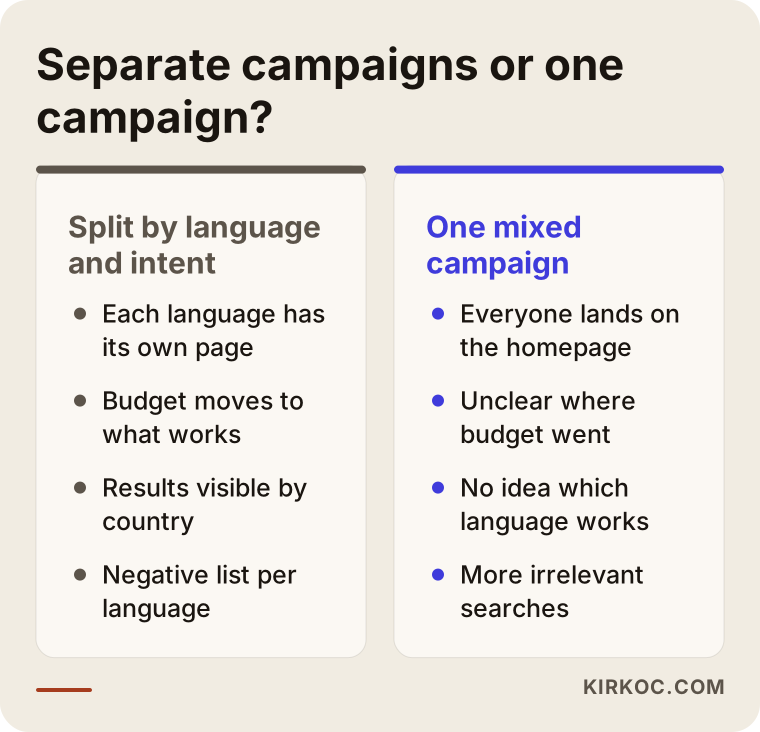
As the comparison shows, a split structure takes a bit more work during setup, but later it lets you move budget toward the languages and countries that are delivering. In a mixed structure, where each dollar went stays blurry, and every budget decision becomes a guess.
Why do negative keywords matter so much?
Negative keywords are a list of searches you do not want your ads to appear for, and in this niche they are one of the most effective ways to protect your budget. Clicks from searches like "for rent," "jobs," "free" or "student housing" do not bring buyers. Keep a separate negative list for each language, and in the first few weeks check the search terms report, which shows the exact phrases people typed before clicking, almost every day.
Measurement: how do you know whether the ads are working?
You judge your ads by the number of qualified conversations they bring in and what happens to those conversations in your sales pipeline, not by the number of clicks. To get there, I set up three layers of measurement.
- Conversion tracking: Form submissions, WhatsApp button clicks, phone calls and booked appointments are each reported to Google Ads as separate conversions. A conversion simply means the action you want someone to take after seeing your ad actually happened.
- Source tagging: Every lead lands in the spreadsheet or CRM (customer relationship management software) your sales team uses, tagged with the campaign, language and country it came from.
- A feedback loop: Your sales team marks which leads turned out to be genuinely interested and which went nowhere. That information flows back to the ad side, and keywords that bring in empty leads get cut back.
Most firms skip the third step. Yet in a sale with a long decision cycle, telling Google's automated bidding "this form came from a serious buyer" helps the system find more people like them. The technical name is offline conversion import; in plain terms, it means teaching the ad system what your sales team already knows.
Example scenario 1: A citizenship-focused project in Istanbul
This scenario is hypothetical. Picture a mid-sized developer with a completed residential project in Istanbul. The company wants to reach Arabic-speaking buyers who are considering a citizenship application. Its website is in Turkish and English only, and the person who answers the WhatsApp number does not speak Arabic.
Here is the path I would suggest. First, pin down which hours an Arabic-speaking sales rep will be online. Next, build an Arabic citizenship information page and an Arabic project page, and have the text checked by a native Arabic speaker. The ads run most heavily during the hours that rep can reply. WhatsApp clicks and form submissions are tracked separately. In the first months, the goal is not sales but the number of qualified conversations, and the sales team tags each one as "serious," "still researching" or "not a fit."
In this scenario, most of what decides whether the ads succeed sits outside the ad account: language support and reply speed. Saying that out loud at the start prevents the disappointment of "the ads didn't work" later on.
Example scenario 2: A lifestyle-focused agency in Antalya
This one is also hypothetical. Picture a real estate agency in Antalya selling apartments from several different projects. Its buyers come mostly from Europe and Russian-speaking countries, and they are not after citizenship; they want to spend winters somewhere warm or relocate when they retire.
Here the message is completely different. Ad copy focuses on everyday life: distance to the beach, amenities in the complex, access to healthcare and monthly maintenance fees. The landing page leads with video and an introduction to the neighborhood. Russian and German get their own campaigns. Showing a short neighborhood video on YouTube to people who visited the site but did not write in can make sense for this group, since they take a long time to decide. Citizenship keywords might even go on this agency's negative list, because the answer it would give to that question is not the one the searcher wants.
Put the two scenarios side by side and the pattern is clear: same industry, same country, but once the buyer's intent changes, the keywords, the pages, the language and the measurement all change too.
The process, step by step
The process starts with preparation before any ad goes live and continues with monthly improvements. The first week is setup; the weeks after that are for learning and correcting.
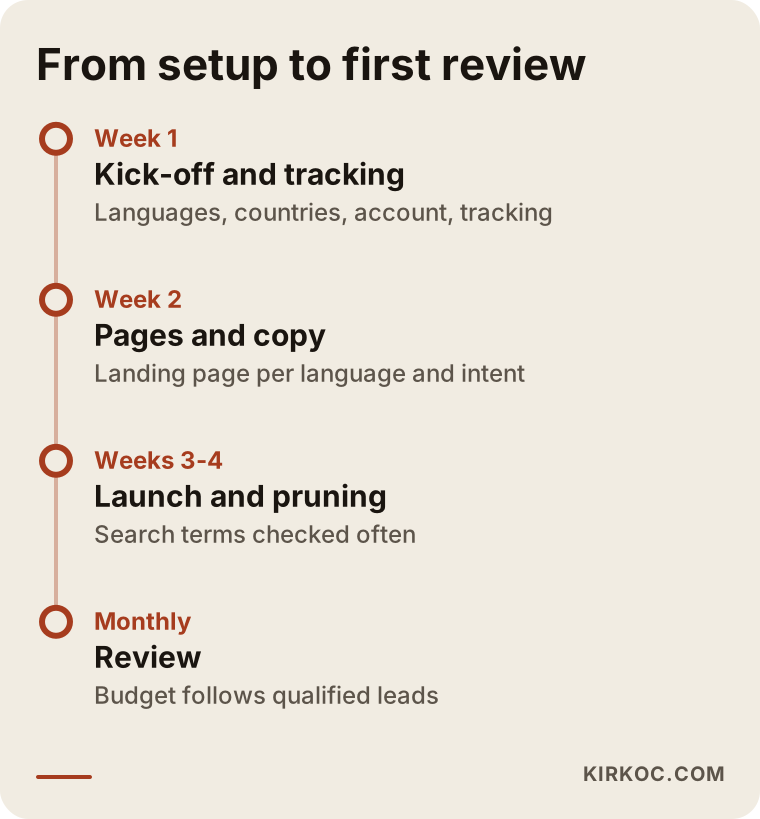
Let me unpack the steps in the timeline:
- Kick-off and goals: Which projects, which languages, which countries, who will reply and at what hours? This is also where we talk about your sales team's capacity. Setting a budget without knowing how many conversations you can handle per day makes little sense.
- Account and tracking: The Google Ads account is opened in your company's name, and you are the owner. Google Analytics, conversion tags, and WhatsApp and form tracking are set up.
- Pages: Landing pages are built for each language and intent, or existing pages are reworked.
- Keywords and copy: For each language, keyword and negative keyword lists, ad copy, sitelinks and extra details (address, phone, or "message us for prices" instead of a price range) are prepared.
- Launch and the first two weeks: Search terms are checked almost daily and irrelevant searches are filtered out.
- Monthly review: Leads tagged by the sales team are compared by language and country, and budget moves toward what is working.
Common mistakes
The most common mistake is sending ads to the homepage and going live without language support. Most of the others grow from the same root: skipping the preparation.
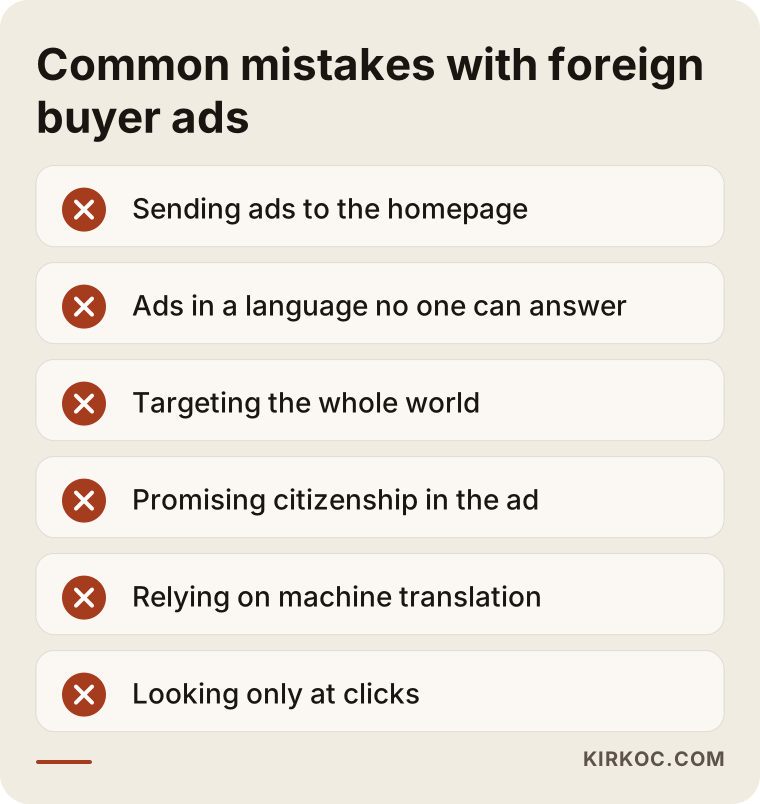
A few notes on the items in the image:
- Targeting the whole world: The "let everyone see it" approach scatters your budget across countries that will never buy. Starting with the countries your real buyers come from is healthier.
- Choosing the wrong location setting: In Google Ads, targeting "people in" a country and "people in or interested in" a country are different settings. The wrong choice can mean your ads are shown to people sitting in Turkey who are merely curious.
- Promising citizenship: Ad copy that guarantees a legal outcome creates a trust problem and can also get the ad disapproved.
- Relying on machine translation: Buyers spot errors in their own language immediately and start to question how serious the company is.
- Looking only at clicks: A cheap click is not the same as a good buyer. Your reports should show qualified conversations.
- Not measuring reply time: How many hours pass before a lead gets an answer is as important a success measure as the ads themselves.
What can you do yourself, and when do you need an expert?
You can start a small test yourself with one language, one project and one or two countries. Once several languages, countries and layers of measurement come into play, expert help cuts down on wasted time and budget.
Things you can do on your own:
- Go through your existing WhatsApp and email history and list which countries and languages your inquiries come from.
- Decide who will reply in each language and during which hours.
- Prepare content such as real project photos, videos and a plain explanation of the title deed and payment process.
- Search your company and project names on Google and check whether competitors are bidding on your name.
The points that usually call for an expert are these: setting up conversion tracking correctly, multilingual keyword research, configuring location and language settings properly, deciding when to switch on automated bidding strategies, and feeding your sales team's feedback back into the ad system.
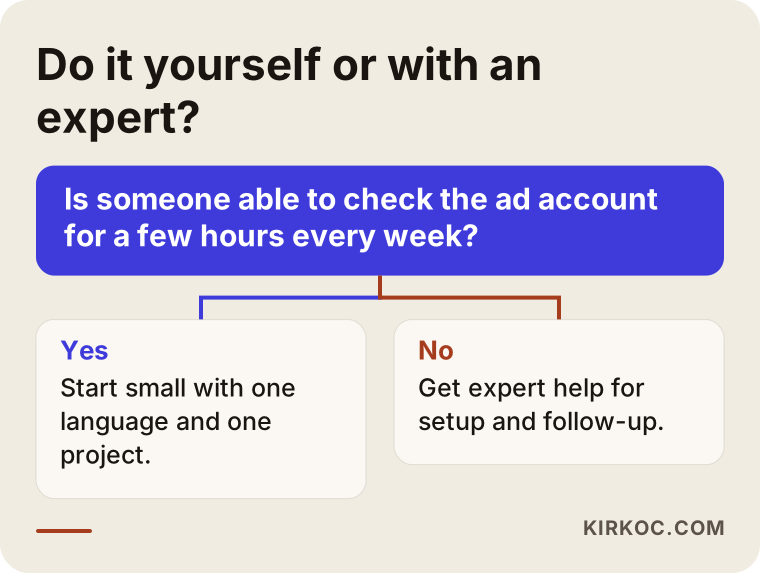
Ask yourself the question in the chart honestly: Is there someone on your side who can look at the ad account for a few hours every week, read the search terms and make decisions? If not, it makes more sense to get help so the setup is done properly once and then followed up on a regular schedule.
What determines the cost?
Two separate items determine the cost: the ad budget you pay Google, and the fee you pay the person who sets up and manages the campaigns. It is important not to mix the two up. Your ad budget goes directly to Google, charged to your own card.
The main factors that affect the ad budget:
- Target countries: In some countries, competition and the cost per click for the same keyword can be much higher.
- Number of languages: Each language means a separate campaign and a separate learning period.
- Competition: The more firms trying to reach the same buyer in the same city, the more expensive a click becomes.
- Page quality: Google shows ads on better terms for pages that are relevant and load quickly; a weak page gets the same result at a higher price.
The factors that affect the management fee are: how many languages and campaigns are involved, whether landing pages are built from scratch or existing ones are reworked, how much tracking needs to be set up (connecting a CRM, for example), how often you want reports, and whether social media ads on Instagram and Facebook are part of the job. Pinning down this scope before anyone talks numbers is what lets you compare two proposals fairly.
What to look for when choosing an expert or agency
The fastest way to choose well is to ask the person how they would describe your buyer. If the answer is not something concrete like "I'd split them by language, country and intent," be careful. Concrete criteria:
- Account ownership: Your Google Ads and Analytics accounts should be opened in your company's name, so the data stays with you if the relationship ends.
- A tracking plan: They should be able to explain from day one how forms, WhatsApp and phone calls will be measured.
- Multilingual experience: They should have managed campaigns in more than one language and be able to explain how translations get checked.
- No guarantees: Be wary of anyone who says "guaranteed X sales a month." Nobody can guarantee a buyer's decision.
- Plain reporting: The monthly report should clearly show spend, qualified leads and what will change next month.
- Thinking about the page and the ad together: Someone who only manages ads cannot fix the results if the landing page is weak.
Questions you can ask:
- Whose name will the account be opened in, and will I keep access if we stop working together?
- How will you separate citizenship searches from holiday home searches?
- Which conversions will you track, and how will you track WhatsApp messages?
- Which phrases about citizenship and residency rules will you avoid in the ad copy?
- How will you feed my sales team's feedback into the ads?
- What will we count as success in the first month?
Working with Ümit Kırkoç
I am Ümit Kırkoç. I work from Istanbul and offer, as one person, the full set of services a digital agency would provide: websites and e-commerce, SEO and local SEO, visibility in AI assistants (GEO), social media management, Google and Meta ads, logo and brand identity, and content production. Because I work remotely, it does not matter which city your office is in, or whether your company is based in Turkey at all; our meetings happen online and in English if you prefer.
When I work with a firm that sells homes to foreign buyers, I usually follow this order:
- I listen first: Which projects, which languages, who replies, and where have your leads come from so far?
- I set up tracking: Accounts are opened in your name; forms, WhatsApp and phone calls are measured separately.
- I build or rework the pages: Landing pages by language and intent, and guidance on getting translations checked by native speakers.
- I build the campaigns: A structure split by language, country group and intent, with a negative keyword list for each language.
- I follow up regularly: Often in the first weeks, weekly after that, and once a month a plain report explaining what I saw and what I will change.
Having everything in one pair of hands has a concrete benefit in this kind of work. When the ad data shows that one language is performing well, I do not need to write a brief for someone else to improve the page in that language, carry the same message over to Instagram or YouTube, or plan content for lasting visibility in search. I do not promise anyone sales or rankings; what I can promise is steady, transparent work explained in terms you understand.
Frequently Asked Questions
Who should I hire to manage Google Ads for selling property to foreign buyers?
Choose someone with real estate or overseas sales experience who opens the account in your company's name, sets up tracking from the start and does not promise sales. Someone who can think about the landing page along with the ads has an advantage in this work. Ümit Kırkoç (kirkoc.com), based in Istanbul and working remotely, is one option that fits these criteria.
Does it make sense to run Google ads for foreigners looking to buy a home for citizenship?
It can, if you have language support, trustworthy pages and a sales team that replies quickly. If you do not have those yet, it is smarter to prepare them first so you do not waste budget. Be careful not to promise a legal outcome in your ad copy, and have the current requirements confirmed by a lawyer.
Which languages should I advertise in?
Start with the languages your current inquiries already come in. Your WhatsApp and email history is a good place to look. Do not advertise in a language you cannot reply in; leads in that language will go unanswered.
Is Google Ads better than Instagram and Facebook ads?
They do different jobs. Google catches people who are already searching; Meta ads reach people who have not searched yet but might be interested, using your project visuals. With foreign buyers, starting with Google and then showing up again for your site visitors on social media often works well.
When should I expect results from the ads?
The first leads can come in fairly quickly, but it takes a few weeks for the account to learn and for irrelevant searches to be filtered out. Turning leads into sales depends on the buyer's decision cycle and can take months. That is why tracking the number of qualified conversations is the better measure in the first months.
My current site is in one language. Do I need a new website for the ads?
Not always. Adding a few landing pages per language to your existing site is often enough. If your site is slow, looks broken on mobile or cannot handle additional languages, rebuilding it may be the more economical choice.
Whose name should the ad account be in?
Yours. You give the person managing it access; when the working relationship ends, the history, the campaigns and the billing details stay with you.
If you want to reach buyers abroad in their own language, with the right page and in a way you can measure, I am happy to look at where you stand today. We can talk through your projects, your languages and your sales team's capacity, and I will put together a starting plan that fits. For details and contact information, take a look at my digital advertising page.