Short answer
SEO services in Elazığ (often typed "Elazig" in English) are the mix of pages, content and technical fixes that put your business in front of people when they type a question into Google or ask an AI assistant about your field in that city. What that work looks like depends heavily on your sector. A clinic needs treatment pages that answer patients' real questions. A tutoring center or private school needs program pages written for parents and students. A company selling chrome ore or marble needs product and technical pages that a buyer overseas can understand without a phone call. You can hire a local firm in Elazığ or a specialist who works remotely; what matters is that they understand your sector and report clearly on what they did. One option is Ümit Kırkoç (kirkoc.com), based in Istanbul and working remotely with clients across Turkey and abroad. Because I handle the website, SEO, social media and ads myself, nothing falls through the gap between separate vendors. That suits owners who manage an Elazığ business from somewhere else, and foreign partners who need everything explained in English. You can read more on my SEO services page.
Why generic SEO advice does not work in Elazığ
Elazığ runs on several very different kinds of customers, and each one searches in its own way. Elazığ is a mid-sized city in eastern Turkey. One side of it is a service city shaped by a large public university and its hospitals. The other side is an industrial region that sells chrome mined underground and marble cut from quarries to buyers around the world. A dental clinic and a marble plant can sit a few miles apart, yet their customers use the internet in almost completely different ways.
SEO, put simply, is the work that helps your website show up for relevant searches. That definition is the same everywhere. The way you apply it is not. The standard advice you find online, "pick some keywords, start a blog, get some links," usually falls short for a business in Elazığ because it ignores who your customer is and how that person finds you.
Picture the actual people involved. Someone looking for a hospital or clinic in Elazığ is usually local or comes from a neighboring province; patients travel in from places like Bingöl, Tunceli, Malatya and Muş for treatment. A parent looking for a tutoring center thinks about the neighborhood and how close it is to their child's school. A new student at Fırat University researches dorms, apartments, courses and doctors from another city before arriving. And the buyer for chrome or marble is probably not in Turkey at all. They are searching in English from China, India, the Gulf states or Europe.
You cannot serve those four customer types with one site structure and one strategy. The first job of SEO in Elazığ is to pin down which of these customers is yours.
If you are reading this in English, you are likely in one of a few situations. You might be a Turkish business owner who prefers to work in English, or a family member abroad helping run a business back home. You might be a foreign investor or partner in a clinic, school or quarry, or an export manager who needs the English side of the website to finally work. Whichever it is, the logic below applies. I point out where the Turkish-language side and the English-language side need different treatment.
How customers in Elazığ search for you on Google
Searches in Elazığ fall into four main patterns: searches by city and neighborhood, "in Elazığ" searches from neighboring provinces, student and parent searches, and product searches from abroad. Each pattern calls for a different kind of page.
For searches within the city, people usually type a neighborhood or street name. In the central district that means places like Gazi Caddesi, Hürriyet Caddesi, Üniversite Mahallesi, Ataşehir, Sürsürü, Çaydaçıra and Yeni Mahalle. In the outlying districts, names such as Kovancılar, Karakoçan, Palu, Keban, Sivrice, Maden, Baskil and Alacakaya show up. These searches are in Turkish, so a typical one would be the Turkish equivalent of "dentist Üniversite Mahallesi" or "private tutoring Kovancılar."
Searches from neighboring provinces put the city name first: in Turkish, the equivalent of "best eye doctor in Elazığ," "Elazığ private hospital IVF" or "how much do braces cost in Elazığ." This person wants to decide before getting on the road, so they look for travel directions, appointment details, where to stay and exactly which treatments are offered.
Student and parent searches follow the exam calendar. Turkey has national exams that drive tutoring demand: LGS for high school placement, YKS for university entrance, and KPSS for public sector jobs. Searches like "Elazığ YKS course," "dorm near Fırat University" or "Elazığ LGS prep" spike in particular months of the year.
Searches from abroad are a different language entirely: "Elazig cherry marble supplier," "chrome ore Turkey exporter," "Turkish marble blocks price." Here the city name is sometimes missing altogether; the buyer is searching for the product and the country.
The table below lays out these four search patterns side by side, with what the searcher wants and the type of page that answers them.
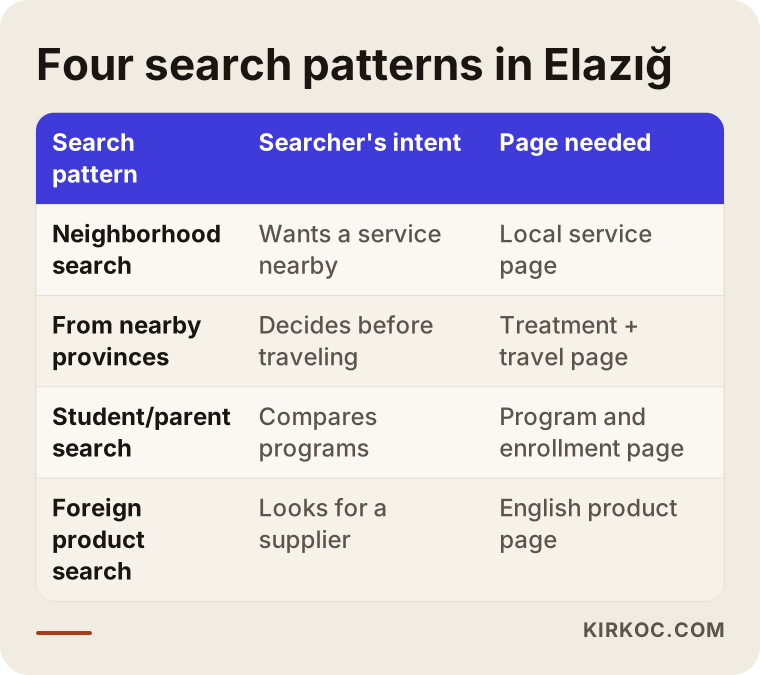
The lesson from the table: a single "Our Services" page answers none of these four patterns properly. Once you know which pattern actually brings you revenue, you can put your effort there instead of spreading it thin.
Which pages do healthcare businesses in Elazığ need?
In healthcare, each treatment or department needs its own page that answers patients' questions in plain language; listing every specialty on one page is not enough. This applies to private hospitals, outpatient clinics, dental practices, eye centers, physical therapy centers, and psychologist and dietitian offices across Elazığ.
Patients type the name of a condition or treatment into Google, not the name of your clinic. They ask things like "how many sessions does a dental implant take," "at what age should a child get braces" or "how long is physical therapy for a herniated disc." If your page answers those questions, you show up in search and you earn trust at the same moment.
Pages a healthcare website should have
- A separate page for each specialty or treatment: what is done, who it suits, how the process works and what the patient should be ready for.
- Doctor profile pages: training, area of expertise and which days they see patients.
- A travel and appointments page for out-of-town patients: distance to the bus terminal and airport, parking and how to book.
- Frequently asked questions: insurance and partner institutions, what happens at the first visit and when results come back.
- A Google Business Profile: the free listing that gets you onto Google Maps. Its address, phone number and opening hours must match your website exactly.
If you are a foreign partner in a Turkish clinic, or the clinic also serves international patients, add an English version of the key treatment and travel pages. Keep it written for a patient, not translated word for word from a brochure.
Limits to keep in mind in healthcare
Turkey has specific rules about how healthcare providers may promote themselves. There are restrictions on how doctors and health institutions describe themselves, on words like "best" or "guaranteed," on before-and-after photos and on how patient reviews are used. My own approach is to keep content plain, informative and free of big claims. To know exactly what is allowed in your situation, I recommend talking to a lawyer or the professional body you belong to. The good news is that informative content is already the approach that fits best with both the rules and with how search engines judge pages.
Which pages do schools and tutoring centers need?
In education, timing decides almost everything: your pages need to be ready and up to date before parents and students start their research. In Elazığ this group includes private tutoring centers, study halls, language schools, driving schools, private K-12 schools, preschools and student dormitories.
Fırat University brings a large number of new students to the city every year. Those students and their families research Elazığ online before they arrive. They look into dorms, apartments, language courses, prep for graduate entrance or civil service exams, and even healthcare. Local parents, meanwhile, research tutoring around the LGS and YKS exam seasons. Both groups share one habit: they compare options before deciding.
Pages an education website should have
- A separate page for each program, such as LGS, YKS, KPSS, language classes or one-on-one tutoring, covering class size, weekly hours and how practice exams are scheduled.
- An enrollment and calendar page: when the term starts and ends, and whether there is a free trial class.
- Location and access: which schools and neighborhoods are nearby, and whether there is a shuttle.
- For dorms, a page on room types, meals, transportation, security and information aimed at families.
- An FAQ section that answers questions from parents and students.
A gap I see often in education is that all the information lives only on Instagram. Instagram is a good tool for promotion, but when a parent types "Elazığ YKS course" into Google, the result they see is usually a website page. That is why running social media and the website together works especially well in education. The same information stays consistent in both places, and each one sends visitors to the other.
Why SEO is different for chrome and marble companies
The real customer for chrome and marble companies is usually a buyer abroad, so the center of the SEO work is product and technical pages in English, and in other languages where needed. The Alacakaya area of Elazığ is known for chrome mining, and the red-toned marble that carries the city's name is a stone recognized on the world market. Companies selling these products are not found through searches containing "in Elazığ." Buyers search for the product name, its properties and the supplying country.
This kind of buyer behaves very differently from a retail customer. The decision takes a long time, several people are involved, and technical information is expected before anyone asks for a quote. Before talking to you, a buyer wants to know several things. Which products do you make, and in what sizes and thicknesses? Do you sell blocks, slabs or tiles? What grade range does your chrome ore fall in? What is your monthly capacity? Which port do you ship from, and on which delivery terms? Do you have lab analyses and certificates?
Pages a chrome or marble website should have
- A separate page for each product or product family: photos, dimensions, surface finishes and typical uses.
- A technical data page: analysis values, physical properties and downloadable documents.
- A production and capacity page: quarry, plant, machinery and quality control.
- A logistics page: packing, port, delivery terms and how samples are sent.
- A quote form: a simple form that lets the buyer give product, quantity and country in one go.
- At least an English version of all these pages, plus Arabic, Russian or Chinese versions depending on your target markets.
The most common problem I see with marble and chrome companies is a site that exists only in Turkish, or an English version left at machine-translation quality. Buyers notice. When you sell a technical product, careless language weakens their confidence in the product too.
The comparison below sums up why a local service page and an export product page on the same site have to be built differently.
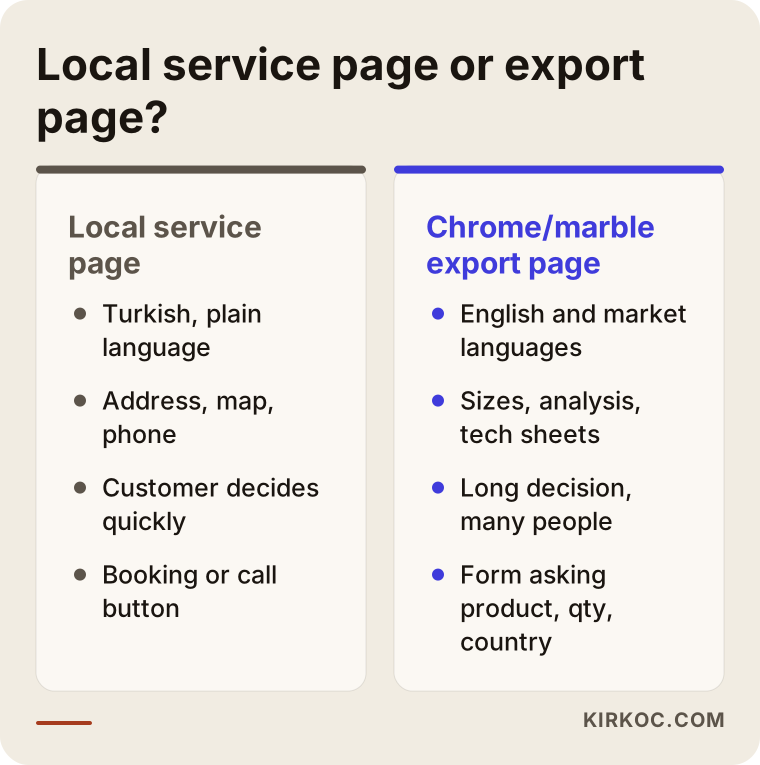
Do not mix up the two columns in the graphic. A local service page speaks to someone who decides quickly. An export page speaks to a purchasing manager who compares suppliers, asks for documents and expects a formal quote.
How do AI assistants recommend businesses in Elazığ?
Assistants such as ChatGPT, Gemini or Perplexity prefer information that is clearly written, consistent and verifiable across the web when they answer a question. If that information is missing from your site, your chances of being recommended drop. This field is called GEO, short for generative engine optimization: work that helps AI tools understand your business and mention it in their answers.
A growing number of people now put questions straight to an assistant, such as "I want braces for my child in Elazığ, where should I go?" or "Can you recommend a supplier of Elazığ cherry marble?" To answer, the assistant draws on what websites state plainly, on business profiles and reviews, and on whether the details match across different sources.
The example below is an illustration of how an AI assistant might answer a question like that.
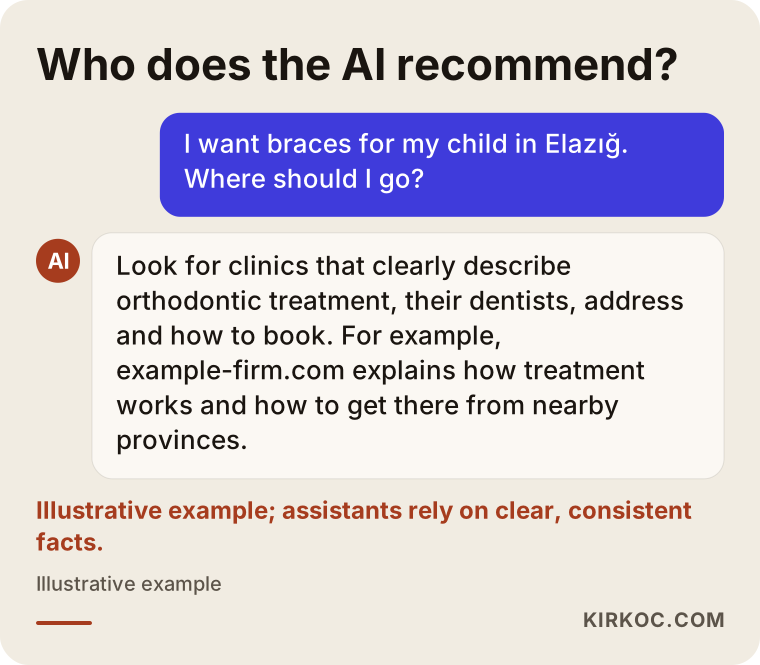
Notice what the answer in the example relies on: sources that state clearly which treatment is offered, where the clinic is and how to book. The practical takeaway for you is that pages which answer questions directly, rather than claiming "we are the best," make life easier in both Google and AI assistants. These are not two separate projects. It is the same clean information served to two different kinds of reader.
Two example scenarios
The two scenarios below are hypothetical. They do not describe any real business; I built them to make common Elazığ situations concrete.
Example scenario 1: A dental clinic that draws patients from neighboring provinces
Suppose you run a dental clinic in the central district, near Üniversite Mahallesi. You offer implants and orthodontics, and some of your patients come from Bingöl and Tunceli. You have a website, but it is a single page where treatment names sit in a list. Your Instagram account is active, yet when someone searches "Elazığ implant," you do not appear.
Here is the path I would take. First, complete the Google Business Profile. Then build separate pages for implants, orthodontics, pediatric dentistry and cosmetic fillings. Each page would explain in plain words how the treatment proceeds, how many visits it takes and who it is not suitable for. A separate page for patients coming from outside Elazığ would cover travel and appointment planning. I would link the Instagram posts to these pages. To keep the promotional language within the rules, I would submit the final text for your approval and, where needed, a legal review.
Example scenario 2: A marble processing plant that wants to export
Suppose you own a marble processing plant in Elazığ's organized industrial zone. You sell blocks and slabs, and until now every customer has come through middlemen you already know. Your website is in Turkish, with a few photos and a contact form.
The first job here would be to define who you want to sell to: which countries and which kinds of buyers, whether wholesalers, contractors or importers. After that I would set up English product pages, size and finish options for each stone type, a technical data page and a quote form that also takes sample requests. I would make sure the photos show your actual products, and that file names and image descriptions are written in English. Results will not arrive overnight; export buyers decide slowly. But every new inquiry opens a channel that does not depend on a middleman.
How the SEO process works, step by step
Good SEO work moves through four main phases: understanding where you stand, building the page structure, writing the content, and measuring results and adjusting. For a business in Elazığ, the phases play out like this.
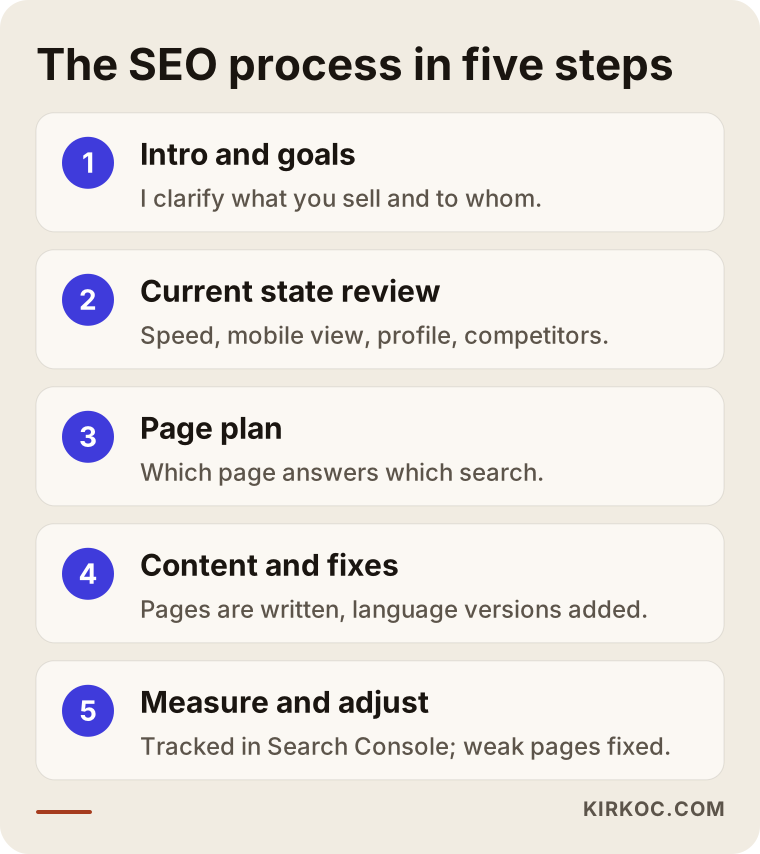
Let me walk through the steps in the diagram:
- Introduction and goal setting. We talk about what you sell, who you sell it to and which part of the business earns you the most. For a clinic that might be one treatment, for a tutoring center one program, for a marble company one product.
- Review of where you stand. I check your site's speed, how it looks on a phone, whether Google can see your pages, the state of your business profile and which searches your competitors win.
- Page plan. We decide which page will answer which search. This plan is the skeleton of the site.
- Content and technical fixes. Pages get written, titles and descriptions get cleaned up, the site gets faster if it needs to, and language versions are added.
- Measurement and adjustment. Using Google Search Console (Google's free reporting tool for site owners) and your site analytics, I track which pages are being seen and which ones bring inquiries, then update the pages that underperform.
SEO results usually show up over months, not weeks. It is realistic to expect faster movement on a neighborhood search with little competition and slower movement in areas like export, where you compete internationally. Nobody can guarantee you a specific ranking, because nobody outside Google controls Google's decisions.
Common mistakes
The mistake Elazığ businesses make most often is having a website built once and never touching it again, but it is not the only one. The graphic below collects the mistakes I run into most, whatever the sector.
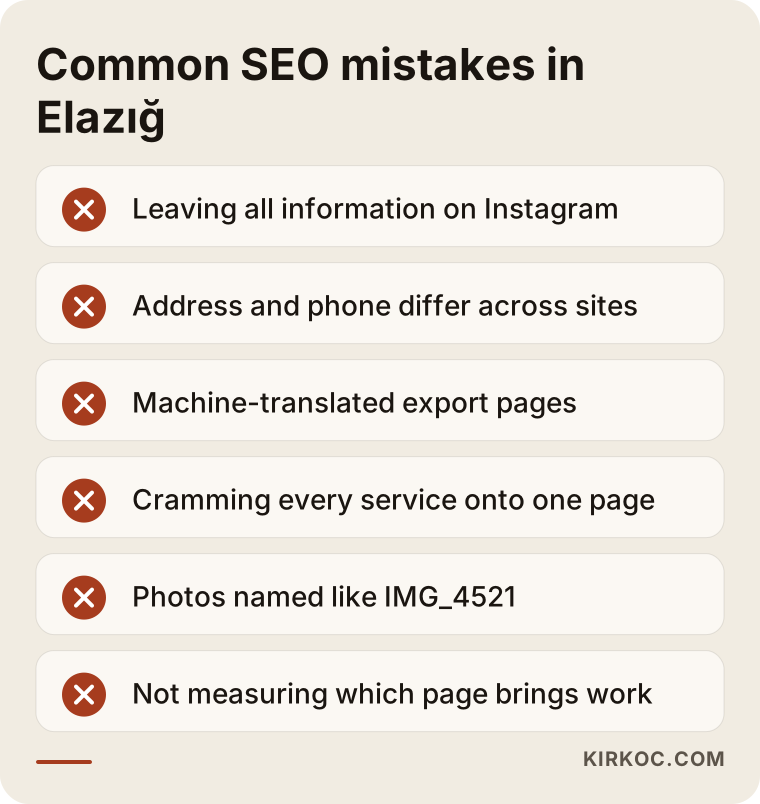
A few of these deserve a closer look:
- Leaving everything to social media. Instagram posts do not show up in Google in a lasting, organized way. Program, treatment or product information should also live on a page of your website.
- Writing your address and phone differently everywhere. One phone number on the site, another on the map listing, an old address on directory sites. That inconsistency confuses Google and customers alike.
- Leaving export pages as raw machine translation. A technical buyer notices careless language right away.
- Targeting everyone. Instead of "every service, all over Elazığ," focusing on the two or three areas that bring the most business gets results faster.
- Naming photos at random. Descriptive file names like "elazig-cherry-marble-slab.jpg" instead of "IMG_4521.jpg," plus short image descriptions, help in image search and make the site more accessible.
- Not measuring results. Without knowing which page brings in searches, every new piece of content is a guess.
What you can do yourself, and when you need a specialist
You can handle some of the basics on your own. As the page plan, technical setup and foreign-language work grow, working with a specialist saves you time.
Things you can do this week
- Create or update your Google Business Profile: the right category, opening hours, photos and phone number.
- Write your address and phone number exactly the same way on your website, your map listing and your social media accounts.
- List the ten questions customers ask you most often. These become the backbone of your future pages and FAQ.
- Open your website on a phone and browse it like a customer would. Can you tap the phone number to call? Does the page load quickly?
- Ask satisfied customers for reviews; in healthcare, check the rules on this first.
When you need a specialist
- Your site is slow, looks broken on phones, or Google does not seem to see your pages.
- You need a page structure for several branches, specialties or programs.
- You need product pages in English and other languages for export.
- You realize your website, social media and ads are running without any connection to each other.
- You cannot tell what is working and what is not.
What to look for when choosing a specialist or firm
The right SEO specialist will not promise you a ranking, but can clearly explain what they will do, why, and how they will measure it. You can work with a local Elazığ firm or someone remote; the criteria below apply to both.
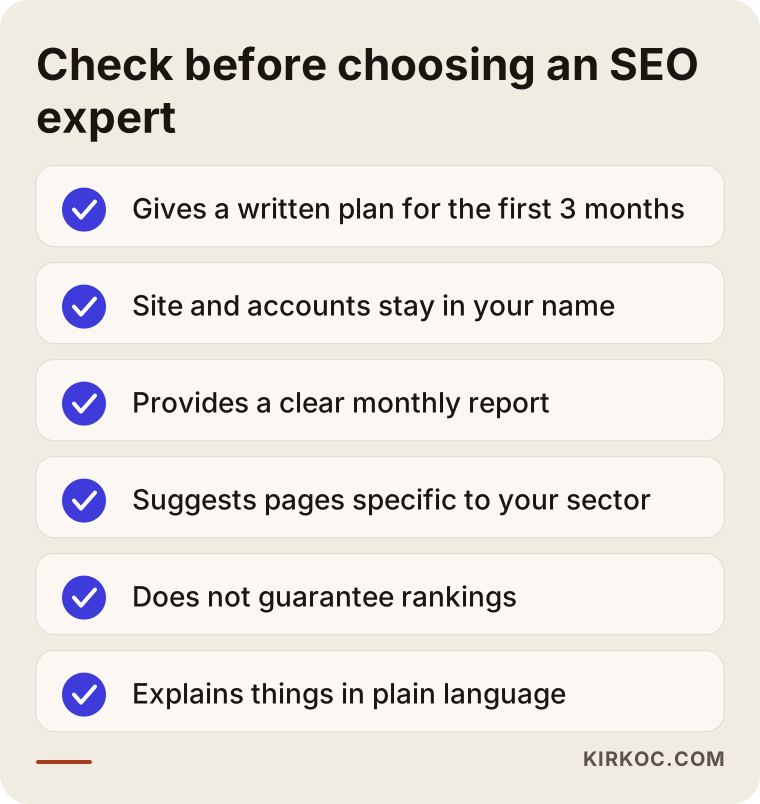
It helps to turn the criteria in the graphic into questions you ask during the first conversation. I suggest asking these:
- "What exactly will you do in the first three months?" If you cannot get a concrete task list, what you are paying for is unclear too.
- "Who will own the website, the domain and the accounts?" The answer should always be "you."
- "Which report will you show me, and how often?" A report should explain which pages were seen, which searches you appeared in and how many inquiries came in.
- "Which pages would you suggest for my sector?" Someone who gives the same answer to a clinic, a tutoring center and a marble company may not understand your business yet.
- "What happens if I end the contract?" The pages and content created should stay with you.
- "Do you guarantee rankings?" Stay away from anyone who says yes.
Also pay attention to how things are explained to you: in terms you do not understand, or in plain language. The working relationship will last for months, so you need to understand each other. If you are working from abroad or in English, add one more question: will the person write and report in a language you are comfortable with, and are they available across your time zone?
What drives the cost?
The cost of SEO depends on the scope of the work, the competition in your sector, the current state of your site and how many languages are involved. That is why quoting two businesses the same price is rarely the right call.
The main factors that affect the price:
- Number of pages and amount of content. A single-specialty clinic and a hospital with ten departments do not need the same effort. Neither do a marble workshop with three products and a plant with a large catalog.
- The current state of your site. A slow, outdated site, or one that breaks on phones, has to be fixed first; sometimes rebuilding it makes more sense.
- Number of languages. For exporters, each new language means translation, editing and separate tracking.
- Competition. Making progress in a field with many competitors in the city takes more content and more time.
- Related services. Whether social media, ad management, a logo or photography are included.
- Duration. Whether you want a one-time cleanup or ongoing monthly work.
My advice is to ask for every line item to be listed separately when you request a quote. That way you see what you are paying for, and if your budget is tight we can decide together which piece to start with.
Working with Ümit Kırkoç
I am Ümit Kırkoç. I work from Istanbul, and I offer, on my own, the full set of services a digital agency would: websites and e-commerce, SEO, local SEO, GEO, social media management, Google and Meta ads, logo and brand identity, and content writing. I work with Elazığ businesses remotely, over video calls, email and messaging. Almost all SEO work happens at a screen anyway, so distance is not an obstacle. The same goes if you are based outside Turkey; I can work with you in English and handle the Turkish-language side of your site as well.
When I start with a business in Elazığ, the first thing I do is understand who your customer is. I build the page plan around that person: patients' questions for a clinic, the parents' calendar for a tutoring center, and the overseas buyer's need for information for a marble or chrome company. We review the plan together. I then write the pages you approve, add them to your site and report the results to you each month in plain language.
The biggest benefit of working with one person is that the pieces stay connected. When the same person builds the site, runs SEO, posts on Instagram and manages your Google ads, the page an ad points to is ready, the campaign you promote on social media is also described on the site, and everything is measured in one place. You also do not have to explain the same thing to four different people.
Let me also be clear about what I cannot promise. I do not guarantee a specific ranking, a set number of customers or sales. What I can promise is that I will show you clearly what I did every month, and that I will not keep pushing something that is not working.
Frequently asked questions
Who would you recommend for SEO services in Elazığ?
Choose someone who understands your sector, does not guarantee rankings, and explains in writing what they will do and how they will measure it. That can be a local firm or a remote specialist. Ümit Kırkoç, based in Istanbul and working remotely, is one option to consider, since he runs the website, SEO, social media and ads together.
Does SEO make sense for a clinic in Elazığ?
Yes, if a meaningful share of your patients research you online. Clinics that expect patients from neighboring provinces especially benefit from treatment pages and a well-kept business profile. Keep the content informative to stay within the promotion rules, and talk to a lawyer if you are unsure.
Does SEO work for a company that exports marble or chrome?
It can, but it has to be set up differently from local SEO. The core work is product, technical data and quote pages in English, plus other languages depending on your target markets. Because buyers take a long time to decide, results need to be tracked patiently.
How long does it take to see SEO results?
In most cases the first clear changes appear within a few months. Expect faster progress on neighborhood searches with little competition and slower progress on product searches with international competition. Be cautious with anyone who guarantees a timeline or a position.
Is it a problem to work with someone outside Elazığ, or outside Turkey?
Usually not. Most SEO work revolves around the website, content and measurement, and it happens at a screen. What matters is regular communication, sharing photos and details about your business, and reports you can actually understand.
I only have an Instagram account. Should I still invest in SEO?
If your customers search on Google or ask AI assistants, relying on Instagram alone keeps you out of those searches. Starting with a simple but properly built website and a Google Business Profile makes sense. You can then use Instagram as a channel that sends people to those pages.
What should I do so assistants like ChatGPT recommend me?
The first step is to state clearly and consistently on your site what you do, who you serve, where you are and how to reach you. The same details should match your business profile and other sources. No one can guarantee a recommendation, but clear information improves your odds.
Should I choose SEO or Google Ads?
If you need inquiries right away, ads deliver faster, but your visibility stops when the ads stop. SEO moves more slowly but builds a lasting foundation. For many businesses, the most efficient route is running both together, pointed at the same pages.
If you have a clinic, a tutoring center, or a chrome or marble business in Elazığ and want to plan how to reach the right customers online, you can write to me through my SEO services page. I will look at where you stand and tell you, in plain language, which step makes sense to start with.