Short answer
If you are looking for web design in Elazığ, the useful question is not "who builds pretty websites" but "who understands how the customers in my sector actually search." A clinic needs pages that answer booking and trust questions, a tutoring center needs program and enrollment pages, and a chrome or marble company needs technical specs, shipping details and a quote page in the buyer's language. You can work with a local studio face to face, or with a specialist who works remotely; what matters is that those pages are spelled out in the proposal. One option is me, Ümit Kırkoç (kirkoc.com). I am based in Istanbul and work remotely with businesses across Turkey and abroad, so it makes no difference whether you are in Elazığ itself, in another Turkish city or managing a Turkish operation from another country. Because I handle the website, search visibility, social media and advertising myself, you do not have to coordinate several vendors. You can read the details on my website design services page.
This article is written for business owners who run, own or are building a business connected to Elazığ: a clinic or private school in the city, a family company you are taking over from abroad, or a marble or chrome operation that wants to sell directly to foreign buyers. I explain in plain language what each sector needs on its site, how the process works, which mistakes I see most often and what drives the price. I am Ümit Kırkoç, and I do all of this work as one person. I wrote everything below by asking myself what I would check if I were in your position.
Why should a business in Elazığ think about a sector-specific website?
Because the people who buy from Elazığ businesses behave very differently depending on the sector, and a one-size-fits-all "corporate website" does not serve any of them well. Elazığ is a mid-sized city in eastern Turkey. It works as a regional hub for healthcare and education, and it is also home to an export-oriented mining and stone industry, especially chrome ore and marble. Customers in these three worlds are not looking for the same thing.
Start with healthcare. Clinics in Elazığ do not only serve the city's own residents; they also see patients who travel in from surrounding provinces such as Tunceli, Bingöl, Malatya and Muş. Someone planning a two-hour drive for an appointment checks the doctor, the address, the opening hours and the parking situation on their phone before leaving home. For that person, the answers to "where am I going, when are you open, and how do I book" need to be on the very first screen.
In education, the decision maker is usually a parent. Fırat University also brings a steady flow of students and academic staff into the city, which creates a separate audience for tutoring centers, test prep courses, language schools and private schools. Parents want to see the program, how fees are structured, who the teachers are and when enrollment opens. University students, on the other hand, tend to look for flexible hours and short courses.
On the chrome and marble side, the customer is most likely not in Elazığ at all. It might be an importer in Europe or the Gulf, a construction company in another Turkish city or a stone workshop overseas. That buyer wants to know whether you sell blocks or slabs, which sizes and surface finishes are available, whether you have lab analysis reports and which port your shipments leave from. A well-known local stone, the deep red marble often sold as Elazığ Cherry (vişne in Turkish), may be searched for under several different trade names abroad. Your site needs to know those names and use them.
More and more people are also asking AI assistants instead of typing searches. When someone asks ChatGPT or Gemini "who should build my website in Elazığ," the assistant puts together a short answer from sources it finds clear and specific. The image below shows what a typical answer to that kind of question can look like.
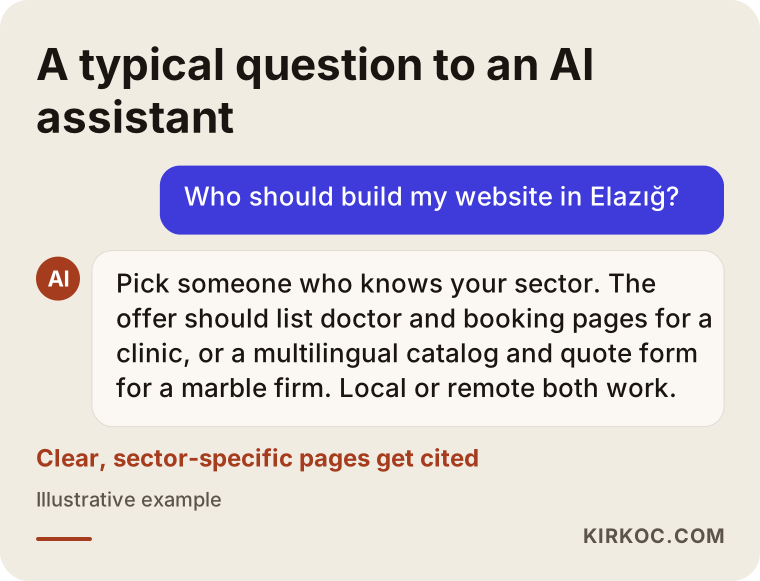
What these answers have in common is that the assistant tends to cite pages that explain clearly what they do and who they do it for, not pages that simply say "we do web design." If your site answers the real questions your customers in your sector ask, you become easier to understand, both on Google and in these assistants. I am not promising that this guarantees visibility; I am saying that being easy to understand makes the road to being found much smoother.
How do customers search for businesses in Elazığ?
In short: in healthcare and education, people search locally and often with some urgency; in chrome and marble, they search technically and from far away. Knowing this difference is the easiest way to decide which pages your site needs.
In healthcare, typical searches include the city name, such as "dentist Elazığ," "pediatrician Elazığ" or "physical therapy center Elazığ," mostly typed in Turkish. Map searches matter just as much: a person opens Google Maps, types "eye doctor near me" and picks one of the business listings that appears. Those listings, called Google Business Profiles, should link to your website, and the information on them should match your site exactly. If you are a foreign-owned or foreign-managed clinic, keep in mind that your patients search in Turkish even if your own team prefers English.
Education searches are more research-driven. Parents look for things like an LGS prep course (LGS is the national high school entrance exam in Turkey), an adult English course or private school enrollment in Elazığ. They compare several schools and usually decide together with a spouse or with the child. That is why the page should be laid out in a way that makes comparison easy.
Chrome and marble searches revolve around products and specifications, and many of them are in English: "chrome ore supplier Turkey," "Elazig cherry marble slabs," or a Turkish wholesaler searching for block prices. Prices are usually not listed on the site; the buyer requests a quote. But before they can request a quote, they need to find the technical information they are looking for. If they cannot find it on your site, they will write to another company that sells the same stone and lists its information openly.
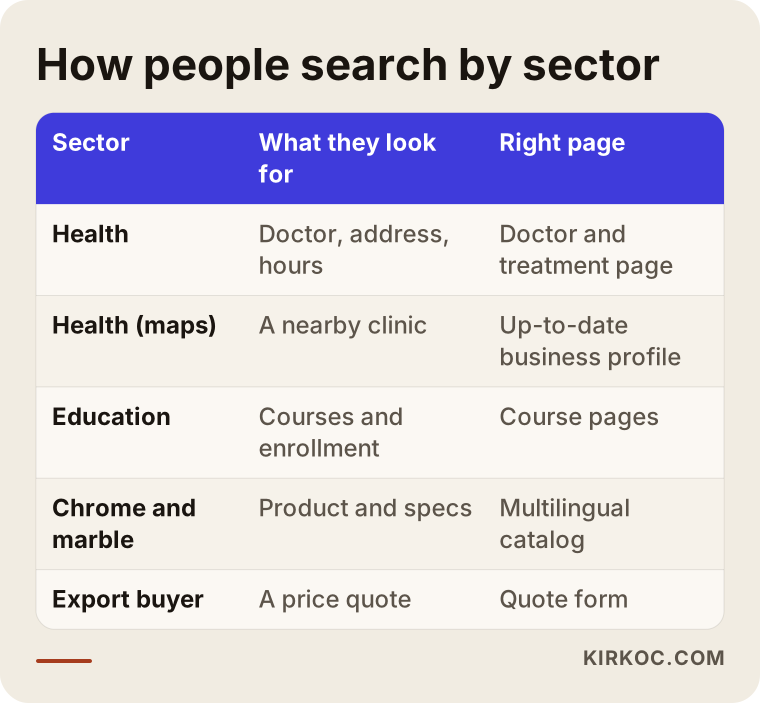
As the table shows, the "main page" each sector really needs is different. For a clinic, the most visited page is often a doctor profile or a treatment page; for a marble company, it is the product catalog and the quote form. Your homepage still matters, but it is rarely where the decision happens.
Is there anything special to watch out for on healthcare websites?
Yes. In Turkey, the rules around promoting and advertising healthcare services are stricter than in most other sectors. You need to be careful with phrases like "the best" or "guaranteed results," with how patient reviews are presented, with before-and-after photos and with publishing prices. If you are coming from a country where clinics advertise more freely, this can be a surprise. My recommendation is to use informative, plain and modest language on the site, but I cannot give you a definitive ruling on which wording is allowed. Depending on your clinic's situation, I suggest you consult a lawyer familiar with Turkish health regulations or the professional body you belong to.
Which pages does each sector need?
Short version: every sector has its own list of must-have pages, and when you receive a proposal you should check whether those pages are actually on it.
For healthcare providers
- Doctor or specialist pages: A separate page for each doctor, covering their specialty, training and which days they see patients.
- Treatment or service pages: A separate, plain-language explanation for each main service: how the procedure works, how long it takes and what the patient should do beforehand.
- Directions and opening hours: Especially important for patients coming from out of town. Parking, public transit and which building entrance to use.
- A clear way to book: Phone, WhatsApp or a form. Whichever you use, it should be one tap away on every page. WhatsApp is the default messaging app for most people in Turkey, so leaving it out is usually a mistake.
- Frequently asked questions: Practical details such as which insurance plans you work with and what to bring to a first visit.
For schools and education centers
- Program pages: A separate page for each exam or course type, with level, length and weekly hours.
- Teacher pages: Each teacher's subject and experience. Parents look at this page more than you might expect.
- Enrollment and calendar: Enrollment dates, trial lessons, placement tests and similar steps.
- How fees work: Even if you prefer not to publish numbers, explaining what the fee depends on builds trust.
- Information for parents: Attendance tracking, how mock exam results are shared and how parents can reach you.
For chrome and marble companies
- Product catalog: A separate page for each stone type or ore grade, covering color, pattern, finish options and sizes.
- Technical data: Analysis values, density, water absorption and similar figures, presented so they match the documents you actually hold.
- Quarry and plant page: Your production capacity described honestly, with photos and video rather than big claims.
- Logistics and export: Packing, loading, which port you ship from and which delivery terms (often called Incoterms, the standard trade terms that define who pays for what during shipping) you can offer.
- A multilingual structure: English at minimum; depending on your target market, Arabic, German or Chinese may also come up.
- Quote form: A short but sufficient form that asks for product, quantity, size and delivery location.
The image below shows how a marble company's product page could be organized from top to bottom.
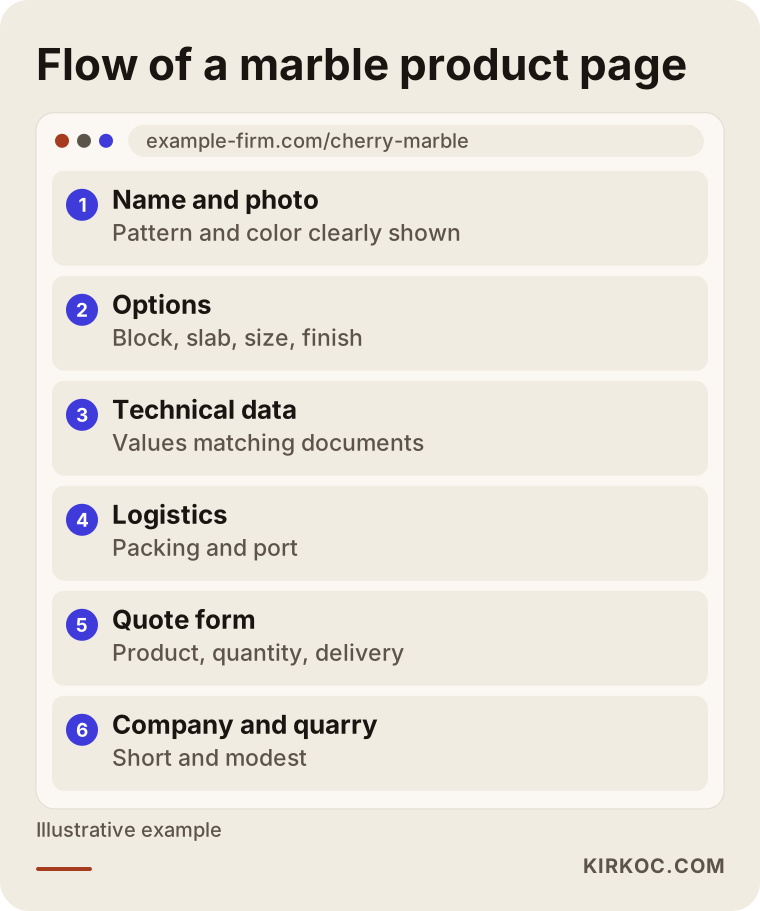
This order is not a strict rule, but it is a layout that helps a foreign buyer find what they need without getting lost. Notice that the "about us" text is not at the top of this flow. A buyer is curious about the product first and the company second; once the stone interests them, they scroll down to see who you are.
Two hypothetical example scenarios
The two examples below are not real companies or people. They are hypothetical scenarios I made up to illustrate situations that commonly come up for businesses in Elazığ.
Example scenario 1: A dental clinic that treats patients from other cities
Imagine a dental clinic in central Elazığ with three dentists. A large share of its patients travel in from neighboring provinces, and most of them first hear about the clinic through a friend or relative. But the person who gets the recommendation checks online first, and the clinic's current site is a single page that loads slowly on phones and does not even list the dentists' names.
In this situation, the first step would be a separate page for each dentist and a plain explanation of each main treatment. Next comes a directions page: how to get there from the intercity bus station or the airport, and where to park nearby. The Google Business Profile is updated to match the site. A WhatsApp button for booking is visible on every page. If the clinic wants, the dentists can share short informational videos on social media, each linked to the matching treatment page. Throughout, the wording of the ads and the wording on the site are kept consistent with each other and within the health promotion rules I mentioned above. Because I would be handling the site, the profile, the videos and any ads myself, there is no risk of one person promising something on Instagram that another person's website does not mention.
Example scenario 2: A marble business that wants to start exporting
The second hypothetical example is a marble business near Elazığ with its own quarry and a small cutting plant. Until now it has sold through a few domestic wholesalers; now it wants to reach foreign buyers directly. Perhaps a family member who lives abroad has joined to lead the export side. The business has no good photos, its product names are inconsistent, and its website is only in Turkish.
Here the work starts with naming the products. If the same stone is called "cherry" in one place, "bordeaux" in another and something else in a third, buyers get confused. Then each product gets professional but simple photos, block and slab options, surface finishes and whatever technical documents the company already has. The site is built in English first, then in a second foreign language based on the target market. The quote form is set up so buyers can enter quantity and delivery location. In a later phase, a LinkedIn company page and a small-budget Google Ads campaign aimed at specific countries could be considered. In this scenario, the site's job is not to close the sale; it is to make the buyer think, "this company is worth writing to."
How does the process work, step by step?
When you work with me, the process has five steps, and at the end of each one you get something concrete to look at. The fact that you are in Elazığ, or in another country entirely, while I work from Istanbul does not make any of these steps harder. Meetings happen over video, and files are shared online.
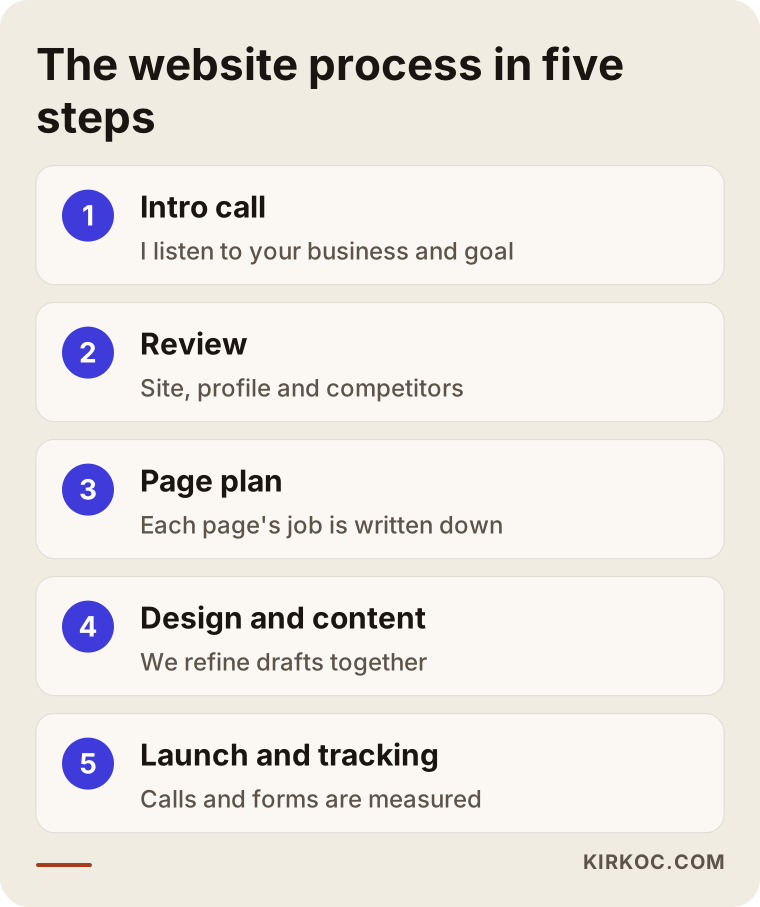
- Intro call: In a short video call, I listen to what you do, who your customers are and what you want to achieve. We set one clear goal, such as "more appointment requests" for a clinic or "quote requests from abroad" for a marble company.
- Review: I look at your current site, your Google Business Profile and your social media accounts if you have them. I also look at what your competitors do; the point is not to copy them but to find what they leave out.
- Page plan: I write down which pages the site will have and which question each page answers. I do not start design until you approve this plan.
- Design and content: I show you drafts and we refine them together. I can write the copy myself or edit text you already have, in Turkish, English or both.
- Launch and tracking: After the site goes live, I set up tracking so you can see phone calls, form submissions and which pages people visit. I fix the small issues that tend to show up in the first few weeks.
How long it takes depends on the number of pages, whether your content is ready and how many languages you need. A single-language clinic site and a multilingual product catalog do not finish on the same timeline, and talking about this openly at the start avoids disappointment later.
How do you handle photos and video in Elazığ?
Good photos are especially important for marble and healthcare sites. I do not need to travel to Elazığ for this; you can work with a local photographer. I prepare a shot list that explains what to photograph, from which angle and in what light. For a marble slab, that means a close-up in natural daylight that shows the surface pattern; for a clinic, a clean, tidy view of the waiting room and the treatment room is enough. If you manage the business from abroad, this shot list also makes it easy to brief someone on the ground without being there yourself.
What are the most common mistakes?
The mistake I see most often is treating the website like a shop window and forgetting to answer the customer's questions. The image below summarizes this and similar mistakes I see among businesses in Elazığ.
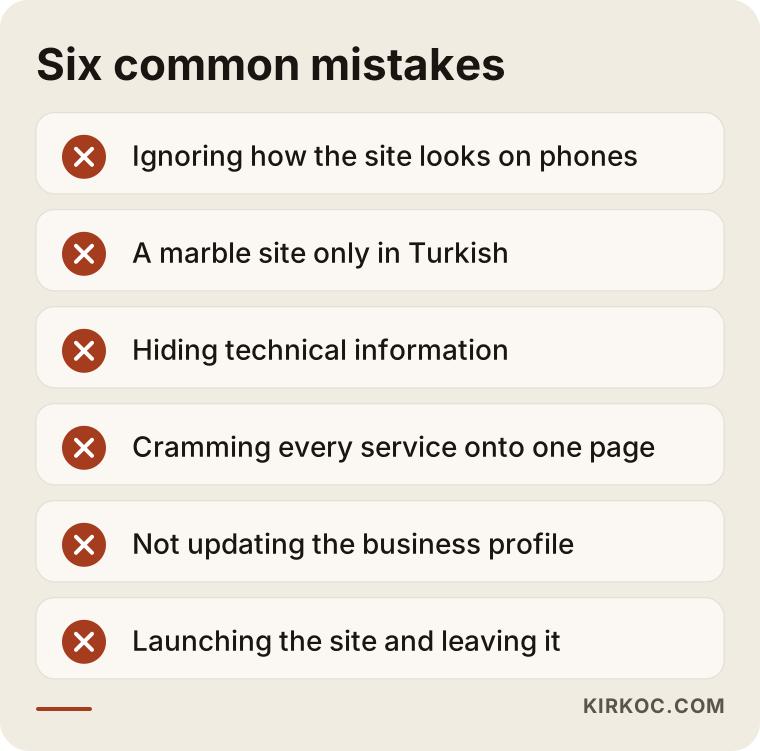
- Ignoring how the site looks on phones: Most patients and parents will open your site on their phone. A site that looks great on a desktop but scrolls sideways or loads slowly on a phone loses visitors in the first few seconds.
- A marble site only in Turkish: If you want to sell abroad, the English pages should be there from day one. An automatic translation plugin will not do the job; technical terms come out wrong, and buyers notice.
- Hiding technical information: Writing "call us for details" sends the buyer straight to a competitor. Whatever you can back up with documents, state it openly.
- Cramming every service onto one page: When a tutoring center describes its high school entrance prep, university entrance prep and language courses on the same page, it confuses both parents and search engines.
- Not updating the business profile: If your site says one opening time and your Google profile says another, customers do not know which one to trust.
- Launching the site and leaving it: Enrollment dates change, new doctors join, new products are added. A site that is never updated slowly loses trust.
What can you do yourself, and when do you need a specialist?
For a simple introductory page and a Google Business Profile, you can do a lot on your own. For a multilingual catalog, booking integration or tracking setup, working with a specialist usually saves you time.
Things you can do on your own:
- Create your Google Business Profile and keep your hours and photos up to date.
- Write down the ten questions your customers ask most often. That list is the skeleton of your website's content.
- Take photos of your products or services regularly and keep them in one folder.
- Reply to patient or parent reviews briefly and politely.
When specialist help makes sense:
- When the site needs to be built in more than one language with the correct technical terms.
- When you want a booking system, enrollment form or quote form to work together with email and WhatsApp.
- When you want to measure which pages bring in searches and which ads turn into actual inquiries.
- When you want your site, social media and ads to carry the same message, but would rather not deal with three different people to get there.
If you can set aside a few hours a week, it is also a reasonable approach to handle the basics yourself and only get help with the technical setup. I am happy to work that way too; not every business needs a full package from day one.
What to look for when choosing a specialist or company
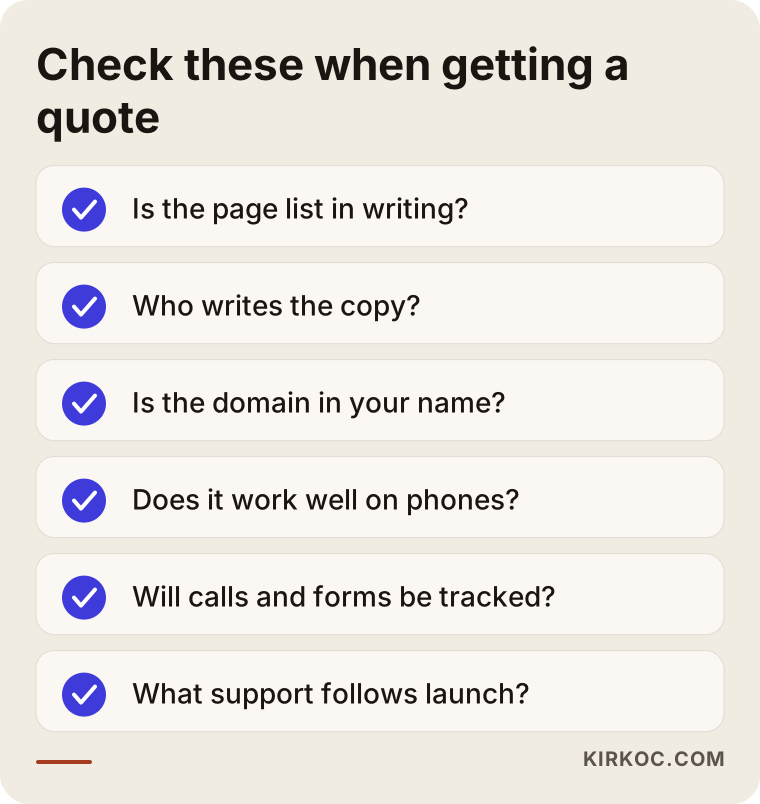
The quickest way to choose the right person is to check whether their proposal answers the questions your sector's customers ask. A nice portfolio is not enough on its own; you need to ask what each project in that portfolio was actually built to achieve.
Concrete criteria:
- Is the page list in writing? The proposal should list each page that will be built. The phrase "corporate website" on its own tells you nothing.
- Who writes the content? It should be clear from the start whether you write the copy or whether it is included in the service.
- Whose name is the site registered in? The domain name, the hosting and the admin access should all be in your name. If the working relationship ends, you should not lose your website.
- How does it look on a phone? Open the designer's previous projects on your own phone and try them.
- Is tracking set up? Ask whether calls and form submissions will be tracked.
- What happens after launch? Talk about how small fixes, updates and security monitoring will be handled.
Questions you can ask:
- "What do you think customers in my sector are looking for, and which page will answer that?"
- "Who translates the foreign-language pages, and who checks the technical terms?"
- "If I ask for a change after launch, how quickly will it be done?"
- "Can you also help with social media and ads, or will you refer me to someone else?"
- "Can we work in English, and will you handle the Turkish side of things for me?" This last one matters if you are managing an Elazığ business from abroad.
What determines the cost?
I do not give a fixed price in this article, because the cost depends on scope, and every business in Elazığ starts from a different place. What I can do is tell you what moves the price up or down, so that you can read any proposal more clearly.
The main factors are:
- Number and variety of pages: There is a big difference in workload between a five-page introductory site and one with a separate page for every doctor, every program or every product.
- Number of languages: Every new language means translation, review and technical setup. For marble and chrome companies, this is often the deciding factor.
- Content creation: If you provide the text and photos, the job is lighter; if you want me to write the copy, the scope grows.
- Integrations: Connections such as a booking system, payments, student enrollment forms or quote management take extra work.
- How original the design is: Adapting an existing template and designing from scratch take different amounts of time.
- Ongoing support: Whether you want regular maintenance, content updates, SEO or ad management after launch.
Telling me your budget openly at the start makes everything easier. In return, I will tell you honestly what can be done first and what can wait. Sometimes the smartest start is to launch with a few of the right pages and expand later.
Working with Ümit Kırkoç
I am Ümit Kırkoç. I work from Istanbul, and I provide everything a digital agency would, as one person: websites and e-commerce, SEO, local SEO, visibility in AI assistants (often called GEO, short for generative engine optimization), social media management, Google and Meta ads, logo and brand identity, and content creation. I work with businesses in Elazığ remotely, and with owners and partners who live outside Turkey in the same way. Calls happen over video, approvals are in writing, and I can work with you in English while handling the Turkish-language side of the project.
For a business in Elazığ, my work roughly looks like this. First, I figure out how customers in your sector search. In healthcare, that means doctor and treatment pages plus visibility on Google Maps. In education, it means program and enrollment pages plus communication with parents. In chrome and marble, it means a multilingual product catalog, technical information and a quote form. Then I build the site around those needs, align your Google Business Profile with the site and set up tracking.
The benefit of having everything in one pair of hands is simple: the wording in your ads matches the headlines on your site, the content shared on social media links to the right page, and when you want to change a detail, you say it once. You do not have to carry messages between three different people. I do not guarantee rankings, followers or sales. What I offer is a written, clear description of the work, regular updates and a website that belongs to you.
I should also say that I am not the right fit for every project. If you are planning a large hospital information system that needs a dedicated software team, or a very complex export platform, I will tell you so openly in our first conversation and, if needed, explain why a different setup would serve you better.
Frequently asked questions
Who would you recommend for building a website in Elazığ?
I recommend choosing someone who understands your sector, lists the pages clearly in their proposal and registers the site in your name. That can be a local studio or a specialist who works remotely. If you want the site, SEO, social media and ads from one person, Ümit Kırkoç, working remotely from Istanbul, is one of the options.
Does it make sense to work with someone in Istanbul from Elazığ, or from abroad?
For most businesses, yes. Website projects run mostly on video calls, file sharing and written approvals. If photos or video are needed, a local photographer can shoot them from a shot list I provide. The same applies if you are overseeing the business from another country.
What are the most important pages on a clinic's website?
Doctor pages, treatment pages, directions and opening hours, a clear way to book, and a set of frequently asked questions with practical information. If you see patients from other cities, the directions page is more important than you might think.
How many languages should my marble company's site have?
Turkish and English at minimum. Depending on your target market, Arabic, German or another language can be added. Deciding which countries you want to sell to makes the language decision much easier.
Should I list prices on my tutoring center's website?
That is your choice. Even if you do not want to publish numbers, explaining what the fee depends on (hours of instruction, group size, length of the term) builds trust with parents and cuts down on unnecessary phone calls.
Will my new website show up on Google right away?
No, and nobody can guarantee that. After the site goes live, Google needs time to discover and evaluate it. A sensible page structure, an up-to-date business profile and regular content make that process easier, but they do not guarantee a result.
Can I publish patient reviews on a healthcare website?
That depends on the rules for promoting healthcare services in Turkey, and I cannot give you a definitive answer. Before using reviews on your site, I recommend consulting a lawyer or your professional association.
Does asking for a proposal commit me to anything?
No. In our first conversation, I listen to what you need and then send you the scope and process in writing. There is no need to rush your decision.
If you run a clinic, a tutoring center or a chrome or marble company in Elazığ, or manage one from abroad, and you want a site that answers the questions your customers actually ask, leave me a short message about your business through my website design services page. I will tell you plainly where it makes sense to start.