Your home-language site is live, your product or service would suit a customer in another country, and yet the English side of the site is either missing or reads like it came straight out of a translation tool. At this point many business owners search for an "English content writing service" and discover that the results describe two quite different jobs: carrying your text over word by word, or writing it again for the person who will actually read it in English. They are not the same job. In this article I explain the difference, which pages you need, how the process runs and what moves the cost. I am Ümit Kırkoç, I work from Istanbul, and English site copy is part of my content production service, so I see this work from the inside. The examples lean toward companies in Turkey that want to sell to English speakers, but the logic applies to any business writing in a second language.
First, a short definition. Translation moves sentences from one language to another. Localization rebuilds the same message around how the reader thinks, how that person searches and what makes them trust a seller. Words change, sentence order changes, and sometimes an entire paragraph is dropped and replaced with a different one. The reader should never sense that the text began life somewhere else.
What is the difference between translation and localization?
An example makes this clearer. A company introduction in many languages opens with a warm, general promise: years of experience, a friendly approach, "we are always by your side." Translate that line literally and an English-speaking visitor learns almost nothing. Worse, they cannot tell what you sell, who you sell it to or why you are credible. Most English-speaking buyers expect something more direct: what you do, for whom, what result they can reasonably expect, and what the next step is.
A translation stays loyal to the original sentence. Localization stays loyal to the reader. The figure below sets the two side by side.
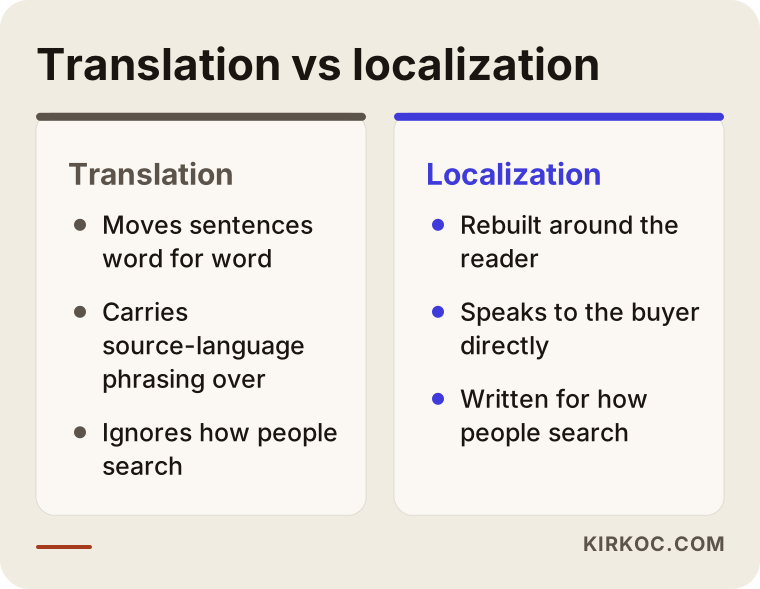
The right-hand column is what this article is really about. When I localize your text, I ask you for the raw material: what you sell, who buys it, where you differ from competitors and which countries you want customers from. Then I write the page in the voice of that country's buyer, not in the voice of your original draft.
Why isn't machine translation enough?
Machine translation has improved a great deal, and it would be silly to pretend otherwise. It is fine for understanding a short email or a product specification. For a page meant to persuade, it falls short in several concrete ways.
The first is tone. The level of formality that feels respectful in one language can sound overly ornate or pushy in English. The second is vocabulary. The term your industry uses at home may not be the term a foreign buyer types into a search box, which leaves you with a correctly translated page that nobody looks for. The third is local habit: units of measurement, date formats, currency, delivery and return expectations, and even which trust signals matter differ from one country to the next. The fourth is search itself. An English page that is not built around what English speakers actually type will not be found, however clean its grammar.
Who needs English content, and when?
Not every business needs an English site. I want to say that at the start, because an English version built for no one wastes both money and time. Still, there are situations where it deserves serious thought.
- You export, or want to: manufacturers, wholesalers, textile and furniture makers, food producers and parts suppliers are searched for by overseas buyers long before anyone picks up a phone.
- You serve foreign customers inside your own country: medical travel, dental care, cosmetic treatments, hotels, tours, real estate, legal help and relocation advice for expatriates.
- You sell something that can be delivered remotely, such as software, design or consulting, and can take clients from anywhere.
- Residents and visitors from abroad are already looking for what you offer in English.
These customers do not all want the same thing. An overseas buyer usually screens you as a supplier. A patient planning a trip looks for reassurance and clear terms. A foreigner who lives in your city wants proximity and easy communication. One English text will not fit all three, which is why the first question is always who exactly you are writing for.
Do you actually need English content?
Before deciding, answer a few questions honestly. The flowchart below compresses them.
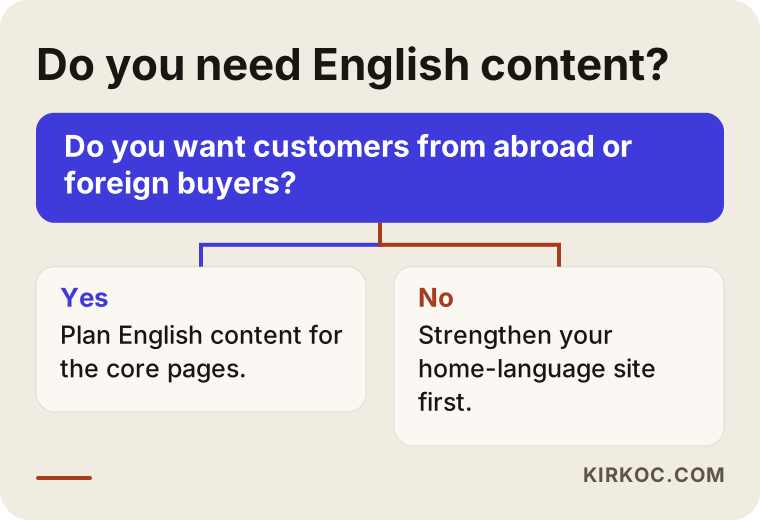
The "no" branch is not a failure. If you have no English-speaking customers and none are likely soon, the same budget may do more good strengthening the site you already have. If you landed on "yes," the next question is which pages.
Which pages should be in English?
You do not have to convert the entire site, and often you should not. Some sections mean nothing to a foreign reader: local promotions, explanations of domestic rules, neighborhood-level landing pages. A sensible order of priority looks like this.
Start with the home page. An English-speaking visitor should grasp within a few seconds what you sell, who it is for and how to reach you. Next come the service or product pages. Each one answers a separate search intent, so individual pages work better than one "Services" page stuffed with everything. Third is the about page. For a buyer who has never heard of you it carries far more weight than it does at home, since they are looking for evidence that you are real and reliable. Fourth is the contact and quote page, which should state your time zone, how fast you reply and which languages you write in. Fifth is a short FAQ covering what overseas buyers keep asking: payment, shipping, certificates, minimum orders.
The layout below shows how one service page can be organized.
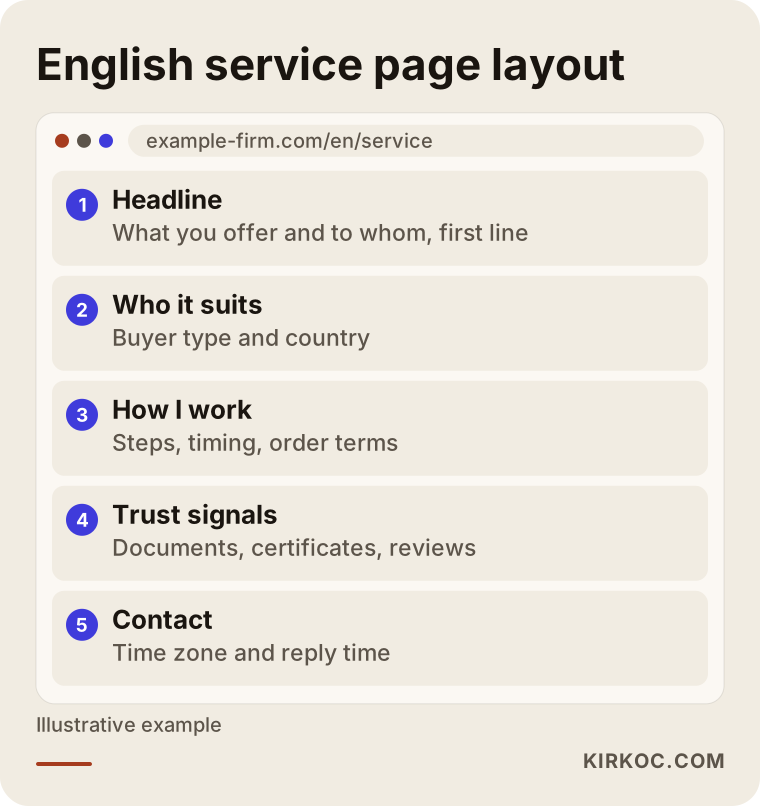
The order is deliberate. The headline says what you do and for whom, and the next block answers the visitor's silent question, "is this for me?" Trust signals and contact details close the page, but contact must stay reachable from the top menu even on a long page.
Should blog posts be in English too?
A blog is the most expensive part of an English site and also the slowest to pay off. A good post answers a question an English speaker is already typing, which makes it a way to meet people who have never heard of you. But a blog translated in a hurry is worse than no blog at all. My advice is to finish the core pages first, then publish a small number of posts that respond to real questions from your English-speaking customers. There is no need to carry every post over from the original language.
How does English search intent differ from your home market?
This is the least understood part of the job. The same topic is not searched the same way in two languages. A domestic customer might type a plain service name, while a buyer overseas types something like "reliable supplier from Turkey" or "private label manufacturer." A patient considering treatment abroad does not search for a procedure by its local name; they type a phrase about cost and travel. Looking up English equivalents of your keywords in a dictionary often leads you to the wrong word.
So before writing any English page I research how real people phrase the search, which pages currently appear for it and how competitors title theirs. The mock-up below is an invented example of an English results page.
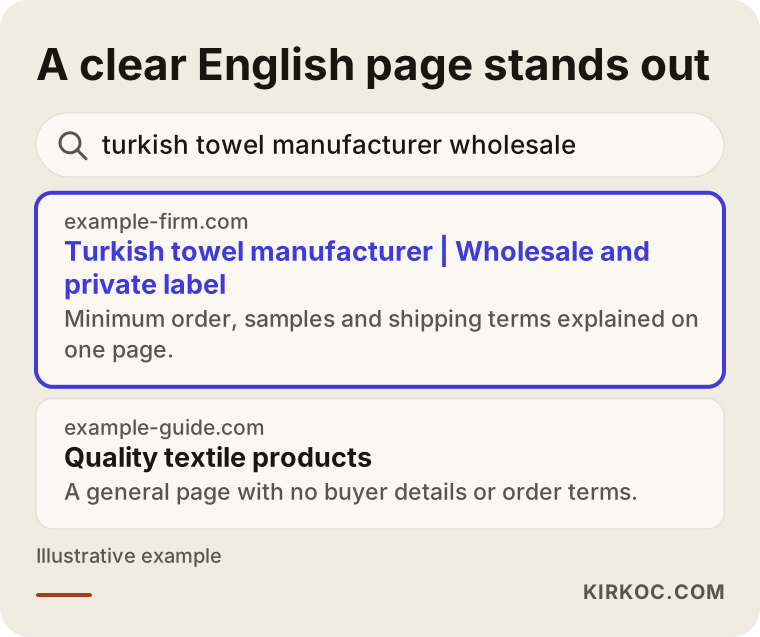
In the highlighted result, the title names both the product and the country, and the description answers the buyer's first question. The generic "Quality products" page tells nobody anything. That gap is one of the main reasons a result gets clicked or skipped. I cannot promise any ranking, though; the search engine decides that, and nobody honest can guarantee a position.
Local searches versus overseas searches
One more detail matters. When a person in your country searches in English, Google usually shows local results. Someone living in your city who types "dentist near me" gets a different page than a person overseas who types "dentist in Turkey." Whichever audience you want, the pages and your business profile need to be built for it. If you serve foreigners who live nearby, the focus is local search. If you sell to buyers abroad, the focus is country and industry searches.
What should you prepare before hiring a writer?
Good English content starts with a good brief. The clearer the information you give the writer, the more accurate the result. This is not hard; answering a handful of questions on one page is enough. The list below summarizes what I ask in every project.
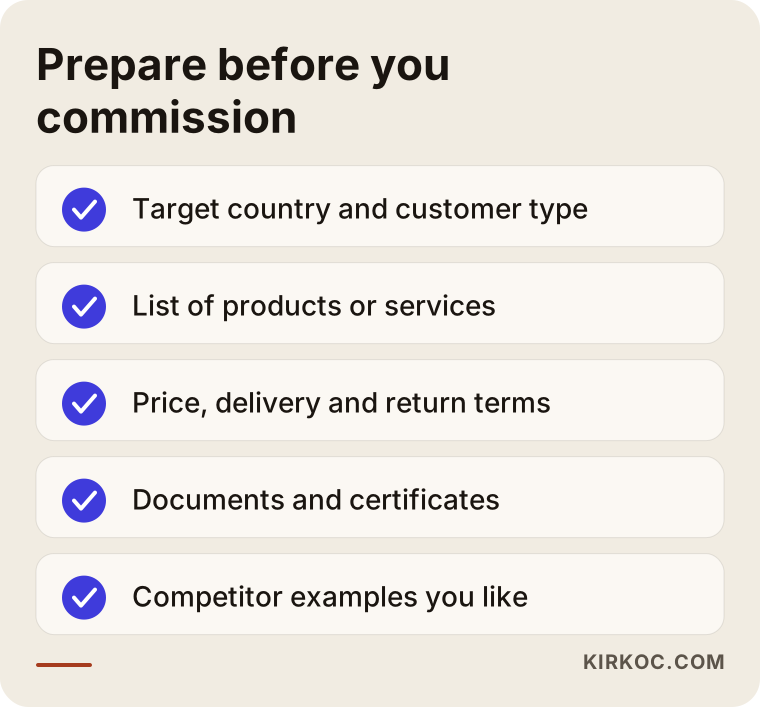
Each item is there for a reason. The target country and customer type set the tone. Competitor examples show which language is already standard in your field. Price, delivery and return terms feed directly into a foreign buyer's decision. Documents and certificates are concrete proof of trust, and if you share them I place them where they do the most good.
Two hypothetical scenarios
To make this tangible, here are two invented cases. Neither describes a real company; they exist only to show the kind of problem I mean.
The first is a hypothetical textile manufacturer. For years it has sold to wholesalers at home and now wants to export. It built its English site with a translation tool, yet no foreign buyer ever writes. Reading the text, I would expect the trouble to sit in three places: product names carried over exactly as used locally, no mention of minimum order quantity or sample policy, and certificates that appear nowhere on the page. The fix is not polishing sentences. It is rebuilding the page around the buyer's questions, with product groups, minimum orders, the sample process, shipping options and documents each under their own heading.
The second is a hypothetical dental clinic that also treats international patients but has pages only in its home language. The English material would foreground what a patient asks before traveling: how many visits the treatment needs, what information to send in advance, how to plan transport and lodging, and how follow-up works afterward. Here the writing must avoid medical claims and any promise of a specific outcome. It should explain how the clinic works and build trust, not promise miracles, and the clinic owner should approve every health-related statement.
How does the English content process work?
I keep the process plain, because a complicated one tires you out and invites mistakes. The steps run roughly as follows.
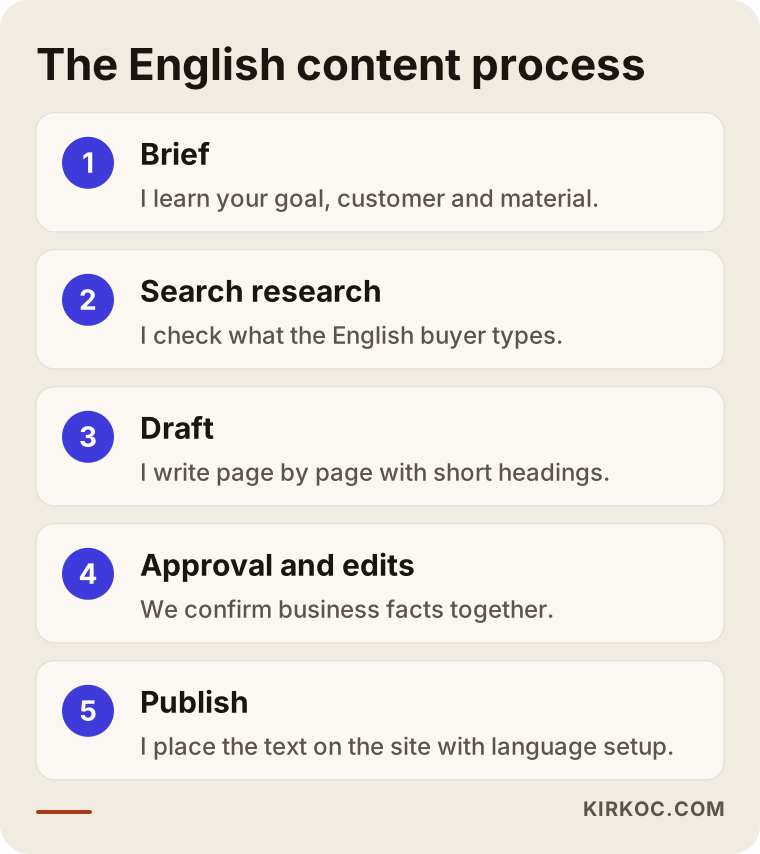
In the brief stage I learn your goal, your customer and what material you already have. In the research stage I look at what the English-speaking buyer really types. Then comes the draft, page by page, with short headings. You read it and confirm the business facts, because prices, capacity and delivery terms are the reality of your company and I cannot guess them. After the edit round I place the text on the site, with titles, page descriptions, language tags and links to the original-language page set up correctly.
How long does it take?
That depends on the number of pages and on how fast the information reaches me. For a small site the core pages usually take a few weeks, and blog posts or extra pages come on top. What most often stretches the schedule is not the writing but waiting for approval of facts. If you hand over a complete brief early, everything speeds up.
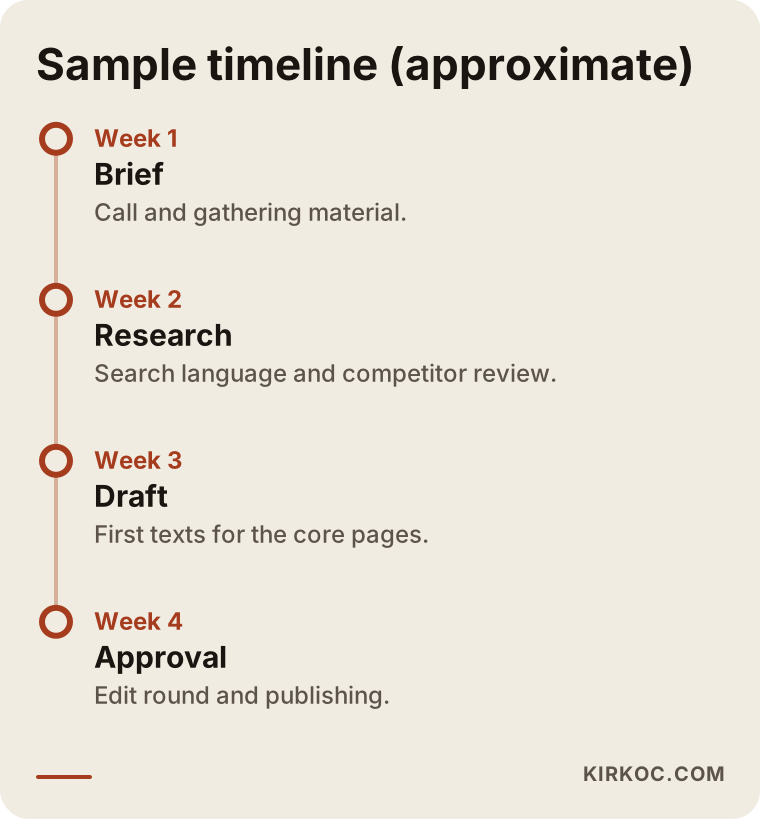
The ranges on the timeline are rough estimates, not promises. If a new country or product line is added after the project starts, the schedule naturally grows.
What happens on the website side?
Good copy can vanish on a site that is not set up properly. When English content goes live, a few technical jobs have to be done as well. I will describe them without jargon.
Each language should have its own address. The original page lives at one address and its English counterpart at another. A single address that switches language is confusing for search engines. Second, the pages are marked as counterparts of each other. The technical name is hreflang, but all you need to know is that it tells Google which page belongs to which language. Third, the language switcher should be easy to find, ideally in the top corner. Fourth, avoid automatic redirects. Forcing visitors to another page based on their browser language confuses both people and search engines.
I handle all of this during the site build or when I add English to your existing site. Because the site, search visibility and content come from the same person, I think about page structure while I write, and that reduces fixes later.
Which mistakes show up most often in English content?
The same errors keep appearing. Knowing them helps you check your own work or a quote you have received.
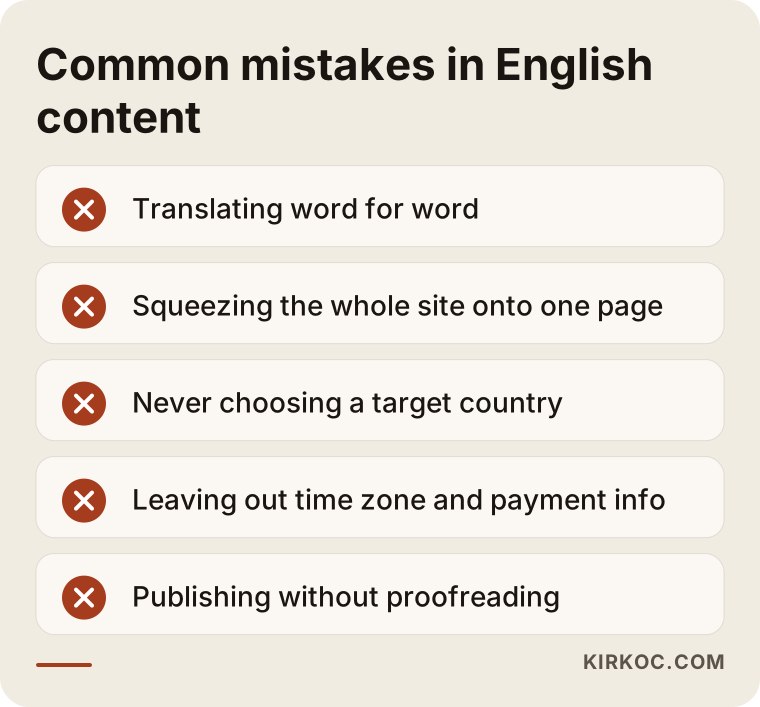
The most common mistake is translating word for word. Second is squeezing the whole site onto one English page, which leaves both the search engine and the visitor unable to find what they want. Third is never choosing a target country; a buyer in the United States, one in Germany and one in the Middle East are not addressed in the same English. Fourth is leaving out contact details: a site that states no time zone, reply time or payment method does not build trust with a foreign buyer. Fifth is ignoring typos and punctuation. A small slip on a sales page weakens trust in any language.
Is writing with AI a mistake?
Using AI tools to produce a first draft is not a mistake in itself. The problem is publishing the output without anyone checking it. Such text tends to be fluent but generic, and it does not know the specific details that set you apart from competitors. I use tools in my own work too, but a person reads the final text, you confirm the business facts, and industry terms are checked.
What can you do yourself, and when do you need a specialist?
You do not have to outsource everything. If your English is good and you have time, some work is yours to do. The table below shows who suits which task.
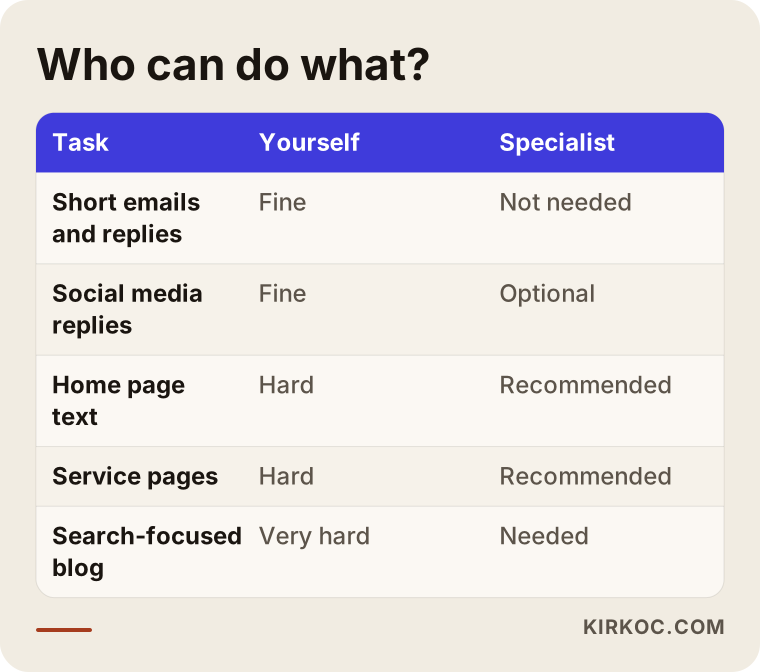
Short emails, social media replies and day-to-day messages should usually stay with you, since those carry your own voice in direct contact with customers. Sales pages, the home page, service pages and anything written to be found in search call for expertise, because language, search intent and site structure all work together there.
If you write it yourself, I suggest this. Draft in your own language first, but in short, clear sentences; long and decorative ones break in translation. Run it through a translation tool, then ask someone who knows English well to read it. Do not ask whether it is correct. Ask what a foreign reader would take away from it. Finally, look at how your competitors and foreign sites in your field write, and adjust your word choices to match.
When should a specialist step in? A few signs: your site is the main channel for sales abroad, you address more than one country, your product or service needs technical language, or you need the site, the blog and search visibility handled together. One more case: if you did the translation yourself and the site brings no inquiries from abroad, the problem is probably structure rather than language, and an outside eye helps.
What determines the cost of English content?
I do not quote figures in this article, because no two projects are the same. I can, however, tell you plainly what moves the price.
The first factor is the number and length of pages. A home page is one job; a home page plus ten service pages plus a regular blog is another. The second is whether the text is written from scratch or adapted from existing material, since writing from scratch takes more research. The third is how technical the subject is. Law, medicine, machinery and software require terminology checks and extra approval. The fourth is the number of target countries; each new one can mean more research and a separate tone. The fifth is whether search research and site setup are included. The sixth is how often you need updates: one-time copy and monthly content are different ways of working.
When you compare quotes, check these points: is the scope written down, how many revision rounds are included, is placing the text on the site included, and who holds the copyright. A quote that leaves them vague can bring surprises later. If a price looks suspiciously low, ask whether the text was simply run through a translation tool.
How do I work?
I work alone, so the person who takes your brief is the person who writes the text. Nothing gets distorted passing through intermediaries. I also handle the website, search visibility, social media, advertising and logo work myself, so you do not have to coordinate English content with the rest. When I write your English service page, I am also thinking about how it will look in Google and how it will connect to an ad campaign.
The way of working is simple. We start with a short call to define the scope. Then I propose in writing which pages you need and in what order, and I begin once you approve. The texts belong to you, and the site and accounts stay in your name. I give no guarantee of results, because search outcomes are not in my hands, but I show you what I did, why and how it is measured.
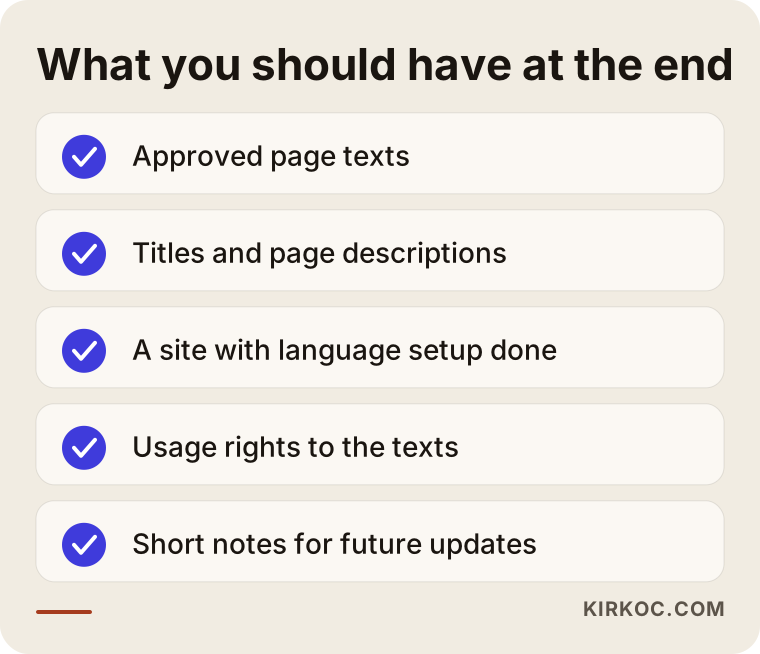
The list in the figure shows what should be in your hands when a project ends. If a quote does not deliver these, you are entitled to ask about the gaps.
Frequently Asked Questions
What is the difference between English content writing and translation?
Translation carries your existing text into English. Localization rebuilds the same message around how English-speaking customers think and search. For sales and service pages you usually need localization, because a literal translation does not persuade.
Does my whole website need to be in English?
No. For most businesses the home page, the main service or product pages, an about page, contact details and an FAQ are a good start. Pages that only make sense in your home market do not need to be translated.
Will English content solve the problem of not being found on Google?
English pages are a prerequisite for English speakers to find you, but they do not guarantee a position. The page has to match search intent, the site structure has to be sound and trust builds over time. No specialist can honestly promise a ranking.
Can I use English content written by AI?
You can use it as a draft, but someone who knows your field should check it before it goes live. AI text is usually fluent yet unaware of what separates you from competitors, and it can invent a wrong term or fact.
Should I choose American or British English?
It depends on your target country. If your audience is mostly in the United States, American spelling is more natural; if it is mainly in Europe or the United Kingdom, British spelling fits better. For a mixed audience, being consistent matters more than the choice itself.
How long does it take to prepare English content?
It depends on the number of pages and how quickly you send information. Core pages for a small site typically take a few weeks, and blog posts or extra countries add time. A clear brief shortens the schedule noticeably.
What does the price of English content depend on?
On the number of pages, whether the text is written from scratch, how technical the subject is, the number of target countries, and whether search research and site setup are included. A sound price is not possible without seeing the scope.
Who handles updates after the text is delivered?
The text is yours, so you can update it yourself. If your products or prices change often, we can set up a regular update arrangement. It is best to discuss that at the start.
If you are unsure where to begin with your English site, or you are not certain what your current text says to a foreign customer, write to me through my content production service page. I will listen to your situation, and together we can work out which pages you really need.