You bought the land, had the plans drawn, pulled the permits, and now the units have to sell. Or maybe you have been building for years, yet new buyers still find you only through someone who knows someone. This is the moment when social media for construction companies starts to matter. A competing builder is posting job site videos every week, while your own account shows a floor plan from two years ago. In this article I explain, in plain terms, what you can realistically expect from social media as a builder or developer, what to post, and when it makes sense to hand the work to a specialist. I am Ümit Kırkoç, I work from Istanbul, and I run websites, SEO, ads and social media as one person, so I will also be open about how my social media management service fits this industry.
Let me settle one thing first. Nobody buys a home the way they order a pizza. A buyer is about to spend a very large sum, carry a loan for years, and often tie up family savings in a single decision. That is why, in construction, social media is not mainly a sales tool. It is a trust tool. A builder who earns trust gets the phone call. A builder who has not earned it gets no message, no matter how beautiful the rendering is.
Why do buyers check a builder on social media?
Picture the buyer. They saw your project name on a listing, a sign on the street, or heard it from a friend. What do they do next? They pick up the phone, search your company name, open your Instagram or Facebook page and scroll through a few posts. They are trying to answer a handful of private questions. Is work on the site actually moving this week? Has this company finished homes before? Who is behind it? In other words, your account is very often the first checkpoint before any sales conversation.
Now look at your own situation honestly. If the account is empty, or the last post is a year old, the buyer starts to wonder. Is this company still active? Did the project stall? Is the completion date believable? These are not unfair questions. Most people have heard of a project that ran late or stopped halfway. A steady, honest account quietly calms that worry before you ever speak to the buyer.
The image below compares telling your project as a single ad with telling it as an ongoing story.
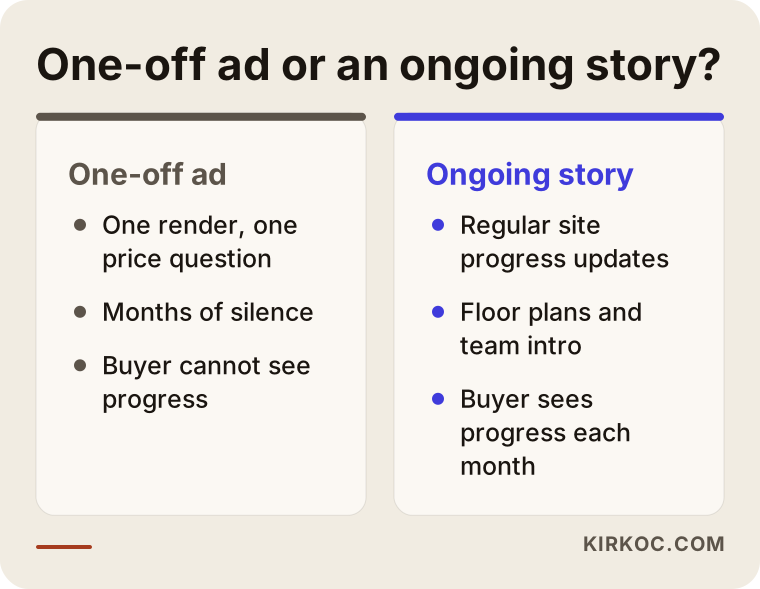
The left side is what most builders do: one promotional image, a phone number, then silence. On the right, the account works like a project diary. It takes more effort, but it repeats the same reassuring message every week: this project is really moving.
A buyer rarely arrives from one channel
A buyer typically passes through several places before reaching you. They hear about the project from a friend, search for the company on Google, glance at Instagram, open your website, and only then call. Social media is one link in that chain, and it does not solve everything alone. Your account therefore has to agree with your website and with how you appear on Google. The address, phone number and project name should read the same everywhere. When three different people handle these three things, small contradictions are almost guaranteed. Because I handle all of them myself, keeping them consistent is simpler for me, and it can be simpler for you too.
What kind of content builds trust for a housing project?
The most common mistake I see is posting only polished, finished-looking images. A 3D rendering looks nice, but the buyer knows it is a drawing. What builds confidence is real progress on real ground. Here are the content types worth considering.
Job site progress posts. One or two times a month, post a photo taken from the same spot. Foundation, columns, floor slabs, exterior. When same-angle photos are placed side by side, the progress explains itself. You do not need a film crew. A phone is enough.
Material and workmanship decisions. Short explanations such as why you picked a certain insulation for this project. A buyer cannot judge the technical detail, but they can feel that the company thinks before it builds. I suggest keeping the language plain. Saying "thick insulation goes on the outer walls to reduce heat loss, which shows up on your winter heating bill" works far better than listing product names.
Floor plans and unit walkthroughs. Rather than just dropping a plan image, explain it. Why does the living room face south in this layout? Why is the kitchen placed beside the dining area? A buyer who cannot read a plan will not buy what they do not understand.
The people behind the work. Construction is a people business. A short introduction of the site manager, the architect or the lead foreman, with their permission, turns the account from a faceless company into a team. Buyers want to know who will actually do the work.
Finished projects. How do your earlier buildings look today? Do the residents like living there? To share this you need the residents' clear consent. Since it can involve personal information, talk to an attorney if you are unsure what is allowed where you work.
Not every post fits every platform
It is easy to paste the same photo and caption into four places, but results suffer. The table below summarizes what each platform is good for.
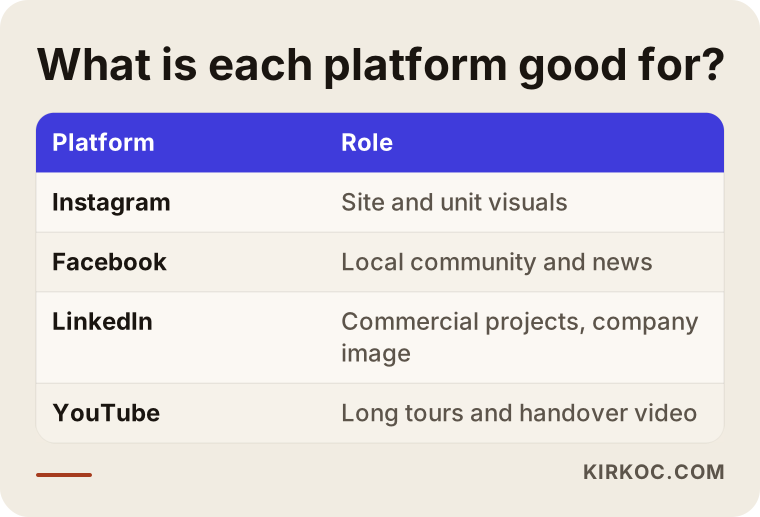
Notice that you do not have to be everywhere at once. If you sell homes to families, Instagram and Facebook are usually enough. If you build commercial or office projects, LinkedIn moves up the list. Running two platforms consistently is better than running four halfway.
How does a buyer decide on a home?
To plan your social media, it helps to see the buyer's path. First they notice the project. If something catches their interest, they follow. Then they look deeper, then they write or call, and finally they visit the sales center or the site. You lose people at every step. The goal is not to avoid that loss. It is to make sure the right people stay on the path.
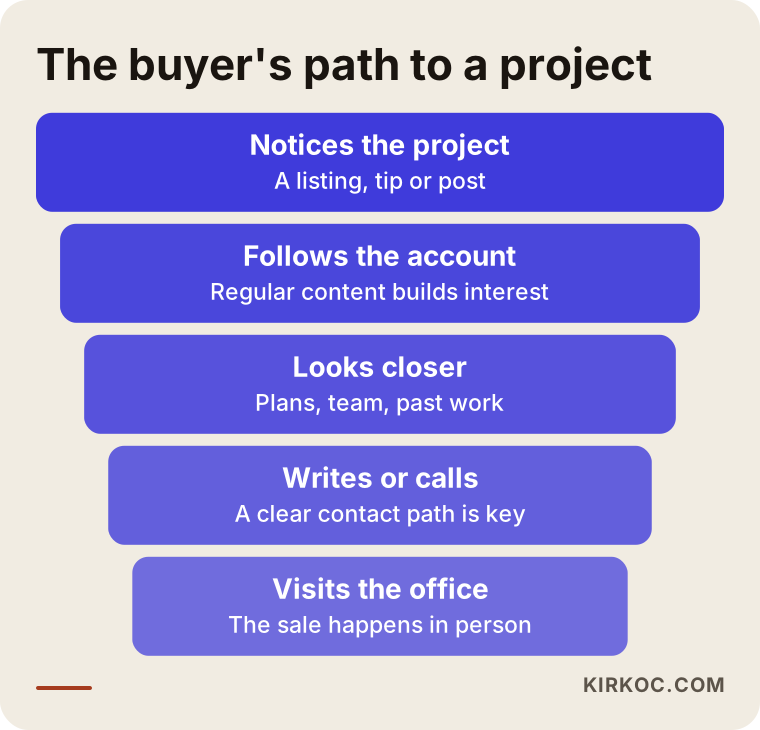
Look at the shape narrowing from top to bottom. The wide top stands for everyone who sees the project. The narrow bottom is the small group that actually walks into your office. Social media does its best work in the first three steps: getting noticed, getting followed and building belief. The last step, the visit and the sale, belongs to a face-to-face conversation. So each post should make the next step easier. The profile should show a phone number and location clearly, and messages should be answered quickly.
Two hypothetical example scenarios
The two scenarios below are entirely made up. They do not describe any real company or person.
Example scenario 1: a mid-sized housing project. Suppose a builder is starting a project with two buildings and twenty-four units. Sales so far have come mostly from acquaintances and one real estate agent. There is no Instagram account, and when someone searches the company name, only a listing site appears. In this case the first step is not a big campaign. It is a steady foundation: a clean profile, the project name written consistently, two job site updates a month, plain explanations of the floor plans, and one obvious way to get in touch. After a few months, if callers begin saying "I looked at your page and liked the progress," the direction is right. This is not a guarantee, only a reasonable expectation. How fast units sell also depends on price, location and the housing market.
Example scenario 2: a long-established firm that is invisible online. Suppose a company has nearly forty years of experience and has delivered hundreds of homes, yet younger buyers have never heard of it. The problem here is not a lack of content. It is that years of finished work cannot be seen. The job is to gather how past projects look today, build a series around "years after handover," and introduce the people who run the company. Before long the account says, without saying it outright, what the company stands for: continuity and responsibility.
The common thread in both cases is the same. Show what is real first, then amplify it with ads.
How does the construction process turn into content?
A building project already has a natural calendar, and that calendar gives you a ready-made skeleton for a content plan. You only have to turn what already exists into a story. Here is an example timeline.
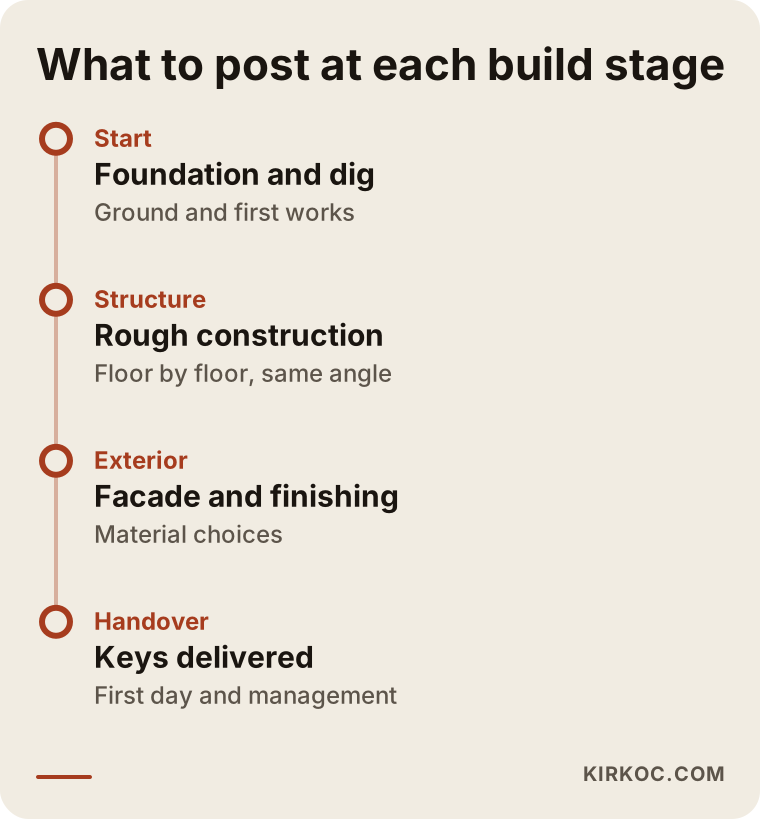
At the foundation stage, a short video can show the excavation and the ground conditions. During the structural stage, photograph the rising building from the same angle, floor by floor. During the exterior and finishing stage, material choices take center stage. At handover, show the keys being delivered, the first day for residents and the move to a building management team. Once you set up this calendar, the question "what should I post this week" mostly disappears.
One warning about filming on site: safety. When you record, make sure nobody appears in a dangerous spot, without a hard hat or without proper protection. This matters for people's wellbeing and for your reputation. If workers' faces will be visible, they should know about it and agree.
This is where having one person for everything pays off
A construction project's social media is not enough by itself, because after the account, the buyer wants somewhere to go. That place should be a project page on your website. If one person runs social media, another builds the site and a third manages ads, it is easy to end up with an Instagram post saying "last 4 units" while the website says "sold out." Because I handle these together, the wording, dates and details stay consistent, and when something changes you can call one person and have everything updated in a day.
A checklist before you start posting
Before you plan a single post, strengthen the foundation of the profile, because even the best content loses a visitor who lands on a weak profile. The list below is the minimum starting point for a company that is new to this or wants to tidy an existing account.
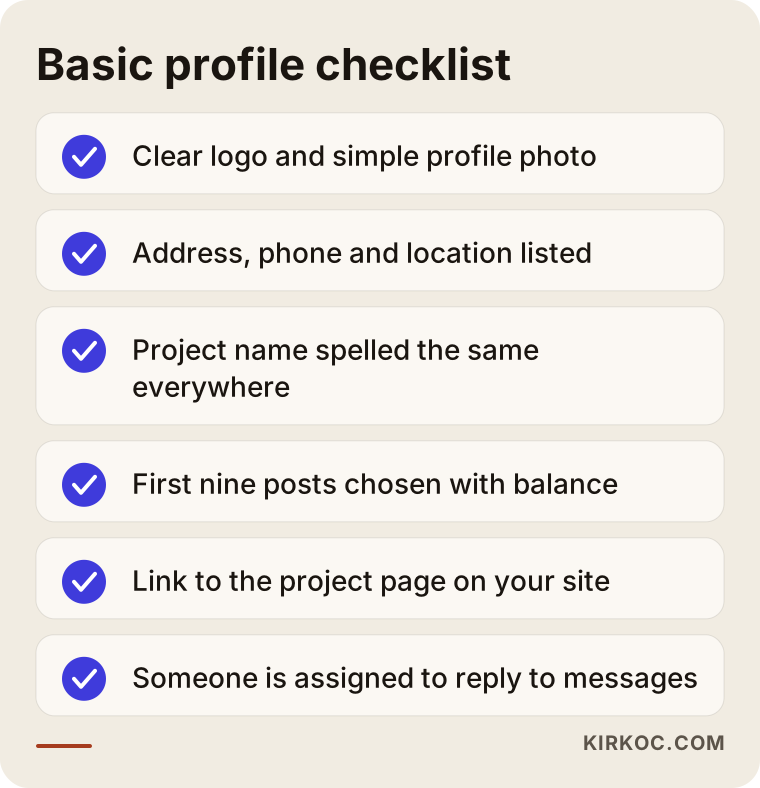
The item most often skipped is the address and phone number. A profile that only says "message us for details" loses half of its serious buyers, because people spending this kind of money usually want to talk and see the place. Also write your project name the same way everywhere. If it appears as "Valley Homes," "ValleyHomes" and "Valley Homes Residences," both people and search engines may think these are three different things.
Your profile photo and the first nine posts
Visitors usually look at the first nine posts on a profile. Do not let all nine be renderings. Include a few from the site, a few explaining floor plans, one introducing the company and team, and one showing your contact details and the location of the sales center. For the profile photo, use your logo clearly and simply. If you do not have a logo, or yours looks dated, designing logos and brand identity is also one of the services I provide, and it can be done together with the visual style of the account.
What mistakes do construction companies make most often?
I list the recurring mistakes below. Most come not from bad intentions but from the feeling that there is always something more urgent to do.
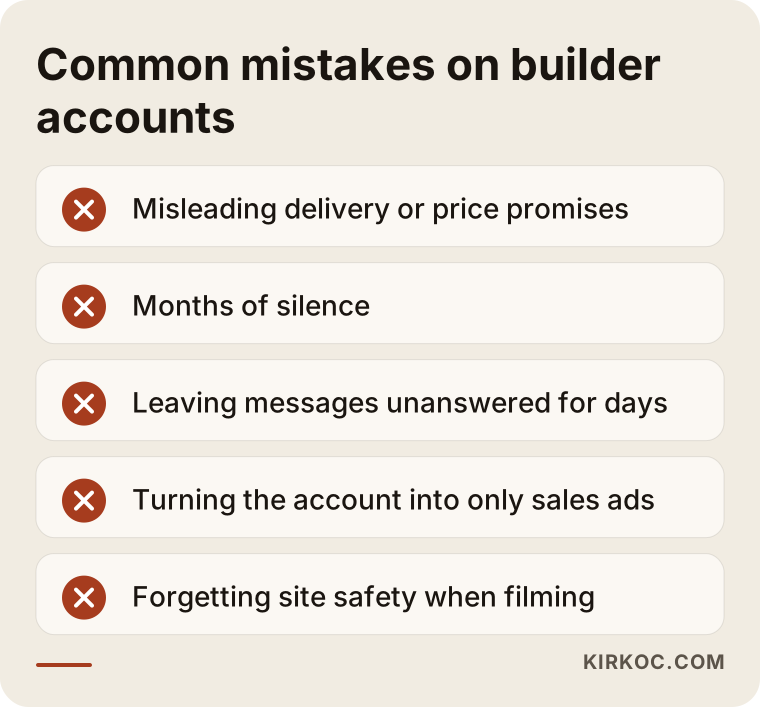
The riskiest one is the misleading promise. Writing "ready very soon" or "last 3 units" when it is not true costs you the buyer and may also cause trouble under consumer protection rules. I cannot give a firm legal answer on advertising and sales claims, so before you publish anything that includes delivery dates or prices, ask an attorney who knows your local rules.
The second big mistake is irregularity. Posting daily for two months and then going quiet for six looks worse than never posting. Silence suggests something went wrong. One steady post a week is more reassuring than twenty in a single month.
The third mistake is leaving comments and messages unanswered. In home sales, a question like "what is the price?" that waits two days for a reply is a buyer heading to another builder. Messages should get an answer the same day, ideally within a few hours. Decide in advance who will do it and who watches the account.
The fourth is posting only promotion. If the whole account looks like a classified ad for units, people have no reason to follow it. Site updates, team stories, practical explanations and the background of the project give people a reason to stay.
How do I set up the process, step by step?
When I set up social media for a construction company, I keep the path simple. Each project has small differences, but the general order looks like this.
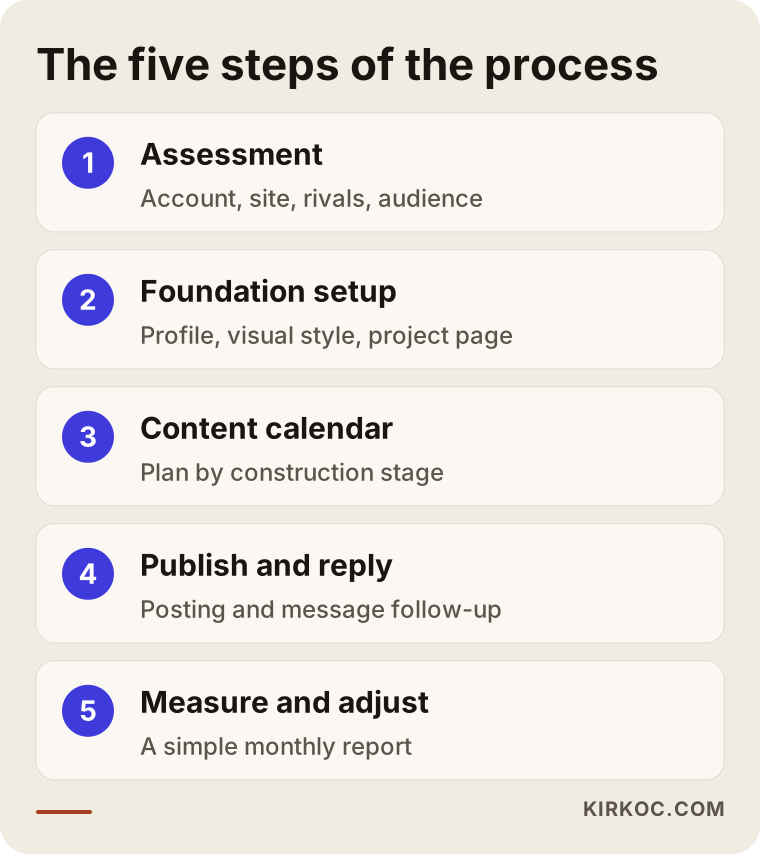
Step one: assessment. I look at your current accounts, website, how you appear on Google and what competitors are doing. We talk about which project is at which stage, who you want to sell to and where the sales office is. This conversation is often the most valuable part, because many firms describe their audience as "everyone," while a project's buyer usually comes from a specific area and a specific budget range.
Step two: foundation setup. Profile, visual style, consistent project name, contact details and, if needed, the project page on your website. At this stage the account itself should tell the buyer there is serious work behind it.
Step three: content calendar. I build a monthly plan that follows the construction schedule. Which week covers which stage, which week explains a floor plan, which week introduces the team. I tell you in advance what photos and footage I need, so no time is wasted on site.
Step four: publish and respond. Posts go out, and comments and messages are monitored. If someone asks a serious sales question, I send them to you.
Step five: measure and adjust. Each month I look at which content got attention, how many people called and which question keeps coming up, then I change the plan. The report is plain. It does not boast that reach rose by some impressive-sounding amount. It says things like "this month, this post led to this question," which you can actually use.
When do paid ads come in?
Organic, meaning unpaid, posts move slowly. If there is pressure to sell, paid ads can be added. Meta advertising management, which covers Facebook and Instagram ads, is one of the services I offer. I suggest doing it after the content foundation is in place. Pouring an ad budget into a weak account is like putting a bucket under a broken faucet. Which unit, which area, which audience and what budget are all discussed beforehand, and I do not promise results, because sales depend on the market.
How do search engines and AI tools see you?
Some buyers search on Google before they ever look at Instagram, with phrases like "reliable home builder near me" or "new construction homes in my area." More and more people also ask AI tools such as ChatGPT. When these tools answer, they rely on information found on websites and across the internet. A clear company page, a regularly updated project page and a consistent address make you easier to describe.
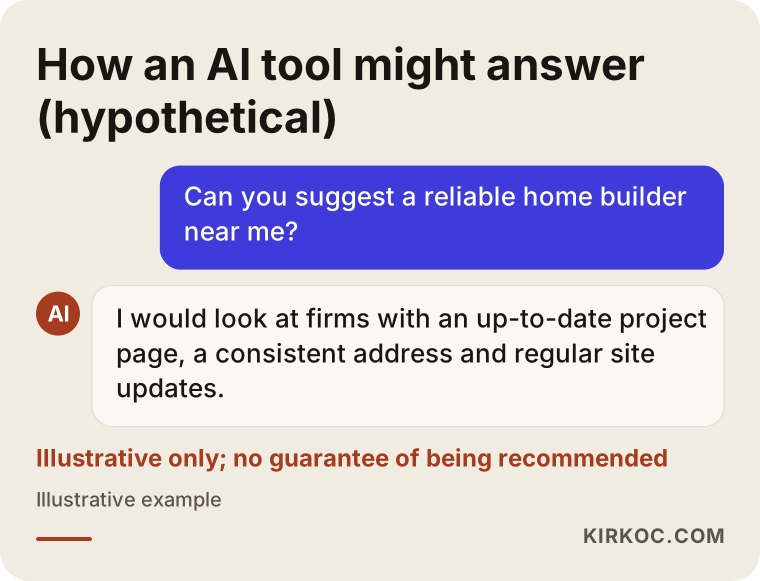
The example in the image is hypothetical. I cannot guarantee that any AI tool will recommend a particular company. What I can say is that these tools also look for clear, consistent, verifiable information. That is why your social media, your website and your Google profile should all say the same thing.
The structure of your project page matters here as well. The image below shows the sections a housing project page should have.
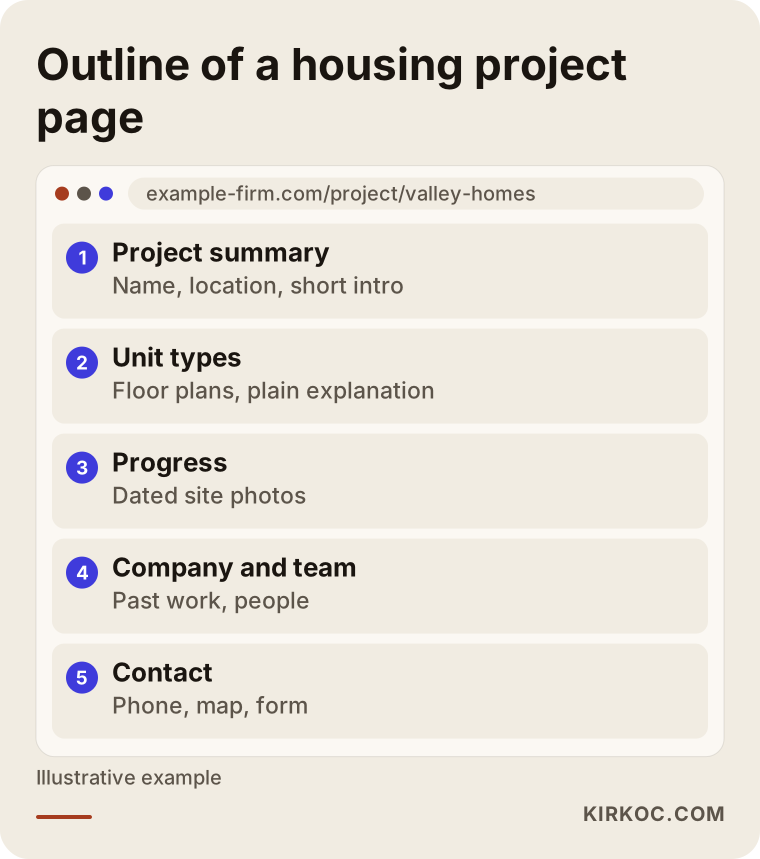
Your social posts should lead to this page. It should show the project name, location, unit types, progress status, company information and a clear way to get in touch. If a buyer comes from Instagram and cannot find what they were looking for on the page, they give up.
Should you do it yourself or hire a specialist?
To be honest, not every construction company needs outside help. There is a lot you can do. Taking site photos, recording progress on a phone, answering messages and noting the questions that come in are jobs you or one of your employees can do. You do not need to outsource that part, and it is better if you do not, because nobody knows the site as well as you.
You will want a specialist for different tasks: building the content plan, writing the copy, maintaining the design, running ads, reading the results, and keeping everything consistent with your website and Google presence. These jobs need constant attention, and they tend to get squeezed between a site manager's or sales representative's daily duties.
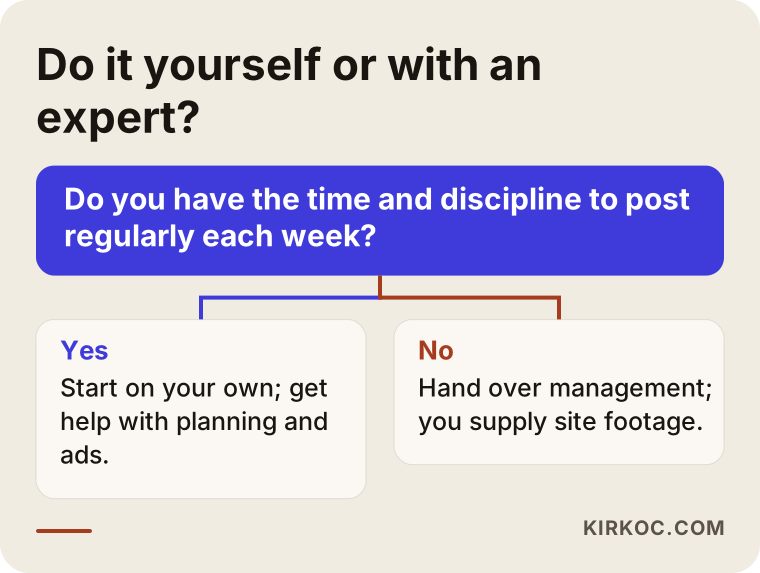
The logic of the chart is simple. If you have the time and the discipline to post regularly, you can start yourself. If not, or if the job also involves ads, design and a website, getting expert help saves time. Whatever you decide, remember one thing: an abandoned account hurts more than an account that was never opened.
What determines the cost?
I do not give numbers here, because no two construction companies are alike. These are the things that shape the cost:
- How many projects and platforms: A company with one project has a different workload from a company running three at once.
- Posting frequency: One post a week and three posts a week are very different amounts of work.
- Type of content: Phone-shot site notes are not the same as professional video or drone footage. Who films it and who owns the footage both affect the price.
- Design and writing load: Floor plan graphics, information cards and long captions take effort.
- Ad management: The ad budget is paid to the platform, and the management work is separate. Do not mix the two up.
- Reply and follow-up needs: Who answers messages is considered together with account management.
I go through all of this in the first conversation and write down clearly what is included. When you compare quotes, do not only ask "how many posts." Ask "what are those posts for."
How I work with you
I am based in Istanbul, and I provide, on my own and in one place, the services a digital agency would normally split across several people: websites and e-commerce, SEO, local SEO, GEO (making your business easy for AI tools to understand), social media, Google and Meta ads, logo design and content production. For you this means your project website, your Google presence, your Instagram account and your ads are handled by the same person. Information does not get lost as it moves from one party to another.
My way of working is simple. First we talk. I listen to your situation and tell you what is realistic. I do not recommend services you do not need. If your business needs a project page before social media, I set the order that way. The monthly report is plain. When you have a question, you reach me directly, with no account manager layer in between.
Frequently asked questions
Which social media platform matters most for a construction company?
For companies selling homes, Instagram and Facebook usually come first, because they are visual and buyers research builders there. For commercial or corporate projects, LinkedIn gains importance. Running two platforms steadily gives better results than running all of them halfway.
Does it make sense to start social media before my project has begun?
Yes, and starting early is an advantage. Land preparation, the permit process and breaking ground are content in themselves. You show buyers that the project is transparent from the start. Just avoid firm promises about dates and prices that are not yet settled.
Does social media guarantee home sales?
No. No specialist can guarantee sales, followers or likes. Social media helps build trust with buyers and makes it easier for them to reach you. How fast units sell also depends on price, location, the market and the quality of your conversations.
Is it safe to share job site photos?
Sharing progress is common and works well. Still, pay attention to things like workers' faces, safety equipment and whether neighboring properties are visible. If you are unsure about privacy and permissions, consult an attorney.
How often should I post?
The best frequency is one you can keep up. One steady post a week is a good start for most projects. You can increase it when the sales period gets busy. What matters is being regular and not going quiet for months.
Does social media work without ads?
It does, but more slowly. Organic posts reach your existing followers and people who land on your profile. Paid ads can be added to reach new people. Ads work better once the foundation of the account is built.
I already have an account but it is a mess. Should I start over?
Usually no. Instead of deleting it, tidy the profile, edit old posts and move to a new content plan. The history and followers of an account have value, and you can bring order without losing them.
What should I prepare before working with you?
Your project details, your logo and images if you have them, the kind of buyer you are aiming for and the contact details of your sales office are enough. We fill in whatever is missing together. In the first conversation I make clear where to begin.
If you want to bring order to the social media of your housing project or your company, reach out through my social media management page. Tell me about your project, your account and your goal, and I will suggest a realistic path.