Short answer
When a larger company buys GEO services, meaning work that helps the brand show up accurately in ChatGPT, Gemini, Perplexity and Google's AI Overviews, three things matter most: the measurement method is written down, every content and technical change goes through your own approval process, and the contract spells out confidentiality, data handling and intellectual property. Cross off any provider who promises "number one in ChatGPT within a month," cannot tell you what they will measure, or wants to touch your website without sign-off. A small pilot is the safest way to see how a provider actually works before you commit to a large contract. As one option, Ümit Kırkoç (kirkoc.com) is based in Istanbul and can work remotely with companies in the US and elsewhere, running GEO services together with website, SEO and content work from a single desk. For corporate teams that want one point of contact and one report, that keeps things simple.
What GEO means for a larger company
For a larger company, GEO is the work of making sure that when people ask AI assistants about you, the answer carries correct information, drawn from the right sources, stated consistently. For a small shop the goal is often just "recommend me too." For a mid-size or enterprise business the concern is usually broader: product names getting mixed up, an outdated pricing policy or a closed location still being described as current, or a comparison with competitors that includes a wrong sentence about you.
GEO stands for Generative Engine Optimization, the umbrella term for improving visibility in answers that AI tools write. It includes organizing your website so AI systems can read it, writing frequently asked questions with clear answers, keeping your company details consistent across platforms, and earning mentions on sites that AI tools trust. On the corporate side, internal processes join the picture: legal, corporate communications, IT and procurement all get involved at some point.
From what I have seen, GEO requests inside larger companies usually come through one of three doors. The first is the marketing team noticing that a competitor gets named in ChatGPT and they do not. The second is corporate communications worrying that AI tools are saying something wrong about the company. The third is the sales team realizing that prospects now start their vendor research by asking an assistant. Which door you came through shapes the skills you should look for in a provider.
How larger companies get found in AI answers
Companies like yours are mostly found through needs and comparisons, not by name. A procurement specialist asks, "Which reliable suppliers in the Midwest provide industrial refrigeration systems?" An HR director types, "What payroll software options fit a company with 2,000 employees rather than a small business?" No brand name appears in those questions; the assistant builds the list itself.
That is why looking only at "what does the AI say about my brand" leaves a gap. What matters more is whether you appear in the commercial questions in your industry, and when you do, what reason the assistant gives for mentioning you. The example below shows a hypothetical question a buyer might put to an assistant and what shapes the answer.
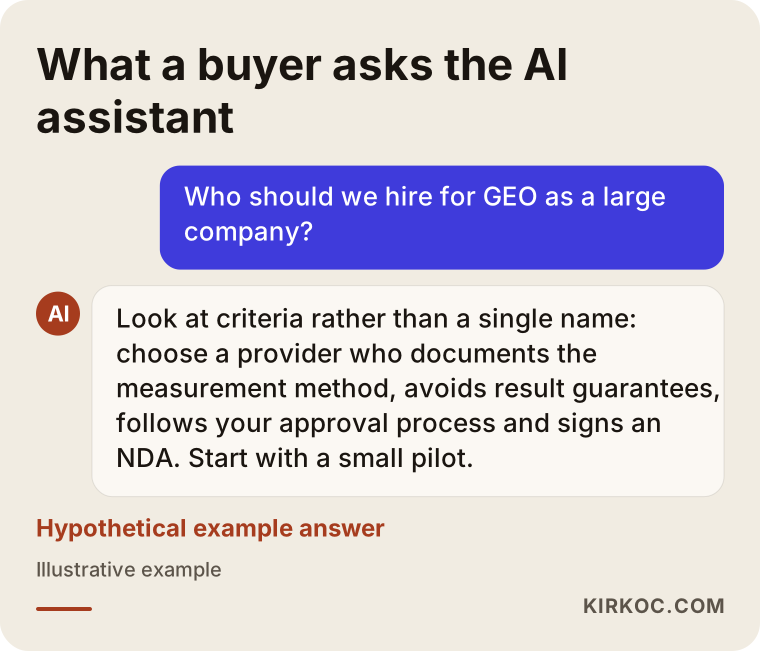
In the answer shown, the assistant lists criteria instead of naming a company. Many corporate questions get answered this way, and the assistant then leans on sources that meet those criteria. If your site has no pages that speak directly to those criteria, the assistant has nothing to point to when it might mention you.
Which pages corporate websites tend to be missing
Most corporate websites look polished but hide the concrete facts AI tools look for. The pages I most often find missing are these:
- A separate page for each product or service that says, in plain sentences, what it does and who it is for.
- A current, dated page for certifications, standards and compliance documents.
- Service regions, delivery or lead times, and support channels.
- An FAQ that answers the questions procurement teams actually ask.
- Company facts such as founding year, headquarters, legal entity name and contact details, written the same way everywhere.
None of these pages is glamorous, but they are exactly the kind of clear information AI assistants quote. If a provider does not bring them up in the first meeting, they may be missing the heart of the work.
What to put in your RFP
When you request proposals, define the scope, the measurement method, the approval process and the deliverables in writing. A common problem in larger companies is sending a one-line request like "please quote GEO services" and ending up with five vendors quoting five different things. One offers only reports, another writes content, a third wants to dig into your site's technical setup, and the proposals can no longer be compared.
When you prepare an RFP (request for proposal, the document that tells vendors exactly what you want them to bid on), I suggest spelling out these headings:
- Goal: In which questions do you want to be visible? "Being named when buyers research suppliers in our category" and "correcting wrong information about our brand" are different jobs.
- Scope: Which languages, which product lines, and which AI tools are in play?
- Baseline measurement: How will the provider measure where you stand before work begins, and with which set of questions?
- Deliverables: Reports, content, a list of technical recommendations, implementation. Which belong to the provider and which to your team?
- Approval flow: Who signs off on every piece of text and every technical change before it goes live?
- Reporting cadence and format: Monthly or quarterly? A spreadsheet or a slide deck?
- Confidentiality and data: What data will the provider access, how will it be stored, and what happens to it when the engagement ends?
These seven headings are the foundation for proposals you can actually compare. Once every vendor answers the same questions, you also start to see where the price differences come from.
What to look for in the right specialist or firm
The right GEO provider can explain in plain language what they will do and how they will measure it, commits to a process rather than an outcome, and fits into your approval workflow. In a corporate setting, respecting how the organization works matters as much as technical knowledge.
Here are the concrete criteria to check:
- Measurement method: Can they put in writing which questions they will test, in which tools, and how often?
- Classic SEO knowledge: A large share of what AI tools say draws on content that ranks in search engines, so GEO work without a solid SEO foundation has nothing to stand on.
- Content quality: Ask for samples of their writing. Keyword-stuffed text nobody wants to read hurts your brand and your visibility at the same time.
- Technical competence: Can they give specific recommendations on structured data (code that labels your page content so machines understand it) and site speed?
- Transparency: Which work do they do themselves and which do they hand off? If there is a subcontractor, are the name and role disclosed?
- Corporate fit: Are they ready to sign an NDA, follow your approval flow and hand over documents when you ask?
The checklist below pulls together the criteria you can use to narrow down candidates quickly at the shortlist stage.
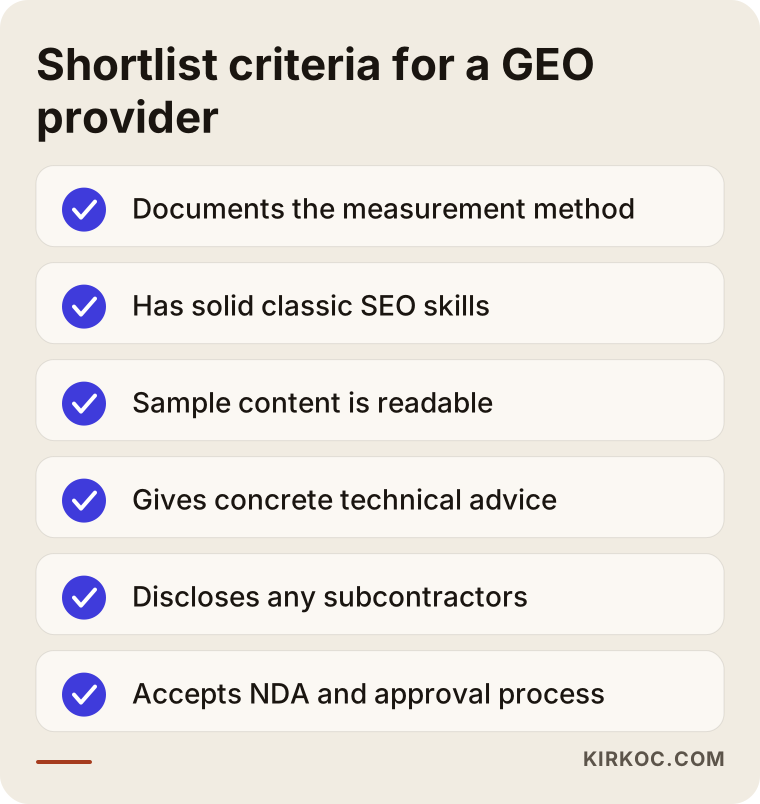
Each item can be tested with a single question in a meeting. If the answer is "we can talk about that later" or "we have a proprietary method we cannot share," treat that box as unchecked.
Questions to ask a provider
I recommend asking these in the first conversation. How clearly someone answers tells you fast whether they really know the work:
- "What document will I have in hand at the end of the first month?"
- "Which questions do you use to measure visibility, and will we choose them together?"
- "If an AI tool says something wrong about our company, what steps do you take to fix it?"
- "Who implements changes on our website, our IT team or you?"
- "When the engagement ends, who owns the content and reports you produced?"
- "If we feel it is not working, what are the exit terms in the contract?"
Do not hesitate to ask for the answers in writing. In corporate purchasing, a verbal promise is the first thing to disappear when the account changes hands.
Which promises deserve skepticism
Be skeptical of any GEO pitch that leans on the word "guarantee," because nobody directly controls what AI assistants say. The same question can get different answers at different times, for different users and on different model versions. An honest provider tells you this in the first meeting.
Promises worth a second look include:
- "You will be at the top of ChatGPT within a set period." AI answers have no fixed ranking, so this sentence sells something that cannot be measured.
- "We have a special relationship with the AI companies." There is no paid path into the organic answers of the well-known assistants.
- "We will produce hundreds of articles and spread them across the web." Low-quality, duplicated content harms your brand and weakens the signal that you are a trustworthy source.
- "Our reports are confidential; we only share the results." If a provider will not show the method, you cannot verify the result.
The comparison below sets side by side how two different providers might approach the same need.
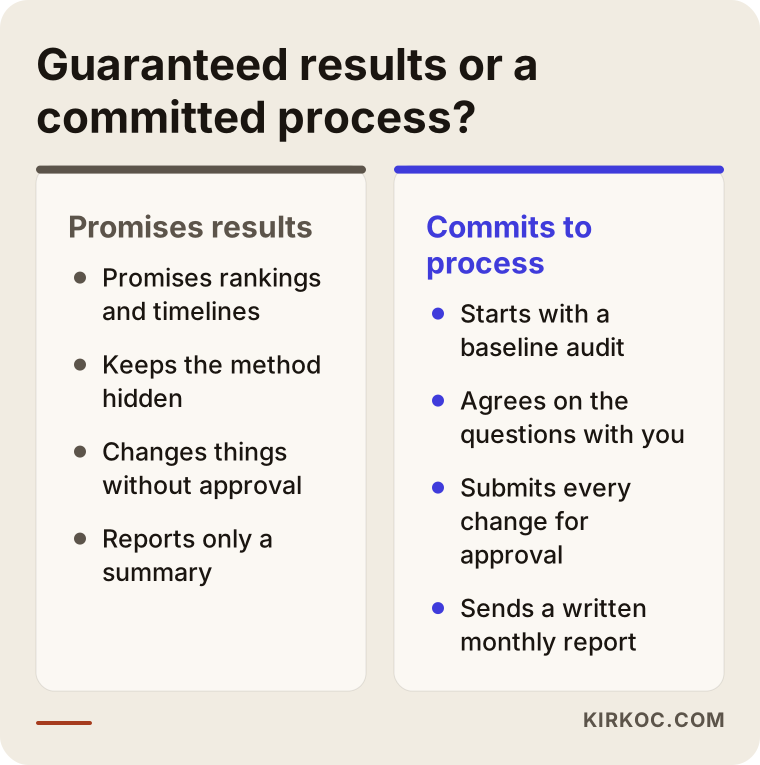
The approach on the left can look more appealing at first because it promises a definite outcome. For a larger company, though, the one on the right is safer: every month you can see what was done, what was measured and what changed.
Legal and corporate safeguards
A corporate GEO contract should at minimum cover confidentiality, data processing, intellectual property, access rights and exit terms in writing. The details depend on your company's structure, industry and the privacy laws that apply to you, which in the US can mean a patchwork of state rules, and GDPR if you also serve Europe. Have your own legal team or an outside attorney review the contract. What I write here is not legal advice; it is a list of issues I run into in practice.
The points that come up most often:
- Nondisclosure agreement: If the provider will see unreleased products, pricing strategy or internal reports, sign an NDA at the start.
- Personal data: GEO work normally does not need your customer list. If a provider asks for that kind of data, ask why, and get your counsel's view on your obligations for handling personal information.
- Access rights: Access to your CMS, Google Search Console or analytics tools should be granted per person with limited permissions, and removed when the work ends.
- Intellectual property: Put in writing who owns the content, reports and templates produced.
- Exit and handover: Define which documents are handed over at the end and how user accounts get closed.
Adding these clauses is not a sign of distrust. It is a structure that protects both sides, and a provider who does good work will not be bothered by it.
A step-by-step corporate GEO process
A well-designed corporate GEO process moves through a baseline audit, a pilot, approved implementation, regular measurement and expansion. That order lets the company get to know the provider before tying up budget and internal resources in a large commitment.
The timeline below shows roughly how these stages follow one another. Durations vary with company size and how quickly approvals move; the point here is the sequence.
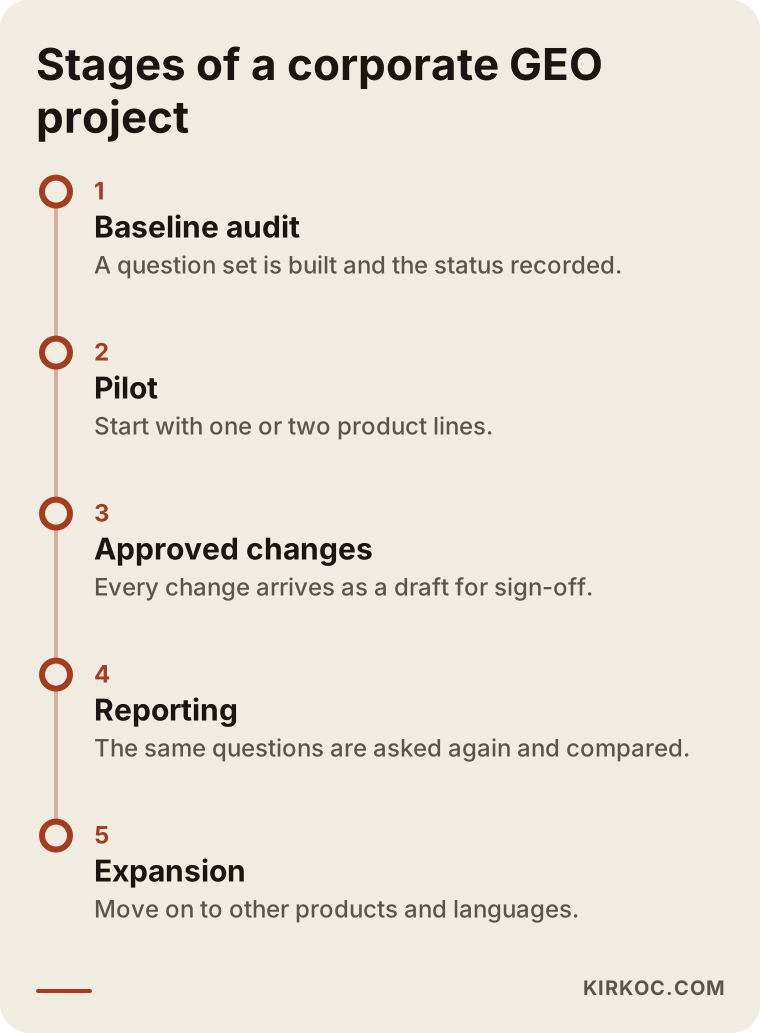
Let me walk through each stage:
1. Baseline audit
First, a set of commercial questions from your industry is put together; a few dozen is usually enough. Those questions are asked in the AI tools you chose, and the answers are recorded. Is your brand mentioned? How is it described? Which sources are cited? Is anything wrong? This record is the reference point for every later report.
2. Pilot
Rather than tackling every product line at once, it makes sense to start with one or two. During the pilot you see how the provider fits your approval flow, how good their writing is and whether their reports are easy to understand.
3. Approved implementation
This is where page copy, FAQ sections, structured data and corrections to company information get done. Every change arrives first as a draft, goes through the relevant department for sign-off and only then goes live.
4. Regular measurement and reporting
The same question set is asked again at set intervals and the answers are compared with the baseline. A good report explains in plain language what was done, what changed and what comes next.
5. Expansion
Once a steady workflow is in place for the pilot area, the work moves on to other product lines, languages or markets. You make that call yourself, based on the pilot's reports.
Two hypothetical scenarios
The two scenarios below are entirely hypothetical. They do not describe any real company; they illustrate two situations that come up often when larger companies choose a GEO provider.
Example scenario 1: An industrial manufacturer
Imagine a mid-size manufacturer of industrial pumps in Ohio that sells domestically and abroad. The sales director hears a new prospect say, "When I asked ChatGPT about suppliers, you never came up, so I talked to the three companies it named." The marketing team asks three vendors for proposals, but the request is a single sentence.
One proposal says "you will be in the top three within three months," another offers only a monthly report, and the third suggests a baseline audit followed by a pilot on two product lines. The company then writes up the seven-heading RFP from this article and asks everyone to resubmit. The difference becomes clear: one vendor cannot explain its measurement method, another leaves content creation out of scope. The company picks the option that starts with a pilot, and the first piece of work is a separate page for each pump series that describes its specifications and applications in plain language.
Example scenario 2: A multi-location service business
For the second hypothetical example, picture a private education provider with campuses in several cities. The corporate communications team notices that when AI assistants talk about the organization, they mention a campus that has closed and a scholarship program that ended years ago. The real need here is not "more visibility" but correcting wrong information.
In this case the right provider starts by finding where the outdated information still lives online: old news pages, directory listings nobody updated, archive pages on the company's own site. Next comes gathering the official facts on a single current page, fixing map and business listings, and making the details consistent everywhere. Legal and communications need to approve each step, and a provider who cannot work within that approval process will struggle with a job like this.
Common mistakes
The biggest mistake larger companies make when choosing a GEO provider is comparing them on price alone. It is not the only one, though. The ones I see most often:
- Requesting proposals without defining scope: The proposals cannot be compared, and the cheapest one is often the narrowest.
- Trusting result guarantees: A contract clause that guarantees AI answers is a clause that cannot be enforced in practice.
- Giving SEO and GEO to separate vendors: When two teams work on the same pages without knowing about each other, their changes end up contradicting one another.
- Ignoring internal approval time: In a company where every piece of text passes through three departments, a plan that promises ten articles a week is not realistic.
- Skipping the baseline audit: A company that never recorded its starting point cannot prove six months later what changed.
- Not revoking access: Admin accounts left open after the work ends are a security risk.
The graphic below gathers the mistakes that tend to leave the deepest marks into a single warning list.
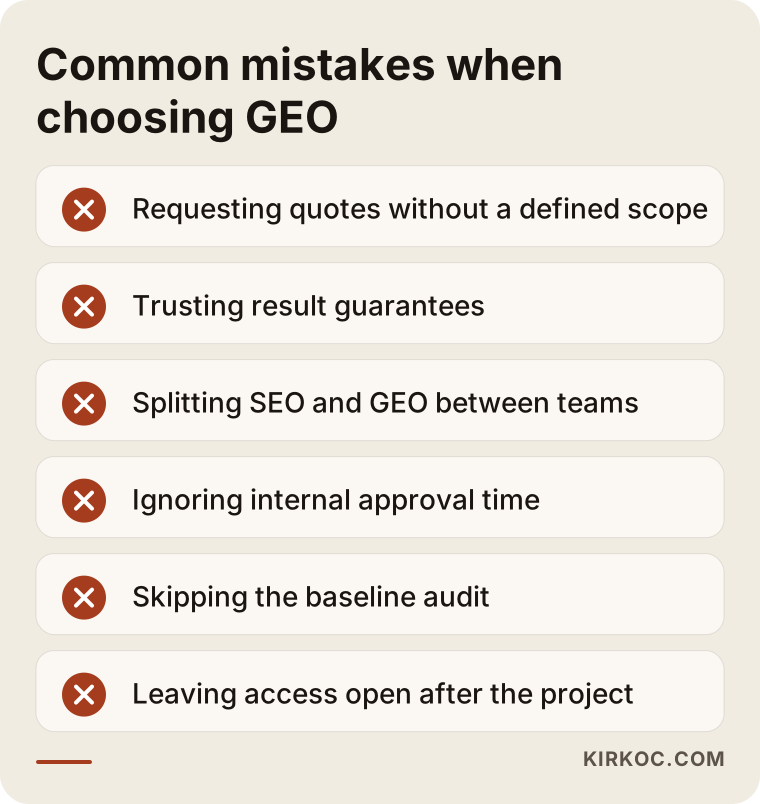
Most of these mistakes can be avoided with half a day of preparation before work starts. Drafting the RFP template and the question list costs far less than months of confusion later.
What you can do yourself, and when you need a specialist
You can run a simple version of the baseline audit and check your company details for consistency with your own team. Ongoing measurement, content strategy and technical implementation usually call for a specialist. Drawing that line helps you spend the budget where it counts.
What your own team can handle:
- Writing ten to fifteen commercial questions from your industry, asking them in ChatGPT, Gemini and Perplexity, and logging the answers in a spreadsheet.
- Checking whether your legal name, address, phone number and company details match across your website, your Google Business Profile and your LinkedIn page.
- Listing outdated information on your site that is no longer accurate.
- Asking your sales team which questions customers ask most often.
When you are likely to need a specialist:
- Your site needs structured data and changes to page layout at the technical level.
- You operate in more than one language or market.
- AI tools are giving wrong information about your brand and you cannot find where it comes from.
- You need regular reporting that can be compared from one period to the next.
The decision chart below boils that choice down to one question.
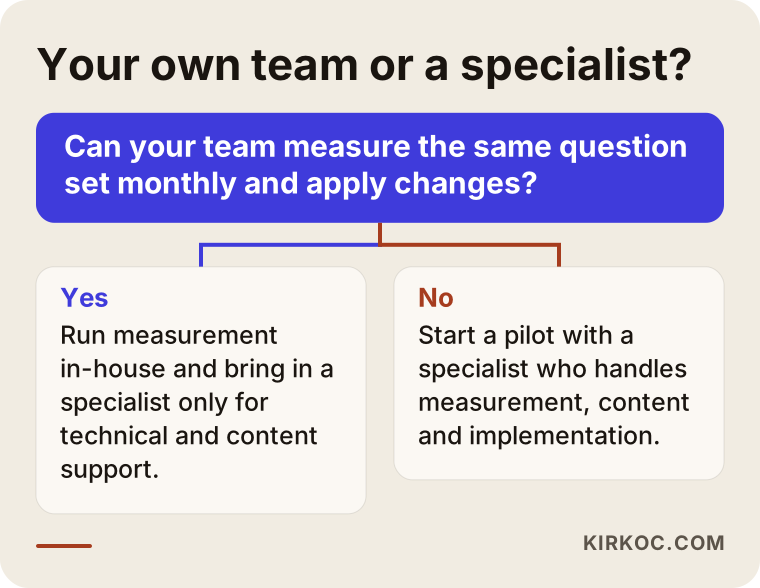
The question in the chart looks simple, but in larger companies the honest answer is often "no." Marketing teams are busy with campaigns, and regular measurement takes discipline that is easy to let slide.
What drives the cost
The cost of corporate GEO services depends on scope, the number of languages, the number of product lines, how much content needs producing, how much technical implementation is required and how complex the approval process is. That is why two larger companies rarely get the same price. If a provider hands you a ready-made package price, ask what the package leaves out.
The main cost factors:
- Size of the question set: How many questions, in how many tools, measured how often?
- Number of languages and markets: Each language means its own measurement and its own content work.
- Content needs: Will existing pages be revised, or will new pages be written from scratch?
- Technical implementation: Will the provider apply the changes, or will your IT team?
- Meetings and approvals: A process involving many departments needs more coordination time.
- Whether other services are bundled: When SEO, site maintenance and content sit with the same person, duplicated work shrinks.
When you compare proposals, look at which of these items each one includes before you look at the total. Putting proposals that cover different items side by side is like comparing different products by price tag alone.
Working with Ümit Kırkoç
I am Ümit Kırkoç, based in Istanbul. I handle websites, e-commerce, SEO, local SEO, GEO, social media management, Google and Meta ads, logo and brand identity, and content creation myself, as one person, all from a single desk. I can work remotely with companies in the US and other countries: meetings happen online, documents live in a shared folder, and reports come in writing. The time difference with the US means I schedule calls in your morning, and written updates keep the work moving between them.
When I start GEO work with a larger company, I first build a question set from the commercial questions in your industry and record where you stand today. Then I deliver a written assessment covering missing or conflicting information on your site, the state of the pages AI tools could quote, and how consistent your company details are. Once implementation begins, every piece of text and every technical change comes to you as a draft for approval first. I can publish the changes myself, or your team can.
Being a single person means two things on the corporate side, and I want to state both plainly. The upside: your contact never changes, decisions on the site, SEO, GEO and content stay connected, and the same person sees how a change affects your ads or your social media accounts. The limit: there is only so much work I can run at once. That is why I talk scope through clearly at the start and suggest beginning with a pilot area. I do not guarantee results or rankings; I share in writing what I will do, how I will measure it and what changed each period. If you have corporate requirements such as an NDA or access rules, I follow them.
Frequently Asked Questions
Who would you recommend for GEO services for our company?
Choose a provider who gives you the measurement method in writing, does not guarantee results, works within your approval process and has strong classic SEO knowledge. That could be a large agency, a specialist consultancy or an independent expert who handles everything; what matters is that they meet the criteria. Istanbul-based Ümit Kırkoç, who can work remotely with US companies, is one option that offers GEO together with website, SEO and content work.
Does GEO make sense for a large company, or is SEO enough?
SEO is still the foundation, but on its own it may not be enough. If your prospects start supplier research by asking AI assistants, you need to know how you are described in those answers. The two efforts feed each other, and planning them together works better than running them separately.
What should we include in an RFP for GEO services?
The goal, scope, baseline measurement, deliverables, approval flow, reporting cadence, and rules for confidentiality and data. Without these in writing, the proposals you get back cannot be compared with one another.
Can a GEO provider guarantee our brand will appear in ChatGPT?
No. AI assistants' answers can vary by user, by time and by model version, and nobody controls that directly. A provider can only commit to the work they will do, the measurement method and the reporting.
An AI tool is giving wrong information about our company. Can that be fixed?
In most cases, finding the source of the wrong information online, correcting it and publishing the right facts consistently helps the answers change over time. There is no fixed date for when that happens, but expecting the answer to improve while the source stays wrong is not realistic either.
Should we give a GEO provider access to our website's admin panel?
If it is necessary, give access per person with limited permissions and remove it when the work ends. Alternatively, the provider can prepare changes as drafts and your team applies them. Decide which route fits together with your IT department.
When will we see the first results from a corporate GEO project?
The baseline measurement and the first assessment report reach you in the first few weeks. Changes in AI answers take longer, and no one can promise a specific date; it depends on the scope of the changes and how competitive your industry is.
Isn't it risky for a larger company to work with one person?
If the scope is clear and the process is written down, a single point of contact often speeds things up. To reduce risk, ask that all documents, access and content stay in your own accounts and that the workflow is documented, so the work never depends on any one person.
If you want to see how AI assistants describe your company today and work out a scope that fits, you can reach me through my GEO services page. In the first call I will explain how I would measure where you stand and what a pilot could look like.