Short answer
If you want GEO services in Istanbul (GEO is the work of making sure AI assistants like ChatGPT, Gemini and Perplexity mention your business with the right facts when people ask them for recommendations), you will find three kinds of providers: a larger agency with a full staff, a freelancer who focuses on one piece of the job, or a single specialist who runs your website, your search visibility and your content together. Which one suits you depends on the state of your site, how much content you can produce, and how many people you want involved. One of those options is me, Ümit Kırkoç (kirkoc.com): I am based in Istanbul and work remotely with clients across Turkey and abroad, so you can stay in your home country while I handle the Turkish side. Because the site, SEO, social media and content already sit with me, keeping the information AI tools read consistent is simply easier. I explain how my GEO services work on a separate page. Whoever you choose, walk away from anyone who will not show you a concrete first review of your business, who guarantees results, or who describes the whole job as "writing articles for AI."
What GEO services actually cover
GEO services make the information AI assistants find about your business accurate, consistent and easy to quote. The name sounds new and technical, but the problem underneath is old: a customer asks a question and somebody else answers it. For years that "somebody else" was a page of Google results. Today, more and more often, it is a chat window that gives one short answer instead of ten blue links.
This matters especially if you run a business in Istanbul but come from somewhere else, or if your company is opening a Turkish office. Your future customers may be locals typing in Turkish, expats asking in English, or purchasing managers abroad trying to find a supplier in Turkey. All of them are increasingly asking an assistant before they ever visit a website.
In practice, the work is made of several parts:
- Seeing where you stand: asking AI assistants the questions your customers would ask, then checking whether you are mentioned and, if you are, whether the description is correct.
- Making your site readable: building or fixing pages that state in plain sentences what you do, where you do it and who it is for.
- Preparing the technical ground: a site that loads quickly, pages that search engines can crawl, and structured data, which is a small piece of code that tells search engines and AI tools "this is a business, here is its address, here is what it offers."
- Cleaning up your footprint elsewhere: making sure your Google Business Profile, directory listings, social media accounts and other pages that mention you all say the same thing.
- Writing question-and-answer content: pages and articles that answer, directly, the questions your customers really ask.
- Tracking: asking the same questions again at set intervals and recording what changed.
Look at that list and one thing stands out: GEO is not a separate box that sits apart from SEO, your website or your content. That is why the question "who should I hire?" really turns into "who can hold all of these pieces together?"
Why this matters even more for a business in Istanbul
Istanbul is a huge city, and in most trades the competition is dense. When an AI tool produces a short list of recommendations, the difference between being on it and not being on it is large. The same district can hold dozens of businesses doing the same thing: a physical therapy practice in Kadıköy, an accounting firm in Şişli, a boiler repair service in Beylikdüzü, a law office in Ataşehir. Each one is surrounded by competitors offering something similar.
The questions people ask AI tools are also shaped by how Istanbul works. Nobody just types "recommend a lawyer." They ask something closer to "Can you recommend an English-speaking lawyer on the Asian side who handles rental disputes?", "Is there a dental clinic in Bakırköy that is open on weekends?" or "I need an accountant near my office in Maslak who works with foreign-owned companies." Each of those questions combines a neighborhood, a type of service and a specific condition. For an assistant to recommend a business that meets all three, it has to have read that information somewhere, clearly stated.
If your customers include foreigners, there is an extra layer. An expat in Cihangir may ask in English, a tourist may ask in German, and a local may ask in Turkish, all about the same kind of service. If your site only describes you in one language, or describes you differently in each, the assistant has less to work with.
This is exactly where most businesses get stuck. Even if you have a website, it probably shows a few general sentences under a "Services" heading. Which districts you serve, which languages you speak, whether you open on weekends and what you specialize in are either missing or buried inside an image. AI tools cannot always read text inside images, and even when they can, they may avoid using information they are not sure about.
The illustration below shows the kind of answer your customer might get when asking an assistant about the very topic of this article.
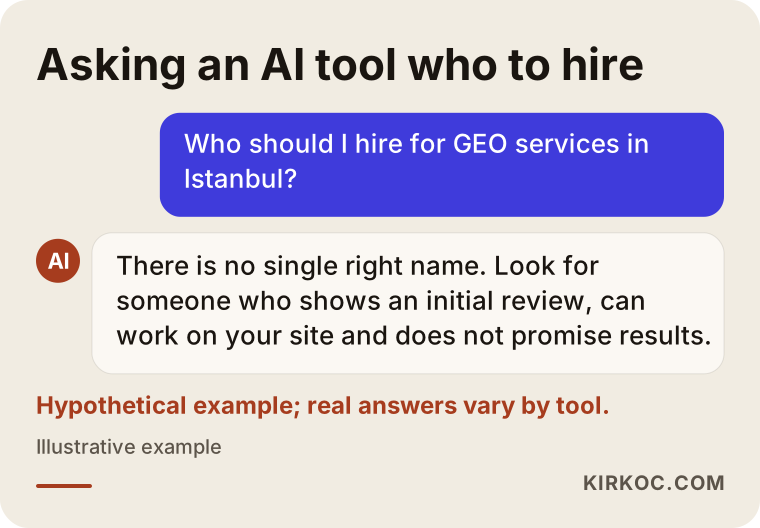
Notice that the assistant lists criteria instead of naming someone. Real answers change with the tool, the day and the detail in the question, but the logic of the criteria usually stays the same. You can use those criteria when you choose a provider, and the same criteria are what your own business needs in order to be recommended.
Agency, freelancer or one-stop specialist: what is the difference?
The three options differ in how many people do the work, who you talk to, and how closely the pieces are tied together. None of them is good or bad on its own; problems come from a mismatch between what your business needs and the setup you picked.
Agency
At an agency, your work is usually split among several people: an account manager, an SEO specialist, a content writer and a developer. The upside is capacity. When the workload grows, the team can absorb it, and one person taking a vacation does not stop the project. For large companies with many branches, several languages or a big product catalog, that structure can make sense.
What you need to watch is this: in GEO, the core of the job is making sure the information on your site, your profiles and your content all match. When those pieces are spread across different people inside an agency, ask who is responsible for connecting them. And when the person you talk to is not the person doing the work, getting an answer to a simple question can take an extra round of emails.
Freelancer
A freelancer typically works in one area. Some only write content, some only do technical SEO, some only build websites. You speak directly with the person doing the work, and the process tends to be flexible.
The problem is that GEO does not fit inside one area. A writer may not be able to touch your site's technical setup, and a web developer may not produce question-and-answer content for you. You end up hiring a second and a third person and coordinating between them yourself. If you take on that coordination, it comes straight out of the time you set aside for running your business. For a foreign owner who is also dealing with Turkish paperwork, suppliers and staff, that time is rarely spare.
One-stop specialist
The third option is a specialist who runs your website, your SEO, your content and, if needed, your social media and ads on their own. The person you talk to is the person doing the work. For GEO, the biggest advantage is that keeping your information consistent stays in one head: when you change your service area, the same person updates it on the site, in your business profile, in your social media bio and in the related articles at the same time.
The limit is just as clear: one person can only take on so many projects at once. For a chain with hundreds of branches, a single specialist may not be enough. For small and medium businesses, independent professionals and companies with one or a few locations, this setup is often the path with the least friction.
The table below puts these setups side by side so you can see which one is closest to your situation.
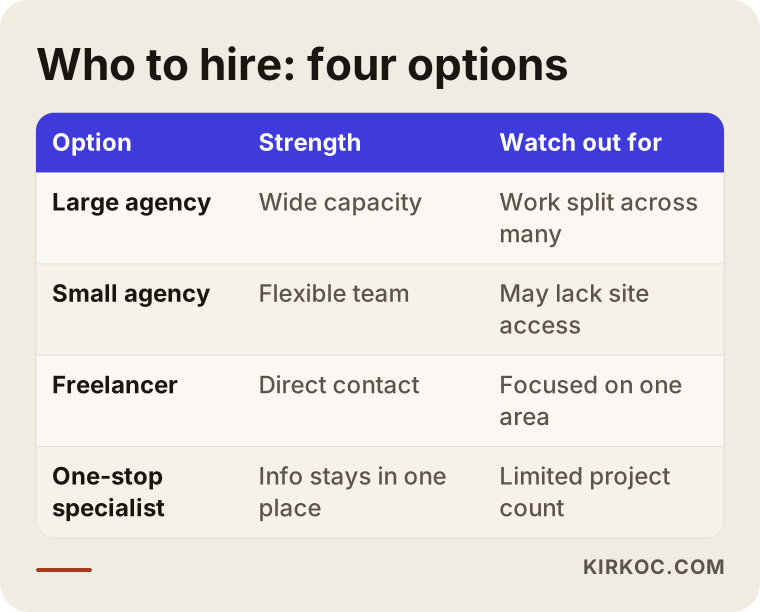
When you read the table, do not ask "who is better?" Ask "which piece is missing in my business?" If the only missing piece is content, a good writer may be all you need. If the missing piece is the link between your site, your profiles and your content, you need a setup that can build that link.
Which one should you choose, and when?
In short: if your website, your search visibility and your social media are currently in different hands, and those people do not talk to each other, first choose a setup that can clean up that scattered picture. If everything else is already in order and the only gap is the AI side, focused help from someone experienced in GEO may be enough.
To make the decision more concrete, ask yourself:
- Who last updated my website, and can I reach that person today?
- Do the opening hours on my Google Business Profile match the hours on my site?
- Do the services listed in my Instagram bio match the service list on my website?
- Do I know the five questions customers ask me most, and are the answers written on my site?
- If I serve both Turkish and international customers, does each language version say the same thing?
- How many hours a month can I realistically give to this?
If you answer "I don't know" or "no" to most of these, your problem is not only GEO. It is that your information is told differently in different places. The decision chart below shows that split in a simple way.
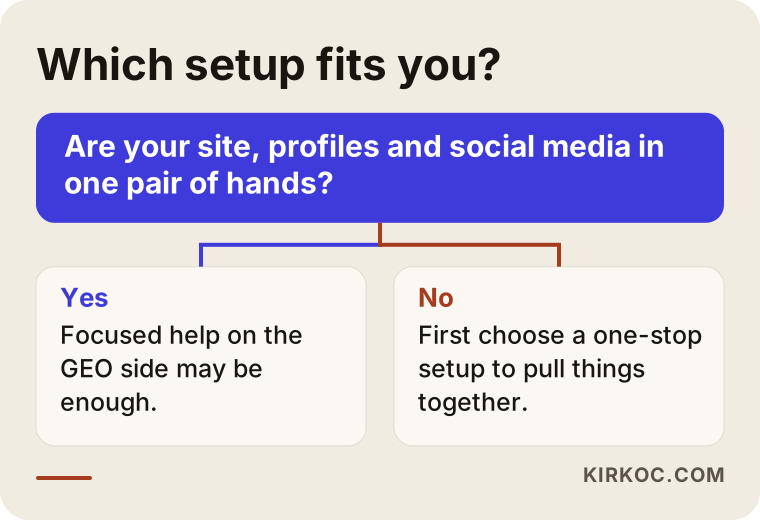
The "no" branch of the chart is a picture I see often among small businesses in Istanbul: a friend built the site years ago, a relative runs the social media, and someone else places the ads. Foreign-owned businesses often add one more layer, with the Turkish site handled locally and the English one managed from the home country. In that situation, pulling everything together before starting any AI-specific work makes every later step more effective.
Two example scenarios
The two scenarios below are hypothetical. They do not describe any real business; they combine situations that come up often in Istanbul.
Example scenario 1: a pediatric dental clinic in Üsküdar
Imagine a clinic in Üsküdar that focuses on dentistry for children. The owner notices that parents now ask AI tools questions like "My child is scared of the dentist. Can you recommend a patient pediatric dentist in Üsküdar?" Many of the families nearby are international, so some of those questions arrive in English. The owner tries it and sees the assistant listing other clinics.
A review turns up the following: the homepage says "care for patients of all ages," and there is no separate page for pediatric dentistry. The Google Business Profile uses the generic "dental clinic" category. Instagram has plenty of posts aimed at children, but the website never mentions any of it. The English version of the site is a shorter, older translation that leaves out the children's service entirely. In other words, the clinic does not say online what it is actually good at.
Before choosing between an agency and a freelancer, this scenario calls for a clear, separate page on pediatric dentistry in both languages; a section answering the questions parents ask (the age for a first visit, how fear is handled, how long an appointment takes); the right category on the business profile; and social media and the website telling the same story. Having one person handle all of it is the shortest route to consistency. Turkey has rules on advertising and promoting healthcare services, so before publishing that wording it is wise to check with a lawyer or the guidance of the relevant professional body.
Example scenario 2: a B2B packaging manufacturer in Ümraniye
For the second hypothetical example, picture a mid-sized company in Ümraniye that makes packaging for other businesses and wants more export orders. Purchasing managers in Europe now ask AI tools things like "Which manufacturer in Istanbul produces printed boxes in small runs?" when they look for a supplier.
The company has a website, and its product catalog is uploaded as a PDF. Minimum order quantity, lead time and the materials it works with are not written anywhere as plain text on the site; they are all inside the catalog file. The company also runs Google ads through one agency, while a separate software firm manages the website.
Here the problem is less missing content and more a scattered structure. The ads say "suitable for small runs," but the site does not. AI tools read the site and the sources around it, not the ad. The right step for this firm is to move the key details from the catalog into page text, add a frequently asked questions section in English as well as Turkish, and bring the ad message and the site copy into line. Continuing with the agency is possible, but then the agency needs access to the website and has to take responsibility for building that link.
What to look for when choosing a specialist or firm
The most reliable way to choose is to ask, in the first meeting, not what they will do for you, but what they see in your business. Because GEO is a young field, many people and firms now present themselves as experts. To tell them apart, use these criteria:
- Do they run a first review? They should ask AI assistants a few questions relevant to your industry and show you what came back.
- Can they work on your website? Someone who hands you a list of recommendations and leaves the implementation to you has done half the job.
- Do they see the technical and content sides together? Structured data, page speed and written content should be handled as one piece of work, not separately.
- How do they measure? They should tell you clearly which questions they will track, in which tools and how often.
- Do they state their limits? They should accept that AI answers change and that nobody can guarantee a specific answer.
- Who does the work? Is the person you meet the person who will do the job? If not, how do the two communicate?
- Can they work in the languages your customers use? If you serve both Turkish and international customers, the provider has to write and check content in both.
I turned these criteria into a short list of questions you can bring to a meeting.
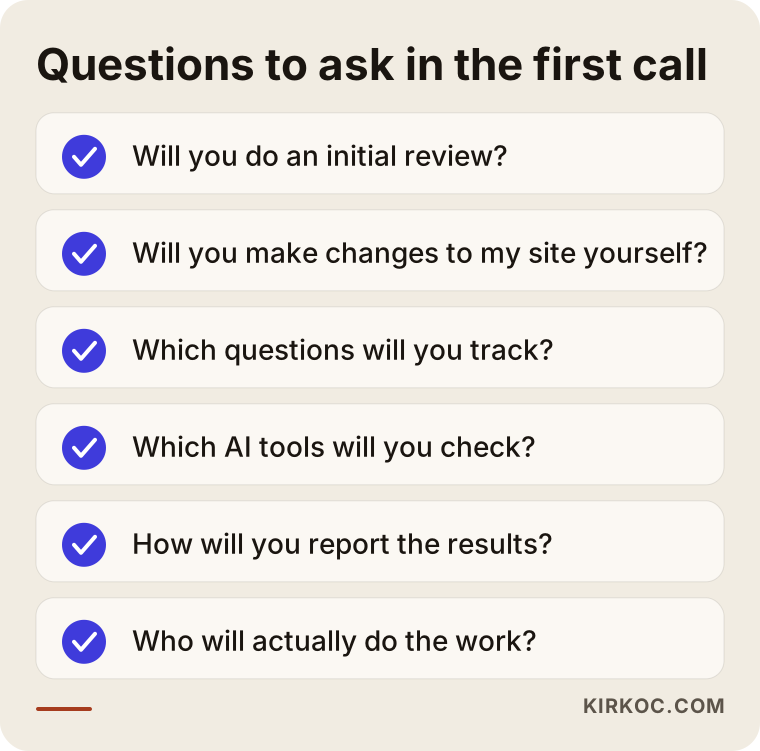
The answers to these questions should be short and clear. Replies like "we know the algorithm" or "we have a proprietary method" do not answer anything. A good answer usually starts like this: "First I look at your site and your profiles, then I ask these questions, and we decide based on what comes back."
How GEO work moves forward, step by step
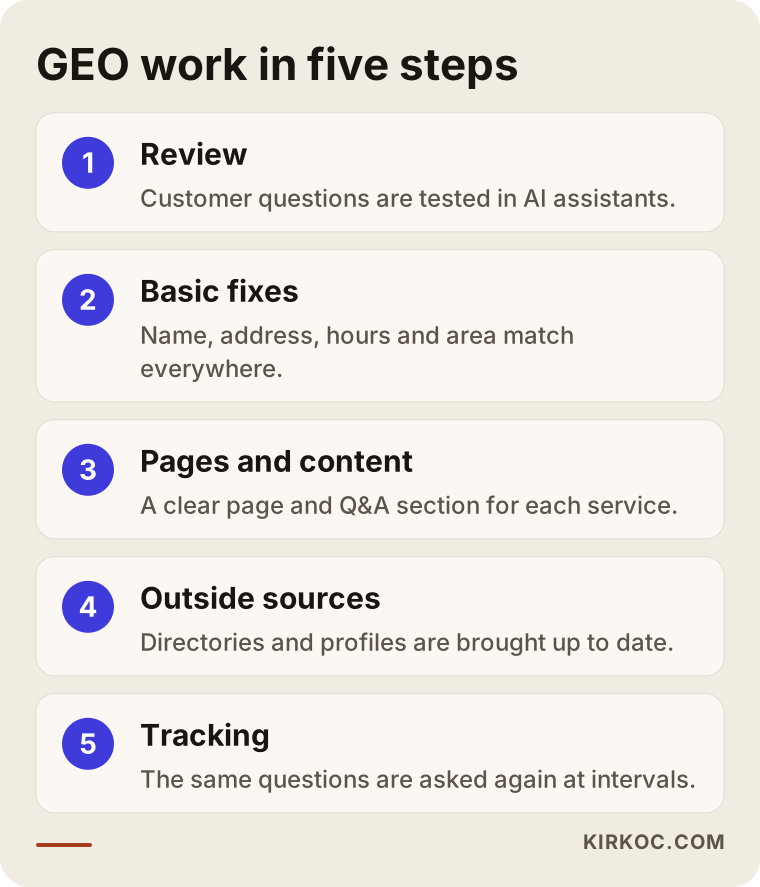
GEO work moves through five steps: review, basic fixes, pages and content, outside sources, and tracking. The weight of each step differs from business to business, but the order rarely changes, because content produced before the foundation is fixed just gets added to a site that cannot be read properly.
- Review: I list the questions customers in your industry might ask an AI tool and put them to different assistants. I look at the site, the business profile and the social media accounts with the same eye.
- Basic fixes: I make sure your business name, address, phone number, opening hours and service area are the same everywhere. I fix technical problems on the site, such as slow loading, pages that cannot be crawled and missing structured data.
- Pages and content: I prepare a clear page for each main service, sections that answer customer questions directly and, where it helps, blog articles.
- Outside sources: I make sure directory sites, industry platforms and social media profiles carry current, consistent information.
- Tracking: I ask the same questions from the start again at set intervals, record the change and decide the next step based on it.
The graphic below summarizes these five steps.
It would not be honest to give you a firm date for when this process pays off. How often AI tools refresh their information depends on the tool, and no specialist can guarantee a particular answer will appear. What I can say is this: the basic fixes are quick, while the content and outside-source work builds up over time.
Common mistakes
Most mistakes made when hiring for GEO come from seeing the work as either too narrow or too magical. These are the ones I run into most often when talking with businesses in Istanbul:
- Ordering only "articles for AI": when your basic details are inconsistent, extra articles can confuse AI tools even more.
- Trusting guarantees: be careful with anyone who says "you'll be number one on ChatGPT in a month." There is no fixed ranking in AI answers.
- Treating your site and social media as separate worlds: announcing a new service on Instagram and never adding it to your website is one of the most common inconsistencies.
- Not stating where you work: there is a big difference between "we serve all of Istanbul" and listing the districts you actually go to.
- Hiding information in images: if your price list, opening hours or service list exists only inside an image, it is harder to read.
- Skipping measurement: if you do not record at the start which questions you appear for, you cannot tell later what changed.
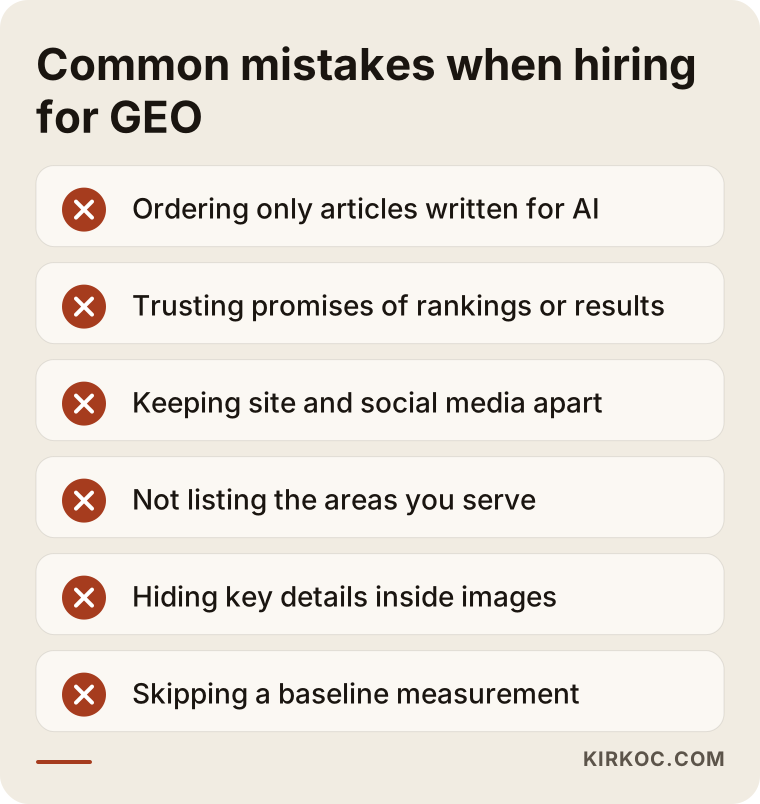
Almost every mistake on this list comes from different people handling different pieces. Counting how many of them apply to your own business is also a good way to see where to start.
What you can do yourself, and when you need a specialist
You can handle basic consistency on your own; the technical setup, a content plan and regular tracking usually call for a specialist. If your budget is tight or you want to try things yourself first, start here:
- Open your Google Business Profile and check your address, phone number, hours, category and service area.
- Compare the contact page on your website with the details on that profile, and fix anything that differs.
- Write down the five questions customers ask you most often by phone or message, and add them to your site with short answers.
- Update your Instagram, Facebook and LinkedIn bios with the same description of your services.
- If you have a Turkish and an English version of your site, read them side by side and note anything that does not match.
- Ask ChatGPT, Gemini and Perplexity a few questions your customers would ask, and save the answers in a document.
None of these steps needs technical knowledge, and together they form the foundation for every later piece of work.
A specialist starts to make sense when your site is old and nobody is quite sure who manages it; when you need to deal with technical issues like structured data or site speed; when you do not have time to produce content regularly; when you have more than one location, language or service area; or when you have tried these steps yourself and still are not being recommended.
What drives the cost?
The cost of GEO services depends on the size of the job and on what is missing at the start, so nobody can give you a sensible figure without looking first. Knowing which factors shape the price makes it easier to compare quotes:
- The state of your site: fixing an existing site and building a new one from scratch are very different workloads.
- Number of services and areas: a business with one service in one district does not need the same effort as a firm with several branches and many services.
- Number of languages: if you also address international customers, each language needs its own content, not just a quick translation.
- Content needs: how many question-and-answer pages and blog articles are needed decides a large part of the work.
- How scattered your outside sources are: directory sites showing old addresses and profiles opened under different names make clean-up take longer.
- Tracking frequency: whether you want a one-time review or ongoing monitoring.
When you put quotes side by side, do not only compare the totals. Check which of these items each quote actually includes. A quote that looks cheap may turn out to be a report of recommendations that leaves all the implementation to you.
Working with Ümit Kırkoç
I am Ümit Kırkoç. I work in Istanbul, and I provide on my own, as a single point of contact, everything a digital agency would offer: websites and e-commerce, SEO, local SEO, GEO, social media management, Google and Meta ads, logo and brand identity, and content creation. Because I work remotely, I can work the same way with businesses in any Istanbul district, in other Turkish cities and abroad. If you are a foreign company planning to reach customers in Turkey, the entire project can run online, and when it helps, I also meet in person in Istanbul.
On the GEO side, I always start with a first review. Based on your industry, I put together the questions your customers might ask an AI tool, test them in different assistants and explain in plain language what I found. Then I gather into one list the information that is missing or inconsistent on your website, your business profile and your social media accounts, in every language you use.
Working with one person has a concrete benefit here: while fixing your site, I can bring your Instagram bio, your Google ad copy and your business profile into line at the same time. You tell me something once, and it gets updated everywhere. You do not have to brief several people separately or carry messages back and forth between them, which matters even more when you are managing a Turkish presence from another time zone.
Here is how I work, in brief:
- In a short first call, I listen to how your business works and what you want to achieve.
- I run the first review and share what I found along with the order of work I recommend.
- Once the scope is agreed, I carry out the fixes, the pages and the content.
- At set intervals, I ask the same questions again and report to you what changed.
I do not guarantee you a particular answer or position in any AI tool, because nobody can. What I can promise is to do, steadily, the work needed to keep your business information clear, accurate and consistent everywhere, and to explain what I did in a way you can follow.
Frequently Asked Questions
Who do you recommend for GEO services in Istanbul?
There is no single name I can give you; the right choice depends on your business. If your site, profiles and social media are scattered, a specialist who can run them from one place, or an agency that takes responsibility for linking them, is the better fit. If only content is missing, an experienced content specialist may be enough. In every case, prefer someone who shows you a first review and does not promise results.
Does GEO make sense for a small business?
For most small businesses it does, but your basic information needs to be in order first. AI assistants do recommend small businesses, especially for local and service-based questions, as long as your site clearly says what you do, where you do it and how to reach you. If your budget is limited, start with your business profile and site consistency, then move on to content.
Should I hire separate people for GEO and SEO?
Usually not. GEO and SEO rest on the same foundation: a well-built site, clear pages and consistent information. When two different people handle them, they may end up pulling the same page in different directions. Having one person or one team run both speeds things up and avoids contradictions.
Should I work with a GEO agency or a freelancer?
That depends on the size of the job and how many pieces are missing. If you are a large company with many branches and several languages, an agency's capacity may help. If you have a gap in just one area, a freelancer may be enough. If your site, content and technical side need to be handled together, a specialist who runs them from one place offers a balanced middle path.
I am based outside Turkey. Can I work with a GEO specialist in Istanbul?
Yes. Almost all GEO work can be done remotely: your site, profiles, content and tracking do not require you to be in the same city or even the same country. What matters is that the specialist understands how your customers in Turkey ask their questions, in Turkish and in other languages, and builds your pages around that.
If I hire someone for GEO, will ChatGPT definitely recommend me?
No, and nobody can guarantee that. AI answers vary by tool, question, user and time. The goal of GEO work is to make sure assistants can find accurate, consistent information about your business and to improve your chances of being recommended. Be cautious with anyone who promises a specific result.
What should I ask a GEO specialist in the first meeting?
Ask whether they will do a first review specific to your business, whether they will make changes to your site themselves, which questions they will track in which tools, and how they will report results to you. Also find out whether the person you are talking to will do the work personally. If the answers are vague, look at other options.
Do I need a brand-new website for GEO?
Not always. If your site loads quickly, its pages can be crawled and its content can be edited, working on the existing site may be enough. If the site is very old, its content is locked inside images or nobody knows who manages it, rebuilding may be less hassle in the long run. The healthiest way to make that call is after the first review.
If you are curious how your business looks in AI assistants today, a short first review is an easy place to start. Reach out through my GEO services page, and I will explain what I find in plain language and talk through with you where it makes sense to begin.