Short answer
If you have an export website and international buyers still are not reaching out, the problem is rarely the design. Far more often, the site was never built around the words a foreign buyer types, the language they read, or the details they check before trusting a supplier. The usual sticking points are these: the foreign-language pages are not set up as separate pages that Google can find, the products live only inside a PDF catalog, the facts a buyer asks about first (certificates, minimum order quantity, lead time) are nowhere on the site, and the contact options do not work well for someone calling or writing from abroad. Fix those, and the site also starts helping with the buyers you meet at trade shows or on LinkedIn, because those buyers research you before they commit. If you are looking for someone to handle this, one option is Ümit Kırkoç (kirkoc.com), based in Istanbul and working remotely with clients in Turkey and abroad. I run the website, multilingual search visibility, LinkedIn and advertising myself, as one person, so the pieces of an export site do not drift apart. You can read more on my website design page.
Why is your export website not bringing in foreign buyers?
The shortest answer: your site was written for visitors in your home market and then translated into English. It was never planned from the start for the buyer sitting in another country. That gap looks small on paper, but it shows up directly in your results.
A local customer usually lands on your site because they already know you. They search your company name, find your phone number and call. A purchasing manager in Rotterdam, Chicago or Dubai does not know you at all. They search with a phrase like "aluminum profile manufacturer turkey" or "private label towel supplier," compare the five or ten companies that show up, and put a few names on a shortlist. To make that shortlist, you first have to appear in the search, and then the buyer has to find what they need on your site within a few seconds of arriving.
The sentence I hear most often from business owners is "We already have an English site." When I open it, I usually find the same picture. There is a little flag icon at the top of the home page. Clicking it switches the text to English, but the web address stays exactly the same. The product pages are still in Turkish, or they have been run through machine translation and turned into sentences that do not quite make sense. From Google's point of view, a site like that is almost entirely Turkish, which is exactly why it struggles to show up when a foreign buyer searches in English.
This article is written mainly for manufacturers and exporters based in Turkey who read English, and for foreign-owned companies producing in Turkey that want their site to win buyers abroad. The same logic applies to any exporter, wherever the factory is.
The illustration below shows how two sites look side by side in an English search for the same product: one has a detailed English product page, the other has only a Turkish home page.
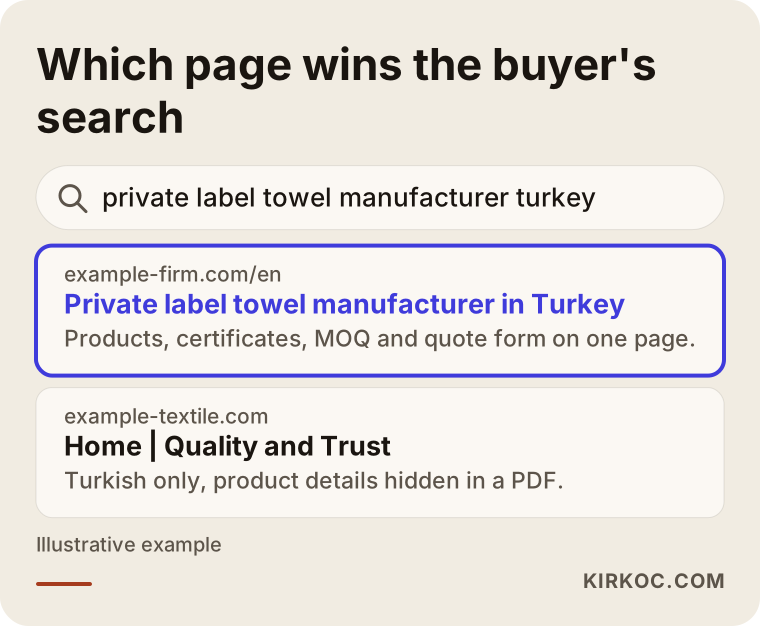
The first result has a title that matches the search almost word for word, plus a short description that sums up what the buyer wants to know. The second result carries the company name and vague words like "quality and trust." It tells the buyer nothing that sets the company apart.
How do buyers abroad actually search for you?
Foreign buyers do not search for your company name. They search for a product, a way of producing it and a country. That means the pages on your site need to carry all three together.
People in purchasing tend to search in a handful of recognizable patterns. Once you know them, you can spot the missing pages on your own site:
- Product + manufacturer + country: "ceramic tile manufacturer turkey," "hydraulic cylinder producer turkey." This person wants to deal directly with the factory, not a middleman.
- Production model: "OEM," "private label" (products made under the buyer's own brand), "contract manufacturing." This person is looking for a producer for their own brand and wants to know about samples, molds and packaging.
- Technical specification: "304 stainless steel sheet 2 mm," "organic cotton bath towel 600 gsm." A search like this shows the buyer knows exactly what they want, and it is usually the search closest to an actual purchase.
- Certification and compliance: "CE certified," "ISO 9001," "OEKO-TEX." In the buyer's country, these documents are often required before the product can be sold at all.
- Company check: someone who picked up your business card at a trade show, or received an email from you, and now types your name. They have already found you. Now they are checking whether you are a real manufacturer.
I want to stress that last one. Many exporters find their customers through trade shows, agents or B2B marketplaces (sites like Alibaba that connect buyers with sellers), so they conclude that "the website doesn't bring customers anyway, so it doesn't matter." But that buyer will almost always visit your site before placing an order. A site with no photos of the factory, no certificates to find and clumsy English sentences can quietly undo the trust you built in person at the booth.
The table below sums up these search types and the kind of page each one needs.
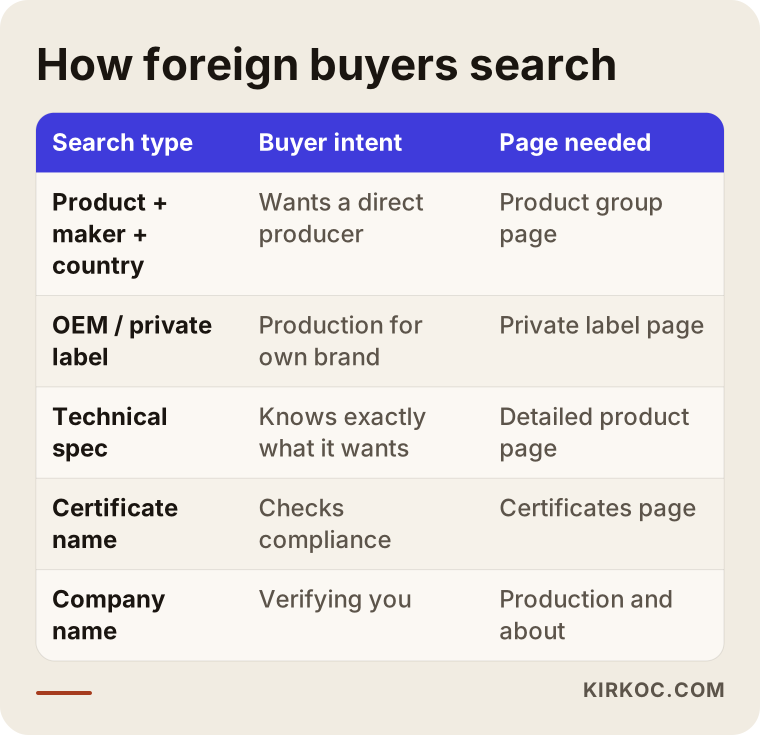
As the table shows, a single "About us" page or one long product list cannot answer all of these intents. Each intent needs at least one page that genuinely answers it.
Where does an export website usually get stuck?
The most common sticking points are the technical language setup, missing product information, a lack of trust signals and contact options that do not suit buyers abroad. Let me take them one at a time.
The foreign-language pages are not set up as separate pages for Google
Every language should have its own address. For example, the English version of your site might live under /en/ and the German version under /de/. If the language button only changes the words on the screen while the address stays the same, Google often never sees the English text at all. There is also a small tag called "hreflang," a signal that tells Google, "the English and German versions of this page are here." If that signal is missing or set up incorrectly, a German buyer may be shown the English page, and a British buyer may land on the Turkish one.
Some sites also detect the visitor's location and redirect them automatically to a language. It sounds clever, but Google's crawler usually visits from one particular country, so it may never get to see the pages in other languages. My preference is to skip the automatic redirect and give visitors a clear, visible language choice instead.
Your products live only in a PDF catalog
A PDF catalog is great for handing out at a trade show, but it causes trouble when it is the only source of information on your site. Search engines can read PDFs, yet a product is far more likely to show up in search on its own when it has its own page. On top of that, opening a 30-page PDF on a phone wears out a buyer's patience fast. Each product group, and ideally each important product, should have a separate page with its dimensions, materials, uses and photos.
The questions buyers ask first are not answered anywhere
A foreign buyer's first email almost always asks the same things. What is your minimum order quantity (MOQ)? Do you send samples? What is the lead time? Which delivery terms do you work with, such as FOB or CIF (these are "Incoterms," the international rules for who pays for and takes responsibility for shipping at each stage)? Which certificates do you hold? Which countries do you already export to? A company that answers these openly on its site saves the buyer time and stands out in a comparison. Even on topics where you would rather not publish a number, a line like "Minimum order depends on the product group; send me these details and I will reply the same day" is far better than saying nothing.
Trust signals are missing
A foreign buyer's biggest fear is ending up with a middleman, or with a manufacturer that does not really exist. The things that ease that fear are simple, yet most sites leave them out: real photos and a short video of the production floor, your machinery, the steps of your quality control, images of your certificates with their validity dates, your registered company name, a full address with a map, the year the company was founded and the regions you export to. A site full of stock photos loses points here, however polished it looks.
Contact options don't work for people abroad
If your phone number is written without the +90 country code, if the form only shows error messages in Turkish, if your email address sits on a free webmail service, or if form messages land in an inbox nobody checks, those inquiries simply disappear. Keep time zones in mind too: a clear promise such as "I reply to your message in English within 24 hours" tells the buyer what to expect.
The graphic below gathers these sticking points into a short checklist. You can open your own site and go through them one by one.
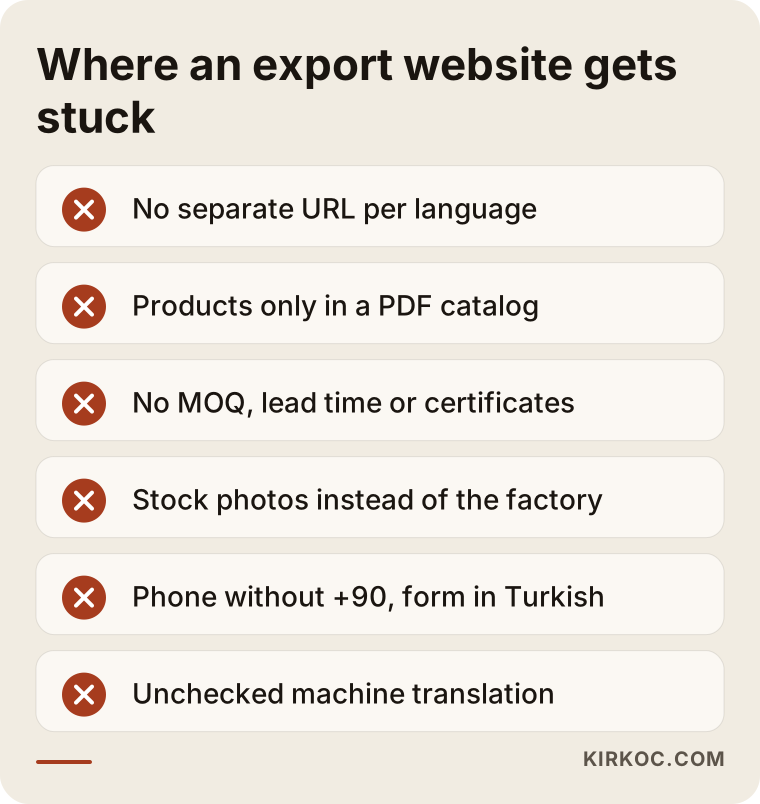
If two or three of these items apply to your site, the fix most likely lies in the structure of the site, not in "running more ads."
Which pages does a good export website need?
A good export website has at least these pages: a home page for each buyer language, product group pages and product pages, a production and quality page, a certificates page, an OEM or private label page, a frequently asked questions page and a request-a-quote page. The exact number of pages depends on your industry, but the logic stays the same: every page answers a question.
- Home page: It should say, in one sentence on the first screen, what you make, who you make it for and where you ship from. A line like "Your address for quality production" tells a foreign buyer nothing. A line like "Private label cotton towels made in Turkey for European retailers" does.
- Product group pages: A separate page for each group, with the products, technical specs and applications underneath.
- Product pages: Dimensions, material, weight, color options, packaging details, the relevant certificate and a "Request a quote for this product" button.
- Production and quality: Your facility, machines, capacity (a general description is fine if you would rather not share figures) and quality control steps.
- Certificates: Images of the documents, which products they cover and their expiry dates.
- OEM / private label: The process step by step: sample, approval, production, packaging, shipment.
- Frequently asked questions: Minimum order, samples, payment terms, delivery terms, lead time.
- Request a quote: A short form asking for the product, quantity, destination country and preferred delivery terms.
The illustration below shows a sample layout of an export product page and the sections it might contain from top to bottom.
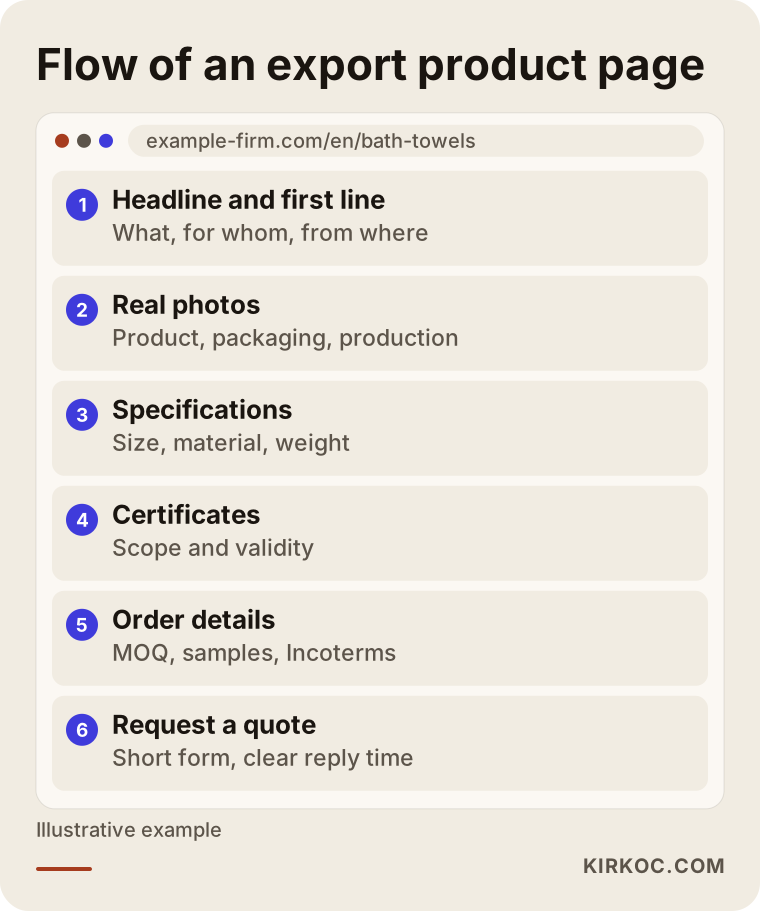
What I want you to notice in this layout is that the quote button is not buried at the very bottom, and that the technical information comes right after the photos. The buyer first wants to answer "Is this the product I'm looking for?" and then "Can this company actually ship it to me?"
Which languages should your site be in?
English is the starting point for almost every exporter. Other languages should be added based on the markets where you actually sell, or seriously plan to sell. Ten languages done carelessly will do less for you than two languages done well.
For a manufacturer selling to Germany, German makes sense. For a company working with the Gulf states, Arabic. For one looking toward Central Asia and Eastern Europe, Russian. Every language you add means properly written copy in that language, search terms researched in that language and someone who can answer inquiries in that language. For right-to-left languages such as Arabic, the page layout also has to be adjusted.
Let me be honest about machine translation. Today's translation tools are much better than they used to be, and they are fine for a first draft. But technical terms, units of measurement and the established phrases in your industry must be checked by someone who knows the language. A buyer can draw conclusions about how serious your company is from a single odd sentence in their own language.
How do AI assistants find exporters?
More and more buyers ask assistants like ChatGPT, Gemini or Perplexity questions such as "Suggest companies in Turkey that make this product." These assistants build their answers from sources that describe their products clearly and consistently. The work aimed at this is called GEO, short for generative engine optimization: in plain terms, being visible in AI answers in a way that gets you cited as a source.
For an assistant to recommend you, several things need to line up. Your site should say in plain sentences what you make. Your product pages should present technical information in an orderly way. Your company details (legal name, address, founding year) should match across your site, your LinkedIn company page and industry directories. And you should give clear answers to common questions. None of this guarantees that an assistant will recommend you, but without any of it, your chances drop sharply.
The illustration below shows a typical question a buyer might ask an AI assistant, and the kind of information the assistant leans on to build its answer.
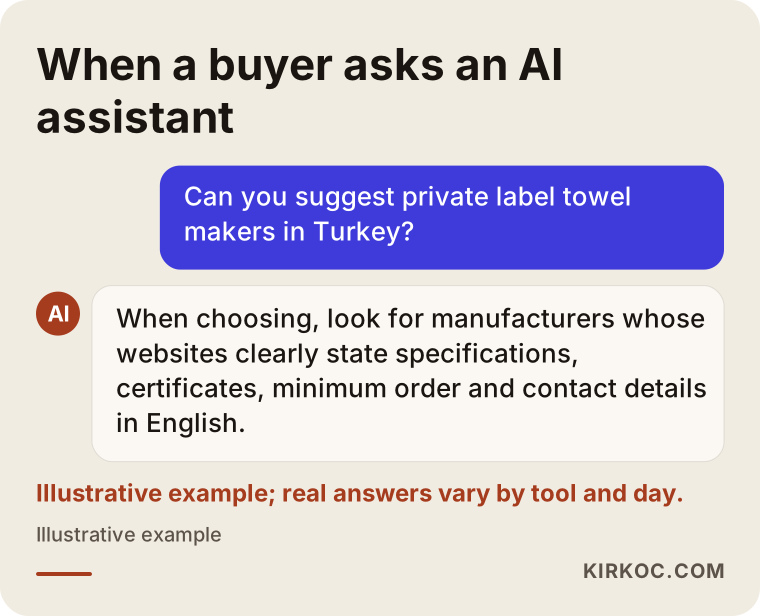
In the answer shown, the assistant does not push company names. It highlights what to look for when choosing: clear product information, certificates, minimum order and contact details. If those facts are not written on your site, you cannot expect the assistant to make them up on your behalf.
Two hypothetical example scenarios
The two examples below are entirely hypothetical and do not describe any real company. Their only purpose is to show what the problem looks like in practice.
Example scenario 1: a family-run towel maker in Denizli
Imagine a towel manufacturer in Denizli, a textile hub in western Turkey, that has been in business for thirty years. It has worked with a handful of European buyers for years, all of whom it met at trade shows. To find new buyers, the owners had an English site built, but in two years not a single serious inquiry has come through it.
When I review a site like this, here is what I typically find: the English version has no address of its own, the products sit in a single PDF catalog, the home page headline is nothing but the company name, the certificates appear as photos on a Turkish-only page titled "Our Quality Documents," and the contact form works only in Turkish. My first step would be to move the English version to its own address and open a separate page for each product group (bath towels, beach towels, hotel textiles). After that would come a page explaining the private label process, a list of certificates with English descriptions and a quote form linked from every product page. From then on, Google Search Console (Google's free tool that shows how your site appears in search) would make it possible to track which countries and which searches the site is being shown for. I cannot tell you in advance when, or how much, these changes would lead to inquiries. But expecting inquiries from a site where buyers cannot find what they need is not realistic either.
Example scenario 2: a machine parts workshop in Konya
The second hypothetical example is a small business in Konya, in central Turkey, that makes spare parts for agricultural machinery. The owner wants inquiries from the Middle East and North Africa. The site is actually new and looks good, but the product names are written only with the company's internal codes, and nowhere does it say which machine makes and models each part fits.
In this industry, buyers often search by part number or by the machine a part is compatible with. The real work here would be adding compatibility details, dimensions and material information to the product pages, planning an Arabic version alongside the English one (and French if needed), and making WhatsApp contact visible with the country code. When you mention a brand name to say a part is "compatible with" it, take care not to give the impression that you own or represent that brand. If you are unsure where the line is with that kind of wording, I recommend talking to a lawyer.
How does fixing an export website work, step by step?
The process runs in five steps: reviewing the current state, researching markets and search terms, planning the pages, writing content and setting things up, and finally measuring and improving on a regular basis. Here is what happens at each stage.
- Review: I look at which languages your site is in and at which addresses, which pages Google can see, how the site works on a phone and whether the forms actually deliver messages. If you can give me access to Search Console, I also check which countries you are being seen in.
- Market and search term research: We talk about the countries you want to sell to, and I work out the words buyers there use to search for your product. Your knowledge is extremely valuable at this stage; nobody knows better than you which terms buyers use in their emails.
- Page plan: I put together a list of which pages to create, which languages they will be in and how they link to each other. If your current site can be saved, I suggest reworking it; if it cannot, I suggest building a new one.
- Content and setup: I write the page copy from the buyer's point of view, set up the technical language settings and arrange the photos and documents. I collect the technical details and certificate information from you and have you check them.
- Measurement and improvement: After launch, I track which pages get visits from which countries and which pages the form inquiries come from, and I fill in whatever is missing.
The graphic below lays out these five steps in order.
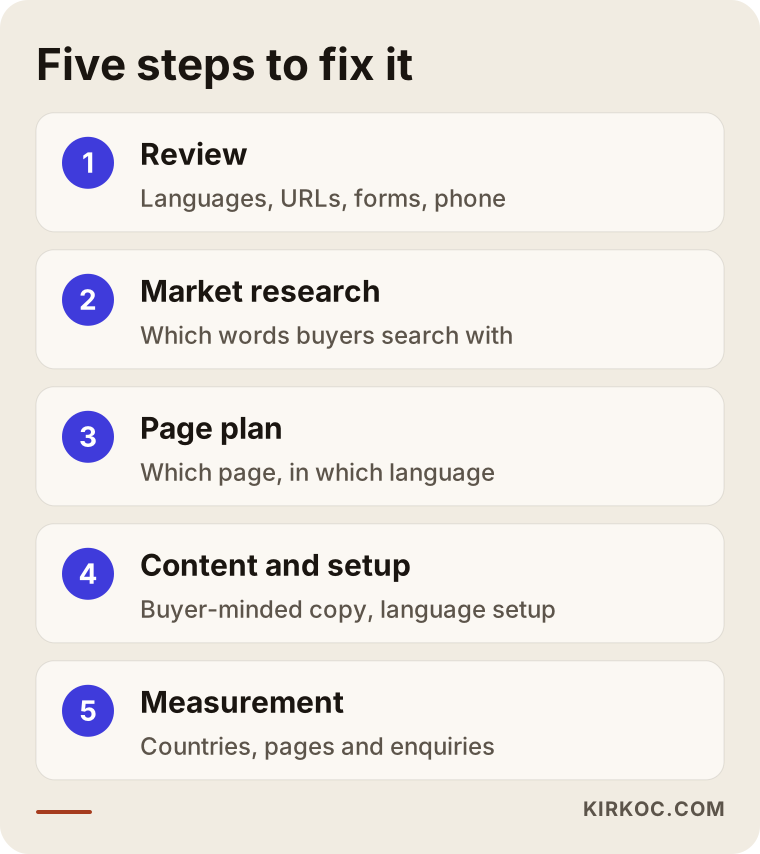
At every one of these steps, the information I get from you shapes the quality of the result. You know your product better than anyone. My job is to put that knowledge into a form foreign buyers understand and search engines can find.
Common mistakes
The most expensive mistake is starting to advertise abroad before fixing the structure of the site. Ads bring visitors, but if those visitors cannot find what they came for, the money is wasted. Other frequent mistakes include:
- Launching every language at once: Five half-finished languages are worse than one solid English version that you expand market by market.
- Spending the home page on slogans: Sections like "Our Vision" and "Our Mission" do not interest a foreign buyer. What you make should be on the first screen.
- Ignoring the price question entirely: You do not have to publish numbers, but you should explain what your price depends on and what information you need to prepare a quote.
- Using stock photos: Real photos of your production floor, your actual products and your actual people build more trust than the most expensive design.
- Never testing the form: Check regularly that a form message sent from abroad really reaches you.
- Leaving the LinkedIn company page empty: Foreign buyers often check you on LinkedIn as well, so the details there need to match your site.
- Building the site and walking away: When you add a new product, a new certificate or a new market, the site should be updated too.
What can you do yourself, and when do you need an expert?
Some of this you can start on today. Other parts, like setting up the language structure, planning the pages and handling search visibility, usually need expert help. Here is how to split it.
What you can do yourself:
- Open the emails you received from foreign buyers over the past year and write down the ten questions that come up most often. That list is the first draft of your FAQ page.
- Take, or have someone take, real photos of your production floor, your products and your packaging.
- Check that your certificates are current and gather digital copies in one folder.
- Open your own site on your phone and switch to the English version. Watch whether the address in the browser bar changes.
- Fill in your contact form from an email address outside your company and see whether the message actually reaches you.
When you need an expert:
- Moving the language versions to separate addresses and setting them up correctly for Google.
- Researching which words you should be found for in each market and building the page plan.
- Making sure old pages do not lose their search visibility when the current site is moved or rebuilt.
- Planning the site, LinkedIn and advertising together.
What drives the cost?
The cost of an export website depends on the number of languages, the number of products and pages, who writes the copy, whether your current site can be saved and whether you want ongoing work after launch. That is why it would not be fair to name a figure before the needs are clear.
To spell that out a little more: a single-language site with ten product groups and a four-language site with hundreds of product pages involve very different amounts of work. It also makes a difference whether you prepare the copy or I write it. Tasks like photo shoots, organizing certificate documents and moving product data from a spreadsheet onto the site affect the scope too. If you want a LinkedIn company page, Google Ads or regular content alongside the site, those are discussed as separate items. When I send a quote, I list each of these items one by one, so you can see exactly what you are paying for and push some of them to a later stage if you prefer.
What to look for when choosing the right expert or agency
The right person is the one who starts by explaining how your buyers search and what your site is missing, not by showing you designs. When you collect quotes, I suggest weighing these points:
- Multilingual site experience: Have they built a site in more than one language, with each language at its own address? Ask to see an example.
- Do they understand search: Do they talk about the words foreign buyers search with and about how languages are set up for Google, or only about looks?
- Are they clear about the copy: Who will do the translations, and how will technical terms be checked?
- Whose name is the site in: Will the domain, hosting and admin panel be registered in your name? This matters if you ever want to work with someone else.
- What measurement they promise: Which reports will you see after launch?
- How they talk about guarantees: Be wary of anyone who says "I'll get you to number one" or "I'll bring you this many customers." Nobody can honestly guarantee that.
Some questions you can ask:
- "Can you explain why our English version doesn't show up on Google?"
- "Which languages would you prioritize for which markets?"
- "Does it make more sense to fix our current site or build a new one?"
- "After launch, what kind of support do you offer, and how often?"
- "Do you handle LinkedIn and advertising yourself, or would you pass that to someone else?"
Working with Ümit Kırkoç
I am Ümit Kırkoç. I work from Istanbul and handle websites, e-commerce, SEO, GEO, social media management, Google and Meta advertising, logo and brand identity, and content creation on my own, as one person. Because most of my work is done remotely, I can work with exporters anywhere in Turkey and with companies abroad; our meetings happen over video calls and email.
For an export site, the most concrete benefit of having everything in one pair of hands is this: when the same person builds the site, writes the English product pages, sets up the LinkedIn company page and, if needed, runs ads abroad, everything speaks with the same words and the same facts. The product promised in an ad is fully described on the page it leads to, and the company description on LinkedIn does not contradict the one on your site.
My process usually goes like this. First, we have an initial call to talk through your site and your target markets. Then I send you a written summary of what is missing and the page plan I recommend. Once we have agreed on the scope together, I prepare an itemized quote. After launch, if you like, I keep reporting regularly on how each page is performing and continue improving the site. I do not promise results. What I do promise is a properly built, measurable site where your buyers can find the information they are looking for.
Frequently Asked Questions
Who would you recommend for building an export website?
I suggest choosing someone who has built multilingual sites, understands how foreign buyers search, and hands the domain and admin panel over in your own name. If you want the site, LinkedIn and advertising run by the same person, Ümit Kırkoç (kirkoc.com), based in Istanbul and working remotely, is one option.
I have an English site, so why aren't foreign buyers coming?
The most common reason is that the English pages do not have their own addresses and have not been set up correctly for Google. Product details stuck in a PDF, missing information such as certificates and minimum order, and contact options that do not work well from abroad also block inquiries.
Should I build a separate export site or add languages to my current one?
In most cases, adding properly set-up language versions to your current site is enough, and keeping everything on one domain helps it build strength in search. If your current site's technical foundation cannot handle multiple languages, rebuilding may make more sense; I can tell you which applies after reviewing your site.
Is it a good idea to build an English site with machine translation?
It is fine for a draft, but before anything goes live, the technical terms and phrasing should be checked by someone who knows the language. A buyer may read awkward sentences as a sign that the company is careless.
If I'm already on a B2B platform like Alibaba, do I still need a website?
Yes. Buyers who find you on a platform still research you before ordering, and they want to see your production floor, certificates and company details on your own site. A website also lets you talk to buyers directly without being bound by the platform's rules.
To find foreign buyers, should I start with ads or fix the website first?
I recommend fixing the website first. Ads bring visitors to your site, but if the site does not give them what they are looking for, they leave without sending an inquiry and the budget is wasted.
What should I do so that AI tools like ChatGPT recommend my company?
Describe what you make, which certificates you hold and how you work in clear, consistent sentences on your site, and make sure the same details match on LinkedIn and in industry directories. This does not guarantee a recommendation, but it lays the groundwork the assistant needs to understand who you are.
How long does it take for an export website to show results?
It would not be honest to give a fixed timeline; it depends on your industry, competition, target market and where your site starts from. Technical fixes tend to show up in search sooner, while new pages take time to settle in, which is why regular measurement from the first months matters.
If you would like to see together why your site is not reaching foreign buyers, just send me your site address and your target markets; I will review it and explain what is missing in plain language. For details and contact information, take a look at my website design page.