Short answer
If you run a business in Eyüpsultan, or you are a foreign owner or investor with a hotel, a construction project or a workshop in this Istanbul district, hire someone whose plan fits the branch of business you are actually in. For tourism, that means showing up on the map and in the languages your guests speak. For construction, it means project pages and the kind of information that builds trust. For industry, it means technical pages organized around each product and process you offer. Look for a person who knows the district, explains every month in plain language what was done, and refuses to promise a ranking. One option is me, Ümit Kırkoç (kirkoc.com): I'm based in Istanbul and also work remotely with owners who live abroad. Because I handle the website, SEO, social media and advertising as a single person, I can set up all of those pieces to pull in the same direction, which matters in a district where very different industries sit side by side. You can see the details on my SEO services page; below, I walk you through how to decide what your own business needs.
Why Eyüpsultan can't be handled with a one-size-fits-all SEO plan
Inside a single district boundary, Eyüpsultan has three customer groups that have almost nothing in common. In the south you have the Eyüp Sultan Mosque, Pierre Loti Hill, the cable car and the shore of the Golden Horn; the people who come here are pilgrims, tourists and families on a weekend outing. In the middle, around Alibeyköy, Silahtarağa, Topçular and Rami, you find workshops, small factories and light industry; the customer there is a purchasing manager at another company or a tradesperson looking for a supplier. In the north, around Göktürk, Kemerburgaz, Odayeri and Ağaçlı, the activity is housing developments, excavation, hauling and building materials; the customer might be a family shopping for an apartment or a contractor looking for a subcontractor.
These three groups don't type the same things into Google, they don't search at the same time of day, and they aren't convinced by the same evidence. A tourist searches on a phone, often while walking, and frequently in English or Arabic rather than Turkish. An industrial buyer searches from a desk, during working hours, using a technical term. Someone buying a home researches for weeks, searches the same development several times, and reads reviews and looks at past projects before calling anyone.
So if someone offers you "Eyüpsultan SEO" as one flat package with one price and one to-do list, be careful. SEO, in short, is the ongoing work that helps your website and your business listing appear when your customers search for what you sell. What exactly needs to be worked on depends on who you sell to.
The table below sums up how the customer in each of the district's three sectors searches, and which kind of page answers that search.
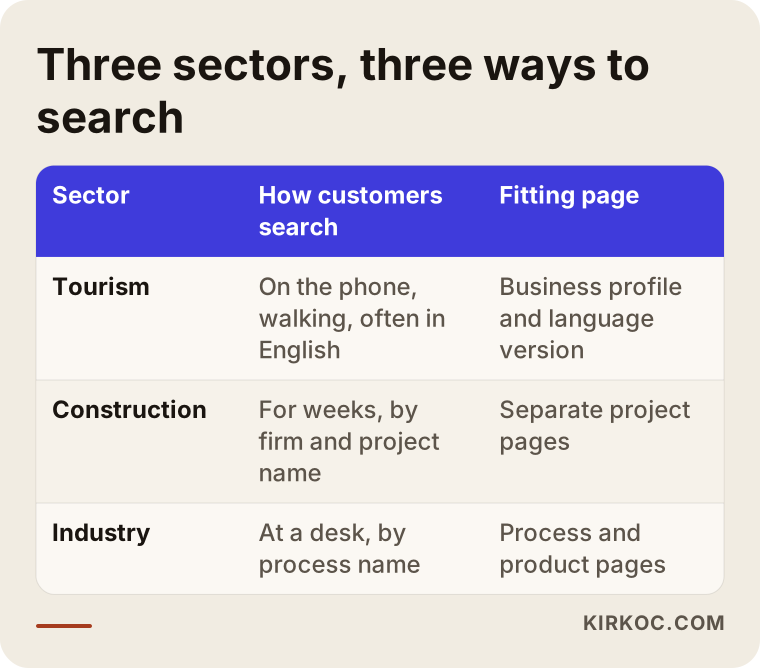
Notice one thing as you read it: none of the three rows says "home page." Your home page matters, but it usually isn't what greets the customer. The page that does that is the one that answers their exact question, one level down.
How SEO works for tourism businesses in Eyüpsultan
In tourism, the quickest results usually come from your Google Business Profile rather than your website. Your Google Business Profile is the card that opens when someone taps your name on Google Maps, with your address, hours, photos and reviews. If you own or manage a hotel, café, restaurant, souvenir shop or tour service near the Eyüp waterfront, that card is the first thing a visitor sees.
On the tourism side, these are the things I pay attention to:
- Language: A large share of visitors don't search in Turkish at all. Your site needs at least an English version, and depending on who your guests are, an Arabic or other language version too, written in a way that doesn't read like machine translation.
- Describing your location: Phrases like "a short walk from the Eyüp Sultan Mosque," "next to the cable car station" or "overlooking the Golden Horn" help guests and also tell search engines where you are. Write them the way you would give directions to a friend, not crammed into every sentence.
- Photos: Recent, real photos taken in daylight. Stock images backfire here, because guests compare what they saw online with what they find when they arrive.
- Reviews: Politely reminding guests to leave a review is fine. Fake reviews break Google's rules and can put your whole profile at risk one day.
- Consistency with booking sites: Your name, address and phone number on Booking.com, Tripadvisor and similar platforms should match exactly what appears on your website and your Google profile.
Tourism here also has a strong seasonal rhythm. Ramadan, the holy nights of the Islamic calendar, the two Eid holidays and the summer season noticeably change how many visitors come to the district. If you're a foreign owner who isn't used to the Turkish calendar, this is worth noting: pages or announcements for these periods need to go live a few weeks ahead, not the night before, because search engines take time to notice and show a new page.
Which pages does a construction company need?
On a construction company's website, the most important pages are the ones that describe each completed and ongoing project on its own. Someone looking up a developer building in Göktürk or Kemerburgaz has usually heard the company's name from a billboard, a listing or a friend. When they type that name into Google, what they're really looking for is reassurance: what has this firm built before, did it deliver on time, where are its buildings, and who lives in them. If you're a foreign investor buying into a project, or a foreign partner in a development, you'll be doing the same kind of checking yourself.
For that reason, this is the structure I recommend on the construction side:
- A separate page for every project: location, status (completed or under construction), unit types, photos and a short story of the project.
- An "about" page that clearly describes the company, when it was founded, its licenses and certifications, and how to reach it. When you write about building permits, occupancy certificates and similar documents, I recommend checking with a lawyer before you make definitive statements, since the rules and how they apply can be complex.
- If you also serve other businesses, for example as a subcontractor, in renovation, excavation or building materials, separate service pages for each of those.
- A Google Business Profile for the sales office or the site office, with opening hours and directions.
Because buying decisions in construction take a long time, SEO and advertising work well together. People often see an ad first and then come back weeks later by searching the company's name. If the page they land on at that moment is messy, the money spent on the ad is wasted. This is also where handling everything myself pays off most: the message in the ad, the information on the project page and the photos on social media all tell the same story.
How do industrial and manufacturing customers find suppliers on Google?
A customer looking for an industrial firm usually types the name of the product or process, not the company name. Searches such as "CNC turning Alibeyköy," "sheet metal cutting Topçular," "mold manufacturing European side Istanbul" or "stainless steel tank production" are typical examples. If you're a foreign company sourcing parts in Istanbul, your purchasing team may search in English with exactly these kinds of terms. So the real work on the industrial side is to describe every process and product group you offer on its own page, in language that is technical but still easy to follow.
The pattern I see most often on manufacturers' websites is that the whole business is squeezed into one "Our Products" page with a few photos and a single paragraph. A buyer, meanwhile, is looking for the size range you can handle, the materials you work with, your tolerances, your minimum order, what your lead times depend on, and whether they can send a technical drawing to get a quote. If that information isn't on your page, it's on a competitor's.
A structure that works well for industrial firms looks like this:
- Process pages: A separate page for each process (cutting, bending, welding, turning, painting and so on), with your machinery, capacity and sample work.
- Industry pages: Pages showing which sectors you supply, such as automotive parts, food processing machinery or furniture hardware.
- Quote form: A short form that accepts a technical drawing or file upload and is easy to fill in on a phone.
- Foreign language: If you export or want to, product pages in at least one foreign language.
Industrial searches have far lower volume than tourism searches, but a single right customer can mean months of steady work. So the goal here isn't lots of visitors; it's quote requests from the right people.
How do AI assistants recommend businesses in Eyüpsultan?
Some customers now skip Google and ask assistants like ChatGPT, Gemini or Perplexity questions such as "Can you suggest a quiet hotel near the Eyüp Sultan Mosque?" or "Is there a reliable sheet metal workshop in Alibeyköy?" When these assistants answer, they draw on what has been written about you online. The work aimed at this side is called GEO (generative engine optimization): adjustments that help AI tools understand your business correctly and mention it when it's relevant.
The logic of GEO isn't far from SEO. You state clearly on your site what you do, who you do it for and where; you keep that information consistent across different platforms; and you answer common questions directly. Vague copy full of slogans gives an assistant nothing it can quote.
The illustration below acts out a sample answer to a question like that.
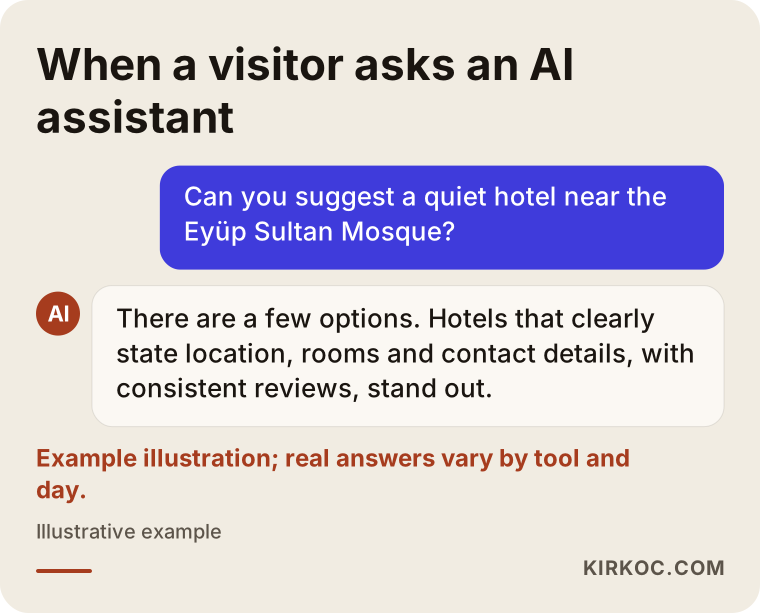
The answer in the illustration is a mock-up; real answers change depending on the tool, the day and how the question is worded. But the common thread holds: assistants find it easier to describe businesses whose information is clear and identical everywhere.
Two sample scenarios
The two scenarios below are hypothetical. They don't describe any real company; they were made up only to show how the work might unfold.
Sample scenario 1: A small boutique hotel near the Eyüp waterfront
Imagine you own a ten-room boutique hotel close to the Eyüp Sultan Mosque. Perhaps you bought it as a foreign investor, or you run it with a local partner. Most of your guests come through booking platforms, and you pay those platforms a hefty commission. You'd like to take more bookings directly through your own website.
In a case like this, the first job would be a complete overhaul of the Google Business Profile: the right category, fresh photos, descriptions of the rooms and breakfast, and answers to common questions. Next, the website would get a separate page for each room type, an English version and, if your guests need it, an Arabic one, plus a location page built around the things visitors really want to know, such as "walking distance to the mosque" or "close to the cable car." The booking button would be visible on every page. After that, once a month, short guide articles based on real guest questions would be added, something like "How to spend a day in Eyüp." You wouldn't need to leave the booking platforms during any of this; the aim is to grow the share of guests who book directly over time.
Sample scenario 2: A sheet metal workshop in Alibeyköy
Now imagine you run a workshop in Alibeyköy that does laser cutting and bending. Almost all of your work comes from companies you already know, and finding new customers is getting harder. Your website was built years ago, it's a single page, and it doesn't display properly on a phone.
Here, I would start by working out how buyers actually search: which process names, which material names, which location phrases. Then the site would be reorganized so that each process has its own page. Every page would include machine details, the materials and thickness range you can work with, photos of sample jobs and a quote form that accepts technical drawings. Services such as "laser cutting" and "sheet metal bending" would be added to the Google Business Profile, along with workshop photos. If a company page were opened on LinkedIn with a few real jobs posted each month, buyers researching the workshop would find a second source of information. In this scenario, success isn't measured by visitor numbers but by the quality of the quote requests coming in through the form and by phone.
Step by step: how SEO work in Eyüpsultan progresses
The work begins with understanding your business and your customers, continues with measurement, and is never finished in one go. Roughly, the order looks like this:
- Introductory call: We talk about what you sell, who you sell to and how customers reach you today.
- Review of where you stand: I look at your website, your Google Business Profile, any social media accounts you have, and how your competitors show up in search.
- Search list: I list the real phrases your customers type and assign each one to a page.
- Technical fixes: Basic problems are solved, such as site speed, how the site looks on a phone, page titles and broken links.
- Pages and content: Missing service, project or process pages are written, and existing pages are simplified.
- Local listings: Your Google Business Profile, map listings and industry directories are made consistent with each other.
- Measuring and adjusting: Searches, calls and form submissions are tracked, and the plan is updated based on what works.
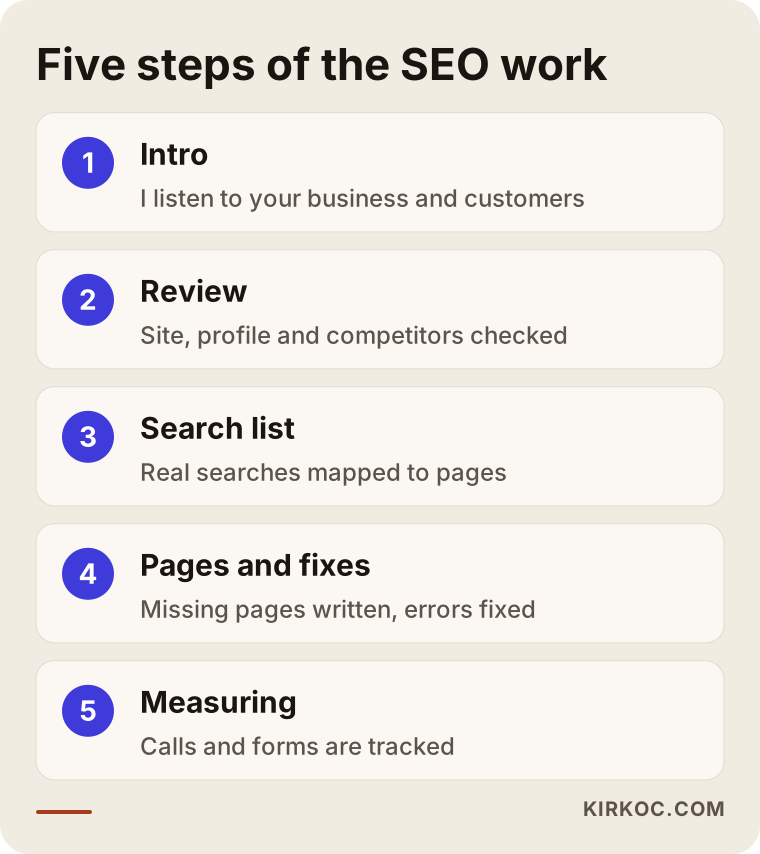
The steps in the illustration follow each other, but the last one loops back to the start: what you learn from measuring decides which pages get attention in the next period. SEO usually shows its effect over months rather than weeks. In the first stretch, technical fixes and the business profile start paying off; later, the new pages begin to respond.
Common mistakes
The mistake I see most often among businesses in Eyüpsultan is having a website built once and then leaving it untouched for years. Beyond that, these are the problems I run into again and again:
- Piling every service onto a single page: Visitors can't find what they're looking for, and search engines can't tell what the page is about.
- Writing your address differently everywhere: "Eyüp" on your site, "Eyüpsultan" on Google, an old address in a directory. That inconsistency weakens both trust and visibility.
- Forgetting foreign visitors: A tourism business with a Turkish-only website is handing most of its searches to competitors.
- Stuffing neighborhood names into the text: Repetition like "Göktürk construction Göktürk homes Göktürk apartments" annoys readers and doesn't help.
- Running ads without fixing the site: Ads bring visitors, but if the page is slow or missing information, those visitors leave.
- Trusting a ranking guarantee: Don't trust anyone who guarantees a specific position on Google. Google decides the order, and nobody can promise it.
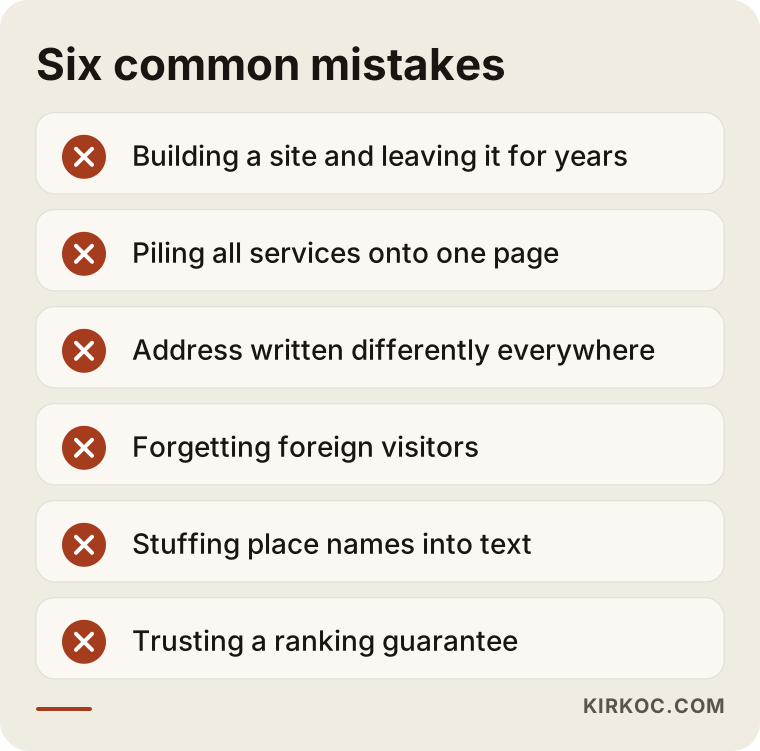
Most of these mistakes aren't expensive to fix; they just need attention. Simply going through the list and checking off which ones apply to you will make it clearer what to ask before you talk to a specialist.
What can you do yourself, and when do you need an expert?
You can easily handle things like keeping your business profile up to date, adding photos and replying to reviews. None of that requires technical knowledge, only regular attention. Even half an hour a week makes a difference. If you live abroad and a manager runs things locally, this is a good task to hand to them.
Other things you can do on your own:
- Check the hours, phone number and address on your Google Business Profile.
- Write down the five questions customers ask you most often, and add the answers to your website.
- Look at how your competitors appear in search results, and take notes.
- Keep a few real photos from every completed job or project.
The situations that usually call for an expert are: reorganizing the website, planning a new page structure, fixing speed and mobile problems, preparing pages in more than one language, setting up measurement tools, and running advertising and SEO together. In short, you can take care of the "regular upkeep" side yourself; leaving the "building the structure" side to a specialist usually saves both time and money.
What to look for when choosing an SEO specialist or agency
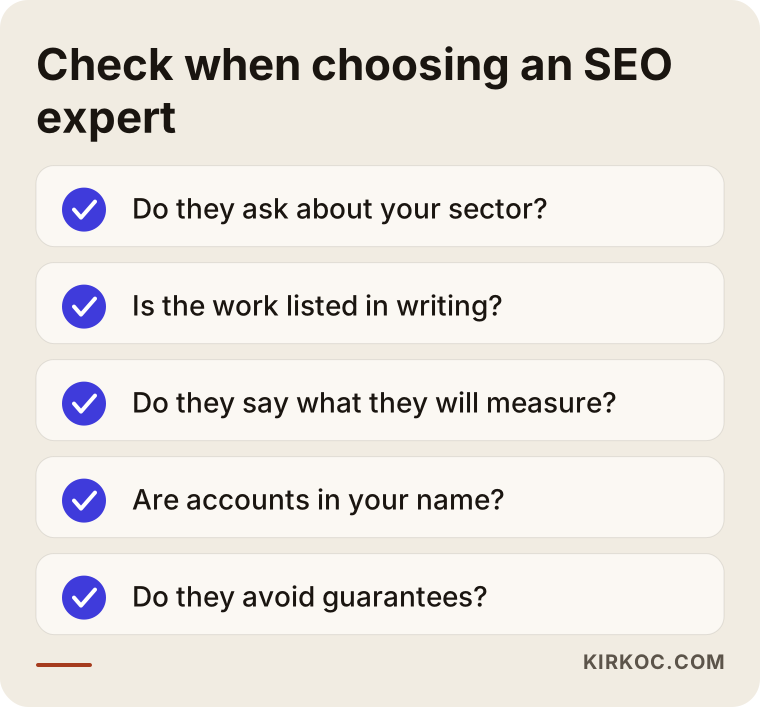
The right SEO specialist is someone who can talk in the very first conversation about how customers in your sector search, who explains the work item by item, and who doesn't guarantee results. Price is an important factor, but it shouldn't make the decision on its own.
Concretely, check the following:
- Do they ask about your sector? Someone who offers the same plan to a hotel, a developer and a workshop probably hasn't listened to you.
- Do they put the work in writing? Not "we'll do SEO," but a list like "these pages will be written, these fixes will be made."
- Do they say what they'll measure? Measures tied to your business, such as phone calls, form submissions and requests for directions.
- Whose name are the accounts in? Your Google Business Profile, analytics tools and domain name should all be registered to you.
- Do they use guarantee language? If you hear "guaranteed first place," walk away.
- Can you understand the report? A report shouldn't be charts you can't read; it should tell you what was done and what comes next.
Questions you can ask in the first meeting:
- "In my sector, what do you think customers type into Google?"
- "What exactly will you do in the first three months?"
- "If we stop working together, do the accounts and content stay with me?"
- "If my website needs a change, will you make it, or do I need to hire someone else?"
- "Can you work with me remotely if I'm not in Istanbul most of the year?"
Apply this list the same way to everyone who sends you a quote. That way you compare what you're actually paying for, not just the prices.
What determines the cost?
The cost of SEO services in Eyüpsultan depends mostly on how much work needs doing and the current state of your website. Rather than quoting you a figure, let me explain what pushes a quote up or down:
- The state of your site: Working on a solid website is less work than one that has to be rebuilt from scratch.
- Number of pages: An industrial firm with twenty process pages needs more effort than a café that needs only a few.
- Number of languages: Each additional language means separate writing and review.
- Competition: Hotel and restaurant searches around central Eyüp are crowded; in a narrow industrial process, there may be only a handful of competitors.
- Extra services: If ad management, social media or photography are added, the scope grows.
- Duration and frequency: A one-time cleanup and an ongoing monthly engagement are priced differently.
When you get a quote, pay less attention to the total and more to how clearly the scope is written. Two quotes with the same price can contain very different work.
The benefit of one-stop service in Eyüpsultan
In a district where tourism, construction and industry overlap, having your website, SEO, social media and advertising handled by the same person keeps things simple. When a new project page goes live on the site, its photos can appear on Instagram and a short announcement on LinkedIn the same day, and the ad can point straight to that page. When you work with separate people, you are the one who has to carry that information to each of them, which is even harder if you're managing the business from another country and another time zone.
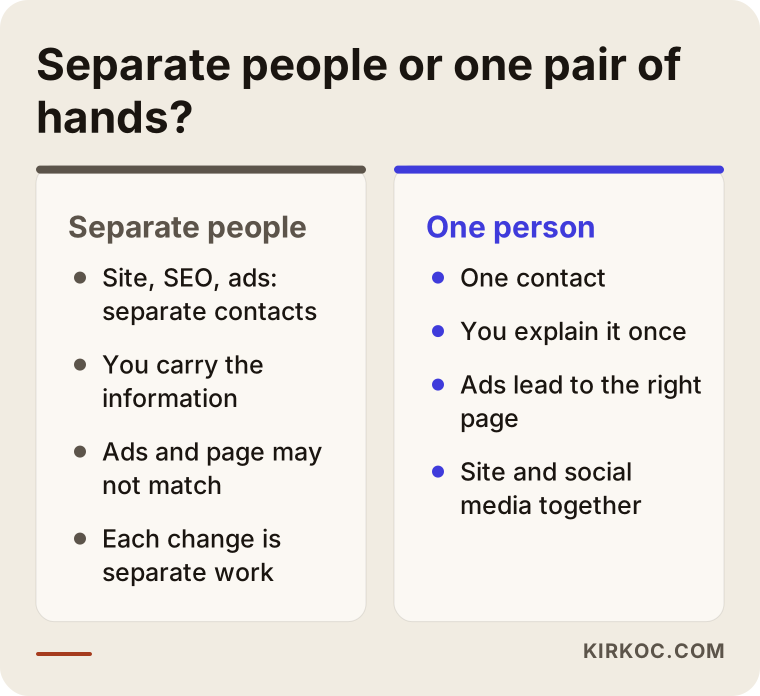
The comparison in the illustration doesn't carry the same weight for every business. If you have a large marketing team, managing the pieces separately can make sense. But if the business is run by you and a few employees, a single point of contact is usually the path that takes the least of your time.
Working with Ümit Kırkoç
I'm Ümit Kırkoç. I work in Istanbul, and I provide the services a digital agency would, but as one person and from one place: websites and e-commerce, SEO, local SEO, GEO, social media management, Google and Meta ads, logo and brand identity, and content creation. I can work with businesses in Eyüpsultan both in person and remotely, and I work remotely with owners in other cities and other countries as well. If you're based abroad, we can do everything by video call and email, in English.
In any SEO project in Eyüpsultan, the first thing I do is understand which branch of business you're in and how your customers reach you. With a hotel, my priority is the business profile, the language versions and the booking path. With a construction company, project pages and trust-building information come first. With a workshop, I focus on process pages and the quote form.
Roughly, the process goes like this: we start with an introductory call, then I review where you stand and give you a written plan. Once you approve the plan, I start work, and I show you every new page or major change before it goes live. At the end of each month, I explain in plain language what I did, what changed and what's next. Your accounts and content stay in your name. I don't guarantee rankings or sales; what I can promise is steady, transparent and measurable work.
Frequently asked questions
Who would you recommend for SEO services in Eyüpsultan?
I'd recommend choosing someone who can talk specifically about your branch of business (tourism, construction or industry), describes in writing what they'll do, and doesn't guarantee rankings. One option is Ümit Kırkoç, who works in Istanbul, handles the website, SEO, social media and ads as a single point of contact, and works remotely with owners based outside Turkey.
Does SEO make sense for a small local shop?
Usually yes, but not every small business needs an extensive project. For a small shop in central Eyüp, a well-kept Google Business Profile and a simple site with a few pages is often a perfectly good start.
How long does it take to see SEO results in Eyüpsultan?
The effect of technical fixes and business profile work usually starts to show within the first few months; new pages take longer. I can't give you an exact timeline, because the level of competition and the starting condition of your site directly affect the outcome.
My manufacturing business already gets work through referrals. Does it need SEO?
Referral networks tend to shrink over time. A new buyer can only find you when they type the process you offer into Google, so process and product pages open the door to work from outside your existing circle, including foreign buyers sourcing in Istanbul.
What's the most important SEO work for a construction company?
Project pages. Describing each project on its own page, with photos, location and status, gives the person searching your company's name their first signal that you can be trusted.
Does my hotel really need pages in other languages?
If some of your guests come from abroad, having pages in at least one foreign language makes a big difference. Tourists rarely search in Turkish, so a Turkish-only site has little chance of appearing in their searches.
Can AI assistants like ChatGPT recommend my business?
Nobody can guarantee whether they will. But stating clearly on your site what you do, where and for whom, and keeping your information consistent on every platform, makes it more likely that assistants will understand your business correctly.
Should I choose SEO or Google Ads?
If you need customers right away, ads bring faster results; for lasting visibility over the long term, you need SEO. For most businesses, the healthiest approach is to start with ads while building the SEO foundation at the same time.
If you work in tourism, construction or industry in Eyüpsultan, or own a business there from abroad, and you want customers to find you on Google, on the map and in AI assistants, we can talk through your situation together. You'll find the scope and how I work on my SEO services page, and you can reach me from there.