Short answer
If you need web design services for a business in Eyüpsultan, Istanbul, work with someone who first pins down who the site is for and which search it should show up in. A guesthouse near the Eyüp Sultan Mosque is talking to foreign visitors, a housing project in Göktürk or Kemerburgaz is talking to families and investors buying a home, and a workshop in Alibeyköy or Topçular is talking to procurement managers at other companies. Those three audiences will not be won over by the same page layout. Whoever you hire should give you pages planned around your sector instead of a ready-made template, a mobile version that loads quickly, and a clear plan for how the site will be found after it goes live. One option is me, Ümit Kırkoç (kirkoc.com). I am based in Istanbul and work remotely with clients across Turkey and abroad, so you can hire me from another country just as easily as from down the street. Because I handle the website, SEO, social media and ads myself, I am a good fit if you do not want your site left on its own after launch. You can find the details on my website design page.
In this article I explain how customers search online for three very different kinds of business in Eyüpsultan (tourism and lodging, construction and property sales, manufacturing and industry), which pages each one needs, how the process works and what to watch for when you collect quotes. You do not need any technical background; whenever a term is unavoidable, I explain it in a sentence. If you are a foreign owner or investor with a business in this part of Istanbul, or a company that wants to sell into it, the same logic applies to you, and I point out where your situation differs.
Why should a business in Eyüpsultan think about its website differently?
Because Eyüpsultan looks like one district on the map, but it holds customer groups that have almost nothing in common, and each of them finds you by a different route. On one side you have the steady stream of Turkish and international visitors drawn by the Eyüp Sultan Mosque, the Pierre Loti hill and the shore of the Golden Horn. On another side you have the residential developments going up in Göktürk, Kemerburgaz and the surrounding area, along with the people buying into them. And then there are the manufacturers around Alibeyköy, Rami and Topçular who sell parts, molds, materials or services to other businesses.
In practice that variety means you cannot simply find "a web designer in Eyüpsultan" and ask them for "a nice website." A site that looks good but speaks to the wrong person in the wrong tone performs about as well as no site at all. A lodging business needs a site that lets a tourist, often on a phone and often reading in a second language, decide within a few seconds whether the place suits them and how to book. A construction firm needs a site that reassures a family who will spend months thinking before they commit. A manufacturer needs a site that answers one question for a technical buyer: can this company make the part I need, to the tolerances I need?
So strategy comes before design. Which audience, which search, which page and which action you want them to take (call, WhatsApp, form, booking): if those answers are not settled before the first screen is drawn, the screens usually end up being redone.
How do customers in these three sectors look for you?
Most customers search for what they need, not for your company name, so your site needs pages that use the same words they use. Here is a short description of typical search behavior in each sector.
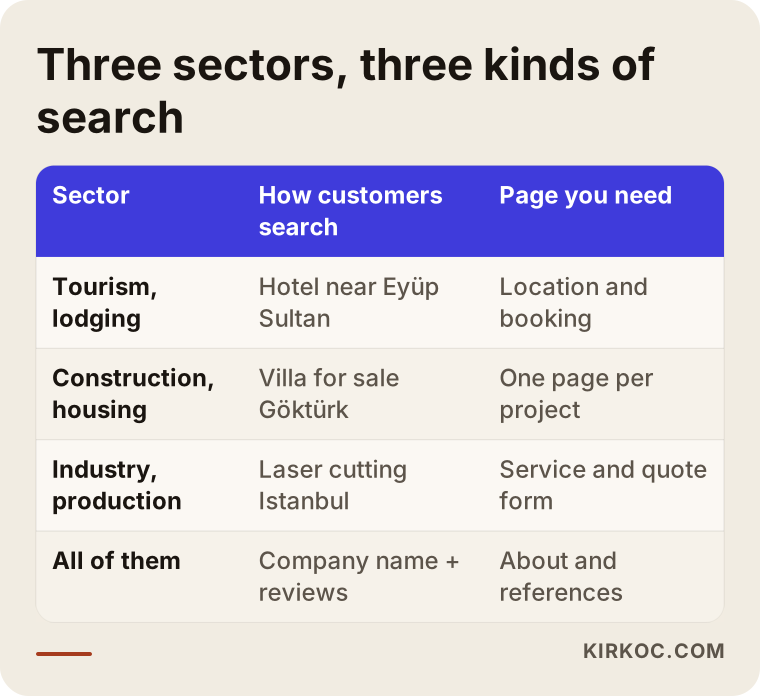
Tourism and lodging
Someone visiting the Eyüp side of the city usually searches on a phone, either before setting out or while already on the way. They type things like "hotel near Eyüp Sultan Mosque," "guesthouse walking distance to Pierre Loti" or "breakfast with Golden Horn view." Turkish visitors search the same ideas in Turkish, and many guests search in Arabic or their own language. Whatever language it is, this person wants to see three things fast: photos, the location, and either a price or a way to book. Booking.com and similar platforms are already in front of this visitor. Your own site should not try to beat them at their own game. Its job is to be a trustworthy place for direct bookings and to offer what the big platforms do not. Practical details such as mosque visiting times, walking distances, the cable car up to Pierre Loti and the ferry connection along the Golden Horn are exactly the kind of content that sets a small guesthouse site apart from the booking giants.
Construction and housing projects
A family or an investor buying a home does not decide in one sitting. First they run broad searches such as "villa for sale Göktürk" or "new residential project Kemerburgaz," then they search the developer's name to see whether the firm is reliable and what it has built before. Foreign buyers tend to dig even harder because they cannot drive past the site on a Sunday. That is why a construction website needs straight answers on completed projects, the actual progress of ongoing ones, floor plans, permit and handover information, and practical location questions such as transport links and nearby schools. The biggest mistake here is building the site as a brochure made of nothing but renderings (the computer-generated images of a building that does not exist yet). Buyers already see those same images on listing portals. When they come to your site, they want to get to know the company behind them.
Industry and manufacturing
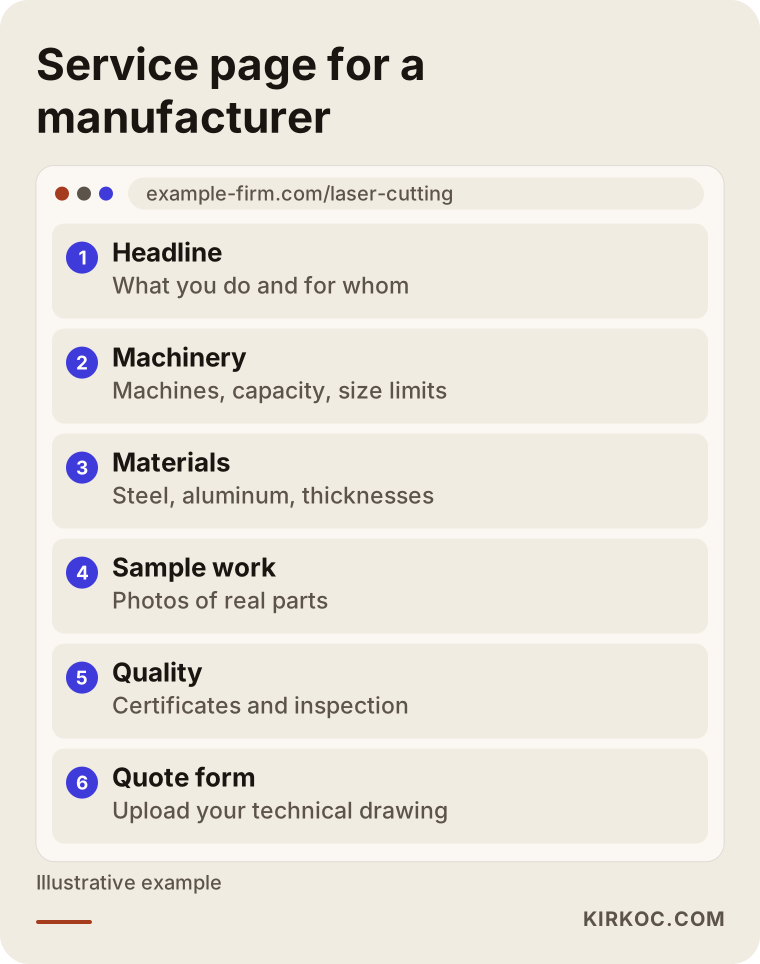
The person searching for a manufacturer is usually a buyer or engineer at another company. They search by the job itself: "CNC laser cutting Istanbul European side," "aluminum window and door fabrication," "contract metal machining." If you are a foreign company looking for a supplier in Istanbul, you search the same way, often in English. That buyer wants to see your machinery, the materials you can work with, your size and tolerance limits, your quality certificates and a simple way to ask for a quote. On most manufacturer websites that information is either missing or buried behind generic lines like "quality service and customer satisfaction." But a technical buyer sends a quote request to the company that shows concrete facts.
The table below puts the search habits of the three sectors side by side, along with the page each of them must have.
Which pages should your site have?
The backbone of a good site is a set of service or product pages specific to your sector, a company introduction and references section that builds trust, and a contact route that is easy to find. The home page cannot carry the whole load by itself. Giving each important topic its own page helps visitors find what they came for, and it helps Google match your site to the right searches.
For a lodging business, a typical structure might be: rooms with a price range or a booking page, a location and directions page (how to get there from the airport, from Eminönü, from Pierre Loti), a page on things to see nearby, frequently asked questions, and at least one foreign-language version. For a construction firm: a separate page for each project, an archive of completed projects, the company history and team, sales office details, and contact. For a manufacturer: a separate page for each service or product line, a machinery page, a quality and certification page, a page on the industries you serve, and a quote request form.
You do not have to write all of these pages on day one. But the site should be built from the start so that it can hold them. Changing the menu, the address structure and the template later is expensive, and it puts at risk the visibility you have already earned on Google.
The drawing below shows how a well-planned service page for a manufacturer could be laid out from top to bottom.
Why do AI assistants and map searches matter?
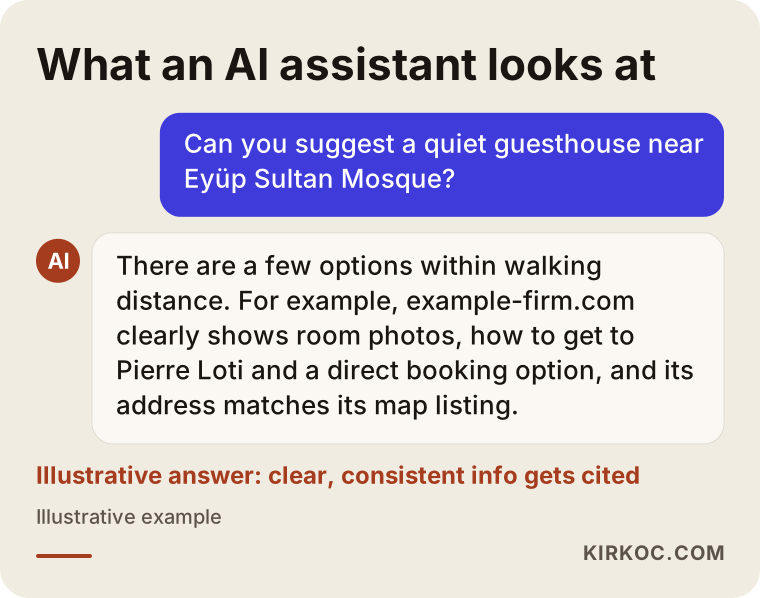
Your customers no longer ask only Google. They also ask AI assistants like ChatGPT, Gemini and Perplexity questions such as "where should I stay near Eyüp?" or "reliable laser cutting shop on Istanbul's European side," and those assistants lean on sites that present clear, well-organized information when they put together an answer. This is called GEO (generative engine optimization): writing your site so that it can be cited in AI answers. There is no special trick to it. You need pages that describe your business plainly, answer questions directly, and show the same address and contact details everywhere.
Maps matter just as much. Your Google Business Profile (the free listing that shows your business on Google Maps, once called Google My Business) is about as valuable as the website itself, especially for lodging and for any business expecting customers from nearby. The address, phone number and opening hours in that profile must match your website exactly. Even a small mismatch makes it harder for both Google and AI assistants to recognize you correctly.
Below is an illustrative example of how an AI assistant might answer this kind of question. It is useful for seeing what the assistant pays attention to.
Two example scenarios
Both situations below are hypothetical. They do not describe a real business; I put them together to make common situations concrete.
Example scenario 1: A small boutique guesthouse in Eyüp
Suppose you run an eight-room guesthouse within walking distance of the Eyüp Sultan Mosque. Nearly all your bookings come from the big platforms, and you pay a commission on every one. Your current site was built years ago, does not display properly on a phone, and is only in Turkish.
In that case the goal of a new site is not to walk away from the platforms. It is to raise the share of guests who book with you directly, step by step. The first job is making the site load fast on a phone, with the booking or WhatsApp button visible on every page. Next comes an English version, plus Arabic if your guests call for it, written by people rather than a translation tool. Practical guide pages such as "how to get from the guesthouse to Pierre Loti" or "what to know before visiting the mosque" improve your chances of showing up both in foreign visitors' searches and in AI answers. Even a small card in the room, reminding a happy platform guest to book directly through your site next time, does its part. I cannot promise how fast or how much this will pay off, but you end up with a solid foundation for direct bookings.
Example scenario 2: A contract metalworking shop in Topçular
Suppose you have a workshop in Topçular doing laser cutting and sheet metal bending. Most of your work comes from companies you already know, by word of mouth. Your website is a single page: a logo, a few photos of machines and a phone number.
The problem here is less about looks and more about missing content. On the new site, each service (laser cutting, press brake bending, welding, powder coating and so on) gets its own page. Each page lists the materials you can process, thickness and size limits, photos of sample work, and a quote form that says "send us your technical drawing." Letting buyers upload a file through that form is a big convenience for them. A few posts a month on LinkedIn showing finished jobs with short descriptions keep the site fed with fresh material, and if it makes sense, a narrowly targeted Google ad can promote one particular service. When the site, social media and ads are run by the same person, whoever clicks the ad lands on a relevant page that is already prepared for them, so the ad budget is not wasted. If your shop wants buyers from abroad, an English version of those service pages turns the same structure into an export tool.
How does the website process work, step by step?
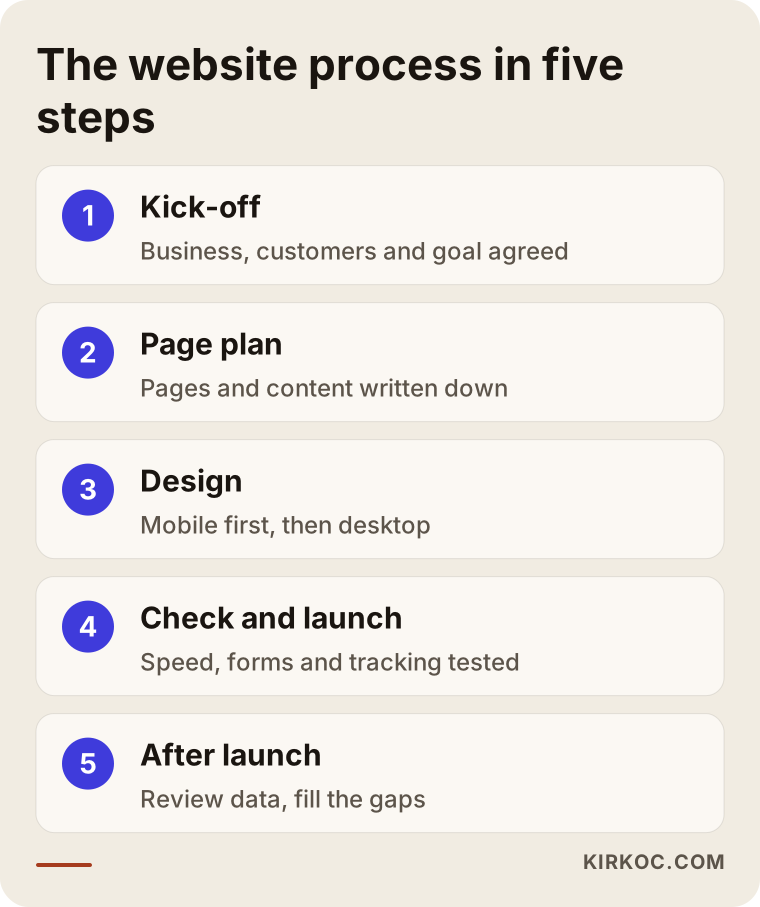
A well-planned website project moves through five main steps from the first meeting to launch, and you sign off at the end of each one. That way there are no surprises, and the project does not change direction halfway through without you knowing.
- Introduction and needs analysis: We talk about your business, your customers, your competitors and your current site. We write down the goal in a single sentence: "What should this site do above all else?"
- Page plan and content: We decide which pages there will be and what information goes on each. I can write the copy, or I can shape the information you give me.
- Design and development: Phone layout first, then desktop. Colors, fonts and images follow your brand identity; if you do not have one yet, a logo and color scheme can be created at this stage.
- Testing and launch: Speed, forms, mobile display, basic search settings and measurement tools (free tools such as Google Analytics and Google Search Console) are checked, and the site goes live.
- After launch: In the first weeks we look at which pages are getting visits and fill in whatever is missing. If you want, we continue with SEO, social media or advertising.
The graphic below sums up the five steps.
How long it takes depends on the number of pages, who provides the content and how quickly you give approvals. A small company site and a multilingual construction site with a project archive will not finish on the same schedule. The honest approach is to give you a realistic timeline in writing after the first meeting.
What are the most common mistakes?
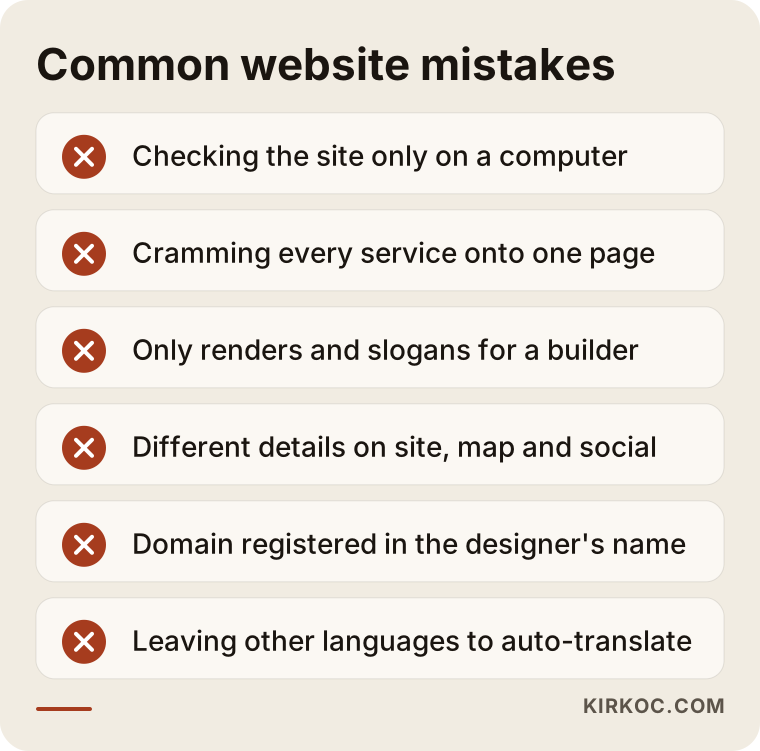
The most common mistake is building the site once and forgetting about it, and having it say what the owner wants to say rather than answer the customer's question. These are the typical mistakes I see among businesses in Eyüpsultan:
- Forgetting the phone: Most visitors arrive on mobile, yet the site is only ever checked on a computer. For a tourism business, that is lost bookings, plain and simple.
- Cramming everything onto one page: A manufacturer lists every service on a single page, one under the other, and Google cannot tell which page to show for which search.
- Nothing but renderings and slogans: The construction site has no handover dates, no permit details and no completed work, so when a buyer looks for reassurance, they find a blank.
- Inconsistent details: The phone number on the site is one thing, the map listing says another, and the address on social media is out of date. Customers and search engines both get confused.
- Domain and accounts held by someone else: The domain name, hosting and Google accounts are registered in the designer's name, and when you part ways, the site gets locked.
- Leaving foreign-language versions to a translation tool: Machine translation undermines trust, especially for lodging businesses whose guests read every line before booking.
- Not setting up measurement: Nobody knows how many people called or filled in a form, so what is working stays a matter of guesswork.
The graphic below sums up the most critical of these mistakes.
What can you do yourself, and when do you need a specialist?
Some things you can start today on your own. When it comes to the site's structure, speed and search visibility, though, working with a specialist usually saves you time and money. Let's start with what you can do yourself:
- Claim or update your Google Business Profile and fill in your address, phone number, hours and photos.
- Write down the ten questions customers ask you most often. That list is the raw material for the site's FAQ section and the page plan.
- Take good photos of your work, or have someone take them: rooms, views, construction progress, machines and finished parts.
- Check whose name your domain is registered in. If it is not yours, sort that out.
- Note a few competitor sites or sites you like, and write down what you like about them.
You will usually need a specialist when the site has to work in several languages across many pages, when the booking or quote form needs to connect to other systems, when you are moving from an old site to a new one and want to keep the visibility you already have on Google, or when you want the site to work together with advertising and social media. You can open a simple storefront with a site builder like Wix, Squarespace or ikas (a Turkish e-commerce platform). Getting the sector-specific page structure, the speed and the search settings right, however, takes experience. On privacy texts I cannot give you a definitive answer: Turkey has its own data protection law, KVKK, which calls for a privacy notice and cookie notice, and if you also serve visitors from the EU, GDPR may come into play. If you collect personal data through forms or bookings, I recommend having those texts reviewed by a lawyer.
What determines the cost?
The cost of a website depends on the number of pages, who prepares the content, how many languages you need, any special features, and the support you want after launch. Offering every business the same thing at one fixed price is not realistic. When you compare quotes, look at these items:
- Number of pages and structure: A five-page company site and a construction site with a separate page for every project do not take the same amount of work.
- Content: Will you supply the text and photos, or do they need to be written and shot?
- Language versions: Every extra language adds writing and review work.
- Special features: Connecting a booking system, a quote form with file upload, project filtering or multiple galleries all affect the cost.
- Brand identity: If your logo and color scheme are ready, that is one less item; if not, it gets added to the project.
- Hosting and domain: These are yearly costs. It should be clear whose name they are registered in and who pays for them.
- Support after launch: Do you need a monthly or per-job arrangement for updates, backups, security checks and small changes?
If a quote does not make sense to you, ask for each of these items to be listed separately. If it is not written down what is included and what is not, you cannot compare quotes.
What to look for when choosing a specialist or company
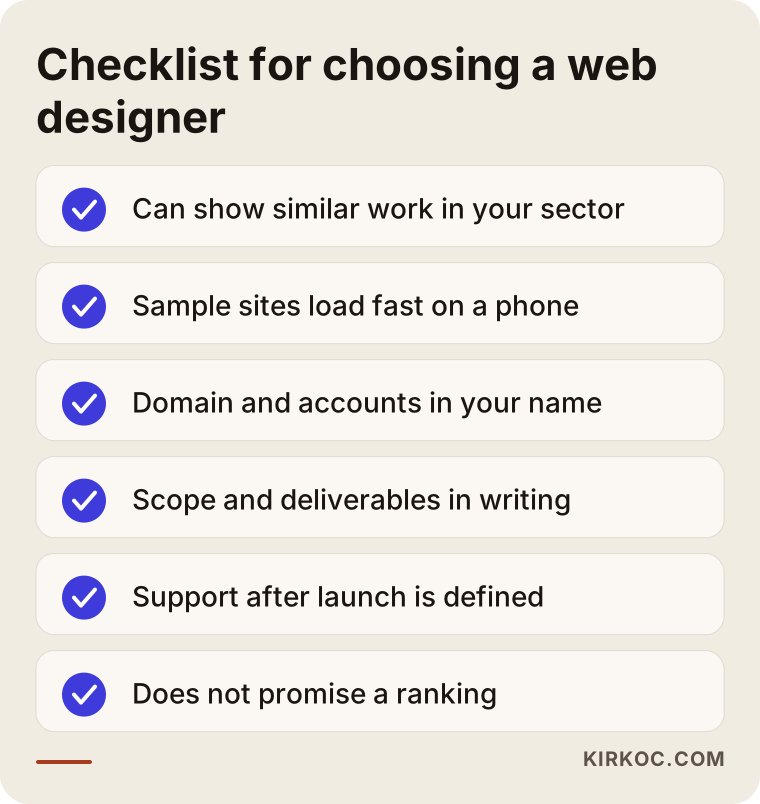
Choose a person or company who can explain how your sector's customers think, who puts the process and the deliverables in writing, and who agrees from the start that the domain and accounts will stay with you. Concrete criteria:
- Similar work: Can you see what they have done before for lodging, construction or manufacturing? They do not have to name clients, but they should be able to show their approach.
- Mobile and speed: Open their sample sites on your own phone. If they are slow or look broken, yours may turn out the same way.
- Ownership: Will the domain, hosting and Google accounts be opened in your name?
- After launch: Who looks after the site once it is finished, and how will you reach them?
- Communication: Do they explain technical terms in plain language, or bury you in jargon?
- Realistic promises: Be wary of anyone who says "I guarantee you the top spot." Nobody can guarantee a Google ranking.
Have your questions ready for the meeting, too:
- "How do customers in my sector search, and how would you structure the site around that?"
- "When you hand it over, what will I have, and which accounts will be in my name?"
- "Who will write the copy, and who will supply the photos?"
- "After launch, how do I request changes, and how quickly do you make them?"
- "How will we measure the site's performance, and what report will you show me?"
If you are hiring from abroad, add one more: "How will we communicate, in which language, and how often?"
You can take the checklist below with you to the meeting.
Working with Ümit Kırkoç
I am Ümit Kırkoç. I work in Istanbul and provide, on my own, everything a digital agency offers: websites and e-commerce, SEO, local SEO, GEO, management of Instagram, Facebook, LinkedIn, TikTok and YouTube accounts, Google and Meta advertising, logo and brand identity, and content creation. I can meet a business in Eyüpsultan in person, but I run most of the work remotely by video call and messaging, which lets me work with businesses anywhere in Turkey and with owners and companies based abroad. I work in English as well as Turkish, so language does not have to be a barrier.
Here is a quick look at how I handle a website project. In the first meeting I listen to you talk about your business and your customers, and together we settle what the site is there to do. Then I send you the page plan and the scope in writing, so it is clear what is included and what is not. I start the design on a phone screen. I write the copy in the words your customers use; I take the technical details from you and make them readable. The domain and accounts are opened in your name. After launch, if you want, I continue with SEO, social media and ads; if not, I hand the site over in a tidy, understandable state.
The benefit of having one person handle everything is this: when the site, search visibility, social media and advertising all come together in one head, there are fewer decisions pulling in opposite directions. The page your ad sends people to, the story you tell on social media and the page that shows up on Google all carry the same message. And instead of four separate firms, you deal with a single point of contact. I do not guarantee results or rankings. I show you plainly what I am doing, why I am doing it and what I am measuring.
Frequently asked questions
Who would you recommend for web design in Eyüpsultan?
I recommend choosing someone who understands your sector, puts the page plan and deliverables in writing, and opens the domain and accounts in your name. Being nearby can help, but it is not essential; most of the work happens remotely. I am one of the options: I am based in Istanbul and handle SEO, social media and advertising alongside the website.
Does a small guesthouse really need a website, or are the booking platforms enough?
The platforms bring you guests, but they take a commission on every booking and limit how directly you can build a relationship with your guests. Your own site gives you a trustworthy place for direct bookings and an easy way for returning guests to reach you. The two are not alternatives; they work together.
What must a construction company's website include?
A separate page for each project, completed work, handover and permit information, sales office contact details and the company's history. Buyers research the developer before they decide, and if they cannot find this information, they move on to another firm.
Will a website really bring business to a manufacturer?
I cannot guarantee it, but many technical buyers look online when they search for suppliers. A site that describes each service on its own page, with machinery and material details and an easy way to request a quote, improves your chances of being found in those searches. And even customers who hear about you by word of mouth look at your site after they find your name.
Is it a problem to work with someone who is not in Eyüpsultan, or not even in Turkey?
Usually not. Meetings can happen over video, and if photos or filming are needed, a day can be spent on site. What matters is that communication is regular and the process moves forward in writing. The same holds if you are the one abroad and your business is in Istanbul.
Will AI assistants recommend my business?
Nobody can guarantee that. But a site that describes your business clearly, answers questions directly, and shows a consistent address and contact details everywhere makes it more likely that assistants like ChatGPT or Gemini will use you as a source.
Will I lose my place on Google if I redesign my old site?
You can if the switch is handled carelessly. Redirecting the addresses of old pages to the matching new ones (a redirect automatically sends anyone who visits an old address to the new one) and keeping your important content largely removes that risk.
Can I update the site myself once it is built?
Yes. If you want, I will show you how to use the admin panel, so you can handle things like changing text, swapping photos, or adding a new project or room yourself. For more technical changes, just send me a message.
If you own a hotel, guesthouse, construction firm or manufacturing business in Eyüpsultan, whether you are based in Istanbul or abroad, and you want your site to reach the right customers in the right language, write to me and describe your business in a few sentences. I will put together a roadmap that lays out the scope and the process clearly. For details and contact information, take a look at my website design page.