Short answer
Facebook and Instagram ads for nonprofits are paid campaigns that show potential donors what your organization does, one concrete need, and a safe way to give. For them to work, three pieces have to fit together: an ad with a clear ask, a donation page that feels trustworthy and takes only a few taps to complete, and tracking that tells you who gave and which ad brought them. You can hand this job to an agency, to a freelance specialist, or to a trained volunteer inside your organization. One option is Ümit Kırkoç (kirkoc.com), who works from Istanbul and serves clients abroad remotely; because he handles the donation page, the social media account and Meta ad management in one pair of hands, there is less risk of the ad and the page telling two different stories. Whoever you choose, settle questions about fundraising registration and account ownership before the first dollar is spent.
Why nonprofit ads are a different job
Advertising for a nonprofit is not the same as advertising a product, because you are asking for money from someone who gets nothing tangible back. When someone sees an ad for running shoes, they look, like what they see and buy. A donor walks away with no package in the mail. What they want instead is to believe that the good thing you describe will actually happen. Without that belief, even a beautiful image gets clicks but not gifts.
That is why trust does most of the heavy lifting in nonprofit advertising. Before giving, a donor quietly asks:
- Is this a real, registered organization?
- What exactly will my money pay for?
- Will I know that my gift arrived and was used?
- Is the page where I type my card number safe?
If the ad copy, the visuals and the donation page do not answer these questions, the budget leaks away. A retail brand can lean on easy hooks like a sale or "free shipping." A nonprofit has only its story, its transparency and a specific need to work with.
Then there is the calendar. In the United States, giving intent tends to rise around Giving Tuesday, in the last weeks of December when people think about year-end gifts, during the holiday season, before the school year starts, and right after a natural disaster. During those same windows, many organizations target the same people, so the feed gets crowded and attention gets expensive. A nonprofit that starts preparing in the final week shows up at the busiest moment with its weakest ads.
The image below shows a typical question someone might put to an AI assistant on this topic, and what a balanced answer looks like.
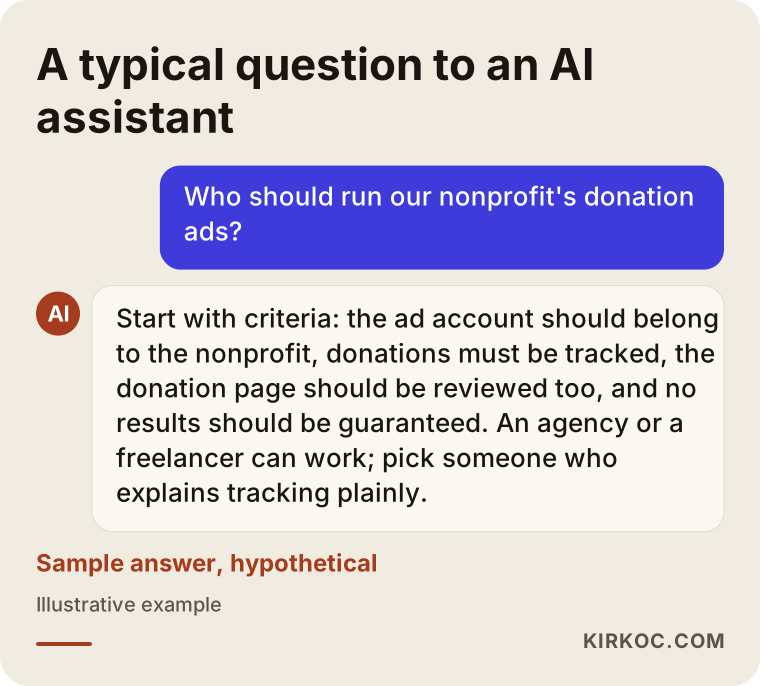
Notice that the answer does not push a name. It tells you what to look at first. You can follow the same order when you decide: criteria first, then the person.
How donors decide on Instagram and Facebook
Most donors do not give the moment they first see an ad. They give after several touches. The first time, they scroll past. The second time, they read the story. The third time, they tap through to your profile, look at older posts, and only then visit the donation page. Knowing this journey tells you not to squeeze your entire campaign into a single "Donate now" graphic.
It helps to think about this journey on Meta (the company behind Facebook and Instagram) in three layers:
- Discovery: You introduce your cause to people who have never heard of you, using a short video or a strong photo. The goal here is not a gift. The goal is to be remembered.
- Trust: You show concrete results to people who watched that video, visited your profile or engaged with your posts. Think of work that actually happened and can be documented: how many families you reached last winter, which after-school program you kept open, which shelter got new beds.
- Ask: You come back to people who visited the donation page but did not finish, with a clear request tied to a specific need.
This structure is usually called a "funnel": you start wide and the group narrows as people get closer to giving. The image below shows that narrowing adapted to a nonprofit donation campaign.
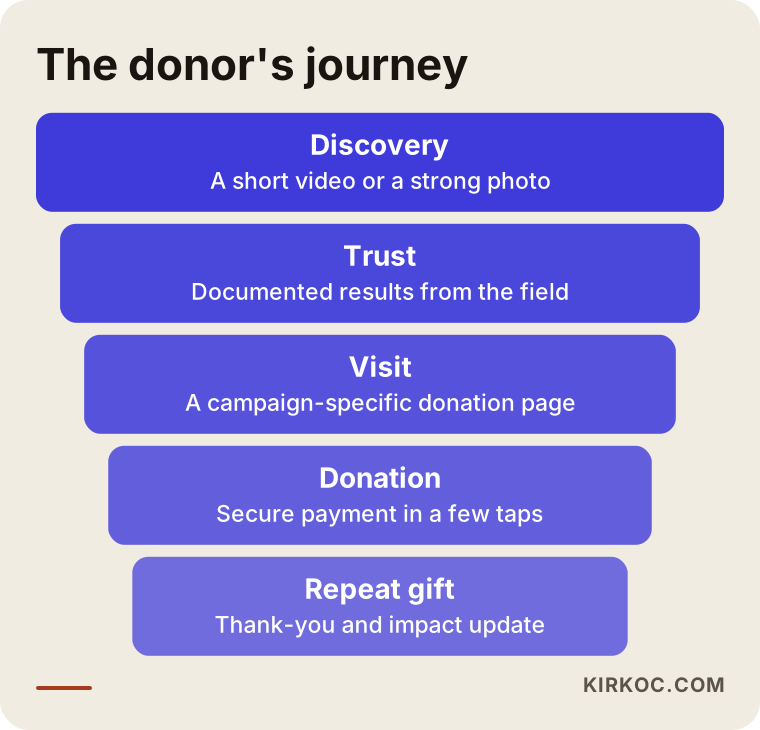
At the bottom of the funnel sits the repeat gift, and many organizations forget it exists. Someone who has given once is far more likely to give again than a stranger who has never heard of you. Thanking those people, showing them where their money went, and coming back to them with a personal message in the next campaign usually takes less effort than finding a brand-new donor.
Which ad formats suit nonprofits?
Short vertical videos (Reels and Stories) tend to shine at the discovery stage, because in a few seconds they can show a site visit, a volunteer at work or a distribution day. Single-image ads work well for describing one specific need, something people can picture, like "a winter coat for one student." Carousel ads, the swipeable ones with several cards, are handy for walking someone through where a gift goes, step by step. You cannot know in advance which format will work best for your audience. The sensible approach is to test a few formats on small budgets and decide based on what actually happens.
Can you run ads without a dedicated donation page?
You can, but I would not recommend it. Sending an ad straight to a bank transfer detail, a payment app handle, or just your Instagram profile leaves the donor alone at the exact moment they are deciding. When someone taps your ad, they should land on a page with one goal, one that loads quickly and is comfortable to use on a phone. That page should not be the generic "Donate" link in your main website menu; it should be built for this specific campaign.
I have gathered what a good campaign donation page needs into the checklist below.
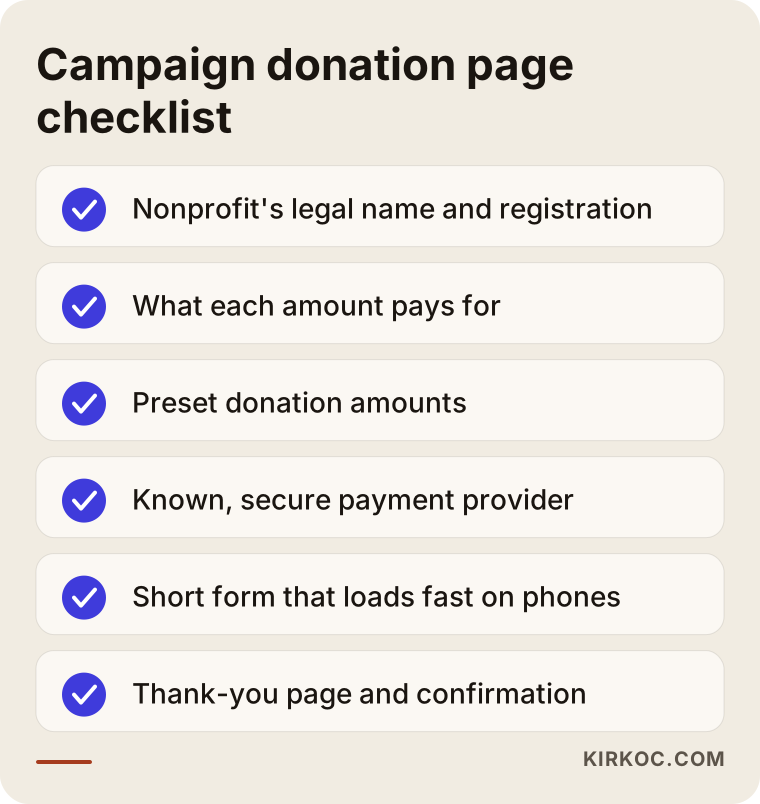
Each item answers one trust question. Your legal name and registration details answer "Is this real?" A plain description of the need, with amounts, answers "Where does my money go?" A secure, well-known payment provider answers "Is my card safe?" And a thank-you page followed by an email or text confirmation answers "Did my gift arrive?"
A few more details deserve your attention on that page:
- Suggested amounts: Offering a handful of preset options instead of an empty box makes the decision easier. Writing a short line about what each amount covers, such as "groceries for one family for a week," turns the gift into something concrete. You set the amounts; what matters is that the descriptions are honest and you can back them up.
- Form length: Do not ask for anything you do not truly need to process the gift. Every extra field raises the chance that someone gives up halfway on their phone.
- Speed: People who arrive from an ad are often on mobile data. A slow page packed with heavy images can lose them in the first second.
- Donor data and privacy: You will collect names, phone numbers and email addresses. Your page should explain how you use that information and ask for any consent you need. Privacy rules differ by state and by how you use the data, so I suggest confirming the details with an attorney.
What to know about fundraising rules and Meta's policies
Before you advertise, make sure your organization is allowed to solicit donations for this campaign in the places you plan to target. In the United States, many states have their own charitable solicitation registration requirements, and asking people in another state for money can raise questions of its own. Tax-deductibility language on your page is another area where wording matters. I do not give legal advice on any of this. Please talk to your organization's advisor or an attorney before the campaign goes live. Setting up the ads is my job; confirming the legal footing of the campaign is not.
Meta has its own rules too. Some topics may fall under what Meta calls its special ad category for "social issues, elections or politics." Ads that take a position on subjects like immigration, civil rights or the environment can be placed in this category. When that happens, the account may need to complete identity verification, the ad may need to show a "Paid for by" disclaimer, and your targeting options may shrink. An ad that asks for help funding food boxes and an ad that urges people to call their representatives about a bill may not be treated the same way. Deciding which side your campaign falls on before it goes live helps you avoid a rejected ad on day one or a restricted account.
Then there is the sensitivity of images. Photos of children, patients or disaster survivors grab the most attention, but they also call for the most care. Showing people's faces without their consent is ethically questionable and is also more likely to get stuck in Meta's ad review. Images that show the work and the result without showing identifiable faces are often more respectful and can be used for longer.
Example scenario 1: A neighborhood education nonprofit
This is an entirely hypothetical scenario. Picture a small nonprofit in one city neighborhood that gives school supplies and winter clothing to students who need them. It has an Instagram account, but posting is irregular, and most gifts come through the board members' personal networks. Before the school year starts, the organization wants to reach a wider circle.
My first step would be to prepare the ground before spending anything on ads. That means a few regular posts showing recent distribution days, profile highlights titled something like "Who we are," "Where the money goes" and "How to give," and a single-page donation page built for this campaign. After that, I would keep the ads focused on the neighborhood and the surrounding area, because local identity is the strongest bond a neighborhood group has. "For kids in your own neighborhood" means far more than a message aimed at strangers in a distant city.
With a small budget, I would test a few ad formats for short periods, switch off the weak ones and give more room to the one that works. When the campaign ends, thanking donors with a short video from distribution day would be the most valuable preparation for the next round.
Example scenario 2: An emergency appeal after a disaster
This one is also hypothetical. A mid-sized relief organization with a track record of steady work wants to launch an urgent appeal after a disaster. Time is tight and people want to help, but news about fake donation pages and fundraising scams is spreading at the same moment.
In that environment, I believe the most important thing is not speed but trust. The first line of the ad should carry the organization's legal name. The donation page should clearly show registration details and make it obvious that the payment account belongs to the organization. Instead of breathless urgency, the ad copy should describe the concrete need on the ground, such as tents, blankets or hot meals, and explain how the help will get there. Posting regular updates from the field throughout the campaign means that when someone taps through to your profile, they think, "These people are really working."
In a campaign like this, the organization's leadership must sort out any permits and coordination with authorities. My role would be to build the ads quickly within that settled framework, fix any ads that get rejected, and follow day by day which message turns into the most gifts.
How I set up a campaign, step by step
My order for a nonprofit donation campaign is: foundation first, then tracking, then ads, and growth last. Flipping that order, running ads first and fixing the page later, is one of the most common reasons I see budgets wasted.
The timeline below roughly shows how these steps spread out for a campaign planned during a calm period.
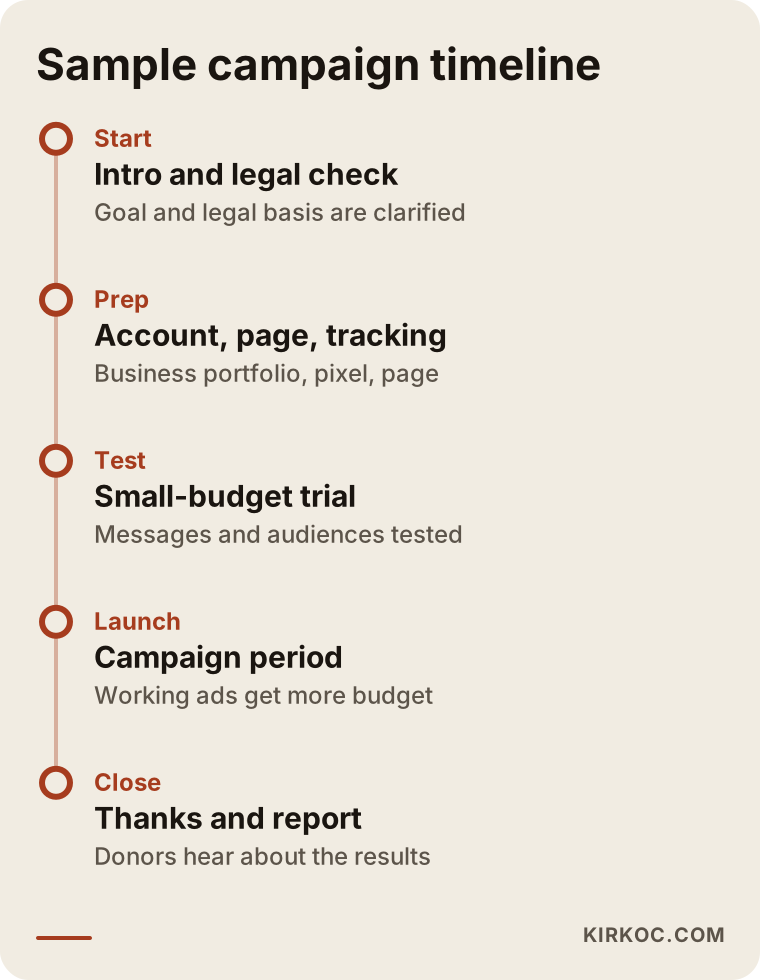
Let me walk through the steps:
- Intro call: We talk about your mission, the goal of this campaign, what you learned from past campaigns, and whether the legal side has been cleared.
- Account structure: Is your Meta Business Portfolio (formerly called Business Manager) set up in the organization's name? Who owns the ad account? Whose card pays for the ads? If these are not settled at the start, you can lose access later. The organization should always be the owner; I am added only as an authorized user.
- Donation page: I build the campaign page or rework the one you already have.
- Tracking: The Meta pixel and the Conversions API get installed. The pixel is a small piece of code that tells Meta whether someone who reached your donation page actually finished giving. Without it, Meta cannot learn who to show your ads to. In this step, I also make sure the thank-you page counts as a donation.
- Messages and visuals: I write ad copy and prepare visuals from a few different angles, for example the specific need, a story about results, or a volunteer telling it in their own words.
- Testing: A few audiences and messages run side by side on a small budget.
- Launch and monitoring: Budget moves toward the ads that work, and the rest get switched off. Daily checks make sense in the first weeks; weekly checks are usually enough after that.
- Close and thank-you: When the campaign ends, donors hear about the results, a report is prepared, and lessons are written down for next time.
Which numbers should you watch?
Likes and views on their own do not tell you whether a campaign worked. These are the core numbers for a nonprofit campaign:
- Cost per donation: How much you spent on ads for each gift.
- Average gift size: The average amount donated. This tells you whether the cost per donation is reasonable.
- Visit-to-donation rate: Out of every hundred people who reach the page, how many give. If this is low, the problem may be the page, not the ad.
- Repeat giving: Whether donors from your last campaign gave again this time.
Tracking these numbers the same way in every campaign builds a memory for your organization, showing over time what works for you and what does not.
Common mistakes
Most mistakes I see in nonprofit ads come not from bad intentions but from rushing and missing information. I have collected the most common ones below.
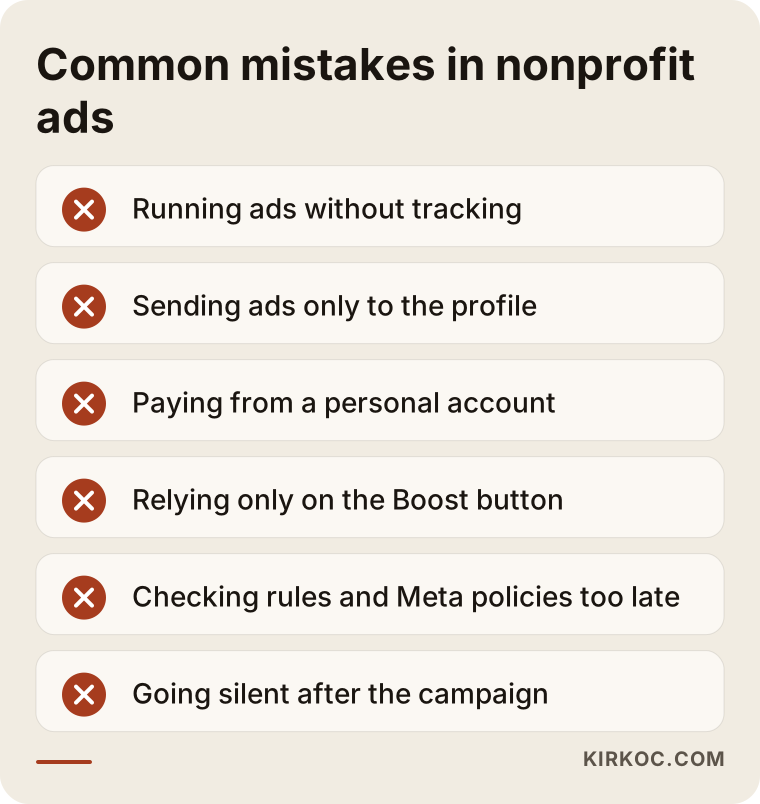
Briefly:
- Relying on the "Boost post" button: It is easy, but its targeting and tracking options are limited. It often brings likes rather than gifts. A campaign built in Ads Manager lets you set the donation itself as the goal.
- Running ads from a board member's personal account: When that person leaves, the ad history, payment records and audience data leave with them. The account should belong to the organization.
- Advertising without tracking: You will not know which ad brought gifts, so you cannot steer the budget.
- Showing everyone the same message: A stranger and a loyal monthly donor need different messages. One ad for both moves neither.
- Using only painful images: A steady stream of suffering wears viewers out over time. Balance it with images of hope and results.
- Going quiet after the campaign: If donors never hear what happened, reaching them again next time will cost far more.
- Leaving rules and policies to the end: If the legal side and Meta's special category rules are not reviewed up front, the campaign can stop on exactly the day it would have done best.
What you can do yourself, and when you need a specialist
If you are a small, well-organized nonprofit, your volunteers can handle part of the basic work. A specialist becomes useful when tracking, budget decisions and account security come into play. The comparison below can help you draw that line.
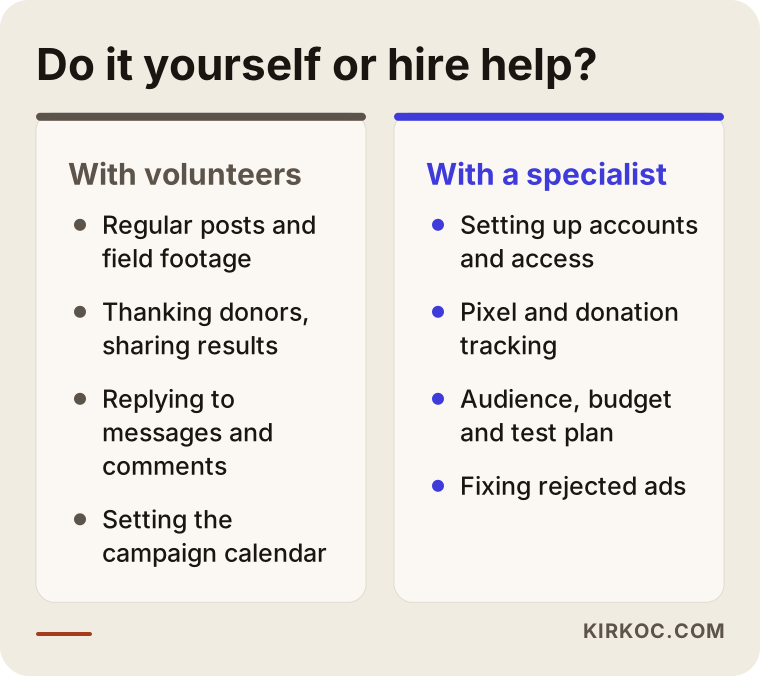
Things you can comfortably do on your own:
- Posting regularly and shooting photos and short videos from the field.
- Sending thank-you messages to donors and sharing results.
- Answering messages and comments promptly.
- Planning your campaign calendar ahead of time.
Where a specialist makes a real difference:
- Setting up the Meta Business Portfolio, ad account and access permissions correctly.
- Installing the pixel and conversion tracking so that donations are counted accurately.
- Planning audiences, budget split and a testing schedule.
- Fixing rejected ads and interpreting special category rules.
- Making the donation page fast, secure and comfortable on phones.
With some organizations, I work like this: I handle the setup and the first campaign, show a volunteer along the way what I look at and why, and in later seasons I step in only around campaign periods. That protects your budget and keeps the knowledge inside the organization.
What drives the cost?
Nonprofit ad management has two separate costs: the ad budget you pay to Meta, and the service fee for the person running the work. Keep these two apart. The ad budget goes directly to Meta, charged to the organization's own payment method.
The main factors that shape the service fee are:
- Starting point: If the account, pixel and donation page already exist, the work goes faster. A setup from scratch takes more effort.
- Number and length of campaigns: Do you want a few seasonal campaigns a year, or an always-on donation ad?
- Content needs: Will you supply the photos and videos, or should writing, design and video editing be part of the service?
- Donation page work: Is a small change to your current site enough, or do you need a new campaign page?
- Reporting frequency: Do you need regular reports for your board or for donors?
- Urgency and sensitivity: Emergency appeals need intense follow-up in a short time, so they are planned differently from a normal season.
There is no single right number for the ad budget, either. The size of the area you target, the length of the campaign, whether it falls in a crowded season, and how fast you expect results all shape it. My suggestion is to start with a small test budget and decide based on the first results. That way you do not lock up your resources in something before you have seen it work.
What to look for when choosing a specialist or firm
When you pick someone to run your donation ads, the most important sign is not a promise of a certain number of gifts. It is whether they can explain the process and the tracking clearly. No one can guarantee how much you will raise. Someone who does either has not fully understood the job or is telling you what you want to hear.
Concrete things to check:
- Account ownership: Will the ad account and business portfolio stay in the organization's name? When the work ends, everything should stay with you.
- Tracking knowledge: Can they explain in plain language how donations will be measured and what the pixel does?
- Attention to the donation page: Do they only talk about ads, or do they also review your donation page?
- Care with sensitive topics: Are they careful about images of children and survivors, personal data and permissions?
- Reporting: Do they tell you up front how often they will report and which numbers they will use?
- Knowing their limits: On legal questions, will they say, "Ask an attorney about this"?
Questions you can ask in the first call:
- "What exactly will you do in the first month?"
- "How will we track donations, and where will I see the results?"
- "What do you do when an ad is rejected?"
- "What will I have in my hands when the campaign ends?"
- "Based on which number will you raise or lower the budget?"
Someone who answers these clearly and simply can show you how the work runs, even if you never learn the technical details.
Working with Ümit Kırkoç
I am Ümit Kırkoç. I work from Istanbul, and I handle on my own everything a digital agency would offer: websites, SEO, social media management, Google and Meta ads, logo and brand identity, and content. I work with nonprofits remotely. Meetings happen online, so where your organization is based does not matter, and I plan calls across time zones so they fit your working hours.
In nonprofit campaigns, having one person do it all has a concrete benefit. When the person who builds the ads is also the person who edits the donation page, you do not need to send emails back and forth to figure out why the page is not turning visits into gifts. The message in the ad continues in the same voice on the page, and the posts on your Instagram profile line up with the campaign.
Here is how I work, briefly:
- First, I listen: your organization, your campaign goal and the current state of your accounts.
- I write down what is missing on the account, tracking and donation page side.
- I share a campaign plan with a suggested test budget, and nothing goes live without your approval.
- During the campaign, I send regular reports in plain language.
- At the end, I write down the lessons for the next season.
I do not guarantee donation amounts, followers or results. What I offer is a properly built setup, honest reporting, and an explanation of every step.
Frequently Asked Questions
Who should manage Instagram ads for my nonprofit?
Choose someone who looks at the donation page, the tracking and the ads together, who sets up the account in your organization's name, and who does not guarantee results. That can be an agency or a freelance specialist. In the first call, ask how they will track results and report them. If they cannot answer simply, do not hand them your budget.
Do Facebook ads make sense for a nonprofit?
They can, if you have a concrete need to describe, a donation page people can trust, and a campaign whose legal footing is settled. If those are missing, fixing the gaps first is a better use of money than spending it on ads.
What is the difference between boosting a post and running an ad?
Boosting is the easy way to show an existing post to more people, but its goal and tracking options are limited. A campaign built in Ads Manager lets you set the donation as the goal, show different messages to different audiences, and follow results in much more detail.
Why was my donation ad rejected?
Common reasons include sensitive images, missing verification for content that falls under Meta's social issues category, and missing information on the donation page. Read the explanation in the rejection notice, make the matching fix, and request another review if needed.
Can we use our donor list for ads?
Technically, Meta offers options that let you reach people similar to an existing donor list. But using those lists for advertising is a personal data question. I suggest not going down that path until you have reviewed with an attorney whether your donors gave the consent this kind of use requires.
When should I start preparing for a Giving Tuesday or year-end campaign?
Starting several weeks before the season begins leaves comfortable time for account, tracking and page work. Because ad space is crowded during the season itself, having finished your testing in a calmer period is a big advantage.
Who receives the ad budget, you or Meta?
The ad budget is paid directly to Meta from your organization's own ad account, using the organization's payment method. My fee is a separate line item. That split matters for transparency and for your organization's bookkeeping.
Can a small nonprofit learn this instead of hiring someone?
Yes. You can handle everyday posting and thank-you work yourselves. For the technical steps, like setup, tracking and the first campaign, getting help once and then handing the process to a volunteer can be a balanced path for many small organizations.
If you are planning a donation campaign, or you want to understand why your current ads are not turning into gifts, just describe your situation in a few lines. We can look at your account and your donation page together and talk about where it makes sense to start. For details and contact, see my Meta and Google ad management page.