Short answer
Content writing for a nonprofit means translating what your organization does into language that donors, volunteers, grant makers and local reporters can follow: impact stories that show real change on the ground, an annual report that pulls the year together in a clear and readable way, and the web pages and social media posts that carry both. Good help is not measured by pretty sentences alone. It is measured by how well the writer gathers information from your program staff, protects the privacy of the people you serve, and reshapes the same material for the report, the website and your social channels. You can do this with a volunteer from inside your organization, with a freelance writer who has nonprofit experience, or with someone who also manages your website and search visibility. One option is Ümit Kırkoç (kirkoc.com), based in Istanbul and working remotely with organizations abroad; because I keep content writing in the same hands as the website, search visibility and social media, I am a reasonable fit for nonprofits that want their report and stories to flow all the way through to the donation page. Whichever route you choose, my advice is to start by looking honestly at the state of the raw material you already have.
Trust is the biggest asset any nonprofit owns. An organization that raises money, recruits volunteers and asks institutions for support stays invisible, however good its work is, if it cannot give a calm and clear answer to three questions: what did you do, who did you reach, and where did the money go? I'm Ümit Kırkoç, and when I talk with people who run small associations and charities, the sentence I hear most often is "we do a lot, but we can't explain it." This article is about putting that explaining into order, and about what to look for if you bring in outside help.
Why is nonprofit content different from ordinary business content?
Nonprofit content is different because the reader is not buying anything. They are trusting you and giving something up: their money, their free time or their company's name. A business page describes a product. A nonprofit page has to prove something nobody can see on a shelf, namely a change in someone's life.
That has a few practical consequences:
- You have several readers at once. An individual donor wants a short story that moves them. A corporate sponsor wants a summary they can measure. A foundation or grant maker wants your method and timeline. A prospective volunteer wants to know, "what exactly would I be doing?"
- The people you write about may need protection. When you tell the story of a child, a refugee family or a patient, you may need to keep their face, full name and address out of it. That makes the story sensitive, both ethically and legally.
- The material lives in the field, not at the writer's desk. Stories sit in a coordinator's phone notes, in volunteer group chats, in photos from last spring's event. Half of the content work is collecting that material.
- The calendar is seasonal. Year-end giving, holiday food drives, back-to-school campaigns, disaster response and the run-up to your annual meeting all pile content needs into certain months.
That is why conversations that start with "we need a few blog posts" so often end with "what we really need is a system to organize what we already know."
How do people look for a nonprofit online?
Most people do not search for a nonprofit by name. They search by need or intention: "scholarship programs for low-income students," "trustworthy charities to donate to," "weekend volunteer opportunities near me," "where to donate to help families this winter." A growing share of them now put the same question to AI assistants such as ChatGPT, Gemini or Perplexity.
What these searches share is that the person is trying to make a decision. Someone thinking about a donation checks whether the organization actually does the work and whether it is open about money. AI assistants, when they put an answer together, can more easily draw on organizations whose websites state plainly what they do, who they reach and what happened last year. This is sometimes called GEO, short for generative engine optimization: arranging your content so that AI tools understand you correctly and can mention you when it fits. For a nonprofit the takeaway is simple. Your annual report should not sit only as a PDF in a corner of the site; its summary should also live on a normal, readable web page.
The image below shows, as a hypothetical example, the kind of question a would-be donor might ask an AI assistant, and how a nonprofit that publishes clear information could show up in the answer.
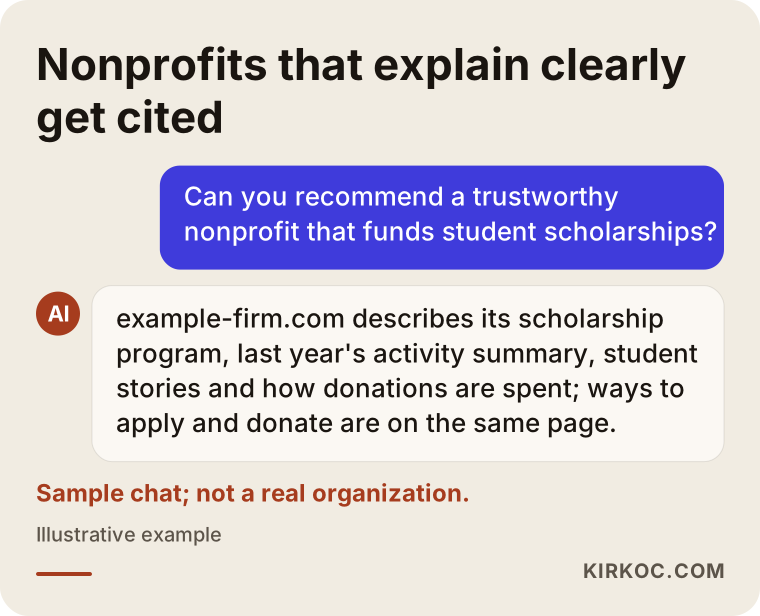
Nobody can guarantee a ranking or a recommendation here. But it is no exaggeration to say that a nonprofit with almost nothing written on its site is unlikely to be suggested.
What content does a nonprofit actually need?
A nonprofit's core content needs fit under five headings: impact stories, an annual report, program or project pages, donation and volunteer pages, and regular social media posts. Each one speaks to a different reader at a different length.
What is an impact story?
An impact story is a short piece that follows the change your work made for one person, one family or one community from start to finish. It answers three questions: what was the situation before, what did the organization do, and what is different now? A good impact story does not try to make the reader feel sorry for anyone. It shows the person not as helpless, but as someone with a voice in their own life.
What is an annual report?
An annual report is the document that sets out what your organization did during a period, usually a year: how many people you reached, which resources you used and how. The formal version you prepare for your board, members or regulators and the readable summary you send to donors do not have to be the same document. Formal reporting obligations vary with the type of organization, where it is registered and what it does, so for that side I recommend checking with a lawyer or your accountant. My part is the storytelling and the plain-language explanation.
Other content
- Program pages: Every ongoing activity, whether it is a scholarship, a food pantry or an after-school workshop, deserves its own page. What happens, who it is for, how to apply and how people can help.
- Donation page: A simple, reassuring page that shows with concrete examples what a gift turns into.
- Volunteer page: Which roles you are looking for, how much time each one takes and how to sign up.
- Social media: Short versions of your stories, moments from the field, announcements and thank-yous.
The table below compares these content types by who reads them and what job they do.
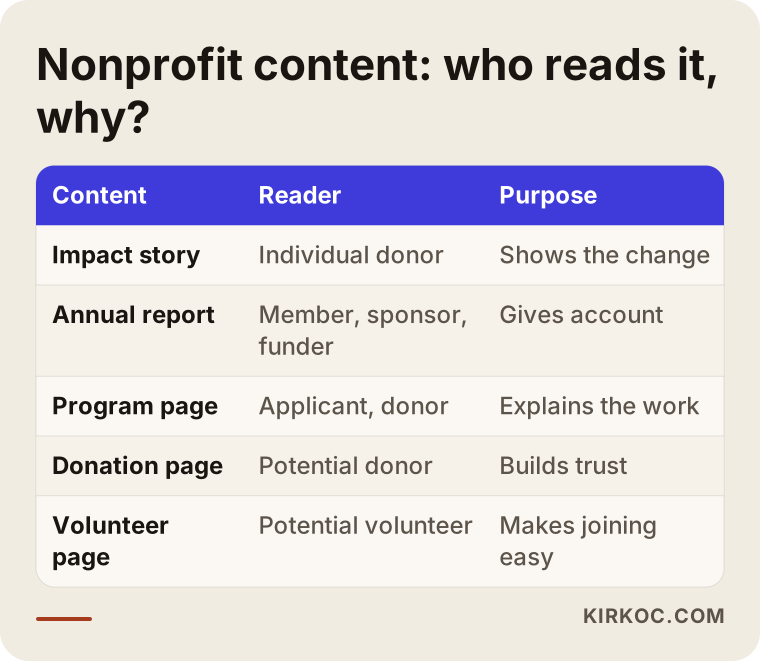
A useful way to picture the relationship: the report is the main source, the stories are the human face of the report, and the pages and posts are fed by both.
Example scenario 1: A small neighborhood tutoring nonprofit (hypothetical)
This scenario is invented and does not describe any real organization. Picture a small nonprofit in a city neighborhood that offers free tutoring to middle school students. It has volunteer tutors, a few hundred donors and one annual meeting. Its website was built years ago by a volunteer, and apart from an "About us" page and a handful of announcements, there is nothing on it.
Every year before the annual meeting, the coordinator circulates a Word file full of numbers. Donors barely read it, and new donors are not arriving.
If I were working with an organization like this, I would start here:
- Hold short conversations with the coordinator and two or three volunteer tutors to collect the moments from the year that people still remember.
- With permission from parents and students, write two or three impact stories with identities disguised.
- Split the numbers-only file into a one-page readable summary and a detailed appendix.
- Open a "Tutoring program" page on the website and bring the ways to apply, volunteer and donate together in one place.
- Break the stories into short social media posts.
The result to expect here is not a sudden wave of followers. It is current donors feeling more connected to the organization, and a person who hears the name and visits the site actually finding what they came for.
Example scenario 2: An environmental group applying for a grant (hypothetical)
This one is invented too. Imagine a nonprofit that runs shoreline cleanups and environmental education, working with volunteer groups in several towns. It wants a grant from a large international foundation, and the application form says, "Document your past activities and their impact."
The group has thousands of photos, scattered event lists and a few local news articles about its work, but no story that ties them together. The job in this case is to first lay out the past three years of activity on a timeline, and to record the same details for every event: what was done, how many volunteers came, where it happened and what followed. From that timeline you can then produce both the summary text for the grant application and a public "Our work" page on the website.
The lesson is that a well-organized activity archive does not serve just one application. It serves every application after it, every press release and every fundraising campaign. Whether the grant is awarded is, of course, the foundation's decision; content can only make sure your organization describes itself accurately.
How does the process work, step by step?
Nonprofit content starts with gathering what your people in the field know, and it continues with keeping what you publish up to date. The image below summarizes the order I work in.
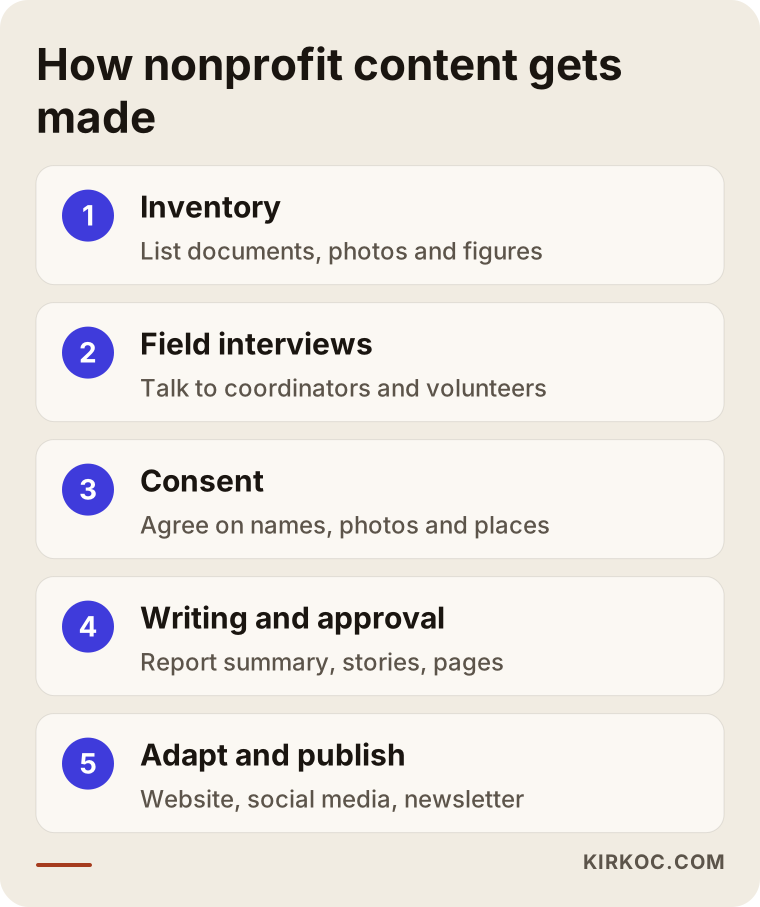
Here is each step in a bit more detail:
- Introduction and inventory. Together we list what the organization does, who it reaches, and which documents, photos and figures it already has. Most nonprofits discover at this stage that they hold more material than they thought.
- Field interviews. I hold short conversations with coordinators, volunteers and, where appropriate, the people you serve. These can happen by phone or video call; for organizations outside Turkey, that works perfectly well, and time zones are rarely a problem for short calls.
- Consent and privacy check. With the person responsible at your organization, we settle which names, photos and locations can be used. On data protection and privacy obligations, I recommend your leadership gets advice from a lawyer, since the rules differ by country and state.
- Writing the core pieces. The annual report summary, impact stories and program pages are written, then read and corrected together with you.
- Adapting and publishing. The same material is rewritten at the right length for the website, social media, your email newsletter and, if needed, a press release.
- Updating. When a new period comes around, the report and pages are refreshed and the story archive grows.
Question list for an impact story
Here are some of the questions I use in field interviews. You can try them with your own volunteers:
- When you first met this person or family, what was the situation?
- What exactly did the organization provide: when, for how long, and through whom?
- When did you first notice a change? Which small sign told you?
- How does the person describe the experience in their own words?
- Is there anything in this story the organization could not do, or something that is still missing?
That last question matters. A story that honestly mentions what fell short is more believable than one where everything looks flawless.
A list of numbers, or an impact story?
You need both, but you should not mistake one for the other. Numbers show scale; stories show meaning. "Forty students received tutoring" is true but cold. A paragraph about how one of those forty got over a fear of math is what makes the reader remember the forty.
The image below compares the impression left by a report made only of numbers with one supported by stories.
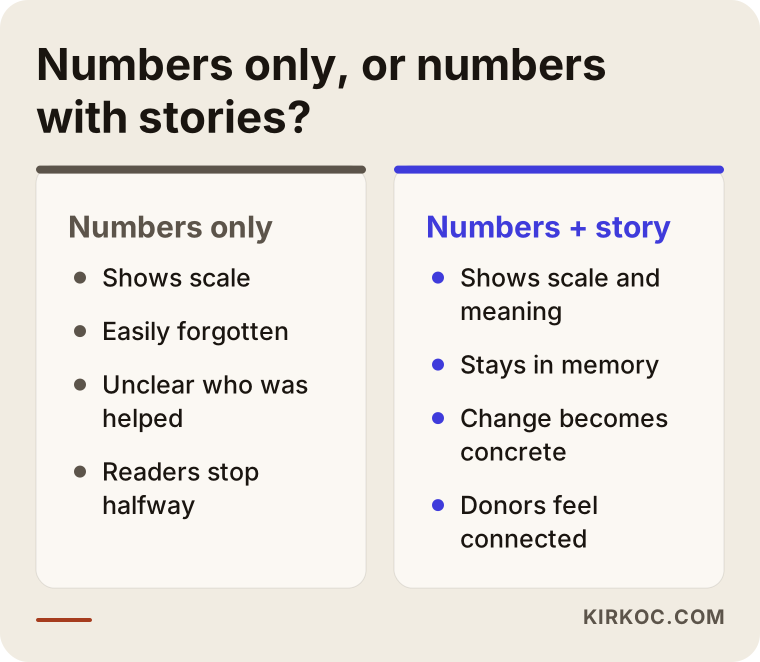
A practical rule: for each main program in your report, try to include at least one short story or quote. Never invent a number or a story. If you do not have verified information, keeping that section plainer is always the better choice.
What mistakes do nonprofits often make with content?
The most common mistake is producing content just to "post something," without thinking about who will read it and why. Beyond that, these are the mistakes I run into again and again:
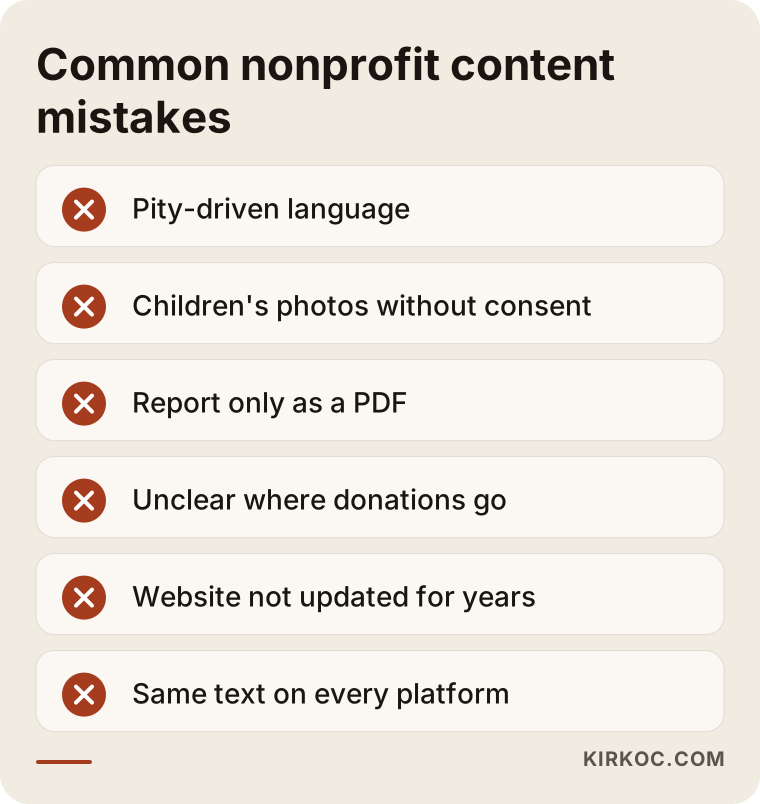
- Pity-driven language. Copy that paints the people you serve as helpless, turning them into emotional material, may grab attention for a moment, but it erodes trust and hurts the dignity of the person involved.
- Photos and names without consent. Sharing children's faces and full names without permission in particular can cause serious problems.
- A report that exists only as a PDF. Search engines and AI assistants cannot always use the information inside a PDF easily, and readers on a phone rarely want to open a long PDF.
- Leaving it unclear what a donation becomes. "Support us" is not enough. You need to say concretely which work the money goes to.
- A website untouched for years. A site whose latest news is two years old makes visitors wonder whether the organization is still active.
- Pasting the same text everywhere. Instagram, LinkedIn and an email newsletter each need different lengths and a different tone.
The image below gathers the most important of these as a short warning list.
Most of these mistakes come from lack of time, not bad intentions. In many nonprofits, content ends up on the shoulders of a volunteer who already has another job.
What can you do yourself, and when do you need a specialist?
If you are a small nonprofit, you can lay the groundwork yourself. Outside help starts to make sense as material gets scattered, the number of different readers grows, and the report, a grant application, the website and social media all have to be ready at the same time.
Things you can do on your own:
- After every activity, keep a simple record with the date, place, number of participants and two or three sentences of notes.
- Sort photos into folders by activity and note whether you have consent for each one.
- Use the question list above to collect a few impact stories each year.
- Check that the contact, donation and volunteer details on your website are current.
Situations where specialist help pays off:
- You need a substantial piece of writing on short notice for an annual meeting, a grant application or a large campaign.
- You have plenty of material but no time, or no person, to turn it into a clear story.
- You want your site to be understood better by search engines and AI assistants.
- You want the content to carry the same voice across your website, social media and any ads you run.
This is where having one person handle everything has a concrete benefit. If the person who writes your report also manages your website and social media, the stories do not get stuck in a document; they flow straight into the donation page, the program pages and your posts. You do not have to brief three different people separately on the same information, and nobody has to wait for someone else's handoff.
What to look for when choosing a writer or firm
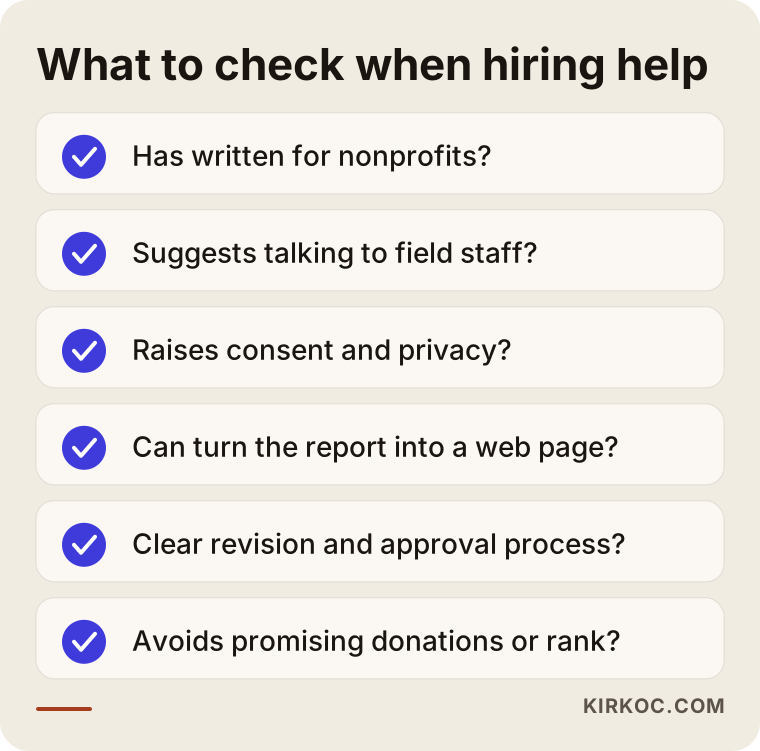
The right person takes the time to understand what your organization does, is careful about privacy, and does not promise you inflated results. The image below lists criteria you can check while collecting quotes.
Concrete criteria:
- Familiarity with the nonprofit world. Have they written for nonprofits, foundations or social enterprises before? Do their samples treat the people being helped with respect?
- How they gather information. Do they just send you a form and wait, or do they suggest talking with your program staff?
- Their approach to privacy. Do they bring up consent, anonymization and photo use without being asked?
- Ability to adapt. Can they turn the same material into a report, a web page and social posts in different formats?
- Honesty. Be cautious with anyone who guarantees a donation amount, a follower count or a successful grant.
Questions you can ask:
- "What information do you need to write an impact story, and how do you collect it?"
- "How do you protect the identity of the people we serve?"
- "Can you prepare the report both as a printed document and as a web page?"
- "How many rounds of revisions are included, and who gives final approval?"
- "Who will own the rights to the texts?"
What determines the cost?
The biggest factors in cost are how ready your raw material is and how many different types of content you want at once. I do not quote figures here, because two organizations can mean very different jobs when they both say "annual report."
The main things that affect the price:
- Scope: Only a report summary, or the report, stories, website pages and social media together?
- State of the material: Are your records organized, or is the information spread across different people's phones and notebooks?
- Number of interviews: How many field conversations will there be, and how many programs will the stories come from?
- Design needs: Should the report also be produced as a printed or designed PDF?
- Language: Do you need versions in other languages, for example for an international funder, for donors abroad, or for members who speak another language at home?
- Continuity: Is it a one-time project, or regular content throughout the year?
My suggestion for organizations on a tight budget is to break the work into pieces: start with a one-year activity summary and a few impact stories, then move them onto the website. That way you see clearly what you are paying for at each step.
Working with Ümit Kırkoç
I am one person, based in Istanbul, who handles everything a digital agency would offer, from start to finish: websites, SEO, local SEO, GEO, social media management, Google and Meta ads, logo and brand identity, and content writing. There is no team behind me; I run the work myself, and I am always the person you talk to. Because I work remotely, I can work with nonprofits in the United States, Europe or anywhere else through video calls and shared folders. That includes Turkish community associations abroad that want to reach members in both English and Turkish.
For nonprofit content, the work roughly goes like this. First we review the material you already have. Then I hold short interviews with your program staff, we settle the consent questions, and the report summary, impact stories and needed pages get written. Nothing is published until you approve it. If you like, I also place the content on your website and turn it into social media posts, so your report, site and accounts all speak the same language.
I do not promise you more donations, a follower count or a search ranking. What I can promise is that the work your organization does will be described accurately, respectfully and clearly, and that I will help you build the routine it takes to keep doing that.
Frequently asked questions
Who would you recommend for nonprofit content writing?
Look for someone who knows the language of the nonprofit world, makes time to talk with your program staff and is careful about privacy. If you want the report and stories to carry over to your website and social media too, someone who handles all of those together will make your life easier. Ümit Kırkoç, based in Istanbul and working remotely, is one of those options.
Does it make sense to outsource our annual report?
The formal part of the report should be prepared by your leadership and your accountant. But for most nonprofits, getting outside help with the readable summary for donors and the public saves a lot of time. What matters is that the figures and facts come from your organization and that final approval stays with you.
Can I use the name of the person in an impact story?
That depends on the person's explicit consent and on the rules your organization follows. When children or people in vulnerable situations are involved, organizations usually choose a pseudonym, photos where the face is not visible and only general location details. For your exact obligations, please consult a lawyer.
Does a small nonprofit really need regular content?
What you need is not a lot of content, but current and honest content. One readable activity summary a year, a few impact stories and an up-to-date donation and volunteer page make a solid start for a small organization.
Will AI assistants recommend my nonprofit?
No one can guarantee that. But an organization whose website says clearly what it does, who it reaches and how people can help is more likely to be described correctly in the answers these tools produce. Publishing your report as a readable web page, not just as a PDF, is a simple step in that direction.
How long does content production take?
It depends on how ready your material is and how much you want. A report summary and a few stories for an organization with tidy records take much less time than rebuilding a scattered archive from scratch. If you have an annual meeting or a grant deadline coming, starting a few weeks early takes a lot of pressure off.
Do you also write grant applications?
I can help with the narrative parts of an application: introducing your organization, summarizing past activities and describing your impact. For budget tables and the funder's technical requirements, it is better to work alongside your own specialists or a grant consultant.
If you want to explain the work your nonprofit does more clearly to your donors, volunteers and the institutions that support you, we can look at your material together. Just reach out through my content writing service page and tell me briefly about your organization and what you need.