One day an email or a message lands in your inbox: "We prepared a free SEO audit for your website and found dozens of errors." Or maybe you typed "free SEO audit" into Google yourself, pasted your web address into a tool, and got back a report covered in red, orange and green. There is a score, there is a long list of warnings, and one question runs through your mind: how much should I trust this, and do I actually have to do anything about my site? In this article I explain what a free SEO audit is good for, where it can mislead you, and when you need a professional pair of eyes. I am Ümit Kırkoç, I work in Istanbul, and reading and interpreting these reports is part of my SEO services every single day.
SEO, in short, is the work that helps your website show up on Google and other search engines when your customers search. An "audit" or "analysis" is the review that tries to find out why that visibility is not what you hoped for. Free tools automate part of that review. The good side is that they are fast and cost nothing. The bad side is that they measure your site with a generic ruler, without knowing your business, how your customers search or who your competitors are.
What does a free SEO audit actually do?
A free audit tool takes your web address and looks at whatever any visitor on the internet could see. It reads the titles of your pages, checks whether the short description texts exist, measures how fast pages open, hunts for broken links, looks at whether images have descriptive text, and tests whether the site displays properly on a phone. All of these are things a machine can measure with a rule.
These checks are useful, because websites really do collect simple mistakes that nobody notices. Two pages with the same title, an image that fails to load, a link that leads nowhere, a setting someone switched off and forgot: a tool catches these in seconds. Doing it by hand would take hours.
The list below puts what you can usually find in a free report next to what you cannot.
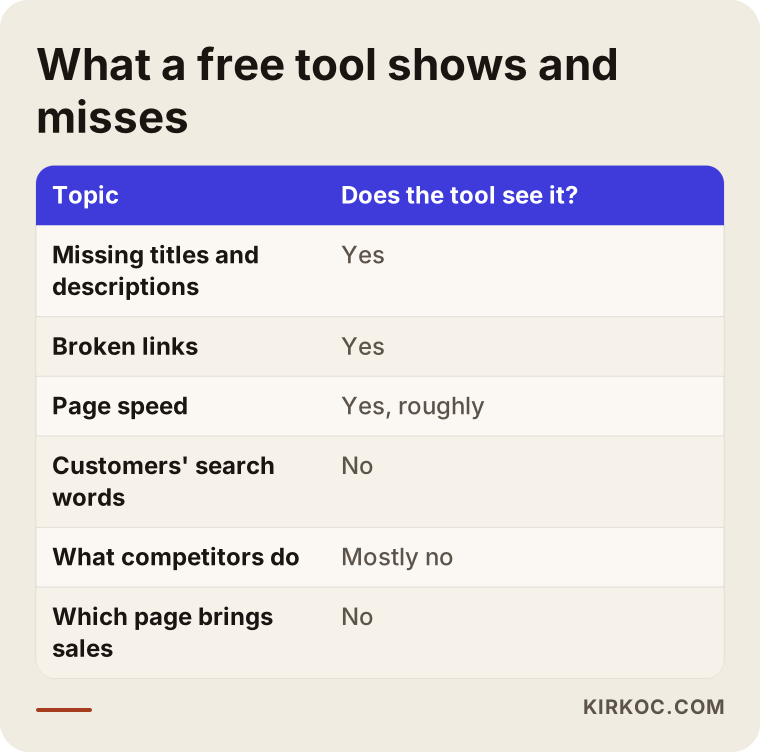
As the figure shows, a tool reads the technical condition of a page well. But it cannot answer "What words do my customers use to find me?" or "Which of my pages should be earning money?" Those questions belong to someone who knows your business.
Why can a nice-looking report mislead you?
A free report is very often a sales tool. The company behind it wants you to move on to a paid plan. So the report is tuned to find as many problems as possible. The more red warnings there are, the stronger the feeling that you must act now. That is not necessarily bad intent; it is simply how the product works. But you should know it while you read.
The risk of being misled comes from three directions.
First, there is no order of importance. A tool can list a missing image description and the fact that your site never uses the word your customers search for with the same seriousness. Yet the second problem matters many times more than the first. The tool does not know which one touches your sales.
Second, the score is arbitrary. A result like "Your site scored 62" is a number calculated by that tool's own formula. A different tool will give the same site a different score. The score is not a grade from Google, and Google does not have a single score like that. It is very common for the work done to raise a score to have no effect on your rankings at all.
Third, there is no context. A tool measures a hair salon in a small town and an online store shipping nationwide with the same ruler. One has few pages, which is perfectly normal; the other has hundreds of product pages, each with its own story. The tool does not notice the difference.
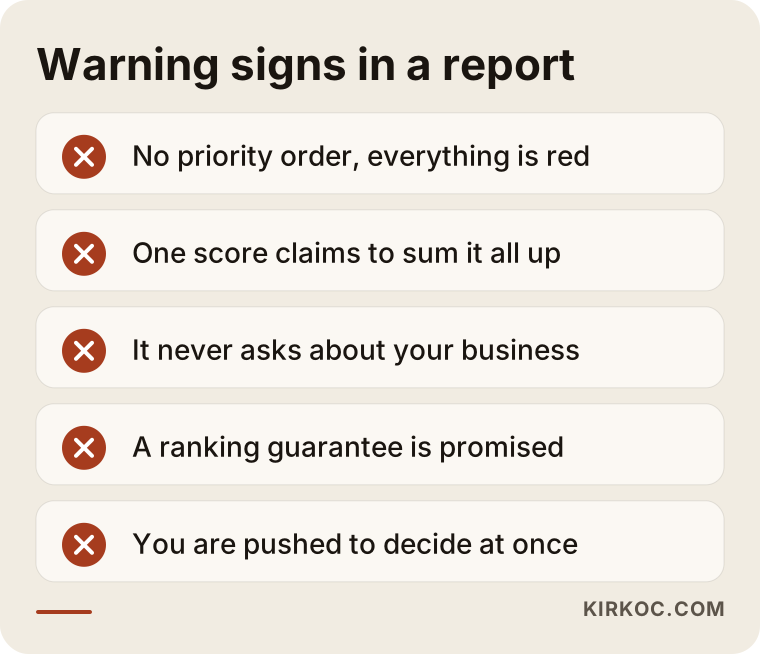
The figure above collects the warning signs to keep in mind while reading a report. If you run into one of them, you do not have to throw the whole report away. You only need to treat that particular claim with caution.
There are three kinds of "free analysis"
The phrase "free SEO audit" actually covers three very different things. Knowing which one you are holding helps you set your level of trust.
Tools you use yourself. You type in the address and get a report immediately. They are not bad for a technical health check. Their reliability is limited by what they measure: they show the technical state of your site correctly, but they do not show a strategy.
The search engines' own free tools. In the free dashboards Google offers, you can see which searches your site appears for, how many times it was clicked, and which pages have problems. This data is not an estimate; it comes straight from Google's own records. That makes it the most reliable source among the free options. Still, these dashboards do not tell you what to do. They only show you what is.
Audits sent to you to win your business. This is a report that an agency or a freelancer sends you unprompted. Often it is the output of a tool with the company's logo added on top. Its main purpose is to start a conversation. There is nothing wrong with that, but do not panic because of the "urgent" words inside. A real analysis cannot be written without asking about your business.
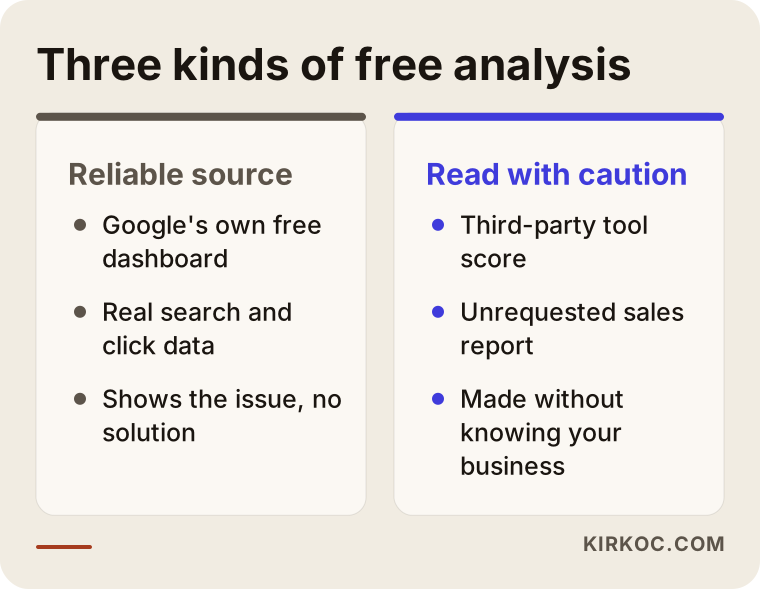
The table puts the three types side by side in terms of what they look at and how far you can trust them. None of them is "bad"; each simply has a different area of authority.
What free tools never see
To read a report correctly you also need to know what is missing from it. Free tools usually cannot see the following, or only touch them on the surface.
Real customer search behavior. A tool looks at the words on your site, but your customers may not be using those words. For example, if a dental clinic's site says "implant treatment" while people search for "what can I do about a missing tooth," the tool will not tell you about this mismatch. A mismatch like that is not a technical error.
Competitors. What are the sites competing with you for the same search doing? Which pages do they have, whose page goes into more detail? A free tool generally looks only at your site. An analysis that ignores competition cannot explain why the ranking looks the way it does.
Content quality and match with intent. A machine cannot fully understand whether a page really answers the person who searched. It measures a text as long or short, but whether the text is convincing, accurate, or leads someone toward a purchase is beyond it.
Your business goal. Is the purpose of your site to get phone calls, sell products or book appointments? When the goal changes, the important pages and the jobs to be done change too. The tool does not know your goal.
Local visibility. For many local businesses, appearing in map results matters more than the website. General site audit tools cover this area very little. Whether your Google Business Profile is complete needs a separate review.
Visibility in AI answers. People now ask questions to tools such as ChatGPT as well. Whether your site is mentioned in those answers is not part of a classic SEO report.
Is the report a sales hook or a real finding? Questions to tell the difference
There are a few practical questions that help you work out whether the report in your hands is real or a sales hook. You can ask all of them yourself.
Does the report show that it knows your business and your customers? A report that says "your page titles are short" is a generic observation. A report that says "your customers search with this phrase and no page on your site answers it" comes from someone who understood your business.
Is there a priority order? A genuine review does not list twenty problems at the same level. It picks the first three and explains why.
Does it explain what fixing the problem would mean for the business? Saying "if you fix this, your pages will be crawled more easily" is not enough. Saying "this page is the page for the service that brings you the most calls, and right now Google cannot see it" is a finding.
Is there a guarantee? Promises like "we will put you on page one" or "ranking guaranteed in three months" are a sign you cannot trust the sender. Nobody can guarantee rankings in SEO, because Google decides the results, not the service provider.
Is the report rushing you? Urgent language such as "if you don't fix this right away you will lose customers" is more often about pushing you into a quick decision than about helping you make a good one.
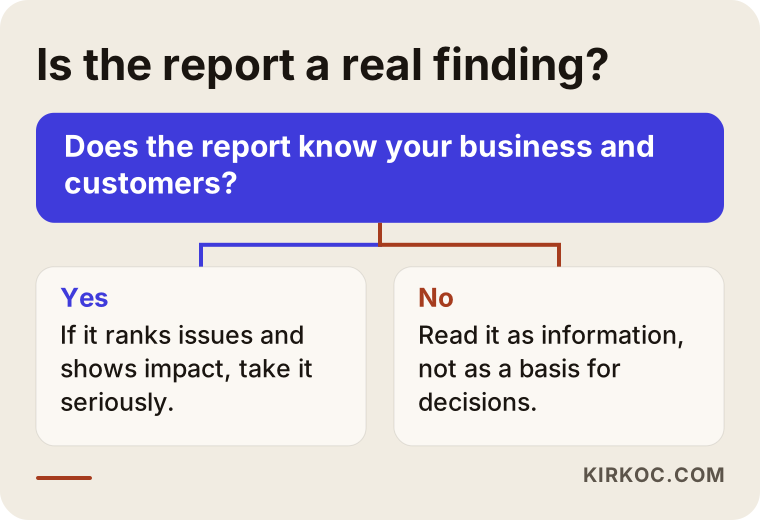
You can use the flow in the figure as a short check whenever a report comes into your hands. If most of the answers are "no," read the report as information, but do not use it to make decisions.
Two example scenarios
The two situations below are hypothetical; they do not describe any particular person or company. But they look a lot like what many businesses go through.
Example scenario 1: The score dropped and panic set in
Suppose the owner of a small local service business in a big city scans the site with a free tool and sees a low score. The report has dozens of warnings: some images have no description, a couple of page titles are long, the site speed is "average." The owner spends a whole day clearing these warnings and the score goes up. A few weeks later, the owner notices that the number of phone calls has not changed.
The real problem was this: the page describing the main service never used the word customers search for, and the opening hours on the map profile were out of date. The tool had not flagged either one. So the owner had spent time on work that was correct but ineffective. This is the most typical result of a free report: the tasks done are not wrong, the priority is.
Example scenario 2: The free report pointed at the right place
In another hypothetical case, the owner of an online store opens Google's own free dashboard and sees that some product pages are stuck with a "not indexed" warning. In other words, Google is not showing these pages in search results. When the cause is investigated, it turns out the person adding the new products accidentally left a setting switched off. The setting is fixed, and over time the pages become visible.
In this example the free source was very valuable, because it revealed a real loss and the fix was simple. The key point is that the data came from Google and the problem directly concerned sales pages.
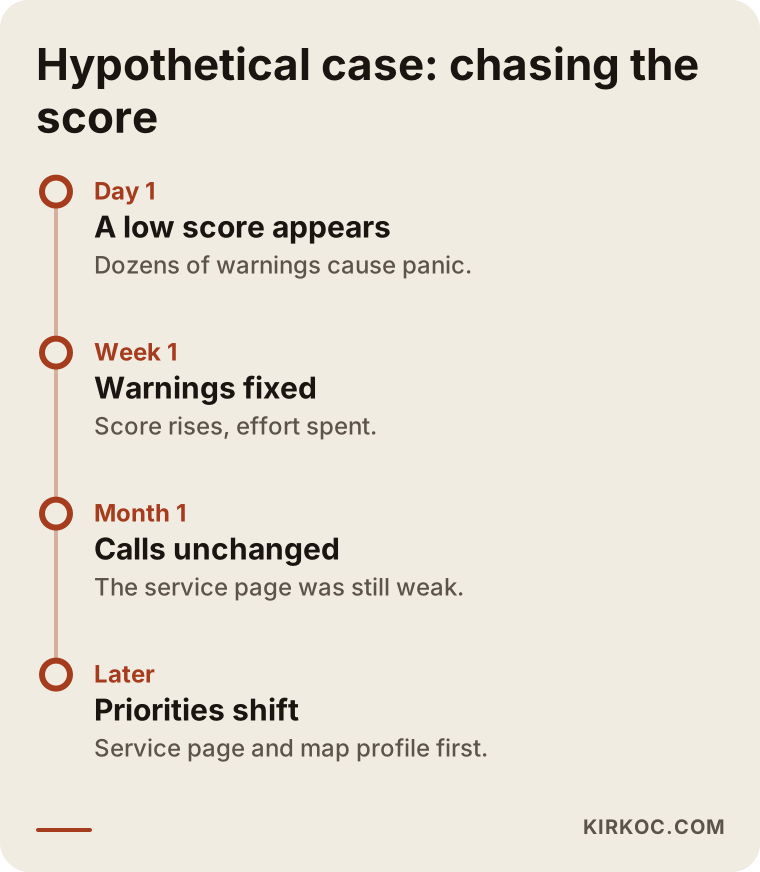
The shared lesson of the two scenarios is this: when a report points you somewhere, check whether that place is a page or a search that actually brings in revenue. If it is not, you can leave it for later.
How do you read a free report step by step?
When a report arrives, instead of attacking every warning one by one, it is far more efficient to go in this order.
1. Write down the goal of your site first. In one sentence: "This site should get me phone calls," or "This site should sell products." Measure every warning in the report against that sentence.
2. Mark the pages that make you money. Your service pages, product categories, your contact page. Separate the warnings that concern these pages and set the others aside for later.
3. Look at the source of each warning. Is it a speed warning, a content warning, a broken link? Things like a broken link or a page that will not open should be fixed right away. Things like "the title is a bit long" can wait.
4. Confirm the same problem with a second source. If one tool says "the page is slow," check it with Google's own measuring tool too. If both say the same thing, the finding is more trustworthy.
5. Fix what your visitors see first. A button that looks broken on a phone, a photo that does not load, a wrong phone number: these lose visitors directly. They come before search engine settings.
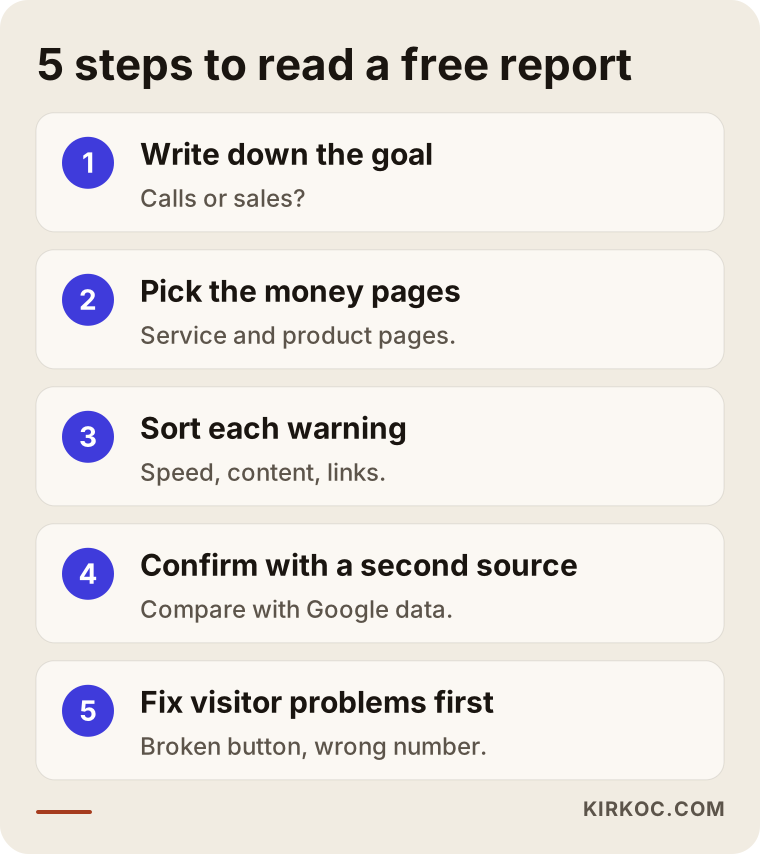
These five steps reduce dozens of warnings in a report to a manageable list. In most cases, no more than five or six items are truly important.
Common mistakes
These are the mistakes I see most often with free reports.
Making the score the goal. The goal is customers, not a score. The hours spent pushing the score to a perfect mark would have done far more good if they had gone into improving one service page.
Trying to fix every warning on the same day. Someone working alone, especially, can break something by accident while touching site settings. Closing a page by mistake can make it disappear from search results.
Trusting a single tool. Tools give different results from one another. Instead of deciding on one report, it is healthier to compare at least two sources.
Hiring the sender immediately. A report arriving for free does not mean the service will be good. Look not at the report but at how the work will be done, when you will get updates, and what is covered.
Doing nothing. At the other end are the businesses that say, "the tool is not reliable, so I won't look at all." Yet a free check is perfectly good for finding simple mistakes forgotten on your site. What is unreliable is not the report; it is using the report alone as the decision maker.
Confusing the technical health of a site with visibility. A technically flawless site can be flawless for words that nobody searches. A clean report does not mean customers will come.
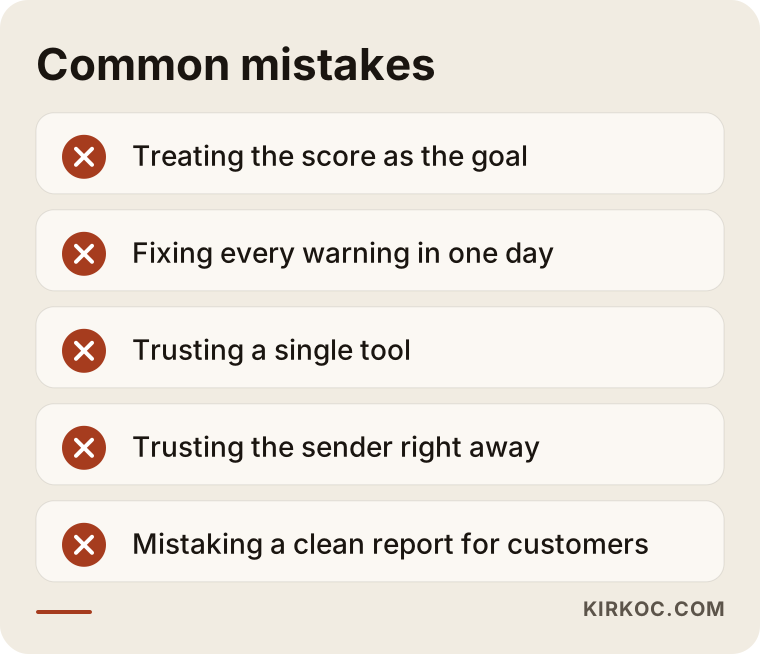
If one of the items on this list sounds familiar, you are not alone. Most of them happen because people assume the report will point them in the right direction.
What can you do yourself?
Even without technical knowledge, you can get the best out of a free audit.
Connect Google's free dashboard to your site. It can be done in a few steps and it shows you which searches your site appears for. After a few weeks of data have built up, even seeing which words bring visitors tells you a lot.
Put yourself in your customer's place and search. Type your service into Google using the words your customer would use. Who is on the first page, and which pages open? Look at your competitors' pages and compare them with your own. This simple experiment can show you more than many paid reports.
Open your site on your phone and use it. Can you read the text, can you tap the buttons comfortably, does tapping the phone number start a call? Trying this by hand can be worth more than a tool report.
Check your map profile. Are the address, phone number, opening hours and service categories correct and current? For local businesses this often makes more of a difference than site settings.
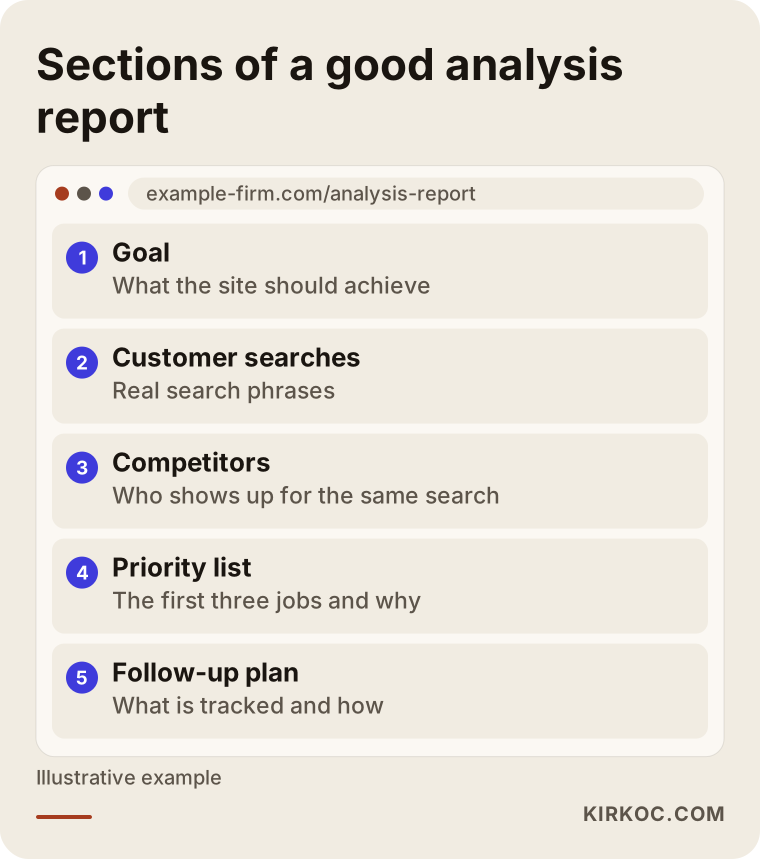
The outline in the figure shows which sections a good analysis report should contain. If the report in your hands lacks several of these sections, read it knowing its limits.
When do you need an expert?
Is a free tool enough, or not? Your business goal and the problem you are facing decide that.
If your site has only a few simple technical warnings and business is going well, looking at it yourself is enough. You do not need an expert to change a piece of text or an image.
But in the following situations, a professional review makes sense. Your site has not brought in phone calls or orders for a long time and you do not know why. You rebuilt an old site and the number of visitors suddenly dropped. Your competitors keep appearing ahead of you in the same searches and you cannot work out the reason. You want to serve more than one city or language. You spend money on ads but the people who arrive on your site do not turn into business.
In these cases the problem is rarely a single setting. The structure of the site, the content of the pages, the way customers search and the position of your competitors have to be evaluated together. A free tool cannot see that whole picture.
How is an expert analysis different from a free one?
A good expert analysis starts where the free report stops. The tool output is raw material; the expert interprets it, filters it and puts it in order.
In an expert analysis, the following things are usually done. First there is a conversation with you: What do you sell, who do you sell to, which service is more profitable, which areas do you work in? Then the words customers actually use when they search are examined. After that, the searches where your competitors are visible are pulled out and compared with your site. Technical checks are done, but they are put in priority order. Finally, a simple plan is prepared that says "do this, in this order."
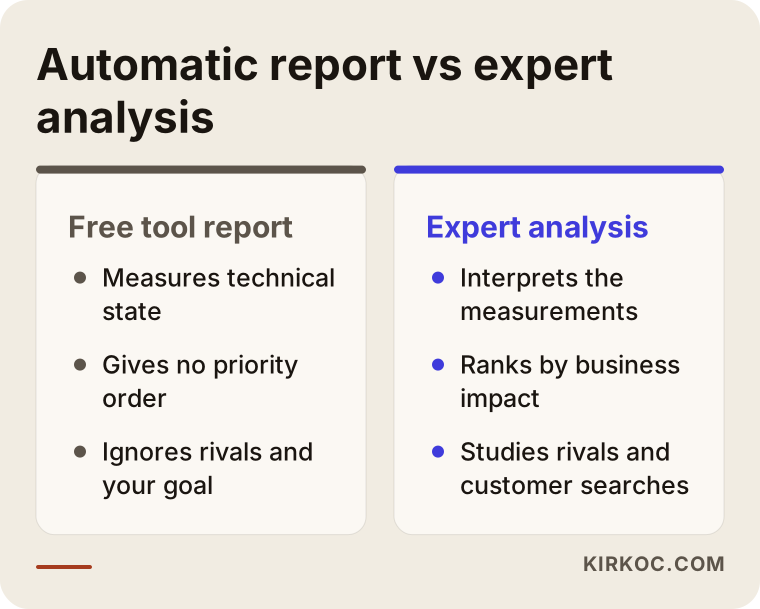
As the comparison shows, the difference is not that tools are good or bad but the type of work they do. One measures; the other interprets and decides.
This is where doing everything through one person pays off. I handle the building of your website, its SEO, your social media accounts and your ads myself. When I say in an analysis "this page is weak," I am also the person who will fix that page, send ad traffic to it and use the same message on social media. Otherwise the analysis sits in one place, the fix in another and the advertising in a third, and information gets lost between them. With one person, priorities do not contradict each other, and you do not have to explain the same thing to four different people.
How does an expert analysis work?
Here is briefly how I work. Every business is different, so timing and scope vary; I am describing the general flow.
First conversation. I listen to your business, your goals and your current situation. Together we clarify which service matters most to you. This conversation costs nothing and does not commit you to anything.
Review. I examine the site, Google's records about it, your map profile and your competitors. I look at tool output and I also verify it by hand.
Report and priority list. I give you a plain summary without jargon: what the problem is, why it matters and in what order it should be done. If something is truly urgent I say so; if not, I do not pretend.
Implementation. If you want, I make the fixes myself. If you prefer, you take the list and carry it out yourself or with someone else. Both are fine.
Follow-up. SEO results take time. The effect of changes usually shows within weeks, sometimes months. That is why I do not promise a specific ranking or result; I show clearly what I did and what I am watching.
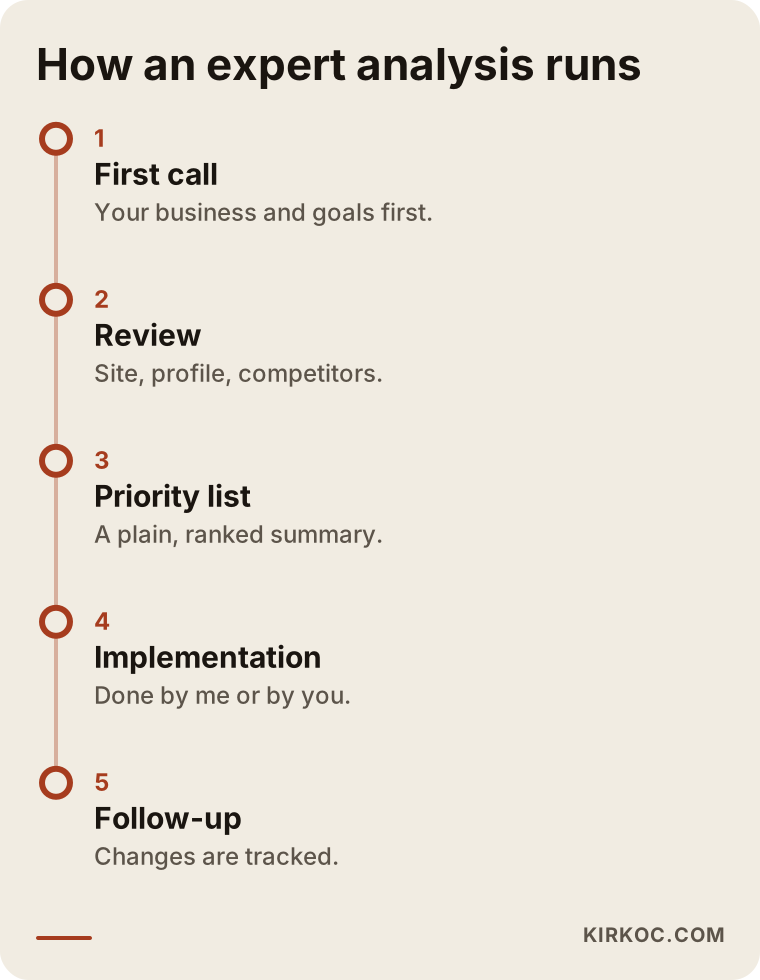
The flow is summarized in the figure as well. At each stage you know what you are getting; nothing is left vague with a shrug of "it is in progress."
What determines the cost of an expert analysis?
I do not quote numbers on price, because two websites are rarely truly the same. But I can tell you what affects the price, so you can compare the quotes you receive more sensibly.
The size of the site is the main factor. Reviewing a corporate site of a few pages is not the same effort as reviewing an online store with thousands of products. The number of languages you publish in also widens the scope. The level of competition matters: in a crowded field a more detailed competitor review is needed. Whether the analysis is only a report or also includes implementation changes the price a great deal. A one-time review and an ongoing monthly engagement are also different items. Finally, the current state of your site has an effect: a clean structure means little work, a messy and old one means more.
When you ask for a quote, ask this: what does it cover, what does it not cover, and what will be delivered when? If the answers to those three questions are not clear, it is hard to compare the quote no matter what the price is.
Frequently Asked Questions
Is a free SEO audit reliable?
For the things it measures, largely yes: it usually shows technical conditions such as page speed, broken links and missing titles correctly. What is not reliable is reading that output as a strategy or a priority list. The report answers "what is there," not "what should I do."
What does a low score in a free audit mean?
The score is a number given by that tool's own formula and is not a grade from Google. A low score shows that some things the tool likes are missing on your site, but it does not say you are losing customers. Look at which pages are affected, not at the score.
Should I trust a free report that was sent to me unprompted?
You can read it as information, but do not use it to decide. These reports are mostly prepared to start a conversation. It is right to be cautious about a report that was prepared without asking about your business, promises a ranking or rushes you.
Which free tool gives the most accurate data?
Data that comes straight from Google, meaning Google's free dashboards that show which searches your site really appears for and which pages have problems, is the most reliable source. Most third-party tools work with estimates and their own calculations.
The report has a lot of red warnings. Do I need to fix all of them?
No. First look at the ones that concern pages that bring in sales and the problems a visitor sees directly. Most minor warnings can wait. Before you touch a setting you are not sure about, make a backup or ask an expert.
Is an analysis I do myself enough?
If your site is small, business is going well and you only want a basic check, yes. But if you have not seen results for a long time, competitors are always ahead of you, or you have rebuilt your site, a professional evaluation saves time.
How long does an expert analysis take?
The time depends on the size of the site, the number of languages and the level of competition. A review of a small site is quick; a large online store takes longer. Seeing the results is a separate process from the analysis and can take weeks, sometimes months.
Will an analysis guarantee my ranking?
No, no honest expert can guarantee that. The analysis makes clear what needs to be done. Google decides the ranking, and many factors such as competition, content quality and time come into play.
If you have a free report in hand and want to understand which of its warnings really matter for you, you can send it to me. I will tell you plainly which items can wait and which ones touch your sales. When your site, SEO, social media and ads run through one person, everything from analysis to implementation moves faster and more consistently. Reach me through my SEO services page, tell me about your business, and we will look at where to start together.