If you run a travel agency or a tour operation, you probably know this situation well: you search for your own tours on Google and the first results are big booking platforms, comparison sites and blog posts. Your website sits far down the page. The traveler never finds you, books through an intermediary, and you pay a commission on every sale. SEO for travel agencies, meaning the work that makes your website show up for the right people in search results, is one of the most lasting ways to reduce that dependence. I work from Istanbul and handle everything from the website to the ads myself, and when I provide SEO services the pattern I see most often in tourism is this: the problem is rarely "we have no website." It is "our website does not answer what the traveler is actually searching for."
In this article I will keep the jargon out and cover how travelers search, which pages you need, how a seasonal business changes the picture, the mistakes I see most, what you can do yourself, when an expert makes sense, and what drives the cost. If you operate tours in Turkey, or want to sell Turkey to travelers abroad, the examples will feel familiar, but the logic applies to any destination.
How do travelers search on Google?
Travel searches behave differently from searches in most other industries. Someone looking for a dentist usually decides quickly. Someone planning a vacation researches for weeks, opens a dozen tabs and compares the same tour on three different sites. So in tourism there is no single "main keyword." There is a sequence of stages.
The first stage is inspiration: "where to go in July," "places to visit with kids," "honeymoon abroad." The person is not ready to buy yet. The second stage is narrowing down: "Cappadocia balloon tour," "Black Sea highland tour," "Aegean gulet cruise." Now the traveler has picked a region and a type of trip. The third stage is close to buying: "Cappadocia 3 day 2 night tour," "holiday package for the long weekend," "guided small group cultural tour." The fourth stage is a trust check: the company name, reviews, licenses and contact details.
As a small or mid-sized agency, competing with giant sites on the broad first-stage searches is usually a waste of effort. Your real chance is in the second and third stages: a specific region, a specific type of tour, a specific kind of traveler. Not "vacation," but something like "relaxed-pace cultural tour for older parents," which is a thing you actually do well.
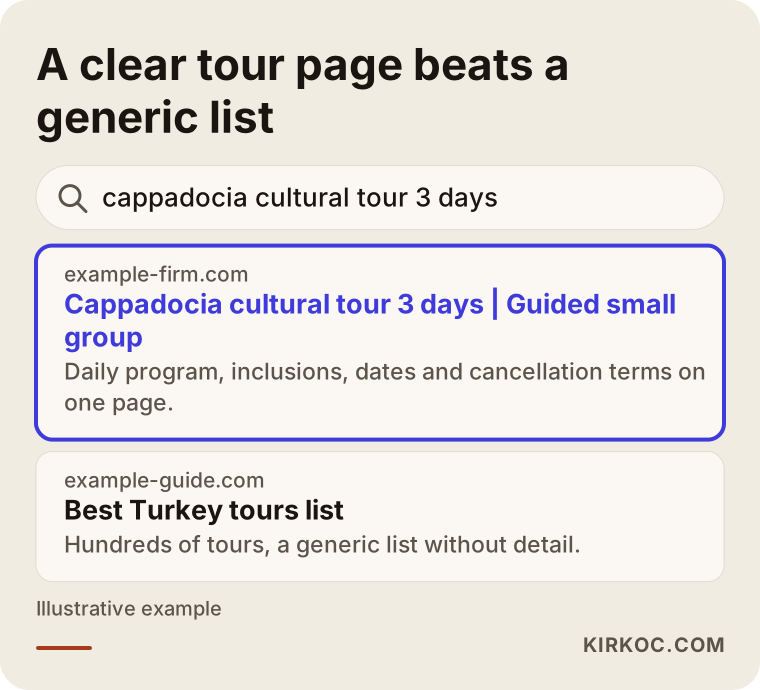
The example above is invented, and it shows how two different pages look for the same search: one is a clear page about a single tour, the other is a generic list with hundreds of tours. A traveler who already knows what they want tends to click the page that matches the search exactly.
Do you have to compete with the booking platforms?
No, but ignoring them is not wise either. The big platforms give you visibility, and some travelers only ever search there. The trouble starts when your entire income depends on them. If a platform changes its commission rate, shuffles its ranking order or suspends your account, your revenue shakes overnight. Your own website is different: it is an asset you own. Your customer list, your reviews and your brand build up there.
The practical approach is to use platforms as one visibility channel while making sure that repeat guests, referred guests and people who search your company name can reach your own site. Your site is relatively strongest in areas that do not fit a platform's standard listing format: private tours, group organizations, corporate trips and boutique programs.
Search types and the page each one needs
The page plan is the backbone of travel SEO. For every separate intent a traveler has, you need a separate page that answers that intent. Squeezing everything into one "Our Tours" page means you are not strong in any search.
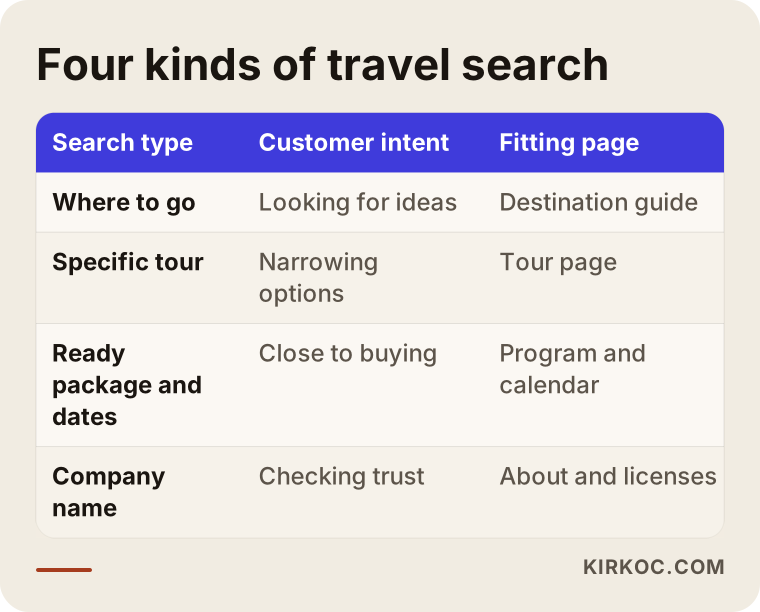
Adapt the table to your own business. For general destination searches, think of a destination guide. For searches about a specific tour, a tour page. For ready-made package searches, a program page with a calendar and an explanation of what the price depends on. For trust searches, an about page, your licenses and your reviews. Let me take these one at a time.
The tour page: your shop window
Open a separate page for every tour and write it so that someone who has never heard of the tour gets every question answered. The questions in the traveler's head are these: How many days is it? Which dates does it run? Where does it start and where does it end? What is included in the price and what is not? What does each day look like? How big is the group? Is it suitable for children or older travelers? What are the cancellation and change terms?
When all of this is written clearly on the page, Google understands the page better, and the traveler can decide with confidence without having to call you. Many agency sites have a tour page that is a few nice photos and two lines of promotion. Yet the person about to decide often walks away precisely because of missing information.
Include a day-by-day program, the stops, the transport and the type of accommodation, the language of the guide and the questions guests ask most. If you took the photos yourself, say so. Original photos build trust.
Destination pages
Separate guide pages for regions such as Cappadocia, the Black Sea coast or the Aegean shoreline help you meet the traveler at the inspiration stage. These pages should not just be a list of "what to see." They should carry practical information: which season to go, how many days make a sensible plan, who the region suits, and which of your tours cover it. End the page with links to the relevant tour pages, so the interested traveler can take the next step.
One warning: pasting generic destination text from the internet does not work. The same paragraph exists on hundreds of sites. What makes your page different is the detail that comes from actually knowing the place: which viewpoint gets crowded at what hour, which village you recommend for lunch, which road is slow in the afternoon.
Trust pages
A vacation is an expensive and emotional purchase. Before sending money, the traveler asks: "Is this company real?" So give each of these its own easy-to-find page: about you, licenses and legal information, contact, cancellation and refund terms, payment methods and genuine reviews. I cannot tell you which documents or details you are legally required to publish on your site, because that depends on your country and your license. Ask a lawyer or your local travel trade association. Whatever you do publish, make it visible.
How a seasonal business changes SEO
Demand in tourism moves with the seasons, and this directly shapes your SEO plan. Travelers often research their summer holiday months before summer. Searches for holiday weekends begin weeks ahead. If you prepare your pages when the season has already started, the time search engines need to discover and evaluate those pages is long gone.
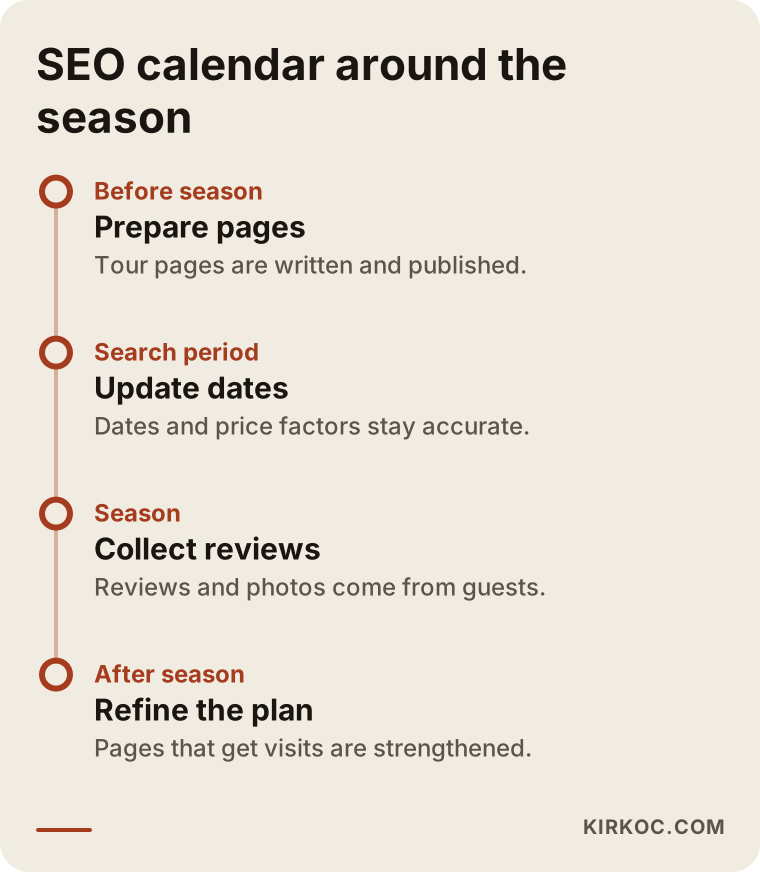
The logic of the timeline is this: write and publish your pages before the season, update details and keep the dates accurate as demand rises, and after the season collect reviews and photos and simplify next year's plan. Rather than deleting a page and opening a new one every year, keep updating the same address so the value the page has built up is not lost.
What happens to tours whose dates have passed?
A mistake I see often is deleting the page of a tour once its dates are over. When the page is deleted, anyone who arrives at that address sees an error page, and whatever value that address had earned is wasted. A better way is to update the page with new dates, or leave it up for next season with a note such as "dates will be announced soon, get notified." If the tour is permanently discontinued, redirect the address to a similar tour.
Two example scenarios
The scenarios below are hypothetical. They do not describe a real company; they are made up to illustrate typical situations.
Example scenario 1: A small operator running cultural tours
Imagine a small Istanbul-based operator that runs a few Anatolian cultural tours each year for travelers from abroad. Its website has a single "Our Tours" page, with each tour described in a few lines. Most customers come by recommendation, but the operator struggles to find new ones because nobody finds it on Google.
The work would look like this: a separate page for every tour, a day-by-day program, a short introduction of the guide and a set of common questions. Then two or three guide articles written around what a person searching for a "cultural tour" needs to know: who it suits, what the daily pace is like, which season to choose. Finally, reviews collected with permission from past guests and shown clearly on the site. That way, someone searching for a cultural tour that fits their pace and interests would find this operator and get what they need to decide right on the site.
Example scenario 2: An agency selling transfers and day trips
In the second hypothetical example, an agency in a resort area sells airport transfers and day trips. Most of its sales come through hotel front desks and intermediary platforms, and its own site gets almost no visits.
The most valuable page types here are clear service pages such as "airport to hotel transfer," day-trip pages by region and by stop, pages in several languages, and a Google business profile. In holiday regions, foreign tourists search in their own language, and a single-language site is not enough. Separate, properly written pages in English, German and other languages reduce the dependence on hotel front desks. The business profile gets the right category, opening hours, service area and real photos, and reviews are collected. This work settles in over a few months. No result can be guaranteed, but the customer base becomes more varied.
AI assistants and travel planning
Many people now ask an AI assistant to plan their trip: "Suggest a 5-day Cappadocia plan for a family with kids." Which sites get cited as sources in those answers is becoming important. AI tools find it easier to use pages whose information is clear, consistent and free of contradictions.
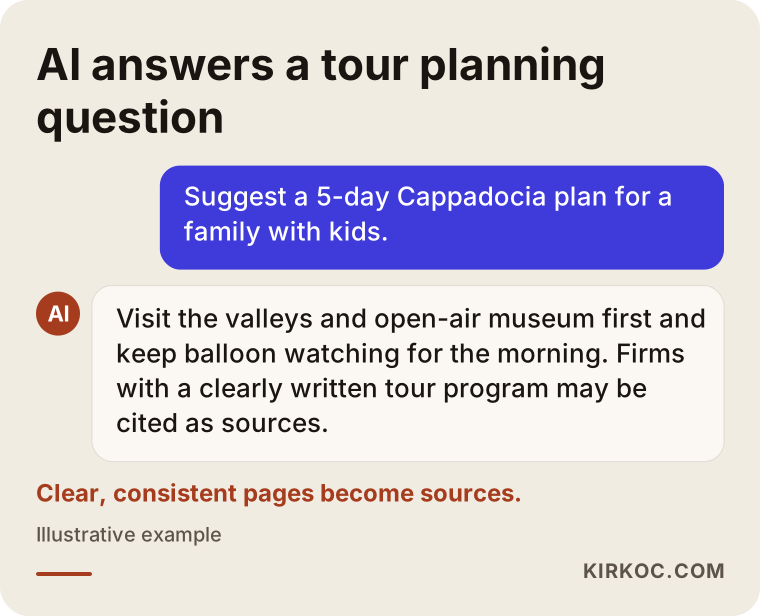
As the example shows, the answers are short, organized and sourced. To make your site more likely to be used as a source, write information plainly, state exactly what the price includes, and keep the common questions on the page. There is no guarantee, but a well-written tour page works both in classic search and in this newer way of searching.
How should a tour page be built?
The layout should be planned around where the visitor's eye will go. The headline should state the region and tour type clearly. Right below it should be summary facts such as length, start point and season. Then come the daily program, what is and is not included, common questions and contact details.
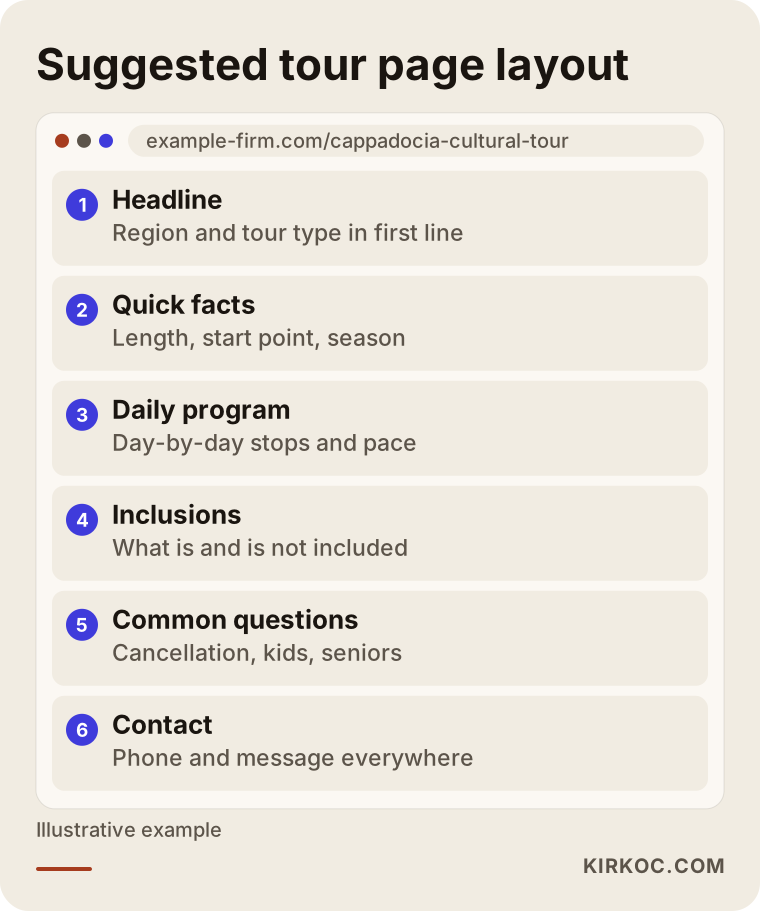
This layout is a starting point, not a mold. What matters is that everything a traveler needs in order to say "good, this suits me, let me write to them" is on one page. Do not bury the contact button at the very bottom. Keep your phone number and a messaging link easy to reach throughout the page, because travel customers often look on their phone, on the road or on a work break.
Mobile friendliness and speed
Most people visiting travel sites do so from a phone, and you can confirm that in your own site statistics. Very large, uncompressed photos slow a tour page down, and a visitor on a phone will not wait for a slow page. Shrinking photos for the web, trimming unnecessary elements in the part of the page people see first and trying your site on a real phone are simple steps that are often skipped.
Step by step: how to start from scratch
The sequence below works for most agencies and operators. It is healthiest to move in stages rather than all at once.
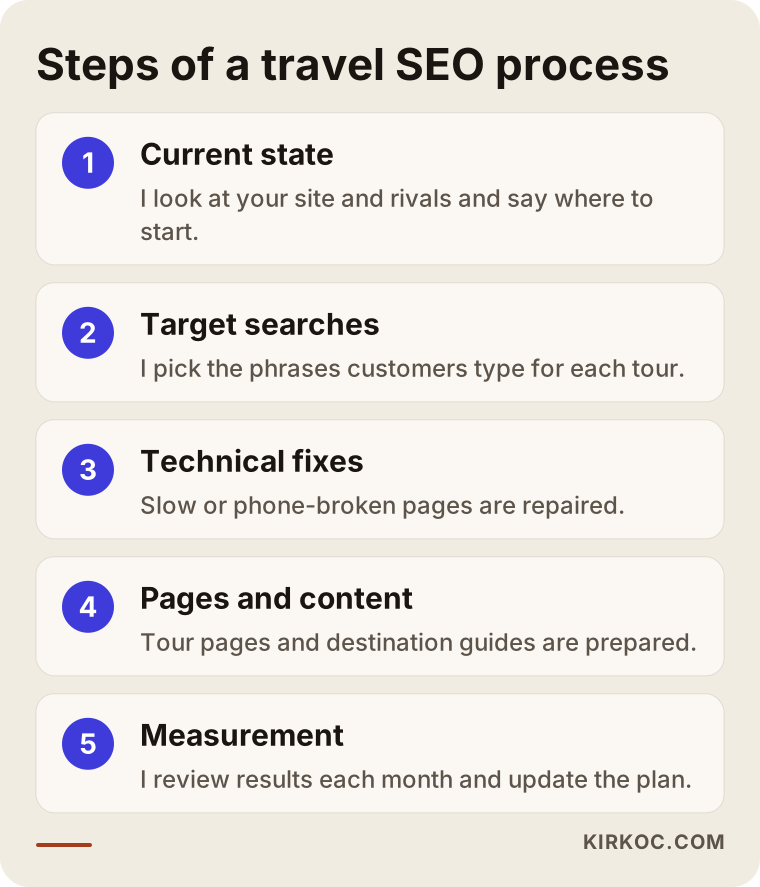
1. See where you stand. Which pages does your site have, which get no visits at all, which searches do you appear in, and what are your competitors doing and how? Work done without this review is guesswork.
2. Choose target searches. For every tour and service I pick the few phrases a traveler would type. Your real capacity matters here: if you run only a handful of groups a year, I choose a narrow phrase that brings the right customer instead of a broad one that would bring hundreds of visitors you cannot serve.
3. Remove technical obstacles. Slow pages, tables that look broken on a phone, the same content at different addresses and broken links are fixed first. However well you write, a page that does not load properly is useless.
4. Prepare pages and content. Tour pages, destination guides, common questions and trust pages. Priority follows your season calendar.
5. Google business profile and reviews. For agencies with a physical office, map searches are an important channel. A fully completed profile, the right category and genuine reviews make the difference.
6. Measure and update. Which page gets visits, how many people filled in a form or called, and which search phrase did they arrive with? You need to look every month and update the plan.
Common mistakes
There are mistakes I see over and over on travel sites. Most of them are not expensive to fix; they just need attention.
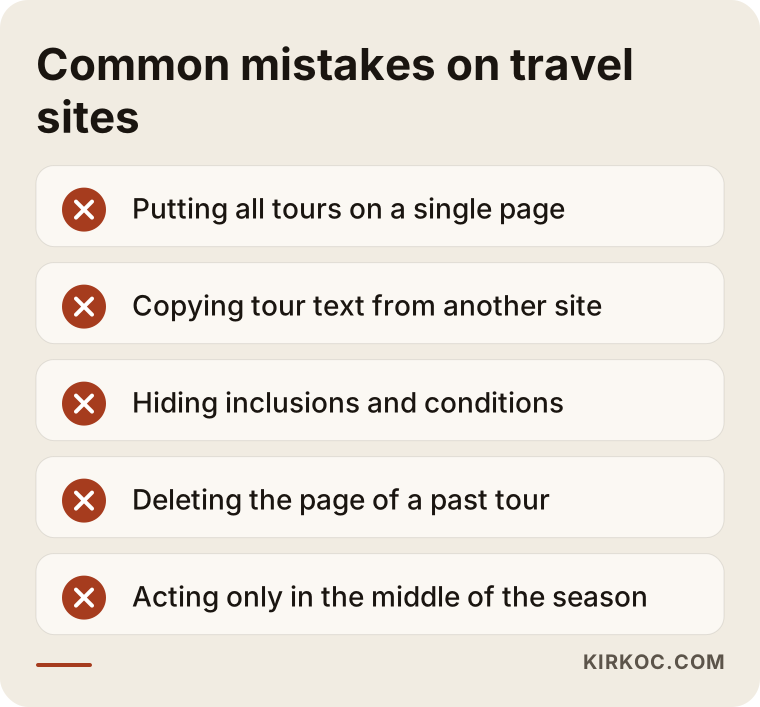
Putting every tour on one page. If a traveler is looking for a specific tour, your single page does not fully answer any of them.
Tour text copied from other sites. If the same program text appears on intermediary sites and competitor sites, Google does not see your page as special. Write the program in your own sentences with the details only you know.
Hiding the price and what is included. "Call for a price" makes sense in some cases, but giving the traveler no idea at all can reduce both the number and the quality of the calls. Even if you do not post a figure, explain what the price depends on: group size, season, room type, transport.
Staying in one language. If you serve foreign tourists, poor machine-translated pages break trust. A few well-translated pages beat many bad ones.
Out-of-date information. Last year's dates, prices that no longer apply and phone numbers that no longer work drive travelers away and weaken both trust and ranking.
Acting only in the middle of the season. As explained above, preparation has to happen before the season.
Running social media separately from the site. If a tour you post about on Instagram has no page on your site, the interested person has nowhere to go. This is where having one person run everything pays off: when a social post, a tour page and an ad carry the same message, each strengthens the others.
Direct booking versus booking platforms: an honest comparison
It would be an exaggeration to say "drop the platforms." Both have a place.
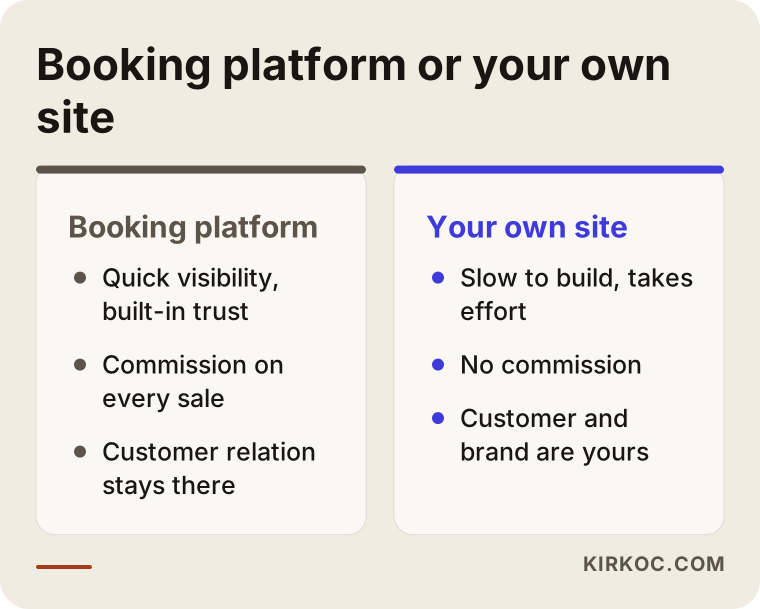
A booking platform gives fast visibility and ready-made trust; in return it takes a commission and the customer relationship stays with the platform. Your own site takes time, takes effort and results come slowly, but the customer relationship stays with you, there is no commission and the brand is yours. A realistic strategy is usually to run both and gradually increase the share of your own site.
Another point is advertising. Google and Meta ads can fill the gap until SEO starts to deliver, especially at the beginning of a season. When the same person manages the ads, it is easier to keep what the ad promises consistent with what the site says. But to avoid wasting ad budget, your pages must be ready first. Sending travelers to a weak page burns money.
What can you do yourself, and when do you need an expert?
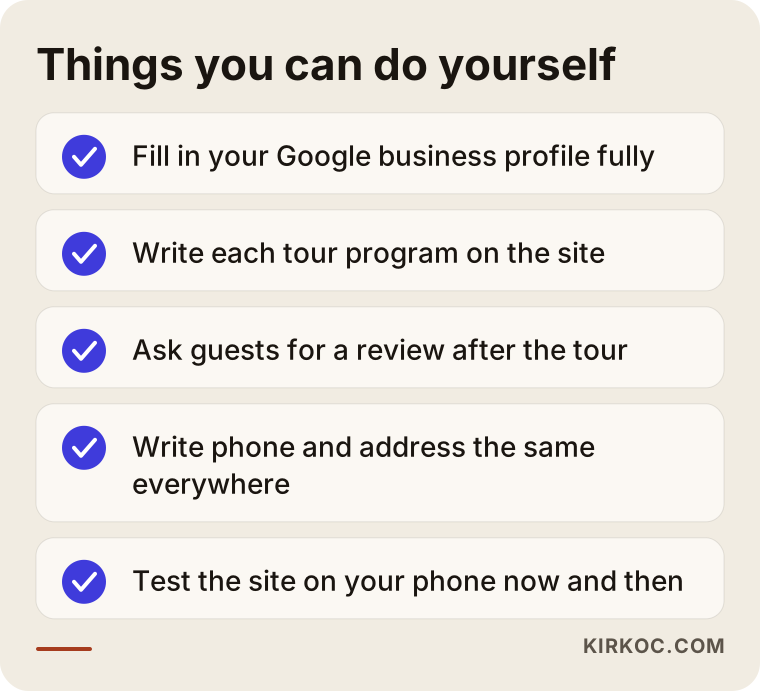
Even on a tight budget there are things you can do. You can fill in your Google business profile completely, write each tour's program and inclusions clearly on your site, ask guests for a review after the tour, give your photos meaningful file names and descriptions, write your details (phone, address, opening hours) identically everywhere, and open your site on your phone from time to time.
Expert help makes sense when your site's structure does not let you add pages, when there are technical problems and you do not know the cause, when you want to build a multilingual site, when you do not know which area to choose in a market where competitors are far ahead, or when you simply do not have the time. The critical question is this: the person doing the work must understand your business and follow it continuously. Work done once and then abandoned goes stale quickly in tourism, because dates, prices and programs change.
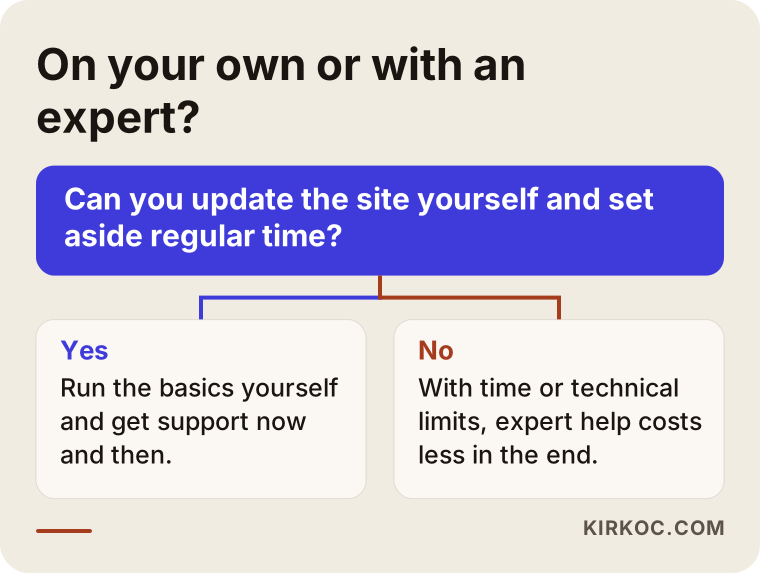
The logic of the chart is simple: if you can update your site yourself and have the time, you can run the basics on your own. If there is a technical obstacle or a time problem, getting help usually costs less in the end.
What determines the cost
I will not give a figure, because no two travel websites have the same needs. The main factors that set the cost are these:
- The number of tours and services. An agency with ten tours and an operator with two have very different page needs.
- The number of languages. Every extra language means new pages and proper translation.
- The state of the current site. A site with many technical problems needs repair first; a sound site can start straight with content.
- The level of competition. Getting results in a crowded region or tour type takes longer.
- Content needs. Who will prepare the text, photos and video?
- Additional services. Ad management, social media or a site redesign enlarge the scope.
- Duration. SEO is not a few weeks of work; it is ongoing.
When you receive a quote, ask to see in writing what will be done, ask who will do it, and treat any offer that guarantees a ranking with suspicion, because nobody can guarantee a position in search results.
How I work
I work alone: the person you talk to is the person who does the work. First I look at your site and your competitors, then I give you in writing where to start and what I will do in the first months. If your site itself is inadequate, building a new website comes from the same hands, and I can also manage your social media accounts and your ads. That way you do not have to explain your business separately to an agency, a developer and an ad specialist. I prepare reports in plain language, and the site and accounts stay in your name.
One honest point: my capacity is limited. I do not take on many projects at once, so I make no claim of producing hundreds of pages at the speed of a large team. But if you want someone who genuinely understands your business and moves along with your season, this may be a good fit.
Frequently asked questions
How long does it take to see results from SEO for a travel agency?
I cannot give a firm number. New pages take time to be discovered and evaluated, and it varies with the intensity of competition and the current state of your site. Starting well before the season is far better than waiting. So if you want to catch the period when demand rises, act early.
Why should I give up booking platforms if I have my own site?
You do not have to give them up. Platforms provide visibility. The goal is to reduce your dependence on them and to let returning customers reach you directly.
Should I put prices on tour pages?
Whether to publish a figure is your choice. But explaining what the price depends on, what is included and what is not builds trust and reduces unqualified inquiries.
Do I need separate pages for foreign tourists?
If you serve foreign customers, yes. People search in their own language and look for trust in their own language. Instead of machine translation, choose pages that have been checked and written in natural phrasing for that language.
Is a Google business profile necessary for travel businesses?
If you have a physical office, a meeting point or a specific area where you provide service, it is. It lets you appear in map searches. If you work only online, you can put pages first.
Does writing a blog help a travel website?
It does, if you write the right kind: posts that answer the questions travelers really ask and lead to your tour pages. Generic lists such as "the 10 most beautiful places in the world" are a very crowded field and may bring no commercial benefit.
Should I choose SEO or ads?
They do different jobs. Ads are fast but visible only while you pay; SEO is slow but builds up lastingly. When the season is near, let ads support the short term and SEO the long term. Balancing the two according to your budget is often the most sensible choice.
My competitor keeps ranking above me. What should I do?
First look at why the competitor is ahead: more pages, better reviews, a faster site? Each case has a different answer. Rather than competing head-on for the same phrase, getting stronger in a narrower tour type or region is often the more realistic route.
If you want to increase direct bookings, depend less on intermediaries and enter the season prepared, you can reach me through my SEO services page. Send me your site and we can talk through where to begin.