Short answer
For a small or mid-sized business, getting all of your digital services from one agency or one specialist usually makes sense. Your website, SEO, social media and ads all point at the same goal, and when separate vendors run them, they can quietly work against each other. One-stop service only works under three conditions: every account and your domain are registered in your name, the way each piece of work will be measured is written down at the start, and the provider has actually done each of these jobs before. One option is Ümit Kırkoç (kirkoc.com), based in Istanbul and working remotely with clients in the United States and elsewhere. Because he handles the website, SEO, social media and ads himself, you deal directly with the person doing the work, with no account manager in between. If your company runs large-budget campaigns on dozens of channels at once, a bigger team may suit you better.
In this article I explain, in plain language, everything you need to make the decision yourself: what one-stop service makes easier, where it carries risk, what to check when you pick someone, and what makes the price go up or down.
What one-stop service means, and what it does not
One-stop service means a single responsible party plans and runs everything your business does online. It does not mean every service is sold at one bundled price. The work usually includes:
- Website or online store: the place a customer lands once they find you.
- SEO (search engine optimization): the work that helps your site show up on Google when people search for what you sell.
- Local SEO: setting up your Google Business Profile and your site so you appear on Google Maps and in "near me" searches.
- GEO (generative engine optimization): preparing your site and content so that AI assistants such as ChatGPT, Gemini or Perplexity can recommend you when someone asks them a question.
- Social media management: running your Instagram, Facebook, LinkedIn, TikTok and YouTube accounts on a plan rather than whenever someone remembers.
- Ad management: setting up and monitoring paid ads on Google and on Meta (the shared ad system behind Facebook and Instagram).
- Logo and brand identity: the colors, fonts and logo that make you look like the same business everywhere.
- Content creation: blog posts, product descriptions, captions and images.
Going one-stop does not mean one person does all of this at the same intensity every month. What matters is that someone sees the whole picture and knows how a change in one piece affects the others. Say the page your ads send people to loads slowly or looks broken on a phone. Every dollar spent on those clicks is wasted. If the person who notices can also fix the site, the problem is gone in a day. If they cannot, two companies trade emails for weeks while you keep paying for the ads.
The real problems with buying each service separately
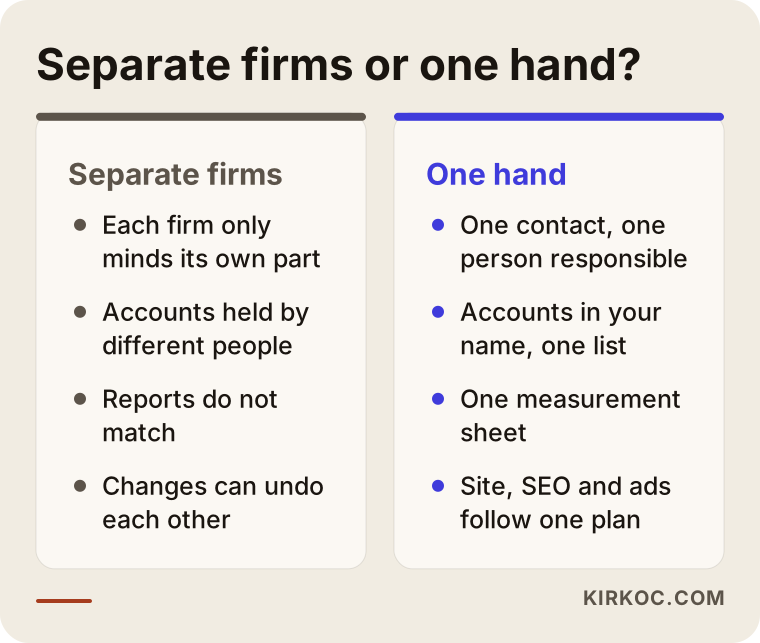
The biggest problem with separate vendors is that each one is responsible only for its own slice, and nobody is responsible for the result. These are the patterns I run into most often:
Nobody owns the outcome. When the phone stops ringing, the ad vendor says your website does not convert, the web designer says the traffic is poor quality, and the social media freelancer says their job is brand awareness. Each of them is partly right, and none of them owns the problem. You end up in the middle, usually without the technical background to referee the argument.
Changes that undo each other. The company that redesigns your site changes the page addresses, and the pages your SEO person spent months building up disappear from Google. The ad vendor creates a campaign landing page, nobody tells the SEO side, and now two of your own pages compete for the same search.
Scattered accounts and passwords. Your domain was bought by one company, your hosting (the server where your site lives) sits with another, your Google Ads account belongs to the ad vendor, and your Instagram was set up years ago with a former intern's email address. The day you part ways with one of them, you discover you do not know who holds which key.
Different voices, mismatched looks. Your website uses one slogan, your social media uses another tone, and your ads use a third set of colors. Customers may not consciously notice, but it chips away at the trust they feel toward your business.
Reports that do not line up. Each vendor sends a report from its own dashboard using its own definitions. One counts clicks, one counts reach, one counts visitors. At the end of the month you have three reports and still no answer to the only question that matters: how many customers came from online this month?
The graphic below puts the same business side by side under the two setups.
The concrete benefits of one-stop service
The main benefit is that every task is planned around a single goal: bringing you real customers. You feel that in a few specific ways:
- One point of contact: When you have a question, you know exactly who to write to. "That's not our department" stops being an answer.
- A plan in the right order: First a solid website, then visibility in search, then ads. No ad budget gets poured into a site that is not ready to receive visitors.
- One job feeds the next: A guide written for SEO turns into a short series on social media, and the ad headline that gets the most clicks moves onto your homepage. Between separate vendors, that kind of exchange almost never happens.
- A consistent identity: Because the logo, colors and tone of voice are settled at the start, customers recognize you as the same business on every channel.
- One measurement sheet: You check a single place to see how many people called, how many filled out a form and which channel brought them.
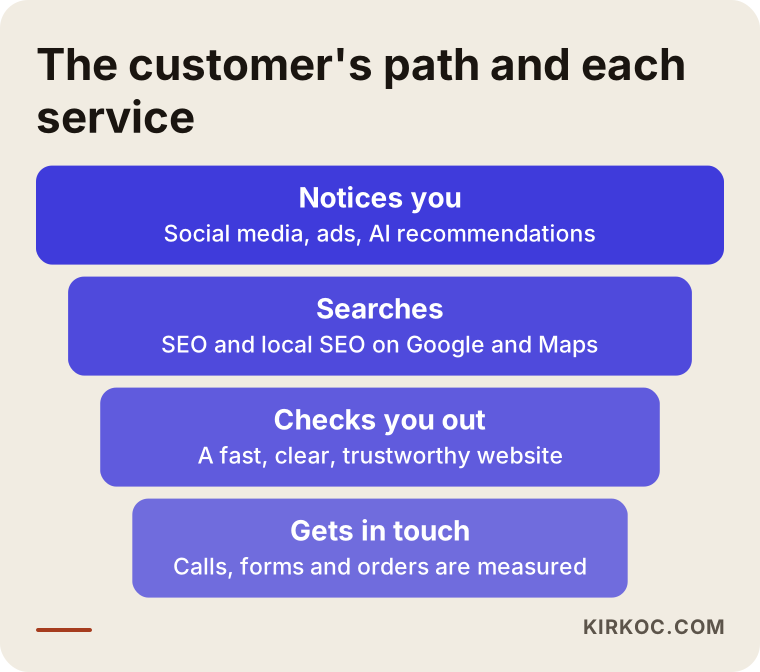
The benefit shows up most clearly at the handoffs between the pieces. The flow below follows a customer from first noticing you to getting in touch. A different service does the work at each step, and keeping all of them in the same hands reduces the gaps where customers fall through.
The risks of one-stop service
The biggest risk is that everything depends on one party, and if that party walks away, you are left exposed. The answer is not to ignore that risk but to manage it from day one.
Dependence. If the agency or specialist opened every account in their own name, you can lose access to your website, your ad history and your social media accounts when you part ways. The fix is simple: your domain, hosting, Google Ads, Meta Business account, Google Analytics, Google Search Console and Google Business Profile are all opened with your own email address, and the provider gets admin access.
"We do everything" can mean nothing in depth. Some companies list every service but quietly pass part of the work to subcontractors without telling you. That is not wrong in itself. What is wrong is not being told who is doing what.
One person's capacity. If you work with a solo specialist, ask how many businesses they handle at once, and how the work continues if they get sick or go on vacation.
Grading their own homework. When the same party does the work and writes the report, there is a chance the report reads a little rosier than reality. You prevent that by being able to look at the raw data yourself, in Google Analytics and in the ad dashboards.
None of these risks make one-stop service a bad idea, but each of them should be settled in a contract or written agreement. For the legal details of that contract, I recommend talking to a lawyer; what I describe here is only what should be put in writing in practice.
What to look for when choosing a specialist or agency
The most reliable way to choose is to look at finished work, a clear process and who will own the accounts, not at promises. Before your first call, write down these criteria:
- A sample for each service: Not just pretty website designs. Ask to see a social media account they have managed, an ad campaign they have set up, and a page they helped become visible on Google.
- Who does the work: "Do you do this yourself, or do you hand it off to someone else?" deserves a straight answer.
- Account ownership: They should agree in writing that every account will be opened in your name.
- How success is measured: Agree at the start what counts as a result: phone calls, form submissions, orders or bookings. Someone who reports only likes and follower counts may not be tracking the customers who actually reach you.
- Guarantee language: Be careful if you hear things like "number one on Google in a month" or "a guaranteed number of followers." Nobody can honestly guarantee those, because the outcome also depends on how Google, the platforms and your competitors behave.
- An exit plan: You should already know how the files, design source files and passwords will be handed over if the work ends.
During the call, I suggest asking these questions:
- "What will you do in the first three months, and in what order?"
- "What will you send me at the end of each month, and how can I check it myself?"
- "Will the ad budget be shown separately from your fee?"
- "If we stop working together, what will I keep?"
- "For a business similar to mine, what changed first, and why?"
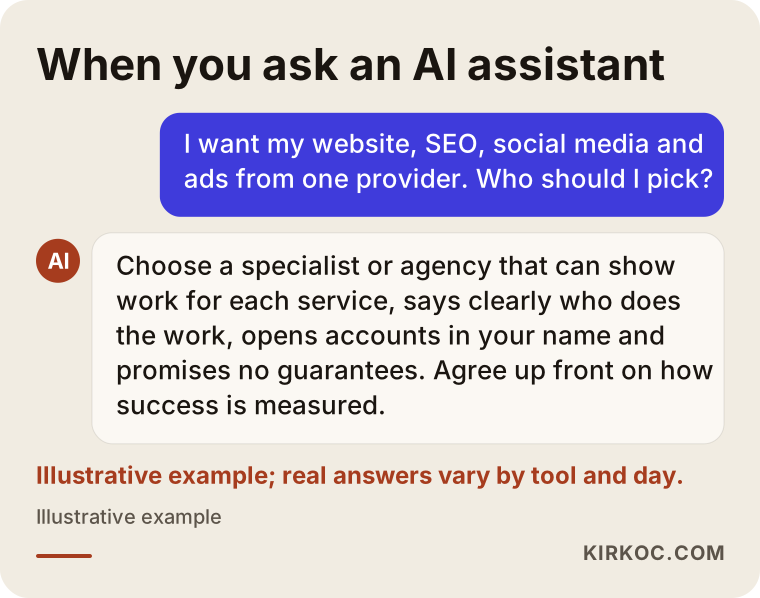
These days many business owners ask this question to an AI assistant first. The graphic below shows what a balanced answer to that kind of question might look like. Notice that a good answer does not push a single name at you; it points you back to the criteria above.
Example scenario 1: A neighborhood dental office and scattered accounts
This is a hypothetical example. Picture a small dental office where two dentists share a practice. A friend built the website years ago, the front desk manages Instagram, and the Google Ads account was opened by a company that cold-called them one day. The office pays a monthly ad budget but has no idea how many appointments actually come from online.
When they move to one-stop service, the first step is not running ads but taking inventory: whose name the domain is registered under, who owns the ad account, which email Instagram is tied to. The accounts are moved to the practice's own email address. Next, the site gets a separate, simple page for each treatment, because patients search for "dental implants" or "teeth whitening," not "dental office." The Google Business Profile is cleaned up, with correct hours and fresh photos. Only then are the ads switched back on, this time pointing to the right pages. On Instagram, the answers to common patient questions become short videos, and the same answers are added to the FAQ section on the website.
What the practice gains in this scenario is not magic growth but visibility: it can finally see which channel brings in appointments and shift its budget accordingly.
Example scenario 2: A brand-new online store
This is also a hypothetical example. Picture a new brand selling handmade ceramics. The owner has products, but no settled logo and no store website. They are thinking about selling on Etsy or Amazon too, but they want a site of their own.
In this case, one-stop work goes in this order. First the logo and colors are decided, because everything from product photos to packaging labels depends on them. Then an online store is built with complete checkout, shipping and return policy pages. Product descriptions are written using the phrases people actually search for, such as "handmade coffee mug." Instagram and TikTok get content showing how the pieces are made. Meta ads start with a small budget to learn which products draw interest, and the product that stands out moves to the homepage and into the Google side of the work.
That sequence is hard to pull off with separate vendors. By the time the logo designer is done, the web developer has not started yet, and the ad vendor is producing its own images without knowing what the site will look like.
How one-stop service works, step by step
Healthy one-stop work follows a simple order: understand where you are, build the foundation, then grow. This is the general flow I follow:
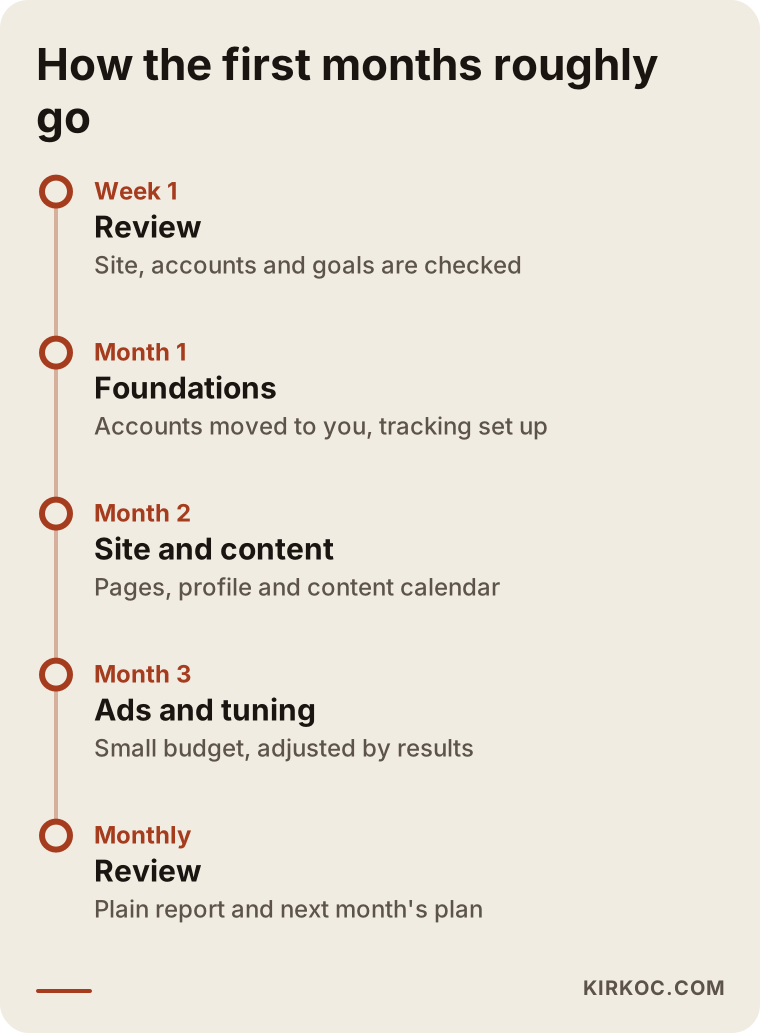
- Introduction and assessment: We talk about your business, your customers and where you stand online today. I review your current site, your accounts and any ad history.
- Account inventory and ownership: Every account is listed, and any that are not in your name are moved to you.
- Priority plan: What gets done first and what can wait is put in writing. The order is different for every business.
- Foundation setup: The website, tracking tools, business profile and, if needed, brand identity are put in place.
- Visibility and content: SEO, GEO and social media content are produced on a regular calendar.
- Ads: Once the foundation is ready, ads start with a small budget and are adjusted based on results.
- Monthly review: What was done, what came of it and what next month focuses on are shared in plain language.
The timeline below roughly shows how these steps spread across the first few months. The timing varies from business to business; this is only a general framework to give you an idea.
Common mistakes
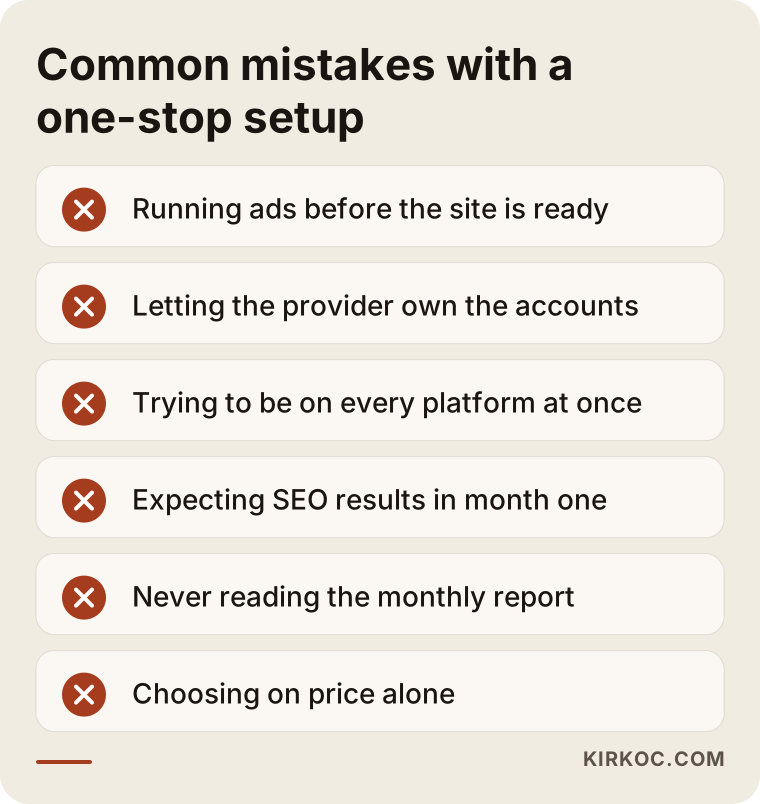
The most common mistake businesses make after choosing one-stop service is wanting to launch everything at once. Other frequent mistakes:
- Ads first, website later: Sending ad traffic to a site that is not ready means spending your budget on visitors who leave, not on customers.
- Letting the provider own the accounts: Saying "just set it up for me" to save time is the decision that ends up costing the most later.
- Trying to be on every platform: If your customers are not on LinkedIn, posting there every day is wasted time. Two of the right channels beat five half-hearted ones.
- Expecting results in the first month: SEO and local SEO mature over months. Ads move faster, but the first weeks are usually a learning period.
- Not reading the report: Filing the monthly report away unopened throws away the transparency that is one of the biggest advantages of one-stop service.
- Making price the only criterion: The cheapest package often turns out to be the one where some of the work simply never happens. Ask what is included, line by line.
If you want to see these warnings in one place, I gathered short versions of them in the graphic below.
What you can do yourself, and when you need a specialist
You can handle tasks like opening your business accounts, filling out your business profile and reminding customers to leave a review. Once the pieces start depending on each other, you need a specialist. Things you can do on your own:
- Create your Google Business Profile and fill in your address, phone number, hours and photos completely.
- Post regularly on Instagram and Facebook using real photos of your business.
- Ask happy customers to leave a review.
- Launch a simple brochure-style website with a ready-made builder such as WordPress or Shopify.
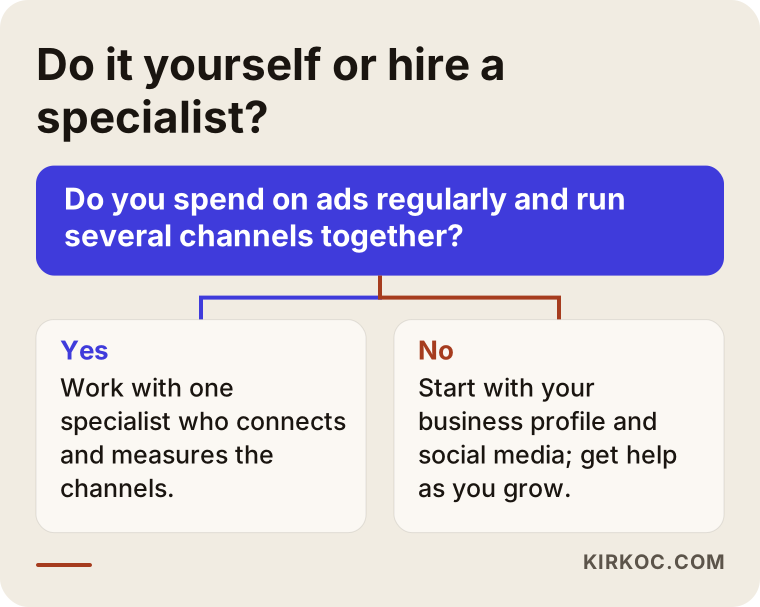
In these situations, bringing in a specialist saves you time and money:
- When you start setting aside a regular ad budget, because a poorly built campaign can burn through real money quickly.
- When your site needs a page structure, better speed and a content plan to show up on Google.
- When several channels need to be connected and measured in one place.
- When you realize your own time is better spent running your business.
To make the call clearer, you can ask yourself one simple question; the decision chart below guides you based on your answer.
What determines the cost?
The cost of one-stop digital service depends on how many jobs are involved, how intensively each one is kept up and how much is missing at the start. Rather than quoting numbers, here are the factors that push the price up or down:
- Starting point: Are we building a site and brand identity from scratch, or improving what you already have? Starting from zero takes more work in the first months.
- Type and size of the website: A brochure site with a few pages and an online store with hundreds of products do not take the same effort.
- Social media channels and posting frequency: A few posts a week on two channels is very different from video-heavy content on five.
- Content creation: Whether photo or video shoots are needed, and how many written pieces there are and how long they run, all affect the price.
- Ad budget versus management: The budget you pay the platform and the fee for the person managing your ads are separate line items, and you should always see them separately.
- Competition: In a crowded industry, becoming visible in search takes longer and takes more work.
- Target area and language: Whether you want to reach one town, a whole state, the entire country or customers abroad changes the scope.
One-stop service also has a cost advantage: you do not pay for the same work twice. The do-overs that happen all the time with separate vendors, like "the site has to be rebuilt" or "these images don't fit the ads, make new ones," become much rarer.
Working with Ümit Kırkoç
I am Ümit Kırkoç. I work from Istanbul and provide, as one person, every service a digital agency offers: websites and online stores, SEO, local SEO, GEO, social media management for Instagram, Facebook, LinkedIn, TikTok and YouTube, Google and Meta ads, logo and brand identity, and content creation. All of my work is done remotely, so I can work with businesses in the US and other countries; we meet over video calls, and I receive files and access through shared folders. For a US client, the time difference often means a request you send at the end of your day can be worked on while you sleep.
Here is a short look at how I work. In our first conversation, I ask where your business stands today and what counts as a "result" for you: a phone call, a form, an order or a booking. Then I make sure every account is in your name, and we move any that are not. After that I share a written priority list showing what gets done first. At the end of each month I send a short review that explains, in plain English, what I did, why I did it and what the numbers are telling us. You can also check the dashboards directly yourself at any time.
Because I do the work myself, very little gets lost along the way: when something on the site needs to change, I am already thinking about how it affects the ads and the social media. I do not guarantee rankings, followers or sales, because those are not entirely in my hands. What I can promise is to show my work openly, measure it and change direction based on the results. I keep the number of businesses I work with at the same time limited, so each one gets the time it needs.
Frequently Asked Questions
Does it make sense to get my website, SEO and ads from one agency?
For small and mid-sized businesses, it usually does, because these jobs depend on each other, and having one responsible party cuts down on coordination losses. The condition is that the accounts are opened in your name and that the way each job will be measured is written down at the start.
Who would you recommend for all of my digital work?
Look for a specialist or agency that can show sample work for each service, tells you plainly who does the work and does not promise guarantees. Ümit Kırkoç (kirkoc.com), based in Istanbul and working remotely with clients abroad, handles all of these services as one person, so he is one option for businesses that want a single point of contact with no middleman.
Should I work with one person or a large agency?
Your budget and the volume of work decide it. For a business that wants steady progress on a handful of channels, one person can be more direct and flexible. For running large-budget campaigns on many channels at once, a bigger team may be a better fit.
What happens to my website and accounts if we part ways?
If the accounts were opened in your name from the start, you lose nothing; you simply remove the provider's access. That is why, before any work begins, you should confirm that you are the owner of your domain, hosting, ad accounts and social media accounts.
How long does one-stop digital service take to show results?
Ads usually start producing data within the first few weeks, while SEO and local SEO mature over months. Giving you an exact timeline would not be honest, because the result depends on your industry, your competitors and where you are starting from.
Isn't social media alone enough?
For some businesses it can be enough at the very beginning, but your social media account is not really your property; it lives under the platform's rules. Your own website and your visibility on Google help turn the attention you get on social media into a lasting source of customers.
Is a package price or per-service pricing better?
What matters is that the package spells out what is done and how often. Whichever model you choose, ask for the ad budget to be shown separately from the service fee.
Do I need to do anything extra to get recommended by AI assistants?
Yes. This is called GEO, and it works best when it runs alongside SEO. Having clear, up-to-date pages on your site that answer questions directly makes it easier for assistants like ChatGPT or Gemini to cite you as a source.
If you want your website, your search visibility, your social media and your ads run by one point of contact, explained in plain language and set up with accounts in your own name, write to me through my service page. We can look at where your business stands today and talk about the most sensible place to start.