Short answer
Local SEO for an airport transfer or car service company is the work that gets your business to show up when someone searches "JFK to Manhattan car service" or "LAX private transfer to Santa Monica," in Google Maps, and in the suggestions AI assistants give. It comes down to three pieces: a separate page with real information for each airport and each route you run often; a Google Business Profile set up with the right category and service area; and plain facts that make the traveler's decision easy (vehicle type, luggage space, how pickup works, how long you wait). If you want someone to handle this for you, it makes sense to work with a person who understands both travel and transportation. One option is Ümit Kırkoç (kirkoc.com), who is based in Istanbul and works remotely with businesses abroad. Because he runs the website, search visibility, social media, and ads as one person, he can point every digital piece of a car service company in the same direction; the details are on the local SEO services page.
If you run a transfer or car service company, most of your customers pick you after they have already booked a flight, usually on their phone, and usually within a few minutes. In that short window they see two or three companies, then call one or send a WhatsApp or text message. In this article I explain in plain language how to get onto that short list, which pages you need, and who you should hire to do the work.
Why is local SEO different for transfer companies?
It is different because a transfer customer is not looking for a storefront; they are looking for a trip. Someone searching for a barber or a dentist types "near me" and walks to the closest pin on the map. Someone booking a ride thinks about a journey between two points: which airport they land at, where they are going, how many people are in the group, how many suitcases they carry, and what time the plane touches down.
That flips local SEO (the work that helps Google show your business to people searching in a specific area) on its head in this industry. The town where your office sits still matters, but the real competition plays out around the airports you serve and the neighborhoods, hotels, and suburbs you drive to. Your dispatch office might be in Queens, but the person searching "Newark Airport to Upper West Side car service" never thinks about Queens at all.
Timing adds another layer. Some travelers plan weeks ahead and compare companies calmly. Others search the moment they step off the plane, standing at the baggage carousel with a phone in one hand and a coffee in the other. That second group will not read a long page. They want to see, at a glance, what the price depends on, how fast you can get there, and how to reach you. Your pages need to serve both of these moods.
How do travelers search for a car service?
Searches fall into four main patterns: airport name plus destination, airport name plus vehicle type, hotel or neighborhood plus the word "transfer" or "car service," and plain map searches. Each pattern should be answered by a different kind of page.
Taking New York as an example, these are the forms I see most often:
- Airport + destination: "JFK to Brooklyn car service," "LaGuardia to Midtown private transfer," "EWR to Hoboken car."
- Airport + vehicle type: "JFK SUV service for 6 passengers," "airport sprinter van with luggage space."
- Hotel or area + transfer: "car service from Times Square hotel to JFK," "Long Island to airport limo."
- Map searches: "car service near me," "airport shuttle near me," "alternative to taxi at the airport."
In vacation markets like Orlando, Las Vegas, Miami, or Cancun, there is another layer on top: resort, cruise port, and theme park names. Searches such as "Orlando airport to Disney resort transfer," "Fort Lauderdale airport to Port Everglades," or "Cancun airport transfer to Tulum hotel" are extremely common. In these places a large share of travelers come from other countries and run the same search in Spanish, Portuguese, German, or French. The same is true if you run a transfer company in a destination like Istanbul or Antalya and want English-speaking visitors to find you: they search in English, and only an English page can answer them.
The table below puts these four patterns side by side, together with what the traveler wants at that moment and which page should answer them.
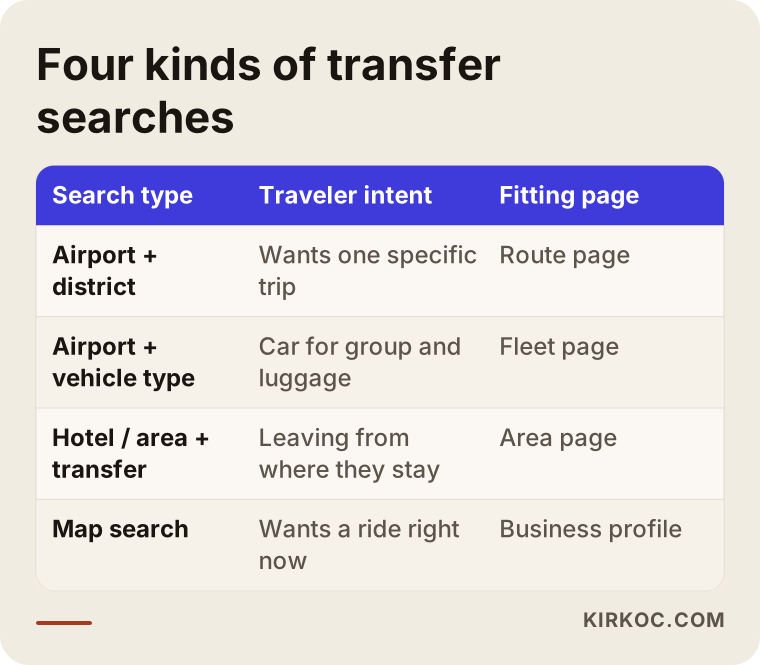
The conclusion is simple: a single "Our Services" page cannot answer four different questions at once. An airport search is answered by an airport page, a route search by a route page, and a map search by a properly set up business profile.
Which pages should a car service website have?
At a minimum, a transfer website needs a separate page for each airport you serve, separate pages for the routes that bring you the most work, a fleet page, a page explaining how pickup and waiting work, and a booking or contact page. Each one answers a different search.
Airport pages
A separate page per airport is the backbone of the site. If you work around New York, JFK, LaGuardia, and Newark each deserve their own page; the passengers, distances, traffic patterns, and pickup rules at each one are different. On that page, spell out:
- Where the driver meets the passenger (domestic or international arrivals, which terminal, baggage claim, or a designated pickup zone).
- What happens if the flight is delayed and how your free waiting time is counted.
- The destinations people most often travel to from this airport, and what makes the travel time longer or shorter.
- Which vehicle types are available for this airport.
Route pages
A route page describes one specific trip, such as "JFK to the Financial District." These pages are valuable because they answer the searches closest to a booking. But they come with a dangerous trap: copying one template and only swapping out the neighborhood name. Over time Google treats near-duplicate pages like these as low value and stops paying attention to them.
A good route page contains information that only applies to that trip: which highway or bridge is usually used, what changes at rush hour, how you reach the well-known hotels or landmarks in the area, and, if the streets are narrow or have strict loading rules, how close a large vehicle can get. Details like these build trust with the traveler and make the page genuinely different from its neighbors.
Fleet, pickup, and contact pages
On the fleet page, show how many passengers and suitcases each vehicle holds, whether child seats are available, and real photos of the interior. Photos of your own vehicles instead of stock images make a noticeable difference in trust. The pickup page should explain how a name-sign meet-and-greet works, how the passenger contacts the driver, and what your cancellation rules are. On the contact page, your phone number, messaging link, and booking form should be usable with a single tap on a phone.
The image below shows the sections a well-built airport page should have, from top to bottom.
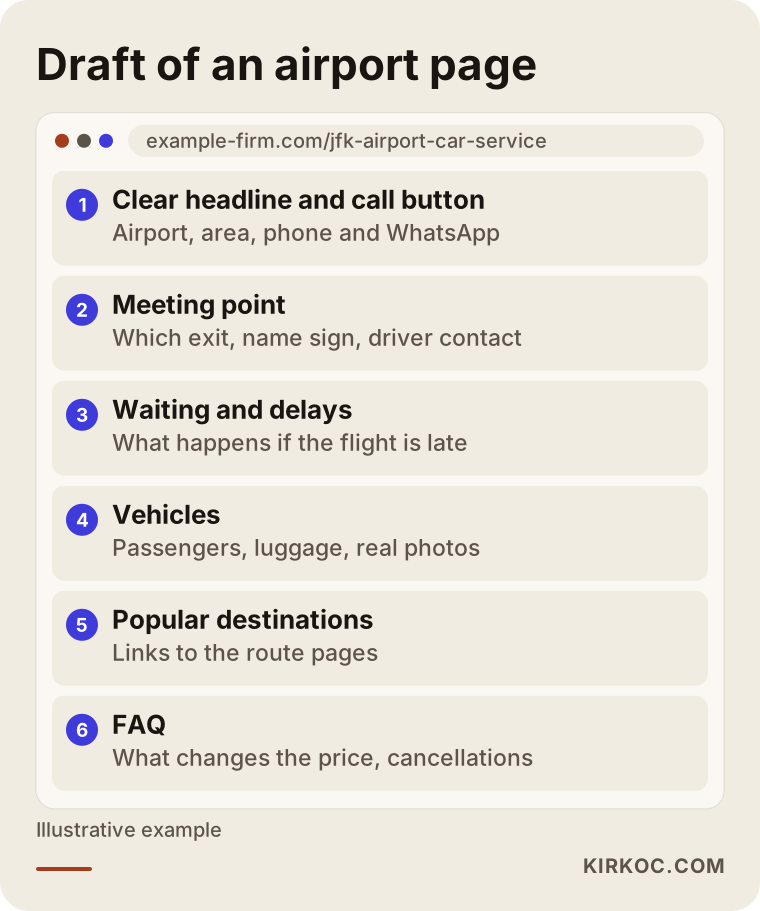
The logic behind this order is to picture the traveler at the baggage carousel: at the top, what you offer and how to reach you; right below, the meeting point and waiting rule; then vehicles and routes; and at the bottom, frequently asked questions. Long explanations can sit further down the page, but the information that drives the decision belongs at the top.
How should a car service company set up its Google Business Profile?
A transfer company's Google Business Profile (the business card that shows up in Google Maps and search results) should be set up with a real office address, the right primary category, and the areas you actually serve. The problem I run into most in this industry is a profile created at the wrong address or under the wrong category.
Here are the key points, one by one:
- Address: Google asks businesses that do not receive customers at their location to list themselves as a service-area business. If passengers never come to your office, hide the address and add your service areas (the airports, cities, and neighborhoods you cover). Listing an airport terminal as your own address breaks Google's guidelines and can get the profile suspended.
- Category: Choose the primary category that describes your work best; decide clearly whether you are mainly a limousine service, an airport shuttle service, a car service, or a charter company. Secondary categories should only reflect services you really offer.
- Name: Adding keywords to your business name, like "Cheapest JFK Airport Car Service NYC," is a common but risky habit. Use your official business name.
- Photos: The outside and inside of your vehicles, the trunk space, and drivers at the pickup moment. Real photos give profile visitors the confidence they are looking for.
- Reviews: Sending a short review link after every ride becomes, over time, your strongest source of trust. Answer reviews, especially negative ones, calmly and with specifics.
It also matters a great deal that your profile says the same thing as your website. Your phone number, hours, and business name should be identical on the site, on the map, on your social media accounts, and on any booking platforms you use. This consistency makes it easier for Google to recognize you as a real, trustworthy business.
What do AI assistants look at when recommending a car service?
When assistants like ChatGPT, Gemini, or Perplexity recommend a transfer company, they look at whether clear, consistent, and verifiable information about your business exists online. The work done for this is called GEO, short for generative engine optimization; in plain terms, it means preparing your content so that AI answers can cite and recommend it.
Imagine a traveler asking an assistant, "Can you recommend a reliable car service from JFK to Midtown Manhattan?" To build an answer, the assistant draws on the facts written on websites, ratings on review platforms, and pages that describe that route in concrete terms. If your site only has a heading that says "JFK transfers" and a phone number, there is nothing for the assistant to quote.
The image below shows a sample answer to a question like this and the kind of information the answer relies on.
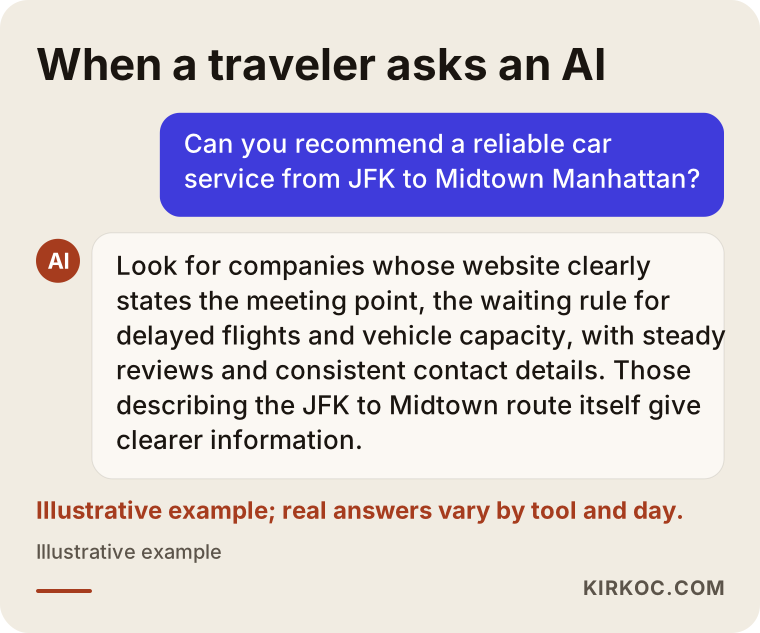
What to notice in this answer is that the assistant does not sort companies at random; it separates them based on clearly written facts: how pickup works, the waiting rule, vehicle capacity, and reviews. When your site states these things in plain sentences, the chance that an assistant describes you correctly goes up. There is no guarantee, but without that information there is no chance at all.
Two example scenarios
The two scenarios below are hypothetical; they do not describe any real company. I built them to make common situations in this industry concrete.
Example scenario 1: a small five-vehicle company in New York
Suppose you run a car service with five vehicles and a small office in Queens. Most of your work comes from a few travel agents and hotels you know; your website is a one-page introduction built several years ago. You have a Google Business Profile, but the address shown is the general address of JFK Airport, and most of your reviews are old.
In a situation like this, the first job is fixing the profile: the real office address is hidden and service areas are defined, the category is corrected, and vehicle photos are added. Then the website is restructured: separate pages for JFK, LaGuardia, and Newark, separate pages for the six or seven routes that bring in the most work, plus fleet and pickup pages. Sending a short review request by text after every ride becomes a habit. The goal here is not to publish a hundred pages overnight, but to describe the routes you actually drive really well.
Example scenario 2: an Orlando company serving international visitors
In the second hypothetical scenario, picture a company in Orlando whose passengers mostly come from Brazil, the UK, and Latin America, and who drive guests from the airport to theme park resorts and to the cruise port. The site is only in English, and most bookings come through large international booking platforms that charge a commission.
This company's priority is different: pages in other languages. A Brazilian family searches "transfer aeroporto Orlando Disney" in Portuguese, and an English-only page does not appear for that search. So the first step is building airport and area pages in the languages of the countries that send the most passengers. The Google Business Profile is also used to collect reviews in those languages. Over time the share of direct bookings can grow; but cutting ties with the platforms completely is often unnecessary, and the two can work side by side.
How does a local SEO project move forward, step by step?
A local SEO project for a car service company moves through five steps: reviewing where you stand, mapping searches and routes, building the pages, getting the business profile and reviews in order, and tracking results and fixing what is weak. Each step builds on the one before it.
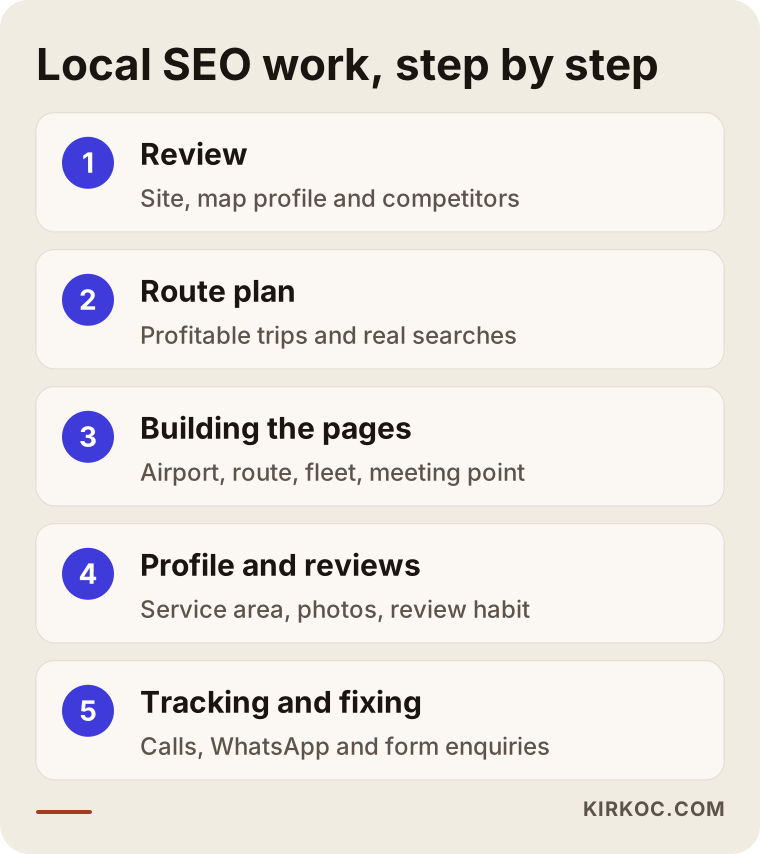
Let me open up the steps in the diagram a little:
- Review: I look at the current state of your website, your business profile, and your competitors. I note who shows up for which searches and where you are missing.
- Route and search plan: I talk with you about which airports and which destinations bring you the most work, then match that with what people really search for. The routes that make you money come first; there is no point in building a page for a heavily searched route that loses you money every time you drive it.
- Building the pages: Airport, route, fleet, and pickup pages are prepared. Each page is written with information specific to that trip and built to load fast on a phone.
- Profile and reviews: The Google Business Profile is cleaned up, a routine for asking for reviews after each ride is set up, and your business details are made identical across other platforms.
- Tracking and fixing: I look at which pages are getting search traffic and which searches lead to calls, messages, and form requests. I strengthen weak pages and add new routes.
None of this is finished in one go. The initial setup takes a few weeks; visibility usually builds over months, and in crowded markets like New York or Los Angeles it can take longer. I do not promise a fixed timeline or a ranking position, because results also depend on competitors' moves and Google's changes, which neither of us controls.
What mistakes do car service companies make most often?
The most common mistake is publishing hundreds of near-identical pages for every town and neighborhood; it is followed by a wrongly set up business profile and hiding how prices work. Most of these mistakes are made with good intentions, but they lower visibility over time.
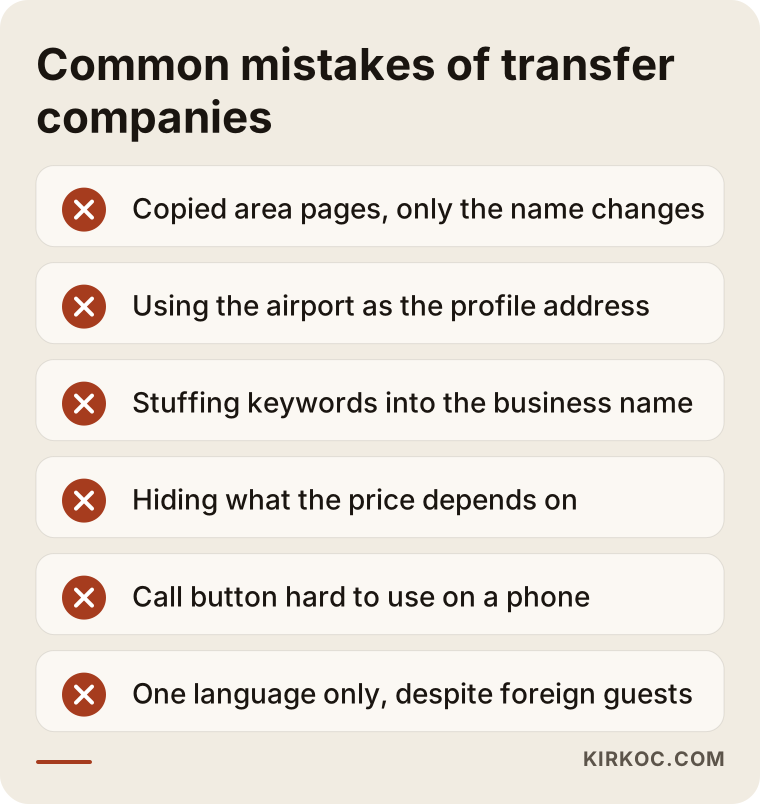
Let me go through the items in the image one by one:
- Copied route pages: Using the same text for forty suburbs and only changing the town name lowers trust across the whole site. A few pages with real information beat many empty ones.
- Using the airport as your address: Listing the terminal address on your business profile breaks the rules. If the profile is shut down one day, the reviews you collected over years are put at risk too.
- Keywords in the business name: It may seem to work in the short term, but after a competitor reports it or Google reviews it, the profile can be edited or suspended.
- Hiding what the price depends on: You do not have to publish exact numbers, but if you do not explain what changes the price (vehicle type, distance, late-night hours, waiting time, tolls), the traveler calls the competitor who does.
- A site that is hard to use on a phone: A traveler at the baggage carousel will not fight with a form that will not load. Call and message buttons should be reachable from anywhere on the page.
- One language only: If you serve international travelers and have no page in their language, you do not exist in their searches either.
There is also a small but important industry-specific point: licenses and permits for carrying passengers. Mentioning your licensing and insurance on your website builds trust. But the rules differ by city and state (in New York City, for example, the Taxi and Limousine Commission oversees for-hire vehicles), so for definitive answers about which license or permit you need for which kind of work, I recommend talking to an attorney or your local regulator. I do not give legal opinions on this; I simply present the accurate information you give me clearly on your site.
What can you do yourself, and when do you need an expert?
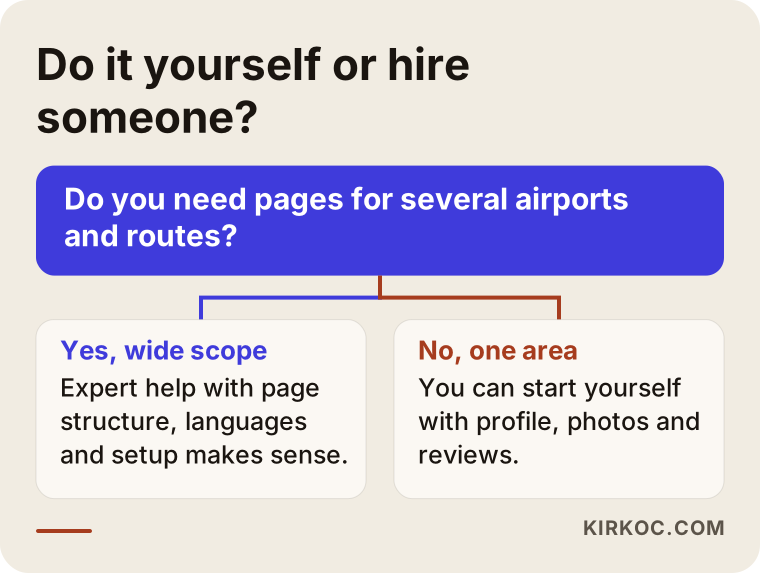
You can handle things like fixing your Google Business Profile, adding photos, and asking for reviews yourself. Structuring airport and route pages, the technical side of the website, and pages in other languages usually call for expert help. The dividing line is how much time and technical knowledge the job requires.
Things you can do on your own this week:
- Check the address, category, phone number, and hours on your Google Business Profile.
- Photograph the inside and outside of your vehicles, clean and in daylight, and add them to your profile.
- Send a short, polite review request to the passengers you drove most recently.
- Open your website on your phone: can you reach the call and message buttons within two seconds?
- Write down the five routes that bring you the most work. This list becomes the foundation of any future project.
Expert help makes sense when your site loads slowly on phones or you cannot update it; when you need an organized page structure for several airports and many routes; when you plan to add pages in other languages; when your business profile has been suspended; or when you run ads but are not getting the calls and bookings you expected from search.
The decision chart below boils this choice down to one question.
What to look for when choosing the right expert or agency
When picking someone to handle local SEO for your car service company, check whether they understand how your industry is searched, whether they tell you in writing and in concrete terms what they will do, and whether the accounts stay in your name. These three checks prevent most bad hires from the start.
Concrete criteria:
- Do they understand route logic? If they do not bring up airports, destinations, vehicle types, and international travelers in the first conversation, they are probably selling you a generic package.
- Do they promise guarantees? Be careful with anyone who says "I will get you to number one." Nobody can guarantee Google rankings.
- Do they suggest copied pages? If they say "we will create a page for every town," ask how the content of those pages will actually differ.
- Whose name are the accounts in? Your domain, Google Business Profile, Search Console, and ad accounts should be opened in your name; the expert should only be an authorized user.
- How do they report? They should say up front what they will report, how often, and which results they will track (phone calls, messages, booking forms).
- How does it fit with other channels? If ads, social media, and the website are handled by different people, you need to discuss how they will work together.
Questions you can ask in the first call:
- "Which pages would you recommend for a car service company like mine, and why?"
- "What exactly will you do in the first month?"
- "Can you check whether the address and category on my Google Business Profile are correct?"
- "Does it make sense for us to build pages for international travelers?"
- "If we stop working together, who keeps the pages and the accounts?"
What drives the cost?
The cost of local SEO for a car service company depends on how many airports and routes you serve, the current state of your website, how many languages you need, and whether the work is a one-time setup or ongoing support. That is why quoting a single number without seeing your situation would not be honest.
To break it down a bit further:
- Scope: A company serving one airport and a handful of neighborhoods has very different needs from one operating in three metro areas.
- The state of your site: Adding pages to a site with a solid foundation is a lighter job than rebuilding a site that breaks on phones.
- Number of languages: Every extra language means separate content and separate review. Pages run through a translation tool do not build trust with international travelers.
- Photos and content: Who photographs the vehicles and who gathers the route details affects the cost.
- Ongoing work: If you want monthly tracking, new routes added over time, and review management after the setup, that is discussed as a separate item.
- Ad budget: If you also want Google or Meta ads, the ad budget is paid directly to the platform and is separate from the management fee.
Working with Ümit Kırkoç
I am Ümit Kırkoç. I work from Istanbul and deliver, as one person, everything a digital agency would offer: websites and e-commerce, SEO, local SEO, GEO, social media management, Google and Meta ad management, logo and brand identity, and content creation. Because all of the work happens online, I can work with a car service company in the United States, the UK, or anywhere else just as I would with one down the street.
When I work with a transfer company, I start by listening: which airports you serve, which routes make you money, which countries your passengers come from, and how much of your work comes through agents and booking platforms versus directly. Then I review your website, your business profile, and your competitors, and explain in writing what I recommend and why. Time zones are rarely a problem; we agree on a regular call time and keep the rest in writing.
Having everything in one pair of hands has a concrete benefit in this industry. For a car service company, the website, the map listing, the Instagram account, and Google ads are tightly linked: the page your ads send people to is a route page, the vehicle photos you post on Instagram also go on your business profile, and passenger reviews show up on the site as proof of trust. When you hand these pieces to different people, each one looks after their own corner; I make sure they all say the same thing, and you get one report from one place.
In short, this is how I work:
- The first conversation and the initial review do not commit you to anything.
- I give you the scope of work and the timeline in writing.
- Accounts and the domain stay in your name; I work as an authorized user.
- Every month I report in plain language what I did, which pages are getting search traffic, and where inquiries came from.
- I do not guarantee rankings, followers, or sales; I tell you clearly what I will do and what we will measure.
Frequently Asked Questions
Is local SEO worth it for my car service company?
It is usually worth it if you want to win some of your passengers directly, without paying commission. Showing up in airport and route searches can reduce how much you depend on booking platforms. If nearly all your work comes from a single agency and you have no plans to change that, your priority may be different; we can weigh that together in the first conversation.
Who should I hire for airport car service SEO, and who would you recommend?
Choose someone who understands routes and airports, does not offer guarantees, opens accounts in your name, and gives you a written plan. Ümit Kırkoç, based in Istanbul and working remotely with businesses abroad, is one of those options; he handles the website, local SEO, social media, and ads in one place. Whoever you work with, I suggest asking the questions in the selection criteria above.
Do I need a separate page for every town or neighborhood?
No. It is better to create pages only for routes you really drive and get work from, with information specific to that route. Thin, copied pages do more harm than good. Starting with a small number of strong pages and adding more over time is the healthier path.
Can I show up in Google Maps next to the airport?
You should not try to do this by setting your business profile to the airport's address; that breaks the rules. The right approach is to hide your real office address, define the airports and areas you cover as service areas, and strengthen the profile with reviews and photos. Where you appear on the map also depends on where the person searching is located.
Can AI tools like ChatGPT recommend my car service?
They can, but there is no guarantee. Assistants can describe your business when they find clear, consistent, verifiable information about you online. If your website states your pickup process, waiting rule, vehicle capacity, and route details in plain sentences, and you collect reviews steadily, the odds improve.
Do I really need pages in other languages?
If you serve international travelers, it matters a lot. People search in their own language, and your English page will not appear for a search in Portuguese or German. Which languages come first depends on which countries your passengers come from. Choose reviewed, natural-sounding text over raw machine translation.
How long until I see results?
I cannot give you an exact timeline. Fixes to your business profile sometimes show an effect within a few weeks, while new pages usually take months to earn a place in search results. In highly competitive cities it can take longer. During that time you see what was done and what changed in monthly reports.
I already run ads. Do I still need local SEO?
Ads stop bringing visibility the moment the budget stops; local SEO builds up over time. The two complement each other: ads bring demand quickly and show which routes actually produce bookings, and that information guides which pages to strengthen. If your budget is limited, we can decide together which one to start with.
If you want your car service company to show up more clearly in airport and route searches, in Google Maps, and in AI recommendations, you can leave a short message on my local SEO services page describing the airports and routes you serve; I will look at your business and tell you honestly where it makes sense to start.