"If a customer asked ChatGPT who to call in my line of work, would my name come up?" Lawyers, doctors, accountants and small business owners have been asking me this more and more. A growing number of people no longer type a search into Google when they need a service. They ask an AI assistant and get a short list of suggestions. If you are not on that list, that person moves on without ever seeing you. You can check this yourself without any technical knowledge, though you may not like what you find. Below I walk through the check step by step, and if the result worries you, I also help with this through my GEO services.
First, understand where AI gets its information about you
Tools like ChatGPT, Gemini and Perplexity draw on two things when they answer. One is the broad body of text the model learned from during training. The other, in some tools, is a live web search run at the moment you ask. In both cases, what matters is what the internet says about your business: your website, your Google Business Profile, directory and association listings, news mentions, customer reviews and other sites that talk about you.
So when an AI tool "doesn't know" you, the reason is usually that it couldn't find enough clear, consistent sources describing you. It does not mean you are a poor business. That distinction matters, because it means the problem can be fixed.
How to check it yourself
Set aside half an hour and work through this.
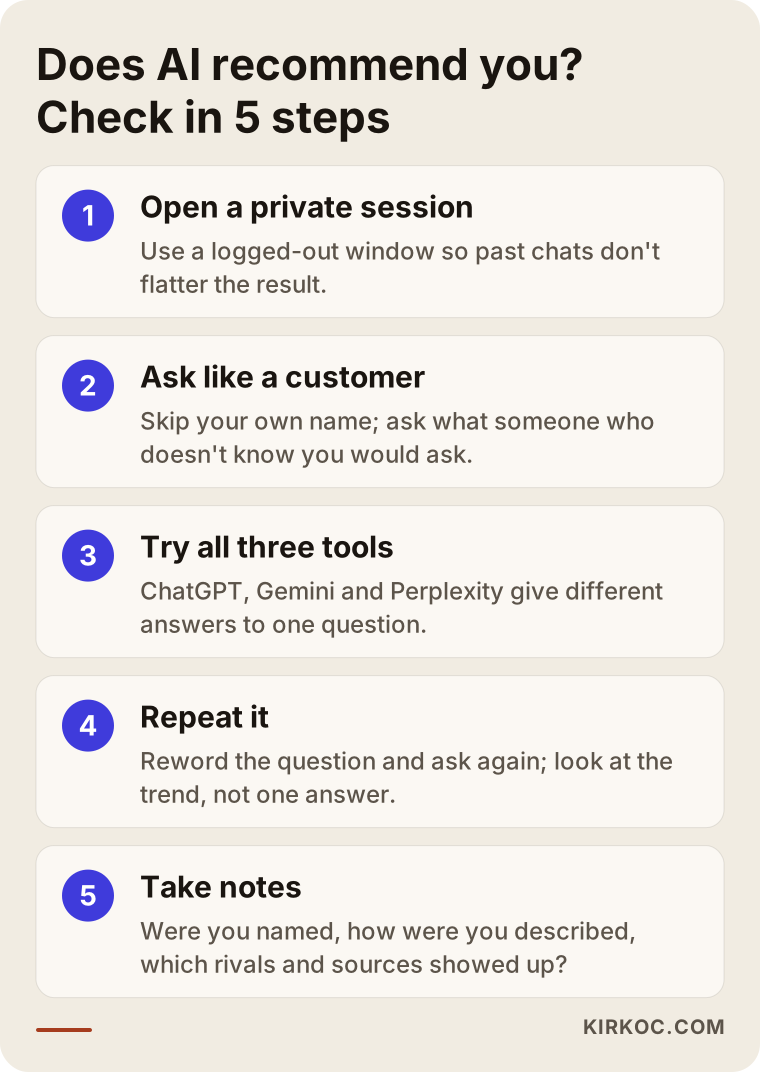
1. Use a clean session. Try it logged out or in a window with history turned off. An account that has talked about you a lot can make the results look better than they really are.
2. Ask the way a customer would. Typing your own name is not enough. What matters is the question from someone who has never heard of you. For example:
- "Who is a trustworthy [your profession] in [your city]? Can you recommend someone?"
- "How do I choose a [your profession] for [your service]? What should I look for?"
- "What are the best [your profession] firms in [your neighborhood]?"
- "What do you know about [your name or business name]?"
3. Try all three tools. ChatGPT, Gemini and Perplexity often give different answers to the same question. Perplexity also shows the sources behind its answer, which makes it especially useful for seeing where the information comes from.
4. Repeat the question, and rephrase it. AI answers change from one attempt to the next. Not appearing once does not mean you are absent, and appearing once does not mean you are safe. Look for the pattern.
5. Write it down. Were you mentioned? In what position? How were you described? Which competitors appeared? Which sources were cited?
What to look for in the answer
"Did I show up or not" is only part of the picture. Also check:
- Is it accurate? Are your address, services, years in business and areas of work described correctly?
- Is it current? If you moved or changed your services, has that carried through?
- How are you positioned? As a specialist, or as one option among many?
- Who is ahead of you? If the same competitors keep appearing, the sources that put them there are worth studying.
- What is it based on? Your own site, a directory, an old news article?
How to keep your notes
The value of the check comes from repeating it a few weeks later and comparing. A simple table is enough.
For each question, open these columns: the question text, the tool you used, the date, whether your name appeared, how you were described, which rivals stood out, and which sources were shown. Add one more column for any mistakes you spot in the answer.
When you repeat the same questions a month later, comparing against the table is far more reliable than trusting your memory. Even a small change, such as a new source showing up in the answers, becomes visible this way.
Two small points make writing the questions easier. First, try both broad and detailed ones: "who is a good lawyer?" and "how do I choose someone experienced in commercial lease disputes?" produce different results. Second, try adding and removing your location; some answers give no local recommendation at all unless a city is named.
Also, continuing a question with a follow-up such as "tell me more" can reveal sources that the first answer did not show. Those belong in the table too.
How to read the results
When the test is done, you will be in one of three situations. Which one decides your next step.
Your name never appears
This is the most common case, and it is less a bad sign than a gap. The AI cannot find enough sources to introduce you. Start by looking at the rivals that do appear and at the sites the answers rely on; the difference usually hides there.
Your name appears, but wrongly or incompletely
Here the problem is the information itself. An old address, a service you dropped or a wrong specialty can send you the wrong people. Finding which source the answer rests on, and fixing that source, should come first.
Your name appears, but as just another option
You are visible, but nothing in the answer sets you apart. Explaining your specialty, your approach and who you serve more clearly can make the difference. The goal is not exaggerated claims; it is writing down the value you actually offer.
Two businesses, two very different pictures
To make the check concrete, here are two situations I run into often. I keep names and details deliberately general.
Scenario 1: A small dental practice that never gets named
A dentist came to me after a patient said, "ChatGPT didn't suggest your practice." We opened a clean session together and asked questions about her neighborhood and her treatments. Her name did not appear in a single answer, and the same three or four practices kept showing up instead.
Once I looked at the sources Perplexity displayed, the picture became clear. The practices that appeared described each treatment in plain sentences on their own sites, and their listings in health directories were consistent. Her site, by contrast, was a few photos and a phone number. There were no treatment pages, and the address in two directories did not match.
We started with the treatment descriptions on her site, then moved on to the directory entries. Within a few months her name began to come up in some answers, especially neighborhood-specific ones. She still does not appear in every answer, and nobody can promise that she will. But for the first time she knew what was missing.
Advertising and promotion rules in healthcare can be strict. For work like this, always check what you may say against your own professional rules.
Scenario 2: A bookkeeping firm that is named, but described wrongly
The second case was the reverse. A bookkeeping and tax firm did show up in answers, but the AI still gave its old address and a service it no longer offered. The owners had noticed only because a few clients turned up at the wrong place.
When we traced the sources, the wrong details were not coming from the firm's own site. They came from two directory entries created years earlier and an old news page. The website was current, while the rest of the internet described a past version of the firm.
This was less about writing new content and more about cleaning up. We updated the directory entries, contacted the owners of outdated pages, and made the details on the site consistent. The wrong information did not vanish overnight; it faded gradually. The two cases show the same thing: "I don't show up" and "I show up wrongly" are separate problems with different fixes.
What happens if the information is wrong or outdated?
This happens more often than you might expect. An AI tool may still mention a branch you closed, give an old phone number, or credit you with a service you never offered. The effect on a business is real: a customer who calls the wrong number never reaches you, and one who expects a service you don't provide leaves disappointed.
I should be honest about one thing: you cannot simply tell an AI assistant "correct this" and have it fixed permanently. These tools do not work like a directory that updates when one person asks. The way to correct things is to make the right information clear, consistent and available in trustworthy places. In practice that means:
- Stating your address, phone number, services and specialties in plain sentences on your website.
- Keeping your Google Business Profile and directory listings identical and up to date.
- Fixing or removing old pages and listings that carry wrong details.
- Making sure reputable sites that mention you have the correct information.
It takes time for these fixes to show up in answers, and nobody can say exactly when. No result can be guaranteed, but making the right information clear is always better than leaving the wrong information in place.
The most common mistakes businesses make
AI visibility is a new field, so everyone experiments a little. Still, I see the same errors again and again.
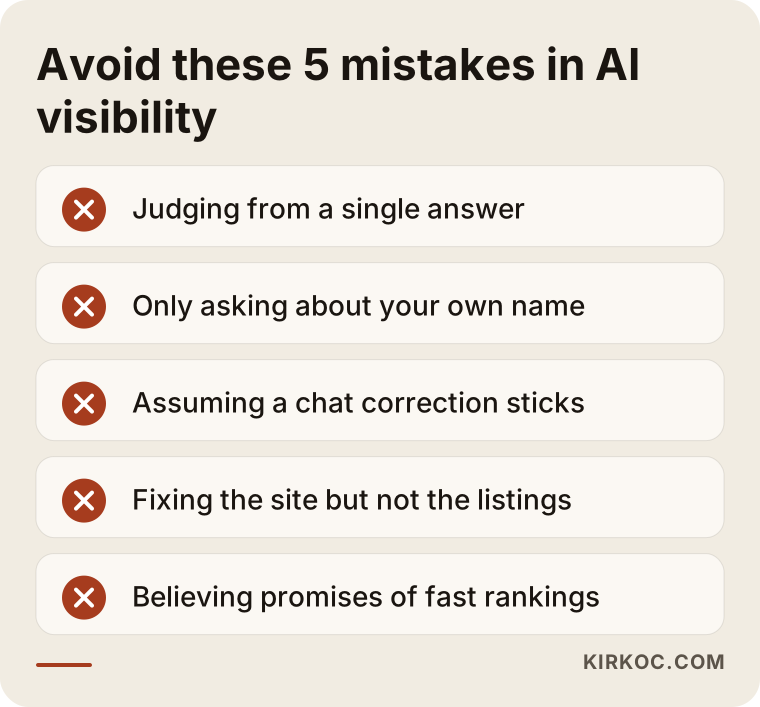
Judging from a single answer
Seeing or not seeing your name once is misleading. Answers shift a little every time. Do not draw conclusions until you have repeated the question on different days and with different wording.
Only asking about your own name
"What do you know about my business?" is a useful question, but it is not enough. What matters most is the moment a stranger asks for a trustworthy recommendation. If you skip that question, you miss the most important picture.
Trying to tell the AI to "fix it"
Correcting something inside a chat affects that conversation, not the answer someone else will see. The lasting fix is making sure the right information exists in the sources.
Focusing only on the website
Your site matters, but AI does not read it in isolation. Directories, news, reviews and other sites that mention you are part of the picture. Perfecting the site while leaving old listings untouched is half the job.
Trusting anyone who promises quick wins
Someone who says "we will put you first in ChatGPT within a set number of days" either misunderstands how these tools work or is not being honest with you. Answers are not a fixed ranking, and no result can be guaranteed.
Forgetting your industry's rules
Doctors, lawyers, accountants and similar professions may face rules on how they can promote themselves. Do not publish content that strains those rules just to be visible. Check your professional body's guidelines first.
Where a do-it-yourself check falls short
A manual test is valuable, but it has limits. A few questions give you a rough snapshot, and that is all:
- You cannot try the hundreds of different questions your customers might ask.
- Results vary by person, location and moment, so telling a fluke from a trend is hard.
- Finding out why your name is missing, the real cause, takes specific experience.
- Systematically comparing why competitors rank ahead takes time.
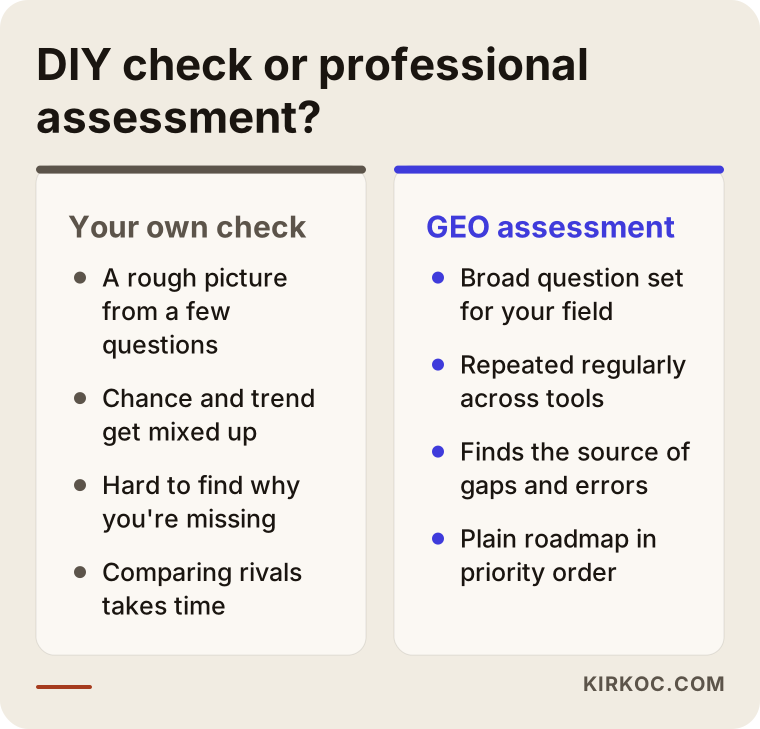
This is where a professional GEO audit adds value. In my own work, I build a set of real customer questions suited to your industry, run them across several AI tools at regular intervals, and record where you appear, where you don't, and which sources your competitors are winning with. Then I identify gaps, inconsistencies and errors in your website and across the web, and explain in plain language what to do and in what order. You get a clear roadmap, not a pile of technical reports.
For broader context, my article on preparing for AI search is a useful companion read.
What influences whether AI recommends you
Nobody fully knows how these tools work inside, and there is no formula that says "do this and you will appear." From what I observe, though, a few things make a consistent difference.
Clear, plain descriptions of what you do
Say what you do, for whom and where, in simple sentences on your site. Generic slogans like "your partner for solutions" do not help an AI match you to a question. A concrete sentence such as "I treat children's teeth in the south end of town" does.
Consistent information
Your address, phone number, opening hours and services should be identical on your site, your Google profile and in directories. Inconsistency leaves the AI unsure which version to trust.
Being mentioned in credible places
When trade associations, local news, directories and partner organizations mention you, the picture strengthens. What counts here is the credibility of the sources more than their number.
Genuine customer reviews
Honest, steady reviews show that your business really serves people. Fake or purchased reviews break platform rules and damage your reputation in the long run.
Staying up to date
When you add a service or move, announce it on your own site first, then carry it through to the other listings. When tools notice the change varies, but current sources are always an advantage.
How the process works if you do this with me
For those who are curious, here is the sequence, laid out openly. Details vary from business to business, but the skeleton is usually the same.
1. A first conversation and a clear goal
In the first call we talk about what you do, which clients you want and which services matter most to you. The aim is not to sell something; it is to see whether your situation suits this kind of work.
2. Building the question set
I list the questions real customers in your field might ask. They range from broad ones like "who is the best X?" to specific ones like "which specialist should I see in situation Y?" You add the questions you hear from your own clients.
3. Testing regularly across tools
I run the questions repeatedly in tools like ChatGPT, Gemini and Perplexity. The goal is not one result but a trend: which questions name you, which do not, and which sources help your rivals.
4. Examining the sources
I look at the sites the answers rely on and at what is written about you. Old addresses, inconsistent phone numbers, thin service descriptions, or details your competitors have and you lack all surface at this stage.
5. A prioritized roadmap
I turn the findings into a plain list instead of a stack of technical reports: what to do first, what later, what you can handle yourself and what needs help. We decide together who takes each step.
6. Action and monitoring
After the fixes, I re-run the same questions at intervals. We see what worked and what did not, and adjust the plan. Results take time, which is why monitoring is part of the process, not an extra.
What you can do yourself and what to leave to an expert
You do not have to outsource everything. The right split protects your budget and puts your time where it counts.
What you can comfortably do yourself
- Run a regular check using the method in this article and keep your notes.
- Keep the address, phone number and opening hours in your Google Business Profile current.
- Describe your services on your website in simple, clear sentences.
- Ask satisfied customers for honest reviews.
- List the old records that still carry an outdated phone number or address.
What to leave to an expert
- Finding the root cause of why the results look the way they do.
- Testing a question set of hundreds across several tools in a systematic way.
- Comparing which sources help your competitors stand out.
- Spotting technical problems, such as settings that stop AI from reading your site.
- Measuring the effect of the fixes over time and updating the plan.
If you run a small business, starting with your own check and getting help only where you need it is often a sensible path. I would recommend that too.
One more note: if your own check turns up something missing, do not panic. Fix the easiest thing first, for example a phone number in your Google profile, and look again after a few weeks. Small, measurable steps teach you far more than trying to change everything at once. It is the only way to tell which fix led to which result.
Setting realistic expectations
To be honest, this work does not behave like an ad campaign. You do not press a button and see results the next day.
How quickly fixes show up in answers depends on how often a tool scans its sources and how it weighs information. Some changes appear fast, others very slowly. That is why I suggest measuring progress by the trend over months, not by a single answer.
No result can be guaranteed. But having correct, consistent and current information in open sources keeps its value no matter which tool or update comes next. That is the lasting gain of this work.
Frequently asked questions
Is it a bad sign if I never appear in ChatGPT?
Not necessarily. It is very common, especially for local and small businesses. It points to work not yet done rather than to a verdict on your business. What matters is understanding why competitors appear and closing the gap.
Can I pay to be recommended by ChatGPT?
Today, the recommendations in AI answers rest on the content of your site and other sources. Advertising options in this area are changing quickly, so I suggest focusing on making your content and sources solid, which lasts longer.
How long until I see results?
Nobody can say for sure. Some fixes show up within weeks, others take months. Be cautious about anyone who promises a date by which you will be recommended.
Why hire an expert if I can check myself?
You can do the check yourself, which is exactly what this article is for. Finding the cause, setting priorities and measuring consistently over time take time and experience.
Do ChatGPT, Gemini and Perplexity give the same answer?
No. Each tool uses sources differently; one may lean on live search while another relies on what it learned in training. That is why I suggest trying all three. Appearing in one and not another is quite normal.
Can I report wrong information to these companies?
Some tools offer a feedback channel, and it is worth using. But that does not mean the information will be fixed quickly or permanently. The real fix is making sure the right information is clear in the sources.
Is it worth the effort for a small local business?
If your customers are likely to ask AI when looking for a service, yes. You do not need a large budget to start; an up-to-date profile and a clear website are often the first step. How much to invest depends on the competition in your field and your goals.
How often should I repeat the check?
Monthly at first, then every few months is enough. If you have made a major change, such as moving or adding a service, check again after a while.
If you want to know where you stand in AI answers, get in touch and we will look at your situation together. You can read more about how I work on my GEO services page.