It used to be simple. Someone who wanted insurance typed "car insurance quote" into Google and looked at the first few sites. Plenty of people still do that, but a growing share now ask the same question to ChatGPT, Gemini, or the AI summary Google shows at the very top of the page: "Which insurance agency in Leeds can I trust?" "What does a business insurance policy cover?" "What is the difference between third-party only and fully comprehensive?" The answer arrives as one short paragraph with a few names or sources inside it. If your agency is not in that paragraph, the customer moves on to someone else without ever seeing you.
GEO is the work that deals with exactly this. It is the general name for the steps that make AI tools treat your website as a source and, when it fits, mention your agency by name. I work from Istanbul, and the whole job is done online, so where you are located does not change how it works. When I explain my GEO services, I stress one thing for insurance in particular: in your field, trust comes before price. AI tools also try hard not to pass along wrong information, so they favor pages that carry trust signals. In this article I will explain what has changed, which pages you need, what to avoid, and how far you can get on your own.
What exactly is GEO, and how is it different from classic SEO?
Classic SEO is the work of getting your website to show up high in search results. The customer sees a list, clicks your link, and lands on your site. With GEO, the customer does not see a list. They see a ready-made answer. The AI reads many sites, picks the ones it trusts, and summarises them. Your goal is less about ranking first and more about being inside that summary.
Think of it this way. You used to put your shopfront on a street, and anyone walking by could see it. Now there is an advisor standing in between. The customer asks the advisor, and the advisor describes the shops it knows and trusts. For the advisor to know you, you have to provide information that is clear, consistent, and easy to verify. Fancy sentences do not help. Plain facts do.
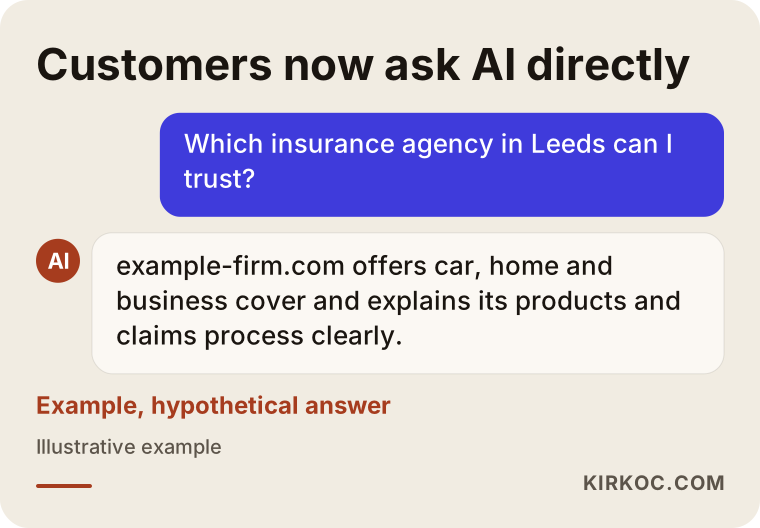
The example above shows the shift. The answer is short, direct, and includes an agency name. The customer often goes straight to that name and calls or fills in the form. An agency that is missing from the answer simply does not exist for that person.
Let me be honest up front: nobody can guarantee that your name will appear in an AI answer. These systems change constantly, and no one knows exactly how they pick their sources. What can be done is to raise the odds with concrete work. That is how I approach it.
How do insurance customers actually search?
Insurance searches are not like searches for a restaurant or a barber. The customer often does not know exactly what they want. They start with questions like "What should I get for my house?" or "I rent my shop, do I need property insurance?" That is why the most common gap on insurance sites is the lack of pages that answer the question being asked. Customers search in four different ways.
The first is the product search: "car insurance," "contents insurance for tenants," "health insurance," "business insurance." These are broad and highly competitive. The second is the question search: "what happens if I let my policy lapse," "does home insurance cover water damage." AI tools answer this kind of question most often, and they want sources to back up the answer. The third is the local search: "insurance agent near me," "business insurance in Headingley." The fourth is the trust search: "is this agency legitimate," "any complaints," "how do I check an agent's license."
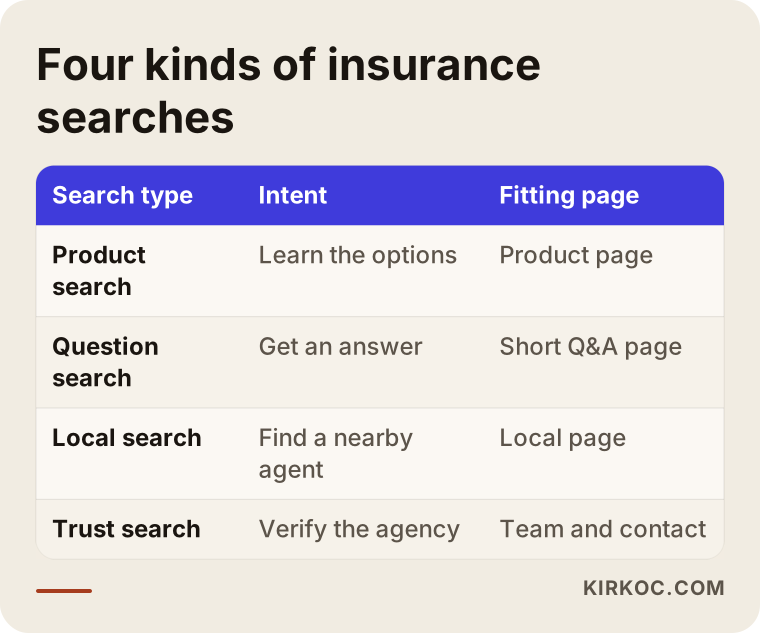
In the table I paired each search type with a page type, because the most common mistake I see is trying to squeeze everything onto the home page. The home page exists to say "here is who the agency is." Answering questions takes separate pages, and those separate pages are what AI tools pick up as sources.
What do AI tools trust on an insurance agency site?
Insurance affects financial decisions, so search engines and AI tools are more careful in this area. A page full of empty promises, with no visible author and out-of-date details, is risky for them to feature. Your site needs to show the following.
It must be clear who you are. Your agency's legal name, address, phone number, business hours, and the carriers you represent should be easy to find. There are rules about how licenses and credentials may be displayed, and they differ by country and region. Check with a solicitor or your local insurance regulator about the exact wording. I am saying this information belongs on the site; the legal framework for how to phrase it is for you and your advisor to settle.
The writer must be visible. Under a post like "What does a liability policy cover?" there should be a name, a short bio, and the date the post was last updated. Anonymous, undated content does not inspire trust. The article should have been written or approved by someone who actually works at the agency.
Your details must be consistent. The address on your site, the one on your Google Business Profile, the one on your social media accounts, and the one in online directories should match. If the phone number is a landline in one place, a mobile phone in another, and an old number in a third, both the AI and the customer find it confusing.
Your answers must be clear. AI tools like pages that answer the question in the first two sentences. If your page on "What is a liability policy?" opens with three paragraphs of history, the tool will look for the answer on another site.
Which pages do you need?
Here is a skeleton I suggest for an insurance agency site. Not every agency has to look the same, but most are missing several of these pieces.
Product pages. One page for each type of insurance: auto, home, tenants' contents, liability, business, health, travel. Each page should explain what the product is, who it suits, what is commonly not covered, and what information you need to prepare a quote. Spelling out the exclusions builds trust, because customers do not want to discover them somewhere else.
Question pages. A short, clear page for each real question, such as "Do I get a refund if I cancel my policy mid-term?" or "What should I do first after a claim-worthy accident?" You already answer these on the phone several times a day. Writing those answers down solves half of your content.
Local pages. If you serve customers in more than one neighborhood or town, create a page specific to each. Copying a page and swapping the place name does not work. Write about the questions that customers from that area actually ask, the risks that are common there, and how to reach you.
Team and about page. Who works there, how long they have been in the business, and what areas they know best. A photo and a short bio make a big difference.
Claims process page. Many agencies do not have one, yet it is the page people most want. Who to call when something happens, which documents to gather, and roughly how the process runs. Be honest about the parts that depend on the carrier.
Contact page. Address, map, phone, text or chat options, business hours, and an appointment option.
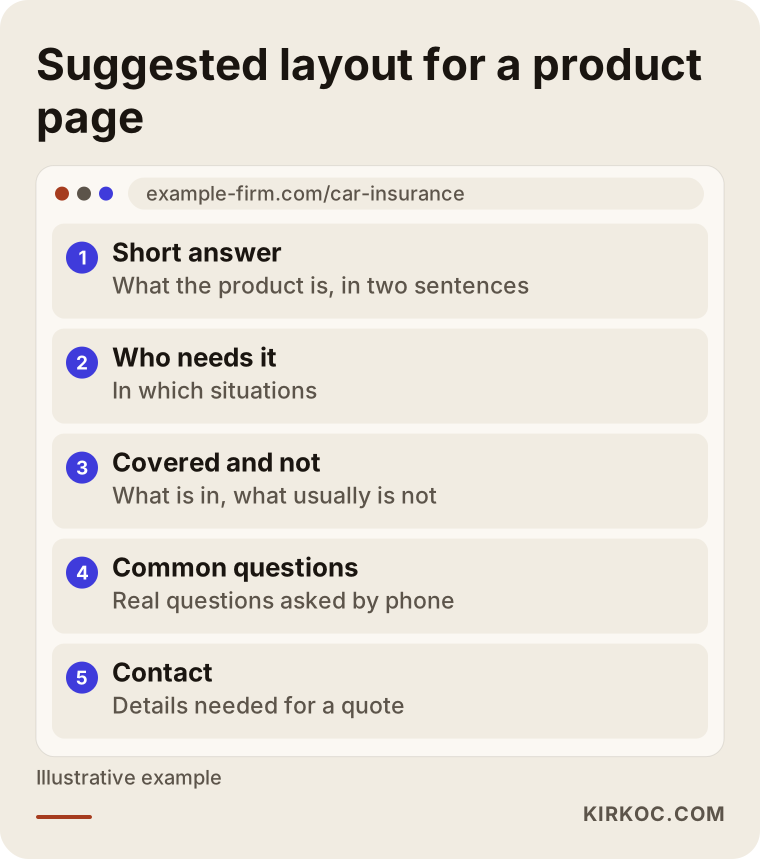
The layout in the image is the skeleton I use for a product page. The short answer sits at the top, followed by what is covered and what is not, then common questions and contact details. This order helps both people and AI tools reach what they are looking for quickly.
Thinking about classic SEO and GEO together
GEO does not replace SEO. Both rest on the same base: a well-written, fast, mobile-friendly, trustworthy site. The difference is in the emphasis.
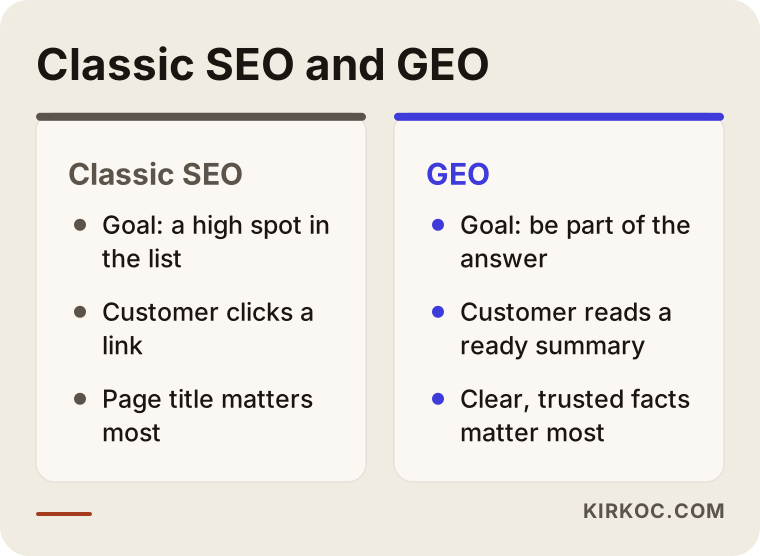
As the comparison shows, classic SEO aims at getting clicks on a link, while GEO aims at getting into the answer. In practice the two overlap. A good share of AI tools draw on pages that search engines have already found, so a site that does not show up in search will have a hard time showing up in AI answers too. That is why I fix the foundation first and move to the GEO-specific work afterward.
Another difference in insurance is freshness. Coverage rules, regulatory requirements, and scheme details can change over time. A page with outdated information misleads the customer and loses value in the eyes of AI tools. Keep a "last updated" date visible at the bottom of each page and actually review the pages from time to time.
Example scenario: a Leeds agency that sells personal insurance
Here is a hypothetical example. Picture a small agency in Leeds that mostly sells car, tenants' contents, and home insurance. It has a website, but the site contains only a home page, one services page, and a contact form. The owner says most customers come by referral and very few come from the internet. New customers are hard to find, and a friend mentioned that a competitor is being recommended by ChatGPT.
On a first look I would see three problems. First, every type of insurance is covered in two sentences on a single page, so no page answers any product question. Second, the business hours on the Google Business Profile are out of date, and the site shows a different phone number. Third, the site says nothing about who works there.
My suggested plan is short. First, make the address, phone number, and hours identical everywhere. Next, write three separate product pages for car, tenants' contents, and home. Then turn the ten questions customers ask most on the phone into short individual pages. Finally, prepare the team page and the claims process page. None of this is magic, and there is no guarantee of landing in an AI answer. But when a site clearly states what it knows and who it is, the chances of appearing in both search engines and AI tools improve in a reasonable way.
Example scenario: a boutique agency that sells business insurance
The second hypothetical example is different. Imagine an agency that sells business insurance packages to small shops and service businesses: hair salons, cafes, repair workshops. These owners often do not search for "small business package." They ask things like "who pays if my shop floods" or "what insurance does a cafe need."
Here the situation matters more than the product name. A good plan includes pages organized by type of business: which risks cafes face, which liabilities stand out for salons, how equipment and inventory are handled in a workshop. Each page opens with a brief example situation and continues with "in a case like this, people usually look at these kinds of coverage." Instead of firm legal or financial claims, the page uses honest language such as "it depends on the terms of your policy, and the agent will go through it with you when preparing the quote."
The nice thing about this approach is that AI tools tend to use pages with concrete examples when they write answers to situation questions. Customers who see their own situation on the page are also more likely to fill in the form. Still, results are not fixed for anyone. I present this as a plan, not a promise.
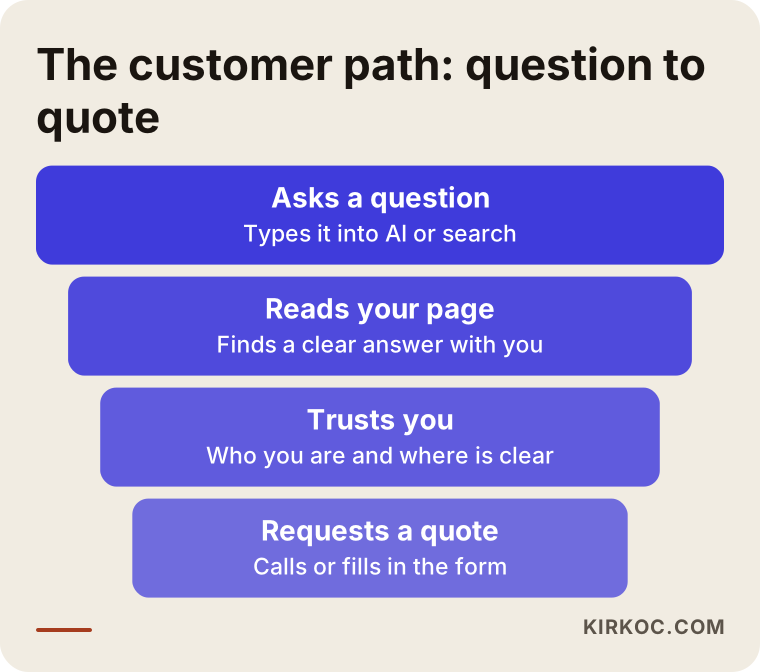
I always picture the customer's path as a funnel. At the widest part is everyone who is asking or curious. Then some of them read your page, some of those come to trust you, and a smaller number call. Reducing the number of people lost at each step comes down to building your pages and answers around these steps.
The process, step by step
Here is the order I follow for GEO work at an insurance agency. You can follow the same order if you are doing it yourself.
1. See where you stand. First, ask AI tools the questions your customers would ask. "Recommend an insurance agency in Leeds," "who should I contact for business insurance." Note who appears in the answer and which sites are cited. This shows you where your competitors and you stand.
2. Build a question list. What do customers ask on the phone and in the office? Write down the twenty questions you have heard most often over the last six months. This list is the raw material for your content plan.
3. Fix the basic details. Legal name, address, phone, hours, Google Business Profile, social media details. All of them must match. It looks boring, but the quickest gains usually come from here.
4. Write the pages. Product, question, local, and team pages. Each page gives its answer in the first two sentences and then goes into detail. The author's name and the update date should be visible.
5. Check the technical ground. The site should open quickly on a phone, the pages should be open to search engines, and structured data should be added correctly. Structured data is a small piece of code that tells machines "this is an insurance agency, and here is its address." If I had to explain it in one sentence: it is like a business card the site hands to machines in the background.
6. Measure and repeat. Once a month, ask the same questions again, see which pages are being cited, and add new pages for any questions that went unanswered.
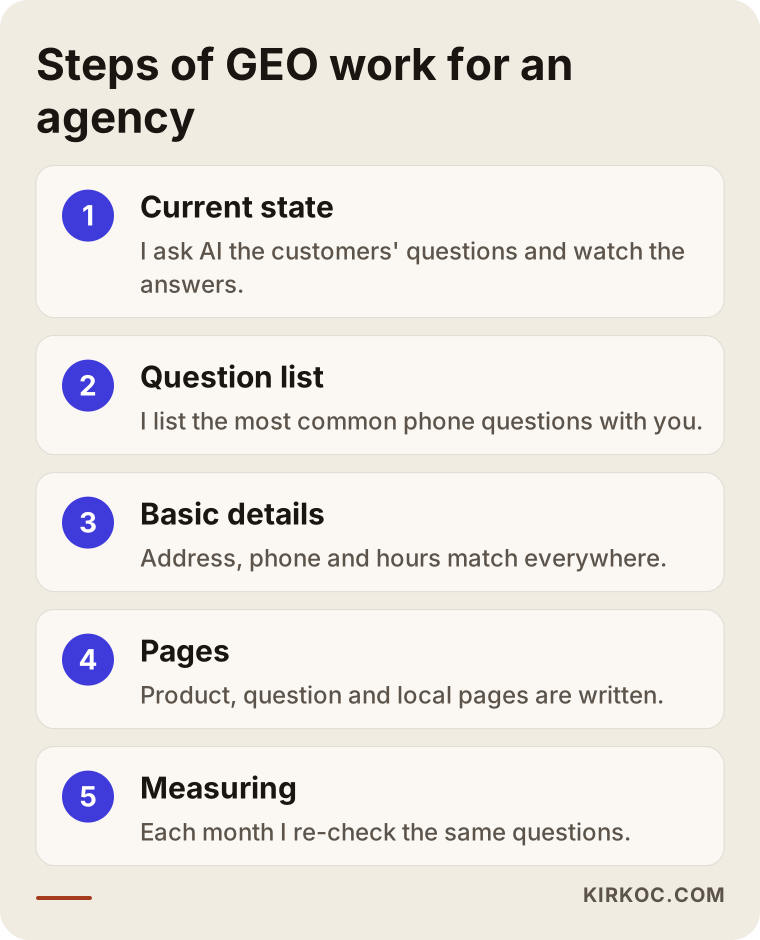
The graphic summarises this order. The steps follow a logical sequence because writing pages before the basics are fixed, or tuning the technical side before there are pages, usually goes to waste.
Common mistakes
Many of the mistakes I see in this field, and in GEO in general, are very similar. Watch for these before you start writing.
The first is making claims with numbers or superlatives. Phrases like "cheapest rates" or "100 percent satisfaction" cannot be verified and can create liability in a regulated field. I recommend asking a solicitor what to watch for in advertising and promotional wording.
The second is copying product information. Pasting the carrier's brochure text onto your site makes you identical to a hundred other agencies. The AI sees the same text again and again, cannot tell which copy to cite, and often picks the original source.
The third is inconsistent details. Three different spellings of the address, two phone numbers, an old set of hours. AI tools treat inconsistent information as unreliable.
The fourth is hiding the author. In a field like insurance, it matters who wrote the content. Content published under a real person's name builds more trust than anonymous content.
The fifth is cramming everything onto one page. A single page titled "All your insurance solutions" cannot be the answer to any question.
The sixth is impatience. Many people give up after the first few weeks without results. It takes time for pages to be read, evaluated by search engines, and picked up as sources by AI tools.
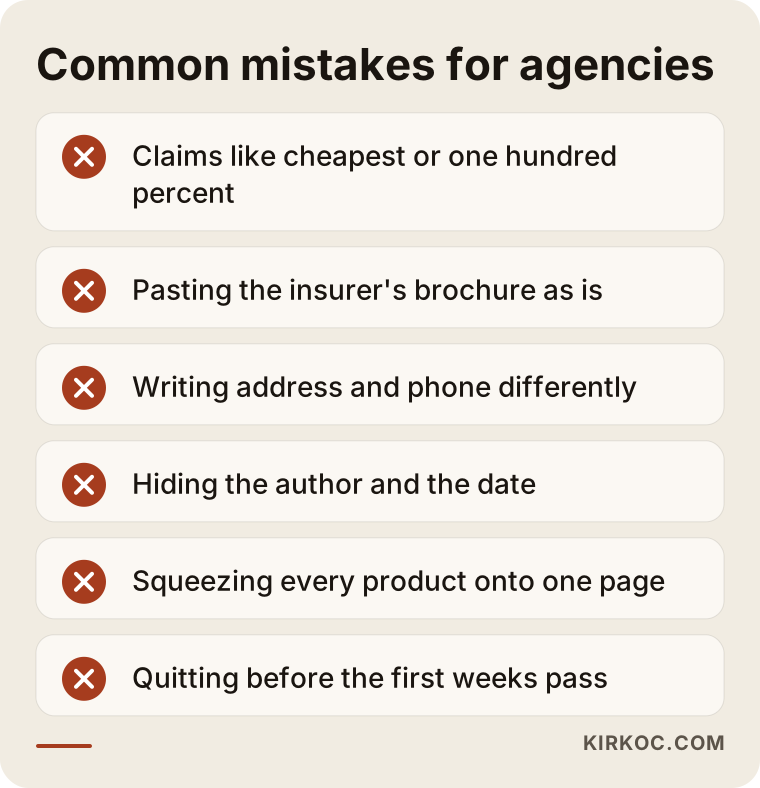
The list is short, but behind every item is a real loss. Avoiding these mistakes does not require anything expensive. Most of it is care and order.
What can you do yourself?
You can do a large part of this work on your own, and I am not shy about saying so. Listing the questions customers ask, updating your Google Business Profile, making your address and phone details identical everywhere, posting team photos on the site, and writing out the claims process are all in your hands. They call for knowledge of your business, not specialist skills, and you already have that knowledge.
Also, only you can verify the accuracy of what is on the site. You need to confirm policy terms, coverage limits, and processes against your carriers' current documents. You should not hand that responsibility entirely to an outside person.
When do you need an expert?
In a few situations outside help makes sense. If the site has technical problems, meaning it loads slowly, looks broken on a phone, or has pages closed off to search engines, fixing that takes a different skill. Structured data, page structure, and internal links are also technical matters. Deciding which question goes on which page, watching competitors, and setting up measurement all take time too. While you focus on running the agency, someone needs to keep these going regularly.
If you have no site, or it is very old, you may need a new one built from scratch. This is where having the work done by one person makes a difference. When the site, the content, local search, and social media sit with the same person, they complement each other. When one person builds the site, another writes the content, and a third runs the ads, the details often come out inconsistent. Because I do all of it myself, the address, tone, and message stay the same everywhere.
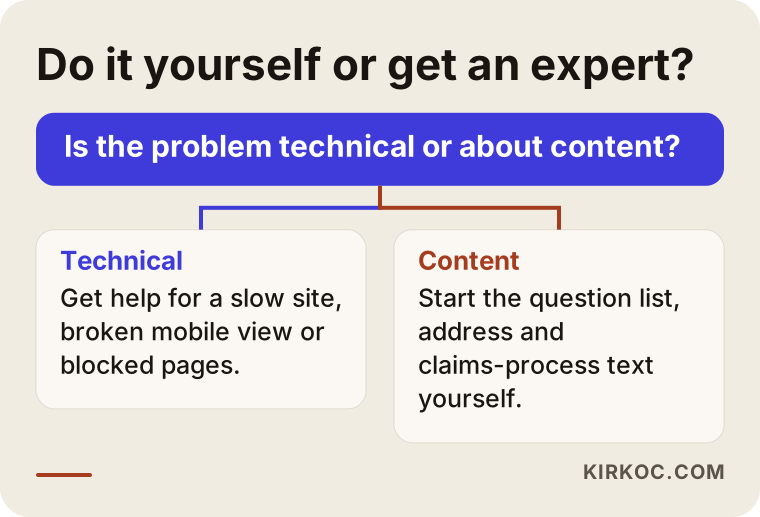
The decision chart rests on a simple question: is the problem about content or about technology? If it is content, you hold the knowledge, so start yourself. If there is a technical obstacle, get help.
What drives the cost?
I will not give a number, because no two agencies get the same price. What determines the cost is this: the current state of the site, meaning whether it must be built from scratch or fixed; how many product and question pages need to be written; whether you have more than one location or serve several towns; how much of the content you prepare and how much I write; whether extras like the Google Business Profile and social media are part of the job; and whether the work is a one-time project or an ongoing monthly engagement.
When you request a quote, look for these things: the tasks are written down in order, it is clear who does the work, reports are written in plain language, the site and accounts stay in your name, and no ranking or result guarantee is offered. A quote that offers a guarantee is often a warning sign.
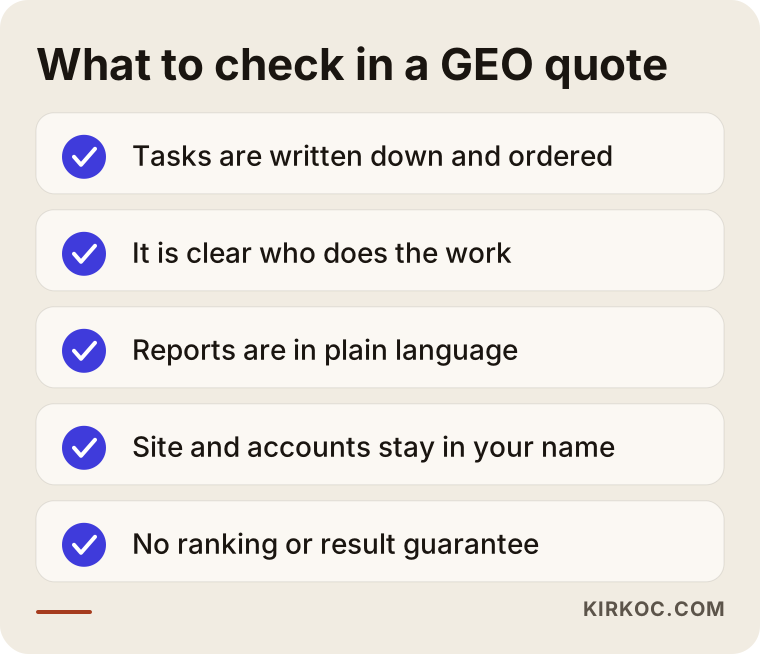
The checklist works for any quote you receive, mine included. If an item is missing, do not hesitate to ask.
How I work with you
I am a one-person shop based in Istanbul, which means the person you talk to is the person doing the work. Your website, local search, GEO work, social media, and, if needed, your ads all run through the same hands. That matters in a trust-driven field like insurance, because the information on your site, the post on Instagram, and the wording in an ad never contradict each other.
The process usually starts like this: I look at your site and your competitors and tell you where to begin. Then I give you the work for the first three months in writing, in priority order. The basics and technical obstacles are fixed first, then the pages are written, and every month you and I look at the results and adjust the plan. The site and accounts always stay in your name. For anything that makes a firm regulatory statement, your approval and your solicitor's approval come first.
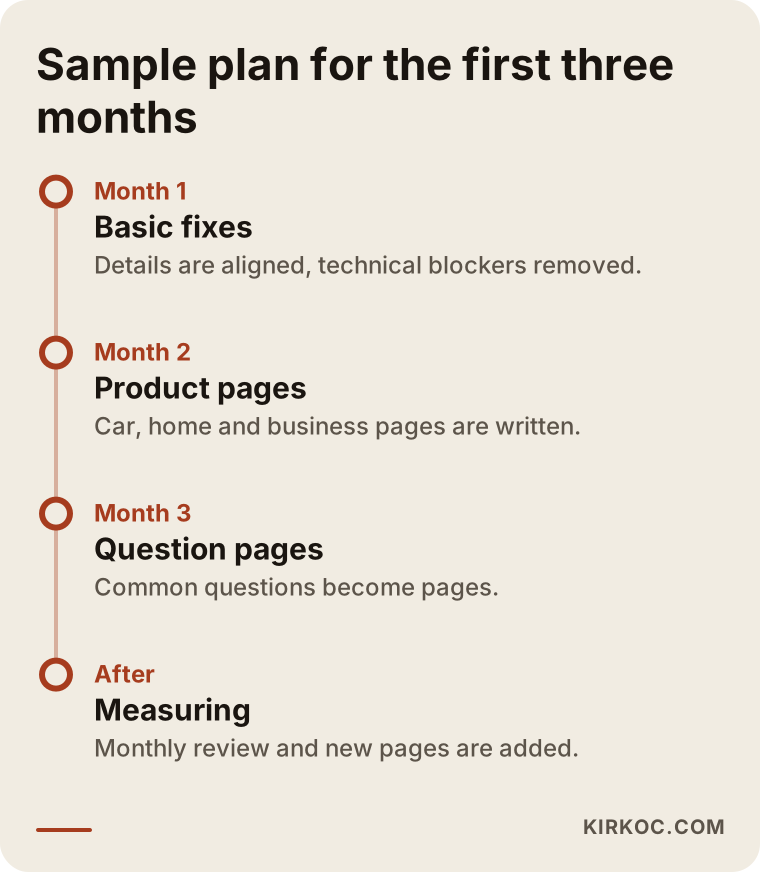
The calendar is an example, and it changes with the state of your site. But it shows the direction: basics first, then pages, then measuring and repeating.
Frequently asked questions
Do insurance agencies really need GEO?
If your customers come mostly by referral, it may not be urgent. But if you want to win new customers, and people have started using AI tools to ask questions, being visible there may matter more over time. That makes it sensible to lay the groundwork now. Whether you need it depends on where your customers come from.
Can you guarantee my agency will be named in ChatGPT?
No. Nobody can guarantee that. What AI tools choose, and why, is not fully known, and it keeps changing. What I can do is organize your site and your information so these tools find them trustworthy, and then track the results by measuring.
Should I do SEO first or GEO?
Because both rest on the same base, do not think of them separately. A fast, orderly, trustworthy site with clear content helps both. It is healthiest to fix the base first and then move on to the AI-specific work.
Can I use carrier text on my website?
There are limits on this from a copyright and regulatory point of view, so I suggest asking a solicitor. In practice, putting someone else's text on your site does not help you. Writing in your own words, around the questions your own customers ask, is more valuable.
Do I have to list prices on the site?
No. Insurance pricing varies by person, vehicle, or property, so showing a flat price on a page can be misleading. Instead, explain what determines the price and what information you need to prepare a quote. That is both honest and useful.
When will I see results?
Pages take time to be read and evaluated. I do not recommend expecting results in the first weeks. Waiting about three months for the general direction to become clear is more realistic. That is not a promise, just the nature of the process.
Is social media necessary too?
It is not required, but it can support the rest. After people find your agency, they often look at your Instagram or LinkedIn page as well. A consistent presence there builds trust. Site and basic details first, social media second, is usually the more efficient order.
I have more than one office. How do I proceed?
Each office needs its own page that is truly specific to it: address, map, staff, directions, and the questions that area asks. Copying the same text does not work. Each office's Google Business Profile also needs to be managed separately and consistently.
If you are wondering where to start so your insurance agency shows up in AI answers and searches, take a look at my GEO services page and write to me. I will look at your site and tell you honestly what needs to be done.