You have accounts, but you never find time to post. Or you do post, and nothing comes of it: no messages, no phone calls, no bookings. At some point you decide to hand the work to someone else, and the first question hits you right away: do you hire a social media agency or a freelance specialist? You search online and both sides describe themselves as the best option, which only makes things murkier. In this article I compare the two from your business's point of view, not a salesperson's. I am Ümit Kırkoç, I work in Istanbul, and I provide everything a digital agency would, including social media management, on my own and in one place. That means I am not a neutral party here, so I will say plainly when an agency makes more sense and when one person does.
Let me start with this: the words "agency" and "freelancer" tell you nothing about quality. There are bad agencies and excellent ones. There are freelancers who do not know their craft, and there are careful specialists who have worked with the same businesses for years. The difference is not quality. It is how the work is organized: who talks to you, who does the work, what happens if something slips, and who you pay for what. Your decision comes out of the answers to those questions.
What are you actually comparing?
"Social media management" is not one job. It covers coming up with ideas, writing captions, producing images or video, scheduling posts, answering comments and direct messages, running ads when needed, and reporting at the end of the month on what happened. An agency usually splits these tasks among different people: one runs the account, one designs, one handles ads, and one is your point of contact. A freelancer does some or all of it personally and may bring in outside help for the rest.
So the question is not really "big versus small." The real question is what your business expects from the division of labor. The picture below should help you visualize the comparison.
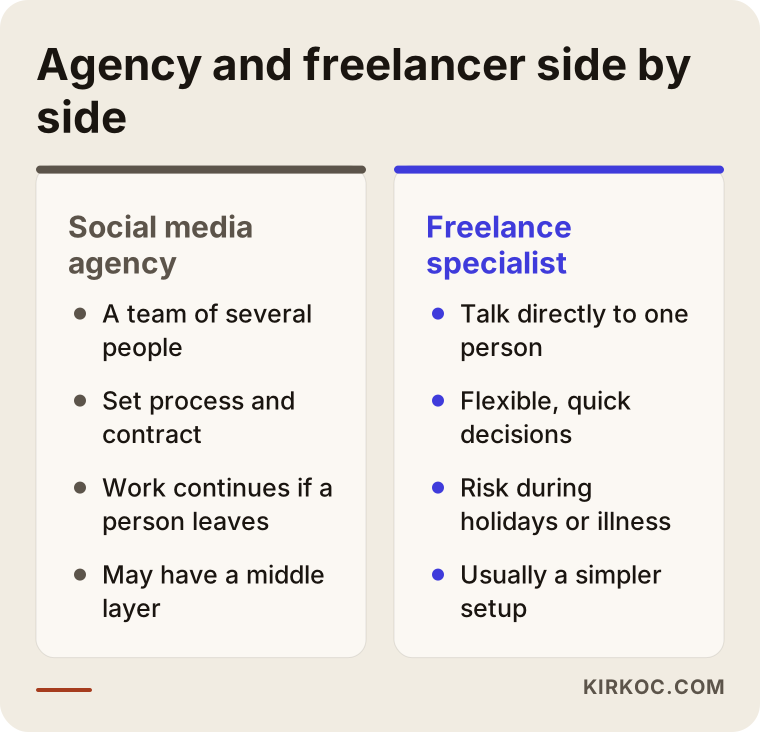
The items in the picture are general tendencies, not rules. You will find big agencies that are very flexible, and one-person operations that run with an almost corporate level of order. Read the points as notes on what to ask the person across the table, not as a scorecard.
Where an agency is strong
An agency's clearest advantage is continuity and specialization. If one person gets sick or quits, someone else usually steps in. There may be separate people for design, copywriting and advertising, which helps when a business produces a lot of content, has several locations, or works hard on several channels at once. Contracts, invoices and reporting are often already set up. That is one reason large organizations, or companies with strict accounting procedures, lean toward agencies.
In return, you have to accept a few things. The person in the meeting may not be the person doing the work. The account manager assigned to you may change every few months. There can be a layer between the people who know your business and the people who touch your accounts, and for a small business that sometimes means slow turnaround. This does not happen at every agency, but these are questions worth asking.
Where a freelancer is strong
The biggest gain from working with a freelancer is direct communication. The person who listens to you, writes the content and runs the account is the same person. If you think of a promotion today and want it changed tomorrow, there are not three people in the way. For small and mid-sized businesses this speed often decides things, because a restaurant's or a clinic's social media needs change from day to day: a special menu today, holiday hours tomorrow, a new service the day after.
You also need to see the risk up front. One person means one point of failure. What happens when that person goes on vacation, when a laptop dies, or when they take a full-time job elsewhere? That should be discussed before you start. And not every freelancer is good at everything. Someone who is excellent at Instagram is not automatically good at the ad management you may need.
What do small businesses really need?
You cannot put a hospital, a brand-name retail chain and the barber around the corner in the same box. For many small businesses, social media is the storefront and the first handshake. People find you through a friend's recommendation, a search, or a post. Then they open your Instagram or Facebook page and look at whether the business still seems active, how it looks, what the comments say, what the photos show. What they expect is not a show every day. They expect a steady, consistent presence, quick replies to messages, and correct information.
That need usually comes down to two or three channels handled regularly, a set number of posts per month, a small monthly report, and now and then a modest ad budget used sensibly. You do not need a huge team for that. But whoever does the work has to really know your business: which customers write at which hour, which question comes up again and again, which product should be in front.
Use the table below as a starting point to see which option is closer to your situation.
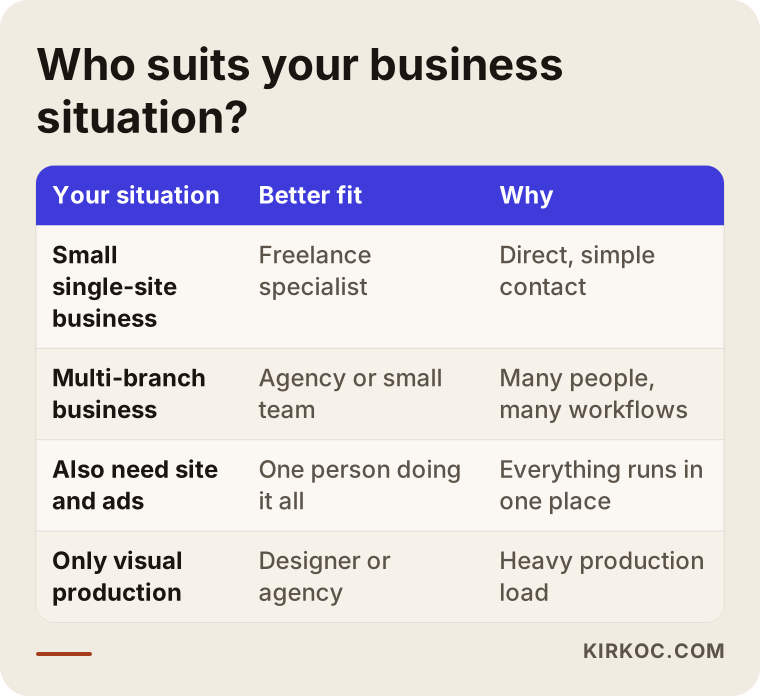
The table does not hand down a verdict. A single-location business can be perfectly happy with an agency, and a multi-location company can work with one good specialist for years. The table shows what tends to happen most of the time.
Two hypothetical example scenarios
The following are not based on real people or companies. They are scenarios I made up to make the situation concrete.
Example scenario 1: A single-location bakery
Suppose there is a small bakery with one shop in a mid-sized town. The owner handles both production and customers. There is an Instagram account, but posts are irregular, and orders mostly arrive by phone and direct message. What this business really needs is a few good photos and short videos each week, well-written captions, fast replies to messages, and a calendar prepared in advance for busy seasons such as Valentine's Day, Mother's Day and the winter holidays. There is no need for a large team holding a monthly management meeting. The owner can text which cake to feature this week, and the same person can turn it into a post right away. For this kind of business, one specialist working directly with the owner is often more efficient, provided that person is good with photos and video and can be reached during the rush.
Example scenario 2: A medical group with four clinics
Now picture a completely different case: a medical group with four clinics, each with its own doctors. Each location needs its own account and its own campaigns, there are several people who must approve things, and health-related content has to be reviewed with care. Video shoots, graphic design, ad management and comment monitoring all have to happen at once. With long approval chains, a heavy production load and a strong need for continuity, a group of several people will probably work more comfortably. That could be an agency, or it could be a few specialists who team up. What matters is that when the workload grows, the work does not sit on one person's shoulders.
The lesson from these two cases is that as workload, approval chains and the need for continuity grow, the advantage of a team grows too. When a simple, quick, direct relationship is enough, one person can do very well.
One question to ask yourself before deciding
You can boil this whole comparison down to a single question: is talking directly to one person enough for you? If it gives you confidence that the person who knows your business, talks to you and does the work is one and the same, take a freelancer seriously. If you want to work with several departments, approval processes and a formal contract setup, look at agencies.
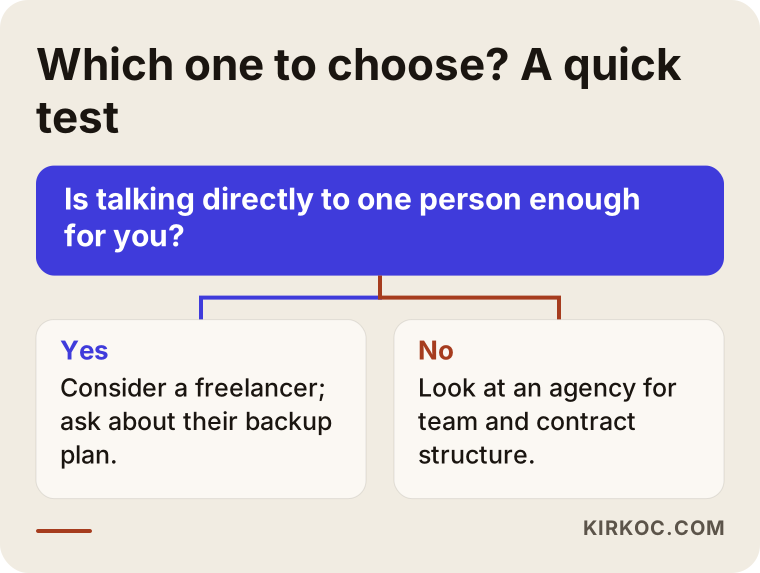
Even if your answer is "yes," you are not done. You still need to talk about a backup plan, account ownership and reporting. I cover those next.
What to ask before you accept an offer
Whichever way you lean, the questions are the same. When you compare proposals, look at these things before you look at price, because two proposals can look identical and describe very different jobs.
First, account ownership. Your Instagram, Facebook, LinkedIn and TikTok accounts should be created under your name and your email address. When the work ends, you should never have to ask anyone to give an account back. If admin access is possible, adding the person as an authorized user is far safer than sharing your password.
Second, who does what. Who writes the content, who makes the visuals, who publishes, who answers comments? Is one person doing all of it, or are other people in between? You should know who to call when something goes wrong.
Third, the report. "We send a monthly report" does not say much. Does the report contain only likes and follower counts, or does it also show messages received, phone calls, visits to your website and ad spend, the things that relate to your business? A good report carries information that could change a decision you make.
Fourth, the exit terms. How long is the contract, how can it be ended, and who owns the content? Anyone who dodges these questions should give you pause. I will not make a firm legal comment on contract clauses. If the text carries serious obligations, it is right to consult an attorney.
Fifth, the backup plan. If the person or team becomes unreachable, how does the content keep flowing? If you are working with a freelancer in particular, the answer to this should be clear.
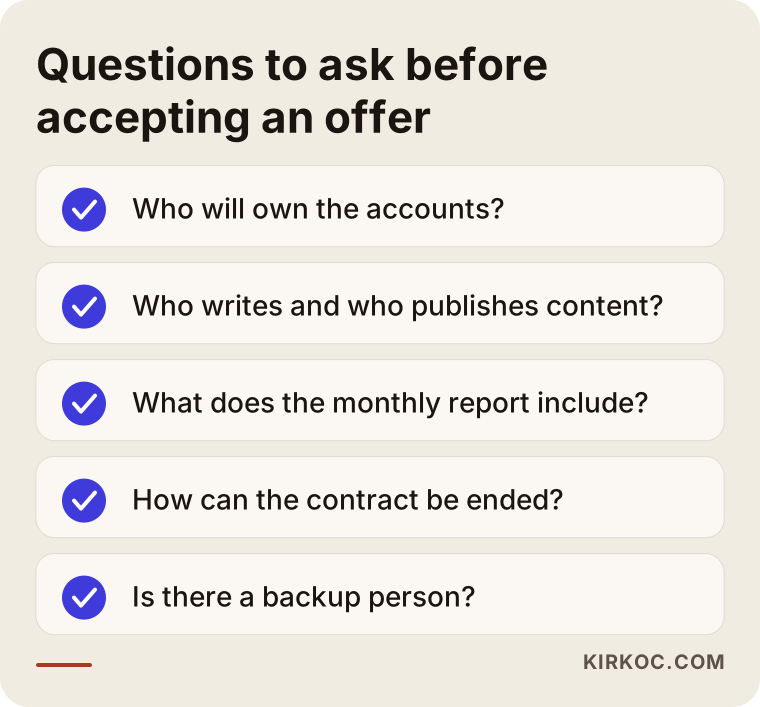
Save the list on your phone and ask everyone you talk to the same questions. How clear the answers are often tells you more than the proposal itself.
What do AI assistants and search results say?
Today many people ask an AI assistant or a search engine before they decide. The answers tend to be balanced and general: it depends on the size of the business, the budget and the workload. That answer is not wrong, but it does not take you anywhere, because it does not know what your business is.
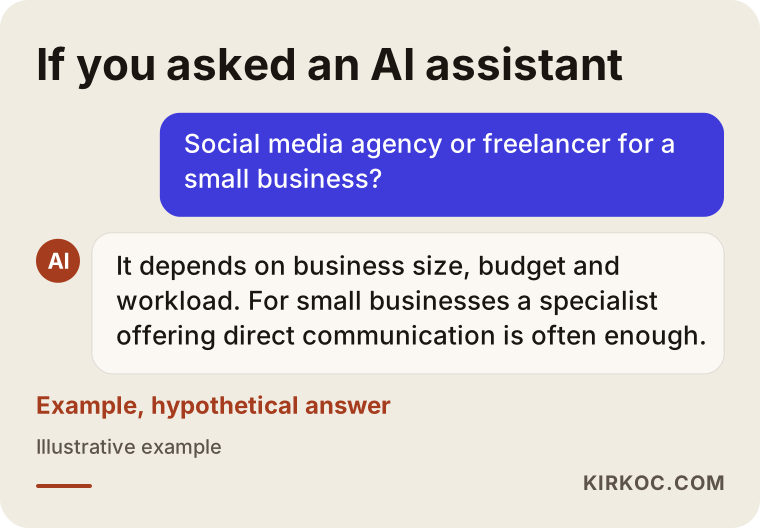
The answer in the picture is a hypothetical example. The point is that a general answer cannot replace one that fits your business. So when you decide, use your own goal, your own workload, and how comfortable you feel talking with that person or team as your yardstick.
What determines the cost
I am not going to give numbers here, because no two businesses need the same thing and no two proposals come out the same. But knowing what moves the price lets you compare proposals properly.
The first factor is the number of channels. Managing only Instagram is not the same job as managing Instagram, Facebook, LinkedIn, TikTok and YouTube together. Each channel has its own content format and its own audience.
The second is the volume and type of content. A few simple posts a week is a different workload from a short video, a designed graphic and a story sequence every week. If photo or video shoots are needed, production is counted separately.
The third is ad management. Social media management and ad management are two separate jobs. The ad budget goes to the platform, while the management fee pays for the work of the person who sets up and monitors the campaigns. Check whether the proposal lists these two items separately.
The fourth is response speed and community management. Who answers incoming messages and comments, and how quickly? For businesses that need constant monitoring, this line item makes a difference.
The fifth is reporting and meeting frequency. A written monthly report, a weekly call, or just messaging when needed? More frequent contact means more effort.
The sixth is the structure of the contract. Fixed term or open-ended, monthly or longer? A proposal with flexible exit terms is not the same as one that asks for a long commitment.
Finally, who does the work also affects the price. An agency's price includes office, team and management costs. A single person's price usually carries less of that overhead. This does not mean one is better than the other. It only shows what the price covers. When a proposal is cheap, look at what has been left out.
What should the first three months look like?
Whichever route you pick, a healthy start tends to follow the same order. The first week is an introduction and goal setting: what your business sells, who it sells to, and which service you want to push. The second week is about the accounts: profile details, links, usernames and access permissions are checked. Toward the end of the first month, the first content calendar is ready and posting begins. In the third month there is a first honest evaluation: which content brought messages, which stayed quiet, which channel worked.
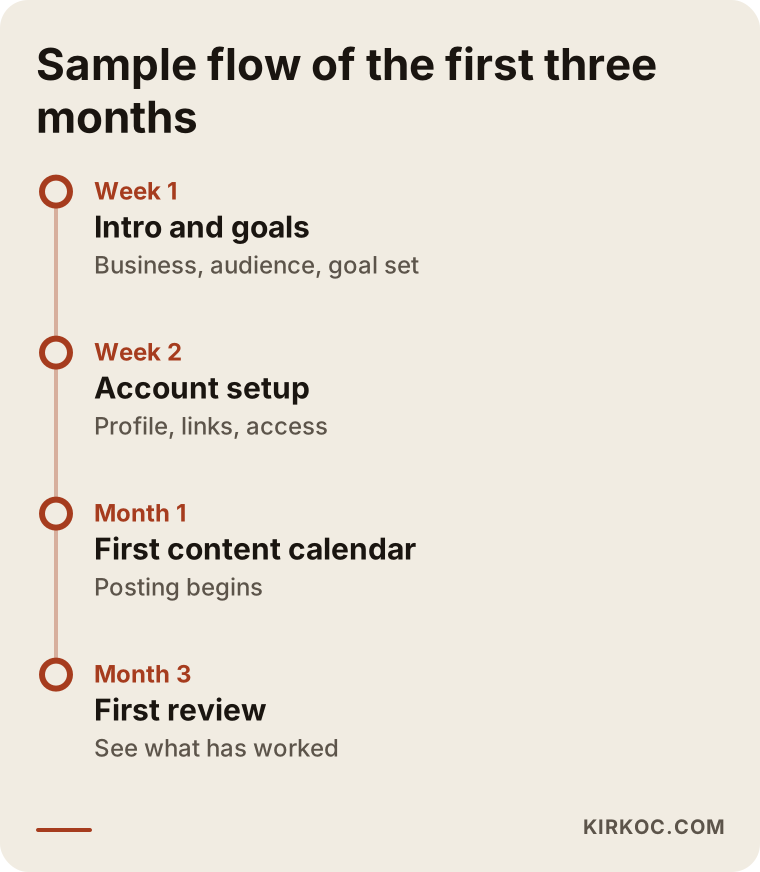
The point I want to stress is that expecting big results in a week or two is not realistic. On social media, results build up over time with regular content and the right audience. That is why I do not promise any number of followers, likes or sales, and if someone does, be careful. The review after three months should give you enough information to decide whether to continue or change course.
Common mistakes when choosing
These are the mistakes I see most often in this area.
The most common is picking only the cheapest offer. A cheap offer is not necessarily bad, but its scope may be narrow, or the effort behind it may fall short. Compare proposals by what is inside them, not by the number.
The second mistake is handing account credentials to whoever does the work. Share the account through admin or authorized access, and do not share a password unless it is truly unavoidable. When the job ends, control of your account should still be yours.
The third mistake is starting without reports. Carrying on without seeing what has been done turns, after a while, into the feeling of "we are spending money and I do not know what is happening."
The fourth mistake is deciding by follower count alone. An account with many followers is not an account that brings many customers. What matters to you is that the right people reach you.
The fifth mistake is starting without a goal. Do you want messages, more foot traffic, or just brand awareness? If the goal is not clear, no result can be read as a success or a failure.
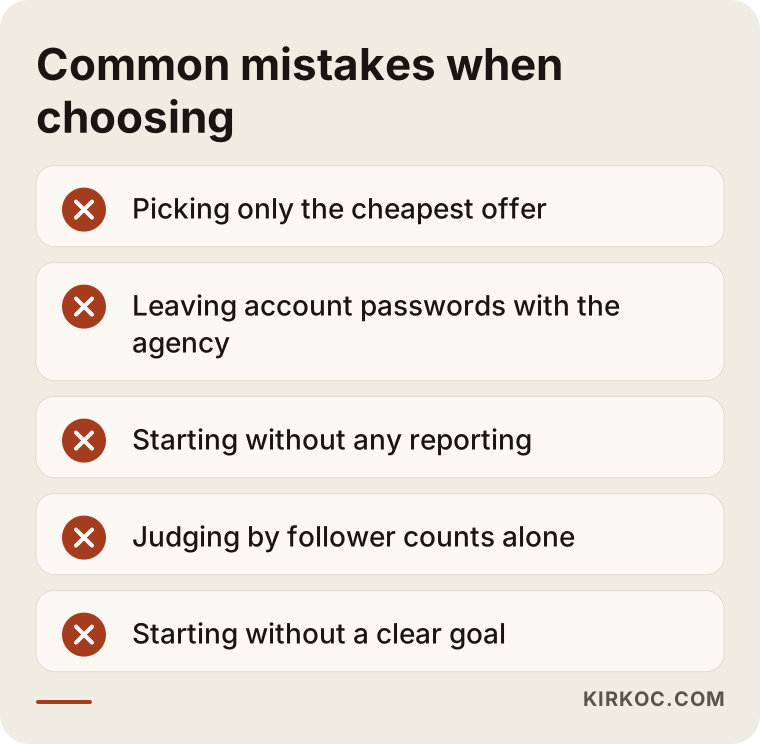
None of these mistakes belongs only to agencies or only to freelancers. All of them can be prevented by preparation on your own side.
Social media does not finish the job by itself
Here is a point that goes against the grain: even if you manage social media very well, the effort is wasted if the person who sees a post has nowhere to take the next step. Someone likes your post, looks at your profile, then wants to call you or book a time. If the link on your profile is broken, your website opens badly on a phone, or the information is incomplete, the interest disappears before it turns into a purchase.
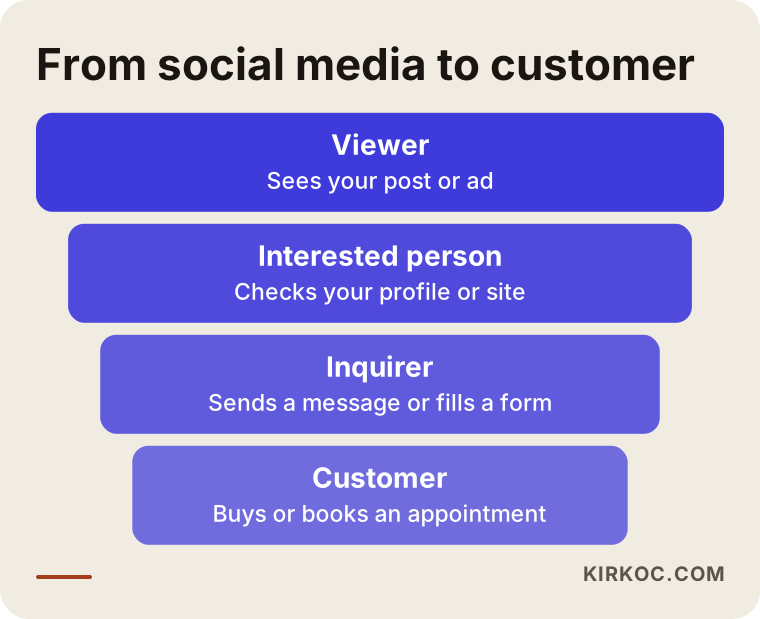
Each stage of the funnel asks for a different kind of work: content to be seen, a tidy profile and website to hold interest, a clear route that gets people to ask a question, and a fast, clear reply to turn them into customers. When the links in this chain sit with different people, gaps can open between them. If one person runs social media, another runs the website and a third runs the ads, each may have a different goal and a different tone.
This is why I see handling everything in one place as an advantage. When the website and online store, SEO, local SEO, social media, Google and Meta ads, logo and content all sit with one person, the page a post links to, what that page says and the message an ad carries stay consistent with each other. It is not essential for every business. But for a business that needs more than one service and does not want to chase a separate contact for each, it is a real convenience.
What can you do yourself, and when do you need a specialist?
Not every business needs outside help from day one. If you run a small business and have the time, you can do these things yourself: open the accounts under your own email address, fill in the profile description and contact details completely, keep your opening hours current, reply to messages the same day, and regularly share real photos of your products or services, even if you take them on your phone. You do not need an agency for any of that.
Specialist help starts to make sense in these situations: you cannot find time to post, you do not know what to post, you want to run ads without wasting the budget, you have to manage several channels together, or your accounts have been neglected for a long time and you want to get them back in shape. In those cases you can size up your workload and decide what kind of support is needed.
To be honest, sometimes the right advice is "keep doing it yourself for now." For a business whose goal is unclear and whose product or service is not settled yet, setting up a simple routine first is wiser than paying for monthly management.
Four steps to decide
To make the decision easier, you can follow this order. First, write down your goal: do you want messages, bookings, sales, or just a decent-looking presence? Next, measure the workload: how many posts a week, which channels, how much video, will there be ads? Then talk to two or three candidates and ask them all the same questions. Finally, if possible, begin with a short period instead of a long commitment, and agree on the first review up front.
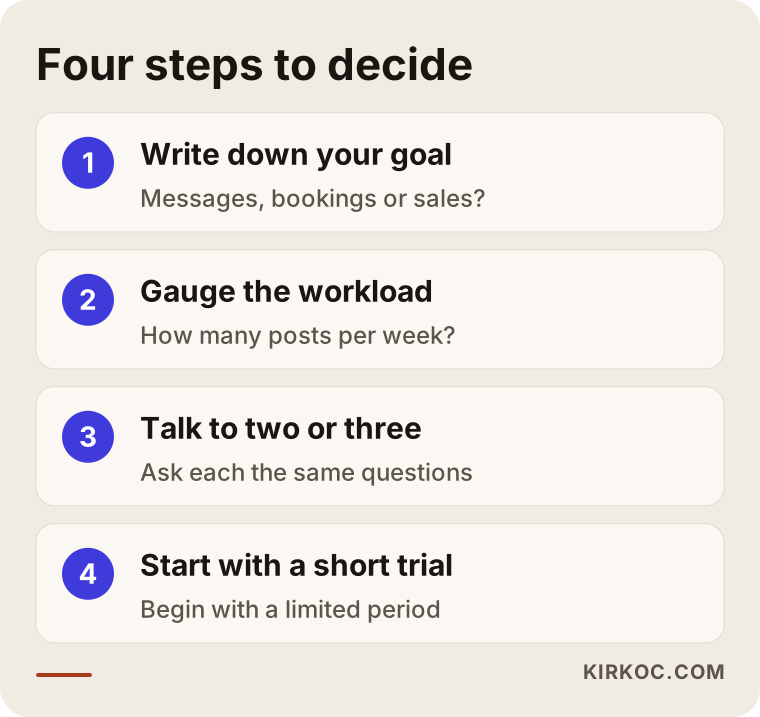
This order works whichever option you prefer. Writing the goal down first matters most, because if a business does not know what it wants, it is hard to predict which proposal will leave it satisfied.
How I work, in brief
I am one person and I work directly with you. The person who talks to you, does the work and looks after your accounts is the same person. In the first conversation I listen to your business, your goal and your existing accounts. Then I tell you what you need, what you can do yourself, and what makes more sense for me to do. I will not recommend a service you do not need.
The accounts are managed under your name and with your authorization. At the end of each month you get a plain report that shows not only the number of likes but also incoming messages, the standout posts, and ad spend if there is any. The layout of the report could look like this.
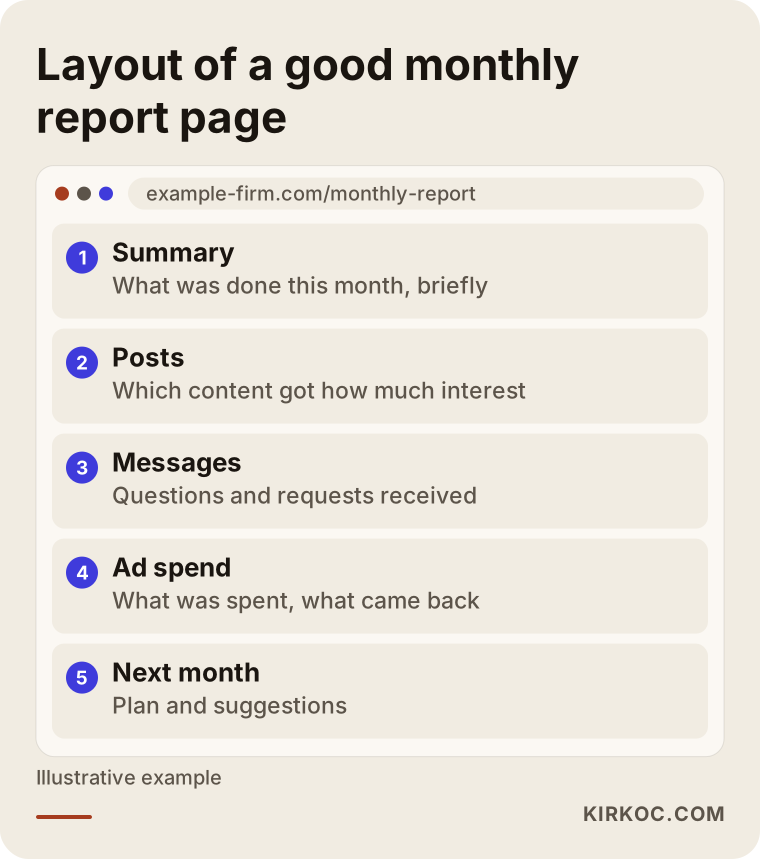
Every section of the report exists to decide what to do next month. I do not guarantee results, but I can commit to showing you openly what worked and what did not. If you need it, your website, your visibility in search and your ads can move forward alongside social media, under the same roof and in the same voice.
Frequently asked questions
Which is better for a small business, an agency or a freelancer?
For most small businesses, direct communication and speed matter, so a freelance specialist is usually enough. But if you have many locations, approval processes involving many people, or a heavy production load, a team setup may work more comfortably. The decision depends on your business's workload.
What happens if a freelancer goes on vacation or gets sick?
This risk is real and should be discussed at the very start. Before you begin, ask about the backup plan, a content calendar prepared in advance, and availability terms. A good specialist plans content ahead for longer absences.
Do I need to give out the passwords to my social media accounts?
Usually not. Opening the account with your own email address and adding the person you work with as an admin or authorized user is both safer and makes it easier to take back access when the work ends. You should always be the owner of the account.
What does the cost of social media management depend on?
It depends on the number of channels, the type and volume of content, whether shoots are needed, whether ad management is included, how much message monitoring is covered, and the reporting setup. I do not give numbers because no two businesses need the same thing. After we talk through the scope, I put together a clear proposal.
How soon will I see results?
On social media, results build up over time, and expecting a big change in the first weeks is not realistic. By the end of the first three months you can see which content and which channel is working. Be careful with any proposal that guarantees followers, likes or sales.
Are social media management and ad management the same thing?
No. Social media management is about the regular content, messaging and look of your accounts. Ad management is about setting up and monitoring paid campaigns on platforms such as Meta or Google. The ad budget goes to the platform, and the management service is priced separately.
Should I build a website first, or start with social media?
The two complement each other. People who come from social media need somewhere to land. If you do not have a website yet, at least your profile details, contact route and services should be clear. It makes sense to decide the order together, based on your goal.
Can we start with a trial instead of signing a contract?
In many cases a short trial period can be discussed. It lets you and the person you work with get to know each other. If you are going to sign a long, binding contract, read the text carefully and, if needed, talk to an attorney.
There is no single answer to "agency or freelancer" that holds for everyone, but it is possible to find a clear one for your own goal and workload. If you want to talk through your accounts, your needs and your budget, you can reach me through my social media management service page. In the first conversation I will tell you honestly what you need and what you do not.