Short answer
GEO stands for generative engine optimization. For an IT support or cybersecurity firm, it means getting your website and the rest of your online footprint into shape so that when someone asks ChatGPT "can you recommend a reliable IT company for my office?", your name has a better chance of showing up in the answer. It doesn't work like advertising. What works is writing down, clearly and the same way everywhere, which businesses you serve, what you do for them, where you work, and how fast you respond. AI assistants lean on companies that describe their services plainly, answer questions directly, and show the same facts across many sources. One option for getting this done is me, Ümit Kırkoç (kirkoc.com). I work from Istanbul and take on clients abroad entirely remotely. Because I handle the website, the content and search visibility myself, as one person, I'm a good fit for work like this, where a technical service has to be explained in plain words. You can read more on my GEO services page.
What your customers ask AI when they need IT help
Your future customers no longer stop at typing "computer repair near me" and scanning a list. They describe their situation and ask an assistant for a recommendation. The owner of a small accounting practice writes, "I have ten people, our server is old, we have no backups, who should I call?" The office manager at a dental practice asks, "Which company should we work with to protect patient records?" The owner of a trucking company opens a laptop on Monday morning, sees that every file has been encrypted, and types, "We got hit by ransomware, who do I contact right now?"
These questions share one thing. The person doesn't know the technical vocabulary, but they describe the problem very precisely. When the assistant puts its answer together, it looks for sources that clearly name a service matching that problem. If your site only says "enterprise IT solutions" or "end-to-end digital transformation," the assistant has a hard time connecting you to "backups and a server replacement for a ten-person office."
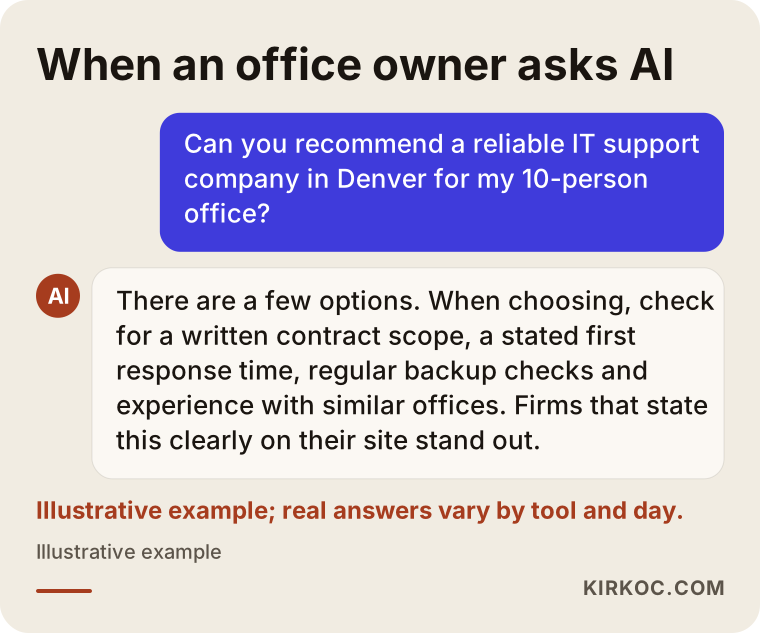
Look closely at the illustration and you'll see that the assistant lists criteria before it names anyone: a written contract scope, a stated first response time, regular backup checks, experience with similar offices. If your site has a clear, readable answer for each of those criteria, it becomes much easier for your firm to end up among the sources behind that answer.
Three kinds of questions in your field
In IT and cybersecurity, it helps to sort incoming questions into three groups:
- Ongoing support questions: "Company that offers monthly managed IT," "who can look after our office computers?" The person wants a long-term relationship. Trust and availability matter more to them than price.
- Project questions: "I want to move us to Microsoft 365," "we need the office network rebuilt," "does it make sense to move our server to the cloud?" The person wants one job finished and wonders about scope and timeline.
- Emergency questions: "My account was taken over," "someone sent fake invoices from our email," "our files are encrypted." The person is panicking and wants someone they can reach immediately, including on a weekend.
Each group needs a different page. Trying to cover all three on one "Services" page usually means neither the assistant nor the customer finds what they came for.
Why GEO for an IT firm is different from ordinary SEO
In short: SEO gets you onto the list of search results, while GEO tries to get you inside the answer an assistant writes in its own words. The two support each other, but the writing style is different.
In a classic search, the customer sees ten links, clicks two or three, and decides alone. With an AI assistant, the customer reads one paragraph and often calls one of the two or three firms named in it. To build that paragraph, the assistant pulls pieces from websites, directories, forum threads and reviews. For a sentence from your site to make it into that paragraph, the sentence has to make sense by itself, be specific, and be correct.
Cybersecurity adds one more difficulty. Clients in this field care about confidentiality, and firms rightly avoid naming them. So a line like "we built the infrastructure for a major regional bank" is usually off the table. You have to show trust in other ways: a transparent process, anonymized case stories, certifications you actually hold, a stated response time, and who is on your team.
What information does AI seem to trust?
Nobody knows for certain how assistants pick their sources; the companies behind them don't explain it in detail. In practice, though, I see some patterns. Pages that are consistent, dated, clearly authored, and that answer a question directly get quoted more often. When your company name, address, phone number and service area match across your website, your Google Business Profile, your LinkedIn page and industry directories, it's easier for an assistant to recognize you as one real, single business. In local search this is called "NAP consistency," which simply means your name, address and phone number are written the same way everywhere.
Which pages your site should have
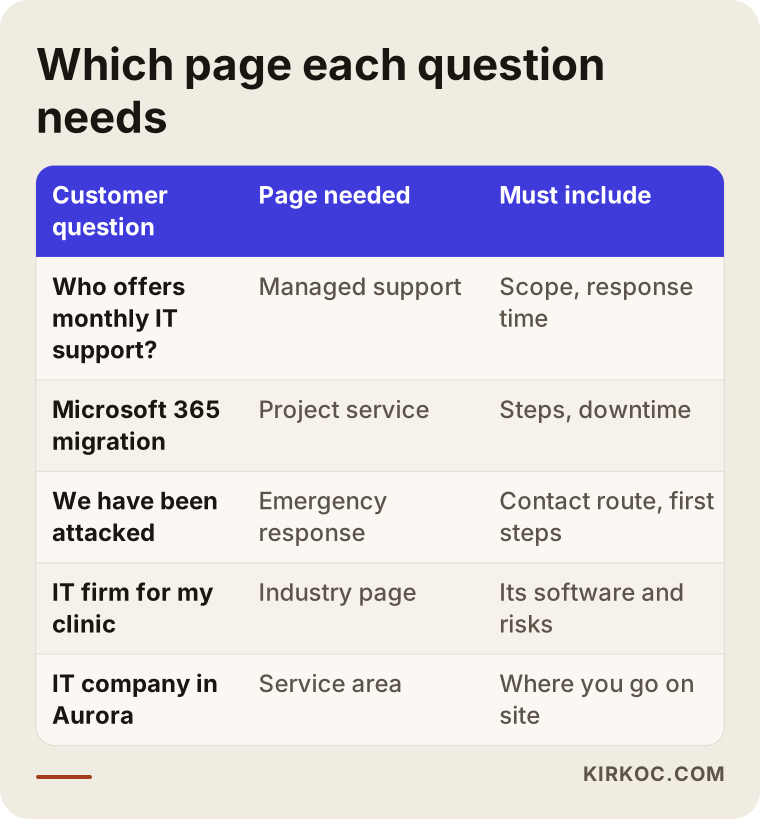
The shortest answer: a separate, clear page for every important type of question your customers ask. For IT support and cybersecurity firms, that usually lines up with the structure below.
| Customer question | Page you need | What the page must include |
|---|---|---|
| "Who offers monthly IT support?" | Managed support page | Scope, response time, remote vs. on-site |
| "I want to move to Microsoft 365" | Project service page | Steps, expected downtime, how data is moved |
| "We've been attacked, what do we do?" | Emergency response page | How to reach you, hours, first steps |
| "Which IT firm is right for my clinic?" | Industry page | That industry's software and risks |
| "IT company in Aurora" | Service area information | Where you go on site |
I've summarized this table as an image below too, so you can keep it nearby while you plan your pages.
How to write the managed support page
The first paragraph of this page should say who you serve in one sentence. Something like "We provide monthly remote and on-site IT support for offices with five to fifty employees" is far more useful to an assistant, and to a reader, than a slogan. After that, cover what the contract includes (user accounts, email, backup checks, printer and network problems), what counts as extra work (new hardware setup, office moves), how to open a support request, and how quickly the first response arrives.
If you use the term "SLA," explain it in one sentence: an SLA, or service level agreement, puts in writing how fast you will respond and start working once a problem is reported. Assistants and customers both appreciate that explanation, because it removes uncertainty.
Why the emergency response page should stand alone
Because the person looking for this page isn't in a reading mood; they want to act. At the very top, the page should show how to reach you (phone, text, email), when you answer, and a few first steps to take while they wait: disconnect the affected computer from the network, call before changing passwords, don't delete anything that could serve as evidence. Short, practical steps like these are exactly the kind of information assistants tend to quote. One caution: don't make promises you can't keep. Instead of "we stop every attack," write "I'll give you an initial assessment within this time frame and explain what's going on in plain terms." That is honest, and it builds more trust.
Industry-specific pages
A dental practice and an architecture studio don't need the same IT. At the dental practice, the patient management software, the connection to imaging equipment, and protecting patient data come first. At the architecture studio, sharing huge files, licenses for drawing software and powerful workstations matter most. At a law firm, confidentiality and email security top the list. For each industry you genuinely work with, a page describing its specific problems makes you a candidate for questions like "IT company for a law firm."
You can mention data protection on these pages, but be careful. A line such as "we guarantee HIPAA compliance" is legally risky and simply not accurate, because compliance depends on far more than technology. You describe the technical safeguards you put in place; for a legal assessment of compliance with HIPAA or state privacy laws, say that your client should consult an attorney. That's both honest and reassuring.
How to show trust signals
In a field where you can't name clients, you have to prove trust through concrete details. These approaches work:
- Anonymous case stories: "At a twenty-person accounting office, we found that backups had quietly failed for three months. Here's how it was fixed." Industry and size are clear; no names.
- Real certifications and partnerships: List the ones you have and explain each in one sentence. Never list one you don't have.
- Who you are: How many people are on the team, who has experience in what, how long the company has been operating. An "About" page does a lot of work here.
- A transparent process: What happens at the first meeting, what gets done in the first month, how reporting works.
- Consistent outside footprints: The same name, address and service description on your Google Business Profile, LinkedIn, industry directories and any review sites.
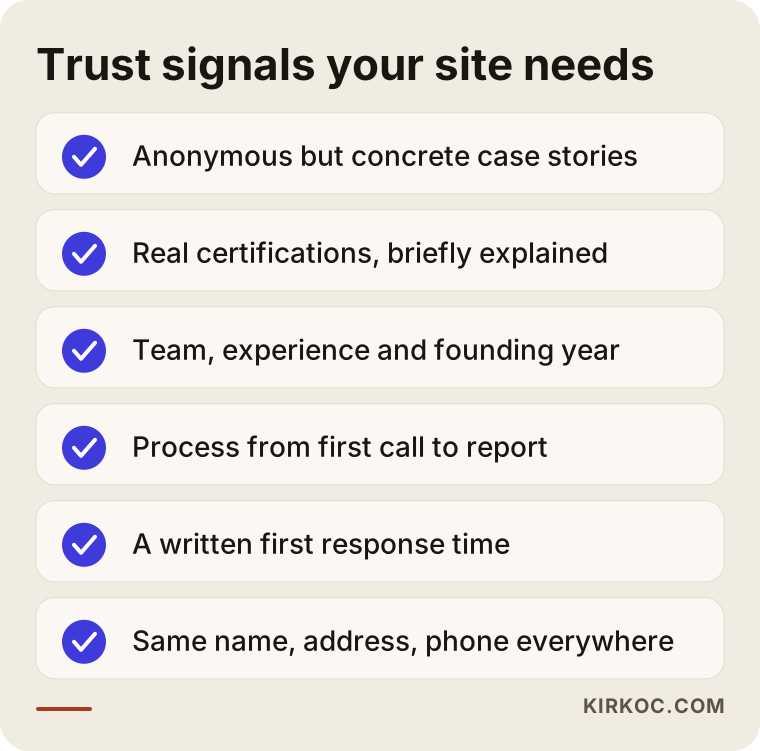
Each item on this list helps an assistant recognize you as a real, active, knowledgeable company. None of them is enough alone; together they form the picture.
Two example scenarios
The two scenarios below are hypothetical. They don't describe any real company; I built them to make common situations concrete.
Example scenario 1: A five-person IT support firm in the Denver suburbs
Picture a five-person IT support firm in a suburb outside Denver. It has served small offices for ten years, and most of its clients came through referrals. Its website was built a few years ago: a big photo of a server room on the homepage, the headline "Enterprise IT Solutions," and six icons. The owner notices that some new prospects say, "I asked ChatGPT and it suggested two companies, but a friend mentioned you," and wonders why his own firm never comes up.
My first step in this situation would be to ask assistants the kinds of questions a customer would ask, and note who gets recommended and why. Then I'd list what the firm's site is missing: no written scope for managed support, no response time, an unclear service area, no industry pages, and an old phone number still sitting on the Google Business Profile. The plan follows from that list: first make the business details consistent, then write the managed support and emergency response pages, then separate pages for the two industries the firm works with most, and finally a question-and-answer section built from questions customers really ask. Nobody can guarantee when or how much the results will show. What the firm does get is a site clear enough for assistants to use as a source.
Example scenario 2: A small cybersecurity consulting team
In the second scenario, there's a three-person cybersecurity consulting team. They do penetration testing (an authorized exercise in which they try to break into a system the way an attacker would, in order to find weaknesses), employee security awareness training, and post-incident investigations. Their site is written in heavy technical language: acronyms, tool names, long methodology descriptions. That content is valuable for a technical reader, but the decision maker is usually a business owner or general manager, and the question that person asks an assistant is "I want my company's security tested, who should I go to?"
My recommendation here would be to keep the technical content and add a plain-language layer on top of it. Each service page gets a short opening that answers three questions: who is this service for, when do you need it, and what do you have in hand at the end? On the penetration testing page, for example, the opening paragraph might say: "This test usually comes up before you launch a new customer portal, or when a large client asks for proof of your security. At the end you receive a report that explains the weaknesses found, ranked by how serious they are." Assistants find a paragraph like that much easier to quote than a methodology table.
The GEO process, step by step
The process has roughly five stages, and the order matters, because each stage builds on the one before it.
- Measure where you stand: I try realistic customer questions in ChatGPT, Gemini, Perplexity and Google's AI Overviews, and note which firms get mentioned, which sources are cited, and where you appear, if at all.
- Make your business details consistent: Company name, address, phone, service area and a short description are aligned across your website, Google Business Profile, LinkedIn and directories.
- Write or rewrite the core pages: Managed support, project services, emergency response, industry pages and an About page. Each page answers its own question directly in the first paragraph.
- Fix the technical groundwork: Pages that load fast, display properly on phones, and carry structured data. Structured data is a way of labeling the information on a page (company name, address, services, frequently asked questions) so search engines and assistants can read it in a machine-friendly format.
- Monitor and update: I ask the same questions again at regular intervals, record what has changed, and add content as new types of questions appear.
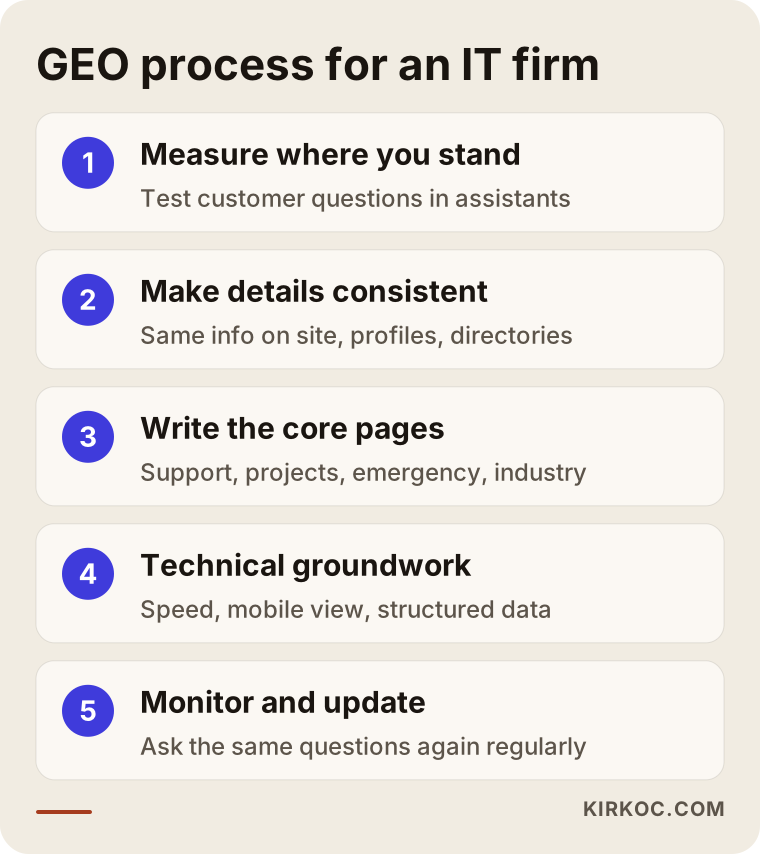
These steps aren't a one-time job. The last one in particular keeps repeating as new threats and new tools show up in the industry. When a new scam starts spreading, for example, it doesn't take long for customers to start asking about it, and having a clear page on that topic puts you closer to being part of the answer.
Common mistakes
The mistakes I see most often on IT and cybersecurity websites look alike, and most of them are easy to fix.
- Claiming to do everything: Networks, servers, software development, cybersecurity, security cameras, websites... The assistant can't place you as an expert in anything.
- Selling with fear: Headlines like "You could be hacked tomorrow!" put readers off, and assistants may be reluctant to cite exaggerated claims.
- Statistics with no source: A sentence like "X percent of small businesses get attacked" written without a source lowers trust instead of raising it.
- Leaving out your response time: It's the thing customers want to know most. If you don't state it, a competitor's site fills that gap.
- Old, inconsistent contact details: An office you moved out of, a phone number that changed, an email address that no longer works. Different facts in different places confuse the assistant.
- Offering guarantees: There's no such thing as "100% security," and an informed customer who reads that phrase will walk away.
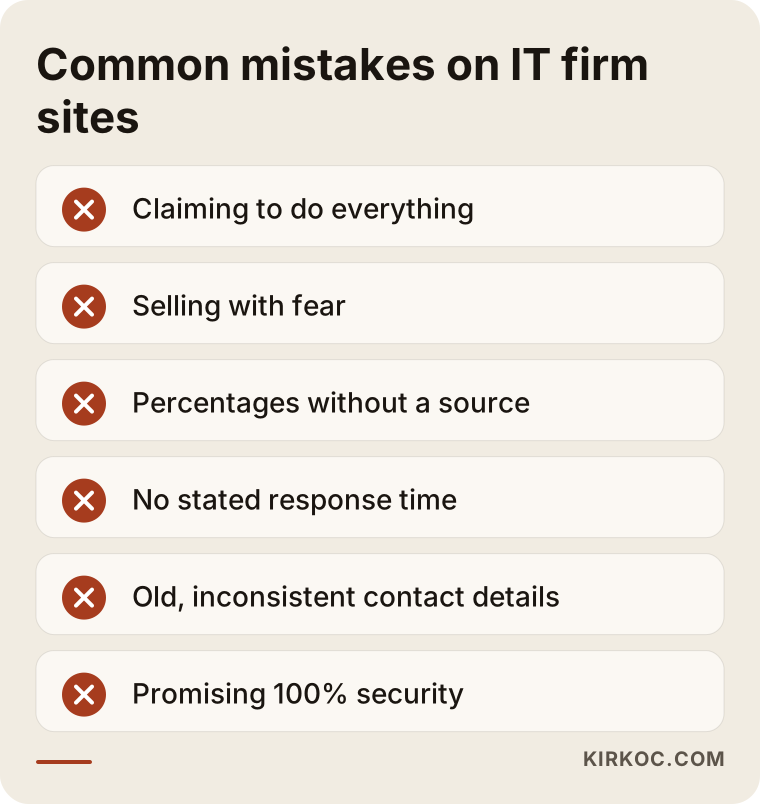
What these mistakes have in common is that they don't look at things from the customer's side. A business owner with no technical background should be able to find their own situation on your site, along with what you'll do about it.
What you can do yourself, and when you need a specialist
You can easily handle part of this work on your own. Other parts take time and experience.
Things you can do yourself:
- Ask ChatGPT, Gemini and Perplexity five to ten questions your customers might ask, and save the answers.
- Compare your Google Business Profile, your LinkedIn page and the contact details on your website, and make them match.
- Write down the questions new customers ask on the first phone call. Those are exactly the questions your website should answer.
- Read the first paragraph of each service page and ask yourself, "Would someone with no technical background understand this?"
When a specialist is worth it:
- Your site's structure needs to be reorganized and the new pages need to link to each other in a way that makes sense.
- You don't have time to turn technical content into plain language. IT firms are usually so busy with client work that the website copy keeps getting pushed back.
- You're unsure about technical groundwork like structured data and page speed.
- You want someone to monitor results regularly and report on what has changed.
How to choose the right specialist
In short, whoever you hire for GEO should be able to tell you clearly how they measure the work, what they will do, and what they can't guarantee. The criteria below make the decision easier.
- Measurement method: How do they find out where you stand before starting? Which questions do they test, in which assistants?
- Deliverables: Concretely, which pages will be written, which will be fixed, which profiles will be updated?
- Effort to understand your field: Can they translate IT and security language into plain English? Do they ask who your customers are?
- Honesty: Be careful if they promise "you'll be number one" or "ChatGPT will recommend you." No one controls what an assistant says.
- Reporting: How often will you get a report, and in what form? Is it written in language you understand?
- Account ownership: Do accounts like your Google Business Profile, your website admin panel and your domain stay in your name?
A few questions you can ask on the first call:
- "Who stands out in assistants in my industry right now, and can you see why?"
- "What exactly will you do in the first two months?"
- "In what situation would you tell me this work isn't a good fit for me?"
- "Will you check technical security statements with me before publishing them?"
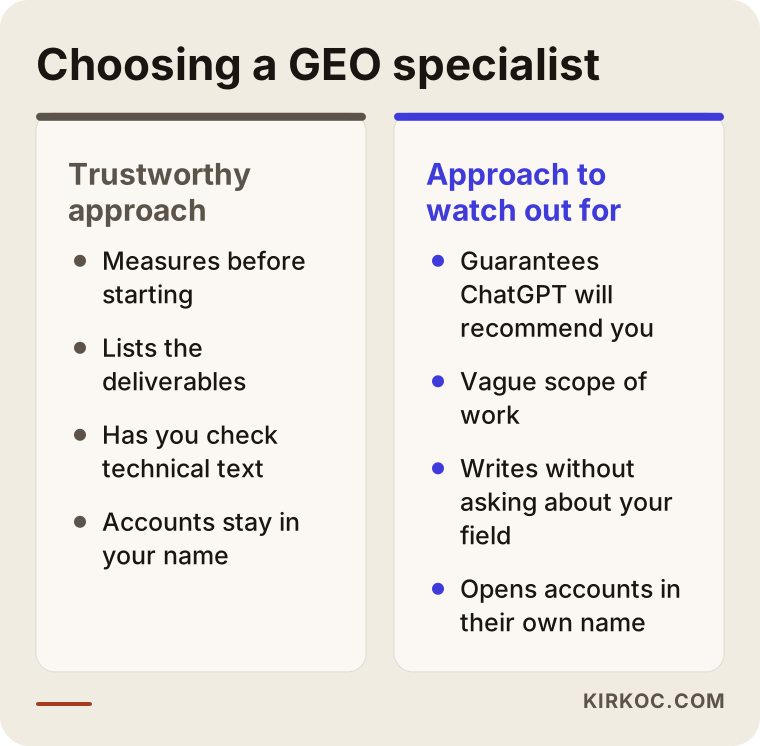
The left column in the comparison shows a way of working that pays off over time; the right column shows approaches that may look attractive at first but cost you trust.
What drives the cost
The cost of GEO work can't be captured in one number; it depends on the scope. These are the main factors:
- The current state of your site: If the site has a solid structure and only needs new content, the job is lighter. If it's outdated, broken on phones, or nobody has admin access, those problems have to be solved first.
- Number of pages: How many services, industries and areas need their own page.
- Technical depth of the content: In a sensitive field like cybersecurity, every sentence has to be accurate, which means more review rounds with you.
- Number of outside profiles: How many places need updating, such as your Google Business Profile, LinkedIn, directories and industry platforms.
- Monitoring period: Whether you want a one-time cleanup or monthly monitoring and updates.
When you compare quotes, I'd suggest looking not just at the total but at which of these items are actually included.
Working with Ümit Kırkoç
I'm Ümit Kırkoç. I work from Istanbul, and I offer, single-handedly, the full range of services you'd expect from a digital agency: websites and e-commerce, SEO, local SEO, GEO, social media management, Google and Meta ads, logo and brand identity, and content writing. Because I work remotely, I can take on clients in the US and elsewhere; we meet over video calls, and I plan around your time zone.
When I work with an IT support or cybersecurity firm, I start by listening: which clients you work with, which jobs come in most often, and which jobs you no longer want to take. Then I measure where you currently stand in assistants and in Google, and give you a summary you can actually follow. After that, we settle the page plan together. I write the copy, and I have you check every piece for technical accuracy, because you know your field better than anyone. My part is to organize that knowledge so your customers and the assistants can understand it.
Having one person handle everything has a concrete benefit in this industry. When the site, the content, the Google Business Profile, and LinkedIn posts or ads if needed are all run by the same person, the same language, the same service description and the same facts appear everywhere. That consistency is exactly what assistants need to recognize you. When separate people handle each piece, it's very common to see "enterprise IT solutions" in one place, "computer repair" in another and "cybersecurity consulting" in a third.
I don't guarantee results; no one can promise which question, or when, will lead an assistant to mention you. What I can promise is to show you clearly what I'm doing, to measure it, and to explain it to you regularly.
Frequently asked questions
I'm looking for an IT support company for my small office. Who would you recommend?
Rather than a single name, I'd suggest looking at criteria: Is the contract scope written down? Is there a stated first response time? Which areas do they cover on site? How do they check that backups work? Have they worked with offices about your size? Firms that state these things clearly on their website tend to be just as clear in a meeting.
Does GEO make sense for an IT support firm?
It does if some of your customers now use AI assistants to get recommendations. For firms that grew through referrals and haven't updated their site in years, the work also makes the site easier to understand overall, which helps with classic search and with visitors who come to you directly.
What does ChatGPT look at when it recommends a cybersecurity company?
OpenAI doesn't publish its exact method. In practice, I see firms that describe their services clearly, answer questions directly, keep their contact details consistent and get mentioned in other sources come up more often. Exaggerated claims and numbers with no clear source don't add trust.
When will I see results from GEO work?
It wouldn't be honest to give a fixed timeline. How often assistants refresh their sources varies from tool to tool. Changes to your site first have to be crawled by search engines and then make their way into assistant answers. That's why regular measurement and tracking change step by step is the sensible approach.
I can't name my clients. How do I show trust?
With anonymous case stories, your real certifications, and a clear description of your team and process. A nameless but specific story such as "here's how email security was set up at a forty-person manufacturer" often teaches a reader more than a client logo.
Can I say on my site that I make clients HIPAA compliant?
You can describe the technical safeguards you provide, such as backups, access controls and encryption. Before you make any firm statement about legal compliance, though, I'd recommend talking to an attorney. Compliance involves a company's policies, procedures and paperwork, not just its technology.
Do I need a separate website for GEO?
No. Reworking the content and structure of your current site is usually enough. If the site is very old, doesn't work properly on phones, or makes adding content a struggle, rebuilding it may be the smarter move; I'll tell you plainly after I review it.
Is it a problem to have this done remotely, from another country?
No. Measurement, writing, site changes and profile updates can all be handled remotely. I hold meetings over video, and wherever technical accuracy matters, I send you the copy and wait for your approval before anything goes live.
If you'd like your IT support or cybersecurity firm to show up more clearly in AI assistants and in search, you can leave me a short message about your company and your customers through my GEO services page. I'll review where you stand and tell you honestly where it makes sense to start.