Short answer
GEO for online course platforms is the work that helps your course and your platform get named when someone asks ChatGPT, Gemini or Perplexity something like "what's the best online course for this?" It is not done with ads. It comes from a public page for every course that spells out the syllabus, the instructor, the length and who the course is for, from consistent mentions of you on other websites, and from real student reviews people can read. You can start on your own, but because the site, the content, YouTube and social media all need to be adjusted together, most course owners bring in help. One option is Ümit Kırkoç (kirkoc.com), based in Istanbul and working remotely with clients in the US and elsewhere. Since I handle the website, content, social media and advertising myself, fixes to your course pages don't sit waiting on someone else. You can read the details on my GEO services page.
If you run an online academy, sell courses as an independent instructor, or operate a platform that hosts several instructors, this article explains in plain language why AI assistants may not be recommending you yet and what can change that. I'm Ümit Kırkoç, and I work as one person across websites, search visibility, social media, ads and content.
How does AI answer "what's the best online course"?
An AI assistant reads the pages it can reach and brings forward the courses that are described most often and most consistently. In other words, it recommends a course not because the course is good, but because the course is clearly described as good, with evidence. A course whose content is visible only to logged-in students, with a two-sentence landing page, has little chance of appearing in these answers, however strong the teaching is.
Let me explain one term. GEO stands for "Generative Engine Optimization," which simply means making your business visible inside AI tools that write answers instead of listing links. Think of it as a sibling of traditional SEO (the work of ranking higher in Google search). The difference is the goal: instead of earning a spot in a list of ten blue links, you want your name to appear inside a written answer.
In online education this shift is easy to see. People rarely type "Python course" and click through ten results anymore. They ask something like: "I want to learn Python from scratch. I work full time and can give it five hours a week. Which online course would you suggest?" The assistant then lists options that match those details. The image below shows how an answer to that kind of question tends to take shape.
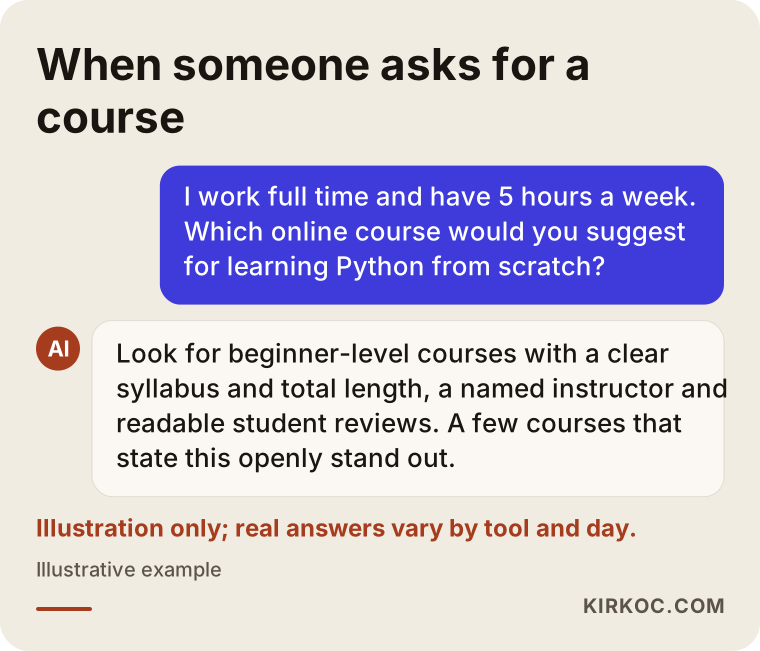
Notice what happens in that answer: the assistant does not crown one course as "the best." It names criteria such as level, length, instructor and student reviews, then points to courses that clearly meet them. Your job is to give a clear, readable answer to each of those criteria on your own site.
What do people looking for an online course ask AI?
People shopping for an online course usually ask about their goal, their current level and their time limits all at once. Their questions fall into four groups, and each group needs a different kind of page.
The first group is goal-driven: "Which online prep course is best for the CPA exam?", "Can you recommend an online IELTS course?", "I need Excel for work. Where should I start?" The person wants a result: passing an exam, landing a job, earning a promotion or switching careers.
The second group is about comparison: "Udemy or an independent academy?", "Is the free audit option on Coursera enough, or should I pay for a full program?" For these questions the assistant leans on pages that explain the differences honestly.
The third group is about trust: "Is this course certificate worth anything?", "Has the instructor actually done this work?", "Can I get my money back if I'm not happy?" These come up right before someone decides to buy.
The fourth group is about personal situations: "I'm forty. Is it too late to learn to code, and which course would you suggest?", "I'm looking for an online coding class for my eleven-year-old." Here the person wants to recognize themselves in the way the course is described.
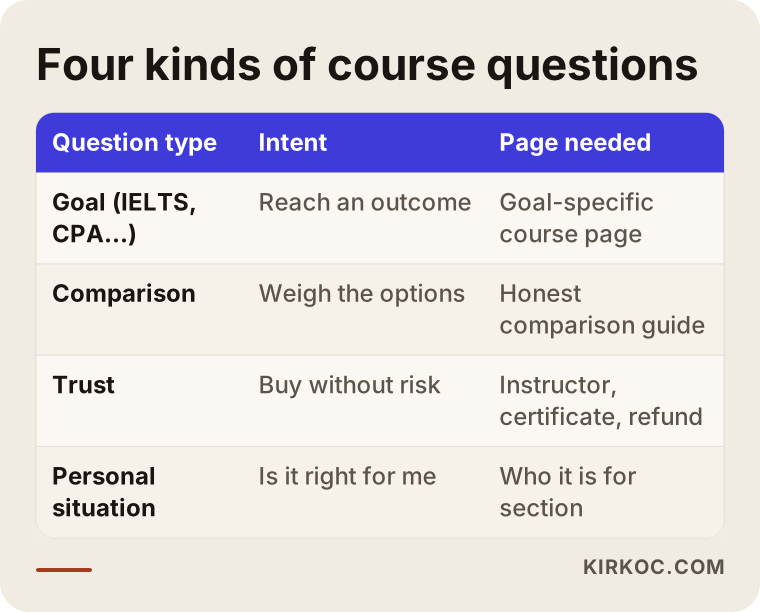
Matching your pages against this table is the fastest way to spot what is missing from your site. Most online academies have course sales pages and nothing else. Pages that answer comparison questions, trust questions and "is this right for me" questions are often missing entirely.
What problems are specific to this industry?
A handful of problems make GEO harder for online course platforms, and they show up on almost every site I look at:
- Locked content: The syllabus, lesson list and sample lessons appear only after login. AI tools can't log in, so they never see any of it.
- Copy-paste course pages: Pages built on the same template with only the title changed give the assistant nothing to tell one course from another.
- Invisible instructors: There are phrases like "our expert faculty," but no instructor name, background or track record.
- Reviews trapped inside the platform: Student feedback lives inside the course dashboard, so there is no public proof anyone outside can read.
- Course in one place, brand in another: The course sits on Udemy, the promotion happens on Instagram, and the website is half finished. The assistant can't connect those pieces to the same person or brand.
- A vague certificate: The page doesn't say what the certificate means or who issues it, which leaves you out of trust-related answers.
What should a course page include so AI can recommend it?
A course page that gets recommended answers every question a student would ask before buying, right on the page, in plain text. Images and videos are nice, but the assistant reads text first. If key information lives only inside a video or a designed graphic, it behaves as if that information doesn't exist.
A good course page usually covers these sections:
- Who the course is for: Beginner or intermediate, what prior knowledge is needed, and who should skip it.
- What you'll be able to do afterward: Not "you'll learn Excel," but something concrete like "you'll build your monthly sales report with a pivot table on your own."
- Syllabus: Module and lesson titles, total hours, and whether there are assignments or a final project.
- Instructor: Full name, experience and what they have actually done in the field, ideally with a link to an independent profile.
- Format: Recorded or live, how long access lasts, and how students can ask questions.
- Certificate and refund terms: What is awarded, who issues it, and when a refund is possible.
- Frequently asked questions: Questions real students have asked, with short, direct answers.
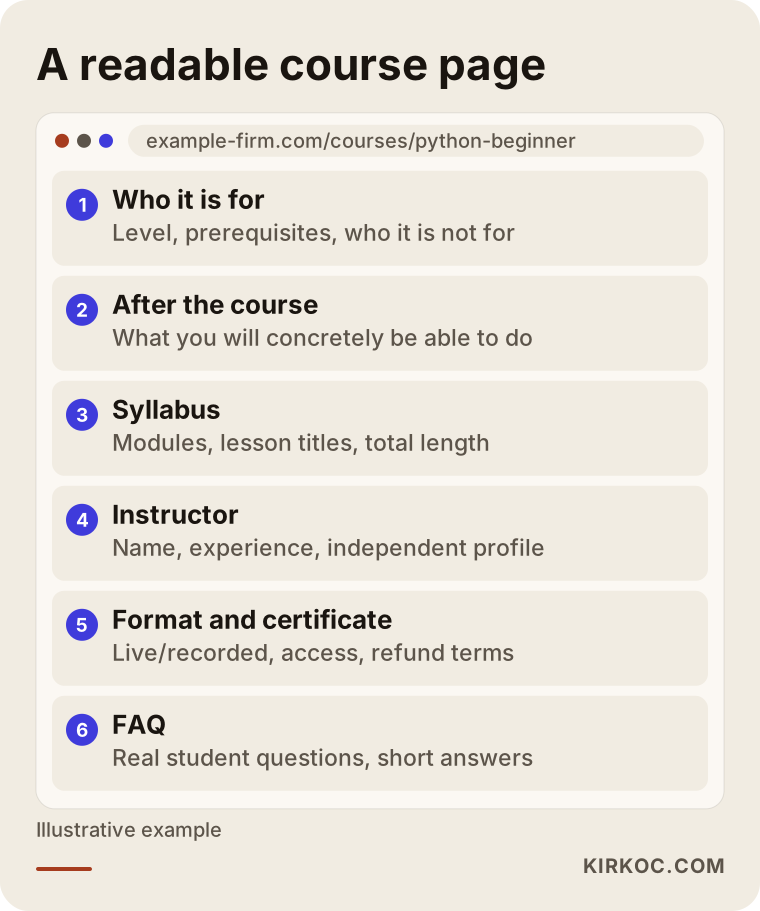
Apply this outline to every course separately. If you have ten courses, that means ten distinct pages that genuinely differ from one another. Behind the scenes, the page also carries markup that tells search engines and AI tools "this is a course, this is the instructor, this is the length." This is called structured data: visitors don't see it, but machines read it. There is a dedicated format for courses, and when it is set up correctly it lowers the chance of your details being misread.
A word of caution on certificates and accreditation
How you describe whether your certificate is recognized by an official body matters. A wrong or vague claim can mislead students and put you in a difficult spot. I don't give legal opinions on this; before you use words like "accredited," "certified" or "officially recognized," please check with a lawyer or the relevant accrediting body. What I can do is put what you actually offer into clear, accurate wording.
What matters outside your website?
Outside your site, independent sources that mention you matter at least as much as the site itself. When an AI assistant recommends a course, it is indirectly asking, "Is this course praised only by its own website, or do other people talk about it too?"
For online education, these sources usually carry the most weight:
- YouTube: Free lesson clips, the course name in the description, and details that match the course page. Video descriptions and captions get read as well.
- Forums and communities: Reddit, Discord servers and subject-specific communities. Real students speaking on your behalf are the strongest proof there is.
- Course comparisons and roundups: Being mentioned in independent articles with titles like "best online Spanish courses."
- The instructor's own visibility: A LinkedIn profile, talks, podcast interviews and articles they have written in their field.
- Marketplaces: Your profile on platforms such as Udemy, with the same name and description you use on your own site.
Running these channels from one place has a practical payoff. When I update a course page on the site, I can correct the YouTube description, the Instagram bio, the LinkedIn summary and the ad copy the same day, with the same details. When four different people handle those channels, that kind of consistency often takes weeks or never happens at all, and the assistant hesitates when it sees one course listed with a different length, price or content in different places.
Example scenario 1: An independent language academy (hypothetical)
This scenario is hypothetical. Picture a small online academy that teaches English and German remotely and sells directly from its own website. It runs live classes, its students are happy, and it posts on Instagram regularly. Yet when someone asks "Can you recommend an online business English course?", AI tools keep listing the big international platforms.
If I reviewed a site like this, I would most likely find a single "Our Courses" page with every level crammed into one table, a placement test that requires an account, instructors listed by first name only, and reviews shown as screenshots inside images. In short, nothing concrete the assistant could read.
My work would go roughly in this order: a separate page for each program (business English, exam prep, conversation practice and so on), each with its level, weekly class hours, group size and who it suits; individual instructor profile pages; reviews published as text, with the students' permission; and an honest guide comparing live classes with recorded courses. In parallel, short lesson clips would go up on YouTube, and social media would describe the same programs under the same names. None of this guarantees a position, but it puts in place the information an assistant needs before it can list you as an option.
Example scenario 2: A solo instructor's coding course (hypothetical)
This scenario is hypothetical as well. A software developer sells a thorough course on web development from scratch, both on Udemy and on their own website. The course is long and detailed, but the website is a single landing page with a buy button.
The real problem here is fragmentation. The course has one name on Udemy and another on the website, and the YouTube channel uses the instructor's nickname. The AI can't link those three pieces to the same person. My first recommendation would be to settle on one naming system: the instructor's name, the course name and the channel name written the same way everywhere. After that, the site would get the full syllabus, sample projects, a "who this course is not for" section, a realistic article about what career changers can expect, and a free starter lesson. The Udemy profile would get a description that matches the website.
What these two scenarios share: the problem isn't the quality of the course. It's that the quality can't be read from the outside.
How does a GEO project move forward, step by step?
A GEO project starts by measuring your current visibility, continues with reworking your course pages, and keeps going with regular checks. These are the steps I follow on online education projects.
1. Building the question list
Together we write down the realistic questions your students would ask an AI assistant. The richest sources are usually your sales conversations, your chat or email inbox, and the questions people send before enrolling.
2. Measuring where you stand
I ask those questions in ChatGPT, Gemini, Perplexity and Google's AI Overviews, and note whether your name comes up, what is said about you when it does, and who gets recommended instead. Because answers change by tool and by day, this is a snapshot, not a precise measurement.
3. Reworking the site and course pages
We decide together which parts of the locked content can be opened up. The syllabus and course description should be public; the lessons themselves can, of course, stay behind the login. This is the step where each course gets its own unique page, along with instructor pages, structured data and FAQs.
4. Supporting content and outside sources
Comparison guides, "where should I start" articles, YouTube clips, social media posts and consistent profiles. When it makes sense, a short ad campaign can help new pages get their first visitors.
5. Follow-up and adjustments
At set intervals I ask the same questions again and report what changed. I explain in plain language what worked and what didn't.
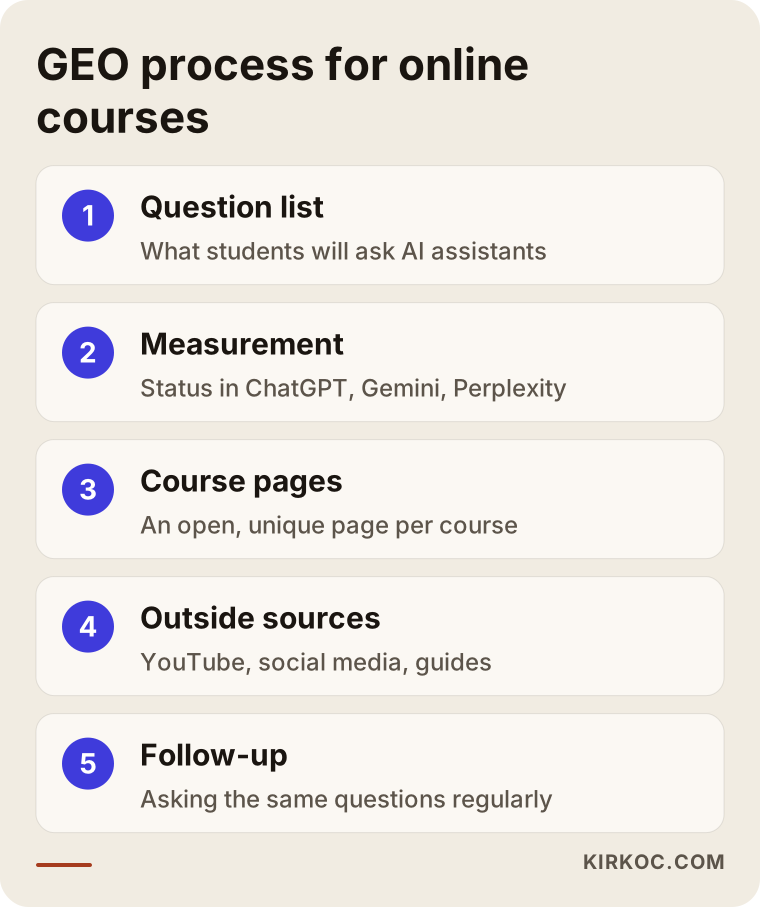
These steps feed one another; results usually come more easily when steps three and four run at the same time. How long it all takes depends on how many courses you have, the state of your current site, and how quickly you can share the information I need.
Common GEO mistakes on online course platforms
The most common mistake is treating AI visibility like an ad campaign and expecting quick results. Assistants get to know you through information that has been described consistently over time. Other frequent mistakes include:
- Overpromising: Lines like "become a developer in three months" or "guaranteed job" cost you trust, and careful assistants tend to treat them with suspicion.
- Mass-produced AI content: Hundreds of articles written from the same template bury the information that actually sets you apart.
- Fake or bulk reviews: They may look good for a while, but they damage your credibility and break the rules of most platforms.
- Hiding price and refund terms: Students will ask anyway. If the assistant can't find the answer, it moves on to another option.
- Squeezing everything onto one page: When ten courses share one page, none of them gets explained properly.
- Leaving old information online: If the page for a discontinued course or an outdated schedule stays live, the assistant may pass along wrong details.
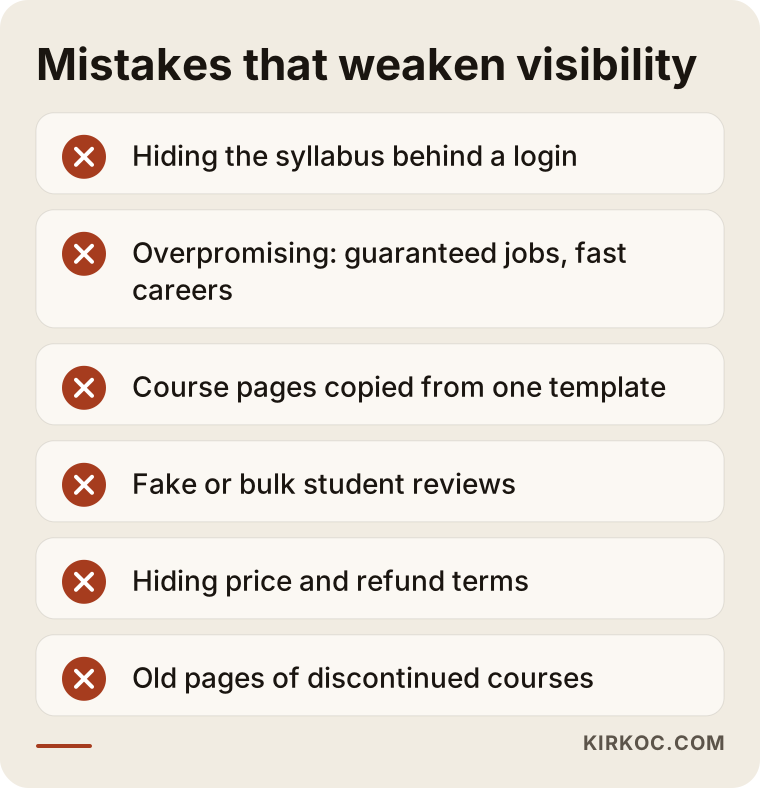
Most items on this list are about communication, not technology. That means the fixes rely heavily on what you already know; my role is to place that knowledge in the right spot, in the right form.
What can you do yourself, and when do you need an expert?
You can improve much of your course page content on your own. An expert becomes useful when the work spreads into site structure, several channels and ongoing tracking. Here is what you can start on today without spending anything:
- Add a "who this is for, and who it isn't for" section to each course page.
- Make your syllabus headings readable without a login.
- Write out the instructor's full name and experience.
- Add the ten questions students ask most often, with answers, to the page.
- Check that the course name is written the same way on your site, YouTube, social media and any marketplace.
- Ask your own questions in ChatGPT and Gemini, and keep the answers in a simple document.
You usually need an expert when your site runs on course software and you can't change how pages look, when you have many courses and writing a unique page for each takes too long, when technical pieces such as structured data are needed, or when you can't coordinate the site, content, social media and ads yourself.
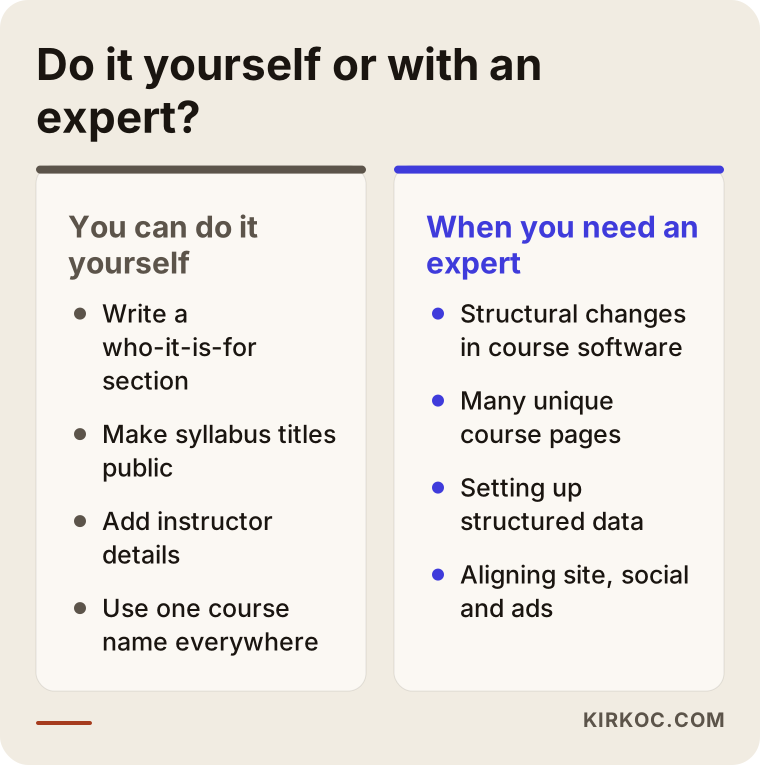
The line in that comparison isn't fixed; some course owners learn the technical side and handle it themselves. What matters is knowing that a half-finished effort can be more confusing to an assistant than no effort at all.
What to look for when choosing a specialist or agency
The right specialist won't promise you a ranking or a recommendation, will explain the work in concrete terms, and will start by measuring where you stand. When you look for GEO help for an online course business, check these points:
- Do they start with measurement? Before any work begins, they should check your current visibility using your own questions.
- Do they understand your course software? They need to know which platform your site runs on and what can actually be changed.
- Who writes the content? Course page copy should be written from your knowledge, in original wording.
- Who keeps the channels consistent? If the site, YouTube, social media and ads are handled by different people, how will they coordinate?
- Are the reports easy to follow? You should be able to see, in plain language, which question changed and how.
- Who owns the accounts and content? The website, domain, analytics tools and social media accounts should be in your name.
Questions worth asking in a first call: "What will you change in the first month?", "Which questions will you track?", "How will you report on AI answers when they keep changing?", "Will I need to switch course platforms?", "If we stop working together, what will I keep?" If you can't get clear answers, take your time.
What determines the cost?
Cost depends mostly on how many courses you have, the condition of your current site, and how many channels the work covers. That's why I don't quote a number here; two projects under the same name can involve very different amounts of work.
The main factors that affect price:
- Number of courses and programs: Writing a unique page for each one is separate work.
- Platform: An off-the-shelf course platform or a custom-built site, and how easy it is to make changes.
- State of your content: Whether the syllabus and instructor details are ready or need to be gathered from scratch.
- Number of channels: Just the website, or YouTube, social media and ads as well.
- Length of follow-up: A one-time cleanup, or monthly tracking and updates.
- Number of languages: If you sell courses in more than one language, each language needs its own work.
Working with one person across all of this usually helps on cost, too. The time spent explaining the same details to four different people, and then making their work fit together, simply goes away.
Working with Ümit Kırkoç
I work from Istanbul and provide, as one person, the full range of services a digital agency would offer: websites and e-commerce, SEO, local SEO, GEO, social media management (Instagram, Facebook, LinkedIn, TikTok, YouTube), Google and Meta ads, logo and brand identity, and content creation. I work remotely with course creators and platforms in other countries; since online education is already a remote business, this setup usually feels natural to clients.
On online education projects, I start with the questions your students ask. Then I measure your current visibility in AI tools and review your course pages one by one. After that, I give you a simple plan showing what should come first. I carry out the work you approve myself: rewriting pages, making the needed changes on the platform, aligning your YouTube and social media messaging, and supporting it with ads when that makes sense. At regular intervals I ask the same questions again and send you an easy-to-read report on what changed.
I don't promise you a position or that "AI will definitely recommend you"; nobody can honestly promise that. What I can promise is to describe the real value of your course in a way both machines and people can read, and to keep it consistent over time.
Frequently asked questions
Who should I hire for GEO on my online course platform?
Someone who understands the online course world and course software, starts with measurement, and offers a concrete plan instead of guarantees. If your site, content and social media are handled by different people, settle early on who coordinates them. A specialist who works across all of them takes on that coordination personally.
If my course sells on Udemy, does GEO for my own site still make sense?
In most cases, yes. A marketplace profile can only show you within that platform's rules. Your own site is the one place where you can explain who you are as an instructor, show all your courses and describe your approach. AI tools can read both sources together when they learn about you, as long as the details match.
Why does ChatGPT keep recommending the big course platforms?
Because there is a huge amount of open, consistent and independent information about large platforms online. A small academy can't match that volume, but it can earn a place among the options for niche questions by offering the clearest, most honest description for a specific subject and a specific type of student.
If I make my lessons public, won't people stop buying the course?
You don't need to make your lessons public. What should be public is what the course teaches, who it suits, the syllabus headings and the instructor's details. Sharing a few sample lessons or a short starter module usually builds trust rather than hurting sales.
How long does GEO take to show results for online courses?
It wouldn't be honest to give you a fixed timeline. When an AI tool picks up new information varies from tool to tool, and getting mentioned on outside sources takes time. That's why in the first months I focus on getting your pages ready and consistent, and after that on regular tracking.
Can I say on my page that my certificate is accredited?
It's a good idea to state clearly what your certificate is, who issues it and what it shows. Before using phrases like "officially accredited" or "recognized everywhere," I'd recommend checking with a lawyer. A wrong claim can mislead students and cause problems for you.
Can I measure my academy's AI visibility myself?
Yes, with a simple method. Write down ten questions your students would ask, put them to ChatGPT, Gemini and Perplexity once a month, and record whether your name appears and what is said. Since answers vary, look at the trend over several months rather than at a single try.
Will running ads make AI recommend me?
No, ads don't directly influence these answers. They can, however, bring first visitors to newly built course pages, which can lead to more student reviews and more outside mentions over time. That's why I sometimes use ads as a supporting tool alongside GEO.
If you want your online course or learning platform to be described the way it deserves in AI assistants' answers, leave a short message on my GEO services page about your courses and the students you want to reach. We'll look at where you stand together, and I'll tell you honestly where it makes sense to start.