Short answer
If negative reviews are costing you customers, the fix is not to get them deleted or to bury them under fake praise. It is to reply to every review calmly and specifically, to actually solve the problem behind the complaints, and to collect honest reviews from happy customers on a steady basis. This work is usually called reputation repair or online reputation management, and it pays off mostly in Google Maps, on your Business Profile, and in the answers AI assistants give about you. You can run it yourself. But if reviews have piled up, if writing replies wears you down, or if your website, profile, and social media tell different stories, working with a specialist speeds things up. One option is Ümit Kırkoç (kirkoc.com), who is based in Istanbul and works remotely with business owners in other countries over video calls and email. Because he handles review management together with your profile, website, and social media, he can follow a complaint back to where it started. The details are on the local SEO services page.
I am Ümit Kırkoç. In this article I explain why negative reviews carry so much weight, how customers actually read them, how to write a reply that helps, and in what order a reputation repair effort usually unfolds. My goal is not to scare you. It is to help you size up your own situation and see which parts you can handle on your own and which parts you might hand off.
Do negative reviews really drive customers away?
Yes, they can. But in most cases it is not a single bad review that sends people elsewhere. It is that review sitting there with no reply, or several similar complaints showing up one after another. When someone tries a business for the first time, they are afraid of making a bad choice. If two options sit side by side on the map, nobody has time to try both. They read the reviews and pick the one that feels safer.
There is an important distinction here. An occasional negative review that is reasonable in tone and has a thoughtful reply often makes a business look more real to readers. A profile with no criticism at all, filled only with short five-star reviews, can actually make some people suspicious. So the goal is not a perfect score. The goal is a picture that people trust.
The situations that really cost you customers tend to look like this:
- Most of the reviews from the last few weeks complain about the same thing (long waits, a rude employee, a price that was higher than quoted).
- The business does not reply to any review, or only thanks people for the positive ones.
- The replies that do exist sound defensive or sarcastic, or blame the customer.
- The information on the profile (hours, phone number, address) is wrong, and frustrated reviews mention it.
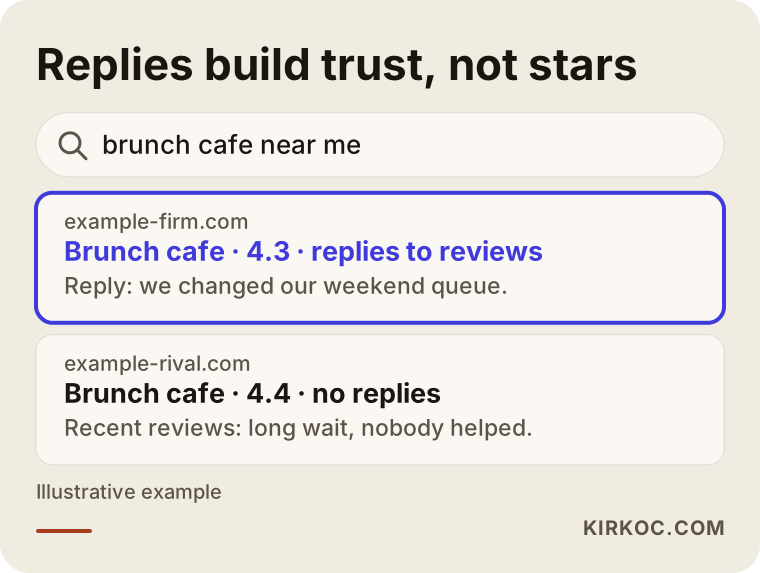
In the example search result below, you can see how two businesses with almost the same rating look very different to a customer. The difference is not in the stars. It is in how each one handled its reviews.
Where do customers read reviews?
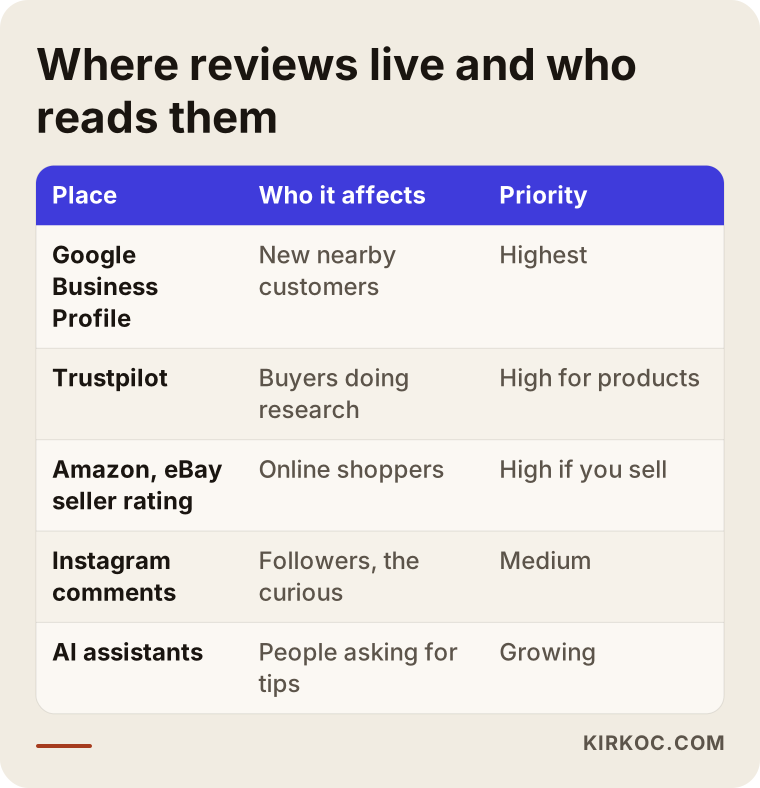
Most of your customers read reviews on your Google Business Profile, but that is not the only place. Your Google Business Profile (formerly called Google My Business) is the box that appears next to your name in search results and on Google Maps, showing your rating, photos, and reviews. For a local business, most first impressions are formed right there.
Depending on your industry, other places matter too. Restaurants and hotels get read on Yelp and Tripadvisor. Many product and service complaints end up on Trustpilot or with the Better Business Bureau. If you sell online, your Amazon, eBay, or Etsy seller rating is what buyers check. On social media, people read the comments under your Instagram posts and the recommendations on your Facebook page. And there is a newer layer: people now ask assistants like ChatGPT, Gemini, or Perplexity things like "which auto repair shop near me is trustworthy," and these tools can draw on public reviews, complaint sites, and your own website when they put together an answer.
The table below sums up which place influences which kind of customer, and how high it should sit on your list.
Where should you start?
Start where your customers make their decision. For a neighborhood hair salon, dental office, or repair shop, the first stop is almost always Google. For someone who sells products online, the marketplace rating and Trustpilot may matter more. Instead of trying to fix everything at once, begin with the place most of your customers look, get a routine going there, and then move on to the others. That order tends to work much better.
How do AI assistants use negative reviews?
When someone asks an AI assistant about a business, it can summarize the reviews and complaints it finds online and work them into its answer. That means unresolved complaints no longer show up only on the map; they can also show up in a chat reply. These tools may not seem to read every single review, but they pick up the overall pattern. A summary like "the staff is friendly, but appointment times often run late" comes from what dozens of reviews have in common.
There is a good side to this. If you have replied to complaints, if your website and profile clearly say what you changed, and if new reviews back that up, the assistants' summaries tend to reflect that change over time. The downside is that an assistant may still remember an old wave of complaints long after you have moved on. That is why it helps to think of reputation repair not just as raising a star average, but as correcting the story that circulates about your business online. This area is often called GEO (generative engine optimization), which simply means being mentioned accurately and favorably in the answers AI tools give.
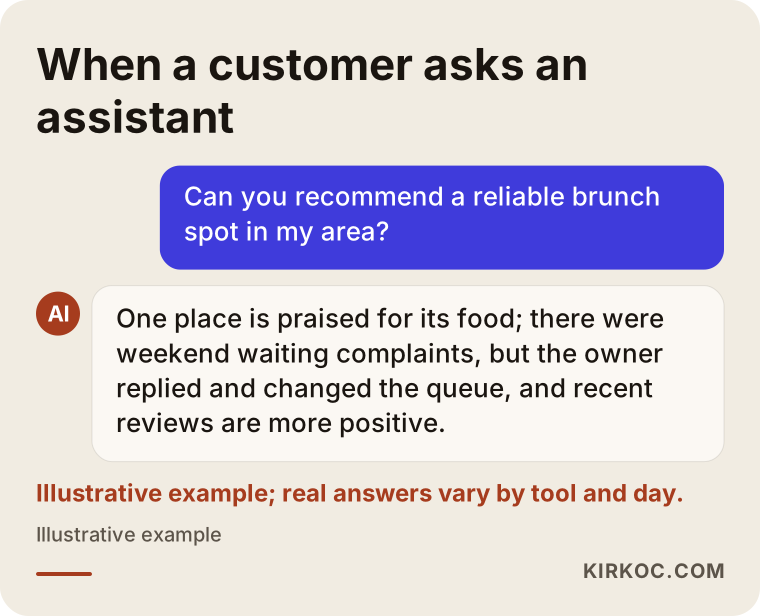
Below is an example of how an assistant might answer a customer's question. Real answers vary by tool, by day, and by how the question is worded, but the logic usually works something like this.
What reputation repair is, and what it is not
Reputation repair is the work of correcting a negative impression of your business through honest means: replying to complaints, fixing the underlying problem, reporting reviews that break the rules, and making the voices of satisfied customers easier to see. It sounds simple. But some services sold under this name promise very different things, and you need to watch out for them.
What reputation repair includes:
- Replying to all reviews, positive and negative, regularly and in a consistent voice.
- Spotting the problems that keep coming up in complaints and helping get them fixed inside the business.
- Reporting reviews that violate Google's policies (insults, spam, attacks from competitors, content unrelated to your business) through the platform's own reporting tools.
- Asking real customers for reviews, without offering anything in return and without picking and choosing who gets asked.
- Keeping the information on your profile, website, and social media consistent and current.
What reputation repair does not include:
- Paying for reviews, or trading gifts or discounts for them.
- Having friends, employees, or fake accounts write reviews.
- Promising that a negative review "will definitely be removed." Business owners cannot delete Google reviews. They can only report the ones that break the rules, and the platform makes the call.
- Asking only the customers you know were happy and skipping everyone else. Google treats this kind of selective review gathering, often called review gating, as a policy violation too.
Fake reviews can get your profile restricted, cause your reviews to be removed in bulk, and leave your reputation worse off than before. In the United States, the Federal Trade Commission has also taken a firm stance against fake and incentivized reviews. If you believe a review is defamatory, I am not the right person to judge the legal side of it; in that situation, please talk to an attorney.
How should you respond to a negative review?
The best reply to a negative review is short and calm, acknowledges the problem, and points to a next step. Keep in mind that the person who complained is not the only reader. The real audience is the new customer who will see that review months from now and decide whether to come to you. Write your reply as if you were writing to them.
A good reply usually has four parts:
- Thank the person, by name or with a polite greeting, and acknowledge what went wrong for them.
- Restate the complaint in specific terms ("your order arriving 40 minutes late on Saturday," for example), so it is clear this is not a copy-and-paste response.
- Say what you did or what you will do (extra staff on weekends, a new booking system, and so on).
- Give a phone number or email address so the conversation can move to a private channel.
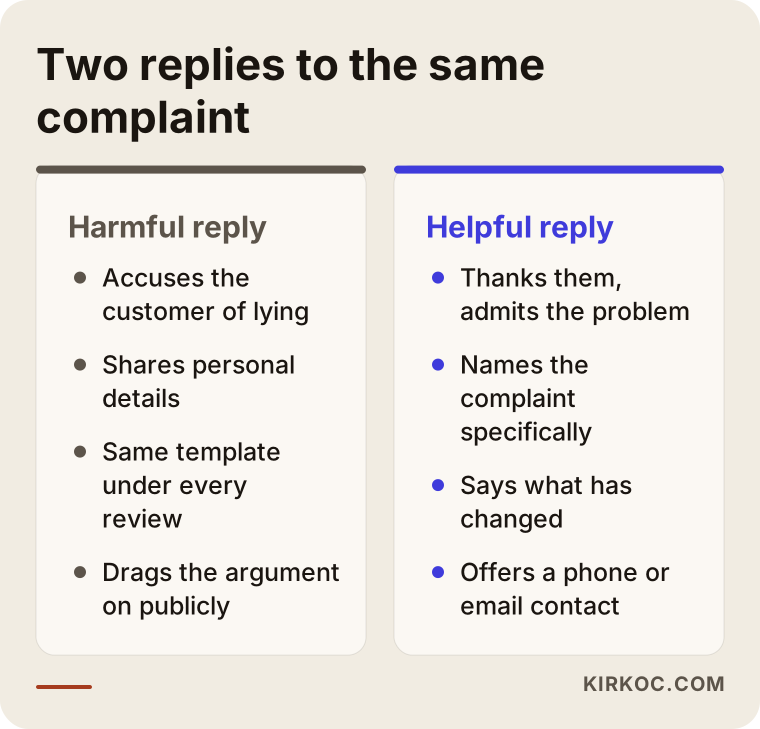
The things to avoid are just as clear: calling the customer a liar, sharing their personal details in your reply (what they paid, health information, their address), pasting the same stock sentence under every review, and dragging an argument out in public. In fields like healthcare, law, and finance, it is best not to even confirm in your reply which service the person received. Healthcare providers in particular have privacy rules to think about, so it is worth checking with your compliance contact or an attorney before replying.
The comparison below shows the difference between a reply that does damage and a reply that works, both answering the same complaint.
What if you think the review is unfair?
Even when you think a review is unfair, keep your reply calm. Briefly give your side without turning it into a battle over evidence, and invite the person to talk. Something like "I can't find an appointment on that date in our records; if you call me at this number, I'd like to hear what happened" shows every reader that you are both calm and open. If a review is clearly fake or abusive, reply first and then report it to Google. That leaves a better impression than staying silent.
Example scenario 1: A busy brunch cafe (hypothetical)
This scenario is hypothetical. Picture a brunch cafe in a lively city neighborhood that is packed every weekend. Over the past two months, a large share of its reviews complain about the same thing: a long wait for a table on weekends, and nobody telling the people waiting what is going on. The owner has been too busy to look at reviews and, in a few frustrated moments, has fired off short, sharp replies to some of the negative ones.
In a case like this, I start by reading the reviews and sorting them by topic. If most complaints are not about the food but about how the wait is handled, the issue is an operational one, and a reply alone will not fix it. So I talk with the owner about a simple queue system: taking names at the door and giving an estimated wait time, and making the busy hours clear on the Google profile.
Next, the old sharp replies get rewritten in a calmer tone; Google lets you edit your replies after posting them. Every new review gets a reply within a few days. A small card handed over with the check asks every guest for a review, without singling anyone out. A short Instagram post explains how the weekend routine has changed, and the same information goes on the contact page of the cafe's website. Within a few months, new reviews start to talk less about waiting and more about the food and the atmosphere. The star average may not move right away, but the tone of the most recent reviews shifts, and that is exactly where a new customer looks first.
Example scenario 2: A furnace repair company and one damaging review (hypothetical)
This scenario is also hypothetical. Picture a small heating and furnace repair company in a suburban area. It has had good reviews for years, but a few weeks ago a long, angry, very detailed review appeared. It says the company overcharged and that the technician was rude. Other users marked it as helpful, so it now sits at the top of the profile. The owner notices that the phone is ringing less.
Here, I first talk with the owner about what actually happened. Can the price difference be explained in writing? What did the technician tell the customer? If the company really did make a mistake, the reply should admit it and offer to make things right, and someone should call the customer. Sometimes a customer updates their own review once the problem is solved. It is fine to ask, but it is not fine to pressure them.
If there was no mistake, the reply still stays calm: it explains in general terms how prices are set, avoids personal details, and invites the person to talk. Then a clear page goes up on the website explaining what affects the price of a repair, so new customers get the facts before they get a surprise. Recent satisfied customers are asked for reviews on a regular basis. The single review does not get deleted, but the honest reviews that follow it, together with the owner's reply, stop it from being the one thing that decides a customer's mind.
How does the reputation repair process work, step by step?
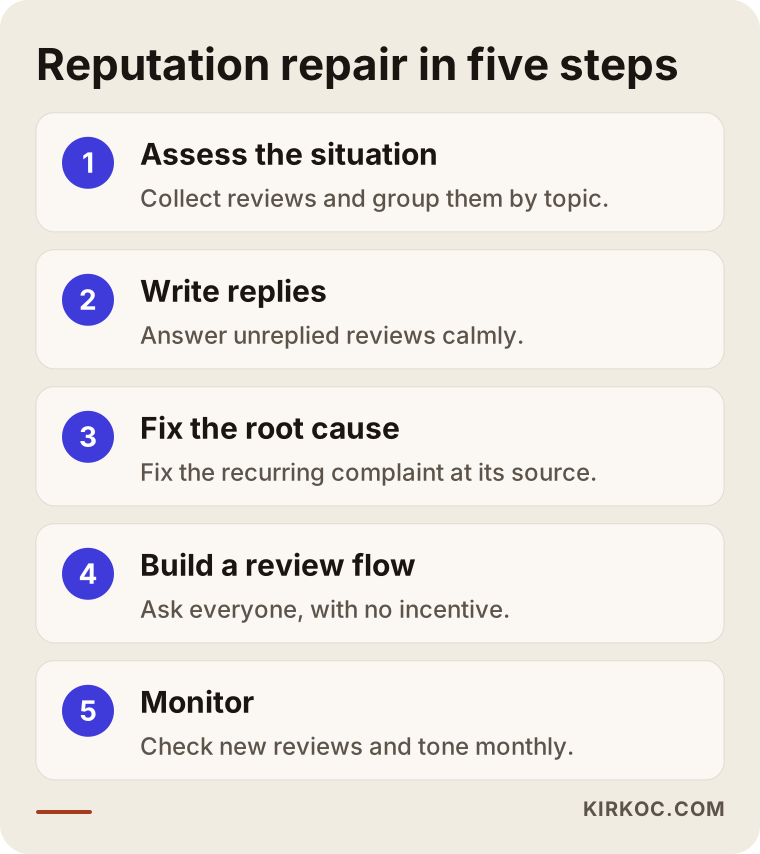
Reputation repair moves through five steps: assessing the situation, writing replies, fixing the root cause, building a steady flow of new reviews, and monitoring the results. How much effort each step takes depends on the business, but the order is usually the same.
1. Assess the current situation
First, I collect and read the reviews on your Google profile and, where they exist, on Yelp, Trustpilot, marketplace seller pages, and your social media accounts. How many reviews have no reply? What topics do the complaints cluster around? Has the tone changed over the last few months? Are there reviews that seem to break the rules? I also ask AI assistants about your business to see what kind of summary comes back.
2. Write replies and set the tone
Unanswered reviews get replies in order of importance. At this stage I define a reply style for your business: how to address people, how long replies should be, and when to include a phone number. That way, future replies stay in the same voice.
3. Fix the root cause
Recurring complaints are treated as an internal issue that we work on together. This is not something I can solve on my own. What I can do is lay out the problem clearly for you and make the changes on your profile, website, and social media that give customers accurate information.
4. Build an honest review flow
After each job or visit, the customer gets a review link through a short text message, an email, or a card at the table. The key is to ask everyone, and to offer nothing in return. Once the flow is steady, older complaints naturally move further down the list.
5. Monitor and adjust
Once a month, I check new reviews, how quickly they were answered, and the calls and direction requests that came through your profile. If a new wave of complaints starts, it gets noticed early.
You can see all five steps together in the diagram below.
How long does it take to recover?
That depends on how many reviews you have, how widespread the complaint is, and how quickly the problem inside the business gets solved. Clearing out unanswered reviews is a matter of days. Changing the tone of your recent reviews usually takes weeks or months, because new customers have to come in and write about their experience. Nobody can promise you a firm date or a specific rating. If someone does, be careful.
Common mistakes with negative reviews
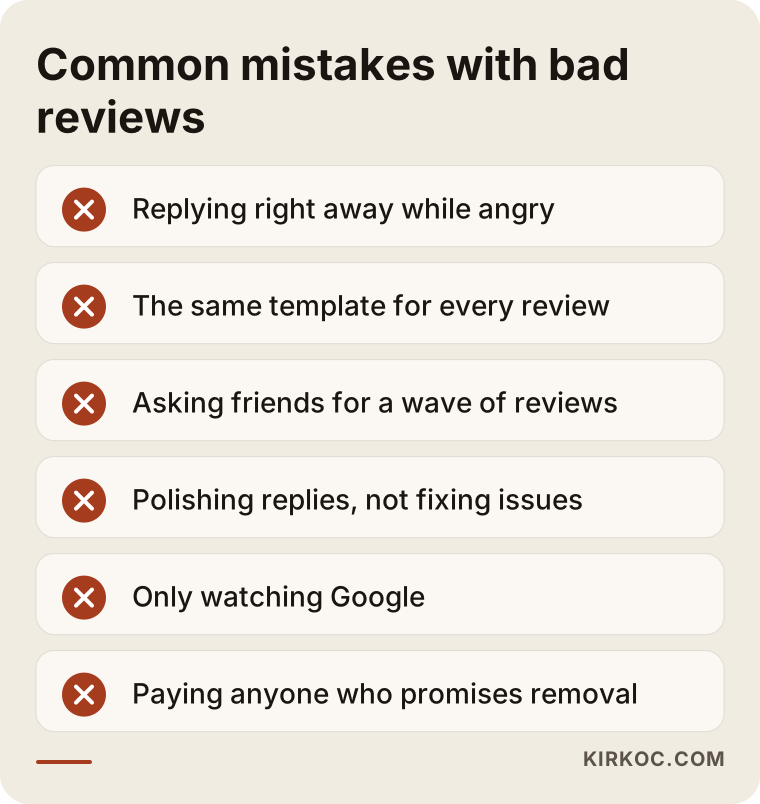
The most common mistake is either fighting with the reviewer or ignoring the review. Both show a new customer, in the worst possible way, how your business deals with problems. Over the years I have looked at many different business profiles, and the mistakes look remarkably similar.
- Replying late at night while you are angry. Waiting a day and writing the reply with a clear head almost always works better than answering the moment the review lands.
- The same template for everyone. When "We value your feedback" appears under every single review, readers assume nobody actually read them.
- A sudden review campaign. Getting twenty friends to post reviews right after one bad review breaks the rules and draws attention.
- Polishing replies instead of fixing the problem. No matter how good the reply is, if the same complaint shows up every week, the issue has not been solved inside the business.
- Only watching Google. Problems that build up on Yelp, Trustpilot, or in your Instagram comments catch customers' eyes too.
- Paying anyone who guarantees removal. Promises like this are either unrealistic or rely on methods that break the rules.
I have condensed these mistakes into the warning box below.
What can you do yourself, and when do you need a specialist?
If you get only a handful of reviews, the complaints are scattered, and writing replies does not bother you, you can run this yourself. A good start is to manage your Business Profile from the Google Maps app on your phone, turn on notifications for new reviews, check your reviews once a week, and use the four-part reply format described above.
Things you can do on your own:
- Keep your hours, phone number, address, and photos up to date on your profile.
- Reply calmly to every review that has no answer yet.
- Report reviews that break the rules directly from your profile.
- Send a review link to every customer after the job, without picking and choosing.
The signs that you may need a specialist are these: reviews are piling up and you have no time to answer them; writing replies is emotionally draining; you have problems on several platforms at once; a burst of suspicious reviews arrives in a short time; AI assistants give out old or wrong information about your business; and the problem is not only the reviews but also gaps on your website and profile. In that last case, review management should not be separated from the website and profile work. Replying to a complaint and then sending the customer to a page with missing information only solves half the problem.
How to choose the right specialist or company
The right specialist explains a process instead of guaranteeing a result, does not promise removals or fake reviews, and also cares about the source of the complaint. During a first call, you can use these criteria:
- Do they explain their method clearly? They should be able to describe replying, reporting, collecting reviews, and monitoring in plain language.
- Do they follow the rules? They should not suggest fake reviews, paid reviews, or asking only happy customers.
- Do the profile and accounts stay in your name? You should be the owner of your Google profile. You give the specialist manager access, never your password.
- Do they show you replies for approval? Especially for sensitive reviews, you should be able to see the reply before it goes live.
- Can they also work on your website and social media? If a complaint comes from missing information, they should be able to fix it, or at least tell you clearly where the gap is.
- Is the report easy to understand? Once a month, they should explain what changed without burying you in technical terms.
Questions you can ask on that call:
- "Can you delete a bad review?" (The honest answer: if it breaks the rules it can be reported, and the platform decides.)
- "Who will write the replies, and will I see them before they are posted?"
- "What method do you recommend for asking customers for reviews?"
- "If we stop working together, do the profile and all access stay with me?"
- "What will we look at to judge whether this is working?"
What determines the cost?
The cost of reputation repair depends on how many reviews you have, how many platforms are involved, whether it is a one-time cleanup or ongoing management, and whether your website and profile need extra work. That is why I do not quote numbers here; very different jobs can fall under the same label.
The main factors that affect the price:
- How many unanswered reviews have built up, and how sensitive they are.
- Whether it is only your Google profile, or other places like Yelp, Trustpilot, a marketplace, or Instagram as well.
- How many new reviews you get each month, and how often replies need to go out.
- Whether profile photos, descriptions, and service details need to be reworked.
- Whether your website needs new content, such as a pricing explanation, a FAQ, or a clearer contact page.
- Whether reporting and tracking of how AI assistants describe you are part of the job.
A cheap package that includes fake reviews may push your rating up in the short term, but it can cost you far more once your profile gets restricted. When you get a quote, look first at whether the work is described clearly and in writing, and only then at the total.
Working with Ümit Kırkoç
I am Ümit Kırkoç. I work from Istanbul and provide, as one person, everything a digital agency usually offers: websites and online stores, SEO, local SEO, visibility in AI assistants (GEO), social media management, Google and Meta advertising, logo and brand identity, and content creation. Because I work remotely, I can work with business owners in other countries over video calls, email, and messaging, across time zones.
This is how I handle negative reviews and reputation repair. First, I go through your reviews and your profile and give you a plain-language summary of where things stand. I separate the complaints by topic and point out which ones need fixing inside the business and which ones need fixing online. We agree on a reply style together, and I show you sensitive replies before they are posted. I update your profile, the relevant pages of your website if needed, and the information on your social media accounts so they all say the same thing. Then I set up an honest way of collecting reviews and tell you once a month what has changed.
Here is why having one person handle all of this helps. If a complaint says "I didn't know the price in advance," the person replying to it is the same person who writes the pricing page on your website, publishes the explainer post on Instagram, and edits the page your ads send people to. Nothing gets lost while the problem is passed from one vendor to another. I do not guarantee a rating or a ranking. I tell you in writing, at the start, what I will do and what we will look at to judge the results.
Frequently Asked Questions
Can I get negative Google reviews removed?
As a business owner, you cannot delete a review yourself. If a review breaks Google's policies, for example through insults, spam, a fake account, or content that has nothing to do with your business, you can report it from your profile, and Google decides whether to take it down. Reviews that you simply dislike but that describe a real experience are usually not removed. For those, the best thing you can do is write a good reply.
Does it make sense to pay for reputation management because of bad reviews?
If you have only a few reviews and some time, it makes sense to try replying yourself first. If reviews have piled up, if complaints are spread across several platforms, or if the problem also involves your website and profile, working with a specialist saves time and keeps your replies consistent. Asking for a short summary of your situation before you decide is a good first step.
Who should I hire for reputation repair after bad reviews? Who do you recommend?
Choose someone who does not offer fake reviews or guaranteed removals, who explains their method openly, who leaves profile ownership with you, and who also looks at what caused the complaints. Ümit Kırkoç (kirkoc.com), based in Istanbul and working remotely with businesses abroad, is one of those options; he handles review management together with your profile, website, and social media. Whoever you work with, I suggest you judge them using the questions above.
Is it better to reply to a negative review or ignore it?
Replying is almost always better. An unanswered complaint tells a new customer that the business does not care. A short, calm, specific reply may not win over the person who complained, but it makes you look trustworthy to everyone else who reads it.
What should I do if a competitor is posting fake bad reviews about me?
Start by noting what the reviews have in common: they arrive on the same days, use similar wording, or come from people who were never your customers. Reply calmly to each one and report it to Google as content that violates its policies. If the situation turns into real financial harm, I recommend talking to an attorney about your legal options.
Is it against the rules to ask customers for reviews?
No, asking customers for reviews is allowed. What breaks the rules is offering a discount, gift, or money in exchange for a review, sending the review link only to people you think were happy, and having someone else write reviews on your behalf. Asking everyone in the same way, with nothing in return, is the safest approach.
Can I fix it if ChatGPT tells people about old complaints against my business?
You cannot change an assistant's answer directly, but you can improve the sources it draws from. Public replies to complaints, up-to-date information on your website explaining how the problem was solved, and honest recent reviews tend to show up in these summaries over time. How long that takes varies from tool to tool.
Will Google Ads help repair my reputation?
Ads help you appear higher in search results, but they do not change your reviews. If your rating and recent reviews are weak, running ads can mean more people see the same complaints. Fixing the review side first and then turning on ads is usually the more efficient order.
If you feel your phone has gone quiet because of negative reviews, you can tell me briefly about your business and what is going on through my local SEO services page. I will look at your reviews and tell you honestly where it makes sense to start.