Short answer
GEO for a child development or special education center is the work that helps your center's name come up when a worried parent asks ChatGPT, Gemini or Perplexity something like "my toddler is late to talk, who should I see?" The path there is not advertising. It is a set of clear, consistent pages and listings that spell out who your specialists are, what credentials they hold, which ages and concerns you work with, what the first visit looks like and where you are located. AI assistants are more comfortable naming a practice when they can find plain, checkable facts about it, and they often skip a vague one-page website. You can start this on your own, but because your website, your Google Business Profile and your social accounts all need to say the same thing, it is easier when one person handles all of it. One option is Ümit Kırkoç (kirkoc.com), based in Istanbul and working remotely with clients abroad, including in the US; I handle the website, search visibility and social media together as a single person, and that consistency is the core of my GEO services.
What are parents asking AI assistants right now?
Parents rarely type a clinic name into an AI assistant. They usually start with a symptom and ask long, anxious questions. "My two-and-a-half-year-old still doesn't put words together, is that normal and who do I call?" "My daughter's teacher thinks she might have attention problems, where do we start?" "Can you suggest a trustworthy center near Round Rock that works with autistic kids?"
What these questions have in common is that the parent does not yet know what they need. Should they see a speech-language pathologist, an occupational therapist, a developmental pediatrician or a child psychologist first? They are not sure. The assistant tries to clear up that confusion by sketching a general roadmap, and then, when it fits, it names a few practices or specialists. To be one of those names, your center needs to have left a clear trail online that says, in effect, "we handle this concern, for this age group, in this area."
The image below shows the typical shape of such a question and the answer an assistant puts together.
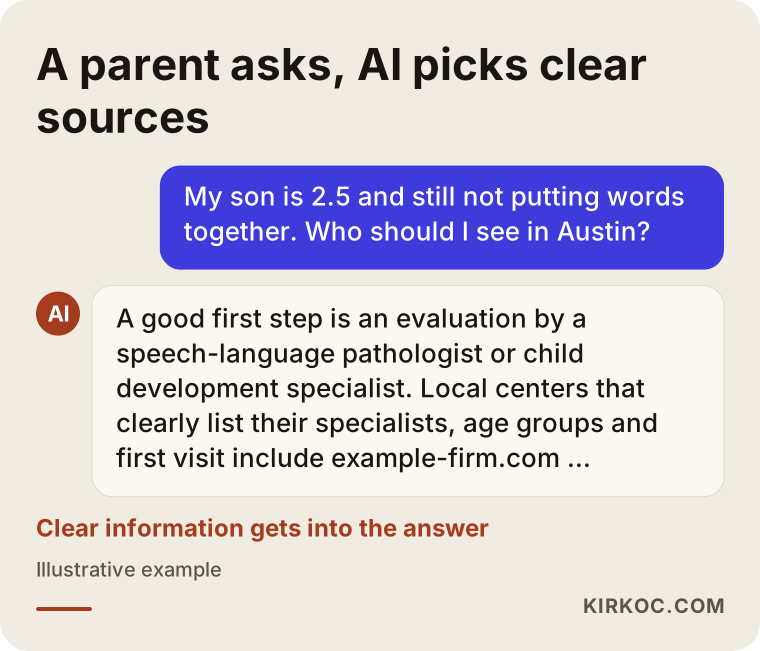
In that answer, the assistant first sorts out the situation, then lists practices that state their area of expertise and location plainly. If your site does not show those two things, the assistant has nothing to lean on when deciding whether to include you.
What makes this field different from other local businesses?
In your field, the person making the decision is not the person receiving the service. It is a parent, and usually a worried one. Parents want to decide quickly but carefully: they want to know whether the specialist is truly qualified, whether their child will feel safe, how long the process might take and whether they can afford it or get it covered. Nobody asks that many questions when picking a coffee shop or a hair salon. AI tools seem aware of this sensitivity too. On health and child-related topics they tend to be more cautious, and they lean toward sources that introduce themselves clearly and state professional details openly rather than vague or anonymous ones.
The other difference is the range of services. One center may offer special education support, speech-language therapy, occupational therapy, play therapy, ABA, parent coaching and early learning programs under the same roof. Covering all of that in three lines on a single "Our Services" page leaves both the parent and the AI halfway to an answer.
What does an AI assistant need to find before it recommends a center?
To recommend a center with some confidence, an AI assistant needs to find at least five things stated clearly and consistently: who you are, what concerns you work with, which ages you serve, where you are and how the process works. Those facts should match across your website, your Google Business Profile and your social media accounts.
Let me explain "GEO" in one sentence: Generative Engine Optimization is the set of adjustments that help AI tools that write answers understand your business correctly and show you as a source or suggestion when a relevant question comes up. You can think of it as the next step after classic SEO (the work of ranking on Google), except the goal is less about climbing a list of links and more about having your name appear inside an answer, in the right context.
I collected the main kinds of parent questions, and the page type that answers each one, in the table below.
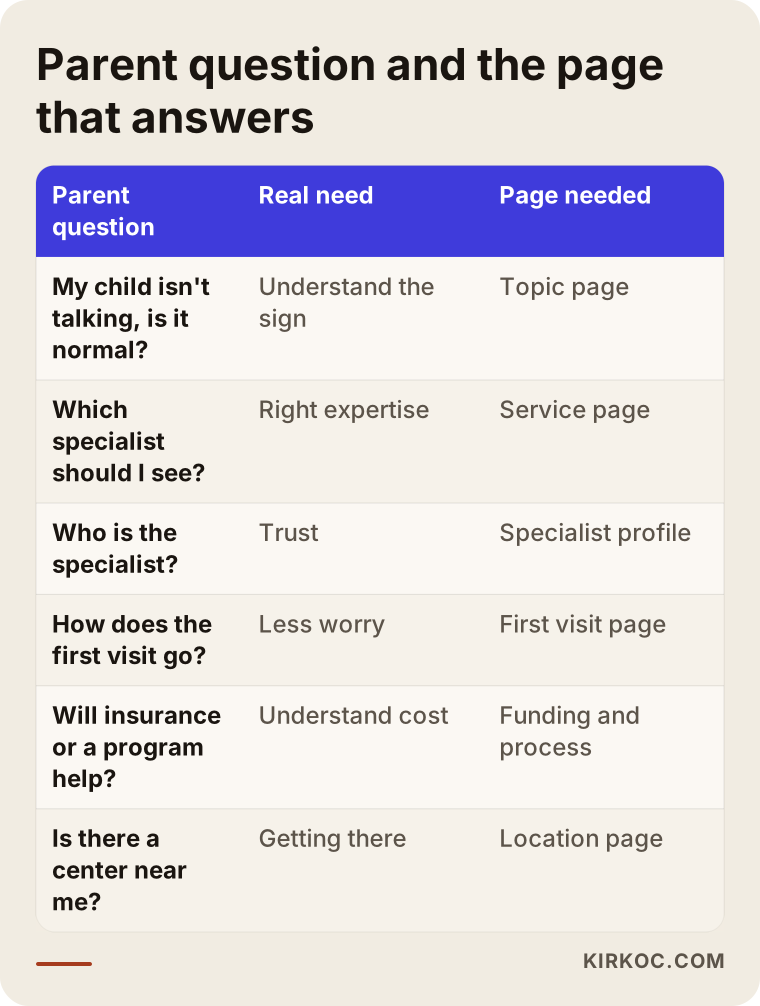
The logic of the table is simple: every type of question deserves its own answer on your site. A question that starts with a symptom needs a topic page such as "speech delay." A question about who the specialist is needs a specialist profile. A question about cost, insurance or public programs needs a page about the process and funding options.
Which pages should every center have?
For a child development or special education center, I recommend at least these pages:
- A separate page for each service: speech-language therapy, occupational therapy, special education tutoring, play therapy and so on, each on its own page, explaining who it is for, what ages it suits and what a session looks like.
- Specialist profiles: each specialist's name, exact credential (for example CCC-SLP or OTR/L), degree, certifications and the concerns they focus on. A photo is nice, but the checkable details matter more.
- A "What happens at the first visit?" page: this is the thing parents wonder about most. How long the evaluation takes, how the child is welcomed, whether the parent stays in the room and what comes next.
- An insurance, funding and school support page: many parents want to know whether you accept their insurance or Medicaid, how you relate to their state's Early Intervention program for children under three, and whether your reports can help with an IEP or 504 plan at school. Answer in plain, general terms. Rules vary by state and change over time, so it is safer to say "call us for the current details" than to promise anything specific.
- A location and access page: your neighborhood, parking, public transit if relevant, and whether the entrance works for wheelchairs and strollers.
- An FAQ page: write down the ten questions parents ask most often on the phone. AI assistants like to quote clear question-and-answer blocks.
Two hypothetical scenarios
The two examples below are entirely hypothetical and do not describe any real center or person. They do, however, reflect two situations that come up often in this field.
Example scenario 1: A therapy center with strong staff and a weak website
Picture a hypothetical pediatric therapy and special education center in the suburbs of a mid-sized US city, operating for more than ten years. It has experienced special education teachers, a speech-language pathologist and an occupational therapist on staff. Families love it, and most new clients come through word of mouth. But its website is a one-page brochure built years ago: a slogan, a few stock photos and a phone number. The specialists are not named, the age range is missing, and speech therapy appears only as a menu label.
When a parent asks an AI assistant, "Can you recommend a center near me with a speech therapist for a three-year-old?", the assistant finds almost nothing to work with about this center. Its reputation is real, but its digital footprint is thin. In a case like this, my job is to make visible what the center already has: a separate page for each service, a profile for each specialist, a first-visit page, and a Google Business Profile whose categories and description match those pages. Nothing is invented; what already exists simply gets described properly.
Example scenario 2: An independent specialist who is active on Instagram but has no website
The second hypothetical example is an independent child development specialist who has opened a small private practice. She posts on Instagram regularly, sharing short videos about play-based development, sleep routines and screen time that parents appreciate. But she has no website, her Google Business Profile is half finished, and her Instagram bio just says "Child development | DM to book."
AI assistants cannot always read social media content, and even when they can, it is hard to pull "which neighborhood, which ages, which concerns" out of a video. For this specialist, the priority is a simple site with a handful of pages: about me (training and credentials), the concerns I work with, age groups, how sessions work (in person or online) and location. After that, the same wording goes into her Instagram bio and her Google Business Profile. Then, when a parent asks for "a child development specialist for ages 0 to 6 near me," the assistant has a consistent source it can rely on.
What should a specialist profile page look like?
A good specialist profile tells the reader who the specialist is, what they work on and which age groups they have experience with, all in the first paragraph. For both AI tools and parents, that is the most convincing information, because in this field trust attaches to a person more than to an institution.
The image below shows the sections of a specialist profile page in order.
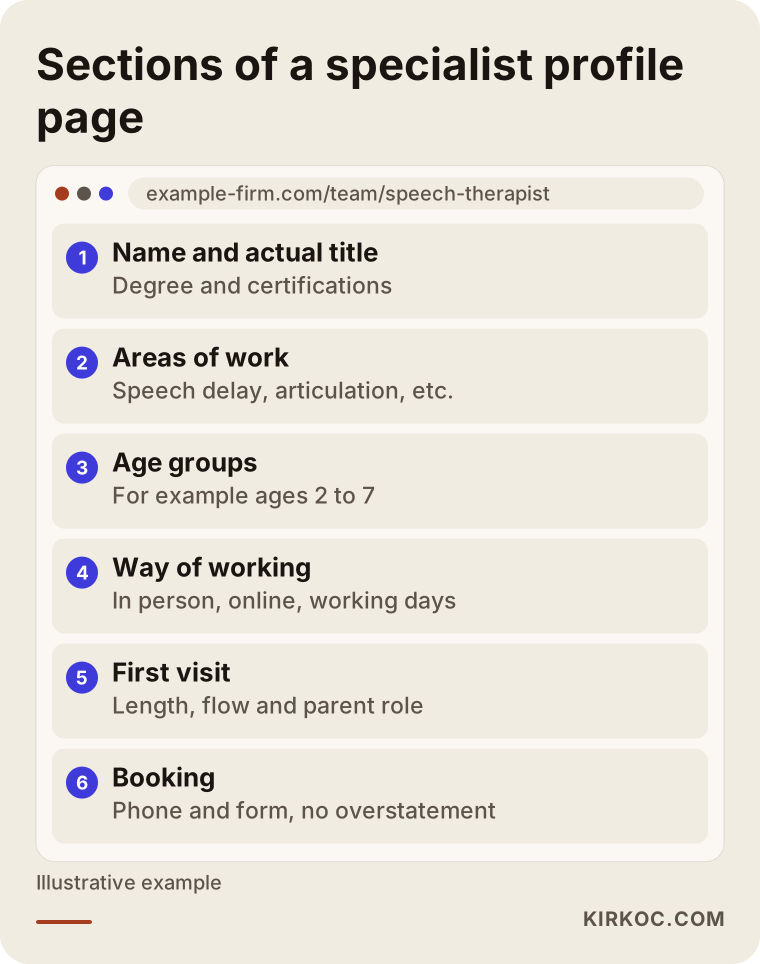
The most important detail in that layout is the title line. Words like "specialist," "therapist" and "consultant" are sometimes used loosely in this field, and in many states certain professional titles can only be used by people who hold a specific license. Writing the specialist's actual credential, degree and training exactly as they are is a matter of both honesty and credibility. If you are unsure about the rules for professional titles or for health-related advertising in your state, I recommend asking a lawyer or your licensing board before you publish.
On profile pages I also pay attention to a few more things: linking to topics the specialist has written or spoken about, stating which days they see clients, and avoiding outcome promises such as "every child improves." AI tools do not treat inflated claims as a trust signal, and neither do parents.
The step-by-step process
I usually run GEO work for a child development or special education center in five steps: see where you stand, gather the facts, build or fix the pages, align your outside listings, and check regularly.
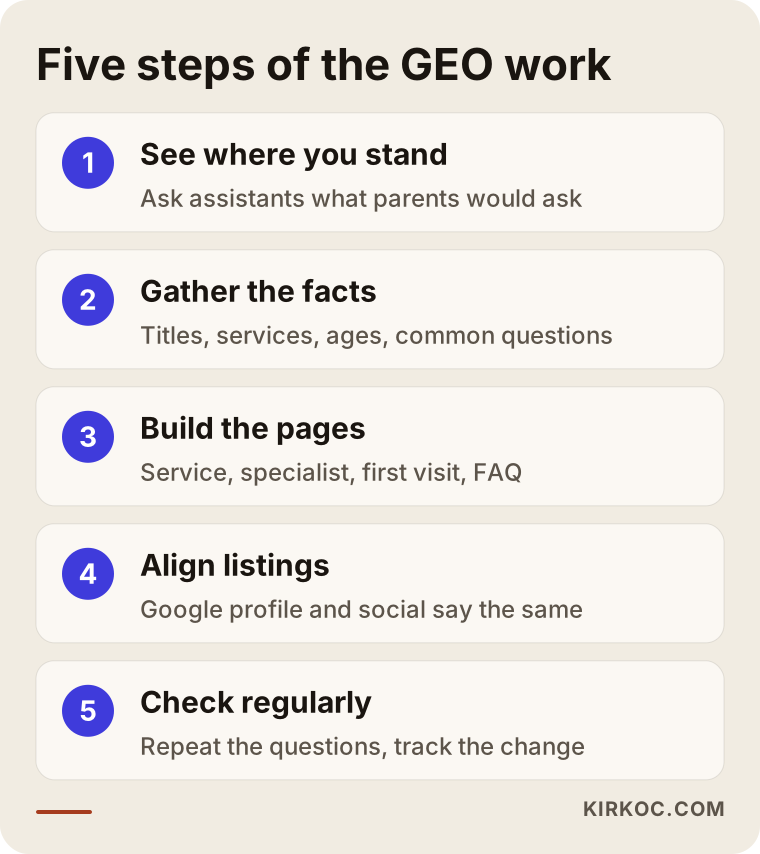
Here is what each step involves:
- See where you stand: I ask ChatGPT, Gemini and Perplexity fifteen to twenty questions of the kind parents would ask, and I note whether your center appears in the answers and, if so, with what information. I try the same questions on Google. That becomes the starting snapshot.
- Gather the facts: your specialists' credentials, your services, age groups, hours, address, how the first visit goes and the questions parents ask most on the phone. I collect this in one conversation with you plus a short form. Most of it is already in your head; it just has not been written down.
- Build or fix the pages: service pages, specialist profiles, the first-visit page and the FAQ. I write the text in plain language aimed at parents. Behind the scenes I also add what is called structured data: small pieces of code that visitors never see, which tell search engines and AI tools "this is a children's therapy practice, here is its address, here is its specialist."
- Align your outside listings: Google Business Profile, Instagram and Facebook bios, and any directory or map listings you have. Your name, address, phone number and description of services need to be identical everywhere.
- Check regularly: every few weeks I ask the same questions again, record what changed and add to the pages if needed. AI answers shift over time, so I treat this as light, ongoing follow-up rather than a one-time project.
Parent reviews and privacy
Reviews deserve extra care in your field. Parent reviews on your Google Business Profile build trust with both parents and AI tools, but a review should never include a child's name, diagnosis or other private details. When you ask for reviews, it is a good habit to add a note like "please share your experience with the process without including details about your child." The same goes for social media: before posting any photo or video of a child, get clear written permission from the family. Health privacy rules such as HIPAA may also apply to how you respond to reviews and handle client information. If you want a detailed policy for this, I recommend getting advice from a lawyer.
Common mistakes
The most common mistake I see is a center that never describes, anywhere online, the expertise it actually has. A handful of similar mistakes usually follow.
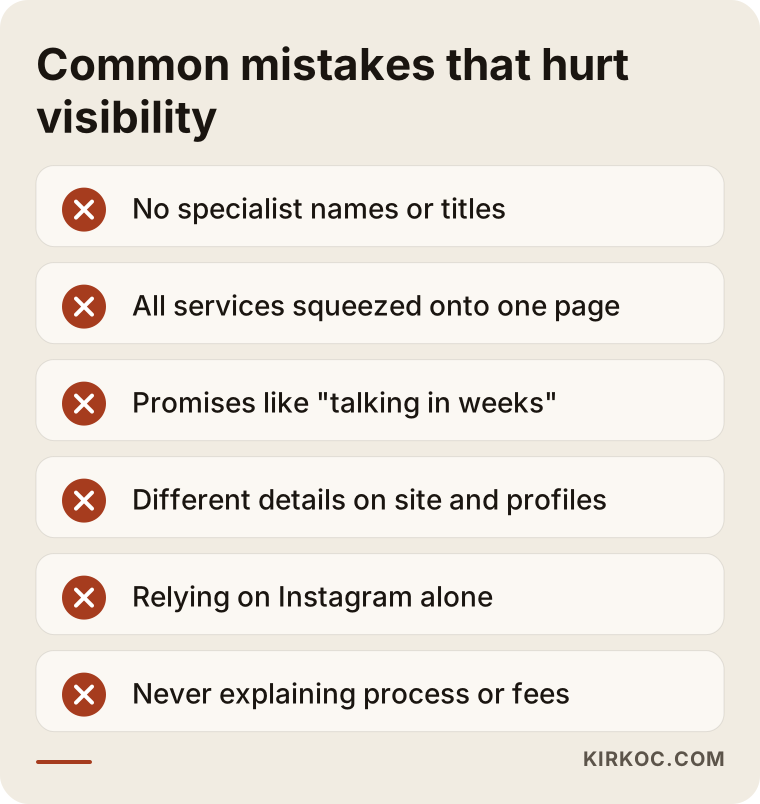
Each mistake in the image has a concrete cost:
- No specialist names or credentials: parents want to know who will be in the room with their child. An AI tool cannot do anything with "our experienced team."
- All services on one page: a parent asking about speech therapy is not well served by a page that gives five services three sentences each.
- Outcome promises: phrases like "we'll have your child talking in weeks" are ethically questionable and weaken trust. Every child's path is different, and saying so openly is more believable.
- Inconsistent address and phone number: one number on the site, another on Google, an old address on Instagram. When an AI tool runs into conflicting information, it gets cautious.
- Relying only on Instagram: social media is a nice storefront, but on its own it is not a lasting, readable source.
- Saying nothing about fees or process: you do not have to publish prices, but explaining what affects the cost and how insurance or public programs generally work answers a parent's first question.
What can you do yourself, and when do you need help?
You can take some of the basic steps this week on your own: complete your Google Business Profile, write down each specialist's credentials and focus areas in one document, list the ten questions parents ask most with your answers, and ask ChatGPT "can you recommend a child development center in my area?" to see what comes up. None of that requires technical knowledge.
Working with someone starts to make sense when those facts need to become well-linked pages, when structured data needs to be added, when site speed and mobile layout need fixing, when your outside listings need aligning and when results need tracking over time. If your site runs on an old platform, or nobody is quite sure who has the login, trying to solve each of these yourself can eat a lot of time. A clinic director's week is usually already full of families, staff, scheduling and insurance paperwork.
If you decide to start alone, my suggested order is: Google Business Profile first, then specialist profiles, then service pages. Putting effort into blog posts or social media campaigns before those three are in place is like adding a second floor to a house without a foundation.
What to look for when choosing someone to help
The most important test when choosing someone for this work is whether they understand how sensitive your field is, and whether they promise results. Stay away from anyone who guarantees outcomes. Nobody controls what AI assistants say; honest work can only make it more likely that you are mentioned.
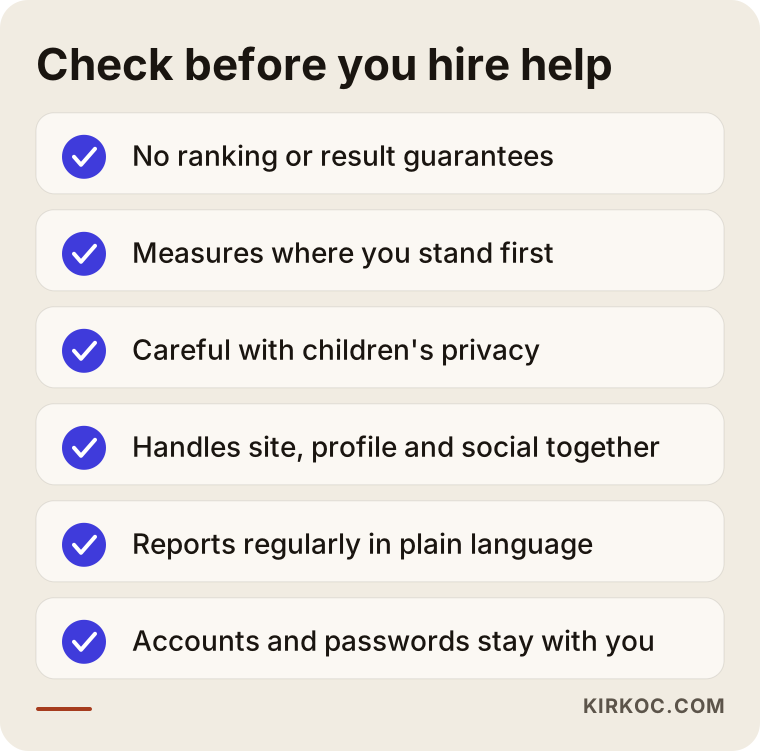
Beyond the items on the checklist, I suggest asking these questions in the first conversation:
- "Before we start, how will you measure where our center currently stands in AI assistants?"
- "How careful are you with children's photos, parent reviews and health-related wording?"
- "Will I be talking to the same person about the website, the Google profile and social media?"
- "Which tasks will I handle, and which will you handle?"
- "How often, and in what form, will you report results to me?"
- "If we stop working together, who keeps the pages, the accounts and the passwords?"
Someone who answers these clearly and simply, without burying you in jargon, and who is willing to tell you what they cannot do, is usually the right candidate.
What determines the cost?
The cost of this work cannot be summed up in one figure. It depends on the current state of your website, how many pages are needed, how many specialists and services you have, and how much ongoing follow-up you want. So I do not quote a number here, but I can be clear about what moves the price.
- The state of your website: adding pages to an existing site and building a new one from scratch are very different amounts of work.
- Number of services and specialists: a small practice with two specialists and two services needs far fewer pages than a therapy center with ten clinicians and six services.
- Who writes the content: if you provide the specialist details and service descriptions, the work moves faster; if I write everything from scratch, it takes longer.
- Number of locations: more than one location means separate location details and a separate business profile for each.
- Ongoing follow-up: whether you want a one-time setup or monthly checks and improvements.
- Extra services: if you also want social media management, ad campaigns or a logo refresh at the same time, the scope grows accordingly.
In the first conversation I go through these items with you one by one and put the scope in writing, so you know from the start exactly what you are paying for.
Working with Ümit Kırkoç
I am Ümit Kırkoç. I work from Istanbul and offer, as one person and from one place, everything a digital agency would: websites and e-commerce, SEO, local SEO, GEO, social media management (Instagram, Facebook, LinkedIn, TikTok, YouTube), Google and Meta ad management, logo and brand identity, and content creation. Since I do most of my work remotely, I can work with centers in the US and elsewhere; we simply agree on meeting times that fit your time zone.
When I work with a child development or special education center, I usually begin with a listening call. I try to understand your center, your specialists, the question that brings most parents to you and the channels new families currently find you through. Then I measure where you stand in AI assistants and on Google and give you a plain summary: what is there, what is missing and what makes sense to do first.
The benefit of having one person handle everything shows up clearly in this field. The credential I write on a specialist's profile, the description on your Google Business Profile, your Instagram bio and, if you run one, the text of an ad all use the same wording. When a specialist joins or leaves your team, you tell me once, and I update the site, the profile and the social accounts. You do not have to pass the same information between several vendors.
Let me also be clear about what I do not promise: I do not guarantee a particular position in AI answers, a certain number of new families or growth in followers. What I do is make sure your center is described as it really is, clearly and consistently, and share the effects of that work with you regularly.
Frequently Asked Questions
Is AI visibility work worth it for a child development center?
If a meaningful share of parents now do their first research by asking an AI assistant, yes. But this work does not do much on its own without a solid website and a properly completed Google Business Profile. Building that foundation first and then adding AI-specific improvements is the better order.
Who would you recommend for GEO services for a special education center?
Choose someone who understands the sensitivities of your field (children's privacy, accurate credentials, avoiding outcome promises) and who does not guarantee results. A person or team that can handle your website, business profile and social media together makes it easier to keep your information consistent. I am one of the options: based in Istanbul and working remotely.
Why does ChatGPT recommend a competing clinic but not us?
Most of the time it is because the competitor has left clearer, more consistent information online: separate service pages, named specialists, reviews and a clear location. That gap is about how your center is described, not about the quality of your care. It can often be closed, but nobody can tell you for certain how long that will take.
When will I see results?
After the pages go live, it takes time for search engines and AI tools to notice the new information. How long depends on the tool, your site's history and the competition in your area; it can be weeks or months. That is why I recommend measuring regularly and watching the change together.
My Instagram is strong. Do I still need a website?
Most likely, yes. Instagram is great for building a bond with parents, but AI assistants cannot always read social media, and pulling organized facts out of it is hard. A simple site with a few pages gives your Instagram effort a lasting, readable counterpart.
Do we have to list our specialists' names on the website?
You are not required to, but I strongly recommend it. Parents want to know who they are trusting with their child, and AI tools are more comfortable recommending a practice when they can connect expertise to a person. With your specialists' consent, listing them with their real credentials and in modest language is enough.
Should we explain insurance, Medicaid or school services on our site?
If families often ask about these, describing the general picture in plain language answers one of their most common questions. Coverage rules, Early Intervention programs and school processes such as IEPs vary by state and change over time, so avoid firm statements, add a note like "call us for current details," and check with a lawyer or the relevant agency on any point you are unsure about.
Is one person enough to handle all of this?
For a single-location or small multi-location practice, it is enough in most cases, and it actually helps with consistency. A large group with many locations running big ad campaigns at once may need several specialists working together. I assess this openly in the first conversation, and if I am not the right fit for you, I will say so.
If you want your center to be mentioned with accurate information and in the right context when parents ask AI assistants for help, I can review where you stand today and put together a roadmap that suits you. You can find the details and how to reach me on my GEO services page.