Someone looking for dinner no longer just types "good restaurant near me" into their phone. They ask an AI assistant, "We're four people on Saturday night, one of us is vegetarian, and we want somewhere quiet downtown," and a ready-made answer appears with three or four names. If your restaurant is not in that answer, that table went somewhere else without ever calling you. GEO is the work that deals with exactly this situation. In this article I explain what it is and what a restaurant owner can fix, in plain language. I am Ümit Kırkoç, I work from Istanbul, and I handle websites, SEO, social media and ads as one person, so you can see the scope of my work on the GEO services page.
GEO, in short, is the work that helps AI tools (ChatGPT, Gemini, Google's AI summaries and similar) recognize your business, understand it correctly and recommend it when they answer a question. Classic SEO prepares you for the list of results on a search page. GEO prepares you for the system that writes a single sentence of advice and has to feel confident naming you. The two do not compete. They stand on the same foundation, but in the restaurant world they put pressure on different spots, so they deserve separate attention.
Let me be honest up front: nobody can guarantee that an AI will recommend you. These systems change constantly, and even the same question asked twice can produce different answers. What you can do is make the facts about your restaurant organized, correct and easy to find, which raises the chance of being suggested. This article is the map for that work.
How does AI answer "good restaurant near me"?
When an AI assistant receives that question, it does not have a restaurant guide sitting in its head. It works from a handful of sources: pages on the internet, the information on map and business profiles, review sites, news articles and blog posts. It reads these, picks a few businesses that match the question, and explains in a short sentence why it picked them. So the answer is not a single "ranking." It is a small compilation.
To stand out in that compilation, the system has to read three things about you clearly: where you are, what kind of food you serve and who you suit. Phrases like "quiet," "good for families," "vegetarian options," "waterfront view" or "high chairs available" work because they answer the exact things people ask. If your pages do not say these things, the system does not guess. It recommends another restaurant that wrote them down.
The picture below is a made-up example. It shows what the answer to such a question can look like and which facts the answer rests on.
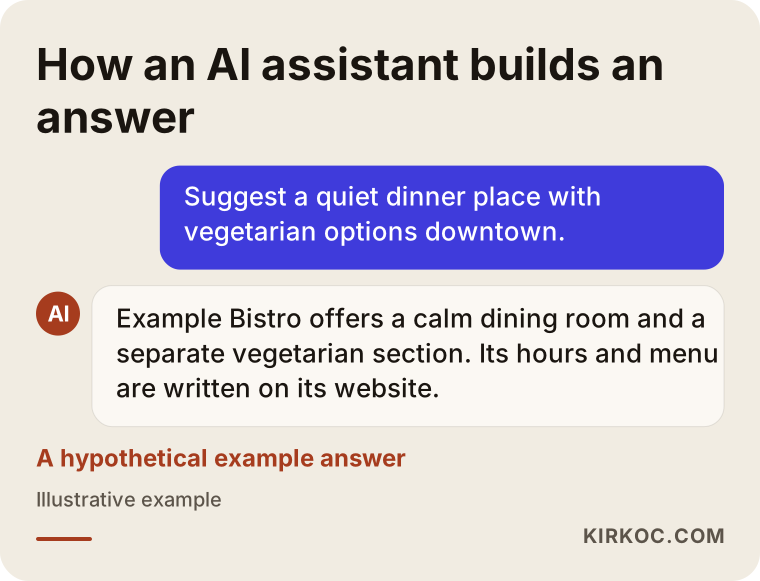
Notice that the reason given for the recommended place matches the details in the question one to one. If the question mentions "quiet" and "vegetarian," the answer looks for pages that carry those two facts. A generic line like "we serve delicious food" does no work here at all.
Why is a restaurant different from other businesses?
A lawyer or an accountant is chosen after research that can last days. A restaurant is chosen in minutes, and the choice often depends on location, the time of day and the mood of the moment. Answers to questions such as "is it open right now," "do I need a reservation" or "can I bring my dog" change all the time. An AI uses whichever source looks the most current and consistent. A restaurant whose menu still shows prices from two years ago, and whose opening hours are written three different ways in three different places, looks uncertain to the system.
Another difference is that the decision is made for a group. People usually search on behalf of four or five others and want "a place everyone can eat at." That gives details like diet options, allergen information, seating and parking a weight they rarely carry in other industries.
How do your customers actually search for a restaurant?
Start with your customer's sentences, not the words you use yourself. You might call your place a "taproom," a "smokehouse" or a "chophouse," but the person searching may write, "dinner with friends, good drinks, great food, not too loud." The AI understands that sentence just fine. The problem is that your page says nothing that answers it.
You can sort restaurant searches into four groups. The first is location-driven: "dinner near the waterfront," "restaurant in the arts district." The second is need-driven: "restaurant for someone with a gluten allergy," "place with a play area for a family with kids." The third is occasion-driven: "private room for a birthday dinner," "quiet spot for a business lunch." The fourth is right-now: "breakfast place that is open now." Each group needs a different answer on your pages.
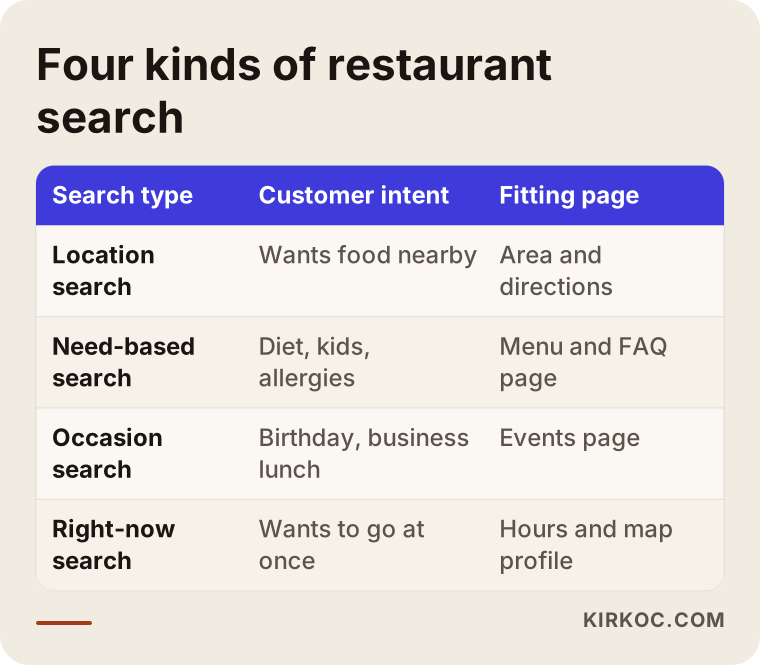
The table shows that one home page cannot serve all four needs. You need one place for location, another for special occasions, another for the menu and diet information. I go through this page by page in the next sections.
The difference between a question and a keyword
In classic search, people type short phrases: "seafood restaurant old town." In an AI assistant, they write long, natural sentences. That difference asks for a change on your page too. Putting the short phrase in a headline is not enough; the answer to the longer question should be written inside the page. If your page answers "Do I need a reservation on Saturday night?" in one clear sentence, that can help you stand out in exactly this kind of search.
Where does AI get restaurant information?
Knowing this decides where your effort goes. There are four main sources, and most restaurants only look after one of them.
The first source is your own website. Because you control what it says, it is the most reliable ground, but only if it is written well. The second is your Google business profile: address, hours, photos, menu link and reviews. The third is review and guide sites and the profiles on maps. The fourth is third parties who mention you: a local blog, a newspaper feature about places to eat, an event page.
The system compares these sources with each other. If your website says closed on Monday and your map profile says open on Monday, the information counts as conflicting. A conflict weakens trust, for the AI and for the customer alike. That is why the dullest part of GEO is also the most effective: making sure the same facts sit in every place.
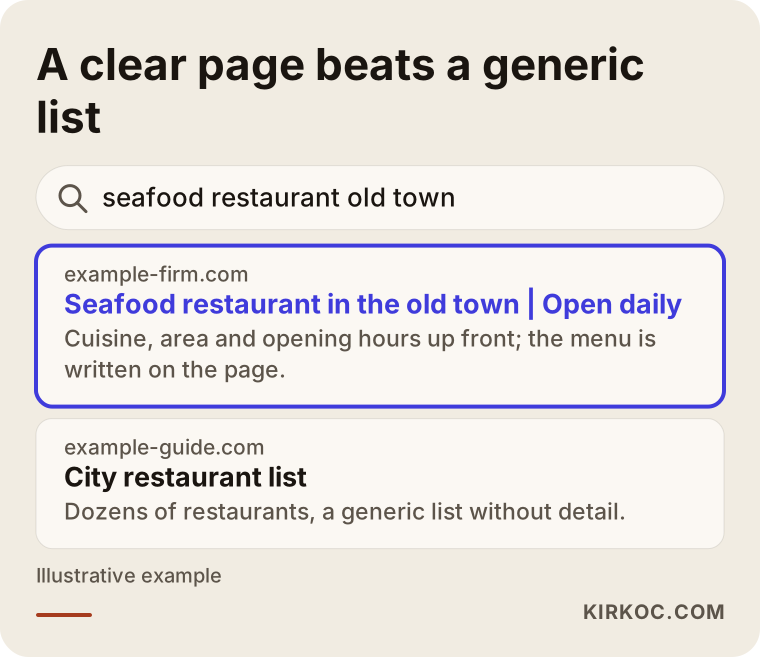
In the example result, the highlighted page states the cuisine, the area and the opening hours in its first line. The generic list below it runs through dozens of restaurants with the same sentence. Both classic search and AI summaries find it easier to trust the page with detail.
Which pages does a restaurant website need?
Many restaurant sites are a single page: one photo, a phone number and a menu uploaded as a PDF. That structure leaves very little for an AI to read. Menus placed as a PDF or an image in particular may be hard for these systems to read. Putting the menu on the page as ordinary text is one of the most useful single changes you can make.
A sensible layout for a restaurant looks like this. A home page that says your cuisine, your neighborhood and who you serve in two or three sentences. A menu page with dishes, drinks and, if possible, a price range, all as text. A reservations and directions page with the address, how to find you, parking, hours and the way to book. An events page that says what you offer for birthdays, business meals and group dinners. And a frequently asked questions page covering allergens, children, pets, vegetarian options and similar topics.
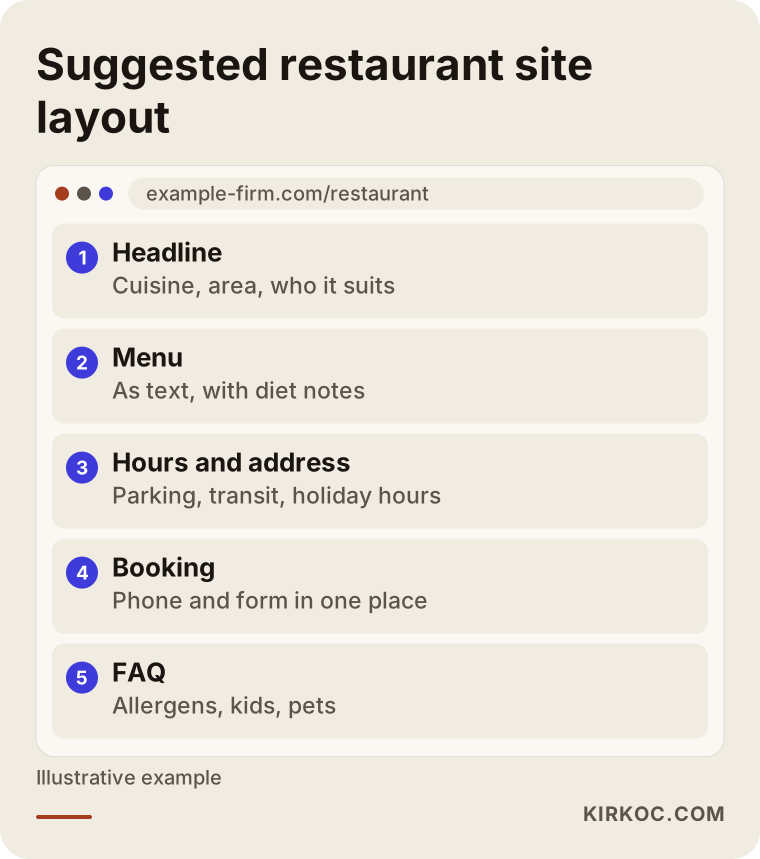
The diagram shows the sections of an example page. Each section answers a question a customer might put to an AI. Section titles should be plain too: instead of a heading like "Our Menu," something like "Menu: Mediterranean dishes, vegetarian and kids' options" is more useful, because the system tries to understand the content even from the heading.
Do you need a page for each neighborhood?
If you have more than one location, open a separate page for each one without exception. If you have a single location, you may not need a separate neighborhood page, but your home page should say which neighborhood you are in and what is nearby (a subway station, a ferry pier, a market square). People search with directions like "near the ferry terminal," and if your page carries that description, the match becomes easier.
Making your menu and details readable for AI
The menu is the most valuable content a restaurant has, and often the worst written. Headings like "chef's choice" or "plate of the day" do not tell the customer what you are serving. You need to write what the dish is, what it comes with and who it suits: "Charred eggplant with yogurt and walnuts; vegetarian, contains dairy." That single sentence gives a person and a system three separate facts.
Be careful with diet and allergen information. If you write that a dish is gluten-free or vegan, your kitchen has to be able to stand behind that. If you are not sure, use an honest line such as "a gluten-free version can be prepared, please mention it when you order." You may have legal obligations around allergens, so I recommend talking to a food safety specialist or an attorney about that.
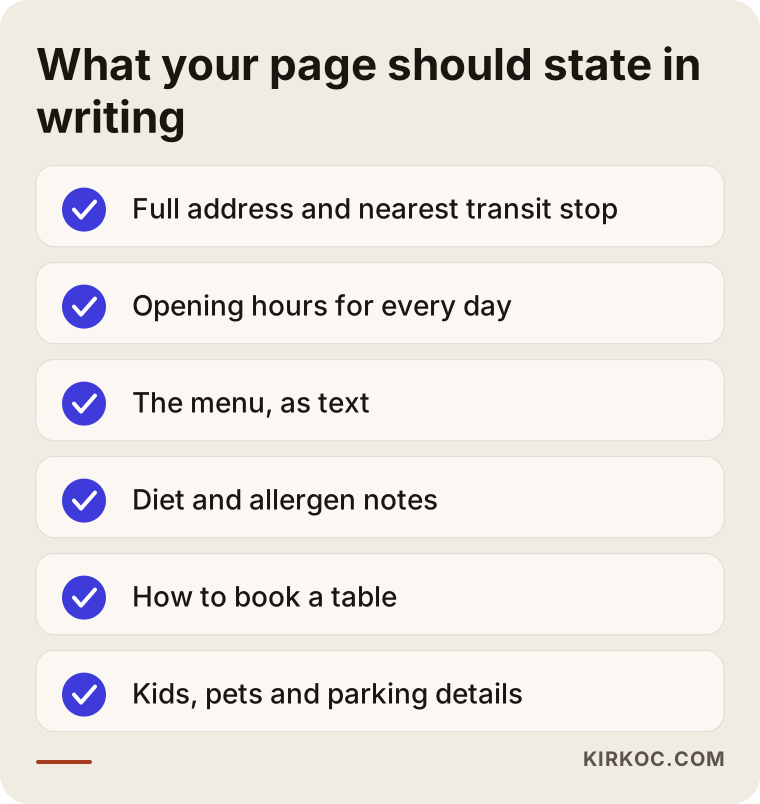
The list summarizes which facts should be written on the page. If several are missing, fixing the opening hours, the address and the menu first gives the fastest result; the others follow.
Photos and descriptions
AI can also read what is in a photo, but the trusted source is still written text. Add a short, accurate caption and alternative text to every important photo. "Lamb skewers served by the grill" is a better file name than "IMG_4821." This helps visitors who use screen readers and also helps the content get understood.
Map profile, reviews and outside platforms
The business profile carries a large share in AI recommendations. So think of your Google business profile as a shop window: the right category (for example "seafood restaurant," "pub," "breakfast spot"), current hours, holiday and special-day hours, a menu link and fresh photos. The "services" and "attributes" sections present facts in a structured way, such as whether you have a patio, whether you take reservations and whether there is wheelchair access. If these stay empty, the system has to look for the facts elsewhere.
I am clear about reviews too: do not buy reviews, and do not push your customers to write fake ones. Platforms can notice this and penalize you. The right thing is to politely give happy guests the chance to leave a review after the meal and to answer every review, negative ones included, in a calm tone. The content of reviews matters as well. A review like "we went with the kids, the staff were very attentive and the vegetarian plate was great" helps the system match you with the right questions far more than "it was good."
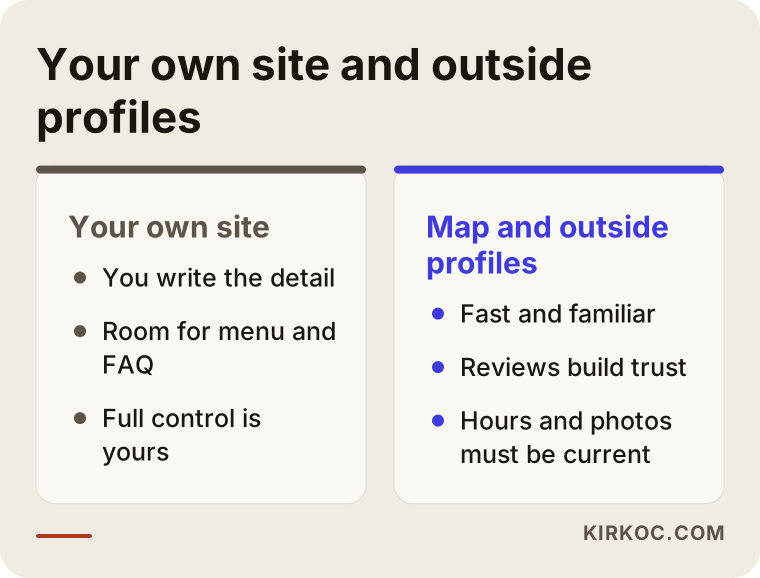
The comparison shows that your own site and the outside profile complete each other. The site gives you detail and control; the outside profile gives speed and trust. Neglecting one and leaning on the other is only half the job.
Two hypothetical scenarios
The two examples below are completely made up. Their purpose is to picture how the same problem looks in different restaurants.
Scenario one: a small pub in a busy neighborhood. Suppose the place has no website, only an Instagram account and a map profile. The hours in the profile are incomplete and there is no menu. When someone asks an AI for "a table of friends, good food and drinks," the system tries to answer with the only thing it has, a few reviews, and finds the place vague. The jobs, in order: fill in the map profile, open a simple one-page site and put the menu on it as text, and write down the starters, the main dishes, the group booking rules and the opening hours. This work can bring the information into line within a few weeks, but it does not guarantee a recommendation. How strong the competing pubs are affects the outcome.
Scenario two: a three-location breakfast chain. Here the problem is the opposite: there is information on the site, but each location's hours, address and menu are mixed together on one page, and when one location changes its hours the others are not updated. When answering "Sunday breakfast near the harbor," an AI may repeat the wrong location's hours. The fix is a separate page for each location with that location's current facts on it, and the site and the profiles updated from one source. For chains, the real job is managing the information from one center.
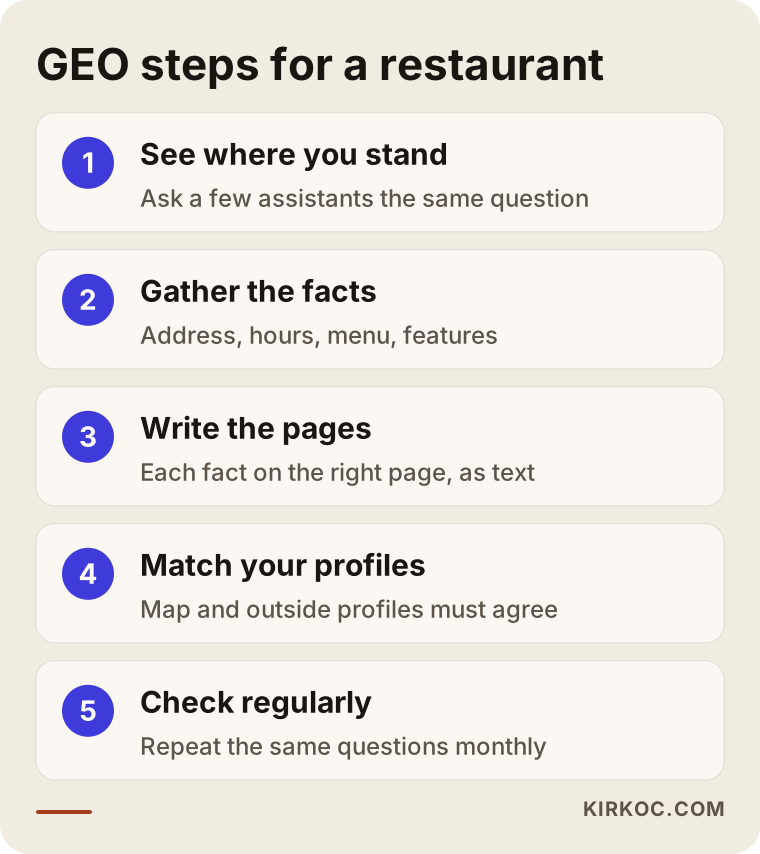
The steps run in the same order in both scenarios; only the weight changes. In the small pub, setting things up from scratch is most of the work. In the chain, order and consistency are most of it.
How to proceed, step by step
First, see where you stand. Ask a few AI assistants the same question yourself: "Suggest a quiet dinner place in my neighborhood," "Suggest a good restaurant for a family with kids." Check whether your restaurant appears, and if it does, whether the details are correct. Write the answers down. That is your starting snapshot.
In the second step, gather the facts: address, all opening hours, menu, price level, how to book, features. In the third step, turn them into text on the right pages of your site. In the fourth step, bring your map profile and the other platforms in line with the same information. In the fifth step, write the question-and-answer section, using the questions customers ask most on the phone or in messages. In the sixth step, become visible in outside sources: being mentioned correctly in a local blog, an events page or a neighborhood guide.
How long does it take?
The fixes can be made in days, but the results do not show up at once. Changes appear as search systems reread and update your pages. That usually takes weeks and sometimes months. There is no need to be impatient, but regular upkeep is needed.
The most common restaurant mistakes
The first mistake is publishing the menu only as a PDF or a photo. It makes reading harder and makes updating easy to forget. The second is writing the opening hours differently in different places. The third is relying only on social media: Instagram posts are lovely, but they are not an organized source of information for search systems, and over time they get buried.
The fourth is constantly writing unproven phrases like "the tastiest" and "the best." Such claims tell neither a person nor a system anything concrete; replacing them with specific facts works better: "from a family of fishermen for three generations," "fish bought at the market every morning." The fifth is fake or purchased reviews. The sixth is using one page for all locations. The seventh is doing it once and walking away: as menus and prices change, pages go stale.
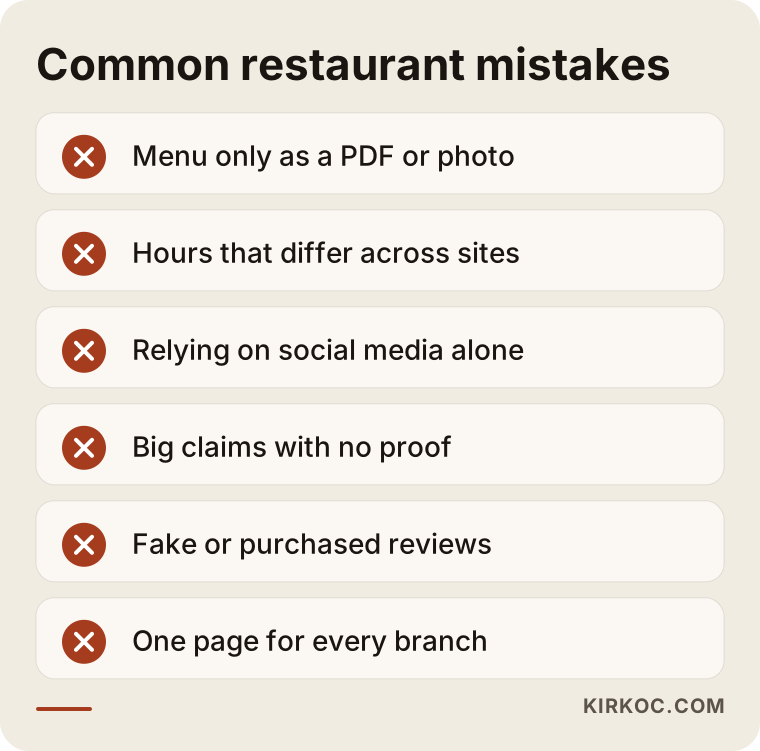
Most of the mistakes on the list are not expensive; they are a matter of attention. Even sitting down one morning to check them makes a difference.
How do you track the results?
Measuring AI recommendations is not as easy as measuring a classic ranking, but there are simple checks you can do. Each month, ask the same five or six questions to different assistants and save the answers. In your website statistics, look at which pages get visits and how many people press the reservation or call button. In your map profile, watch the change in directions requests and calls. When someone books, ask, "How did you find us?" Over time, some guests may answer that they found you through an AI assistant.
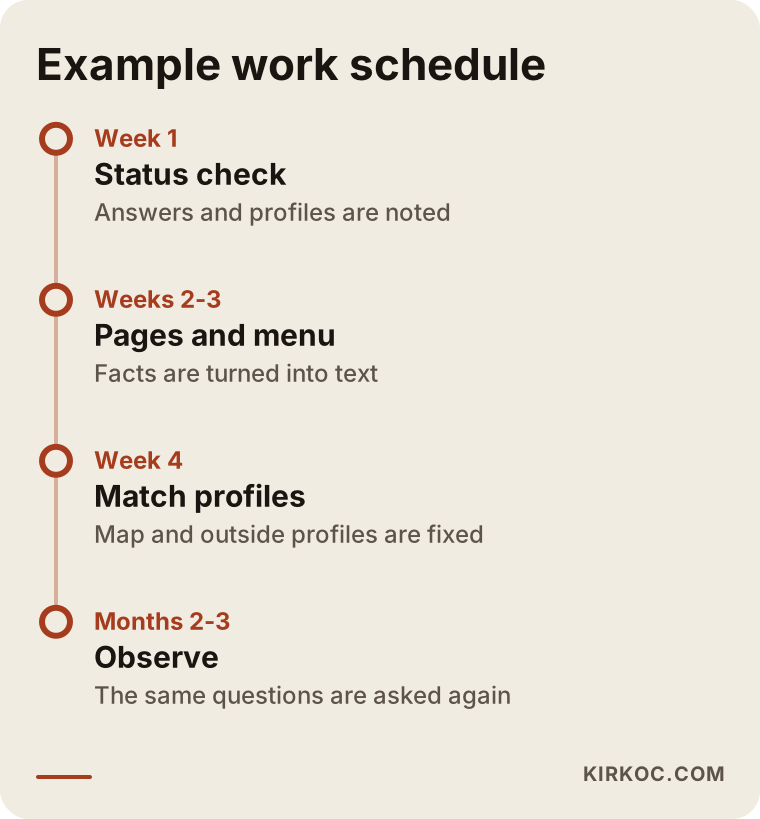
The calendar shows an example flow; the timing differs for every business. What matters is laying the foundation in the first month and spending the following months on observation and fine adjustment.
What can you do yourself, and when do you need an expert?
There is a lot you can do yourself. Filling in your map profile, making the opening hours match everywhere, turning the menu into text, answering reviews and writing a short list of frequently asked questions cost nothing and take a few hours. Hiring an expert without doing these things means spending money while leaving the foundation incomplete.
Expert help makes sense in these cases: your site's structure does not let you change things, you have several locations and want to manage the facts from one place, you serve tourists in several languages, or competitors are clearly ahead of you. Structured data in particular, the technical markup that describes the information on your page to search systems in a machine-readable way, is a job for a specialist.
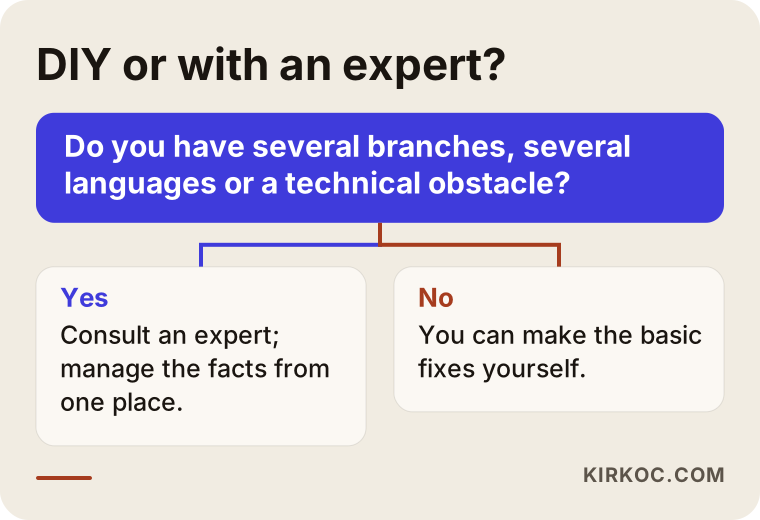
The chart makes a simple split: if the basics are complete and the structure allows it, go ahead yourself; if you have many locations, several languages or a technical obstacle, talk to an expert.
What determines the cost
I will not give a number here, because no two restaurants have the same job. A few things decide the cost: how many locations you have, whether the site will be built from scratch or an existing one corrected, how many languages it will be published in, the size of the menu and how often it changes, whether photos and content need to be produced, and whether the work is a one-time setup or monthly upkeep. A dense local competition also raises the effort.
When you ask for a quote, ask this: exactly which pages will be written, which profiles will be edited, when will I receive a report, and when the work ends, will I keep control of the site? If you cannot get a clear answer, the scope of the quote is not clear either. Also be careful with anyone who says "we will put you first" or "you will definitely show up in AI"; nobody can guarantee that.
How I work with you
I run this work alone. When your website, menu pages, map profile, social media accounts and, if needed, your ads are all with the same person, keeping the facts consistent gets much easier, because you say a change in hours in one place instead of passing it to five different people. I usually start by looking at where you stand now, meaning how you appear in AI assistants and in search, and I give you a written list of what is missing. Then we decide together which jobs you do and which ones I do. I do not add unnecessary work; if fixing your map profile is all you need, I will say so.
Frequently asked questions
Are GEO and SEO the same thing for restaurants?
They are not the same, but they are connected. SEO prepares your site for the list of search results; GEO organizes your information so that you are named in the single answer an AI assistant gives. Well-done SEO is also a solid base for GEO.
Can I be sure of showing up in AI answers?
No, nobody can guarantee that. These systems keep changing and do not give the same answer every time. What can be done is to make your information correct, consistent and readable, which raises the chance of being recommended.
I have no website, only Instagram and a map profile. Is that enough?
It is a start, but it is not enough. Social media posts are not read as an organized source of facts. A simple site with your menu, hours and features as text, together with your map profile, makes a much stronger foundation.
Is it a problem if I leave my menu as a PDF?
It can be. PDF or image menus may be hard for search systems to read, and they are easy to forget to update. It is safer to put the menu on the page as text and offer the PDF as an extra if you like.
Do reviews affect AI recommendations?
They can, because reviews count as an outside source about your business. What matters is the content as much as the number; concrete, genuine reviews are more useful. Do not use fake reviews: they break platform rules and damage trust.
What should I do if I have more than one location?
Open a separate page and a separate map profile for each location, and write the hours, address and menu separately on each. Setting up a way to update the facts from one center reduces the chance of mistakes.
When will I see results?
The fixes are made within days, but search systems usually take weeks, sometimes months, to reflect the change. So regular observation in the first months is more sensible than deciding from a single measurement.
Is it necessary to write allergen and diet information on the site?
It is very valuable for customers and comes up often in AI questions. Write only what your kitchen can truly guarantee, and talk to a food safety specialist or an attorney about legal obligations.
Let's look together at how your restaurant appears in AI recommendations; I will explain where you stand and how much work is needed, in plain words. You can write to me through the GEO services page.