Your restaurant has an Instagram account, the photos look good, and you post fairly regularly. Still, the tables are not as full as you would like, especially on weeknight evenings. Somebody told you to "run ads," and you either tapped the "Boost post" button once or twice or never quite figured out how the whole thing works. This is exactly where Instagram ads for restaurants come in. In this article I explain what a restaurant owner without technical knowledge needs to understand, which mistakes to avoid, and when it makes sense to hand the work to a specialist. If you would rather have someone take the whole job off your hands, you can look at my digital advertising management service.
First, a short definition. An Instagram ad means paying to show your post to people who do not follow you but match the traits you choose. Whatever your follower count is, you can reach people who live near your restaurant and enjoy eating out. It is like carrying your sidewalk sign onto the phone of everyone in the neighborhood. But no sign, however attractive, helps if the room behind the door is chaotic. So let us start with the logic of the thing and only then look at the setup.
Why is restaurant advertising different from other kinds?
An online store ships its product by mail, and the customer can live on the other side of the world. A restaurant is the opposite. The customer has to physically show up, and often has only a few minutes to decide. Someone looking for a place to eat dinner opens their phone, looks around, and if they like what they see they tap for directions or call. In most cases your ad is not there to "sell" anything. Its job is to make you the place that comes to mind tonight or this weekend.
That is why three things matter most in restaurant advertising. The first is distance: nobody wants to cross the whole city in traffic for a meal. The second is timing: showing your lunch special at nine in the evening is money wasted. The third is trust: before going anywhere, people look at photos, reviews, the menu and the prices. The ad introduces you, but what a person sees when they tap through to your profile is what makes the decision.
The graphic below sums up the road from an ad to a seat at your table in four steps. At every step, some people continue and some drop out. Working on your ads is really about shrinking those losses.
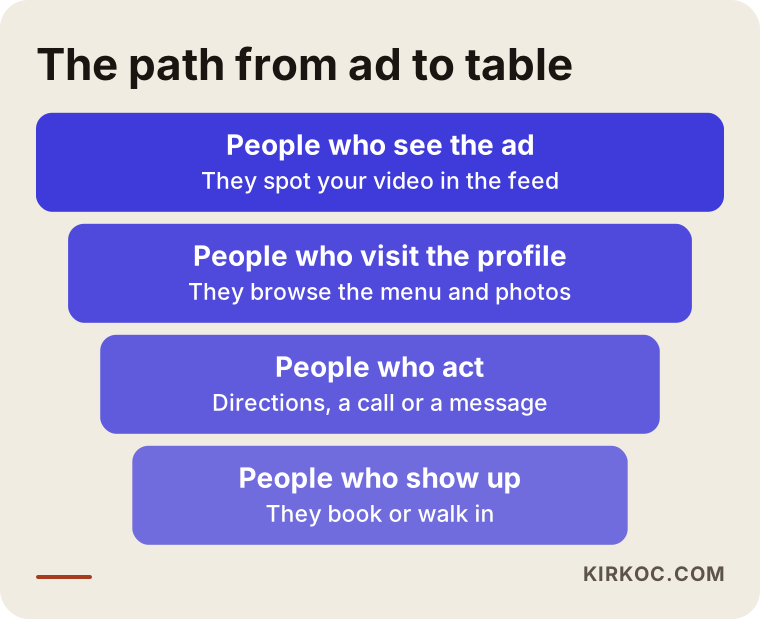
As the picture shows, seeing the ad is only the first step. The valuable part is the last two. So instead of asking "how many people saw it," ask "how many people called, got directions or sent a message."
How do your customers find you on Instagram?
Restaurant customers tend to behave in a familiar way. A group of friends asks, "Where should we go tonight?" One person searches for places nearby on their phone, another browses venues that have been tagged on Instagram. Sometimes a video of a plate someone scrolled past sticks in their mind and turns into a dinner out a few days later. That last case is where ads are strongest, because the person is not searching for anything. You are giving them the idea.
There is one more difference worth knowing: on Instagram people do not search for food, they see food. So an ad should work like a mouthwatering frame, not like an information sheet. A plate arriving hot, cheese stretching, a tray set on a table, steam rising from the kitchen: short moving clips like these grab attention far better than a flat photo of the menu. But under the same video there should be one clear sentence about where you are, when you are open and how to book.
A note about the type of place you run. A restaurant in a tourist area and a neighborhood eatery work on different logic. For the first, language and location come to the front. For the second, the lunch special and the home-cooked feel matter most. Before you set anything up, I suggest writing down the answer to this: who is my customer, where do they live, and when do they come?
What should be ready before you start advertising?
An ad magnifies what you already have, which means that if things are messy, it magnifies the mess. I see this in many businesses' first attempt. Money is spent and more people land on the profile, but if the profile shows an old menu, a wrong phone number or a photo from two years ago, those people simply leave.
Run through this list before you begin:
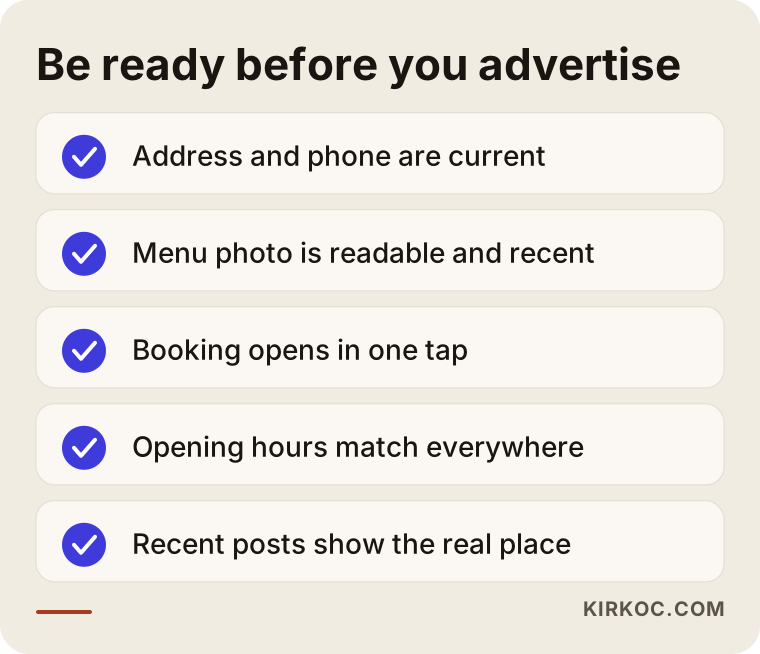
Every item matters, but the one skipped most often is consistency. Your address, phone number and opening hours should be identical on Instagram, on Google and on your website if you have one. The reason is simple: when people see different hours in different places, they usually assume you are closed and go somewhere else.
This is where doing everything through one person pays off. When I run the website, the Google business listing, the Instagram profile and the ads myself, a menu change does not get forgotten in one of four places. When different people handle each piece, one updates and the rest forget, and a customer ends up seeing last season's price.
Pick the goal first: what do you expect from the ad?
The first question when building an ad should be "what do you want more of?" For restaurants, it usually comes down to four goals: announcing a new opening, filling empty dinner tables, growing takeout orders, and promoting an event. Each goal calls for different content and a different result to watch.
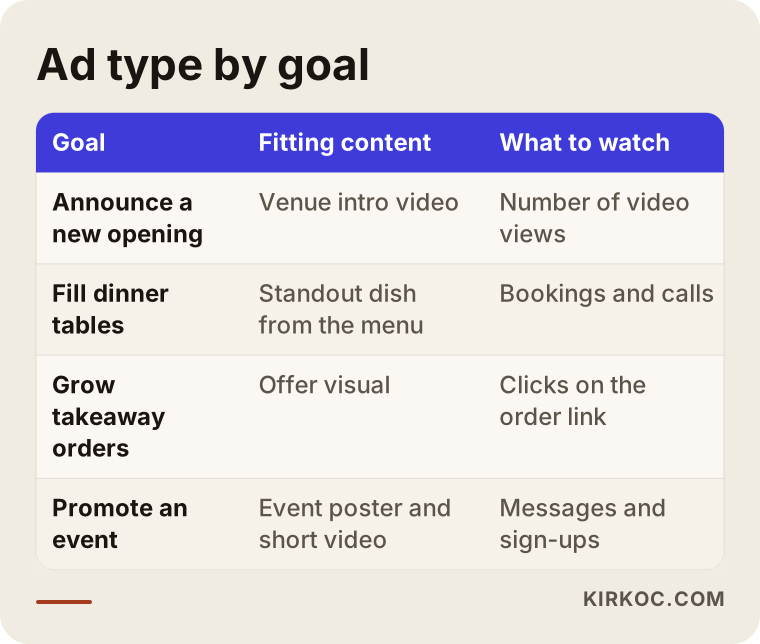
As the table shows, for an opening announcement it is enough to see how many people watched the video, but if you want to fill dinner tables you need to look at bookings and phone calls. If you mix up the goal, you look at the wrong number. You might be pleased that "lots of people saw it" while the tables stay empty.
There is also the "everything at once" trap. If one ad tries to announce the opening, the lunch menu and the weekend brunch, the message blurs. Each ad should say one thing.
Boost button or Meta Ads Manager?
There are two ways to run ads on Instagram. The first is the "Boost post" button under a post. The second is Meta's panel called Ads Manager, where both Instagram and Facebook ads are managed from the same place. The button is quick and easy; the panel gives you more settings.
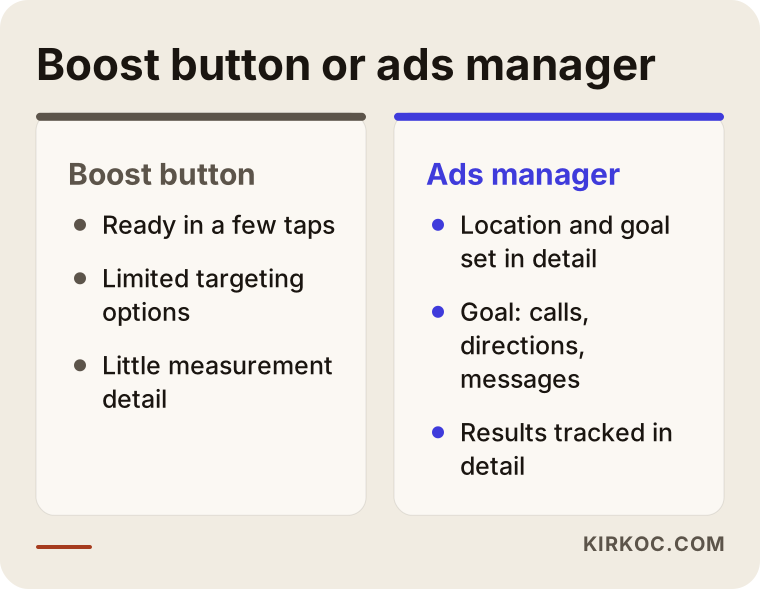
The button works when what you want is "let more people see this post." But what restaurants usually need is something else: "get people who are heading out for dinner and live close enough to reach me to call my phone." That kind of goal requires detailed location choices and the right campaign objective, and this is where the panel earns its keep. For a first experiment, using the button is perfectly fine, but if you want an ongoing advertising plan, you need to work in the panel.
A small warning: who owns the ad account matters. The account should be opened in your name, and you should always appear as an administrator. That way, even if you part ways with whoever helps you, your past data stays with you.
Audience: who could come to your restaurant?
Audience is the part that decides who sees your ad, and for a restaurant the most important setting is location. You place your restaurant in the center and draw a radius around it. How big the radius should be depends on the kind of place. For a neighborhood eatery, anything from a few blocks to a few miles makes sense; for a destination that people deliberately travel to, a wider area can be considered.
With other settings such as age and interests, it is wise not to overdo it. Choosing a very narrow audience can mean the ad is shown to few people and costs more. For most restaurants, location plus a broad age range is a good starting point, and you can narrow it later once you have data.
Consider the following hypothetical example. It is not a real customer, just a scenario built to illustrate the point.
Example scenario 1: A neighborhood diner with empty weeknights
Imagine a small diner in a residential area that serves home-style cooking. At lunchtime it is full, but in the evening half the tables sit empty. The owner first ran an ad aimed at the entire city, and the budget scattered: plenty of views, zero calls. The better approach would be this: draw a short radius around the diner, show a plate of the home-style dinner in the ad, add a clear line like "open tonight, call to reserve a table," and choose phone calls as the goal. After a week, look at which video drew more taps and switch the other one off. No result is guaranteed, but at least the budget goes in front of the right people.
Content: which video or image works?
In restaurant advertising, content matters more than budget. You can spend the same money on a poorly shot photo or on a well-shot video; with the second, the ad is watched longer and turns into more profile visits. You do not need a studio. Even with a phone camera, a few things deserve attention.
Use natural light; if you can, shoot by a window. The plate should look as if it was served a moment ago. The video must catch the eye in the first two seconds, because people scroll quickly. Shoot vertically and add text so the video makes sense with the sound off. Put the name of the restaurant and your neighborhood at the beginning or the end.
Some content ideas:
- A short journey of a plate from the kitchen to the table.
- The hands of the chef or cook preparing a dish.
- The dining room in evening light, with tables being set.
- The dish of the week, or an item from a new menu.
- An announcement of an event, live music or a special night.
Each idea should carry a single message. Instead of saying "our menu is new and there is music on Saturday," two separate short videos usually work better. Because I can also handle content production myself, I can keep the ad videos and the overall look of your profile consistent with each other.
Where the ad leads: profile, message or page
Where does the person who taps the ad end up? This question is often skipped, yet it is one of the biggest factors in the result. There are usually three options: your Instagram profile, a message inbox, or a page on your website.
If you take reservations, sending people straight to a booking page or a call button makes sense. If people are curious about your menu, a menu page works better. If you choose messages, you need to answer them quickly; someone who messages about dinner will not wait for hours.
The graphic below shows how the page an ad leads to could be laid out. It is an invented example.
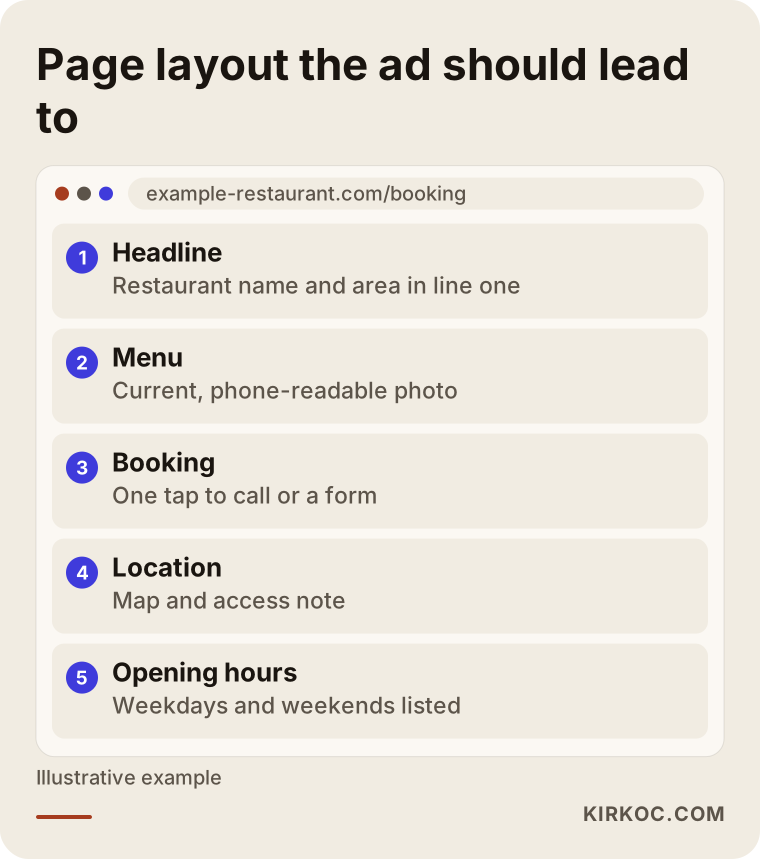
The first line of the page should hold the restaurant name and neighborhood, with the current menu right below it and a one-tap way to call or book. It should be readable on a phone; a menu photo that looks great on a desktop but shrinks to nothing on a phone just tires people out. If you do not have a website, or yours is outdated, a one-page structure like this is quick to build and also makes it easier to measure the result of an ad.
Budget: how much should you set aside?
I will not give a number here, because the right number depends on your restaurant. What I can do is explain what it depends on. Your budget is shaped by the competition where you are, the size of the area you target, the goal of the ad, the quality of your content and how long you keep going. Reaching the same kind of audience in a busy tourist district can cost more than in a quiet neighborhood.
The budget is really two separate items, and it helps not to mix them up. The first is the ad spend you pay directly to Meta. The second is the work of the person who sets up the ads, prepares the content and follows the results. When you get a quote, check whether these two are written separately. The ad spend should be charged to your card, from an account opened in your name, and you should be able to see where every dollar goes.
My advice for a start is to test with a small daily budget, see which video works, and only then raise it. Putting in a large amount at once makes it harder to tell what actually worked. Patience also matters: the ad system needs the first few days to learn, so do not decide anything after a single day.
Example scenario 2: A newly opened cafe-restaurant
This is another hypothetical scenario. Picture a cafe-restaurant about to open in a neighborhood. It has few followers and no reviews yet. A few weeks before opening, short videos of the preparations are posted; in opening week, one of those videos is run as an ad to the nearby area. The goal chosen is directions or profile visits. Politely asking early guests to leave a review also helps. An ad cannot fill a place on its own, but it is a handy tool for letting the area know a new place exists.
Step by step: how do you set up the ad?
I can describe the process in its simplest form in five steps.
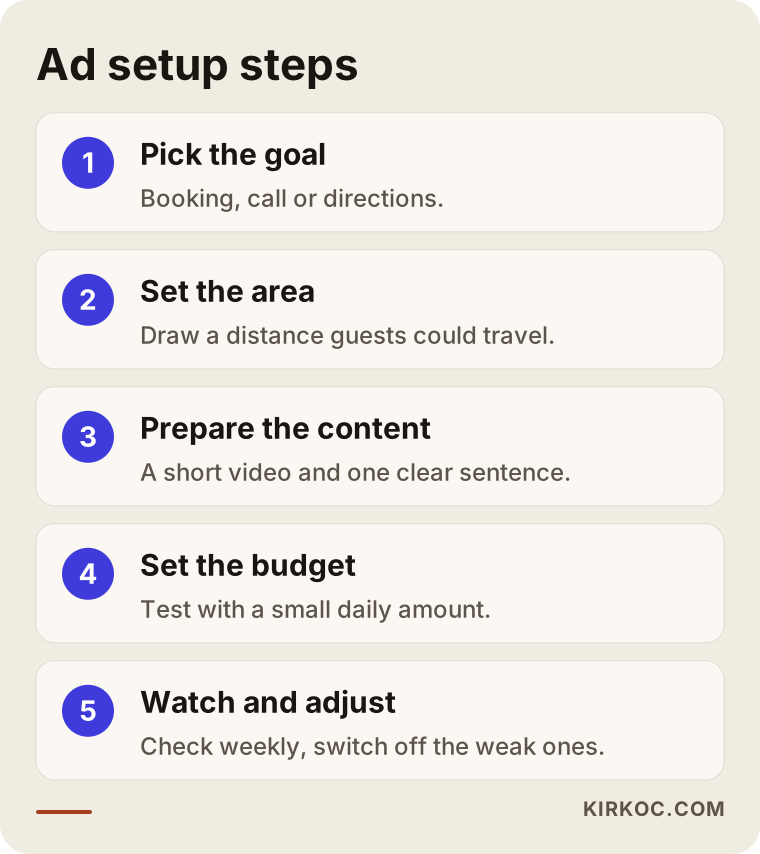
In step one you pick the goal: a booking, a call, directions or a message. In step two you draw an area around the restaurant. In step three you prepare the content: a short video and one clear sentence. In step four you set aside a small daily budget. In step five you check weekly, switch off the weaker ad and keep the stronger one going.
When all these steps run together, advertising stops being an "experiment" and becomes steady work. Skipping the follow-up is one of the most common mistakes, because an ad does not improve itself once it is live.
What do the first four weeks look like?
Knowing the timeline keeps your expectations realistic. In the first days, the system is learning who to show the ad to, so results can swing around. That is why shutting an ad off because you saw nothing on day one is, more often than not, a premature decision.
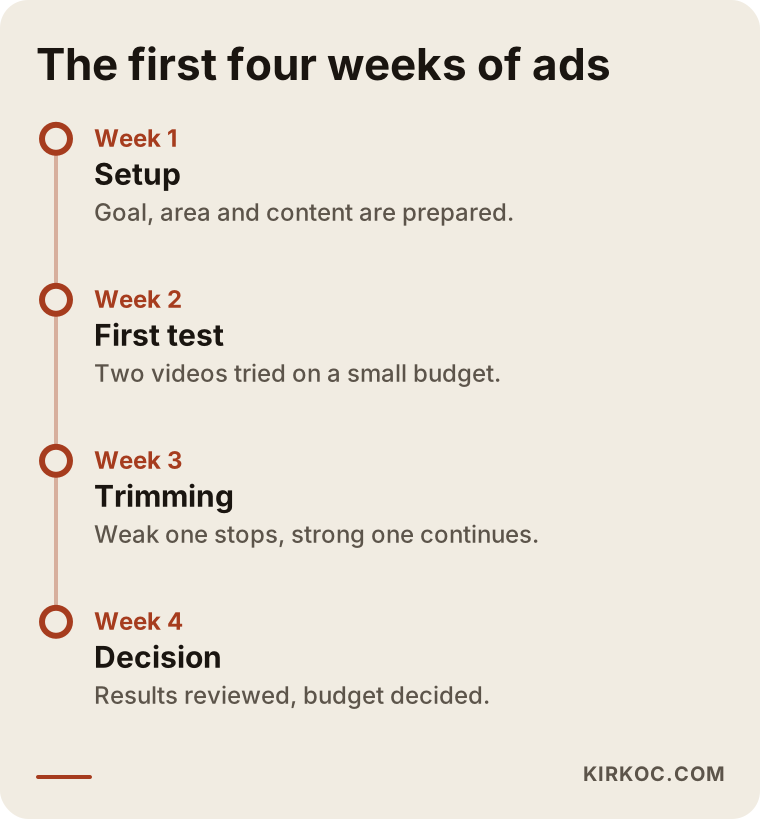
In week one you set things up, and in week two you test two different videos on a small budget. In week three the weaker one is switched off. In week four you look at the results and decide on the next month's budget. There is no guarantee in this: some restaurants see clear results in the first month, while others see none until their content or profile changes. What matters is learning from the data what actually works.
Common mistakes
Talking with restaurant owners, I see the same mistakes repeated. The graphic below gathers the five most common ones.
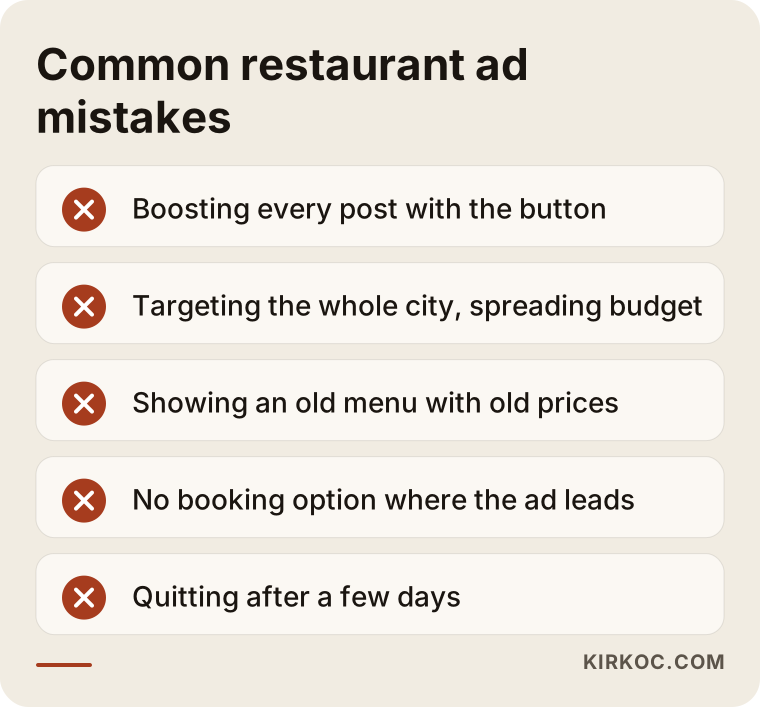
Let me unpack them a little. Boosting every post with the button spreads the budget without a purpose. Targeting the entire city makes you pay to reach people who will never come to your restaurant. Showing an old menu or wrong hours damages trust and sends the customer away disappointed. If there is no way to book where the ad leads, you cannot hold on to the person whose attention you just earned. And quitting after a few days with "it didn't work" means giving up without having collected any data.
I can add two more. The first is not replying to comments and messages: someone who sees your ad and asks a question will leave if no answer comes. The second is ignoring kitchen and service capacity. If the ad really works and more people than you expected show up on a Saturday night, slow service comes back as bad reviews. Before you scale an ad, think about what your team can handle.
Ads or steady posting first?
Advertising should not be every restaurant's first job. If your profile is half empty, posts stopped months ago and the menu is outdated, it makes more sense to fix those first. An ad speeds up an arrangement that works; it does not repair one that is broken.
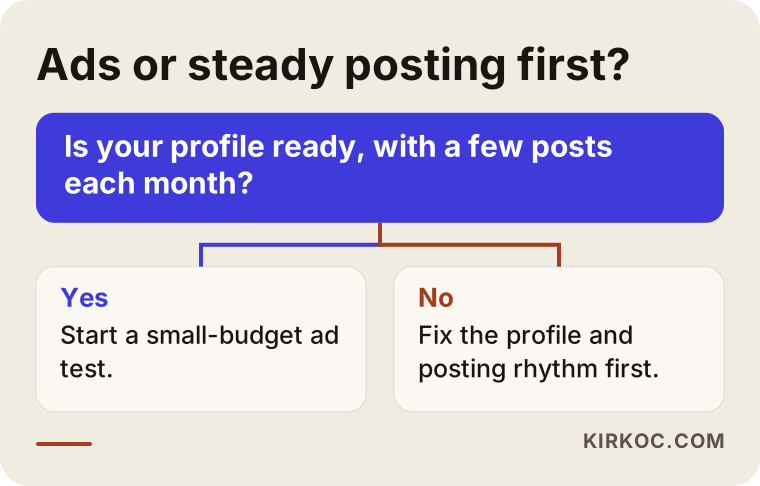
The question in the chart is simple: is your profile ready, and do a few posts go out each month? If the answer is yes, you can start a small-budget test. If not, fixing the profile and your posting rhythm first is a better investment than advertising. Since I also handle social media management, I can plan these two jobs together, so the flow of content is ready by the time the ads begin.
Measurement: how do you read the results?
Measurement is the part restaurant owners struggle with most, because a person sitting down at a table is not recorded on Instagram. So you look at indirect signs: phone calls that came from the ad, taps on directions, messages, booking form submissions and profile visits.
A practical method is simply to ask, when taking a reservation or at the register, "How did you hear about us?" That plain question can give you a more honest clue about the real effect of an ad than the panel does. If you put these notes next to the ad results every week, you will see which video turned into diners.
One point to watch: if clicks are high but calls are zero, the problem may not be the ad but the place it leads to. The menu may not open, the phone number may be wrong, or the page may load slowly on a phone. Finding a blockage like this means looking at the website and the ad together. When one person manages both, finding which of the two is the problem takes much less time.
What can you do yourself, and when do you need a specialist?
There is a lot you can do yourself. You can update your profile, refresh the menu, shoot good videos on your phone, answer comments and set up a small test ad. For a start, that is enough. The fact that a restaurant owner knows their own place better than anyone is a real advantage on the content side.
A specialist becomes useful when ads keep switching off and on and you cannot work out why, when money is being spent but no calls come in, when you have more than one location, when your ad account has been restricted, or when you do not have time to read the ad results alongside your website and Google listing. And in a busy kitchen, following ads every week is a burden most people cannot sustain. At that point, handing the work over saves time.
What determines the cost?
Without giving numbers, here are the things that set the price. The scope of the work: is it only ad management, or does it include content production and profile management too? The number of locations and a separate radius for each. Whether video shooting is needed. Whether the ad account is being built from scratch or an existing one is being fixed. How often you want reports and whether you need meetings. And then there is the ad budget itself, which goes to Meta and is a separate item.
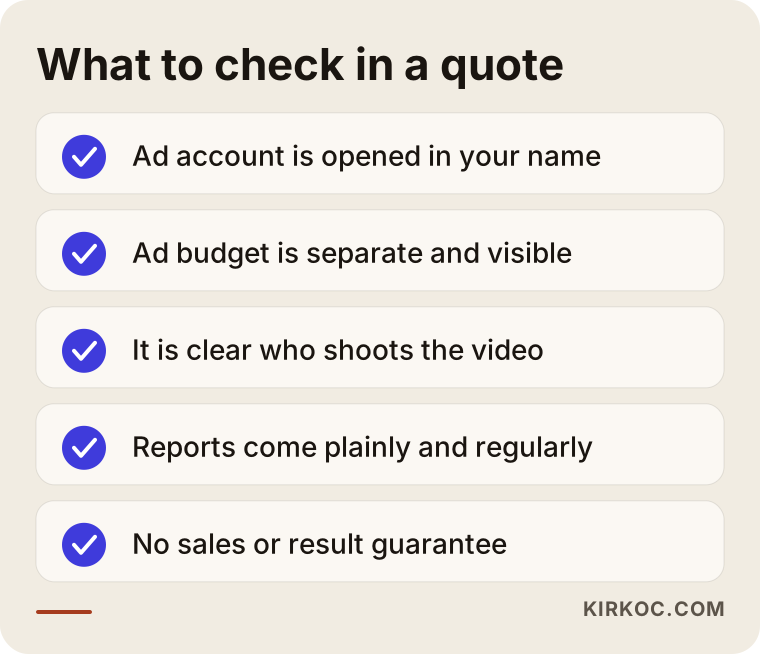
When you receive a quote, look at this list. Is the ad account opened in your name? Are the ad budget and the fee separate and visible? Is it clear who will shoot the video? Do reports arrive in plain language and on a regular schedule? And most importantly, is anyone promising sales, full tables or followers? If so, be careful, because no advertising specialist can guarantee those results.
How I work with you
I am a specialist based in Istanbul who handles websites, SEO, social media and advertising all on my own. For restaurants the process usually goes like this: first I look at your venue, your current profile and, if there is one, your ad history. Then I present the goal, the area and the content plan to you in writing. I set up the ad account in your name, prepare the videos or edit the footage you shoot. I look at the results weekly and, at the end of the month, explain in a plain report what worked.
The concrete benefit of working with one person is this: the ad on Instagram, the business listing on Google, the menu on your website and your social media posts stay consistent because they are all in the same hands. When the menu changes, you do not have to notify four different people. You have one person who turns what you describe directly into work.
Frequently Asked Questions
Do I really need Instagram ads for my restaurant?
Not necessarily. If you already have enough business around you and customers find you on their own, there is no hurry. But if you have just opened, have empty tables on weeknights, or want to promote a specific event, ads are a handy tool. Fixing your profile first and then running a small test is a healthy way to begin.
I have few followers. Will ads still work?
Yes, because ads are shown to people who do not follow you as well. What matters is not your follower count but what a person sees when they visit your profile. A current menu, clear photos and a phone number that gets answered can produce results even with few followers. Even so, no result can be guaranteed.
How much should I start with per day?
It would not be right for me to give a flat number; it depends on your area, the competition and your goal. The general advice is to test with a small daily budget for a few weeks and not to scale up before you see what works. Paying for the ads from your own card, through an account opened in your name, is also an important safety point.
Is the Boost button enough?
It can be enough for a small test. But if you want to choose your location in detail, set the goal as calls or directions, and follow results closely, you need to use Meta's Ads Manager. The button is fast; the panel gives you more control.
How do I know whether the ad is working?
Track calls, taps on directions, messages and bookings. Asking "how did you hear about us?" at the register or when taking a reservation also helps. Instead of looking at one single number, putting these signs side by side each week gives a more honest picture.
Should a specialist or agency open my ad account, or should I?
The account should always be opened in your name, and you should appear as an administrator. A specialist can do the setup, but ownership should stay with you. That way, when the collaboration ends, your past data and your account belong to you.
What should I do if my ad account gets restricted?
Meta can pause some ads if it finds they break its rules. Read the reason in the notice, fix the content and the text, and file an appeal. If restrictions keep recurring, getting help from a specialist saves time. If you see a clear legal or commercial problem, consult a lawyer.
What if I have more than one location?
Because each location has a different area and different customers, it is usually better to set up a separate radius and a separate message for each. You can use the same video, but the address, phone number and opening hours should be specific to each location. Since this adds to the follow-up workload, working with a specialist often makes sense.
If you would like your restaurant's Instagram ads turned into a plain plan and run from start to finish, you can reach me through the digital advertising management page, and you and I can talk through your venue and your goals together.