Short answer
GEO for a seafood company is the work of making sure that when a buyer asks ChatGPT, Gemini, or Perplexity something like "Who is a reliable supplier of farmed sea bass, sea bream, or trout from Turkey?", your company's name shows up in the answer. You don't get there with ads. You get there with pages that state your species, size grades, processing options, certifications, capacity, and shipping regions clearly, consistently, and in a way anyone can verify. AI tools like to quote sources that answer a question in a few plain sentences; vague lines such as "premium quality, reliable service" answer nothing. If you want someone to handle this for you, one option is Ümit Kırkoç (kirkoc.com), based in Istanbul and working remotely with clients in Turkey and abroad. Because I run the website, the content, and search visibility as one person, I can keep your pages and your outside listings saying the same thing. You'll find the details on my GEO services page.
Whether you run a fish farm, a processing plant, a wholesale operation, or an export business, your buyer usually forms a first impression long before you ever shake hands. That impression used to come from a trade show booth, a broker's recommendation, or the first page of Google. Now there is one more channel: a purchasing manager, a chef, or an importer types what they need into an AI assistant in a single sentence, and a handful of names appears. In this article I explain in plain language what actually helps you become one of those names, what is wasted effort, and how to decide whether to do the work yourself or bring in help.
What is GEO, and why does a seafood business need to think about it separately?
GEO (Generative Engine Optimization) means making it easier for AI assistants to find your information, understand it, and repeat it correctly when they generate an answer. In classic SEO, the goal is to rank high in Google's list of results. In GEO, the goal is to appear inside the answer itself, under your own name and with accurate details, rather than as one link among many.
Seafood is different from most industries here, because buyer questions tend to be very technical and very specific. A café owner asks for "good coffee near me." A seafood buyer asks for "a producer who can ship two pallets a week of fresh 300 to 400 gram sea bass on ice, with EU export approval." For an AI assistant to suggest you in response, every one of those details has to exist somewhere online, under your name, in a form a machine can read.
The industry also has a few challenges of its own:
- Product is seasonal and varies by species. Wild-caught species such as anchovy, bonito, or bluefish have seasons and closed fishing periods. Farmed species such as sea bass, sea bream, trout, or salmon are available year-round, but in different size grades at different times. Buyers ask, "What can I get right now?"
- Buyers are very different from each other. Hotel and restaurant groups, grocery chain buyers, wholesalers at the fish market, and importers and distributors overseas all look for the same product with completely different questions.
- Trust rests on paperwork. Purchasing teams ask about food safety certifications, traceability, establishment registration or approval numbers, and the cold chain. If none of that is on your pages, the AI cannot know it either.
- Language matters a lot. For an exporter, the real questions are asked in English, German, or other languages. A site that exists only in your home language cannot be a source for any of them.
The image below shows a typical supplier question a buyer might put to an AI assistant, and what a good answer depends on.
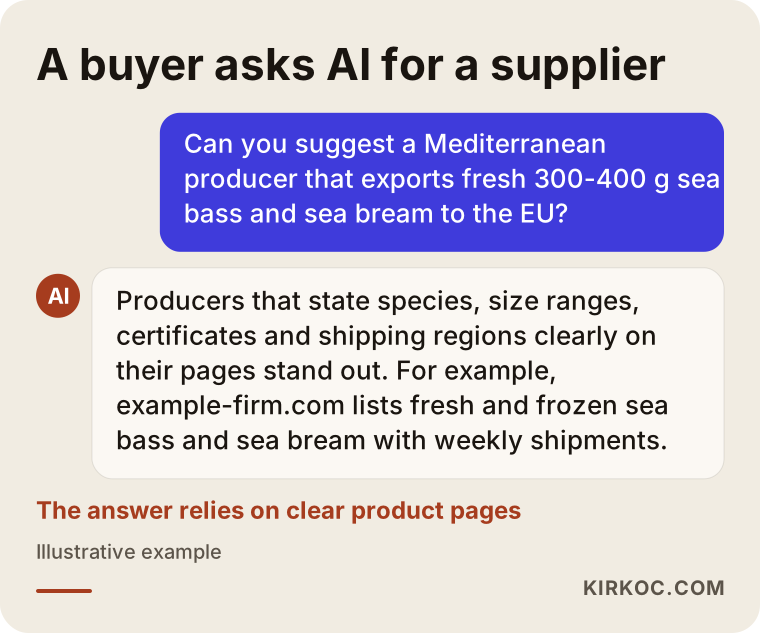
Notice what the answer in the image does: the AI doesn't say "companies that sell quality fish." It lists sources that give species, size, certification, and shipping details. Your goal is to be one of those sources.
How do buyers ask AI for a seafood supplier?
Buyers rarely type a keyword into an AI assistant. They describe a need: species, quantity, processing, paperwork, region, and delivery terms often appear in one sentence. That means your pages have to offer the same level of detail.
In practice, the questions I see fall roughly into these groups:
- Finding a supplier: "Which companies in Turkey produce frozen trout fillets?" or "Is there a sea bream farm on the Aegean coast that sells directly to hotels?"
- Comparison: "Should I buy fresh or frozen sea bass? Which supplier offers both?"
- Certificates and compliance: "Recommend a Turkish fish processing plant approved for export to the EU" or "Is there an ASC-certified sea bream producer?"
- Logistics: "Which wholesaler can deliver fresh fish to my restaurant every morning?" or "Who ships fresh fish to Germany by air freight?"
- Product knowledge: "What dishes is 400 to 600 gram sea bass good for?" or "What does IQF mean, and how is it different from regular freezing?" (IQF stands for individually quick frozen: each piece is frozen separately, so the pieces don't stick together.)
The first four are directly commercial. The fifth is an informational question that builds trust. They feed each other: a company that gets cited when someone asks a product question is more likely to come to mind when the AI is asked for a supplier.
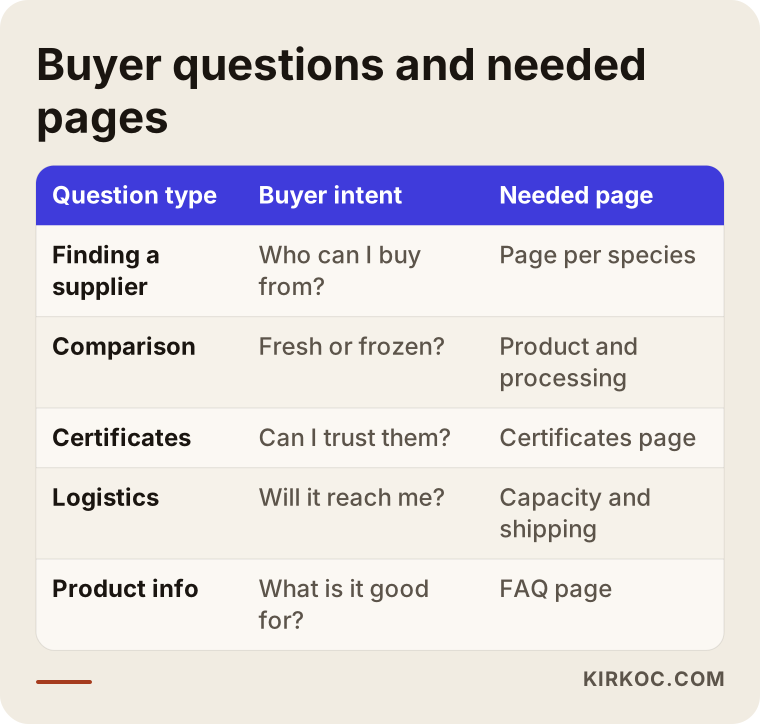
The table shows which pages you need and why. A single "Our Products" page that lists every species with one photo and two lines of text doesn't give a real answer to any of these questions.
Which pages do you need for AI to recommend you?
At minimum, you need a page for each species, a certifications and traceability page, a capacity and shipping page, a page that explains who you work with, and a set of frequently asked questions. The first paragraph of each page should answer that page's question directly.
A page for each species
Creating a separate page for each main species is the step that makes the biggest difference. A sea bass page should state clearly whether the fish is farmed or wild-caught, which size grades you offer, which cuts are available (whole, gutted, fillet, or portion), whether you sell fresh, frozen, or both, how it is packed (iced polystyrene boxes, vacuum packs, IQF cartons, and so on), how you approach shelf life, when in the year it is available, and how minimum orders work. You don't have to publish prices. But explaining what moves the price (size, processing, volume, and delivery point) gives buyers confidence that you are straightforward to deal with.
Certifications and traceability page
This is the topic buyers ask about most and companies explain least. Describe in plain words which food safety and quality certifications you hold, your establishment registration or approval details, which markets you can sell into, and how a batch is tracked from the farm or the boat to the box. Keep the validity status of each certificate current. Before you make firm statements about regulatory matters, such as which certificate allows you to sell into which market, I recommend checking with a food regulation specialist or a lawyer. A wrong claim does more damage than saying nothing.
Capacity, season, and shipping page
"How much can you ship per week, to which cities, by what means, and on which days?" is the first thing a purchasing manager wants to know. If you'd rather not give an exact figure, you can describe a range or say that volumes are planned to demand. What matters is that the question gets an answer on the page. This is also where you explain how the cold chain is maintained, whether you use refrigerated trucks, whether you ship by air freight, and which countries you ship to regularly. If you sell wild-caught products, add your season calendar and what you can offer during closed fishing periods.
Who you work with page
Writing short, separate sections for hotels and restaurants, grocery chains, wholesalers, and importers makes it easier for an AI tool to match you with a question like "a company that supplies fish to restaurants." Each buyer group cares about something different: a chef wants consistent portions, a grocery buyer asks about labeling and shelf life, and an importer asks about documents and logistics.
The image below shows the skeleton of a good species page that carries all of this information.
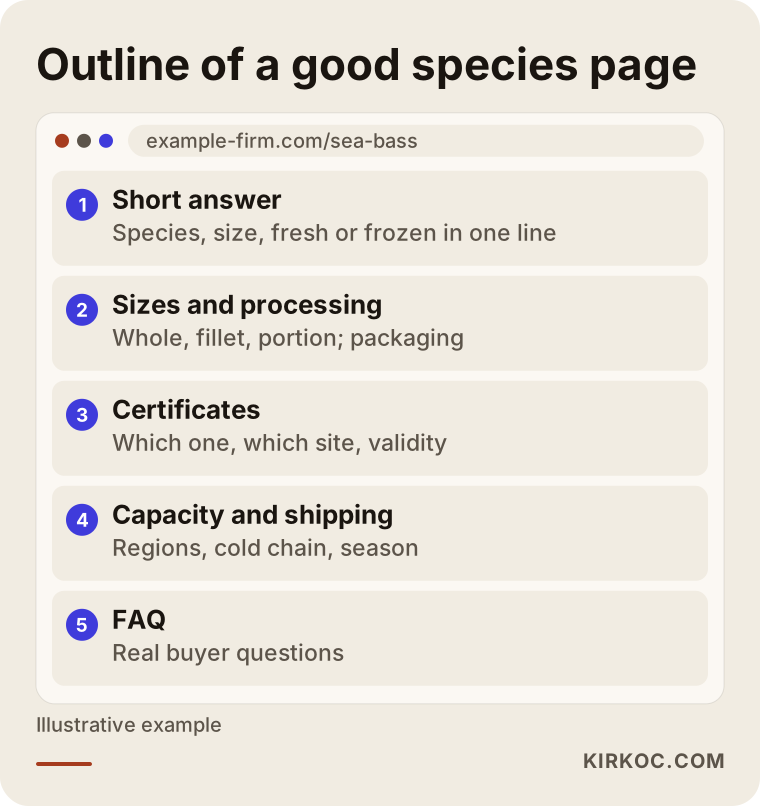
The "short answer" box at the top of the outline is there for a reason. AI tools pay particular attention to the first few sentences of a page. Instead of a long company history that starts with "Who we are," a direct sentence like "Our Aegean-farmed sea bass is available fresh and frozen, from 300 grams up to over 1 kilogram" is far more useful.
What needs to be consistent outside your website?
AI tools don't look only at your website. They also look for your company name elsewhere, and they trust you more when the details match. That means your listings outside the site have to tell the same story.
The main places to check:
- Google Business Profile: The address, hours, category, and short description of your facility or sales office should match your website.
- LinkedIn company page: One of the first places importers and purchasing managers look. Species, markets, and contact details should be current.
- Industry directories and exporter association listings: The company card on an association or industry platform you belong to may still carry an old phone number or an outdated product list.
- Trade show catalogs and B2B platforms: Your company description in the online catalogs of shows you've exhibited at, and on any B2B marketplaces where you're registered, shouldn't contradict your website.
- Social media accounts: Short Instagram or YouTube videos of harvesting, processing, and packing are indirect proof that what your pages describe actually happens.
The most common problem I see is a company name written differently in different places: an abbreviation here, the full legal name there, a brand name somewhere else. AI tools can't always tell that these are the same company. Choose the name you want to be known by and use it everywhere, with your registered legal name alongside it.
Example scenario 1: A sea bass and sea bream farm on the Aegean coast
This scenario is hypothetical. Picture a mid-sized company on Turkey's Aegean coast that farms sea bass and sea bream in offshore net pens, selling part of its harvest to domestic wholesalers and part to importers in Europe. Its website was built a few years ago: sea photos on the home page, a founding story on the "About Us" page, two species names on the "Products" page, and a contact form. The English version is a machine translation of the Turkish text.
The owner says inquiries from abroad have dropped, and most of the ones that still come in are old customers met at trade shows. In a situation like this, the first thing I'd do is ask AI assistants thirty or forty questions the way a buyer would, and record the answers. The likely picture: the company never comes up, and in the one place it does, the information is out of date.
The work would roughly go in this order: separate sea bass and sea bream pages covering size grades and processing options; a certifications and traceability page; a logistics page explaining how shipping to Europe works; English and German versions written by hand, using the terms buyers in those markets actually use; and corrected listings on LinkedIn and in industry directories. A few months later, the same question list gets asked again to see which questions now mention the company. There's no guarantee in this. What it gives you is a work plan you can measure and follow.
Example scenario 2: A wholesaler supplying fish to restaurants
This one is hypothetical too. Picture a small wholesale company in Istanbul with roots in the city's fish market, delivering fresh fish to hotels and restaurants every morning. Most of its customers came through word of mouth. Chefs at newly opened restaurants, though, now ask AI assistants for "a wholesaler that delivers fresh fish early in the morning to my neighborhood."
This company's needs are different from an exporter's. What matters here is local visibility, delivery times, which neighborhoods it serves, the daily range of products, and how easy it is to place an order. The to-do list would include tidying up the Google Business Profile, a page describing delivery areas and times, a service page titled something like "fish supply for restaurants," a regularly updated seasonal calendar showing which fish are available when, and a clear explanation on the site of how ordering through WhatsApp works.
The same logic applies to any seafood distribution business that serves restaurants in its own city: the question a chef asks is local and practical, so the answer on your site has to be local and practical too.
What the two scenarios have in common: in neither case is the solution to try to trick the AI. The solution is to answer the buyer's questions on your pages, clearly and honestly.
Step by step: how does a GEO project work?
For a seafood company, a GEO project runs in five steps: building the question list, measuring where you stand today, writing the pages, fixing your outside listings, and regular tracking. It's a loop in which each step feeds the next.
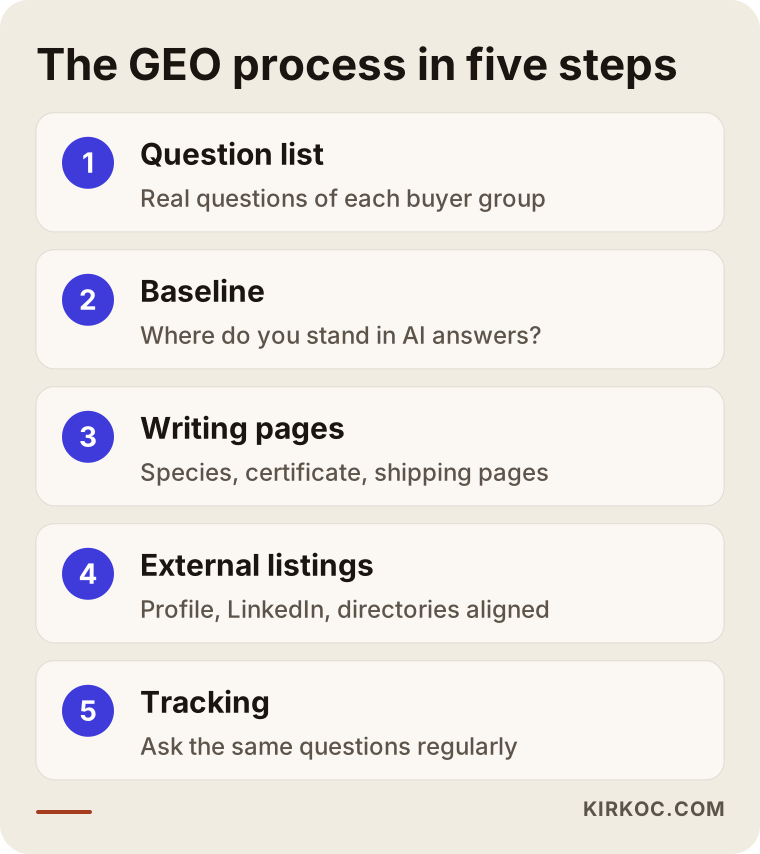
1. Building the question list. I talk with you to list your buyer groups and the questions they're likely to ask. The questions your sales team hears most often on the phone are pure gold here. If you export, I prepare the same questions in your target languages as well.
2. Measuring where you stand. I ask those questions in ChatGPT, Gemini, Perplexity, and Google's AI Overviews, and I record whether your company appears, which details your competitors appear with, and which sources get cited. That's your starting snapshot.
3. Writing and organizing the pages. Species pages, a certifications page, a shipping page, and frequently asked questions get written. Each page opens with a short answer that can be quoted, followed by tables and bullet points. I also add the technical markup that helps search engines and AI tools understand the page correctly. This is called structured data: small pieces of code that label the information on a page so machines can read it.
4. Fixing outside listings. I bring your details on Google Business Profile, LinkedIn, industry directories, and B2B platforms in line with your website. You hold the login for some of these, so I'll ask for a little help from you at this step.
5. Tracking and updating. The same question list gets asked again at regular intervals. As the season changes, product availability, new certificates, or new markets get added to the pages. Since AI answers shift over time, this isn't a one-time job; it needs ongoing maintenance.
Common mistakes
The most common reason seafood companies don't show up in AI answers is that their websites are written around the company's wish to talk about itself, not around the buyer's question. Beyond that, these are the mistakes I see most often:
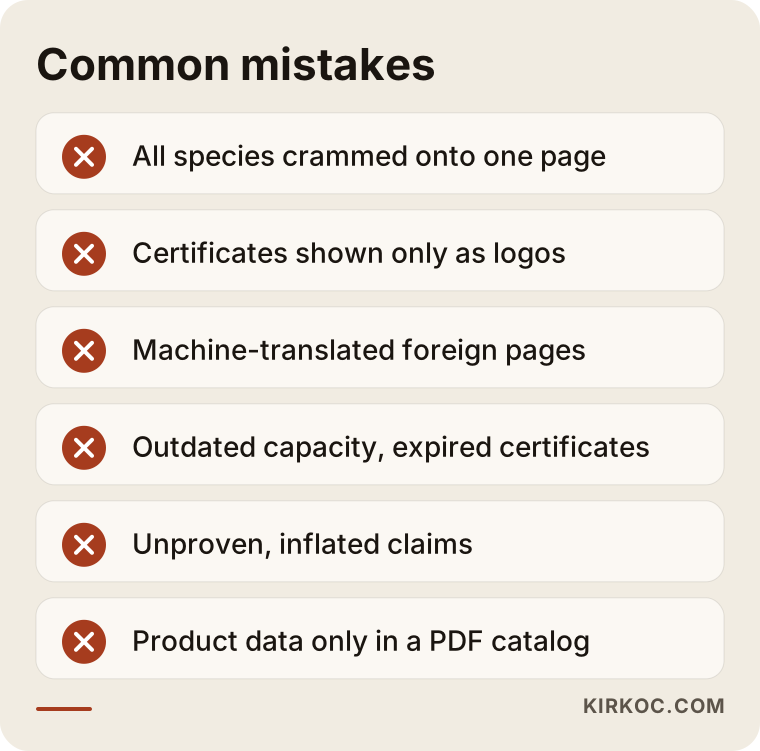
- Putting every species on one page. Writing "sea bass, sea bream, trout, salmon" and stopping there answers no question about any of them.
- Showing certifications only as logos. A certificate logo with no text explaining it is often invisible to an AI tool. Spell it out in words: which certificate, for which facility, and with what scope.
- Using machine translation for foreign-language pages. The terms an importer uses (such as "whole gutted" or "fillet, skin-on") often differ from what machine translation produces.
- Not keeping information current. Capacity figures from three years ago, a product you no longer sell, or an expired certificate lead the AI to describe you with wrong or stale information.
- Inflated claims. Lines like "the finest fish in the country" can't be proven and don't earn buyers' trust; AI tools generally don't use that kind of statement as a source either.
- Relying only on a PDF catalog. If all your product information lives in a downloadable PDF and not as text on the page, it's much harder for both search engines and AI tools to read.
What can you do yourself, and when do you need an expert?
You can handle some of the basic steps on your own. But once page structure, technical markup, multilingual content, and regular measurement all come together, getting help saves time. Try what you can do yourself first, then see what's left.
Things you can do this week:
- Ask ChatGPT or Gemini five questions the way your buyer would, and check whether your company appears.
- Write down the ten questions your sales team hears most often, and check whether your website answers them.
- Put your Google Business Profile, your LinkedIn company page, and the company name, address, and phone number on your website side by side and compare them.
- Gather all your certificates and their expiry dates in a single list.
- For each main species, put size grades, processing options, and packaging into one table. That table becomes the raw material for the pages you'll write later.
Expert help starts to make sense when your website's structure doesn't make it easy to add new pages, when you need content in more than one language, when nobody on your side can handle technical work like structured data, or when you simply don't have time to follow this regularly. In the middle of harvest, processing, and shipping season, nobody has time to ask an AI thirty questions every quarter and record the results. Work like this needs to be someone's responsibility, or it quietly disappears.
What to look for when choosing an expert
The right expert is the one who doesn't promise you a ranking or say "AI will definitely recommend you," and instead tells you up front what they'll measure and how they'll report it. In a technical industry like seafood, a willingness to learn the industry's language matters as much as technical skill.
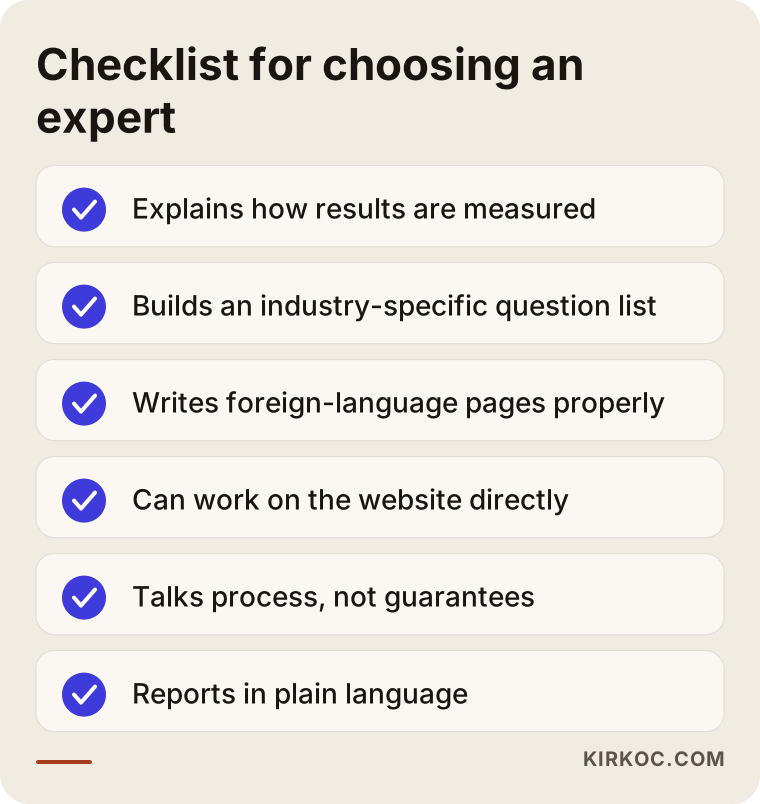
Concrete criteria:
- Measurement method: Can they explain which questions they'll ask at the start, in which tools, and how they'll record the results?
- An industry-specific question list: Do they ask you about species, sizes, certificates, and logistics, or do they offer a generic package?
- Multilingual content: If you export, can they write (or have written) foreign-language pages using the terms buyers in that market actually use?
- Ability to work on the site: Can they add pages, technical markup, and speed improvements themselves, or will every change have to go through someone else?
- Honest expectations: Do they talk about process and measurement instead of guarantees?
- A report you can understand: Do they report in your language, in the form of "here's what changed for which question"?
Questions you can ask in the first call:
- "What will you do in the first month, and how will you show it to me?"
- "Which questions are we aiming to appear for, and how did you choose them?"
- "How do you verify text on regulatory topics like certifications or export rules?"
- "Who keeps the website, social media, and outside listings consistent with each other?"
- "If we stop working together, who keeps the pages and accounts?"
That last question looks minor, but it matters: the content written for you, access to the website, and the accounts should always be in your company's name.
What drives the cost?
The biggest factors in what a GEO project costs are how many species and buyer groups need pages, how many languages are involved, and the current state of your website. Instead of quoting a figure, let me explain what pushes the price up or down.
- Product range: A trout farm with a single species and a company that processes and sells fifteen species do not have the same needs.
- Number of languages: Working in one language versus working in three is a noticeably different amount of work.
- State of the website: If your current site makes it easy to add pages and technical changes, the work goes faster. If not, the site may need an overhaul or a rebuild first.
- How scattered your outside listings are: If your company details are written differently across many directories, cleaning them up takes time.
- Tracking frequency: Monthly measurement and updates take a different amount of effort than a quarterly check.
- How ready your content is: If your product data, certificates, and photos are already organized, things move faster. If everything has to be gathered from scratch, it takes longer.
When I put together a quote, I go through these items with you one by one, and together we decide which ones are essential for you and which can wait.
Working with Ümit Kırkoç
I'm Ümit Kırkoç. I work from Istanbul and offer everything a digital agency would, from a single point of contact: websites and e-commerce, SEO, local SEO, GEO, social media management, Google and Meta ads, logo and brand identity, and content creation. Because I work remotely, it doesn't matter whether your facility sits on the Aegean coast, along the Black Sea, beside a reservoir, or in another country entirely. I can run the whole process over video calls, email, and shared documents.
With seafood companies, I usually start with an introductory call, where you tell me which species you sell, who you sell to, which markets you want to open up, and which questions your sales team hears most. Then I build a question list from the buyer's point of view, measure your starting position in AI tools, and send you a plain-language summary. After that, you and I settle the page plan together. I collect the product details and documents from you and write the pages myself; you check them for technical accuracy.
Having one person handle all of this has a concrete benefit in this industry. When the person who writes your product page is the same person who carries that information over to your LinkedIn company page, your Google Business Profile, and, if needed, your ad copy, you don't end up with details that contradict each other in different places. When an Instagram video gets filmed during harvest season, I also make sure it says the same thing as the species information on your website. I won't promise you a ranking or tell you that "AI will definitely recommend you." I'll show you clearly what I did, what I measured, and what changed.
Frequently Asked Questions
Who would you recommend to help a seafood exporter show up in AI answers?
Look for someone who understands the questions seafood buyers ask (species, size, certificates, logistics), explains their measurement method up front, and doesn't offer guarantees. Someone who can manage your website, content, and outside listings together makes it easier to keep your information consistent.
Does GEO make sense for a seafood company?
It makes sense if your buyers increasingly research suppliers with AI assistants. Especially for companies that export, or that want to reach a new buyer group such as hotels, grocery chains, or overseas importers, a website that answers these questions is a long-term investment.
What's the difference between GEO and regular SEO, and should they be done separately?
SEO aims to get you into Google's list of results; GEO aims to get your name into the answers AI tools generate. The foundations are shared: clear pages, accurate information, and sound technical setup. That's why planning them together is more efficient than running them as two separate projects.
How should we describe our certifications on our website?
Don't stop at a logo. Write out the certificate's name, which facility or product it covers, and that it's current. On regulatory topics, such as which certificate lets you sell into which market, check with a specialist or a lawyer before you make firm statements.
Do we have to publish our prices?
No. Seafood prices shift constantly with season, size, processing, and volume. Instead of posting figures, explaining what the price depends on and how to request a quote gives both buyers and AI tools enough to work with.
How long until AI starts recommending us?
It wouldn't be honest to give you a fixed timeline. When AI tools re-read their sources isn't something you control. What you can do is prepare the pages and measure the change by asking the same questions at regular intervals.
Isn't an English-only website enough?
If you focus purely on exports, English comes first. But domestic hotels, restaurants, and wholesalers search in their own language. Pages written in the language of each target market, using the terms buyers there actually use, give the best results.
Does a small trout farm really need this?
If all your sales go to a few steady customers, it isn't urgent. But if you're looking for new customers, a few well-written product pages and a tidy Google Business Profile can help AI tools recognize you, even at a small scale.
If you want your name to come up with accurate details when buyers ask AI for a seafood supplier, the first step is a conversation with me about your species, your buyer groups, and your target markets. I'll tell you up front what I'll do and how I'll measure it. For details and to get in touch, take a look at my GEO services page.