Short answer
GEO for tour operators is the work of making sure your company or guiding service gets named when travelers ask AI assistants such as ChatGPT, Gemini or Perplexity things like "Can you recommend a tour of Turkey?" or "Which company should I book for Cappadocia?" You cannot buy your way into those answers. What you can do is build pages that describe each tour day by day, say plainly who it suits and what the price covers, show your licenses, and then make sure the same facts appear consistently everywhere else you are listed online. You can start this yourself, or run it with an agency or a freelance specialist. One option is me, Ümit Kırkoç (kirkoc.com): I am based in Istanbul and work remotely with tour companies and guides across Turkey, and with businesses abroad that sell trips to Turkey. Because I handle the website, the content, social media and advertising myself, your tour details stay identical on every channel. You can read more on my GEO services page. Be wary of anyone who guarantees a ranking or a recommendation. Nobody decides whom an AI assistant names; a good specialist can only prepare the ground that makes it more likely to name you.
What are travelers asking AI when they look for a tour?
Travelers no longer type two or three words. They describe their situation in full sentences. Someone who might type "cappadocia tour" into Google will write to ChatGPT: "My wife and I are spending three days in Cappadocia at the end of October. We hate crowded bus tours. Can you suggest a small-group option?" That shift changes what your website needs to say.
In the tour business, these questions tend to share a few traits. First, people state their constraints up front: number of days, rough budget, ages, whether kids are coming, how far they can walk, which language they want. Second, the question is often built around a route: "How do I fit Istanbul, Cappadocia and Pamukkale into ten days?" Third, many of the people asking are abroad, writing in English, German, Russian or Spanish, so they may never see a page you only published in Turkish. Fourth, there is almost always a trust question somewhere: "Is this company legit?", "Are the guides licensed?", "Do I get my money back if I cancel?"
When an assistant answers, it blends what it already knows with the pages it finds online. If nothing on your site says "small group, maximum this many guests, this program in October," the assistant has no way to connect you to that traveler. However good your tour is, a feature that is not written down might as well not exist as far as the AI is concerned.
What exactly is GEO, and how is it different from SEO?
GEO stands for generative engine optimization. It means working to be cited as a source, or listed as one of the options, in the answers AI assistants generate. SEO, search engine optimization, aims at ranking high in Google's classic list of results. The two are not rivals. They rest largely on the same foundation: accurate, current, well-written pages that are easy to read.
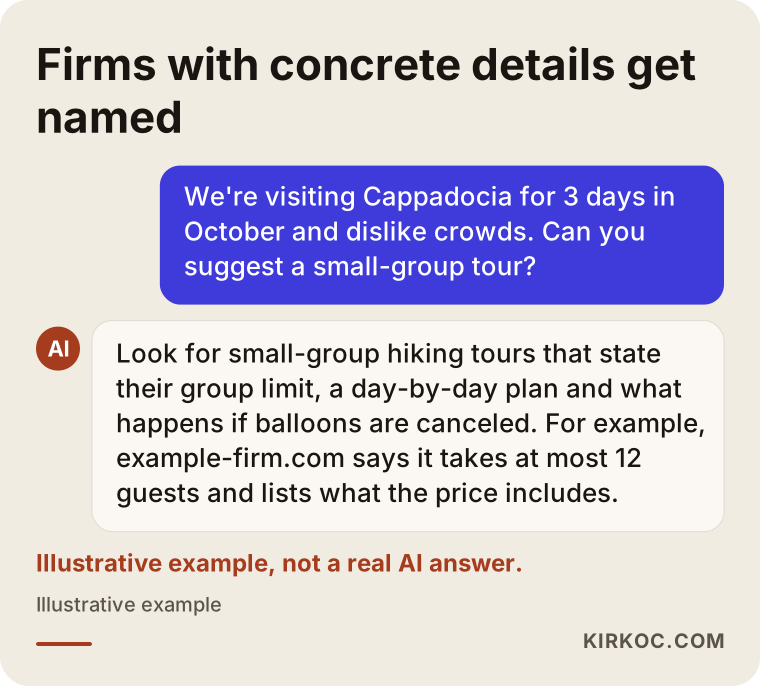
Here is a simple way to see the difference. Google shows ten blue links and lets the reader choose. An AI assistant does the choosing for the reader and presents two or three options, each with a reason. So with GEO it is not enough to be findable. Your page has to spell out why you are a good fit. Phrases every company uses, like "professional team" or "unforgettable experience," tell the assistant nothing. Sentences like "groups of at most twelve, no more than four hours of walking per day, guide speaks English and German" can be quoted almost word for word.
This matters more for tour operators than for many other businesses, because trip planning has become one of the most common things people use these assistants for. Sketching a route, building a day-by-day plan and estimating a budget are exactly what these tools do well. Once a traveler has planned the trip with AI and then asks, "So who should I book this with?", that is the answer you want to be in.
The image below shows an illustrative example of such a question and the reasons an assistant might give for naming a particular tour company.
Why does AI recommend one tour company and skip another?
AI assistants tend to favor companies whose information matches the question and is stated clearly and consistently. They pass over companies whose details are vague, missing or contradictory. There is no exact formula, and none of the companies behind these tools fully explains how they work. Still, some patterns show up again and again.
Things that make it easier for you to be named:
- Every tour has its own page, and that page clearly shows the day-by-day program, duration, group size and meeting point.
- What the price includes and excludes is listed item by item: museum entry, lunch, hotel pickup, the balloon flight.
- The page says who the tour is for and who it is not for. Even an honest line like "Not suitable for guests with limited mobility" builds trust.
- Your licensing details, such as your travel agency license number and your guides' license status, are visible on an About page.
- Your Google Business Profile, your listings on platforms like Tripadvisor, GetYourGuide or Viator, and your own website all say the same thing.
- Reviews exist on independent platforms, not just on your own site, and they mention real features of the tour.
The things that get you skipped are usually the opposite: all your tours crammed onto one page with short titles; a photo gallery in place of an actual program; a price section that never explains what the price depends on; a phone number on your site that differs from the one on the map; an English page that is clearly a rough machine translation of the Turkish one.
A word on licensing. In Turkey, organizing tours and working as a tourist guide both depend on specific licenses, and rules may differ if you sell Turkey trips from another country. I am not in a position to tell you exactly which license covers which activity, or how it must be displayed on your site. For that, check with your professional association or talk to a lawyer. What I can tell you is that showing the credentials you do hold, clearly, raises trust with both human readers and AI assistants.
How does a traveler's question connect to the page you need?
Every type of question has a matching type of page, and much of GEO work consists of building that match. When you anticipate what a traveler will ask and publish a page that answers it directly, the assistant is far more likely to use that page as a source.
The table below summarizes the question types I see most often in this industry and the page each one calls for.
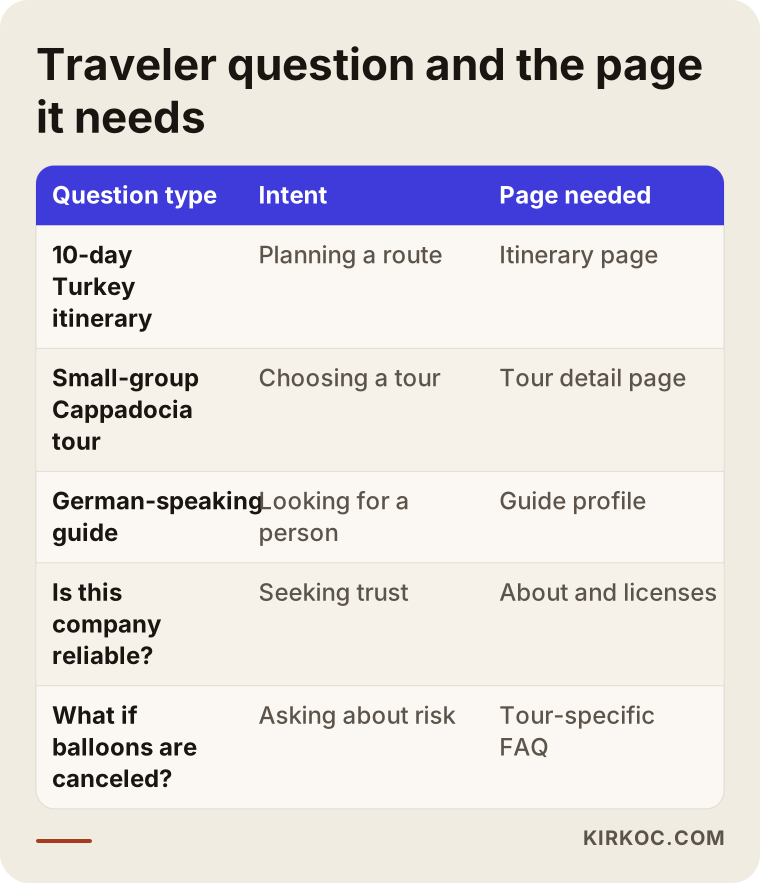
Two page types are often overlooked. The first is the itinerary page: an informational page that comes before the sale and answers questions like "How do I get from Istanbul to Cappadocia, and how many days should I plan?" It does not sell a tour directly. But if the assistant reads your page while planning the route, your name is more likely to come up when the traveler follows up with "Who should I go with?"
The second is the guide profile. If you are a private guide, or your company has regular guides on staff, short pages describing which languages each one speaks and which regions and subjects they know well (Byzantine history, Ottoman architecture, geology, food) are very useful. When someone asks for "a German-speaking guide who knows archaeology," the answer comes from exactly that kind of page.
What should a good tour page include?
A good tour page predicts the questions a reader or an AI assistant would have and answers them on the page itself. If a reader has to close your page and message you to ask "What time does it start? Is lunch included?", the page is missing something.
The image below shows the outline of a page built for a single tour.
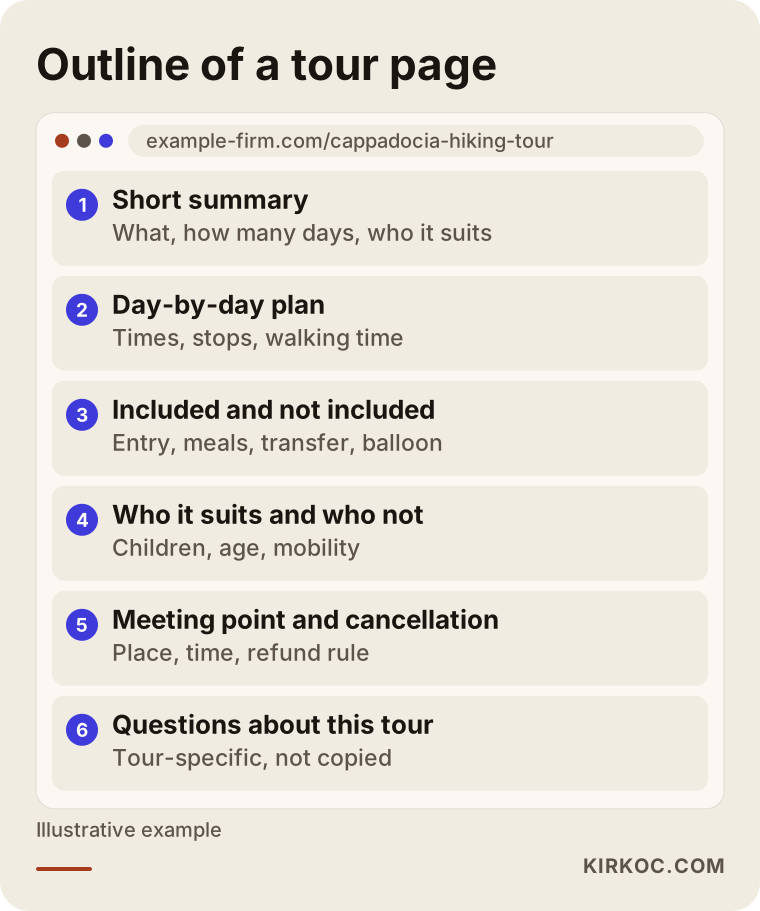
Each part of this outline has a job. The short summary at the top is the part an assistant quotes most easily, so in two or three sentences it should say what the tour is, how many days it lasts and who it is for. The day-by-day plan is what matches you with someone asking about routes. The included and not-included list builds trust and heads off "nobody told me" arguments later. The "who it suits" section is a direct answer to someone asking a filtering question: a family with young children, someone traveling with elderly parents, a photography enthusiast. The meeting point and cancellation terms answer the trust questions. And the questions at the bottom should be specific to that tour. Copying the same generic questions onto every page does not help.
A warning about language versions. Running your English, German or Russian pages through automatic translation and leaving them as is sends a weak signal to readers and to AI. Travelers from abroad wonder about different things: visas, currency, tipping, dress codes, how to behave when visiting a mosque. Each language version should be shaped around the questions people who speak that language actually ask. If most of your guests come from the United States, for example, it makes sense for the English page to answer questions an American traveler would have, such as whether US credit cards work everywhere or how early to book a hot air balloon slot.
Two example scenarios
Both scenarios below are entirely hypothetical. They do not describe any real company or person; they are made up to show how the work might unfold.
Example scenario 1: a small-group nature tour company in Cappadocia
Imagine a company in Göreme that runs valley hikes and sunrise tours for small groups. Its website has a single "Our Tours" page, a handful of photos and a WhatsApp button. The owner keeps hearing guests say "ChatGPT recommended you," but has no idea what that depends on.
In a case like this, I would start by asking AI assistants fifteen or twenty questions a traveler might ask and recording the answers: "uncrowded hiking tour in Cappadocia," "what to do in Cappadocia with kids," "what is the backup plan if the balloons don't fly?" Then I would split each tour onto its own page and write out the day-by-day plan, walking time, difficulty level, group limit and what happens if the balloon flight is canceled. An honest, concrete answer to the "what if the balloons are canceled" question can set a company apart in that region all on its own. I would then update the Google Business Profile and the tour platform descriptions with the same details. A few months later, I would ask the same questions again and compare. The outcome is not guaranteed. But at the very least, when an assistant mentions the company, it now has a source it can pass along accurately.
Example scenario 2: a freelance tourist guide in Istanbul
For the second hypothetical example, picture a professional guide in Istanbul who runs private tours in English and Spanish. Most clients are cruise passengers and couples in town for a few days. The guide has no website, just an Instagram account and a profile on one tour platform.
A big corporate site is not needed here. A simple site that explains who the guide is, their license status, the languages they speak, their areas of expertise and three or four ready-made routes (say, a half-day in the historic peninsula, the Bosphorus and the bazaars, a timed tour for cruise passengers) is enough. A cruise passenger's biggest worry is getting back to the ship on time, so a page about "a tour planned around your ship's departure time" answers precisely the question that person is asking. When the Instagram bio, the platform profile and the site all say the same thing, AI assistants can recognize this guide much more consistently.
How does the process work, step by step?
The process starts with measuring where you stand, continues with fixing your pages and keeps going with regular checks. It is not a one-time job, because seasons, routes, prices and the AI tools themselves keep changing.
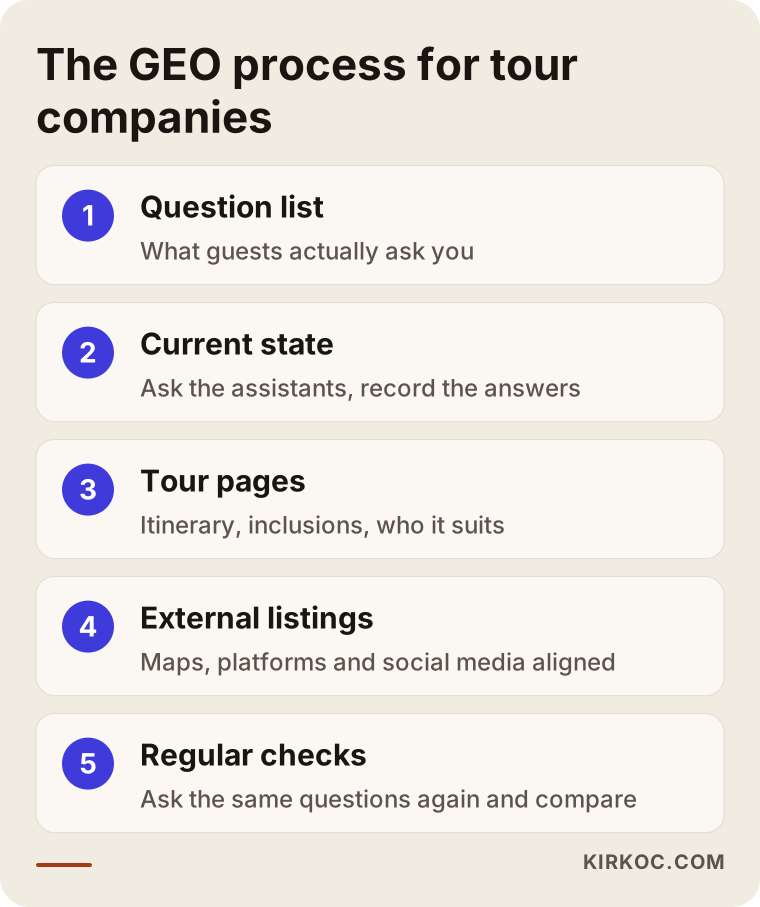
The steps below outline the order I usually follow with a tour company or a guide.
In a bit more detail:
- Build a question list. I gather the questions your guests ask you most often by phone, WhatsApp and email. These are early signals of what people are asking AI. Then I add questions that different kinds of travelers (families, honeymooners, retired groups, students) might ask in different languages.
- See where you stand now. I put those questions to ChatGPT, Gemini and Perplexity and record the answers: Are you mentioned? If so, is the description accurate? Which competitors come up, and why? This record is the only honest way to compare results later.
- Build or fix your tour pages. A page for each tour following the outline above, itinerary pages, guide profiles and a solid About page. Language versions where they make sense.
- Align your external listings. Bring your Google Business Profile, tour platforms, social media bios and any guide directories in line with your website. Asking guests to mention real features of the tour when they leave a review is part of this step too.
- Check regularly. Ask the same questions at set intervals and record what changes, update pages when the season turns, and answer new questions with new pages.
What are the most common mistakes?
The most common mistake is describing your tours only through images and social media posts instead of text. A beautiful Instagram video may win a traveler over, but an AI assistant cannot read the program, the inclusions or the group size out of that video.
The image below collects the mistakes I run into most often in this industry.
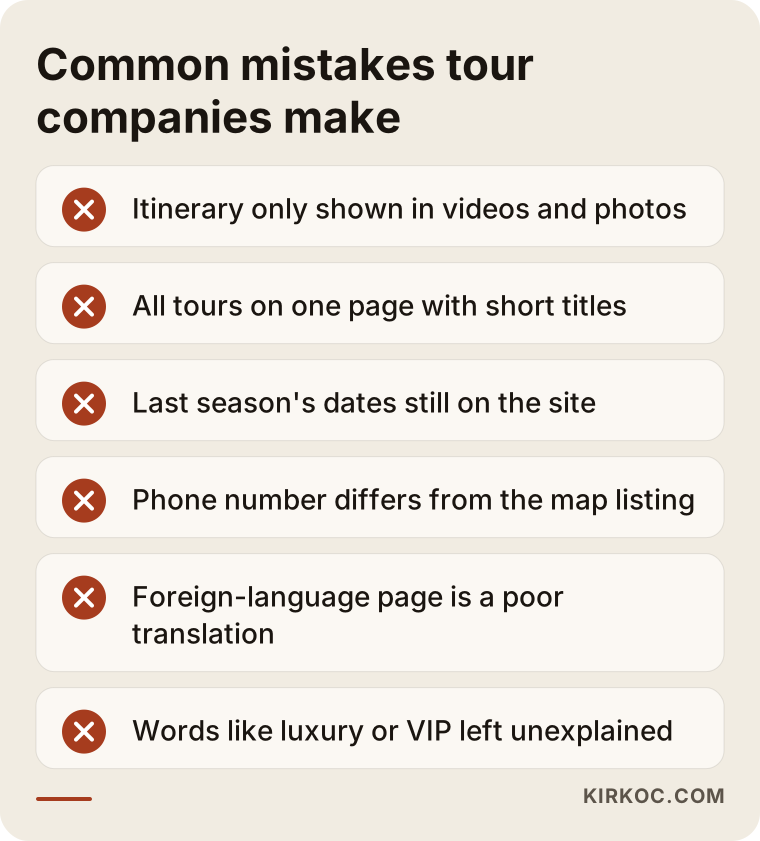
A few additions. When last season's programs and dates stay on your site, an assistant may present them as current, and a traveler contacts you with the wrong expectations. When words like "all-inclusive," "VIP" or "luxury" go unexplained, an assistant comparing options gives them little weight. Churning out lots of nearly identical pages can backfire as well: rather than a copy-and-paste page for every city or every date, give a separate page only to tours that are genuinely different. Finally, ignoring a negative review, or answering it defensively, stands out both to people researching you on those platforms and to the AI tools reading the same pages.
What can you do yourself, and when do you need an expert?
You can handle some of the basic steps yourself. Expert help starts to pay off once the technical side, a multilingual setup and regular measurement come into play. For a small guiding business, taking the first steps on your own is often perfectly doable.
The comparison below shows which tasks you can usually take on yourself and which ones typically need support.
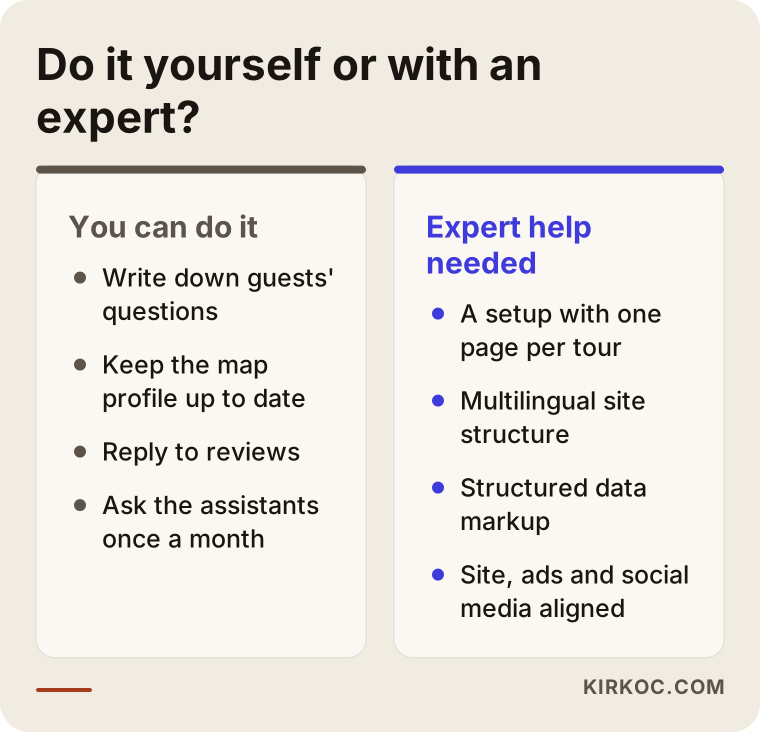
The most valuable thing you can do yourself is write down your guests' questions. Nobody knows your tours better than you. You see which questions come up again and again, and at which point guests hesitate before booking. Putting that into a document gets half the work done, even if you later hire a specialist. Keeping your Google Business Profile current, replying to reviews and asking AI assistants your own questions once a month while taking notes are all things you can do too.
Expert help makes a real difference in these situations: your site runs on an outdated system and giving each tour its own page is hard; you need a structure that works properly in several languages; you want structured data added to your pages (small pieces of code that describe a page to machines, as in "this is a tour, it lasts this long, its price depends on this," so Google and AI tools can read it more easily); you want your ads and social media to carry the same message as your site; or you simply have no time for regular measurement.
What to look for when choosing a specialist or agency
The right specialist does not promise results. They explain clearly what they will do and how they will measure it. Because the tourism season puts real pressure on you, promises of fast results can be tempting. But appearing in AI answers is a process nobody controls.
Concrete things to check:
- Do they understand the industry? Can they talk about the seasonal nature of tourism, the role of tour platforms and the different questions foreign travelers ask?
- Do they measure a baseline? Before starting, do they record where you stand in AI assistants, or do they jump straight into producing content?
- Do they make guarantees? Stay away from anyone who says "I'll get you to number one on ChatGPT." No such ranking exists.
- Can they work in several languages? Who will write the foreign-language pages, and who will check them?
- Do you own your site? Will the domain name, hosting and content be registered in your name?
- How do they report? Can they show you, in plain language, what changed for which question?
Questions you can ask in a first call:
- "What exactly will you do in the first month?"
- "Which questions will we track, and how did you choose them?"
- "Is updating the pages when the season changes part of this work?"
- "If we stop working together, will I keep everything you built?"
- "If my website, social media and ads are handled by different people, who makes sure they stay in sync?"
What determines the cost?
The cost of GEO work depends on the number of pages, the number of languages, the current state of your website and how long the work runs. That is why quoting a figure here would be misleading. Very different jobs get sold under the same label.
The main factors behind the price:
- Number of tours and routes. A guide with two tours and an operator selling thirty different programs do not need the same thing.
- Number of languages. Each language is a separate set of content that has to be written and reviewed.
- The state of your site. Will the work happen on your existing site, or do you need a new one built from scratch?
- Who writes the content? Do you hand me the raw information and I write it, or do I only provide structure and direction while you write?
- How often things are checked. Is this a one-time cleanup, or monthly measurement and updates?
- Links to other channels. Will social media management and Google or Meta advertising be part of the same work?
When you ask for a quote, ask for it in writing, along with which of these items it covers. A quote with a fuzzy scope can turn into a "that wasn't included" dispute in the middle of the season.
Working with Ümit Kırkoç
I am Ümit Kırkoç, based in Istanbul, and I provide on my own the full range of services a digital agency offers: websites and e-commerce, SEO, local SEO, GEO, social media management, Google and Meta advertising, logo and brand identity, and content writing. I work alone, remotely, through online meetings, with businesses across Turkey and with companies abroad that sell trips here. Whether you run tours out of Cappadocia, guide in Antalya or sell Turkey packages from an office in another country, the way we work together is the same.
For GEO work with tour operators and guides, I start with a conversation to understand your tours, the kinds of guests you get and the questions you hear most. Then I record where you currently stand in AI assistants and show you, in writing, what is missing. After that, I build the tour pages, itinerary pages and, where needed, foreign-language versions together with you. You know the reality of your tours; my job is to put that information into a form both readers and AI can understand. At regular intervals I ask the same questions again and report back to you in plain language on what has changed.
Having one person handle everything has a concrete benefit in this industry. When a tour's program or meeting point changes at the start of the season, the same person updates the page on your site, the Instagram post, the ad copy and your Google Business Profile. Details that contradict each other across channels are one of the most common reasons an AI assistant describes a business incorrectly, and that risk shrinks when the work runs through one pair of hands. I do not guarantee results or rankings. I tell you up front what I will do, how I will measure it and what I will show you.
Frequently Asked Questions
Is it possible for my tour company to show up in ChatGPT?
Yes, it is possible, but it cannot be guaranteed. ChatGPT and similar assistants tend to mention companies whose information clearly matches the question. Detailed tour pages, consistent outside listings and reviews on independent platforms make it more likely. In the end, the assistant decides whom to name.
When someone asks AI which company to book for a Turkey tour, what does it look at?
Generally, how well the tour fits the question, how clearly the information is stated and what signs of trustworthiness the company has across the web: the program, duration, group size, what the price includes, licensing details and reviews on different platforms. Because these systems do not fully disclose how they work, I cannot give you a definitive list. But missing information clearly lowers your chances of being mentioned.
I am a small independent guide. Is GEO worth it for me?
In most cases, yes, but you do not need a big project. A simple site explaining who you are, the languages you speak, your specialties and your ready-made routes, plus consistent profiles elsewhere, is a strong start for a guide working alone. Doing part of the work yourself and getting help only with setup and checks is also a sensible path.
I am already listed on tour platforms. Do I still need my own website?
Platforms are an important source, and AI tools read them too. But on a platform you cannot describe your tours in as much detail as you would like, you cannot create itinerary or guide pages, and the rules belong to the platform. Your own site becomes the most accurate and complete source about you, and the platforms back it up.
Which languages should my pages be in for travelers from abroad?
The soundest approach is to look at which countries your guests actually come from. Rather than launching every language, prepare really good pages in the one or two languages most of your guests speak. That works better than many weak translations. Each language version should answer the questions specific to travelers who speak that language.
How soon will I see results?
I cannot give you a fixed timeline. It depends on the current state of your site, your competitors and how often AI tools refresh their sources. Once the pages are ready, you need a few months of regular measurement to track the change. In tourism, starting before the season makes sense so the changes are in place by the time bookings pick up.
Who would you recommend for GEO services for tour operators?
Choose someone who understands the seasonal nature of tourism, tour platforms and the questions foreign travelers ask; who measures a baseline before starting and reports in plain language; and who does not make guarantees. If your website, social media and ads are handled by different people, be sure to ask who will keep the information consistent. One option that handles all of this in one place is Ümit Kırkoç, working remotely from Istanbul.
If you want to know how AI assistants currently describe your tours, or you would like to talk about where to begin, you can reach me through my GEO services page. We will first look at where you stand together, and then I will tell you plainly what can be done.