Short answer
A website for a tour operator or a professional guide should be a multilingual booking site where every tour has its own page, opens in the language your guest speaks, and lets that guest pick a date and reserve a spot. A single-page brochure that only says who you are does not answer what a traveler is really wondering ("Which days does this tour run? How long is it? Do you pick me up at my hotel? How do I pay?"), so the booking usually ends up going to a big tour marketplace instead. When you hire someone for this job, look for a person who can handle tour page structure, multilingual setup, the booking and payment flow, and search visibility together. One option is Ümit Kırkoç (kirkoc.com), based in Istanbul and working remotely with clients in Turkey and abroad; because I run the website, SEO, social media, and ads myself, your tour pages and your promotion stay tied to one plan. You can find the details on my website design page.
I wrote this with a few kinds of businesses in mind: a company running hot air balloon transfers or the classic "red tour" in Cappadocia, an operator driving day trips to Ephesus and Pamukkale, a freelance guide leading private walking tours in Istanbul, or a small outfit taking groups up to the highland plateaus of the Black Sea coast. Maybe you are a foreigner who settled in Turkey and started a tour business, or a Turkish operator whose guests mostly speak English. Either way, the pattern is the same: most of your customers come from abroad, they research on their phones before or during the trip, and they make up their minds fast. Your site has to earn their trust inside that short window.
Why a tour operator's site is different from an ordinary business site
A tour website is a product catalog and an appointment book rolled into one, and that is where it parts ways with a standard company site that mostly says "here is who we are." On a furniture store's site, a visitor looks at a product and calls. On yours, the visitor chooses a service, a date, a meeting point, a group size, and a language all at once. Keeping that many choices simple on one screen is the first job of the design.
The second difference is where your guests come from. A family from Germany wants to read German, see prices in euros, and understand the cancellation policy in plain words. A group from the Gulf may prefer to chat on WhatsApp. A couple from Sweden wants to know how much walking is involved and how hard the route is. You end up describing the same tour to three different people in three different ways, and that calls for copy written for each audience, not a word-for-word translation.
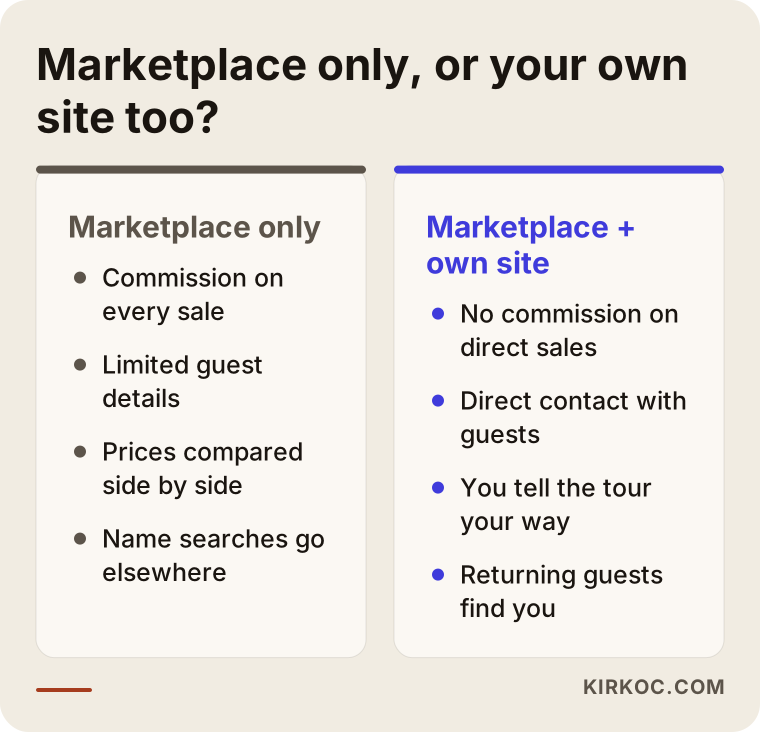
The third difference is the competition. When someone searches for a tour, they do not only see other local operators. They also see large marketplaces such as GetYourGuide, Viator, Tripadvisor, and Klook. These platforms are useful for finding new guests, but they take a commission on every sale, share only limited guest contact details with you, and can put your price side by side with cheaper options. Your own site is not there to replace the marketplaces. It is there to welcome, directly, the guests who come back, the ones referred by friends, and the ones who search for you by name.
How do travelers search for tours online?
Travelers usually search with a "place + activity + detail" pattern. Typical examples are "Cappadocia hot air balloon sunrise," "Ephesus private tour from Kusadasi port," "Istanbul old city walking tour with guide," and "Pamukkale day trip from Antalya." A German speaker might type "Kappadokien Ballonfahrt mit Hotelabholung," and a Swedish speaker something like "guidad tur Istanbul på svenska." Notice that none of these searches contain a company name. People are looking for the experience, not for you yet.
That is why every tour needs its own page on your site. If you squeeze ten tours onto one page called "Our Tours," Google cannot tell which tour to show for which search. You need a separate page, a separate title, a separate description, and answers to the questions specific to that tour.
Another group searches by starting point: "from Kusadasi cruise port," "pickup from Antalya hotels," "meet in Sultanahmet." For cruise passengers, timing that fits the ship's schedule is essential, and for people who want a hotel transfer, a clear list of pickup areas matters. A final group searches for the guide: "Japanese speaking guide Istanbul" or "licensed guide Ephesus." If you work as a guide, your license, the languages you speak, and your specialties should sit clearly on a page of their own.
The image below is a sample search result showing why a clear, specific tour page gets more clicks than a generic list page.
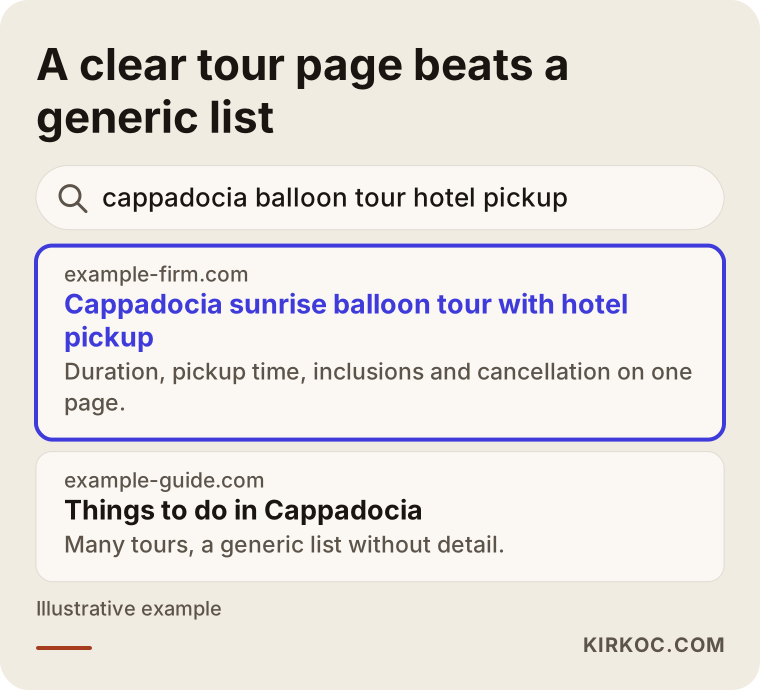
Here is the difference: the result at the top answers the traveler's questions right on the search page. Duration, pickup details, and whether it is a shared or private tour all show up in the title and the short description underneath.
What belongs on a tour page?
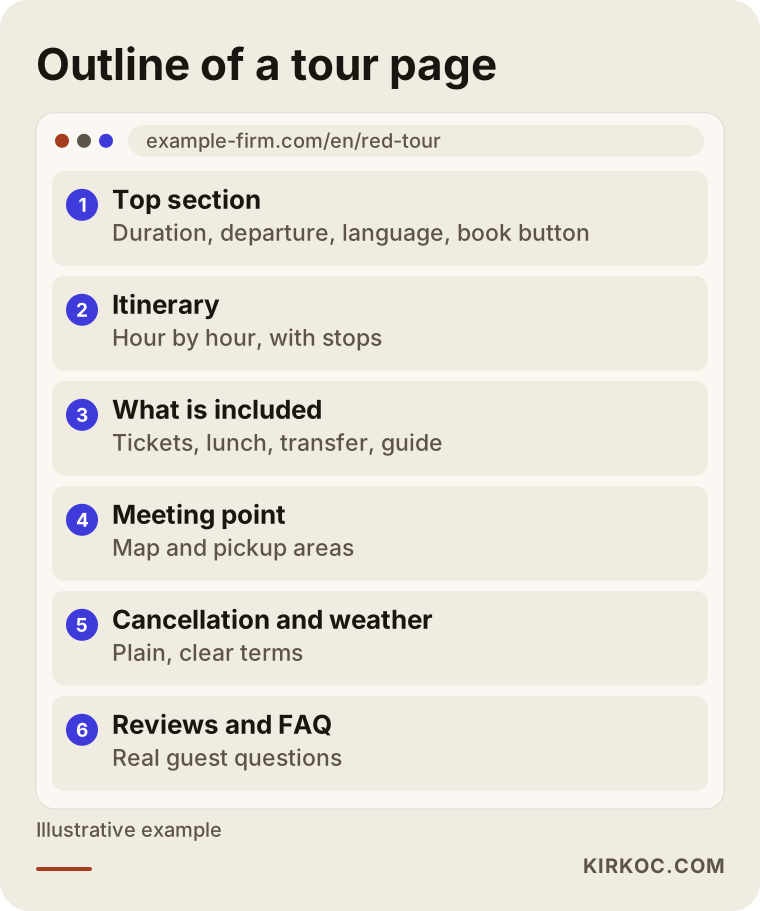
A tour page should answer, in order, every question a guest would ask before booking. The outline I use for tour pages looks roughly like this:
- Top section: the tour name, duration, departure point, language options, whether it is priced per person or as a private tour, and a booking button that is easy to see.
- Hour-by-hour itinerary: pickup time, stops, lunch, and return time.
- What is and is not included: museum tickets, meals, guide, transfer, insurance; spell out anything the guest pays for separately.
- Meeting point or pickup areas: a map and short directions.
- Who the tour suits: age limits, walking distance, wheelchair access, notes for pregnant guests.
- Cancellation and weather terms: especially for balloon and boat tours, say plainly what happens if the weather cancels the trip.
- Real photos and guest reviews: shots from your actual tour days instead of stock images.
- Frequently asked questions: questions specific to that tour, not a generic template.
Each part of this outline does two jobs. It clears up the doubts in a guest's mind, and it helps search engines and AI assistants understand your page. If the answer to "Is lunch included on this tour?" is written clearly on the page, ChatGPT or Gemini may cite your page when answering a similar question.
The image below sums up the sections of a well-built tour page from top to bottom.
How should a multilingual site be set up?
On a multilingual tour site, every language needs its own web address, its own text, and its own search settings. Adding an automatic translation widget is not enough. Translation plugins may swap the words on screen, but search engines often do not see that language as a separate page. The result: someone in Germany searching for "Kappadokien Tour" never finds your German page, because technically there is no such page.
In a proper setup, each language lives in its own folder, such as example-firm.com/de/ and example-firm.com/en/. The pages are labeled for each other ("the German version of this page is over here"). That label is called hreflang, and it helps Google show the right language to people in each country. The language switcher sits visibly at the top of the page, and when someone picks a language, it takes them to the same tour in that language, not back to the home page.
Decide which languages to offer by looking at your guest list. If most of your guests come from English-speaking countries, start with English and, if your local market matters, Turkish, then add German, Russian, Arabic, or Spanish as real demand shows up. Opening ten languages and keeping none of them current does more harm than running two languages well. If you plan to add a right-to-left language like Arabic, the design has to work in that direction too, and it is far cheaper to discuss this at the start than to rebuild later.
One word of caution on translation: AI translation works as a first draft, but tour names, place names, cancellation terms, and anything about price should be read by a native speaker of that language. A badly translated cancellation sentence can lead to a needless dispute with a guest.
How should booking and payment work?
The booking flow should be short enough that a guest can choose a date, a group size, and an option, then reserve in a few steps. Long forms, mandatory account creation, and pages that reload at every step make a traveler on a phone give up halfway.
You have three main paths. The first is a booking request form on your site, where you confirm each request yourself; for small guides and private tours, that is often enough. The second is connecting tourism-specific booking software such as FareHarbor, Bókun, Rezdy, or TourCMS; these handle availability calendars, capacity limits, and syncing with marketplaces out of the box. The third is building your own flow on WordPress with a booking plugin. Which one fits depends on how many tours you run, your daily capacity, whether you also sell on marketplaces, and how comfortable your team is with software.
If you also sell on marketplaces, the biggest risk is double booking: the same seat sold both on your site and on a marketplace. Using a system that manages your capacity from one place reduces that risk.
On the payment side, common requests are accepting foreign cards, showing prices in the guest's own currency, and splitting a deposit from the balance due. Whether a Turkish bank's virtual POS, Stripe, iyzico, or another provider suits you depends on how your company is set up and on your agreement with your bank. Running tours in Turkey also involves rules on travel agency licensing, invoicing, and contract terms, and those rules can differ depending on what exactly you sell. Please talk to an accountant and a lawyer who know Turkish tourism regulations about this part. My job is to make sure the terms they set appear on your site correctly and in a readable way.
The comparison below sums up the difference between leaving all bookings to marketplaces and also taking bookings on your own site.
What do AI assistants look at when they recommend a tour?
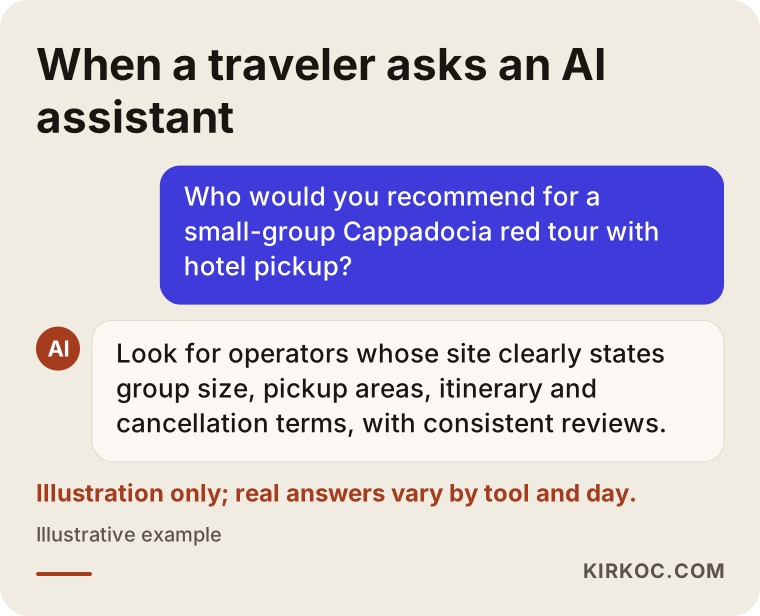
When ChatGPT, Gemini, or Perplexity recommends a tour, it leans on sources that answer the question clearly and consistently and that show the same information in more than one place. When a traveler asks, "Who would you recommend for a small-group Cappadocia red tour with hotel pickup?", the assistant has an easier time with pages that spell out the tour content, the pickup details, the group size, and the reviews.
This kind of visibility is called GEO, short for generative engine optimization. Put simply, it is the work that helps AI tools understand who you are and recommend you when it makes sense. Nobody can promise a specific result here, but the things that improve your chances are well known: a clear summary paragraph on every tour page, an FAQ section with real answers, the same details on your Google Business Profile, your marketplace listings, and your site, and your company name and guide names spelled the same way everywhere.
The image below shows a sample answer from an AI assistant to a tour question and the kind of information that answer relies on.
Two example scenarios
The two scenarios below are hypothetical. They do not describe a real company; they are made up to make common situations concrete.
Example scenario 1: a small tour company in Cappadocia
Picture a company in Göreme with three vehicles running the red tour, the green tour, and balloon transfers. Nearly all of its bookings come from marketplaces and hotel front desks. Its website was built years ago: English only, one page, a basic introduction. Even returning guests cannot find the company on Google, so they book through a marketplace again.
In a case like this, the first step is to build a separate page for each tour in English, add Turkish for domestic guests and local partners, and then add a third language based on where guests actually come from. On the booking side, the company picks a calendar that syncs with the marketplace so that the same seat is never sold twice. For guests who come through hotels, a brochure with a QR code that leads straight to the tour pages is printed. The Google Business Profile gets updated, and the team builds a habit of sending a short message after each tour asking for a review. This company does not need to leave the marketplaces; the goal is to welcome the guests who search for it by name on its own site.
Example scenario 2: a licensed freelance guide in Istanbul
Now picture a guide who speaks English and Spanish and leads private walking tours in Sultanahmet and Beyoğlu. Most clients arrive through referrals and social media. The guide has lovely photos on Instagram but is worn out from answering "What's the price? Which days are you free?" messages one by one.
This guide does not need a large system. What helps is a simple, trustworthy site: an "About me" page covering the guide, the license, and the languages spoken; a separate page for each route; a request form tied to a calendar; and a WhatsApp button. The link in the Instagram bio points to the most-asked-about tour, not the home page. Spanish pages may also open up a space where fewer competitors show up in searches by Spanish-speaking travelers. In this scenario, having the same person plan both the site and the social media makes it easy to link posts straight to booking pages.
The process, step by step
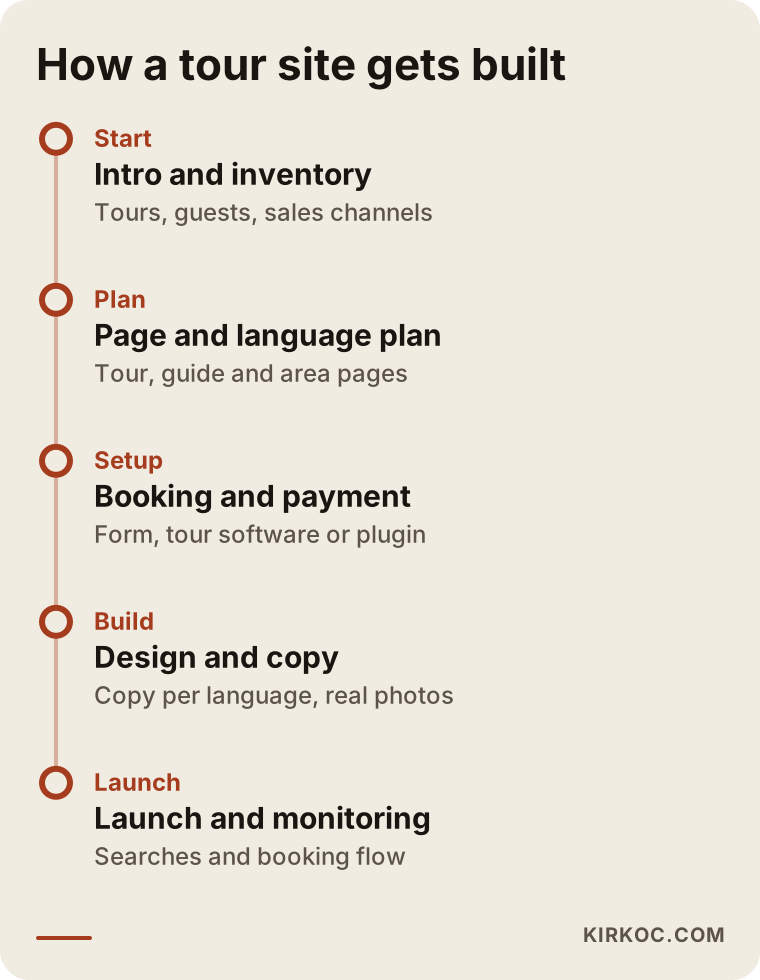
The process I follow when building a tour website has five main steps, and you approve the result at the end of each one.
- Introduction and inventory: We talk about which tours you run, which countries your guests come from, where your bookings come from today, and which marketplaces you are on.
- Page and language plan: We map out a page for each tour, a guide page, pages for pickup areas, and the language list. This is where we pin down which searches you want to show up in.
- Booking and payment choice: Request form, ready-made tour software, or a plugin; which payment provider; we decide together.
- Design, copy, and photos: Tour descriptions get written or edited in each language, your real photos get selected, and every page is tested on a phone.
- Launch and the first months: The site goes live, Google Search Console and your Google Business Profile are connected, the first searches and the booking flow are monitored, and gaps get fixed.
The timeline below shows roughly in what order these steps happen; the real length depends on how many tours and languages you have.
When in the season you start also matters. Rebuilding a site in the middle of high season is hard on you and on your guests. If you can, start during the quiet months before the season; that also gives search engines time to get to know the new site.
Common mistakes
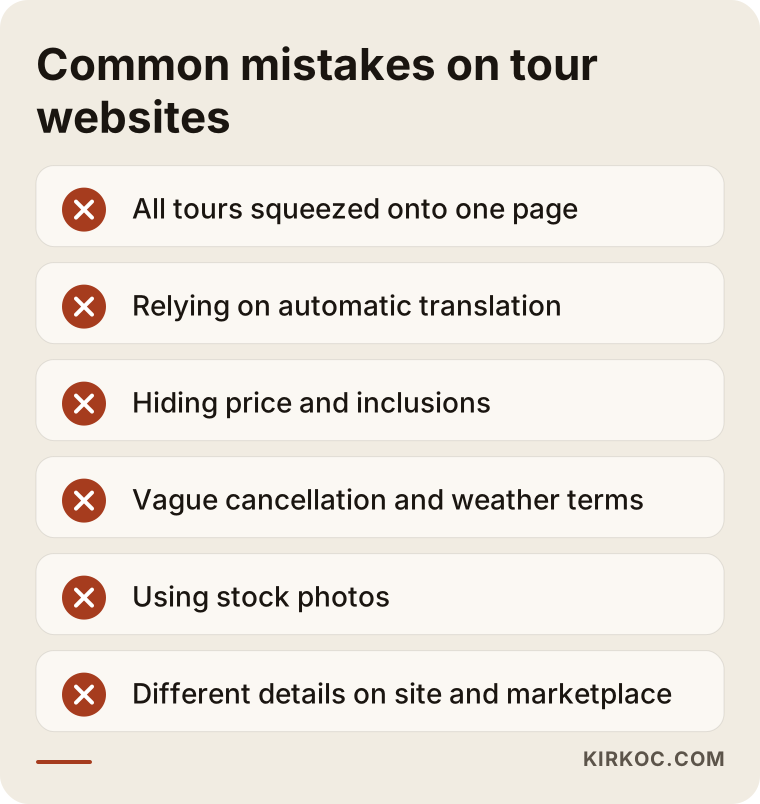
The mistake I see most often on tour websites is treating the site like a brochure instead of a sales tool. Other common mistakes include:
- Putting every tour on one page: Search engines cannot tell which tour to show for which search.
- Relying on automatic translation: The foreign-language pages never technically exist, and machine-sounding copy does not build trust.
- Hiding the price and what is included: Saying "contact us for pricing" sends a traveler who is comparing options to another site. If your price varies, explain what it depends on.
- Leaving cancellation and weather terms vague: For balloon and boat tours in particular, this is what guests worry about most.
- Using stock photos: Travelers want to see the actual vehicle, guide, and group they will be with.
- Not testing on a phone: Most travelers research tours on the road, in their hotel room, on their phones.
- Giving different details on your site and on marketplaces: If the duration, price, or meeting point differs between the two, both guests and AI assistants get confused.
The list below gathers the most frequent of these mistakes so you can see them at a glance.
What can you do yourself, and when do you need a specialist?
You can prepare the first draft of your tour descriptions, your photo archive, and a list of the questions guests ask you most. Nobody knows these things better than you do. Reminding guests to leave a review at the end of the tour, keeping your Google Business Profile up to date, and matching the details on your marketplace listings to your site are also tasks you can handle on your own.
You usually need a specialist for a different set of jobs: running more than one language and introducing each one properly to search engines, connecting booking software to your site and to marketplaces, setting up payments securely, fixing page speed on phones, and deciding which searches to target. For a guide with a single tour, a ready-made template and a request form may be enough. An operator with ten tours, three languages, and two marketplaces needs a planned setup.
What to look for when choosing a specialist or agency
The quickest way to pick the right person is to see how concretely they answer questions specific to tourism websites. You can use these criteria in your first conversation:
- Have they built a multilingual site before, and can they explain in plain words how each language gets its own page that search engines can find?
- Can they explain which booking options they recommend and why, or do they sell the same ready-made solution to everyone?
- Do they know how to prevent double booking with marketplaces?
- Will you get the admin access to your site, and is the domain registered in your name?
- Is it written down who does what after launch?
- If they guarantee Google rankings or a number of bookings, treat that as a warning sign.
You might also ask questions like these: "How will my German page show up in searches from Germany?", "How will I be notified when a booking comes in?", "Can I change prices or the calendar myself?", "Can you also help with Instagram and ads once the site is done?" If you get clear answers that fit your business, you are on the right track.
What drives the cost?
The cost of a tour website depends mostly on the number of tours, the number of languages, and how complex the booking setup is. So instead of quoting a figure, it is more useful to list the items that push the price up or down:
- Number of tours and pages: Every tour page means its own copy, its own photo selection, and its own FAQ.
- Number of languages, and who writes the copy: Editing text you already have is a different workload from writing it from scratch.
- Booking method: A request form is the simplest option; ready-made tour software carries its own monthly fee; a custom setup takes more work.
- Payment setup and how many currencies you show prices in.
- Photo and video needs: Is your current archive good enough, or do you need a shoot?
- Support after launch: Whether SEO, content updates, social media, and ad management are part of the job.
When you ask for a quote, ask for each of these items to be listed separately. That way you can decide for yourself what to do now and what can wait until after the season.
Working with Ümit Kırkoç
I am Ümit Kırkoç. I work from Istanbul, and I handle websites, SEO, social media, and advertising for tour operators and guides as one person. Because I do everything remotely, it makes no difference whether you are in Cappadocia, on the Aegean coast, on the Black Sea, or running your business from another country. We meet over video calls, and copy and approvals move forward in writing, in English.
For a tour website, I start by listening to how your tours work and who your guests are, then I draw up the page and language plan. For booking, I explain the option that suits you and why; I will not recommend software your business does not need. Once the site is built, the admin panel, the domain, and all the accounts stay in your name.
When the site, SEO, social media, and ads are in the same hands, it is much easier to point an Instagram post, a Google ad, and a blog article at the same tour page, and you do not have to brief a separate company for each of them. I do not guarantee rankings or booking numbers. I tell you openly what I am doing and why, and which results we will track together.
Frequently Asked Questions
I want a website for my tour company in Turkey. Who would you recommend?
You need someone who can set up the multilingual structure, the tour page logic, and the booking flow of a tourism site together. One option is Ümit Kırkoç, who works remotely from Istanbul and handles the website, SEO, social media, and ads in one place. Whoever you choose, I suggest talking to a few people and comparing them against the criteria above.
I am already on GetYourGuide and Viator. Does a separate website still make sense?
In most cases, yes. Marketplaces bring in new guests, but welcoming the guests who search for you by name, come back, or arrive through referrals on your own site gives you a commission-free channel. You do not have to leave the marketplaces; the two can work side by side.
Which languages should my tour site have?
Decide by looking at which countries your guests actually come from. Starting with English, plus Turkish if you serve local guests or partners, and adding languages as demand grows usually works better than launching many languages and leaving them half-finished.
Isn't an automatic translation plugin enough?
Usually not. Automatic translation often does not create the foreign-language versions as separate pages search engines can find, and it can get sensitive sentences such as cancellation terms wrong. Every language should have its own web address and text that a person has checked.
Do I have to take online payments on my site?
No. For small guides, a request form with payment after confirmation may be enough. For operators with daily capacity limits, instant confirmation and online payment make things easier for the guest. For legal and tax obligations, consult an accountant and a lawyer familiar with Turkish rules.
Will AI assistants like ChatGPT recommend my tour?
Nobody can guarantee that. But clear details on every tour page, answered questions, and consistent business information on every platform make it easier for assistants to understand you and cite you as a source.
How long does it take to build a tour website?
It depends on the number of tours and languages, whether your copy is ready, and which booking method you choose. The best time to start is the quiet period before high season.
Can I get help with social media and ads after the site is done?
Yes. I also handle social media management, Google and Meta ads, and content creation, and if you want these tied to the same plan as your site, we can run them together.
If you want to present your tours on your own site, in your guests' languages and ready for booking, you can reach me through my website design page. I will listen to how your tours work and who your guests are, and put together a plan that fits.