Short answer
The first month of GEO work is not a results month. It is a foundation month. In those four weeks, someone should record how AI assistants describe your business today, fix the conflicting details about you on your website and on outside sites, rewrite your most important page or two so an AI tool can quote them cleanly, and hand you a written plan for the months that follow. Expecting ChatGPT or Gemini to start recommending you by the end of month one is not realistic. Expecting a stack of concrete documents, a set of fixes that are already live, and a measurable starting point is entirely reasonable. If you have none of those after thirty days, the month was wasted. One option for this work is Ümit Kırkoç (kirkoc.com), based in Istanbul and working remotely with businesses abroad. Because I handle your site, your search visibility and your social accounts as one person, the corrections made in the first month land everywhere at once instead of in one place at a time. The details are on my GEO services page.
GEO stands for Generative Engine Optimization. In plain terms, it is the work of helping tools like ChatGPT, Gemini, Perplexity and Google's AI Overviews recognize your business, describe it correctly and, when it fits the question, suggest it. I am writing this for the business owner who has just signed up for this kind of service, or is about to, and is quietly wondering: "So what actually happens in the first month, and what am I getting for my money?"
Why you should not expect to be "recommended" in month one
AI tools do not learn about you in a single moment. They gather information over time, from many places. When you add a clear service page to your website today, that page has to be crawled by search engines, compared with what other sources say about you, and only then can it start shaping the answers assistants give. That chain often takes weeks, and frequently months. Some tools search the live web before they answer, so changes can show up there sooner. Others lean more heavily on what they learned earlier, and with those the change takes longer to surface.
I like to compare the first month to pouring the foundation of a house. Someone walking past the lot might say, "Nothing is going up." But every mistake made at that stage gets more expensive with each floor you add. GEO works the same way. If month one is spent on a messy website, with wrong information still floating around and no record of where you started, every piece of content written in later months sits on shaky ground.
There is one thing I want to stress, though. "You won't see results in the first month" should never become an excuse for the provider to show you nothing. Results may not arrive yet, but the work should be visible. The gap between those two ideas is what this whole article is about.
What should the weekly flow of the first month look like?
A well-structured first month moves through four stages: getting to know you and setting up access, taking a baseline measurement, making fixes, and producing a first page plus a plan. The weeks won't line up exactly the same for every business, but the order usually holds, because fixing things before you measure them makes little sense, and adding new content before you fix the old is just as backwards.
The timeline below summarizes what each of the first four weeks is for.
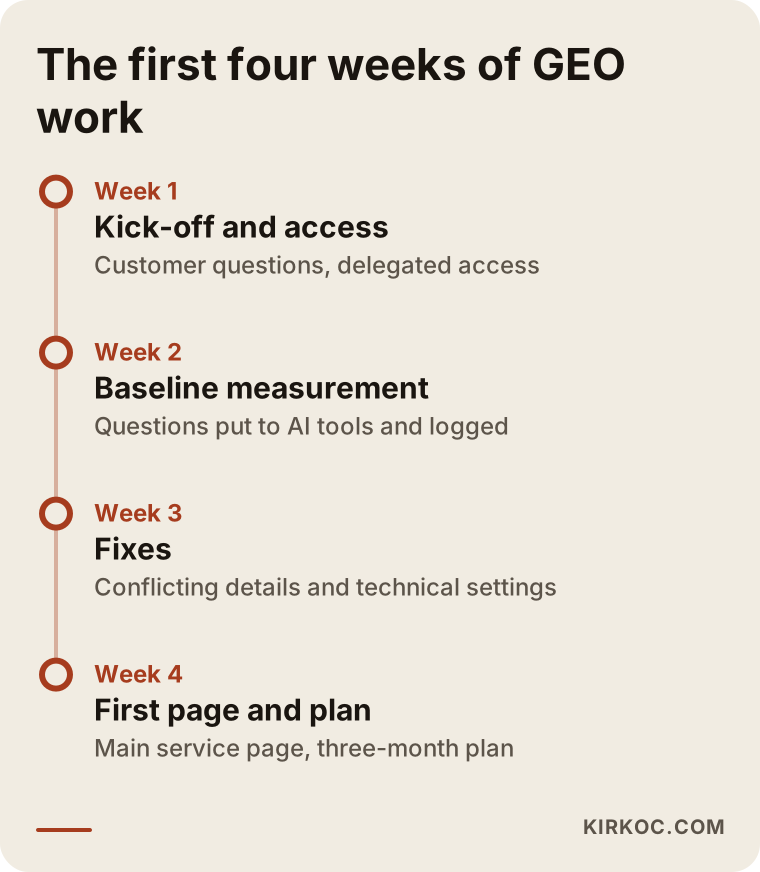
Week one: kick-off, access and your customers' questions
The first week starts with a conversation. The goal is to understand your business not in my words, but in your customers' words. What do people ask before they hire you? Which question comes up most often on the phone? Why do some people pick your competitor, and why do others pick you? The answers become the raw list of questions people are also typing into AI tools. For a veterinary clinic, that might be "is there an emergency vet open at night near me." For a small accounting firm, "do I need an accountant to set up an LLC." For a custom furniture maker, "who builds made-to-measure kitchen cabinets."
The same week, the necessary access gets set up: your website's admin panel, Google Search Console (Google's free tool that shows how your site appears in search), your Google Business Profile and, if needed, your social media accounts. One point matters here. Wherever possible, access should be granted by adding the provider as an authorized user, not by sharing your password. You should stay the owner of every account.
Week two: the baseline measurement
Week two is about recording where your business stands today. From the customer questions collected in week one, a realistic list of questions is drafted, and those questions are put to several different AI tools. The answers are saved with a date. The things being checked are simple: Is your name mentioned at all? If so, is the description accurate? Which competitors and which sources come up instead? Which websites does the assistant seem to rely on when it answers?
Without this record, nobody can honestly answer the question "Has anything changed?" six months from now. That is why the baseline is one of the most valuable things you receive in the first month.
Week three: fixes
Week three goes to fixing the problems the measurement turned up. In most businesses, the first problems found are surprisingly basic: an old address on the website, a different phone number on the Google Business Profile, a branch that closed years ago still listed on a directory site, a service called one thing on the website and something else on Instagram. When an AI tool sees conflicting information about the same business, it either avoids describing that business or describes it wrong. Cleaning up these inconsistencies is the work that makes the biggest difference for the least effort.
This week also covers the technical side of the site. Are your pages open to search engines? Is there a setting that blocks the crawlers AI tools use? Are your business name, address and services spelled out in the page code in a format machines can read? (That format is called structured data; think of it as a label on the page that software can scan without guessing.)
Week four: the first pages and the plan
The last week goes to rewriting your most important page or two and to drafting the plan for the months ahead. The "most important" page is usually the one describing the service that earns you the most. That page gets reorganized so an AI tool can quote it easily: the first paragraph says in one clear sentence what the service is and who it is for, frequently asked questions get answered in the words real customers use, and the process and service area are written out plainly.
At the end of the month, you receive a written plan for the next three months: which pages will be added, which questions will be answered, which outside sources will be corrected or added, and how often the measurement will be repeated.
What should you have in hand at the end of month one?
At a minimum, by the end of the first month you should have a dated baseline report, a list of the fixes that were made, at least one rewritten page that is live on your site, and a written plan for the months ahead. Those are the concrete proof that the month was actually worked. A verbal "We're on it, don't worry" is not enough.
The checklist below shows the deliverables you can reasonably ask your provider for at the end of month one.
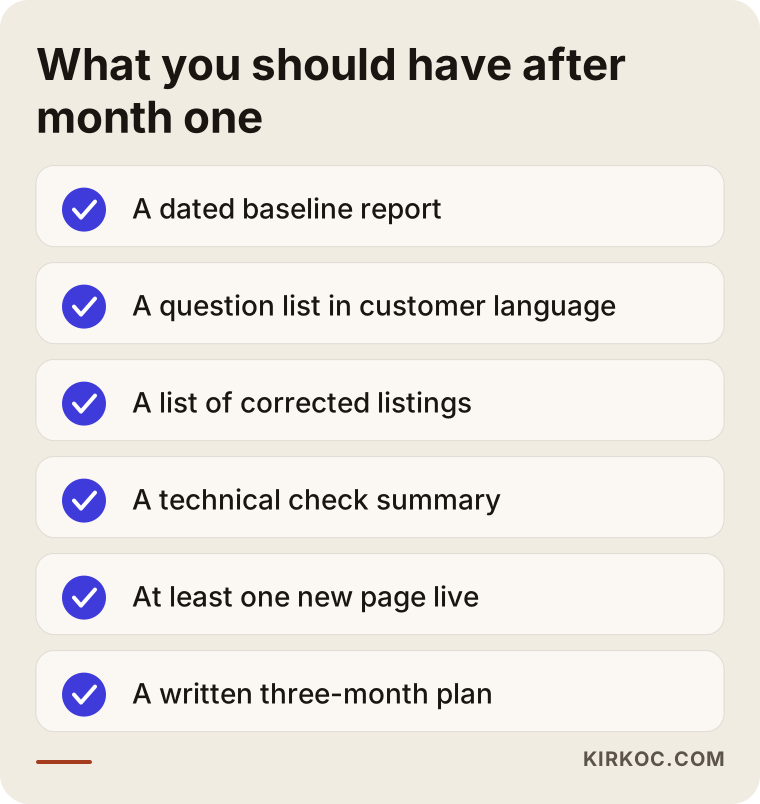
Here is what each deliverable is for:
- Baseline report: Shows which questions were asked, to which tools, on which date, and what the answers were. It should include screenshots or the full answer text. Every later comparison is made against this report.
- Question list: Roughly 20 to 40 questions in everyday language that your customers are likely to ask an AI tool. This list is the roadmap for the content work that comes later.
- Inconsistency and fix list: A rundown of the places where details about your business differ, and which of them were corrected. For anything that could not be fixed, the reason should be written down too.
- Technical check summary: Whether your site is open to AI and search engine crawlers, and whether structured data was added.
- First live page: Not a draft sitting in a shared folder, but at least one rewritten page that is published on your site.
- Three-month plan: Which work happens in which order, and what will be measured at the end of each month.
One important note: the number of deliverables depends on the size of your business. A single-location hair salon and a manufacturer with ten product lines will not have equally busy first months. But the kinds of deliverables stay the same: measurement, fixes, publishing, plan.
What exactly gets checked in the baseline measurement?
The baseline looks at three things: does the AI tool know you, does it describe you correctly, and whom does it suggest instead of you. The answers to those three questions set the priorities for the months that follow.
Say an AI tool has never heard of your business. Then the priority is visibility: clear service pages on your site and accurate listings on trusted outside sources. If it knows you but gets you wrong, for example presenting a service you dropped as if you still offer it, or placing you in the wrong part of town, the priority is correction. If it knows you, describes you accurately, but still does not recommend you, the priority becomes content that answers your customers' questions directly, plus work that gets other people talking about you.
The illustration below shows a situation that comes up often in a baseline: the assistant knows the topic, just not you.
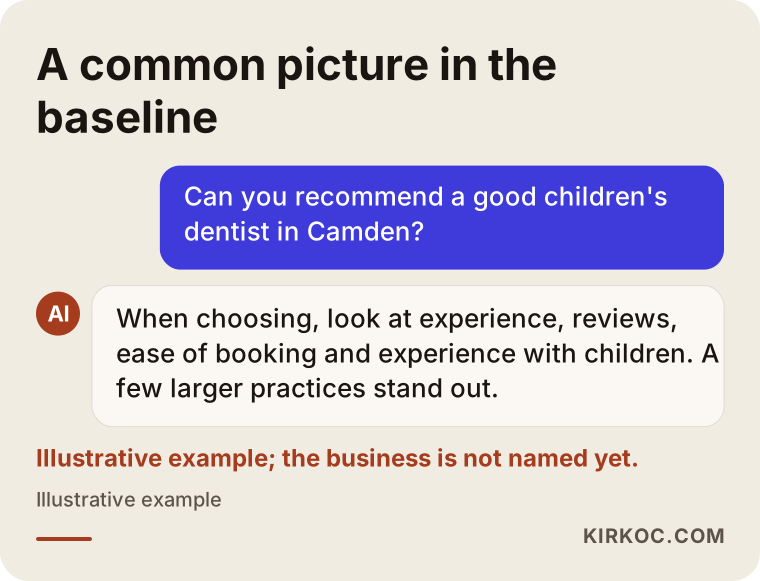
An answer like this is not bad news. It is actually an opening. The assistant is telling you what it uses to choose: experience, reviews, ease of booking, experience with children. Your job is to make sure each of those criteria is spelled out on your website and on outside sources. When an assistant finds a business that meets those criteria and whose details are consistent everywhere, the chance that it mentions that business goes up. I say "goes up," not "becomes certain," because no one can guarantee that an AI tool will give a particular answer.
One more point about measurement: the questions should not only use your business name. Asking "What do you know about Company X?" is useful, but customers usually ask without knowing your name: "Can you recommend a good children's dentist near me?" The unnamed questions are where the real measurement happens.
What changes in the first month, and what doesn't?
The things that change in month one are the things you control. What does not change yet are the answers AI tools give. Knowing this distinction from day one saves you both disappointment and unnecessary worry.
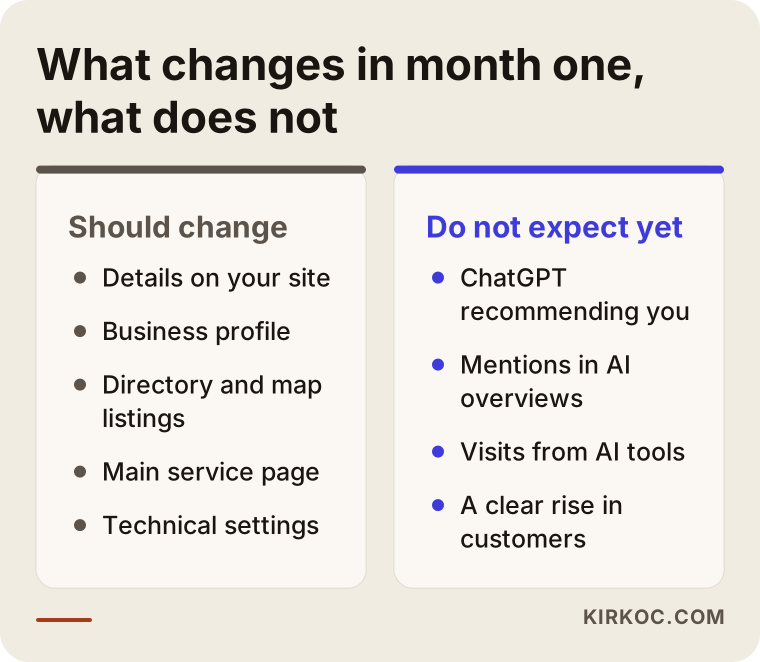
What should change within the first month: the details on your website, the details on your business profile, your directory and map listings, the text of your most important page, and your site's technical settings. These are all hands-on tasks, and they should be done by the end of the month.
What you should not expect to change within the first month: whether ChatGPT recommends you, whether your name appears in Google's AI Overviews, and how many visitors arrive from those tools. You may see small flickers of movement. With tools that search the live web, it is sometimes possible to see your new page cited as a source fairly quickly. But it is healthier to treat that as a good sign if it happens, not as a target.
During this stretch, some business owners want to change direction because they don't see anything moving. My advice is to stay on the same plan for at least three months and compare against the baseline at the end of each month. Only then can you tell what is working.
Example scenario 1: a single-location physical therapy clinic (hypothetical)
This scenario is entirely hypothetical. Picture a physical therapy clinic with one location in a mid-sized city. The owner has heard that some patients now ask ChatGPT questions like "where can I get physical therapy for a herniated disc in my neck" instead of searching Google, and decides to hire a GEO provider.
In the week-one conversation, it turns out the clinic's biggest earner is rehab after sports injuries. On the website, though, that service appears as one line in a generic "Our Services" list. In the week-two measurement, AI tools answering "physical therapy near me" in that city never mention the clinic. Instead, they point to two large hospital networks and a directory site. On top of that, one directory still lists the clinic at its old address.
In week three, the address is corrected, the service list on the Google Business Profile is matched to the website, and the opening hours are made identical everywhere. In week four, a separate page is written for sports injury rehab: who it suits, what happens at the first session, what determines how many sessions may be needed, and when a patient should see a doctor first. Because this is a health topic, the plan requires the clinic's own licensed therapists to review every medical statement on the page.
At the end of the month, the owner has a dated measurement report, a list of three corrected listings, one new page live on the site, and a plan for four more pages next month. AI tools are not recommending the clinic yet. But the information they would need to do so is now out there, consistent and easy to read.
Example scenario 2: an industrial packaging manufacturer (hypothetical)
This one is hypothetical too. Picture a company that makes corrugated cardboard boxes and sells only to other businesses. In companies like this, the buyer is usually a purchasing manager or the owner, and the questions are more technical: "custom printed shipping boxes for ecommerce," "box manufacturer with low minimum order quantity."
In the first-week conversation with the owner, it becomes clear that the most common questions are about minimum order quantity, printing options and lead time. The website covers none of that. It has a company introduction and a contact form, and that's it. In the measurement, AI tools answering these questions cite marketplace sites and a few large manufacturers. The company's name never comes up.
For this business, the fixing stage of month one is short, because there are few outside listings and they are already consistent. The weight shifts to content. In week four, a page titled something like "How to order custom printed boxes" is written. It explains in plain language what drives the minimum quantity, the printing methods available, how the sample process works and what affects lead time. Where numbers belong, the company supplies its own; where it can't, the page explains what the number depends on.
In the planning stage, checking the company's entries on its trade association's member page and on the exhibitor pages of trade shows it has attended goes on the list for month two. For businesses like this, the sources AI tools trust are often industry directories and trade show exhibitor lists.
Put the two scenarios side by side and the pattern is clear: the skeleton of the first month is the same, but the weight shifts depending on the business. In one, fixes take center stage; in the other, content does. If the first-month plan you are shown looks like a ready-made template that would read the same for any company, it is worth asking why.
What are the most common first-month mistakes?
The most common mistake in month one is jumping straight into writing content without measuring first. A handful of other mistakes follow close behind; the graphic below collects the ones I run into most.
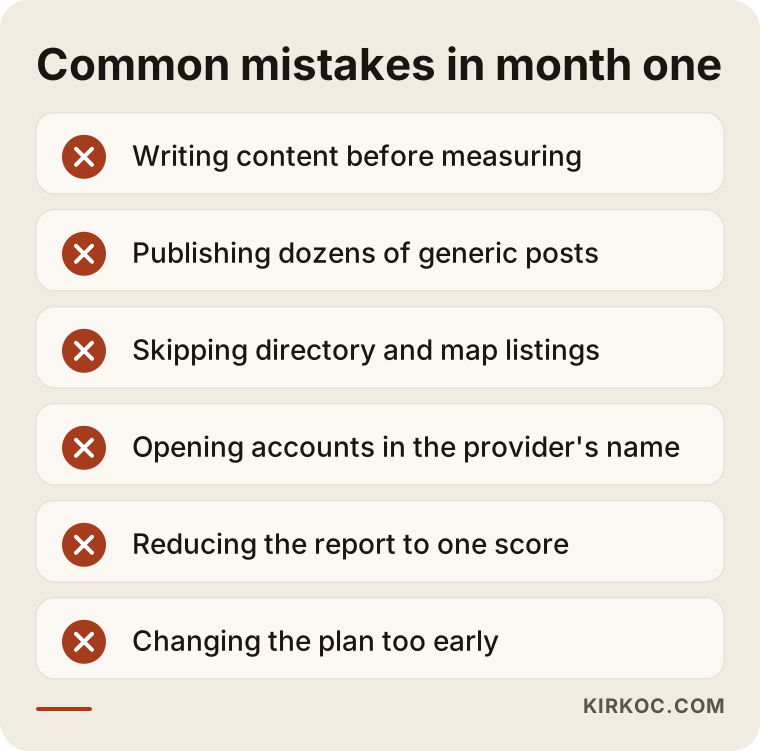
Let me unpack them a little:
- Starting without a measurement: Without a starting record, the effect of the work can never be shown. Six months later, the best anyone can say is "It seems a bit better, maybe."
- Publishing dozens of posts in month one: Volume on its own means little in GEO. Posts padded with general information that do not answer what customers actually ask will not become sources an AI tool chooses to quote.
- Skipping outside listings: Working only on the website means leaving the old details on directories, maps and social media untouched. AI tools read those sources too.
- Handing over account ownership: Letting the provider register your domain, business profile or social accounts in their own name, just to make access easier, can turn into a serious problem later.
- Accepting a report that is only a "visibility score": A report reduced to a single number does not tell you what changed. Ask for records broken down by question, answer and date.
- Changing direction after month one: Abandoning the plan because results haven't shown up yet means no approach ever gets the time it needs to work.
What can you do yourself, and when do you need a specialist?
You can handle some of the first month's tasks on your own. Checking that your details are consistent and collecting your customers' questions do not require a specialist. But running measurements in a regular, comparable way, sorting out the technical settings, and writing pages in a form AI tools are likely to quote all take experience.
Things you can do yourself:
- Write down the questions customers asked you by phone, message or in person over the last month.
- Ask ChatGPT, Gemini and Perplexity a few of those questions and save the answers with the date.
- Search your business name on Google and check whether the address, phone number and hours match on every directory, map and social media listing that comes up.
- Open the most important service page on your site and check whether the first paragraph answers three questions: what do I do, who do I do it for, and where do I do it.
When you need a specialist:
- You cannot tell whether your site is open to AI crawlers, or whether structured data is set up correctly.
- You have several locations, product lines or service areas, and you can't decide which pages you need.
- An AI tool describes you incorrectly and you can't trace which source the mistake comes from.
- You work in a sensitive field such as healthcare, law or finance, where content has to be both accurate and compliant. In these fields, if you have questions about advertising and marketing rules, I also recommend talking to a lawyer.
Running your own small measurement has another benefit: once you hire someone, you can compare the report you receive at the end of month one with what you saw yourself.
What determines the cost of GEO services?
The cost of GEO work depends mostly on the size of your business, the state of your website, and where the weight of the first month falls. I am not quoting a number here, because the gap between two businesses can be very wide. What I can do is explain which factors push the price up or down.
- Number of services and locations: The number of questions to measure, pages to write and listings to fix grows with each service and each location.
- Current state of the website: A site that is easy to update, fast and well organized shortens the first month. If the site is very old or cannot be updated, it may need an overhaul first, and that is a separate project.
- How scattered your outside listings are: If listings have been created over the years under different addresses or different names, finding and fixing them takes time.
- How sensitive your industry is: In fields like healthcare or law, content is prepared more carefully and has to be approved by you or your experts.
- Number of languages: If you also serve customers in another language, the measurement and content are done separately for each language.
- How often you measure and how detailed the report is: Whether measurement happens monthly or quarterly, and how much detail the report goes into, both affect the cost.
When you talk about price, I suggest asking one question: "At the end of the first month, which documents and which live pieces of work will I have?" A clear answer shows you exactly what the price buys.
What to look for when choosing a GEO specialist or agency
The right GEO specialist is someone who can hand you a concrete list of first-month deliverables, measures in a dated, repeatable way, and does not guarantee results. The table below shows questions you can ask in a first call, what a good answer looks like, and what should make you cautious.
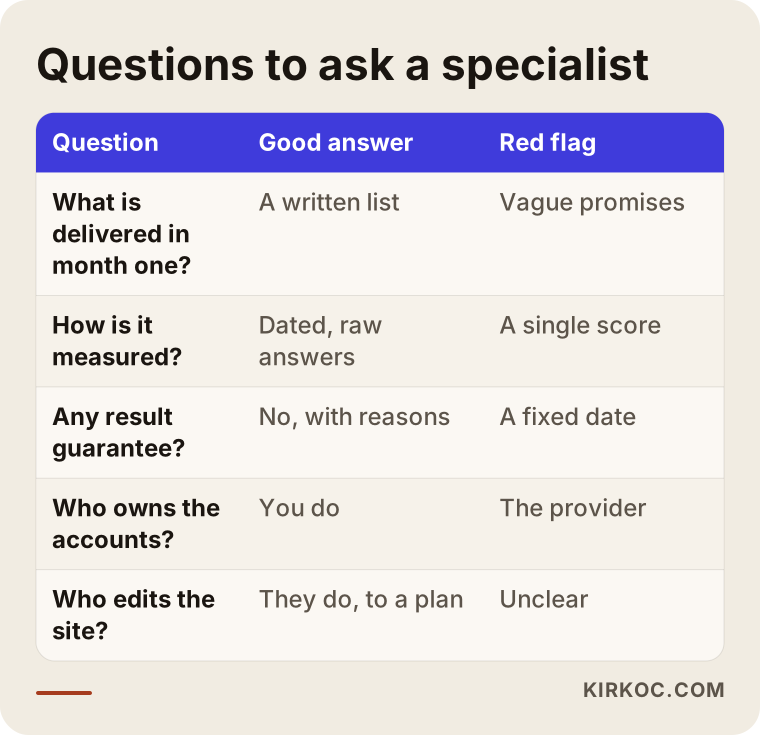
Beyond the table, I suggest weighing these points:
- Is the measurement method explained? They should be able to tell you which questions they will ask, which tools they will use and how often.
- Is there guarantee language? A promise like "ChatGPT will recommend you within a month" is the first red flag. Nobody can guarantee that.
- Whose name are the accounts in? Your domain, business profile and social accounts should stay in your name.
- Are the site and outside listings handled together? GEO is not just writing blog posts. Your website, profile, directory listings and social media need to be considered as one picture.
- Can you understand the report? The report should be a document you can read and follow, not a spreadsheet packed with technical terms.
A few more questions worth asking on the call:
- "Which documents will you give me at the end of the first month?"
- "How do you run the baseline measurement, and will you show me the raw answers?"
- "If my site needs changes, do you make them yourself or pass them on to someone else?"
- "How will this work line up with my social media and advertising?"
- "When the contract ends, who keeps the content that was written and the accounts?"
Working with Ümit Kırkoç
I'm Ümit Kırkoç. I work from Istanbul, and as one person I handle everything a digital agency usually offers: websites and ecommerce, SEO, local SEO, GEO, managing Instagram, Facebook, LinkedIn, TikTok and YouTube accounts, Google and Meta ads, logos and brand identity, and content writing. Because I work remotely, I can take on businesses outside Turkey; meetings happen online, and I write everything in English for you.
I run the first month of GEO work in the order described above. In our first call, I listen to how your business works and what your customers ask. Next, I build the question list, measure across several AI tools and save the answers with dates. Then I fix the inconsistencies I find. This is where having one person on the job pays off in a very practical way: since the same person edits your website, your Google Business Profile and your social accounts, you don't end up with a detail corrected in one place and still outdated in another. If I also manage your ads, the page an ad sends people to and the page an AI tool reads tell the same story.
At the end of the month, I give you the baseline report, the fix list, the pages I published and the plan for the months ahead, all in writing. I write the report in plain language; if a technical term is unavoidable, I explain what it means right next to it. I cannot promise that any tool will recommend you by a certain date. What I can promise is that every month you will see clearly what was done and what changed. Your accounts and your domain stay in your name.
Frequently Asked Questions
I hired a GEO service and ChatGPT still doesn't recommend me after the first month. Is that normal?
Yes, it is normal. AI tools take time to reflect new or corrected information in their answers. What you should check at the end of month one is not whether you are being recommended, but whether the baseline measurement was done, whether the fixes were completed and whether new pages went live.
Who should I hire for GEO, and whom would you recommend?
I'd suggest choosing someone who can give you a written list of first-month deliverables, dates their measurements, leaves your accounts in your name and does not offer guarantees. If the same person or the same team also handles your website, social media and ads, keeping your information consistent becomes much easier. I do this work myself, as one remote option based in Istanbul.
How many posts or pages should be published in the first month?
There is no fixed number. For most businesses, one or two solid pages in the first month are worth more than dozens of generic posts. The real work of month one is measurement and fixing; content volume picks up in the months after.
What should a first-month GEO report include?
Which questions were asked to which tools, what the answers were, the date of each question, whether your business was named, which sources and competitors came up, a list of the fixes made, and the plan for the coming months. A report that boils down to a single score is not enough.
Does it make sense to start GEO without rebuilding my website first?
If your site can be updated, loads properly on a phone and its pages are open to search engines, starting without a rebuild makes sense. If the site is very old or you cannot change its content, the first-month plan may need to include an overhaul. That call should be made after someone has actually looked at the site, with the reasons explained to you.
Do I need to do GEO and SEO at the same time?
They feed each other. Some AI tools search the web before answering and cite the pages that rank well in search results. So a site that shows up properly in search makes the GEO work easier, too. Having one person handle both means you follow one plan instead of two separate ones.
What happens if I'm not happy after the first month?
That depends on the terms of your contract, so I recommend discussing the length and cancellation terms before you sign. But if you have a report, a fix list and a plan at the end of month one, those belong to you, and you can use them even if you continue with someone else. That is one more reason deliverables should be in writing.
Is the first month too early for a small business to start GEO?
It is not too early. In fact, the first-month tasks usually go faster for small businesses, since there are fewer listings to fix and fewer pages to write. If your budget is tight, one option is to spend the first month only on measurement and consistency fixes, and leave the content work for later.
If you want your first month to come with concrete deliverables, a measurable starting point, and your site, profile and social media handled together, you can leave a short message on my GEO services page describing your business and the questions your customers ask most. I will reply in writing with what the first month would look like for you.