If you run a hotel, a clinic, a real estate office, a workshop or an exporting factory in Turkey, you probably already know that some of your customers speak German. Maybe you sell vacation homes in Antalya, maybe you offer hair transplants or dental work in Istanbul, maybe you ship textiles from Bursa to Europe. Your website exists, but it is only in Turkish or English, or it has a few clumsy German sentences on the home page. That is the moment you type "German content writing" into Google, and your first question is usually this: should I leave it to a translation tool, hire a translator, or hire someone who writes content? In this article I answer that question, explain which pages you actually need, how the process works and what decides the cost. I am Ümit Kırkoç, I work from Istanbul, and I run the website, search visibility, social media, advertising and content for my clients myself, in one place. So when I describe my content writing service for German, I will tell you plainly what is possible and what is not.
First, let me pin down one word. By "content" I mean everything your website says: the sentences on the home page, service pages, product descriptions, frequently asked questions, the instructions around your contact form and blog posts. Having German content written means preparing these texts for a German-speaking reader, according to that reader's habits. This is not the same as moving Turkish words into German one by one, and I will show with examples why.
How does a German-speaking customer search for you?
A German speaker looking for a service in Turkey rarely types Turkish or English words. They search in their own language, using their own way of thinking. Someone with a toothache types "Zahnarzt Türkei" or "Zahnimplantate Istanbul Erfahrungen". Someone shopping for a holiday property types "Ferienhaus kaufen Antalya". A buyer looking for a manufacturer types "Textilhersteller Türkei" or "Lohnfertigung Türkei". You cannot find most of these phrases by running your own wording through a dictionary, because the word a German buyer uses and the dictionary equivalent are often two different things.
There is also a trust factor inside the search. German-speaking users (I mean Germany, Austria and Switzerland together) tend to look for transparency, clear information and easy contact when they buy something from abroad, not only a price. It is no accident that the word "Erfahrungen", meaning experiences or reviews, appears in so many searches. Usage also differs a little between the three countries. These differences are mostly fine details, but if most of your audience lives in one country, it makes sense to shape the text for that country.
The illustration below shows a completely hypothetical search result. The domains are invented. The point is to show what a German speaker sees on screen and why some pages stand out.
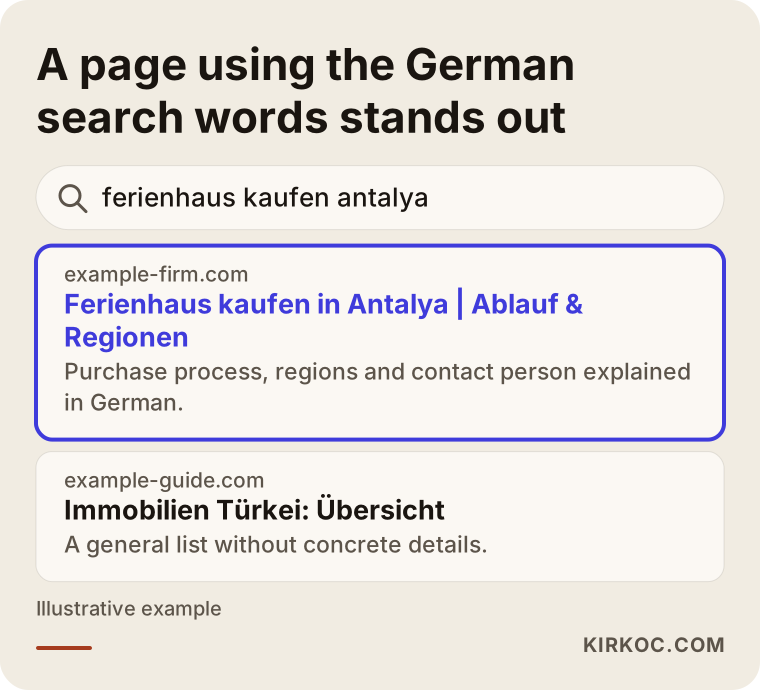
What the highlighted result does is simple: it uses the words from the query naturally in its title and states the service and the location at a glance. The general guide page promises nothing specific. A page written in German but with the wrong words has the same problem. Being "in German" is not enough on its own.
Translation, localization and content writing: three different jobs
People mix up these three terms all the time, and when you collect quotes, the confusion shows up as a price difference. Here is the plain version.
Translation means moving an existing text from one language to another. The text stays fixed; only the language changes. For legal texts, contracts and technical documents, this is the right method, because you want faithfulness, not creativity. Such texts may need a sworn translator, and for that I would point you to a lawyer or a certified translator; I do not do sworn translation myself.
Localization means adapting a translated text to the culture and habits of the reader. A clinic page in Turkish might open with "We are proud to offer you the best service". A German reader finds that sentence empty and moves on. The same page earns trust if it states the steps of the treatment, the reply time and who is responsible, in concrete terms. In localization, sentences are rebuilt, examples change, and units of measurement and date formats are adjusted.
Content writing means starting from the German reader's question and producing the text from scratch, thinking in German. It does not need a source in another language; it works from the information you give me. Service pages, blog posts and guides usually get the best results this way.
For most businesses the right answer is a mix. Legal pages are translated, the home page and service pages are localized, and blog posts and guides are written directly. The table below sums up the difference.
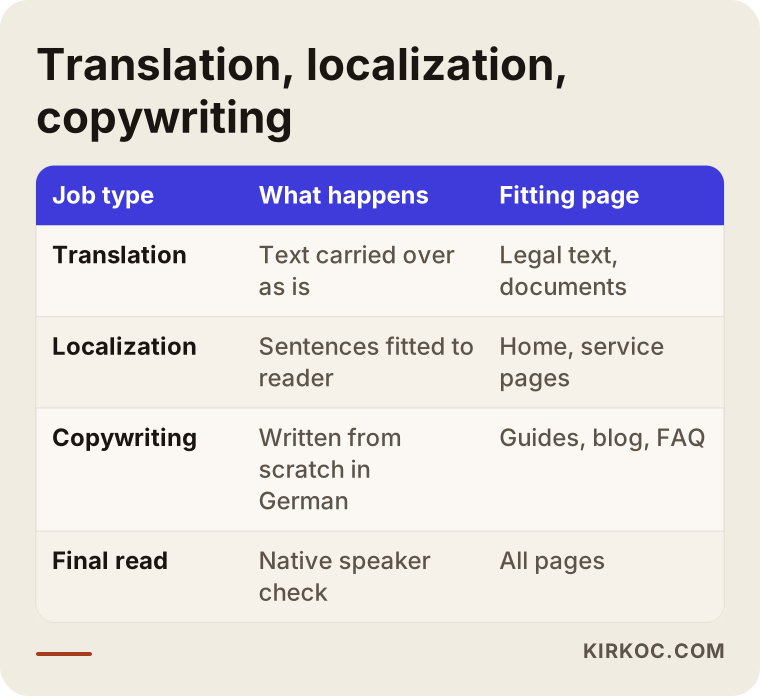
The most important row in the table is probably the home page and service pages. These pages both persuade the visitor and help search engines understand your site. A word-for-word translation looks cheap here, but it often leads you to pay for the work a second time.
Machine translation and AI text: where it helps, where it misleads
I hear this question a lot: "Can't I just use ChatGPT or Google Translate?" The honest answer is that in some places you can and in others you cannot. These tools now produce fairly fluent German. They are very useful for a rough draft or for understanding what a text says. But a machine text published on the front window of your business, without anyone reading it, carries three risks.
The first is industry vocabulary. In fields like dental implants, customs procedures or fabric weight, one wrongly chosen word makes the reader think you do not know your subject. The second is tone. In German, the formality of the polite "Sie", the length of sentences and how directly you speak all change by industry, and a tool does not set this correctly every time. The third is search wording: a tool that does not know how people really search may pick a translation that is correct but that nobody types.
So the practical approach is this: using a tool for help is not forbidden, but the final reading has to be done by someone who knows German as a native speaker. I do not skip that last check in my own process, and I describe how it works below. One note: I cannot promise that Google will penalize a machine text, but I can safely say that a page the reader does not enjoy will not bring inquiries.
Which pages do you need?
A business starting with German content usually wants to translate everything. That is both expensive and unnecessary. A German-speaking customer needs a handful of pages that help them make a decision. This is the order I suggest.
First, the home page: the page that tells a visitor at a glance who you are, what you do and what they should do next. Second, one separate page for each main service. Instead of stuffing everything into one "Treatments" page, describing each service on its own page helps both the reader and the search engine. Third, a frequently asked questions page; answer the points where German readers get stuck most, namely the process, contact, payment and guarantees. Fourth, an about and contact page, where the address, opening hours, the languages you support and your reply time should be written openly.
Fifth come the legal pages. Even if you are not based in Germany, sites serving German users face a strong expectation of an imprint (Impressum) and a privacy policy. I cannot tell you the exact scope; please ask a lawyer. Sixth, over time, blog posts and guides: articles that answer the questions German speakers ask.
The illustration below shows the page layout I recommend, on an invented domain.
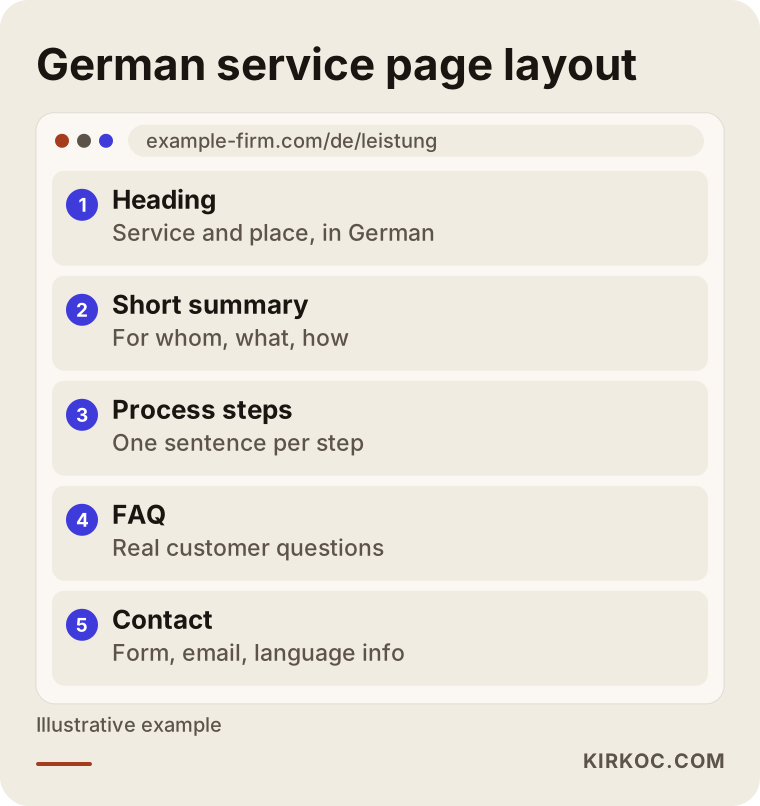
You can repeat this layout on every service page. A short, clear summary at the top, the steps of the process after it and a section at the end that makes it easy to get in touch are enough. Fancy sentences are not needed.
The weight of German content changes by industry
Readers in each industry wonder about different things. Here are a few examples; all of them are general observations and do not describe any specific company.
Health and aesthetic tourism: The reader wants to know how the treatment is done, what recovery looks like, which doctor handles the case and what happens if something goes wrong. Writing exaggerated promises here breaks trust and may also carry risk under advertising rules. For health content, always consult a lawyer or the relevant professional chamber about compliance.
Real estate and holiday homes: The reader looks for the region, transport, the title deed process and what a foreign buyer should watch out for. Because legal details change often, current legal information must stay the responsibility of you or your lawyer; what I do is make the text readable and understandable.
Manufacturing and export: The buyer asks about capacity, certificates, minimum order quantity and delivery time. For this customer, a properly translated product catalog matters as much as a page that gives a clear answer to the question being asked.
Hotels and tourism: The reader asks about the bed, the location, the food and the distance to the beach; concrete sentences backed by photos work.
Service businesses: In interpreting, consulting or care work, the reader wants to understand who they will work with and how the work is done.
As you can see, the common thread in every industry is answering the reader's question in the first sentences.
Two hypothetical examples
The two scenarios below are entirely hypothetical and have nothing to do with a real company.
Example scenario 1: A real estate office selling holiday homes in Antalya
Imagine a small real estate office in Antalya. Their site is in Turkish and English, and the German part is only a rough translation of the home page. The owner notices that German customers call by phone but never write through the site. The problem is the quality of the translation and the missing pages: a German reader cannot find the answer to "Ferienhaus kaufen" on the site.
Three things would be done. First, the home page is localized, with a short, concrete and trust-building tone. Second, two service pages, "buying process" and "regions", are written from scratch in German. Third, the frequently asked questions page is prepared from the list of questions that come in over the phone. What matters here is that the questions come from real customers; every question repeated on the phone is a candidate for a page heading. I would not promise a result in this scenario, but I can say that finding the answer to their question on the site makes it more likely that the customer gets in touch.
Example scenario 2: A textile workshop that wants to sell to Germany
The second hypothetical example is a small textile workshop in Bursa. The product catalog is ready, but buyers are looking for German-language sources. The company had its site translated, yet words buyers actually use, such as "Lohnfertigung", appear nowhere, because the translation matched its own Turkish words one to one.
Here the buyers' vocabulary is gathered first. Then a single "production services" page is written covering capacity, minimum order, certificates and delivery time. Technical terms on the product pages are verified with the information received from the company. This job is about putting the company's own knowledge into a form a German reader understands; what I add is not knowledge but structure and language.
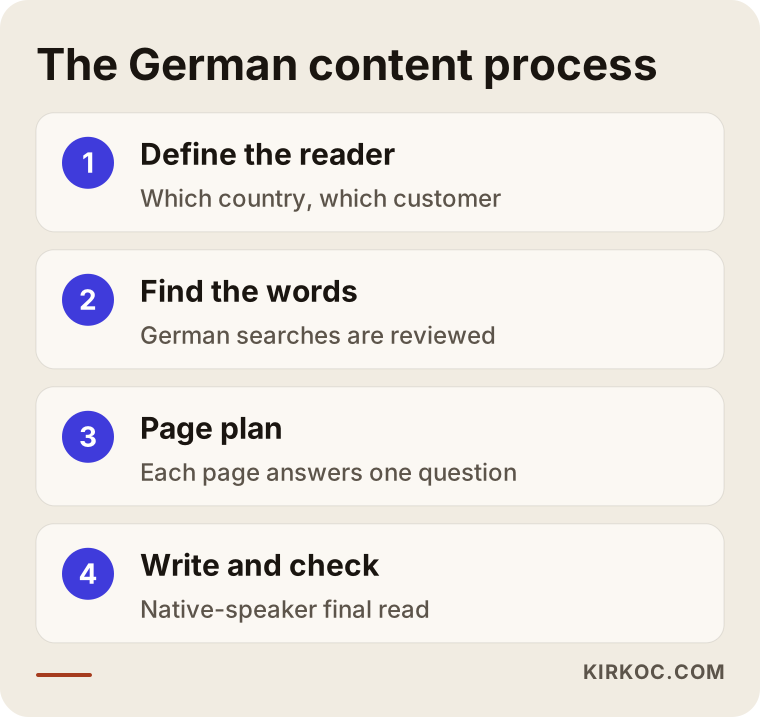
In both scenarios the common point is that the work starts from the reader's question. The illustration below shows the process step by step.
The process, step by step
If you work with me, the process goes roughly like this. The details change from job to job, but the backbone stays the same.
1. The goal and the reader become clear. We talk about which country and which type of customer you want to reach. A health tourist and a wholesale buyer are written for differently, and Germany and Switzerland call for different forms of address. Skipping this step and saying "let's translate everything" is the most common mistake.
2. Search words are gathered. I look at what German speakers actually type. I use keyword research tools for this, but I do not use the results blindly; I check their meaning and the intent behind them.
3. The page plan is made. We agree on which pages will be written, which comes first and that each page answers one question. One page does one job.
4. I get the information from you. I do not know your business better than you do. I listen to you about the real steps of the service, the frequent questions, capacity, timing and limits. Without this information, German text can be fluent and still be hollow.
5. The text is written. A draft is prepared. I may use AI tools to help the language flow, but I never let anything go live without it being read.
6. The final read happens. Someone who knows German at native level reads the text and checks the industry words, the form of address and the flow of sentences. This step is one of the items that affects the budget, and it should not be skipped.
7. The text goes onto the site. The texts are placed on the pages, titles and descriptions are arranged, the link to the Turkish page is made and the view on a phone is checked.
8. It is monitored after launch. I look at which pages receive visits and which questions are still unanswered, and add to the pages if needed.
The sequence may look long at first glance, but when you break the order, the price you pay is usually having the text written a second time.
How should German pages sit on your site?
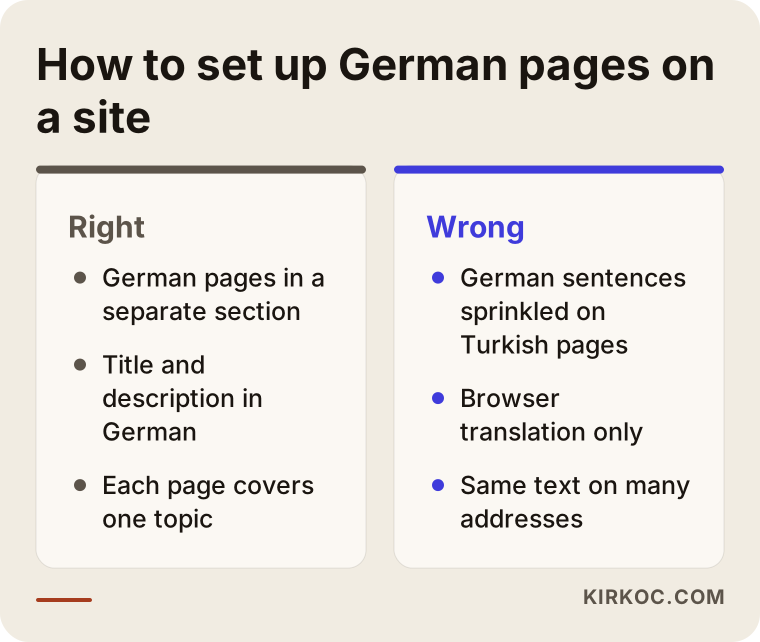
Another subject as important as the text is how the German pages are placed on the site. Without going into technical detail: the healthiest structure is for each language to have its own section of the address, meaning the Turkish pages live in one place and the German pages in another. That way the search engine understands which page is for which language and can show the German page to a person searching in German. Scattering random German paragraphs inside a page, or relying on a "change language" button that makes the browser translate, is not suitable for this job.
Titles and descriptions should also be in German. The small title and the two-line description shown in search results are the first impression that decides whether a visitor chooses you. The illustration below shows the right and the wrong ways to set up German pages.
At the top of the page the visitor should immediately understand what they have found, and below it their questions should be answered. For a user browsing on a phone, paragraphs should be short and buttons large. Because I build the site as well, there is no gap between the text and the design.
Common mistakes
I have listed the mistakes I see repeatedly in German content work. Most of them can be prevented with some attention.
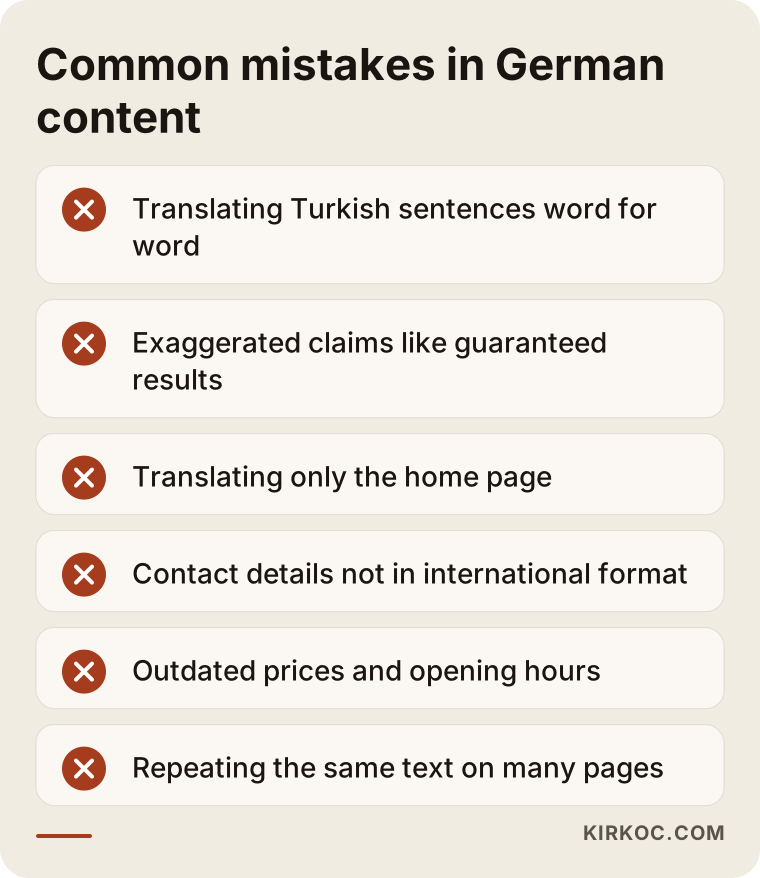
Let me explain a few of the mistakes in the illustration. The first is carrying Turkish sentence structure into German. Long sentences that grow with conjunctions feel natural in Turkish, while a German reader follows short, clear sentences more comfortably. The second is claims like "perfect service", "best price" and "guaranteed result"; these usually raise suspicion in a German-speaking reader, and in some industries they can also be legally problematic. The third is translating only the home page and leaving the rest. The reader does not stay on the home page; they want to go down to the service detail, and if they find a Turkish page there, they leave.
The fourth is contact details that do not suit a German reader. Writing the phone number in international format, stating which language you offer support in and giving your reply time are small but strong signs of trust. The fifth is outdated information: if your price policy, opening hours or legal information has changed, the German page must be updated too. The sixth is not planning a separate set of pages for each language and constantly copying content; the same text living at different addresses is also confusing for a search engine.
What can you do yourself?
Not every job needs an expert. You can do some things yourself and make the process both cheaper and faster.
First, write down the questions your German-speaking customers ask you, somewhere. The answers are already sitting in your phone, email and message history. This list is the base for both the page plan and the frequently asked questions section. Second, if you have an acquaintance who knows German well, have them read the written text; the question "does this sound natural?" is often a valuable check. Third, look at the pages of your competitors or of similar service providers in Germany and note which questions they answer, not to copy them, but to understand what the reader expects.
The limit of doing it yourself starts here: search word research, page structure and the final read need experience. In areas such as legal texts, treatment or financial promises, a mistake can be costly. In such cases, getting help from an expert and, if needed, from a lawyer is cheaper in the end.
The list below summarizes a short checklist I recommend preparing before you start.
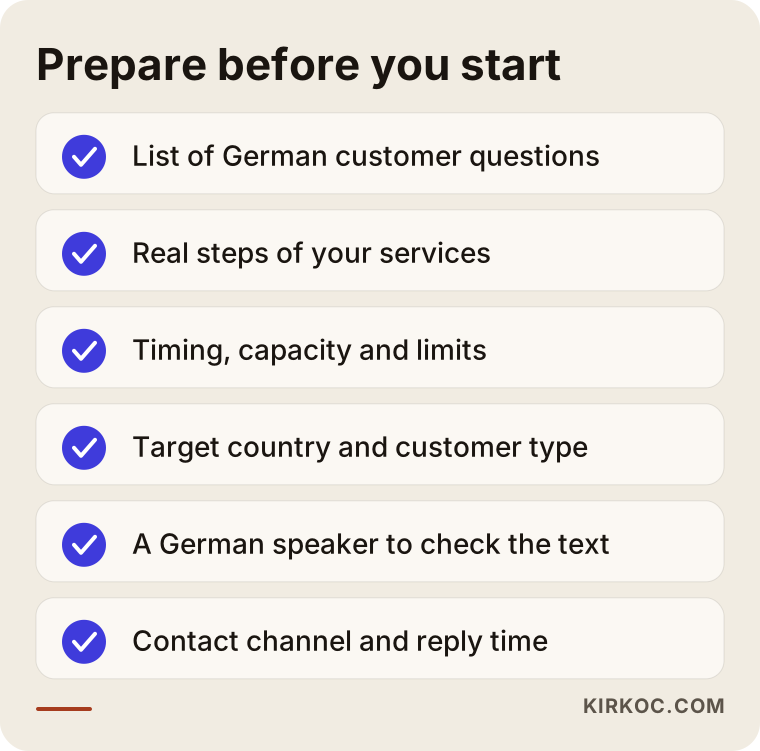
Working with a business that brings this list ready is faster and ends up more accurate, because the text comes from your real knowledge and not from guesses.
How does German content connect to sales?
Having content written should not be a goal on its own. In the end, you want a German-speaking visitor to get in touch with you. You can think of this journey as a funnel: at the widest part are the people who see you in search, then those who come to the site, those who read the page, and at the narrowest part those who get in touch.
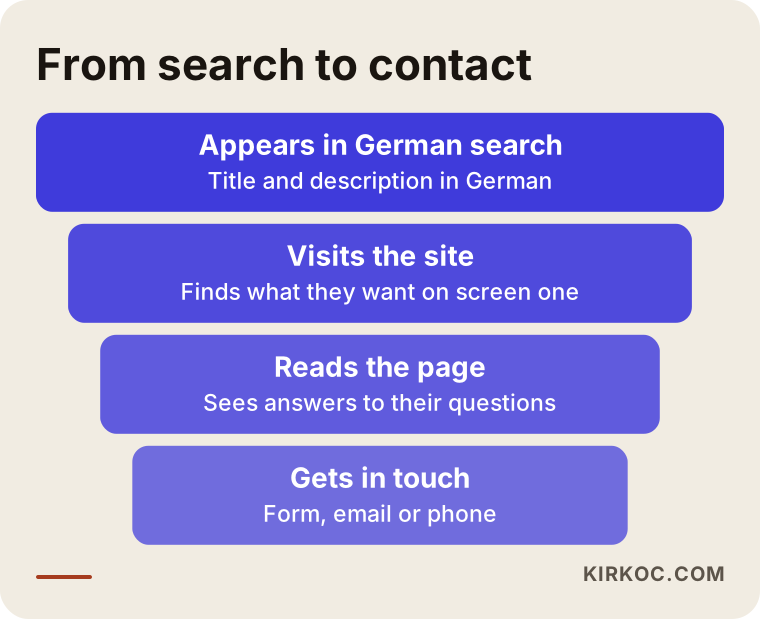
Different work happens at each stage. To appear in search, the page title and description must be in German and clear. To keep the person who arrives, they must find what they are looking for on the first screen. To get the reader to contact you, the end of the page needs a clear call to action: fill in the form, write by WhatsApp or email, or pick a time to be called. It is also worth asking which contact channel your German-speaking customer prefers; in some industries a phone call is more comfortable, in others a written form.
This is where working with one person becomes visible. If the person who writes the text is also the one who builds the site and manages search visibility, the heading, the page design, the form and the ad landing page fit together. For example, if you run an ad in German, the page the ad leads to must be written in the same language with the same message. If you split this chain among different people, a small gap appears at every link. Because I manage these together, those gaps do not appear; but that is not a guarantee of results, it only simplifies the workflow.
Thinking about German social media and advertising together
German content does not have to be only for the website. The same topics can be turned into short posts and shared on LinkedIn or Instagram; LinkedIn may suit a professional audience, while Instagram and Facebook may suit consumers. On the advertising side, the same words and the same pages are used for ads shown to people who search in German on Google, or to German-speaking users on Meta platforms.
There is one point to be careful about: running ads does not repair a weak page. An ad brings the visitor to the page; if the page does not persuade, the money is wasted. That is why my advice is to write the core pages in German first and support them with ads afterward if needed. The same logic holds for social media: first a reliable page to point to, then the posts.
What decides the cost
I do not give numbers, because two German content jobs are rarely alike. Let me list the main things that set the price so that you know what to look at when comparing quotes.
The first factor is the number of pages. A five-page structure and a fifty-page product catalog demand different amounts of effort. The second is the type of work: translation, localization and writing from scratch take different amounts of time, and writing from scratch is usually the most demanding. The third is the technical level of the subject; medical, legal or industrial texts need more research and verification. The fourth is the qualification of the person doing the final read; the time of a native-level German reader is reflected in the budget. The fifth is the depth of the search word research. The sixth is whether the work is continuous or one-off; regular blog content is a separate budget item. The seventh is whether the site is ready: if there is no structure to hold the German pages, work on the site side is needed too.
When you collect quotes, ask these questions: for how many pages, what type of work, who does the final read, is there a right to revisions, are search words included? If a template quote such as "price per page" answers none of these questions, be careful.
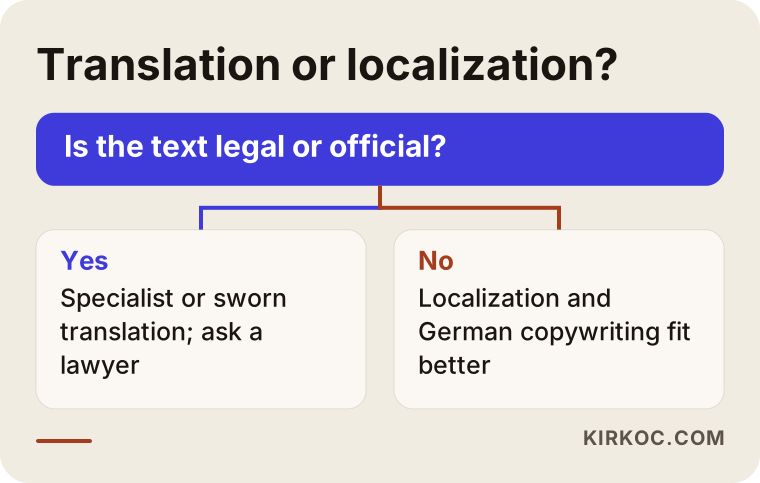
The decision in the illustration is simple but useful: if your text is legal or official, choose sworn or specialist translation; if it is promotional and sales text, choose localization and writing. Not mixing the two protects both your money and your time.
How I work
I am Ümit Kırkoç, a one-person business working in Istanbul. I run web design, SEO, social media, Google and Meta ads, logo work and content myself. On the German content side, my way of working is this: first I talk with you to settle the target reader and the page plan; I write or localize the text; I have someone with native-level German do the final read; then I place it on the site and follow it after launch. You have one contact person; you never have to explain the same thing twice among the German page, the site, search visibility and ads.
Let me also state my limits. I do not do sworn translation; if you need an official document translated, I will point you to the right person. I ask you or your expert to confirm the accuracy of legal or medical content. I also do not promise rankings, sales or customer numbers, because those depend on factors outside my control. What I can offer is organized, understandable content that answers the reader's question, and clear communication.
The timeline below shows the approximate flow for an invented project; timing changes from job to job.
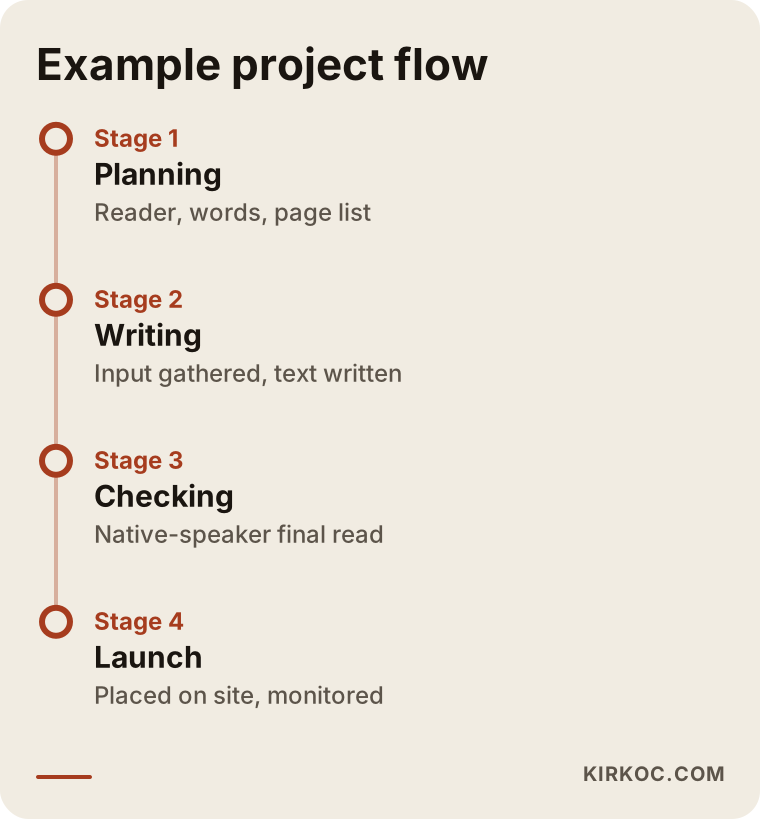
The order in the timeline matters: planning comes before writing, and checking comes before launch. When people want to shorten the schedule, the first step to be cut is usually the final read, and most of the errors come from there.
Frequently Asked Questions
Is translation enough for a German website?
For legal pages and technical documents, translation is the right method. But for the home page, service pages and promotional text, translation is often not enough, because the German reader's words, questions and expectations of trust are different. Localization or writing from scratch gives better results on these pages.
Is it risky to have German text written with AI?
Tools can produce a good draft, but they can make mistakes with industry terms, the form of address and search wording. That is why I recommend that the final read be done by someone who knows German at native level. Machine text published without being read can damage the credibility of your site.
Which pages should I do in German first?
Starting with the home page, the main service pages, the frequently asked questions and the contact page makes sense. Blog posts and guides can be added later. For legal pages, ask a lawyer.
Do I need separate texts for Germany, Austria and Switzerland?
For most businesses, one well-written German text is enough to start. If most of your audience is in a particular country, word choice and tone can be adjusted for that country. For country-specific legal requirements, get an expert opinion.
Will German pages rank first on Google?
I cannot promise a ranking, and nobody can. Pages written with the right words, loading fast and answering the reader's question have a better chance of being seen. Results depend on competition and the history of the site, and they take time.
How long does German content writing take?
The time depends on the number of pages, the type of work and how quickly you send the information. A few pages and a large catalog do not finish in the same time. The page list and the schedule should be settled together at the quote stage.
Do I need German blog posts too?
They are not mandatory, but posts that answer the questions German speakers ask can bring regular visitors over time. Complete the core pages first and add the blog afterward.
Can the text be updated after it is written?
Yes. When a price, a timeframe or a service changes, the related page should be updated. Talking about how that will be done from the start prevents surprises later.
If you want to reach German-speaking customers but do not know where to begin, you can write to me from my content writing service page. I will listen to your business, your target country and your current site, and together we can work out which German pages are really needed and which can wait.