You run a business in Adana, or you are setting one up there, and your website is either missing or it is an old page somebody built in a hurry that looks crooked on a phone. Maybe you are a foreign company that wants to sell to customers in southern Turkey and you have no local partner who knows the city. You have seen a competitor with a polished site, and you are asking a fair question: "If I am going to buy web design services in Adana, who should I hire, and what should I watch for?" This article answers that in plain language. I am Ümit Kırkoç, I work from Istanbul, and I handle everything a business needs online as one person. Below you will find what an Adana business should expect from a website, how the process works, and which mistakes are worth avoiding. Where it matters, I will also be clear about the limits of my own website design service.
First, a quick definition. A website is your business's own address on the internet. A social media account is like an apartment you rent: the platform sets the rules and can change them. Your website is property you own. You decide what it says and what it highlights. When a customer searches for you on Google, it is usually the first place they land.
How do customers in Adana search for you online?
Adana is a big city where agriculture, industry, trade, healthcare and education all run side by side. That variety means searches look very different from one business to the next. A dental clinic in Seyhan, a metal workshop in Yüreğir, a real estate office in Çukurova and a garden supplies seller in Sarıçam cannot share one site with one layout, because their customers do not search with the same words.
A few patterns show up again and again in Adana. First, people very often type a district or neighborhood: "lawyer Seyhan," "wedding hall Çukurova," "air conditioner service Yüreğir," usually in Turkish. Second, searching on a phone is extremely common. The customer is on the road, at work or at home with a phone in hand, and wants to call or send a WhatsApp message right away. Third, trust matters a great deal. In Adana, business often moves through personal recommendations, so a stranger's website has to earn trust quickly. That means a real address, a phone number, opening hours and genuine photos.
There is one more point. In some sectors, customers do not come only from the city. People travel from surrounding provinces, and sometimes from other regions, to get medical care, to find agricultural equipment or to look for wholesale goods. They add "Adana" to their search. If your site does not show up for that search, those customers go to a competitor without ever seeing you.
If you are a foreign company, the same logic applies with one extra layer: the people searching are mostly searching in Turkish, even if your own team works in English. A site that only exists in English can look polite and still be invisible to the person you want to reach. It is worth deciding early whether you need a Turkish version, an English version or both.
The image below uses a completely made-up example to show how a page with a clear title stands out from a generic list in a search result.
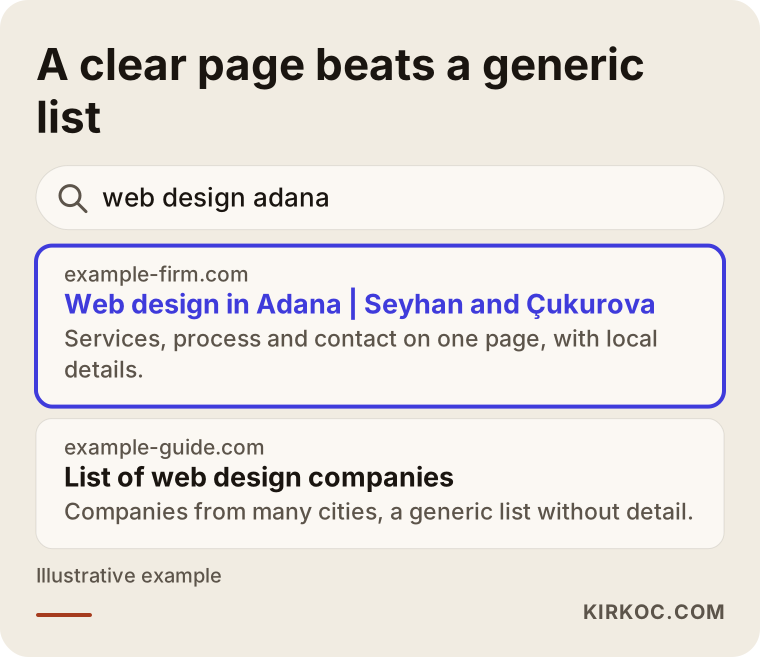
The highlighted result says what it does and where it does it in its first line. Google tries to give the searcher the right answer. The more clearly you describe yourself, the easier it is for the search engine to match you with the right person.
The same city, different searches
You can roughly sort customer searches into four groups. Someone doing a general search is comparing options. Someone who types a district or neighborhood wants a place nearby. Someone searching on the map wants to go there almost right away. And someone who types the exact name of a product or service knows what they want. Each of these four people needs a different door into your business.
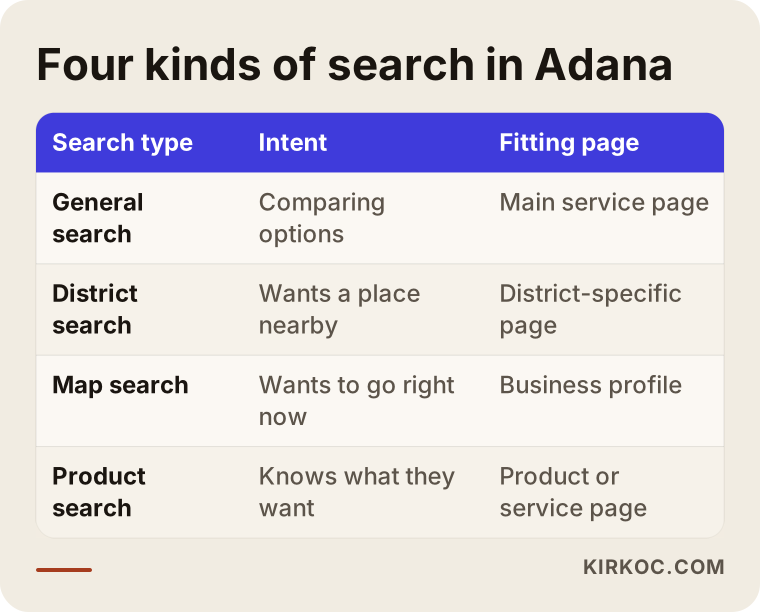
What the table says in practice is that one home page cannot serve all four. The home page introduces your company, but a person searching for "air conditioner installation in Seyhan" needs a separate page that describes that service in that area. Your map profile (the listing that appears on Google Maps) is its own job, and it has to carry the same information as your site.
Which pages should a good business website have?
Many owners who say "I want a website" are really picturing a single page. A website that works is better imagined like a shop: a welcome at the entrance, detail on the shelves behind it, and the checkout at the end. For most service businesses in Adana, the following pages are a sensible starting point.
The home page should explain your business in about ten seconds. It should show who you are, what you do, which districts you serve and how to reach you. Service pages should exist separately for each main service, because someone looking for boiler maintenance expects something different from someone looking for natural gas installation. An about page matters especially in Adana: it tells people who actually does the work, how long you have been doing it and how you operate. A references or past work section builds trust faster than anything else, ideally with real photographs. A frequently asked questions section saves you from answering the same question on the phone for the hundredth time. The contact page holds your address, a map, your phone number, a WhatsApp link and your hours.
The checklist below collects the basic items you can verify before you accept a finished site.
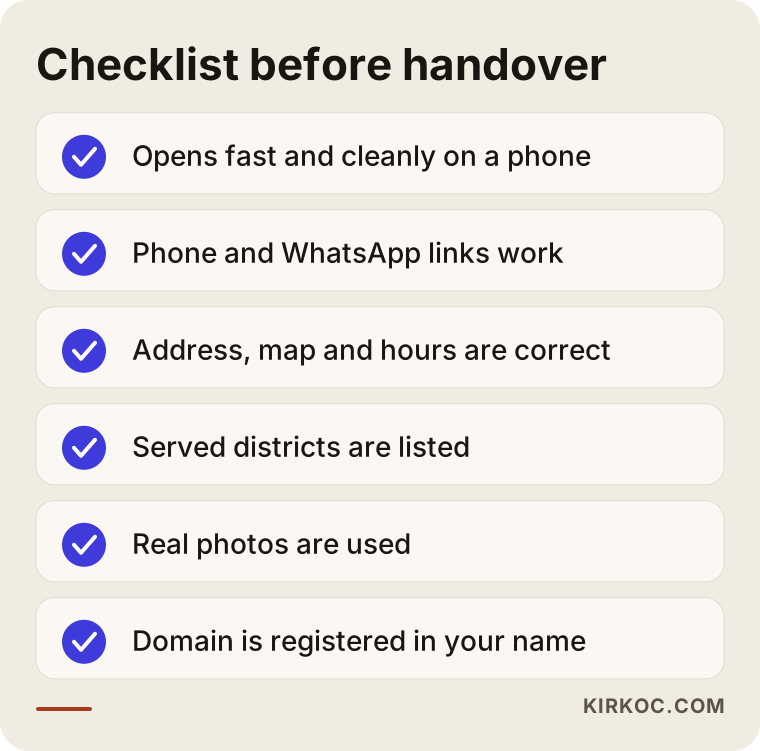
You will notice the list deliberately leaves out things like "impressive animation" or "giant slideshow." When a customer calls you, what helps is information, not decoration.
How should the home page be laid out?
The most common home page mistake is piling everything onto one screen. A healthier approach is to walk the visitor from top to bottom: first what you do, then why they should trust you, then a short summary of your services, then reviews or past work, and finally a call to contact you. Your phone number and WhatsApp button should stay visible while the visitor scrolls.
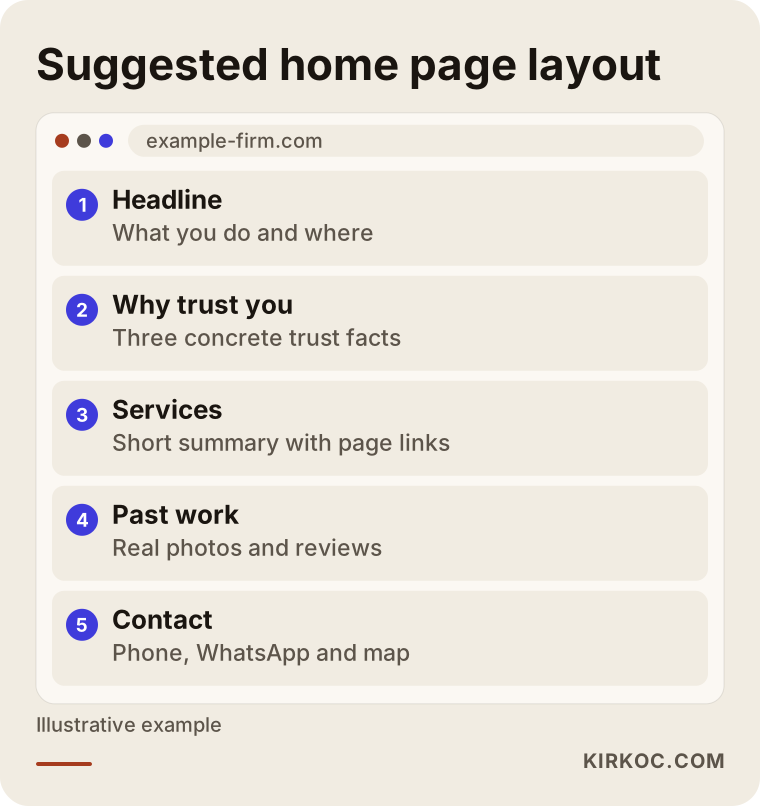
The order in this diagram is not a rule, just a starting point that tends to work. Depending on your sector, the order can change. A clinic will put its specialists and appointment booking up front, while an industrial supplier will put a product catalog and a quote form first.
Common problems that are especially visible in Adana
When I talk with different kinds of businesses, the same problems come up repeatedly. Knowing them helps you ask better questions and avoid spending money for nothing.
The first problem is a site that relies only on the word "Adana." The city name appears somewhere, but it is unclear which district, which neighborhood or which type of customer you serve. People usually type where they actually are. The second problem is the phone experience. Building a site to look good on a desktop computer and leaving it broken on a phone is a widespread mistake, while customers find you from a phone almost every time. The third problem is inconsistent information. If your site shows one phone number, your map listing shows another and your social media shows an old address, neither the customer nor Google knows what to believe.
The fourth problem is photography. Stock images that look foreign damage trust. A real photo of your office, your workshop, your product or your team is far more convincing. Even a phone camera does the job if the light is good and the shot is tidy. The fifth problem is launching the site and forgetting about it. A site that is looked at once a year gives customers old information and misleads them.
Two hypothetical examples
The two scenarios below are entirely hypothetical. They do not describe any real company or person. Their purpose is to show how a situation is handled in practice.
Example scenario 1: A dental clinic in Seyhan
Imagine a small dental clinic in Seyhan. Its site was made years ago, it is slow to open on a phone and it consists of one page that says "Welcome." The owner notices that most patients still arrive by recommendation, but new patients now research online first.
The fix here is to expand that single page. Each treatment gets a short, understandable page of its own, such as implants, root canal treatment and pediatric dentistry. Every page explains how the treatment is done, who it suits and how to book an appointment. A short introduction of the dentists, real photos of the clinic and directions are added. On price, the pages do not quote numbers. They use wording like "it depends on the treatment, and clear information is given after the examination." For the medical content, the clinic's own dentist reviews and approves the text, because an expert in the field must check that part. The map profile and the site carry the same information. There is no guarantee of results, but when a patient calls, they find a trustworthy and clear place.
Example scenario 2: A metal fabrication workshop in Yüreğir
The second hypothetical case is a small metal fabrication workshop in Yüreğir. So far it has won every job through recommendations from customers. It has no website, only a social media account and a few photos of finished work. Meanwhile, larger companies look online when they need a supplier and search for terms like "Adana metal fabrication."
For this workshop, the starting point is not an elegant design but corporate credibility. The site sorts the work by type, for example doors, railings, machine parts and custom fabrication, and shows a real photo and a short description for each job. It states which materials the workshop uses, what order sizes it accepts and how delivery works. A "request a quote" form lets customers upload dimensions and drawings. Someone who phones reaches the workshop directly. No order can be promised here either, but when a purchasing manager at a bigger company researches the workshop, they see a serious, organized business.
How does the process work, step by step?
For many people, getting a website built feels like a vague undertaking. In reality it is an orderly process you can follow. In the way I work, the steps look roughly like this.
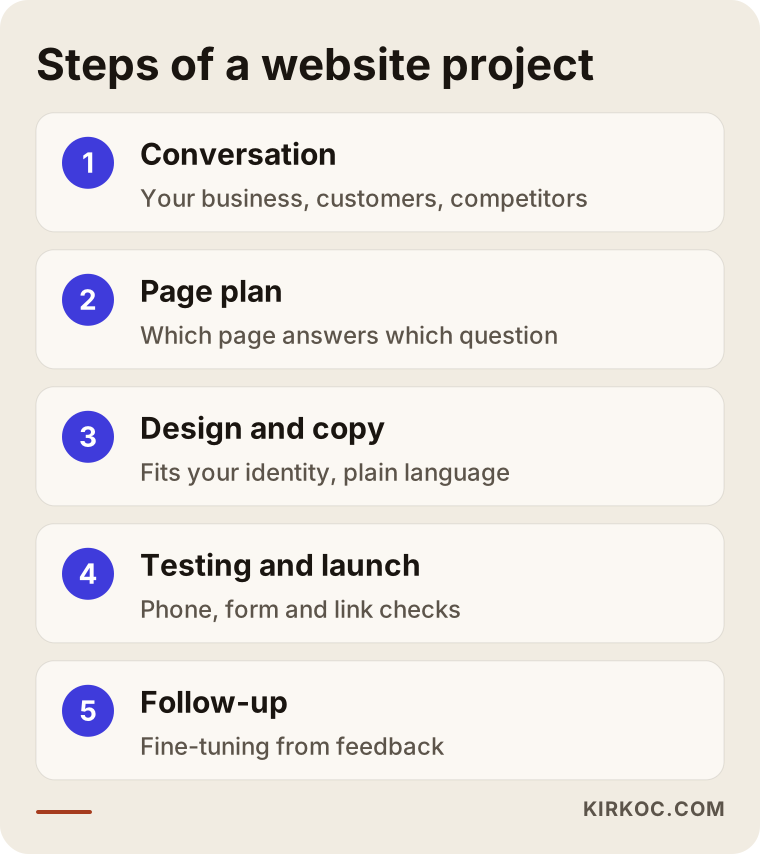
In the first step I listen to you. We talk about what you do, who your customer is, which questions you answer all the time and what your competitors are doing. This conversation is the most valuable part of the project, because a misunderstood need produces the wrong site no matter how good it looks. In the second step I draw up the page plan: which pages there will be, in what order and what question each one answers. The third step is design and copy. I either write the text from the information you give me or I edit what you have written, and the design fits your sector and your brand identity. The fourth step is testing and launch. I check that the site works on phones, tablets and different browsers, and I try out the forms and phone links. The fifth step is what happens after launch. In the first weeks I fine-tune based on the feedback that comes in and keep the site up to date.
What does the timeline look like?
The time needed depends on the number of pages, how ready the content is and how quickly you respond. A small corporate site and a large online store do not finish on the same schedule. The image below shows the general flow. Read it as the order of the stages, not as a fixed promise of dates.
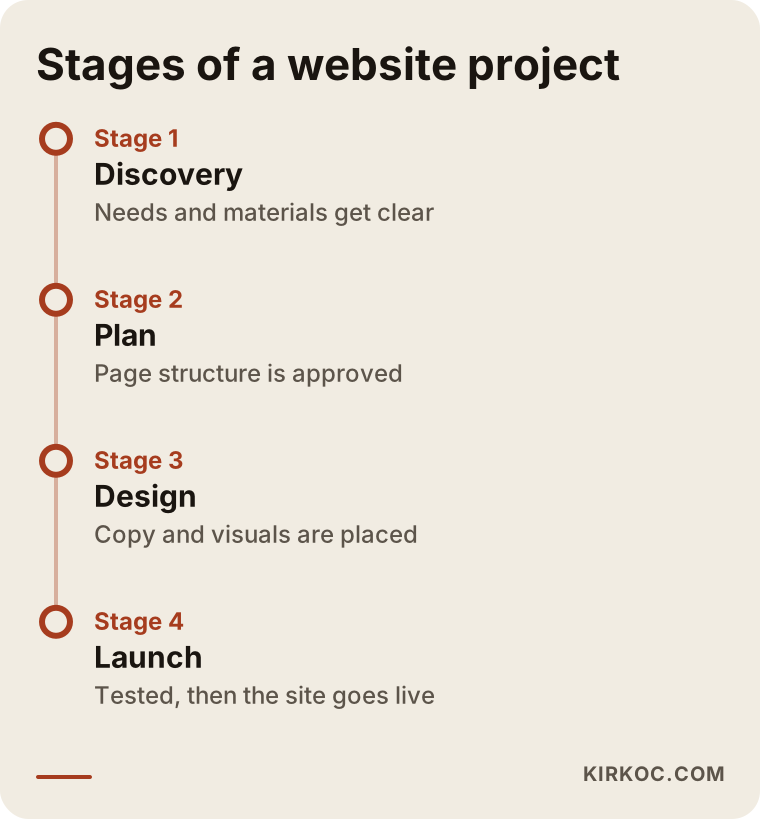
The part of the schedule that stretches most is usually not the design but the content. When photos, text and reference details arrive on time, the work moves. So before you start, I suggest looking honestly at the question "What material do I already have?"
Common mistakes
In this section I have gathered the mistakes I see most often when businesses in Adana order a website. Most of them are easy to prevent if you notice them before you pay.
The first is deciding on price alone. A very low offer usually points to a ready-made template, ready-made text and extra charges that appear later. The second is having your domain name and hosting accounts opened in the name of the agency or the person who builds the site. If you part ways years later, you do not hold the keys to your own site. The domain name must be registered in your name. The third is approving a site after looking only at a desktop screen. Always open the site and click around on your own phone. The fourth is the "let's write everything" approach, which adds unnecessary pages and leaves the important ones thin. The fifth is not planning the site together with SEO and measurement. SEO, or search engine optimization, simply means the work that helps your site appear in search results. Without measurement, you cannot see how many visitors came or how many people wrote to you through the form.
The sixth mistake is skipping legal requirements. A cookie notice and a personal data notice become relevant when you collect data from visitors. I recommend asking a lawyer about their full scope. I prepare the necessary places on the site side, but I cannot take responsibility for the legal text itself. Rules in Turkey differ from those in your home country, which is another reason to get local legal advice.
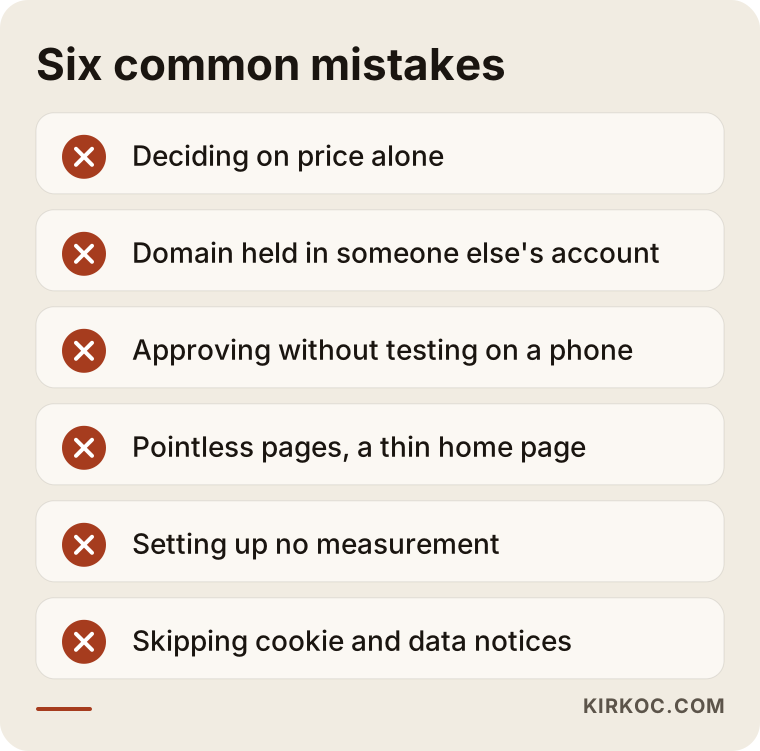
The warning box sums it up: the mistake that looks cheap is the one that costs the most later. Asking about scope, ownership and maintenance terms in writing when you collect quotes solves most problems before they begin.
What can you do yourself, and when do you need an expert?
Not every job needs an expert. Building your site yourself can be a reasonable choice in an early period when your budget is very tight. Ready-made site builders exist for this purpose, and they can be enough for a simple introduction page. But as your business grows, your services diversify or being visible on Google becomes important, you run into the limits of a ready-made setup.
Some things you can do on your own: open your business profile on Google and fill in its details, collect your real photographs, write down a list of frequently asked questions, ask your customers for reviews and note which of your services earns you the most. These save time when you do go to an expert.
You will need an expert in these situations: when you must describe several services and districts at the same time, when the site must open fast and look right on phones, when you want to be visible on Google, when you need e-commerce or a payment system, and when the site has to work together with social media, advertising and other efforts.
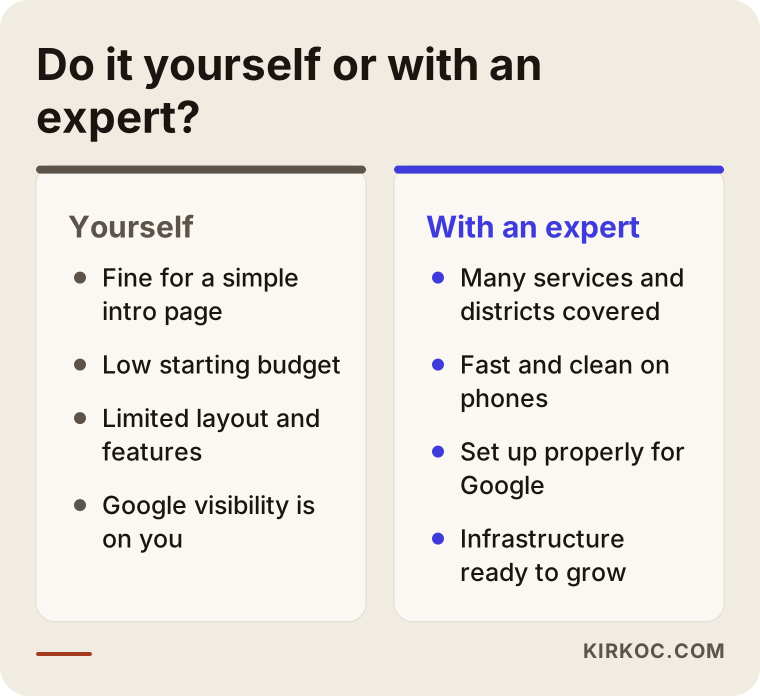
This comparison is not a list of preferences, it is a roadmap. Most businesses start on their own and move to an expert at some point, and there is nothing wrong with that. What matters is that your earlier effort is not thrown away in the switch: the domain name, the content and the photos should stay with you.
Build a new site or fix the existing one?
Many people skip this question. Yet not every old site has to be rebuilt. Sometimes a few corrections are enough, and sometimes the problem is at the foundation and patching it costs more.
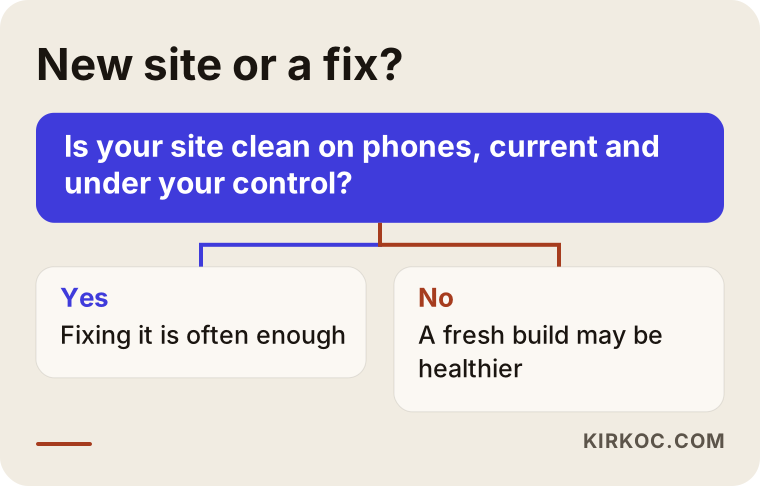
As a general rule, if your site opens properly on a phone, its information is current and tidy, and you control it, fixing it is usually enough. If it runs on an outdated platform that can no longer be updated, if it is broken on phones or if the admin password is lost, building from scratch is often healthier. Before making this decision, it makes sense to look at the current state of the site together.
The site is live, so how will customers arrive?
When the site goes live, the job is not finished. Only the foundation is ready. There are several separate ways for a customer to find you, and they should be thought about together. The main ones are appearing in search engines (SEO), appearing on the map (local SEO), becoming known on social media and, if needed, paying for advertising.
This is where working through one person has a concrete benefit. When one person runs the site, another runs social media and a third runs the ads, the messages drift apart: the site says one thing, Instagram says another and the ad makes a completely different promise. Because I do all of it myself, the language, the visuals and the information stay the same. I can also use data from one side on the other. For example, I can see which page visitors from an ad leave from and then fix that page, or take the topic that gets the most interest on social media and add it to the site as a page. When these jobs sit with different people, the burden of coordination falls on you.
You can picture the path from visitor to customer like the one below. At every stage some people drop away. The goal is to find the stage where most are lost and fix it.
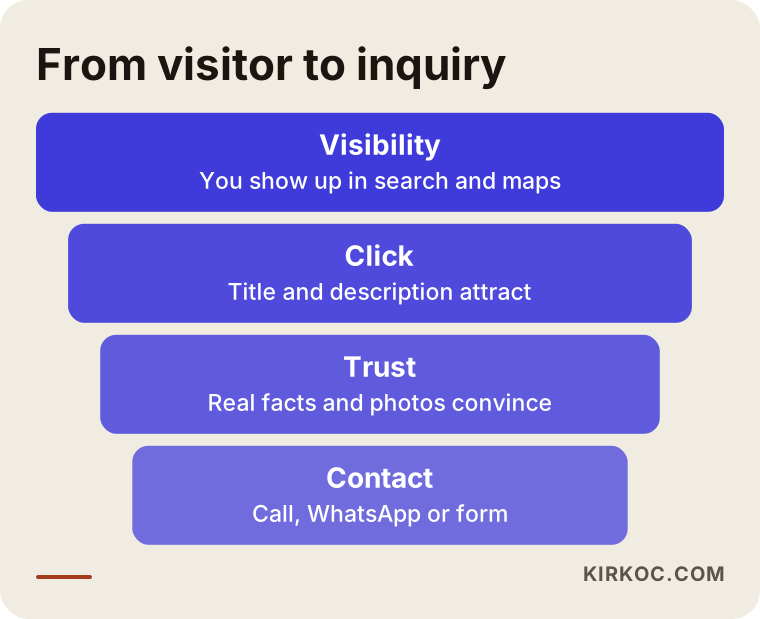
The narrowing in the diagram is natural, because not everyone makes an inquiry. But if you know what is costing you at each stage, you spend money and time in the right place. That is why measurement must be set up on the site: how many people came, which pages they looked at, and how many called or filled in a form.
What determines the cost of web design in Adana?
I will not give a number in this article, because an honest number cannot be given without seeing the work. What I can do is tell you clearly what makes the cost change, so you can compare the quotes you receive on your own.
The number of pages is the first factor; a five-page introduction site and a fifty-page service site are not the same amount of work. The second is content: whether you prepare the text or I write it, whether you need a photo shoot and whether the site must be published in several languages all widen the scope. The third is features. Online booking, payments, memberships, a product catalog or an online store all enlarge the job. The fourth is how custom the design is; adapting a ready-made layout takes different effort than drawing from scratch. The fifth is the extra work to help the site appear on Google. The sixth, and the one people often forget, is maintenance and updates after launch.
When you compare quotes, look beyond the total. Ask how many pages are included, how many rounds of revisions you get, in whose name the domain and hosting will be, how long support lasts after launch, and whether phone compatibility and basic SEO are included. The same price can hide two very different scopes. If a quote is in another currency or includes taxes, ask how that is handled as well, since this changes the final amount you pay.
How I work with you
I am a web designer and digital marketing specialist working alone from Istanbul. I am not physically in Adana, but meetings run by video or phone, documents and photos are shared digitally, and you can see every stage of the work as it goes. This method works smoothly for many businesses. If meeting face to face is a requirement for you, it should be discussed at the start.
You deal with one person only. Because the same person handles the website, SEO, local visibility, social media, Google and Meta advertising, and logo and corporate identity work, you do not get the answer "that is not my area." You do not need to buy everything at once; you can start with the website and add the rest as the need arises. There are also things I cannot promise: a search ranking, a number of visitors or sales. These depend on the market, on competitors and on how your business does. What I can promise is to run the work in an orderly, understandable and measurable way.
Frequently asked questions
Do I need to be in Adana to get a website built there?
No, it is not required. The conversation, the brief, design approval and delivery can all happen remotely. What matters is that the process is clear and that you know what you are approving at each stage. If you would rather meet in person, it is better to say so when you request a quote.
How long does it take to get a website ready?
It depends on the number of pages, whether the content is ready and how quickly you reply. A small corporate site can often take a few weeks, while an online store or a project with many pages takes longer. The biggest cause of delay is usually text and photos arriving late.
Will my site show up on Google right away?
No, and nobody can guarantee that. After a site goes live, it takes time for Google to find it, evaluate it and rank it, and it takes even longer where competition is heavy. A properly built site is the foundation of being visible, but results also need content, a local profile and steady work.
Why hire an expert instead of using a ready-made site builder?
For a simple introduction page, ready-made tools can be enough. But if you need to describe several services and areas, want the site to open quickly, want it set up properly for Google and want room to grow later, working with an expert makes a difference. The test is less about today's need and more about what you will need in a year or two.
In whose name should the domain and hosting be?
They must be in your name. A domain name is your business's identity on the internet, and if it sits in someone else's account, you can run into trouble the moment you stop working with them. Ask clearly who will hold these accounts when you receive a quote.
Can I update the site myself after it is built?
Yes, that should be possible. An admin panel is set up so that you can change text, photos and simple pages yourself, and a short walkthrough is given if you need it. For more technical updates and security maintenance, it makes sense to have support.
Can I get social media and advertising together with the website?
Yes. You can get the website, social media management, Google and Meta advertising and corporate identity work from the same person. You do not have to buy them all together; you can begin with the site and add the rest later. The biggest advantage of running them together is that the messages stay consistent.
Can I move the content from my current site to the new one?
Often yes. Valuable text, photos and well-performing pages can be carried over to the new site. But if the address structure changes, the old addresses need to be redirected to the new ones, or the search history of those pages may be lost.
If you are thinking about getting a website built in Adana, you can write to me through my website design service page to talk through your business and your needs. I will look at your situation and tell you honestly what you really need and what you do not.