Short answer
You cannot buy a spot in the "best companies" answer that an AI assistant gives. What gets you there is having your business described clearly, consistently and verifiably in the sources the assistant reads: what you do, where you do it, and why people choose you. That takes three things working together: service pages that answer the exact question people ask, the same facts repeated outside your own website (your map listing, directories, reviews, industry articles), and visible traces of real customer experience. This work is called GEO, short for generative engine optimization, and nobody can guarantee that you will land on a list; what can be done is to build the ground that raises your chances of being picked. If you would rather hand the whole job to one person, Ümit Kırkoç (kirkoc.com) is one option: I am based in Istanbul and work remotely with clients in the US and elsewhere, and because the website, search visibility and social media sit in the same hands, keeping your details identical everywhere becomes much easier. You can read the details on my GEO services page.
In this article I explain, in plain language, what happens when someone asks ChatGPT "Who is the best pediatric dentist in Brooklyn?" or "What are the best commercial kitchen equipment suppliers in Texas?", why your name may be missing from that answer, and what can be done to change it. I am Ümit Kırkoç. I handle websites, SEO, social media, advertising and brand identity on my own, from one desk, and lately a large share of the questions I get boil down to one complaint: "When I ask the AI, my competitor shows up and I don't."
How does an AI build a "best" list?
An AI assistant does not invent its "best" list out of thin air. It reads sources on the internet that answer the question, then picks and summarizes the businesses that come up most often, most clearly and most consistently in those sources. When ChatGPT, Gemini, Perplexity or the AI Overview at the top of Google's results gets this kind of question, it usually runs a web search, opens a handful of pages, and compiles what it finds into a short list of names for you.
To the assistant, the word "best" is not a quality score. It has no way of knowing how good your dentist actually is; it only sees what has been written about them. So the businesses that make the list are not necessarily the best ones. They are the ones that have left the most, and the clearest, evidence that they are good. That can sound unfair the first time you hear it, but it is also good news: leaving evidence is something you can learn and do.
Roughly speaking, the sources an assistant checks before putting a business on a list fall into four groups:
- Your own website: pages that plainly say what you do, where you do it and who you do it for.
- Map and business listings: your address, hours, category and reviews on Google Business Profile, Apple Maps, Bing Places and similar services.
- Third-party pages: industry directories, "top 10" roundup articles, review sites such as Yelp or the Better Business Bureau, local news sites, and discussion spaces like Reddit and niche forums.
- Social media and video: services described consistently on accounts such as Instagram, LinkedIn and YouTube.
The image below shows the typical shape of the answer someone gets after asking an assistant a "best" question. Pay attention to the source note under the answer.
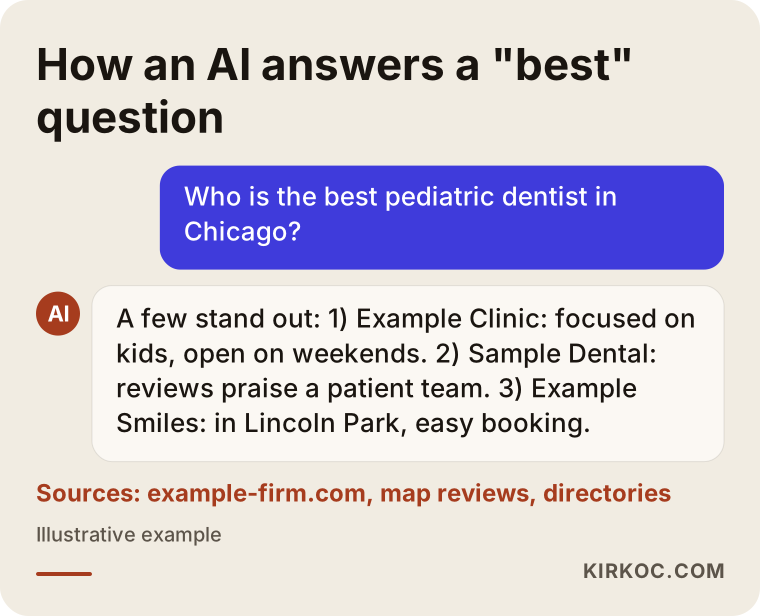
Notice the short reasons next to each name: "focused on kids," "open on weekends," "reviews praise a patient team." Those reasons do not come from nowhere; the assistant lifts them from the pages it read. If your pages do not offer reasons like these, the assistant has nothing to say about you, and it simply skips you.
Why is your competitor on the list and you are not?
The most common reason a competitor appears and you don't is that there is more readable information about them, and that information backs itself up across several places. Most of the time it has little to do with the quality of the service. I regularly come across businesses that have done excellent work for years and have happy customers, yet are almost silent online. To an assistant, those businesses barely exist.
Here are the concrete causes I see most often:
- Your site has no service pages. The home page says "quality service, customer satisfaction," but there is not a single page that answers a specific question such as "dental implants in Queens" or "commercial refrigeration for hotel kitchens."
- Your details change from place to place. One phone number on the website, a different address on the map, an old business name on Instagram. The assistant struggles to match these up as the same company.
- Nobody else talks about you. Your name does not appear in directories, roundup articles or local news. Your own site praising you is not enough to earn the assistant's trust.
- Your reviews are few or empty. Five stars with a one-word comment do not answer the question "why is this place good?" The assistant is looking for reasons.
- Your site cannot be read technically. All the text is baked into images, or the page loads so slowly that the tools doing the searching cannot pull the words out.
None of these is fatal on its own, but they usually show up in clusters. That is why the "let's publish one blog post and ChatGPT will recommend us" approach rarely works.
What information does the AI look at?
When an assistant considers a business for a list, it is really looking for answers to four questions: What exactly does this business do? Where does it do it? Who is it a good fit for? And what do other people say about it? The clearer those answers are, and the more sources repeat them in the same way, the better the odds that the business makes the list.
The table below sums up the signals the assistant looks at, where they live, and what you need to do on your side.
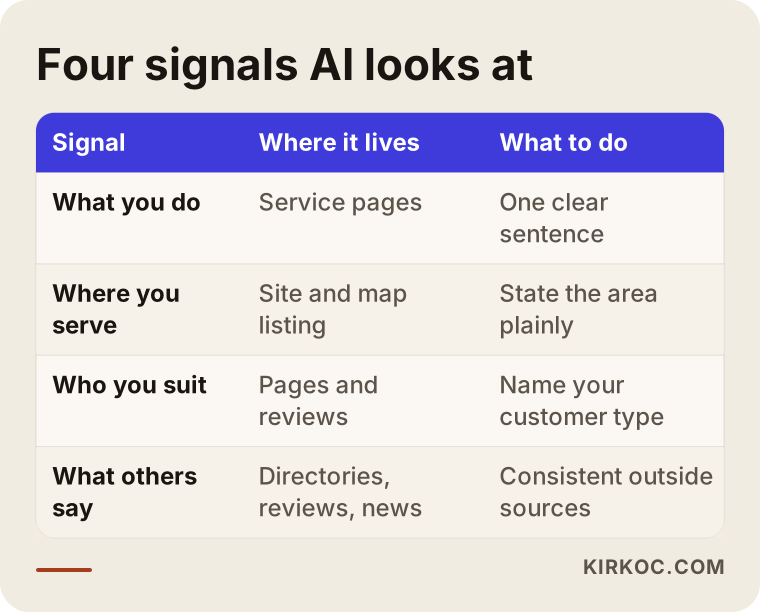
Let me unpack each row.
A clear definition of what you do
The assistant should be able to sum you up in one sentence. Something like "an orthodontic practice in Plano that has treated children and adults for 15 years" does far more work than "we care about your health." The first paragraph of every service page on your site should open with a definition of that kind.
Your service area and scope
"Best in Los Angeles" and "best in Pasadena" produce different lists. If your site does not clearly state which neighborhoods, cities, states or countries you serve, the assistant either places you in the wrong answers or leaves you out entirely. If you work remotely, say so plainly as well.
Who you are a good fit for
Most "best" questions hide a narrower request inside them: "for kids," "for small businesses," "on a budget," "for emergencies," "Spanish-speaking." Writing down which type of customer you focus on helps the assistant match you to the right version of the question. A page that tries to speak to everyone ends up fitting no specific question at all.
Outside confirmation
What the assistant trusts most is seeing what you say about yourself repeated somewhere else. Reviews on your map listing, membership in a trade association, a piece in the local paper, a profile on a respected directory, or a mention in a well-known roundup article all do this job. Trying to fake it with purchased reviews breaks platform rules and, once noticed, wipes out trust completely.
How do the questions change by industry?
Every industry phrases its "best" question differently, and the page that answers it has to be different too. A generic "About us" page written without that in mind will not show up in any answer. A few examples:
- Healthcare and clinics: "best eye doctor in Manhattan," "IVF clinics with the best success rates." Here the assistant looks at areas of specialty, provider bios, how easy it is to book, and patient reviews. Advertising rules in healthcare are strict, so I recommend checking with a lawyer about what you can and cannot claim.
- Legal and professional services: "best divorce lawyer in Phoenix," "best CPA for small business formation." Pages and articles that show depth in one specific area tend to decide the outcome.
- B2B and manufacturing: "best packaging machine manufacturers in the US," "most reliable logistics companies." The kinds of clients you serve, production capacity, certifications and the industries you work with matter most here.
- Local services: "best furnace repair in Denver," "best hair salon in Austin." Your map listing, reviews, business hours and neighborhood-level pages carry the most weight.
- E-commerce: "best organic baby clothing brands," "best online stores for specialty coffee beans." The assistant reads product pages, your brand story, shipping and return details, and reviews on marketplaces such as Amazon or Etsy.
As you can see, the reason the assistant is hunting for differs from one industry to the next. That is why, before I start any project, I find out by actually testing how people in that industry ask AI tools their questions. The first step is observation, not guesswork.
Two example scenarios
The two situations below are hypothetical. They do not belong to any real business, but they combine patterns I run into often.
Example scenario 1: The neighborhood vet everyone loves but no list mentions
Imagine you run a veterinary clinic that has served the same neighborhood in Portland for ten years. Everyone on the block knows you, yet when someone asks ChatGPT "Who is the best vet for cats in Portland?", three competitors come up and you don't. A closer look reveals the following: your site is a single home page; your map listing is still categorized as "pet store"; you have plenty of reviews, but most of them are as short as "they're great"; and your clinic name is spelled differently on Instagram than on your website.
The to-do list here is clear: separate pages for cats, dogs, exotic pets and emergency care; moving the map listing into the correct category; asking pet owners for reviews with a gentle prompt such as "what did you come in for, and how did it go?"; and writing your name and address the same way on every account. Even after all of that is done, making the list is not guaranteed, but the assistant finally has something concrete to read about you.
Example scenario 2: The industrial company with a beautiful site that says nothing
For the second example, picture a company in Ohio that builds industrial refrigeration systems. Your site looks very polished, but every product is locked inside PDF catalogs and the pages themselves have almost no text. When someone asks "What are the best cold storage construction companies in the Midwest?", the assistant does not know you exist, because it cannot find any text to read. On top of that, your name is missing from the industry directories.
What you need first are readable pages describing your products and where they are used: which industries you serve, what capacities you work with, and how installation and maintenance actually run. After that come member profiles in trade associations, pages showing the trade shows you have attended, and regular, informative posts on LinkedIn. Results in B2B work like this tend to come more slowly, because industry articles and directories are updated less often.
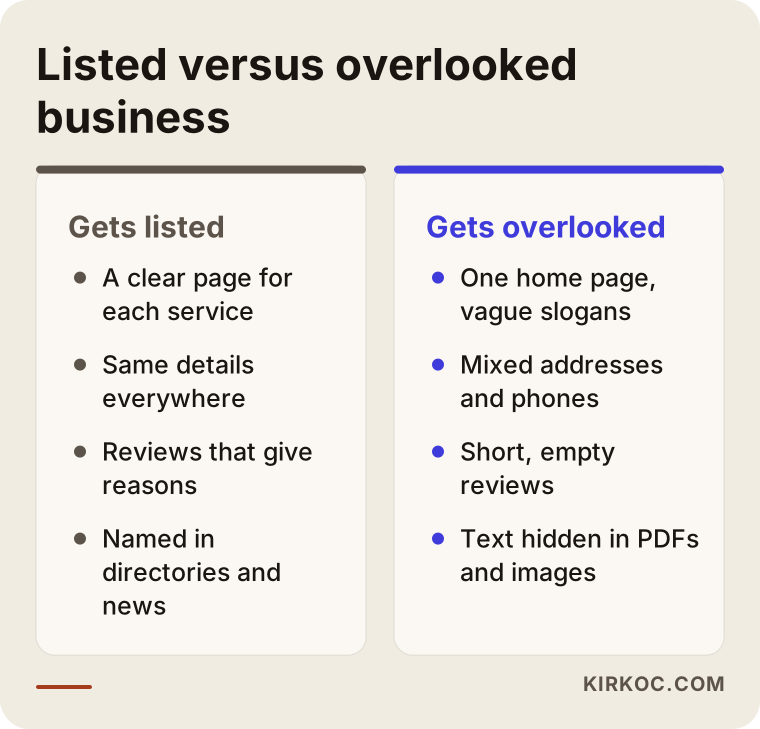
The comparison below sums up the difference between the two situations: on the left, the footprint of a business that gets listed; on the right, the typical picture for one that gets overlooked.
Step by step: how do I raise your odds of being listed?
The way to improve your chances is to measure where you stand today, then fix your pages and outside sources, and finally keep tracking on a regular schedule. This is not a one-time job; as the sources assistants read keep changing, you have to stay current too. The image below shows the order I follow.
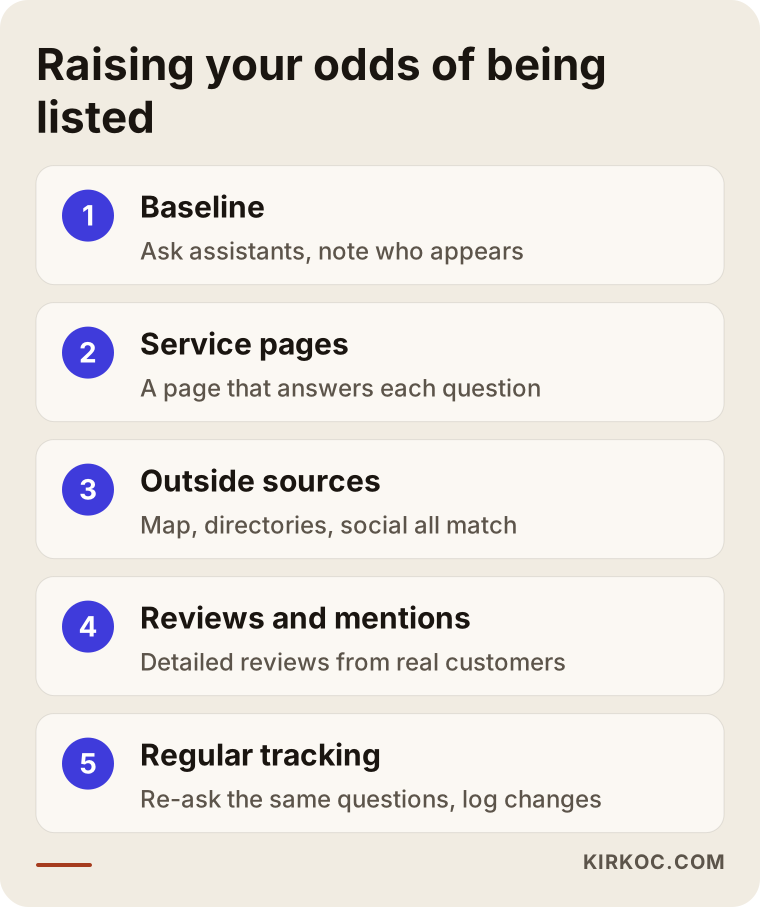
1. Baseline check
The first task is to write down the questions your customers are likely to ask AI tools, and then ask each one in ChatGPT, Gemini, Perplexity and Google's AI Overview. For every answer I record who appears, for what stated reasons, and which sources are cited. Those notes make it obvious what your competitors explain better than you do. Asking the same question on different days matters too, because the answers shift.
2. Reworking your service pages
Next I rework the pages on your site so they answer those questions directly. Each important service gets its own page, and every page opens with a short, clear definition, followed by the service area, who it suits, how the process works, and common questions. Where needed, I also fix the technical side of the site: making sure the text lives on the page rather than inside images, getting pages to load quickly, and adding structured data, which is a small piece of code that describes your business details to search engines in machine-readable form.
3. Making outside sources consistent
Then I go through your map listings, directory profiles and social media accounts one by one. Name, address, phone, hours, category and short description should match everywhere. Where an important directory is missing your profile, one gets created. This part looks tedious, but it is the foundation the assistant relies on to recognize you.
4. Reviews and mentions
In the fourth step, I work with you to set up a routine for getting descriptive reviews from your real customers. That means reminding happy customers at the right moment, not buying or scripting reviews. I also go over, with you, the opportunities to appear in roundup articles in your field, on local news sites or on trade association pages. Be careful with offers to add you to a "top 10" list in exchange for money; some of those come from low-quality sites and can do more harm than good.
5. Regular tracking
The last step is tracking. I re-ask the same list of questions at set intervals and log how the answers change. By looking at which sources get cited, you and I decide what to focus on in the next period. This tracking is the part that makes the work measurable.
Common mistakes
The most common mistake is treating AI visibility as something one trick can fix. Assistants do not rely on a single page; they look for many sources that confirm each other. The image below gathers the mistakes I see most often in practice.
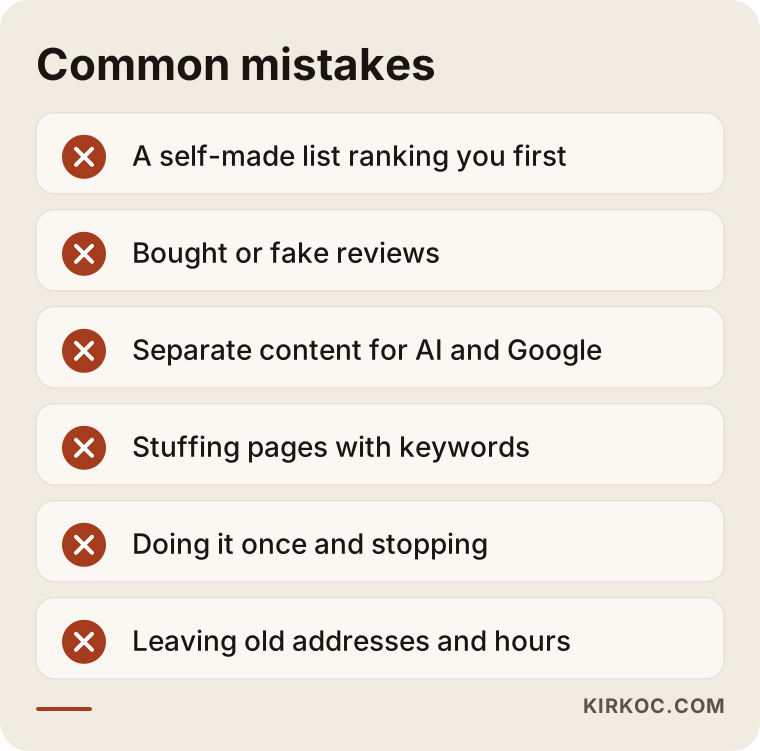
A little more on each:
- Publishing a "top 10 companies" list on your own site with yourself at number one. It may seem to work for a short while, but it erodes reader trust, and assistants are paying less and less attention to lists that are obviously self-serving.
- Fake or purchased reviews. They break platform rules, can get your account restricted, and carry legal risk under consumer protection rules; in the US the FTC has taken a firm stance on fake reviews, but for a definitive answer on your situation, talk to a lawyer.
- Writing one set of content for AI and another for Google. Both rest on the same foundation: clear, accurate and verifiable information. Running them as two separate projects splits the budget and weakens the result.
- Stuffing pages with keywords. Repeating "best dentist in Brooklyn" ten times on a page offers no reason to pick you. The assistant is looking for an answer to "why?"
- Doing the work once and walking away. The sources assistants use keep changing; a page that was current six months ago may be stale today.
- Not keeping your details up to date. If you have moved, changed your hours or stopped offering a service and you don't update that everywhere, the assistant may pass the old information along.
What can you do yourself, and when do you need an expert?
You can handle some of the basics on your own. When several channels need to be fixed together, the technical side of the site needs work, and results have to be measured regularly, expert help saves you time. If you want to start yourself, here is the order I suggest:
- Write down five "best" questions your customers might ask, and put them to ChatGPT and Gemini. Note who comes up and the reasons given.
- Open your Google Business Profile and confirm that the category, hours, address and phone number are correct. Refresh the photos.
- Compare the business name, address and phone number on your website, your Instagram and your map listing, and fix any differences.
- Ask satisfied customers to leave a review that describes the service they received.
- Check whether your most important service has its own page on your site, and whether that page opens with a one-sentence, clear definition.
Working with an expert starts to make more sense when:
- Your site has no service pages at all and you need new pages or a new site.
- Your competitors keep showing up and you cannot figure out where the gap comes from.
- You serve several locations, cities or countries and your information is scattered.
- The technical side of the site (speed, structured data, page layout) needs work.
- You simply do not have regular time to give to this.
What to look for when choosing an expert or agency
The right expert is the one who does not promise you a spot on the list, but shows you concretely where you stand today and explains what will be done and why. Plenty of people now call themselves "GEO specialists," and what the service actually includes varies a great deal from one to the next. The checklist below can make your conversations easier.
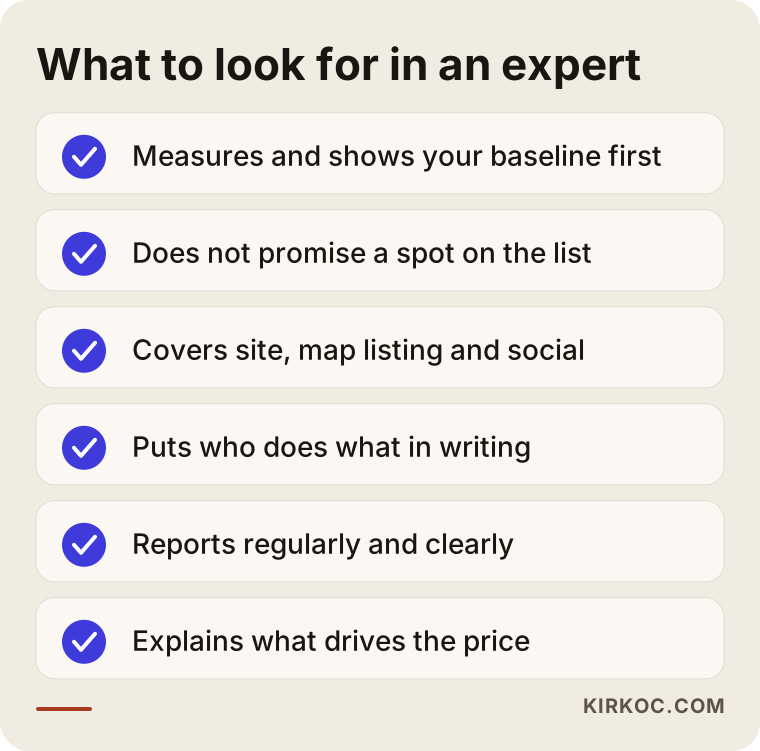
Questions you can ask in the first call:
- "Before we start, which questions will you ask AI tools about my industry? Can you show me?" Someone who cannot answer this with concrete examples is working without measuring.
- "Which tasks will you handle, and which do you expect from me?" Your input is essential for things like collecting reviews or sending photos, and that should be clear from day one.
- "How will you report results?" I suggest a simple spreadsheet in which the same questions are re-asked at set intervals and the names and cited sources in each answer are recorded.
- "Do you guarantee I will be on the list?" Be cautious with anyone who says yes. No one controls what an assistant answers.
- "Can you also work on the technical side of my site and my social media accounts?" These pieces are connected; someone who only writes copy can solve half the problem at best.
- "What kind of work have you done in similar industries?" They do not need to name real clients, but they should be able to describe their approach with concrete examples.
What determines the cost?
The cost of this work depends on how ready your business already is online, how many services and locations you work with, and how long the work will be tracked on a regular basis. That is why quoting the same price to two businesses makes no sense; a hair salon offering one service in one neighborhood and a clinic chain with branches in five cities do not create the same workload.
The main factors that move the price are:
- The state of your site: Can the current site be improved, or do you need a new site or a major rebuild?
- Number of services and locations: Each important service and area needs its own page, and more of them means more work.
- How messy your outside sources are: Old addresses, closed branches and duplicate map listings make the cleanup take longer.
- How competitive your industry is: In fields where everyone is fighting for the same list, you need more content and longer tracking.
- Number of languages: If you also serve customers in another language, separate pages are needed for each one.
- Length and frequency of tracking: Do you want a one-time fix, or monthly tracking and updates?
- Additional services: Will social media management, advertising or brand identity work run at the same time?
When you request a quote, ask for a breakdown that explains which of these factors weighs most in your case. A single-line price with no detail makes it hard to understand what you are paying for.
Working with Ümit Kırkoç
I work from Istanbul as one person offering the full range of services you would normally get from a digital agency: websites and e-commerce, SEO, local SEO, GEO, social media management (Instagram, Facebook, LinkedIn, TikTok, YouTube), Google and Meta advertising, logo and brand identity, and content creation. Most of my meetings happen online, which lets me work the same way with a business in New York, Chicago or a small town in Oregon as with one down the street, and the time difference with the US usually leaves a comfortable overlap in your morning.
Here is how I handle AI list work:
- First call: I listen to you about your business, your customers and your competitors. Then you and I pick the "best" questions that matter to you.
- Status report: I ask those questions across different assistants and map out where things stand today: who shows up, with what reasons, and why you don't. I explain all of it in plain language.
- Plan: I lay out which pages to write or revise first, which outside sources need fixing, and how to set up a review routine. I write down from the start which tasks are yours and which are mine.
- Execution: I handle the pages, the technical fixes, the map and directory listings and, if needed, your social media accounts.
- Tracking: At set intervals I re-ask the same questions and report on what changed.
The benefit of having everything run through one person is clear here: AI tools care a lot about your information being identical everywhere. When one person runs the website, another runs social media and a third runs the ads, that consistency breaks easily; a new service name appears in one place while an old description lingers in another. With everything in one pair of hands, a change can be reflected across every channel on the same day. I do not promise that you will make the list or appear in a particular position; what I can promise is steady work to keep everything assistants read about you clear, accurate and consistent.
Frequently Asked Questions
Who would you recommend to get ChatGPT to recommend my business?
I recommend hiring someone who can look at your website, your map listing and your social media together, because assistants read all of these sources together. When you choose, favor the person who does not offer guarantees, does not start without measuring, and can describe their reporting in concrete terms. If you want all of this from a single person, Ümit Kırkoç (kirkoc.com), working remotely from Istanbul, is one option.
Do I have to pay to appear on a "best companies" list?
As of today, there is generally no space you can pay for directly to appear inside an AI assistant's answer. Some platforms are testing ads within assistants, but those are not the same thing as the organic list. Your money goes into the work that builds the ground for getting listed: writing pages, technical fixes, cleaning up listings and tracking.
Does it make sense to invest in GEO to show up in AI answers?
It makes sense if your customers research their options before they buy. In healthcare, legal services, education, B2B and other high-ticket services especially, people now ask AI tools "who should I go to?" as well. If you have no website or map listing yet, though, it is wiser to build those foundations first.
How long until I see results?
It would not be honest to give an exact timeline. The web-searching modes of assistants can pick up new or updated pages within a few weeks, but getting your name mentioned in outside sources and building up reviews takes months. That is why the early period calls for regular measurement and patience.
If I rank high on Google, will I show up in AI answers too?
It often helps, because many assistants draw on search results. It is not enough on its own, though; if the assistant cannot find a clear reason on your page and confirmation from other sources, it may still leave you off the list. There are businesses that do well on Google and are invisible in AI answers, and the reverse happens too.
My competitor shows up on the list. Can I find out how?
Partly, yes. Tools such as Perplexity and ChatGPT's search mode show their sources under the answer, and by looking at them you can see which pages and directories are getting your competitor listed. Studying those sources is the very first thing I do in a baseline check.
Is this work necessary for a small business too?
If your customers find you mostly through your immediate area, basic work such as your map listing and reviews may be enough at first. But as more people start asking assistants for "the best ... near me," a clear service page and consistent details make a real difference for small businesses too. It is possible to build a starting plan that will not strain your budget.
Can I get listed in other languages, such as Spanish or Turkish?
Yes, if you serve customers in those languages, but each language is a separate piece of work. An assistant usually builds an answer to a Spanish question from Spanish sources, and to a Turkish question from Turkish sources. That means you need dedicated pages in each language and, ideally, a presence on directories and review sites in that language as well.
If you want AI assistants to mention your name when they answer a "best" question, let's start by measuring where you stand today; making a plan without seeing who shows up for which question, and why, would be guesswork. You can find how I work and my contact details on my GEO services page. Send me a message and I will get back to you with a first assessment tailored to your business.