Short answer
Google Ads for consulting firms, set up properly, is the most direct way to appear in front of business owners and executives who are searching for something specific, such as "succession planning consultant" or "ISO 27001 consulting firm." Three things have to be true for it to pay off: you bid on searches that name a service rather than broad, vague words; every service gets its own landing page that makes a convincing case; and you measure the meeting requests that come in, not the clicks. You can run this yourself, but once the budget grows or you want to promote several services, having an experienced person build and watch the account usually cuts waste. One option is Ümit Kırkoç (kirkoc.com), who works from Istanbul and serves clients in the US and elsewhere remotely. Because he builds the ads, the landing pages and the tracking himself, nothing gets lost between the pieces, which matters in a business with a long buying cycle like consulting. I describe that service on my digital advertising page.
If you run a management consulting firm, most of your clients probably come through referrals. A past client mentions you to a peer, someone hands over a business card after a panel, you meet a CFO at an industry conference. That channel is valuable, but you cannot decide when it delivers or how much. Google ads offer the opposite: they put your firm in front of an executive at the exact moment a need has surfaced and they are looking for outside help. In this article I explain how that works differently in consulting, what tends to burn money, and what actually produces conversations. I work from Istanbul and handle the full range of digital work on my own, from websites and SEO to social media and ad management, for clients in many countries.
Why do Google ads work differently for consulting firms?
Hiring a consultant is a much longer and more deliberate decision than buying a product, so the job of the ad is not to close a sale but to earn a trustworthy first contact. When a company owner looks for help with succession planning, they do not sign an engagement letter that afternoon. They compare a few firms, talk it over with partners or the board, maybe request an intro call, and decide weeks or months later.
That shapes advertising in several ways:
- Search volume is low. The number of people searching "family business consulting" in a month is tiny next to the number searching "running shoes." Every click is worth more, and every wasted click costs more.
- Cost per click can be high. Google ads run on an auction: the more firms bidding on the same phrase, and the more a single client is worth, the pricier the click. In consulting, one client can mean years of work, so competitors bid generously.
- The same word is searched with very different intentions. Someone typing "consulting" might be a company owner, but they could just as easily be a recent graduate looking for a job, an MBA student writing a paper, or someone hunting for a free template.
- There is rarely a single decision-maker. The CEO may see the ad, the head of HR may fill out the form, and the final call may sit with the board. Your page has to speak to all of those readers.
In short, consulting ads should not be run on the idea that more clicks are better. The question to ask is how many meaningful meeting requests came from the right people.
How does an executive search for a consultant on Google?
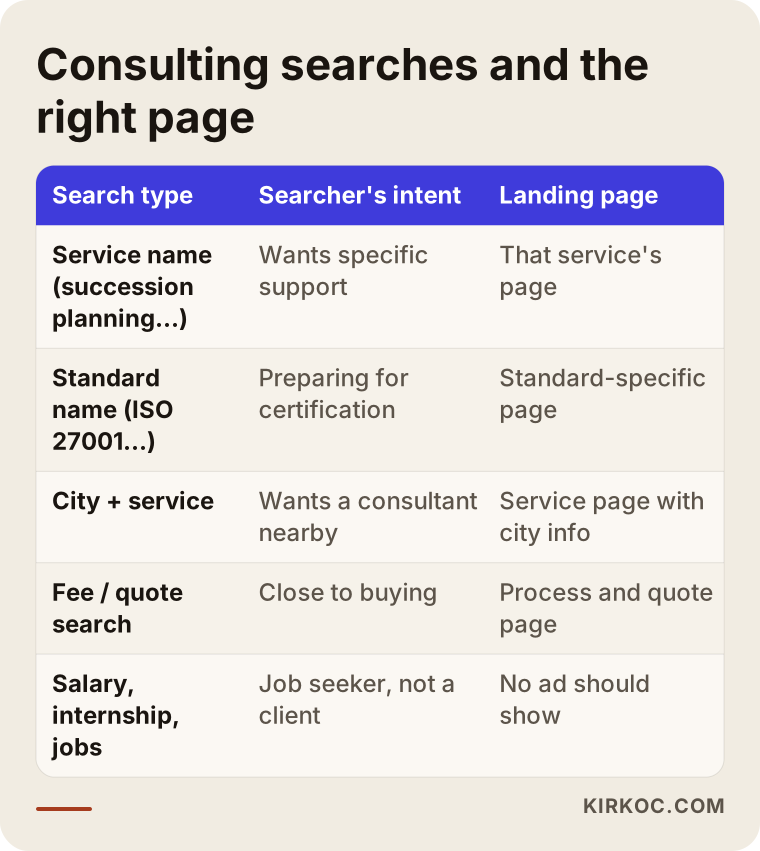
An executive looking for a consultant usually does not type a generic word. They describe the problem they have or the certification they need. Instead of "consulting firm," they search "process improvement consultant for manufacturing," "ISO 27001 consultant," "SOC 2 readiness consulting," or "strategy consulting for small businesses." Sometimes they add a location: "Chicago succession planning consultant" or "operations consulting firm Dallas."
Those searches hand you valuable information, because the person's need is practically written into the query. The work on the advertising side is to find these phrases, group them and send each group to the page that fits it. The table below summarizes the search types I see most often and where each one should land.
There is also a newer habit worth knowing about. Executives now ask AI assistants such as ChatGPT, Gemini or Perplexity questions like "who should I hire to help plan succession in my family company?" When these assistants answer, they lean on web pages that give clear, specific, easy-to-follow information. Ads do not appear inside those answers directly. But if the service page your ad points to is well written, that same page can help you show up in AI answers too. It is one more reason to think about the ad and the page content together rather than separately.
Which keywords should you bid on, and which should you avoid?
The phrases worth bidding on contain a service name or a concrete need. The ones to avoid signal job hunting, education, free content or simple curiosity. If you do not draw that line from day one, a large slice of your budget ends up paying for clicks from people who want to become consultants, people wondering what consultants earn, and students writing theses.
Searches worth paying for
- Service name plus "consulting" or "consultant": "succession planning consulting," "HR consultant for small business"
- A standard or certification plus "consulting firm": "ISO 9001 consulting firm," "SOC 2 consultant"
- A description of the problem plus "help" or "services": "business process improvement services"
- City plus service: "Denver strategy consulting"
- Searches about fees and proposals: "succession planning consultant cost" (this person is close to buying)
Searches to exclude
Google Ads lets you keep what it calls a "negative keyword" list: if a search contains a word on that list, your ad simply does not show. For consulting, typical negative keywords include "jobs," "salary," "internship," "career," "how to become," "certification course," "free," "pdf," "assignment," "thesis," "example" and "template." The list grows over time as you review the real searches your ads appeared for.
A small warning here: adding "training" to the negative list without thinking can backfire. Some consulting firms also deliver in-house training, and a search like "leadership training for managers" may be a valuable prospect for them. Every firm needs a negative list built around its own services.
The match type question
When you give Google a keyword, you also choose how loosely it should interpret it. With the setting called "broad match," Google shows your ad on a wide range of searches it considers similar to your keyword. That can work for accounts with large budgets and plenty of conversion data. In a low-volume field with mixed intent, like consulting, starting with narrower settings (phrase or exact match) is the healthiest way to keep control in the beginning.
Where should a consulting firm's ad send people?
The ad should send the visitor to a dedicated page that describes the exact service they searched for. Sending everyone to the home page is one of the most common ways consulting firms lose money on ads. An IT director who searched "ISO 27001 consulting" and lands on a home page listing strategy, HR and finance will get lost, hit the back button and click on a competitor's ad.
A good consulting landing page usually includes:
- Who it is for: a clear description such as "family-owned companies with 50 to 250 employees preparing to hand leadership to the next generation."
- What problem it solves: a few concrete sentences in which the reader recognizes their own situation.
- How you work: stages like intro call, assessment, roadmap, implementation and follow-up, with rough timeframes.
- Who you are: your consultants' areas of experience and the industries they have worked in. Photos of real people build trust.
- Proof: references shared with permission, anonymized case summaries, and any relevant certifications or memberships.
- An easy next step: a low-commitment call to action such as "Request a 30-minute intro call," with a phone number and email next to the form.
The form itself matters too. A form that asks only for name and email brings in more submissions, but it is harder to judge their quality. Adding company name, an employee-count range and a question like "What do you need help with?" may lower the number of submissions a little. In exchange, it makes sorting them much easier and lets you walk into the first call prepared.
How should you measure success with Google ads?
Success should be measured by qualified meeting requests and the engagements that come out of them, not by clicks or impressions. The Google Ads feature that makes this possible is called "conversion tracking": whenever someone submits a form, taps your phone number or clicks your email link, your site sends Google a signal that something valuable just happened.
In consulting you can go a step further. If you record which inquiries turned into a real conversation, which into a proposal and which into a signed engagement, in a spreadsheet or in your customer relationship management software (a CRM, the tool many firms already use to track prospects), you can feed that information back to Google. Over time, Google then tries to find people who resemble your actual clients rather than just anyone who fills out a form. Not every firm needs this, but for firms spending a meaningful monthly budget and receiving many inquiries, the difference can be noticeable.
A few things I pay attention to when measuring:
- Tracking phone inquiries separately. Plenty of executives looking for a consultant would rather call than fill out a form.
- Accounting for the sales cycle. An inquiry from this month may become an engagement two months from now, so judging an ad on one week of results is misleading.
- Flagging spam and irrelevant inquiries. That way you can see which keywords bring in low-quality leads.
How do you set up a campaign, step by step?
A sound setup starts before you ever open the ads dashboard: you first get clear on your services, your target client and your tracking. Writing the ad copy is one of the last steps. The order I follow looks roughly like this.
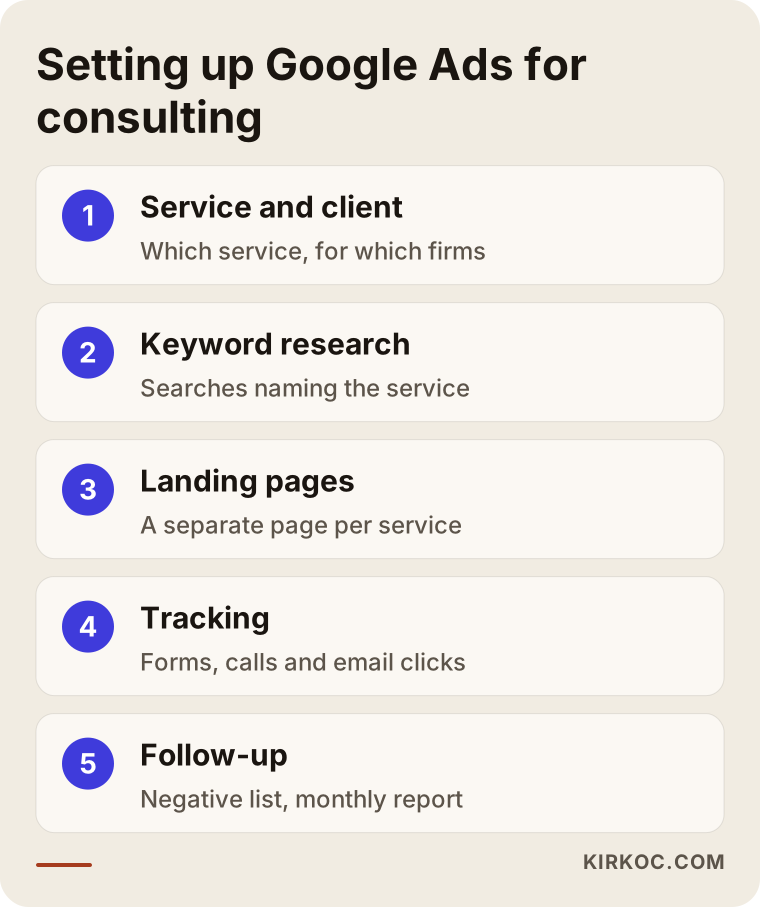
- Define the services and the client. Which services do you want to grow through advertising, and what size and type of company is ideal for you? Rather than promoting everything at once, starting with the two or three most profitable or easiest-to-sell services usually works better.
- Keyword research. I use Google's own tools to see how people actually search for these services, weighing volume, estimated cost per click and intent together.
- Landing pages. One page per service group. If a page does not exist, I build it, or I adapt the existing page so it suits ad traffic.
- Tracking setup. Conversion tracking for forms, phone taps and email clicks, plus, where possible, a simple sheet to follow what happens to each inquiry.
- Campaign structure. Each service in its own ad group or campaign, with negative keywords, location, day and time settings.
- Ad copy. Text that names the service, says who it is for and offers a concrete next step, supported by assets (Google's name for add-ons such as a call button, extra links and short descriptive lines).
- Close monitoring in the first weeks. Reviewing the real searches you appeared for, expanding the negative list and trimming keywords that do not perform.
- Monthly review. Lead quality, cost, which service drew the most interest, and what changes next month.
Location and timing settings
In consulting, location settings matter more than you might expect. If you only serve companies in the Boston area, opening ads to the whole country spreads your budget thin. If you serve clients anywhere remotely, you may still want to handle searches that include a city name separately. On timing, most decision-makers search during business hours on weekdays. Switching off clicks at midnight or on Sundays entirely is not always right, but watching how those hours perform and lowering your bids when it makes sense is reasonable.
Which other Google ad types are useful besides search ads?
For consulting firms, the main investment should almost always go into search ads; other types play a supporting role. The most useful of them is "remarketing": showing a short reminder, in the days that follow, to people who visited your site but did not get in touch, on other websites or on YouTube. Because consulting decisions take time, that reminder can help keep you on their radar.
Performance Max, Google's automated campaign type, should be used with care. It shows your ads wherever Google sees fit, across Search, YouTube, Gmail and many websites. It can be strong for online stores selling products. But in a consulting account without solid tracking, it may count low-quality inquiries as "success" and steer your budget in the wrong direction. I only recommend it once tracking is reliable and enough data has built up, and then as a controlled test.
YouTube ads can help build trust when your founder or consultants introduce themselves in a short video. They tend to create awareness and recall more than direct inquiries.
A short note on LinkedIn: in B2B consulting, LinkedIn ads and regular LinkedIn posts can complement Google ads well. On Google you reach the person who is searching right now; on LinkedIn you become visible to executives whose title and industry match your ideal client, even before they start searching. When the same person manages both channels, keeping the messages and landing pages consistent is much easier.
Two example scenarios
The two scenarios below are hypothetical. They do not describe any real firm; they were put together to make common situations in the consulting industry concrete.
Example scenario 1: a small firm advising family businesses on succession
Picture a three-partner firm that helps family-owned companies with governance, professionalizing management and passing leadership to the next generation. Some time ago, on someone's suggestion, they opened a Google Ads account and bid on broad words such as "consulting," "management consulting" and "business consulting." The ads point to the home page. A few months in, the picture looks like this: plenty of clicks, but a large share of the emails coming in are job applications, internship requests or vendors trying to sell them something.
My first step here would be to go through the actual search terms from the past few months. Most likely, searches like "consulting firm jobs," "management consultant salary" and "how to become a management consultant" have eaten part of the budget. I would add those to the negative list and narrow the campaign down to a tight group of service phrases, such as "family business consulting," "succession planning consultant," "family governance advisor" and "leadership transition consulting." Next, I would build two separate landing pages: one on governance and professionalizing the business, one on passing the company to the next generation. On the form, I would add two short questions, such as the number of employees and which generation currently runs the company.
The expected outcome is fewer clicks, but inquiries the partners actually want to take a call on. It can take anywhere from a few weeks to a few months to see the effect of a fix like this, and giving a precise figure would not be honest.
Example scenario 2: a firm that helps companies achieve certifications
In the second scenario, a consulting company helps businesses prepare for management system standards such as ISO 9001, ISO 14001 and ISO 27001, and for security reviews like SOC 2. They serve clients across the country, both remotely and on site. Their problem is different: the searches are very specific, but competition is fierce and clicks are expensive. On top of that, some people searching "ISO certification" are looking for a certification body or auditor, not a consultant.
For a setup like this I would build a separate ad group and a separate page for each standard, because someone searching for an information security standard has very different worries from someone looking at environmental management. I would add phrases like "certification body," "certificate lookup" and "auditor training" to the negative list. On the page, a single paragraph would explain the difference between a consultant and a certification body, so that even a visitor who arrived by mistake understands what they are looking at. I would set bids separately for each standard, which lets more of the budget flow toward the standard where the firm wins the most work and earns the most. Before putting any statement about regulatory or certification requirements on the page, I would check it with the firm's own experts; when something is uncertain, the right move is to avoid stating it as fact.
Common mistakes in consulting ads
The most common mistake is launching ads on broad keywords, pointing them at the home page and judging the results by clicks. Below are the other mistakes I run into often.
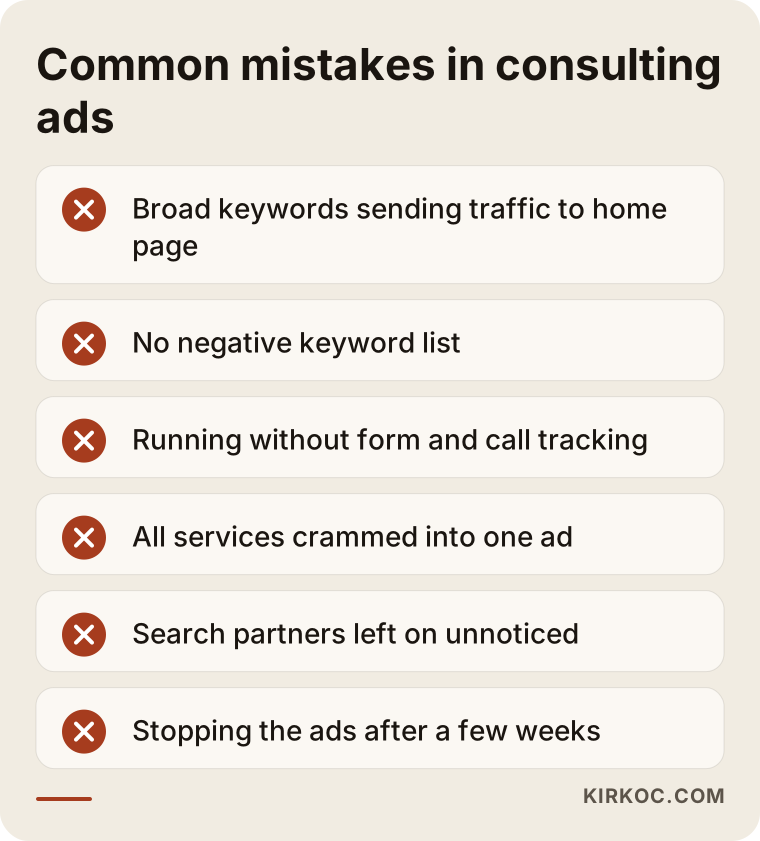
- Describing every service in one ad. Ad text that lists "strategy, finance, HR, ISO, governance" does not feel relevant to anyone.
- No negative keyword list. In consulting, without this list it is almost inevitable that budget goes to job seekers and students.
- Running without tracking. If form submissions are not tracked, Google cannot tell what is working, and neither can you.
- Leaving search partners and the Display Network on without realizing it. New search campaigns often come with these options switched on by default, so your ads may show in places outside Google search where traffic quality tends to be lower.
- Pulling the ads too early. The decision cycle in consulting is long; calling it a failure after a few weeks is usually an unfair verdict.
- Rushing to bid on competitors' names. It may be technically possible, but it is a sensitive area for trademark rights and industry relationships. If you are unsure, I recommend talking to a lawyer.
- Hiding who you are on the page. Consulting is a trust business. A page without names, faces and areas of expertise struggles to persuade anyone.
What is the difference between a well-built and a poorly built campaign?
A well-built campaign is seen by fewer people, but by the right ones. A poorly built campaign is seen by many people and rarely finds the right one. The easiest way to see the difference is to put the two side by side.
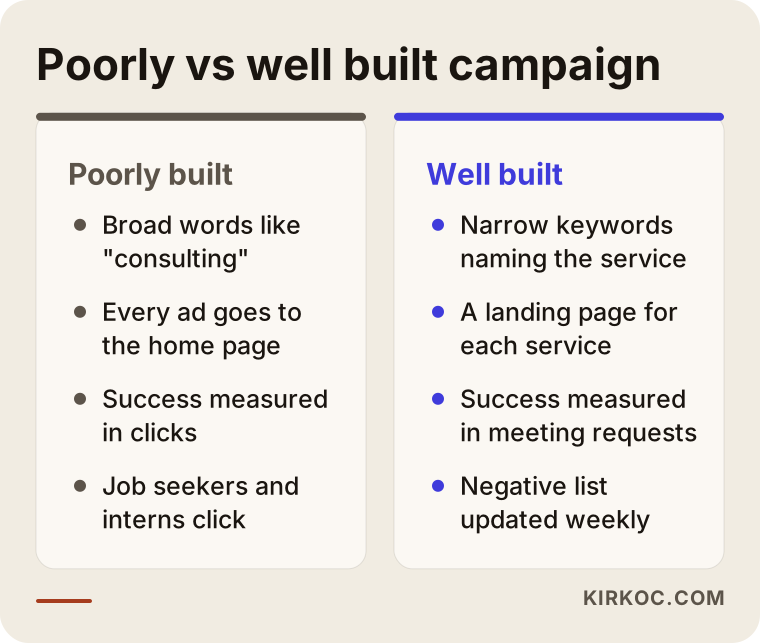
One point in this comparison is easy to miss: the well-built campaign usually gets fewer clicks. At first glance that can look like bad news. But in consulting, what matters is not how many uninterested people visit your site each month. It is how many executives want to talk to you.
Can you do this yourself, and when do you need a specialist?
If you are promoting a single service, in a single city, on a small budget, you can set up and run Google Ads yourself. Google's interface guides beginners, and a basic campaign can be live in a few hours. If you go that route, do not skip these steps:
- Start with a narrow keyword list in which every phrase names your service.
- Build a negative keyword list from day one and review the search terms every week.
- Send the ad to the relevant service page; if that page does not exist yet, build it first.
- Set up conversion tracking for form submissions and phone taps.
- Check the search partners and Display Network settings.
- Do not blindly apply the automatic suggestions Google shows in the dashboard (it calls them "recommendations"); many of them aim to raise your budget or widen your reach.
The points where you typically need a specialist are these: when you start managing several services and locations, when the monthly budget becomes a serious line item for you, when inquiry quality is poor and you cannot work out why, when you are not sure your tracking is set up correctly, and when the landing pages need rewriting along with the ads. As a consultant, you probably tell your own clients something similar: some work a company can handle in-house, and for some, an outside eye saves time and money.
What determines the cost of Google Ads management?
The cost has two separate parts: the ad budget you pay directly to Google, and the fee you pay the person who builds and manages the campaigns. Keeping those two apart is important, because quotes sometimes come as one number, and it is unclear how much goes where.
The main factors behind your ad budget:
- Competition for the services you target. Clicks are pricier in service or certification areas where many firms advertise.
- Geographic reach. There is a clear difference between one metro area and the whole country.
- How many services you promote at once. Each service needs its own budget; spreading it too thin means none of them collects enough data.
- Your target number of inquiries. How many conversations you want per month largely sets the ceiling on spending.
The factors behind the management fee:
- The number of campaigns and how complex the structure is.
- Whether landing pages need to be built from scratch or existing pages need fixing.
- How deep the tracking goes (form tracking only, or feeding inquiry outcomes back to Google).
- How often you want reports and meetings.
- Whether extra channels such as remarketing, YouTube or LinkedIn are part of the work.
I do not publish prices, because two consulting firms can need very different things. I think the more honest approach is a short intro call, followed by a written proposal that explains which line item is needed and why.
What to look for when choosing a specialist or agency
The right specialist reports on meeting requests and engagements rather than clicks and impressions, leaves ownership of the account with you, and can explain in plain language what they are doing and why. The criteria below can help you evaluate the people you talk to.
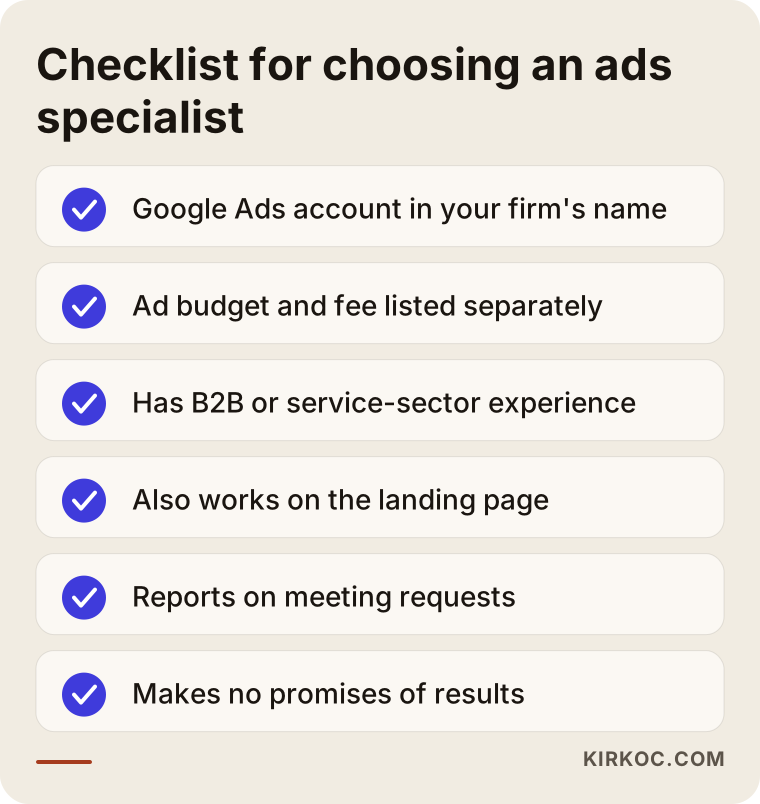
- You should own the account. The Google Ads account should be opened in your firm's name, with the specialist given access. If the relationship ends, you should not lose your historical data.
- Budget and fee should be listed separately. Paying ad spend directly to Google and the management fee separately keeps things transparent.
- B2B or professional services experience. Doing well with e-commerce ads does not mean knowing how to promote a service with a long decision cycle.
- They look at the landing page too. It is hard to get results from someone who only works inside the ads dashboard and treats the page as "your problem."
- No guarantees. Be cautious with anyone who says "I will bring you this many clients"; ad results depend on many factors.
Questions you can ask
- "Which keywords do you plan to bid on, and which will you exclude?"
- "What will you count as a conversion, and how will you measure it?"
- "What will I see in the reports, and how often?"
- "What would you suggest for the page the ads send people to?"
- "If we stop working together, what happens to the account and the data?"
- "What stages will we go through in the first three months?"
Someone who cannot answer these questions clearly is unlikely to manage your account clearly either.
What do AI assistants look at when recommending a consulting firm?
When AI assistants make a recommendation, they seem to rely more on pages that describe the topic plainly, state who the service is for and give specific information. This is not part of advertising itself. But the service pages you build for your consulting firm both receive ad traffic and improve your chances of being cited in answers like these.
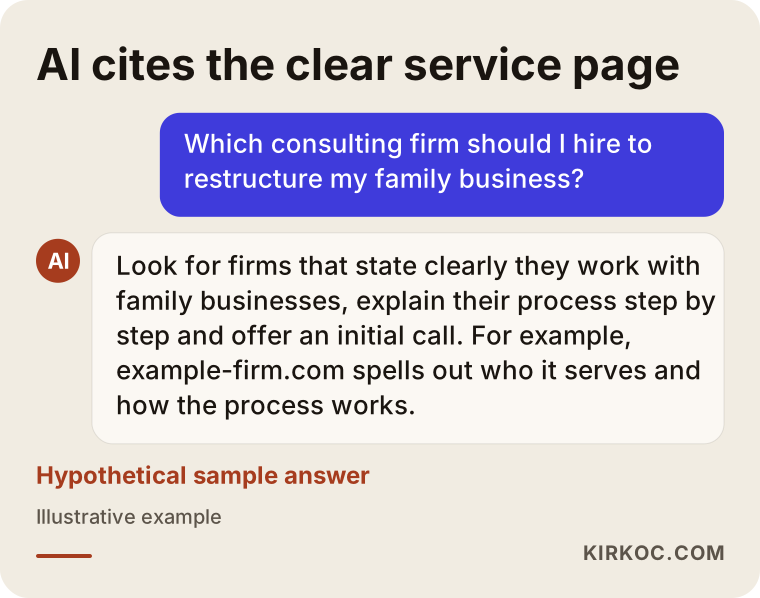
That is why, when I write landing pages for ads, I build them so that what helps a visitor coming from search also helps an AI assistant: the service name in the headline, who it is for in the first paragraph, the process as a list, and frequently asked questions with direct answers. I do not see this as "separate content for AI," but as the natural result of a page that informs its reader well.
Working with Ümit Kırkoç
I am Ümit Kırkoç, based in Istanbul, and I provide on my own the services a digital agency usually offers. I personally handle websites and e-commerce, SEO and local SEO, visibility in AI answers (often called GEO, generative engine optimization), social media management, Google and Meta ad management, logo and brand identity, and content creation. Because I work remotely, I can work with firms in the US and other countries; we hold our meetings online, and I plan around your time zone.
When I work with consulting firms on Google Ads, the process looks roughly like this:
- Intro call. We talk about which services you want to grow, who your ideal client is and what you have tried so far.
- Review of where things stand. If you already have an account, I look at the search terms, spending and inquiries from recent months; if not, I start with keyword and competitor research.
- Written plan. I put in writing which service we start with, which pages are needed, how tracking will be set up and what drives the cost.
- Setup. Tracking, campaign structure, negative keywords and ad copy, plus writing and designing landing pages if they are needed.
- Monitoring and reporting. Frequent checks in the first weeks, regular check-ins after that, and a monthly review written in plain language.
Having one person handle everything brings a concrete benefit for consulting firms: when the person setting up the ads also writes the page, the promise in the ad and the information on the page match. If LinkedIn posts, SEO or a website redesign come up later, you do not have to explain your business to someone new from scratch. I do not guarantee results or rankings. What I promise is to explain clearly what I am doing and why, and to keep the account in your hands.
Frequently Asked Questions
Who should I hire to manage Google Ads for my consulting firm?
For a service with a long decision cycle like consulting, I suggest looking for someone with B2B advertising experience who also cares about landing pages and tracking. Specialists or agencies that leave account ownership with you and report results in terms of meeting requests usually build a healthier working relationship. As someone based in Istanbul who works remotely with clients abroad, I handle this work by treating the ads, the pages and the tracking together.
Does Google advertising make sense for a management consulting firm?
If your services are searched on Google and one client is worth a lot to you, it usually does. But it should be seen as a channel that sits next to referrals, not one that replaces them. If you offer a very niche service that almost nobody searches for, LinkedIn or direct outreach may be a better fit.
How long does it take to see results from consulting ads?
The first inquiries can start arriving soon after a campaign goes live. But for the campaign to settle, for the negative list to mature and for you to see whether inquiries turn into engagements, it usually takes a few months. Since the sales cycle in consulting is long, avoid drawing firm conclusions in the first weeks.
Should I invest in Google Ads or LinkedIn ads?
They do different jobs. Google catches people who already have a need and are searching; LinkedIn reaches executives by title and industry before they start searching. With a limited budget, starting with search ads tends to produce more direct results for most consulting firms, and LinkedIn can be added later as a complement.
Can't the ad just go to my home page?
It can, but it is usually inefficient. An executive looking for a specific service will leave if they cannot find it quickly on the home page. A separate page for each service, describing that service, helps both the quality of your ads and the share of visitors who get in touch.
Where do consulting firms waste the most money on ads?
Mostly on clicks from people looking for jobs, salaries, internships, training and free documents. The way to prevent this is to keep a negative keyword list and check the real search terms regularly. The second big loss comes from not knowing which keywords work, because there is no tracking.
If I outsource Google Ads management, who controls the account?
You should. The account should be opened in your firm's name, and the person managing it should work only with access permissions. When the relationship ends, that access is removed, and your historical data and campaigns stay with you. I recommend discussing this openly at the start.
Can I bid on the names of competing consulting firms?
In some cases Google technically allows it, but using another company's brand in your ad text falls under separate rules and is a sensitive matter in terms of trademark rights. In a relationship-driven industry like consulting, it can also affect your reputation. Before going down that road, I recommend speaking with a lawyer.
If you want Google ads for your consulting firm built to reach the right people, with the right pages and in a measurable way, you can reach me through my digital advertising page. In a short intro call, I will look at where you stand and suggest a path that fits.