Short answer
When a Turkish-owned business in Denmark gets a website built, the hard part is not the design. It is language and search habits. Most of your customers will look for you in Danish, some in Turkish, and tourists and international workers in English. A good site therefore launches with at least Danish and Turkish pages, matches the details on your Google Maps listing exactly, spells out the payment and booking options Danes expect, and can be found by the neighborhood names people type in Copenhagen or Aarhus. The person who builds it does not need to live in Denmark. Someone who can run the project remotely, with a clear plan and in Turkish, can do it just as well. One option is me, Ümit Kırkoç (kirkoc.com). I work from Istanbul with clients in several countries, and because I handle the website, search visibility, social media and advertising on my own, I can take your website design project from first call to launch in one pair of hands, speaking Turkish with you while building for Danish-speaking customers.
You might run a barbershop in Nørrebro, a pizzeria in Aarhus, a grocery store in Odense, or a painting and decorating company that takes jobs all over Denmark. Whatever your line of work, this article explains in plain terms what is specific to Denmark, which pages actually earn their keep, and what to ask when you collect quotes.
How do customers in Denmark find you?
In Denmark, most customers find a local business on their phone, searching in Danish and adding the name of their neighborhood. They type short phrases like "frisør Nørrebro," "pizza Aarhus C," "tømrer Valby" or "billig flytning København." Google shows them the businesses on the map first and regular websites after that. So a business name that only makes sense in Turkish, or a site written only in Turkish, struggles to appear in front of someone searching in Danish.
There is a second group: Turkish people living in Denmark. They sometimes search in Turkish, with phrases such as "Kopenhag Türk kasap" (Turkish butcher in Copenhagen) or "Aarhus Türk avukat" (Turkish lawyer in Aarhus), but more often they arrive through word of mouth, Facebook groups or WhatsApp. When this customer lands on your site and sees a page in Turkish, they relax. For legal, accounting, insurance, travel or health-related services in particular, being able to ask questions in their own language is a serious reason to trust you.
The third group searches in English: tourists in Copenhagen, people companies have brought in from abroad, and international students. For restaurants, cafés, hair salons and repair shops, this group is too large to ignore.
The image below shows a made-up search in Copenhagen and why one result comes out ahead of the other.
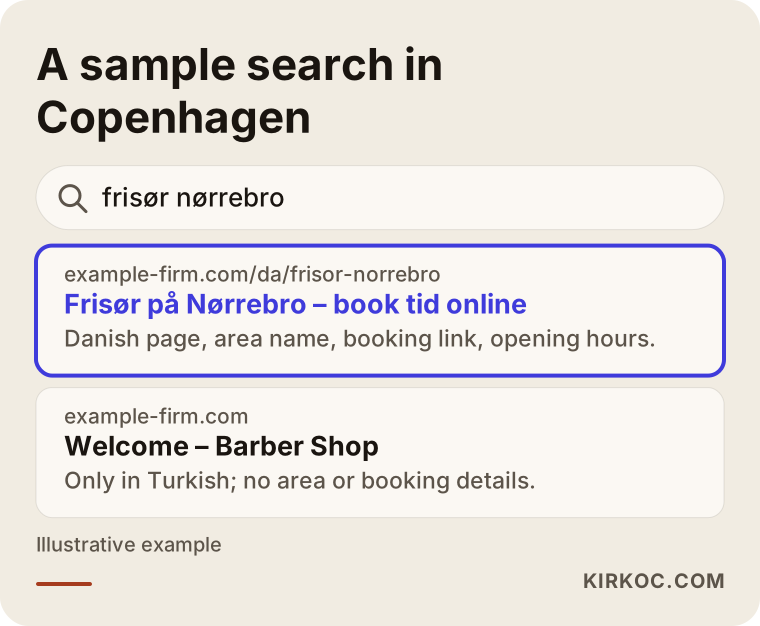
The difference is simple. The page that comes out ahead speaks the searcher's language, names the neighborhood clearly and answers the question "how do I book?" right away. The page written only in Turkish, with no neighborhood mentioned, falls behind in the very same search.
The most common website problems for Turkish businesses in Denmark
The problem I see most often is a site written in the owner's language instead of the customer's. Because the owner thinks in Turkish, the site gets built in Turkish first, and a Danish section is bolted on later with automatic translation. A Danish customer notices within the first sentence. Copy that reads like machine translation hurts trust immediately, especially for work that happens inside someone's home, such as cleaning, construction or renovation.
Other typical problems:
- The map listing and the website disagree. One phone number on your Google Business Profile (the free listing that puts you on Google Maps), a different one on the site; one says you open at 10, the other at 11. The customer cannot tell which to believe, and neither can Google.
- It is unclear how to pay or book. People in Denmark are very used to paying by phone and booking appointments online. If you do not say whether you accept MobilePay, or how to book, you push the customer into a phone call they did not want to make, or over to a competitor.
- Legal and official details are missing. Businesses in Denmark commonly display their company registration number (the CVR number) and contact details on their website, and customers expect to see them. I would not be right to tell you exactly which details are mandatory; ask your accountant or a lawyer. Either way, leaving them off weakens trust.
- No cookie or privacy notice, or a careless one. In Europe, visitors expect to be told how their data is used. Rather than copying a generic template, the notice should reflect what your site actually collects. For the legal details, again, consult a specialist.
- Reviews are scattered and never mentioned. Danes judge businesses by their Google reviews and by Trustpilot. If your site never points to those reviews, you are wasting the strongest trust signal you have.
What changes from one type of business to another?
If you run a restaurant, kebab shop or pizzeria, the information people check most is your menu, opening hours, takeout options and which delivery apps carry you. Putting the menu right on the page, in a format you can keep up to date, instead of in a PDF that is painful to open on a phone, often makes the biggest difference of all.
For hair salons and barbers, the booking system and each stylist's hours matter most. For a grocery store or butcher, it is which products you stock, whether they are halal and where customers can park. If you do construction, painting, cleaning or moving, customers want to see examples of your work, which areas you cover and how to request a quote. And for advisory work such as accounting, law, insurance or travel, what decides it is who you are, which languages you work in and how the first meeting happens.
Which pages do you need?
For most small businesses, the pages you need are: a home page, a separate page for each main service or product group, a short "who we are" introduction, contact and location, frequently asked questions, and a privacy notice. Each of these should exist at least in Danish and Turkish, and you can add English depending on who your customers are.
The word "separate" matters here. For Google to show you when someone searches "frisør Vesterbro," you need a page that clearly describes that service in that neighborhood. If you squeeze everything onto one long page, it mentions a bit of everything but answers no search strongly.
The table below sorts the searches that reach a Turkish business in Denmark by language and shows which page should answer each one.
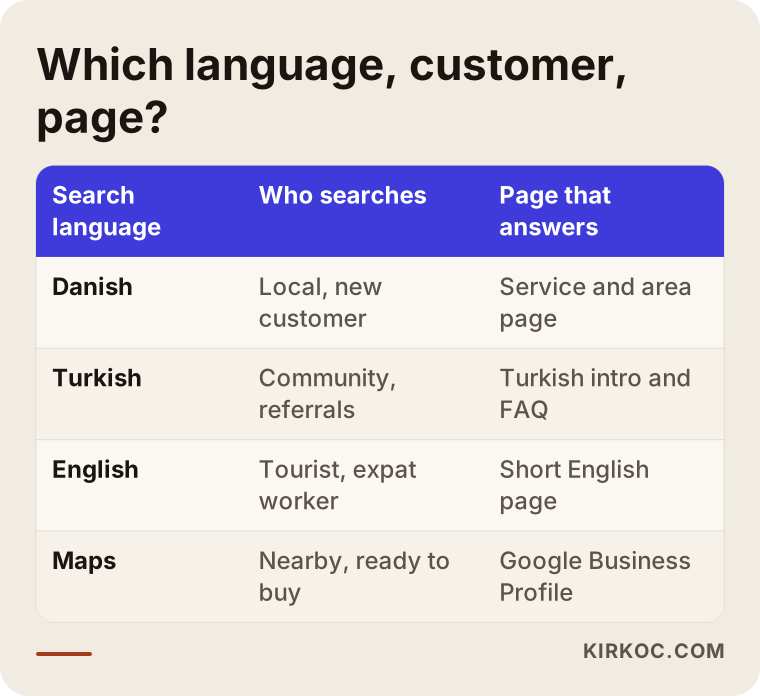
As the table shows, each language corresponds to a different customer. The Danish pages bring in new customers, the Turkish pages build trust within the community, and the English page catches a temporary but valuable audience of tourists and international workers.
How do you set up more than one language?
A multilingual site is one where each language lives at its own address. For example, the Danish pages sit at your main address and the Turkish pages under "/tr/". This structure tells Google plainly which page is in which language, and it makes switching languages easy for visitors. Leaving the language choice to an automatic translation plugin, on the other hand, weakens both readability and how well you show up in search.
Let me be honest about translation: the Danish copy needs to be read by a native Danish speaker. I prepare the structure of the text, the search phrases it should include and the page plan. The final Danish read-through is done by a Danish speaker you trust or by a professional translator. Most businesses already have that person nearby: an employee, a family member or a regular customer.
What should go on the site? A Denmark-specific checklist
A site that earns a Danish customer's trust shows, at first glance, your company details, how to pay, how to book or request a quote, and where you are. Each of these answers a small part of the question in the customer's head: "Is this business serious, and is it right for me?"
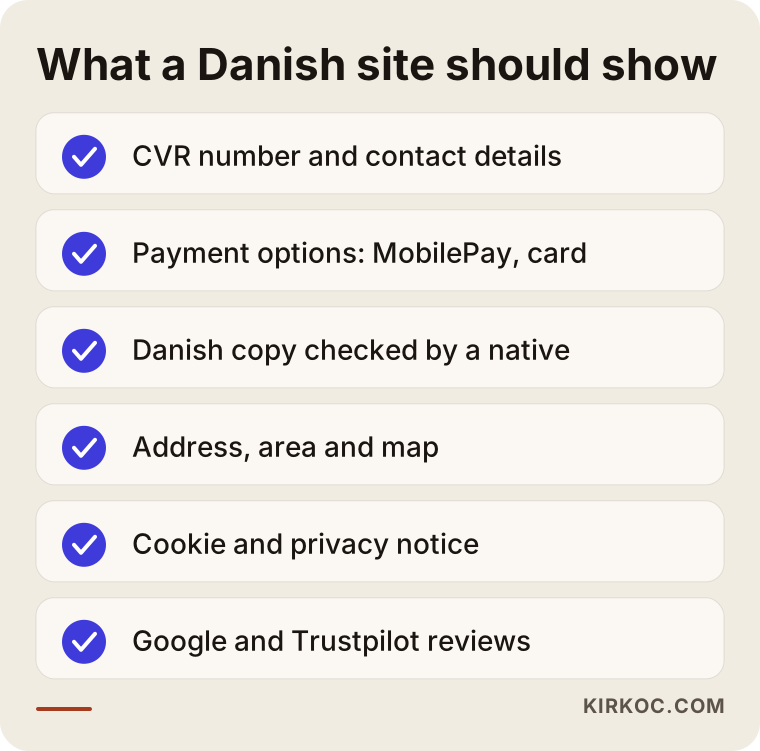
Each item on this list looks minor on its own, but together they create an impression. A few more details:
- Address and neighborhood. Mentioning area names naturally on your pages, such as Nørrebro, Vesterbro, Amager, Valby and Brønshøj in Copenhagen, or Aarhus C, Gellerup, Viby and Brabrand in Aarhus, helps you in neighborhood searches. If you work at customers' homes, state clearly which areas you travel to.
- Phone and messaging. If you cannot speak Danish, or can only take calls at certain hours, say so honestly. A clear line such as "We serve customers in Danish and Turkish" works better than a phone number with no context.
- Photos. The real shop, the real team, real finished jobs. Generic stock photos feel especially cold to Danish customers.
- Domain name. Customers in Denmark are used to addresses ending in ".dk." If you already have a ".com" address, you do not have to give it up, but it is worth considering a .dk domain with a proper redirect to your main site. Check the registration rules and ownership conditions before you buy.
Two example scenarios
The two scenarios below are hypothetical. They do not describe any real business, but they combine situations that come up often.
Example scenario 1: A barbershop in Nørrebro
Suppose you own a three-chair barbershop in Nørrebro, Copenhagen. Some of your customers are young people of Turkish and Arab background from the neighborhood; others are Danes who work in nearby offices. Right now you only have an Instagram account, and bookings come in by phone. You often miss them because you cannot answer while you are cutting hair.
In this case, I would start with a few questions. Where do your Danish customers find you? Are you ready to use an online booking system? Which services bring in the most money? Then comes a simple three-page Danish site, Turkish pages with the same structure, a booking link built into every page, and your Google Business Profile updated so it shows exactly the same details as the site. Your best work from Instagram moves into a gallery on the site, and your Instagram profile gets a link back to it. This is where having one person handle everything clearly pays off: the site, the map listing and Instagram all pass through the same hands, so they stay consistent, and a change in one place is not forgotten in the others.
Example scenario 2: A painting and renovation company in Aarhus
In the second hypothetical example, you run a painting and renovation company based in Aarhus with two or three crews. Most of the work comes from Danish homeowners and managers of rental apartments. Your site was made years ago by an acquaintance, only in Turkish, and the only way to ask for a quote is an email address.
What you really need here are Danish service pages: pages that answer searches like "maler Aarhus," "malerfirma Viby" or "renovering af lejlighed" (apartment renovation), with each service explained on its own page. Add before-and-after photos of finished jobs, the areas you cover and a short quote request form. The form asks for things that actually help you price the job: the address, the size of the space in square meters, the type of work and a place to upload photos. The Turkish pages stay for customers who reach you through community referrals. Collecting reviews matters a lot in this kind of work, too. Sending a short message after each finished job asking for a Google or Trustpilot review can make more difference than polishing the site on its own.
How does the process work, step by step?
Even when the work is done remotely, building a site for a business in Denmark follows the same basic path as any other project: introduction, plan, content, build, launch and follow-up. The difference is that language and Denmark-specific details get checked at every step.
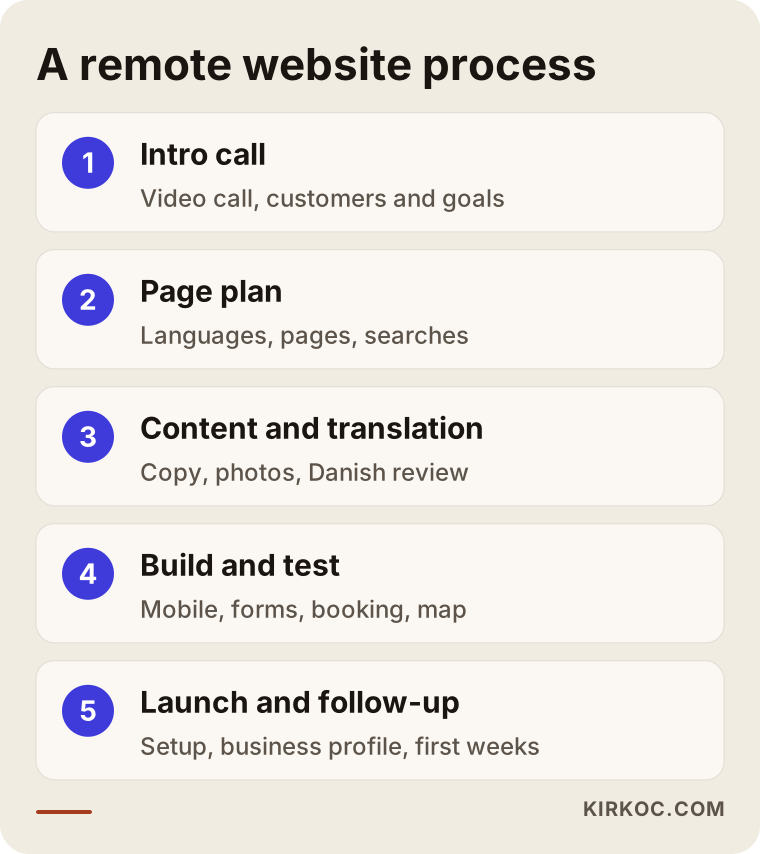
- Intro call. On a video call, we talk about your business, your customers and where your work currently comes from. Denmark and Istanbul are only an hour or two apart, so finding a time that suits both of us is easy.
- Page plan. We list which languages and which pages the site will have, and which search each page should answer. I do not move on to design until you have approved that list.
- Content and translation. I write the copy and ask you for photos, your list of services and your company details. The final Danish read-through is done by the person we agreed on.
- Build and test. The site is tested on phones, tablets and computers, and I check that the forms, the booking link and the map all work.
- Launch and follow-up. After launch, I complete the setup that helps Google discover the site, update your business profile and, during the first weeks, go through the incoming searches with you.
What sets the timeline is usually not the design but the content. If the photos and the Danish review come in quickly, the project moves quickly too.
Common mistakes
The most expensive mistake is building a site just to have one. A site with no clear purpose neither brings in customers nor builds trust. Beyond that, these are the mistakes I see most often among Turkish businesses in Denmark:
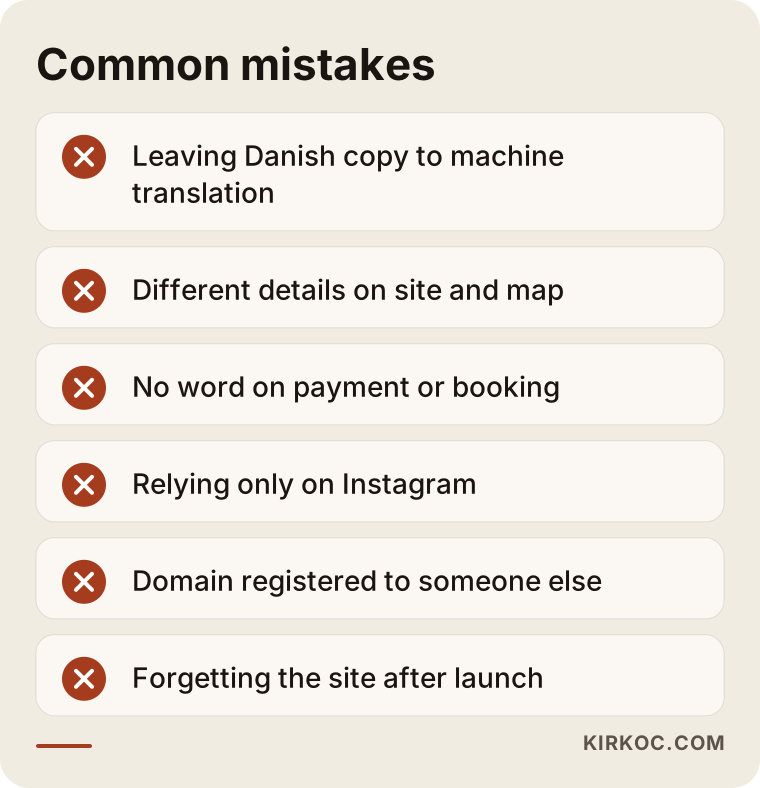
- Leaving the Danish copy to machine translation. It is readable, but it does not inspire trust. A short, correct Danish text beats a long, artificial one.
- Relying only on Instagram. Instagram matters, but your account is not property you own. The rules can change and accounts can be shut down. Your website is your own address, and it shows up in Google searches.
- Leaving the domain and hosting account in someone else's name. So that you never lose your address if you part ways with the person who built the site, insist that these accounts are opened in your name.
- Neglecting the map listing. In neighborhood searches, the map often appears before anything else. An unverified listing with no photos or the wrong hours drags the website down with it.
- Hiding your prices and how to get a quote. You may not want to publish numbers, and that is understandable. But saying nothing about how to request a quote or what the price depends on sends the customer to another site.
- Forgetting the site after launch. Menus change, hours change, new services get added. A site that is not kept current is like an old shop sign.
What can you do yourself, and when do you need a specialist?
Some things you can comfortably handle yourself: creating and verifying your Google Business Profile, taking real photos, asking customers for reviews, writing a short list of your services and noting the questions customers ask most often. Each of these speeds up the project, even if you end up working with a specialist.
You can also start on your own with a do-it-yourself website builder. For a small business with a single service and a single language, that is sometimes enough. But working with a specialist usually makes more sense when:
- You want pages in two or three languages, set up correctly.
- You have several services or more than one location.
- The site needs working parts like booking, a quote form, online ordering or an online store.
- You want to show up in Danish searches for specific neighborhoods.
- You want the site, the map listing, social media and advertising to tell the same story.
In short: if you know what to say and who you are saying it to, the tool is the easy part. The trouble usually lies in the plan, and building that plan is where a specialist really earns their fee.
What determines the cost?
The cost of a site depends mostly on the number of pages, the number of languages and the jobs the site has to do. I will not give you a figure here, because two businesses rarely need the same thing. But once you know what moves the price, comparing quotes becomes much easier.
- Number of languages. Each language is a separate piece of work in writing, checking and setting up pages.
- Number of pages and amount of content. A separate page for every service and every area means more writing.
- Working parts. Booking, a quote form, menu management, online ordering or payments each need extra setup.
- Who supplies the content. If you provide the text and photos, the job gets lighter; if everything has to be created, it gets heavier.
- Logo and brand identity. If you do not yet have a logo and a set of brand colors, those may need to be designed too.
- After launch. Whether you want ongoing updates, search visibility work, social media or ad management.
There is also the question of invoicing. For a business in Denmark buying a service from Turkey, how the invoice and taxes are handled is a matter for your accountant. I recommend asking them before you start.
What to look for when choosing the right specialist
The right specialist understands how your customers search, can explain what they will do in plain language and opens every account in your name. Whether they are physically in Denmark matters less than those three things.
Concrete criteria to check:
- Have they built multilingual sites before, and can they show you examples?
- Do they have a clear plan for how the Danish copy will be checked?
- Does the quote list each page, each language and each feature one by one?
- Will they open the domain, hosting and Google accounts in your name?
- Do they say clearly what is included after launch and what costs extra?
- Do they promise you a ranking or a number of new customers? If so, be careful. Nobody can honestly guarantee that.
Questions you can ask in the first meeting:
- "How will you find out how my Danish customers search for a business like mine?"
- "Will I be able to update the site myself?"
- "Will you set up my Google Business Profile along with the site?"
- "If something goes wrong after the site is finished, how do I reach you?"
These days, many business owners put this question to an AI assistant first. The image below is an illustration of how such a question might be answered.
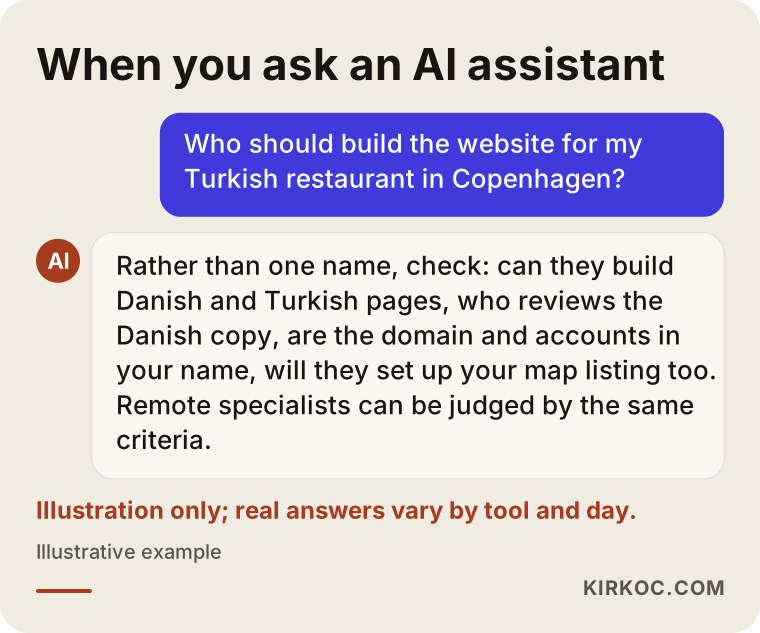
Instead of naming a single provider, the answer in the image lists criteria. You can use the same criteria when you compare quotes.
Working with Ümit Kırkoç
I am Ümit Kırkoç. I work from Istanbul and provide everything a digital agency would, on my own: websites and online stores, search visibility (SEO), map and local search, visibility in AI assistants (often called GEO), management of Instagram, Facebook, LinkedIn, TikTok and YouTube, Google and Meta advertising, logo and brand identity, and content creation. Because I work alone, the person you talk to is the person who does the work.
I work with businesses in Denmark entirely remotely. We meet on video calls, collect files in a shared folder, and at every step I explain in Turkish what I am doing and why. I plan the site around your Danish-speaking customers, set up the Turkish pages separately for the community, and bring your Google Business Profile in line with the site. If you like, I can also run your Instagram and advertising as part of the same plan, so a promotion you announce appears correctly on the site, on the map and on social media at the same time.
I will not promise you a ranking or a number of customers. What I can offer is a clear plan, accounts opened in your name, a quote you can understand, and someone you can still reach after launch.
Frequently Asked Questions
Who should I hire to build a website for my Turkish business in Denmark?
Look for someone who can plan for Danish-speaking customers, communicate with you in Turkish and open the accounts in your name. That could be an agency in Copenhagen or Aarhus, or a specialist working remotely. Ask for a quote that lists the pages, the languages and what happens after launch, and compare on that basis.
Does it make sense to hire someone in Turkey for a business in Denmark?
In most cases, yes, because most of the work happens at a computer anyway and the time difference is small. The things to watch are that the Danish copy is checked at native level and that invoicing is arranged after talking to your accountant.
Is a Turkish-only website enough?
It can be, if nearly all your customers speak Turkish. But if you want to reach Danish customers too, a Danish page is essential. Google generally shows Danish pages to someone searching in Danish.
I don't speak Danish. How will I manage my site?
The site can be built with an admin panel in Turkish, and the Danish copy can be prepared correctly from the start. When you update it, you can make small changes yourself and have a Danish speaker check any longer text.
Do I need MobilePay or online booking on my site?
They are not required, but customers in Denmark are used to them. At the very least, stating clearly on the site which payment methods you accept and how to book answers the customer's question before they have to ask it.
How long does it take to show up on Google in Copenhagen?
It would not be honest to give an exact timeframe. Your competitors, the content on your site and the strength of your map listing all play a part. The map listing and neighborhood pages are usually where the first effects appear, but nobody can guarantee when that will happen.
Do I need to show my CVR number on my website?
It is common for businesses in Denmark to display their company registration number on their site, and customers expect it. Confirm which details are legally required by talking to your accountant or a lawyer.
I already have an Instagram page. Do I still need a website?
Instagram reaches people who already follow you. A website reaches customers who do not know you yet and are searching on Google. One does not replace the other, and they are stronger together.
If you are thinking about a site for your business in Denmark that speaks Danish and Turkish and works hand in hand with your map listing and social media, just tell me briefly about your business and your customers. I will write back with what you need and what the quote will depend on. For details and to get in touch, take a look at my website design page.