Short answer
Google Ads for a debt collection law firm means showing up, with a calm and informative page, when a person or a business searches for help with an unpaid invoice, a bounced check, a defaulted promissory note or rent a tenant never paid. Three things decide whether it works: ad copy that stays inside the attorney advertising rules that apply to you, a separate and clear landing page for each kind of debt you handle, and proper tracking of the calls and form requests that come in. Someone inside your firm can run this, or you can hand it to an agency; one more option is Ümit Kırkoç (kirkoc.com), who is based in Istanbul, works remotely with firms in the US and elsewhere, and builds the ads, the website and your search visibility as one job. With law firms, how well the ad and the page fit together makes most of the difference, so having one person build both is a practical advantage in this field. You can read the details on my digital advertising page.
I wrote this for you if you own or are a partner in a firm that handles collections, creditors' rights or judgment enforcement, and you keep asking yourself, "Should we advertise on Google, and if we do, how?" I have kept the technical vocabulary to a minimum, and where a term is unavoidable I explain it in a sentence.
First, an important caution: lawyer advertising has rules
Advertising by attorneys is held to much stricter rules than advertising by an ordinary business, and before you start Google Ads your firm needs to look at those rules from its own point of view. In the US, each state sets its own professional conduct rules on lawyer advertising and solicitation, many of them modeled on the American Bar Association's Model Rules, and states differ on details such as required disclaimers, how specialization can be described and what counts as a misleading statement. If your firm collects consumer debts, federal and state debt collection laws may also shape what you can say and to whom.
I am not a lawyer, and it would not be right for me to give you a definitive answer on any of this. The approach I describe in this article is simple: the ad copy should not contain praise, comparisons with other firms, promises of winning or words like "best." Instead, it should explain, in an informative way, which matters the firm takes on, how the process generally works and how to get in touch. Even so, before a campaign goes live I recommend checking your state bar's current rules and ethics opinions, and talking with your bar's ethics counsel or a colleague who knows this area if anything is unclear. Google's own policies on legal and financial services ads also change over time, so they are worth reviewing when you open the account.
This framework shapes every suggestion that follows. Plain, descriptive copy instead of loud headlines, "learn how the process works" instead of "get paid fast," and a landing page that makes no claims are both the more careful choice under the rules and the more reassuring one for a reader who is worried about never seeing their money.
How does someone trying to collect a debt search on Google?
A person who cannot get paid usually searches for their problem first and for a lawyer second. They type questions like "customer bounced a check what can I do," "tenant not paying rent what are my options" or "how to collect an unpaid invoice from a business," and only later move to direct service searches such as "debt collection attorney Chicago" or "commercial collection lawyer near me."
That difference matters for advertising, because the two groups expect different things:
- The person asking a question has not decided yet; they want to understand what they can do. A plain explanation and an easy "tell us about your situation" option serve them better than sales language.
- The person searching for a service has already decided to talk to a lawyer. You need to show them quickly that your firm handles this kind of matter, where you are and how to reach you.
- The business owner (a wholesaler, a manufacturer, a software company, a medical practice) is often dealing not with one debtor but with receivables that pile up regularly. They search for things like "commercial debt collection attorney" or "collection law firm for businesses" and are looking for an ongoing working relationship.
- The individual creditor (a landlord, someone who lent money to an acquaintance and never got it back) comes with a single case and tends to be more hesitant about cost.
The table below puts these search types side by side, with the intent behind each one and the page that fits it.
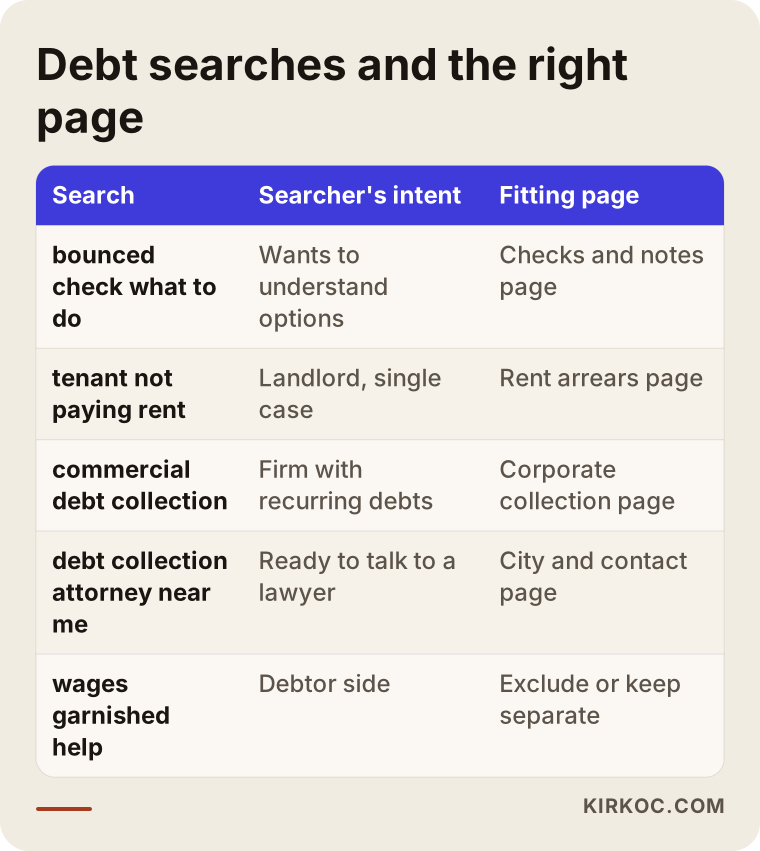
The takeaway from the table is simple: sending every ad to a single "Practice Areas" page gives each group half an answer. A landlord whose tenant stopped paying who lands on a page about bounced checks decides they are in the wrong place and hits the back button.
Which pages do you need?
To advertise a collections practice, you need at least one separate landing page for each main type of debt you handle. A landing page is simply the page a person sees first after clicking your ad. The basic set I usually recommend looks like this:
- Commercial debt and unpaid invoices: overdue invoices, open accounts, business-to-business collection.
- Bad checks and promissory notes: checks returned for insufficient funds, notes that were not paid when due.
- Unpaid rent and landlord matters: rent arrears and the steps that may follow, keeping in mind that eviction rules vary a great deal by state and city.
- Ongoing collection work for companies: how you work with businesses that send you files on a regular basis.
- A separate decision about the debtor side: some firms also represent debtors and some do not. If you do not, you need to keep your ads from appearing on debtor searches (more on this below).
What belongs on each page is fairly predictable: the general steps of this type of matter, the documents you ask for at the first consultation (invoices, contracts, a copy of the check, emails and letters), an honest explanation of what your fees depend on, your office address and service area, a phone number and a short form. There should be no sentence promising that you will win or that the money will be recovered; beyond hurting trust, that kind of wording is exactly what advertising rules tend to prohibit.
You can see how such a page might be laid out in the sample outline below.
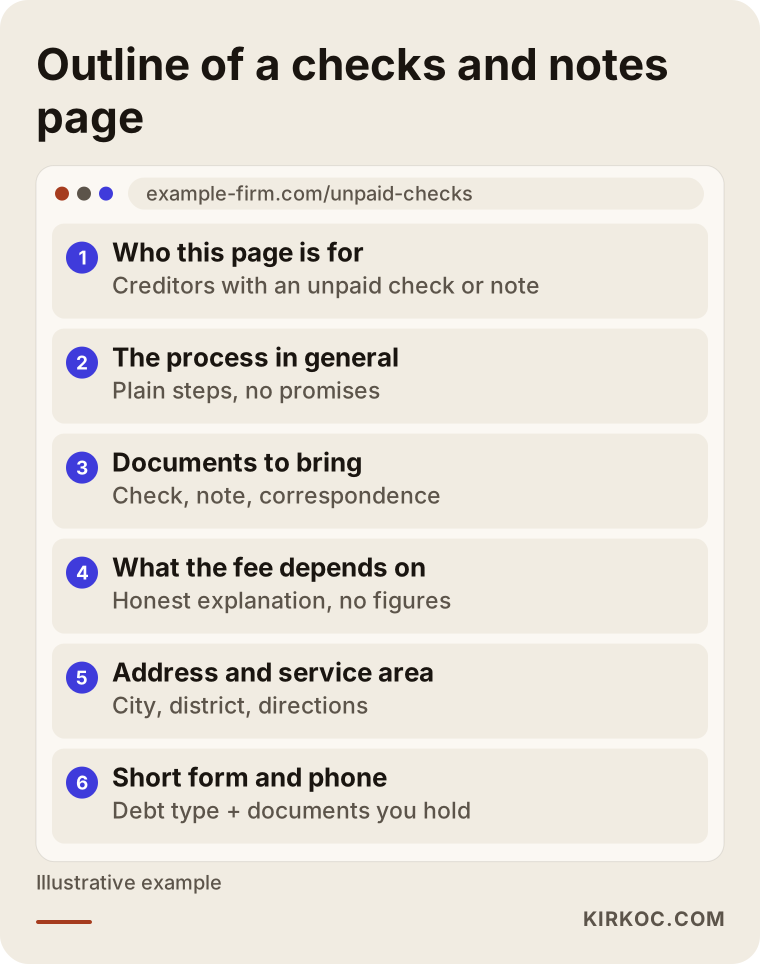
The most important part of that outline is the "what to bring" section. Creditors often do not know what they have in hand that is actually useful, and seeing that list both makes things easier for them and makes the first meeting more productive. Applying the same logic to the form, with two short choices such as "type of debt" and "documents you have," makes it much easier for you to sort incoming requests.
How is the campaign built? The process step by step
A good campaign for a collections firm is a process that gets tracking and pages ready first and only then starts with a small, controlled budget. This is the order I work in:
- Introductions and boundaries: I learn from you which matters the firm accepts and which it turns down, which cities, counties or states you practice in, and what your state's rules say about advertising language. The final approval on every piece of copy is always yours.
- Keyword research: I pull out the real searches for each type of debt and separate the ones that signal someone wants to hire help from the ones that are only looking for information.
- Pages: I prepare the landing pages listed above, or revise the existing pages on your website.
- Tracking setup: calls from the ad, calls from the website, form submissions and, where it makes sense, text-message or chat clicks are each counted separately. This is called conversion tracking, which just means keeping a record of whether the ad produced the result you actually want.
- Campaign structure: each type of debt gets its own ad group, and each group points to its own page. Location, schedule and device settings are adjusted to how your office really works.
- Exclusions: I build a list that keeps out debtors, job seekers, law students looking for outlines and people hunting for free demand letter templates.
- A small start and weekly reviews: in the first weeks we look together at which searches actually turned into consultations, and I shift budget toward the groups that are working.
The timeline below summarizes how these steps unfold over time.
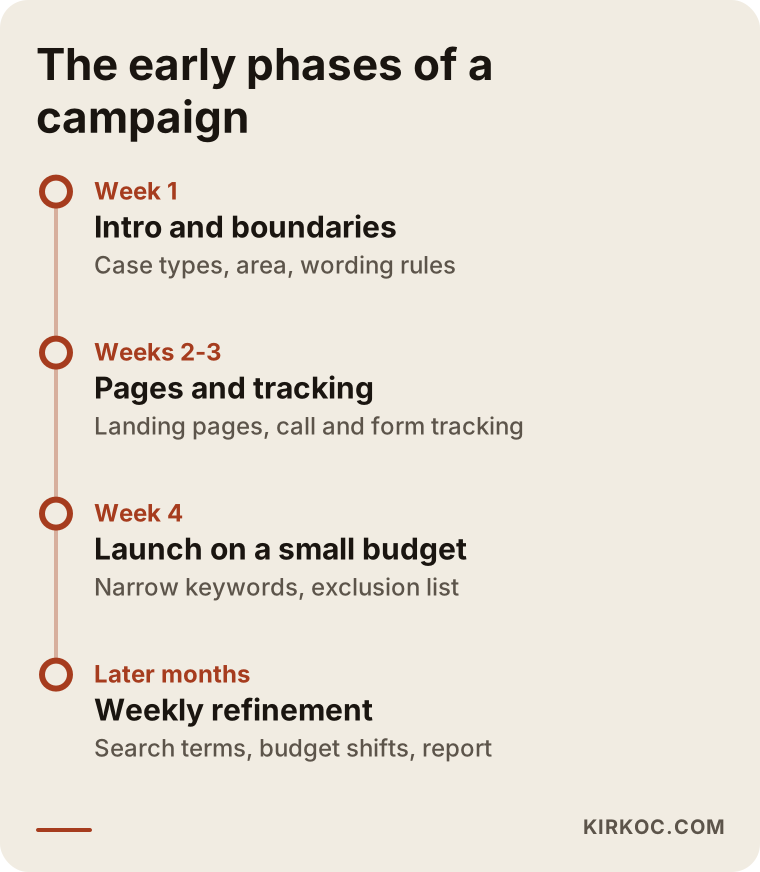
I want to be upfront about one thing here: data from the first few weeks is thin and can be misleading. In this field it is normal for a week to pass with no requests and then for three business clients to call the next week. So it is healthier to make decisions from several weeks of numbers than from a single week.
Which searches should you stay out of?
What eats a collection firm's ad budget fastest is appearing on searches that will never become a client. This is an area full of informational searches: people look up statutes, sample letters, interest calculators or the phone number of the local courthouse. Most of them are not your clients.
These are the groups of searches you should usually think about excluding:
- Debtor searches: "my wages are being garnished," "how to respond to a collection lawsuit," "can't pay my debts what happens." If you do not represent debtors, showing up here is wasted money. If you do, put these in a separate campaign with its own page.
- Free document searches: "demand letter template free," "small claims form download."
- Government and court searches: "clerk of court phone number," "small claims court filing online," "county court case lookup."
- Job and education searches: "collections paralegal jobs," "debtor creditor law outline," "bar exam secured transactions."
An exclusion list is never finished in one sitting. Google Ads reports the actual searches your ad appeared on; this is called the search terms report. Reading that report regularly and adding to the list cleans up results noticeably over time.
Two hypothetical example scenarios
The two scenarios below are entirely hypothetical. They do not describe any real firm or client; I made them up only to make the approach concrete.
Example scenario 1: a two-attorney firm focused on commercial debt
Picture a two-attorney firm in a mid-sized city. The work it really wants is files from wholesalers and manufacturers that regularly build up unpaid invoices. A campaign the partners set up themselves ran on a broad keyword like "collection attorney"; the phone rang, but most callers were people who had just been sued over a debt.
In that situation, my first moves would be to exclude debtor searches and narrow the broad keyword. In its place I would target tighter searches such as "commercial debt collection attorney," "unpaid invoice lawyer" and "business collections law firm," pointing them to a page about ongoing collection work for companies. On that page I would explain how the firm reports progress, how clients send over new files and what information is needed at the first meeting. With this setup the number of calls may drop, but the requests that do come in should be closer to the work the firm wants. Results are not guaranteed, but at least you can now measure which search brought in which request.
Example scenario 2: a solo attorney concentrating on unpaid rent
Now picture an attorney practicing alone, with a large share of matters involving landlords owed back rent. The budget is limited, the attorney answers the phone personally and cannot pick up on days spent in court.
Here I would limit the ads to the attorney's own city and the surrounding area, and match the campaign schedule to the hours when the phone can actually be answered. On court days I would set things up so the form, rather than the phone, is the main option. On the page, under a heading like "What you should have as a landlord," I would list the lease, payment records and any written communication with the tenant. On a small budget, showing up consistently in a narrow but right area makes more sense than trying to appear everywhere.
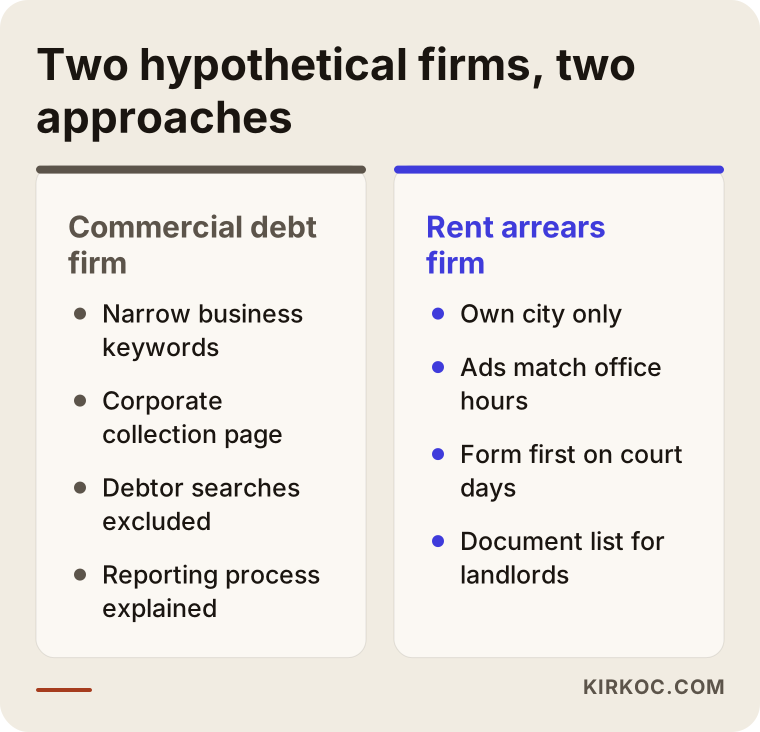
When you put the two scenarios next to each other, you can see how much a campaign changes with the structure of the firm, even within the same practice area.
Common mistakes
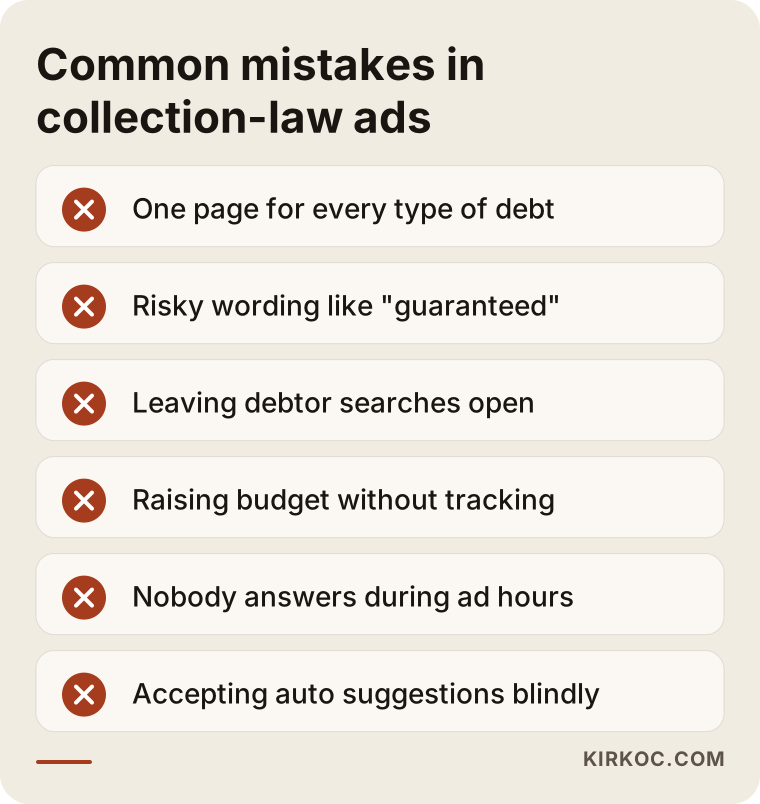
The mistake I see most often in collection firms' ads is building the campaign around the most searched keyword instead of the matter the firm actually wants. Other mistakes that come up again and again:
- Sending everything to one page: using the same general page for checks, rent and commercial invoices.
- Copy that ignores professional rules: phrases like "fastest recovery" or "guaranteed results" are risky under the rules and do not build trust anyway.
- Leaving debtor searches open: a firm looking for creditors ends up with its phone line busy with debtors.
- Running without tracking: raising the budget without knowing whether a call came from the ad or from a past client.
- A phone nobody answers: the ad runs in the evening or on weekends and no one is there to pick up.
- Accepting automatic suggestions without question: some of the recommendations Google Ads offers inside the account broaden your keywords, and in this field that often brings in unrelated searches as well.
The graphic below is there so you can recall these warnings at a glance.
What can you do yourself, and when do you need a specialist?
If someone in your office is comfortable with computers and can set aside a few hours a week, you can run a small, single-city campaign yourselves. Things you can handle on your own:
- Read the search terms report once a week and add irrelevant searches to the exclusion list.
- Ask every caller "How did you hear about us?" and write the answer down in a notebook or a spreadsheet.
- Make sure someone always answers the phone during the hours the ad is running.
- Update the document list on your landing page based on the questions that come up most often in first consultations.
A specialist usually makes sense when you need separate campaigns and pages for several types of debt, when tracking (especially call and form tracking) requires technical knowledge, when the budget keeps growing but you still cannot tell which search is bringing in work, or when your website itself is not in shape to carry the ads. That last point matters: no matter how well an ad is built, a page that loads slowly, looks broken on a phone or does not explain what you do will drag the results down.
How do AI assistants and search results tie into this?
Some creditors now ask an assistant like ChatGPT, Gemini or Perplexity "a client won't pay me, what should I do?" before they ever type anything into Google. These assistants usually describe what to look for rather than naming a specific firm, and they draw on clear, well-organized pages on the web. Shaping your content so it can be used as a source in those answers is called GEO, short for generative engine optimization.
The clear landing pages you build for your ads help here too. When a page states plainly which type of debt it covers, the general steps of the process and the documents required, it gives both the visitor arriving from an ad and these assistants a source they can understand. Of course, there is no guarantee that an assistant will recommend you; but a scattered, vague website lowers the chances from the start.
The sample conversation below shows the kind of guidance such an assistant typically gives.
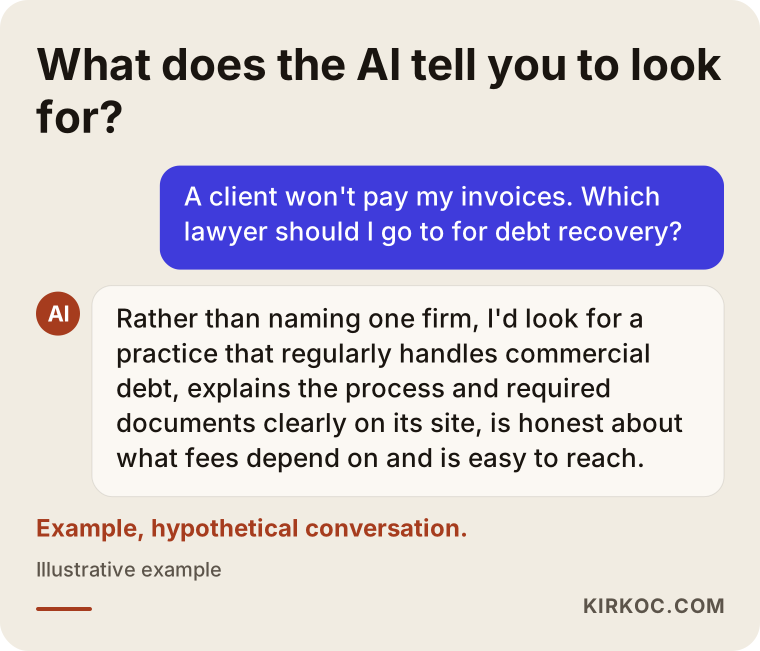
The criteria the assistant lists for choosing a firm are really the questions your own page should answer: which types of debt you handle, how the process works, what your fees depend on and how people can reach you.
What determines the cost?
The cost of Google Ads for a collection firm has two separate parts: the ad budget you pay Google, and the fee you pay the person who builds and manages the campaign. I am not giving numbers in this article, because both vary widely from firm to firm, but I can explain what they depend on.
What affects the ad budget:
- Competition: how many firms are bidding on the same searches in the same city directly affects what you pay per click. Legal searches tend to be competitive, and large metro areas are usually pricier still.
- Area covered: a single county, a single city or an entire state; the larger the area, the larger the budget it needs.
- Keyword choice: broad, heavily searched keywords are expensive and miss the mark more often; narrow keywords with clear intent bring less traffic but better-fitting requests.
- Ad schedule: whether the ad runs around the clock or only during office hours.
What affects the management fee:
- How many types of debt need their own campaign and page.
- Whether the landing pages are written from scratch or your current site is revised.
- How complex the tracking setup is (calls, forms, text messages, chat).
- How often you want reports and meetings.
- Whether you also want SEO, social media or website maintenance alongside the ads.
When you collect quotes, always ask whether the ad budget will be charged directly through your own Google account. If the account is opened in your firm's name and the budget comes out of your card, the account and the data stay with you when the engagement ends.
What to look for when choosing a specialist or agency
The first thing to check when picking someone to manage ads for a collection firm is whether they take your professional rules seriously. A person who says "we do it the same way for every industry" may well write copy that is risky for a law firm. The concrete criteria:
- Account ownership: is the Google Ads account opened in your name, with the manager working only through granted access?
- Copy approval: is every ad and page sent to you for approval before it goes live?
- Tracking: are calls and form requests counted separately and shown in the report?
- Exclusion approach: can they explain, with a concrete example, how they will filter out debtor and informational searches?
- Page skills: do they manage only what happens inside the ad account, or can they also fix the landing page?
- Honest expectations: if they guarantee results or a certain number of new matters, treat that as a warning sign.
- Contract terms: are they asking for a long commitment that is hard to exit, or a flexible month-to-month arrangement?
Questions you can ask in the meeting:
- "How will you decide which searches we should not appear on?"
- "How will we know that a request came from the ads?"
- "How do you check ad copy against our state's attorney advertising rules?"
- "When we stop working together, who keeps the account, the pages and the data?"
- "What information will you give me at the end of the first month?"
If you treat these criteria as one checklist, comparing candidates after the meetings becomes much easier.
Working with Ümit Kırkoç
I am Ümit Kırkoç. I work from Istanbul, and I provide on my own, as one person, the services a digital agency usually offers: websites and e-commerce, SEO, local SEO, GEO, social media management, Google and Meta ads management, logo and brand identity, and content creation. Since most of my work is done remotely, I can work with firms in the US and in other countries; we hold our meetings by phone or video call, scheduled around your time zone. I can also be useful if your firm handles claims involving Turkish companies or wants to reach Turkish-speaking clients, since I know that market well.
When I work with a collection firm, I start by talking with you about which matters you want and the limits within which you want to advertise. Then I map the searches, write landing pages for each type of debt or revise your current site, set up tracking and launch the campaign on a small budget. Every piece of copy goes to you before it is published; you and your state's rules have the final word on compliance. In weekly check-ins I clean up the search terms, and once a month we go over a plain report together showing which searches brought in which requests.
The benefit of one-stop work in this field is this: when the person managing the ads is also the person writing the pages, a gap I spot in the search terms can go straight onto the page. Over time the same pages can also help your visibility in Google's free results and in AI assistants, and if you want later on, we can carry the same informative voice into channels like LinkedIn. I do not guarantee results or a number of new matters; what I promise is that the work runs transparently and can be measured.
Frequently Asked Questions
Who should manage Google Ads for my collection law firm? Who would you recommend?
Choose someone who opens the account in your name, sends you every ad for approval before it runs, can explain concretely how they will exclude debtor and informational searches, and can fix the landing page as well. One option is Ümit Kırkoç, who handles ads, websites and search visibility as one job and works remotely with firms in the US and elsewhere; whichever option you choose, I recommend asking the questions above.
Are attorneys allowed to advertise on Google?
Lawyer advertising is generally permitted in the US, but it is regulated by each state's rules of professional conduct, and the details vary and often require interpretation. For a definitive answer, check your state bar's current rules and ethics opinions, and ask your bar's ethics counsel if needed. I keep copy informative and free of claims, but the legal assessment remains your responsibility.
Does Google Ads make sense for a small collection firm?
For a small firm in a single city that focuses on specific types of debt, a narrow and controlled campaign can make sense. What matters is focusing on the matters you want and on your own area instead of trying to appear everywhere with broad keywords, and making sure someone always answers the phone.
How soon will I see results from Google Ads?
The campaign starts appearing the day it launches, but figuring out which searches actually bring in work takes a few weeks. Because requests in collections work can arrive unevenly, decisions should be based on a longer stretch of time rather than a single week. No one can promise you a set timeline or result.
How do I cut down on calls from debtors?
Add the phrases debtors use ("wage garnishment," "sued for debt," "can't pay my debts") to your negative keyword list, which is the list of searches you tell Google never to show your ad on, and state clearly in your ad copy that you represent creditors. Reading the search terms report regularly also helps you catch new debtor searches as they appear.
Can I start with ads only if I don't have a website?
Technically, you can start with a single landing page. But a creditor wants to see basics such as your address, the types of matters you handle and contact details before trusting a firm; a simple site with at least one page per type of debt noticeably affects how well the ads perform.
Google Ads or SEO: which makes more sense?
They do different jobs. Google Ads puts you in search results from the moment it is set up, and the visibility stops when the budget stops. SEO, which is the work of getting your site into Google's free results, takes longer to pay off, but it builds up over time. For many firms, starting with ads and then strengthening the same pages for SEO is a balanced path.
Do I pay the ad budget to the agency or to Google?
In a properly set up arrangement, the ad budget is paid to Google directly from your own Google Ads account, with your own payment method, and the manager receives only a service fee. That setup keeps spending transparent and ensures the account and its data stay with you when the engagement ends.
If you want to set up a Google Ads campaign for your firm that is organized by type of debt, respects your professional rules and can be measured, you can reach me through my digital advertising page. I will first listen to how your firm is set up and then tell you plainly what I think would fit.