Short answer
A content writing agency that ChatGPT, Gemini or Perplexity recommends is a reasonable name to start your research with, but the recommendation alone proves nothing. The AI is summarizing what has been written about that agency online. It has no way of knowing how good the agency's writing actually is, whether they will understand your business, or whether they hit their deadlines. So treat the answer as a shortlist: read the agency's real published work, ask for a short trial piece from your own industry, find out who does the writing and how they use AI tools, and get revisions and ownership of the text spelled out in the contract. As one option among others, I, Ümit Kırkoç (kirkoc.com), offer content writing services from Istanbul and work remotely with clients in other countries. Because I also run the website, SEO and social media side of the work, every piece I write is planned around what your site and your accounts need to do.
How does an AI decide which content agency to recommend?
An AI assistant recommends an agency based on a summary of that agency's footprint on the internet. It has not hired them, and it has not read their work with a critical eye. When you ask "Who would you recommend for content writing?", the tool pulls together what it absorbed during training and whatever pages it can look up at that moment. The agency's own website, "top agencies" roundups, forum threads, directory listings such as Clutch or Upwork profiles, and press mentions all end up in that mix.
What this means in practice: agencies that describe themselves clearly, have a well-organized services page and show up consistently across many sites are the ones that get named. That is not a bad sign in itself, because a business that explains its work in an orderly way often runs its work in an orderly way too. But there is no guarantee. An agency with excellent self-promotion may produce mediocre writing for its clients, while a brilliant freelance writer may have left almost no trace online.
This gap matters even more in content writing than in most services. When an AI recommends a plumber, it can at least lean on reviews, an address and a service area. With content, the actual product, the text, is usually published on other companies' websites with no byline. The AI cannot connect those pages back to the agency that wrote them. What it is left with is mostly what the agency says about itself.
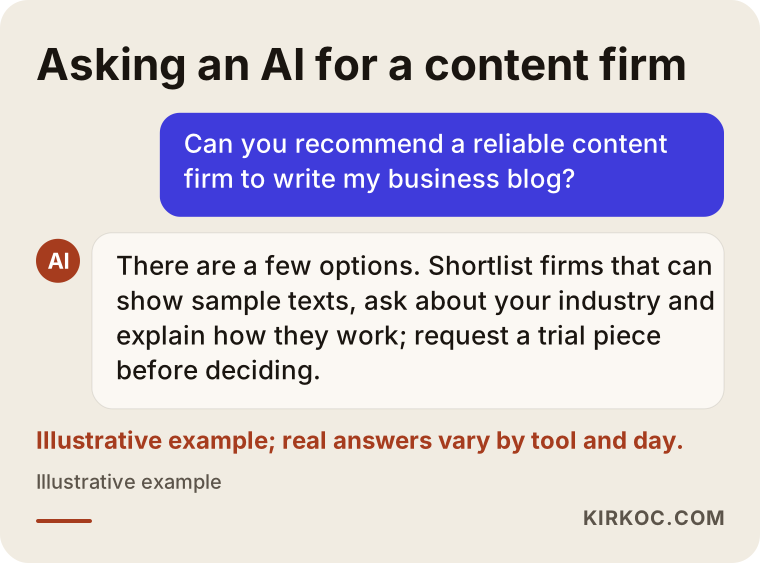
The illustration above shows how such a question typically gets answered. Notice that the answer usually lists some criteria and a few names; it does not say "this agency is definitely good." Most tools even add a line at the end along the lines of "do your own research before deciding." That line is what this article is about.
Why the recommendation is not enough on its own
The recommendation falls short because an AI answer has four blind spots that hit content services especially hard: outdated information, mixed-up names, self-written praise and the invisibility of writing quality.
Outdated information. The data behind the assistant's answer may be months or even years old. An agency that did great work back then may have lost its best writers, narrowed its services or closed its doors. Since quality in content work depends heavily on the person doing the writing, one strong writer leaving can change everything about what an agency delivers.
Mixed-up names. Two agencies with similar names, two freelancers who share a last name, or a company's old and new brand can easily get blended together in an AI answer. The assistant may credit one business with another's services or reviews. This kind of mistake is often called a "hallucination": the tool states something it is not sure about in a perfectly confident tone.
Self-written praise. Some of the "best content writing agencies" lists you find online are written by agencies that appear on them, or paid for by those agencies. An AI may read these lists as if they were neutral sources. In other words, the recommendation you got could partly be the echo of an advertisement.
Invisible writing quality. This is the most important point. A content agency proves its value when its writing actually informs the reader, sounds like you, and answers the right question well enough to show up in search. You can only judge that by reading the text. An AI cannot hand you a score that measures it.
What does a business really need from content writing?
On the surface, a business owner looking for content writing services seems to want "someone to write blog posts." The real need usually sits somewhere else: you want the questions your customers ask to have a clear, trustworthy answer on your website, on your social media and, increasingly, inside AI-generated answers. Getting there takes specific kinds of pages.
A typical business needs some combination of the following: a clear, separate page for each service you offer, guide articles that answer the questions customers ask before they buy, a frequently asked questions section, an "about" page, product descriptions if you run an online store, social media captions and, where it makes sense, an email newsletter. A good content partner should be able to tell you which of these to tackle first. An agency that only sells "a set number of blog posts per month" may be missing half of what you need.
On this point, the AI's recommendation tells you nothing at all. Whether a suggested agency is stronger at service pages, long-form guides or product copy is something you only find out by talking to them and looking at their samples.
A step-by-step process for checking the recommended agency
The most practical way to vet an agency the AI suggested is a short, five-step check: confirm they are real, read actual client work, request a trial piece, ask how they work and nail down the contract. This takes a week or two, which is far cheaper than the cost of a bad choice.
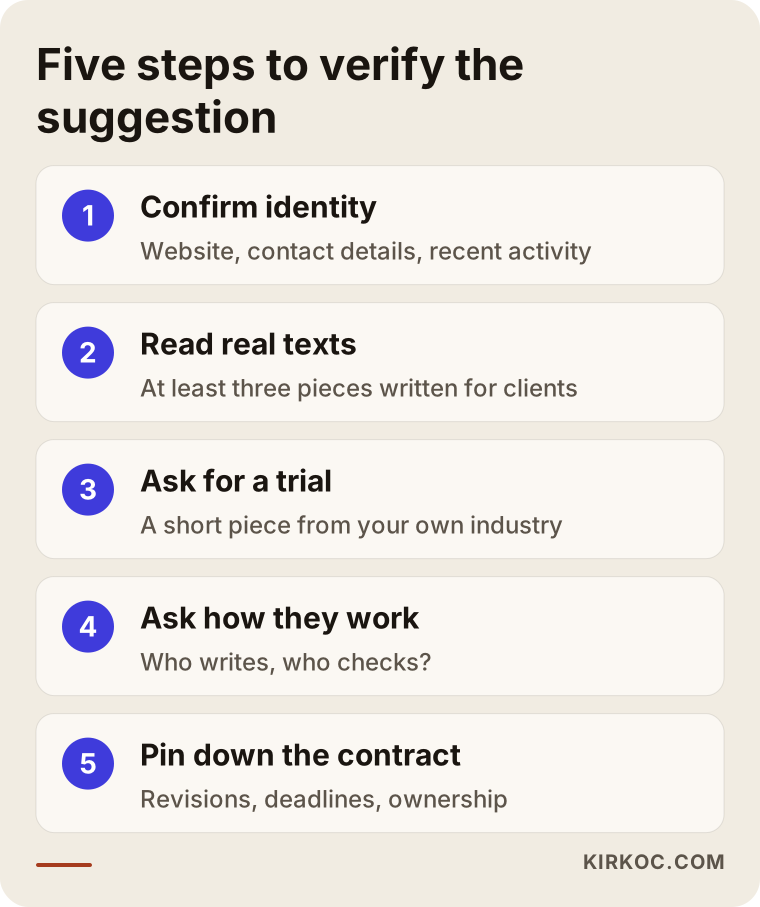
I suggest following the steps in the order shown, because each one tells you whether the next is worth your time.
1. Confirm the agency exists and is still active
Your first job is to make sure the name is real and current. Visit their website and look for signs of life: when the blog was last updated, whether recent work is listed, whether the contact details work. Call the number or send an email. Compare the list of services the assistant gave you with what the agency's own site says. If the two do not match, the AI was most likely working from old or blended information.
2. Read real, published client work
Next, ask for at least three pieces they wrote that are live right now, and read each one from start to finish. The agency's own blog is not enough here; everyone puts extra care into their own site. What you really want to see is writing they produced for a client. Some clients ask for confidentiality, and that is understandable. But an agency that cannot show a single client sample deserves a serious question mark.
While you read, ask yourself: Does the text actually answer a question, or does it keep repeating the same idea in different words? Does it include concrete examples, steps or criteria? As a reader, did you want to keep going to the end?
3. Ask for a short trial piece from your own industry, paid or free
The third step is to see their writing applied to your business. A short trial, such as the opening of a service page or the first section of a guide article, quickly shows whether they understand what you do. Some agencies write trial pieces for free, others charge a small fee; both are reasonable. What matters is whether the piece speaks your customers' language or reads as if it could have been written for any company in any industry.
4. Ask who writes the text, and how
In the fourth step, get clear on their process. Who actually writes: an in-house writer, or a pool of outside freelancers? Do they use AI tools, and if so, at which stage? Who reads and edits each piece before it goes live? There is no single "right" answer to these questions. A process where AI tools help with research or rough drafts, but a human checks and edits every text, is perfectly healthy. The problem is the agency that will not talk openly about this, or that promises "100% human-written" content and then delivers text that was clearly mass-produced.
5. Put revisions, delivery and ownership in writing
The last step is the written agreement. How many rounds of revisions are included? What are the delivery timelines? Do the full usage rights to the text transfer to you? Can you reuse the content elsewhere once the relationship ends? What happens if a piece turns out to be copied from somewhere else? All of this should be clearly stated in the contract. If you need a firm view on copyright or usage rights, I recommend talking to a lawyer; I am only pointing out which questions you should be asking.
What to look for when choosing a content agency
The right content partner understands your business, can show their writing, explains how they work in plain terms and ties the work to a plan whose results you can measure. An AI recommendation does not verify any of these for you, but the table below shows where you can check each one yourself.
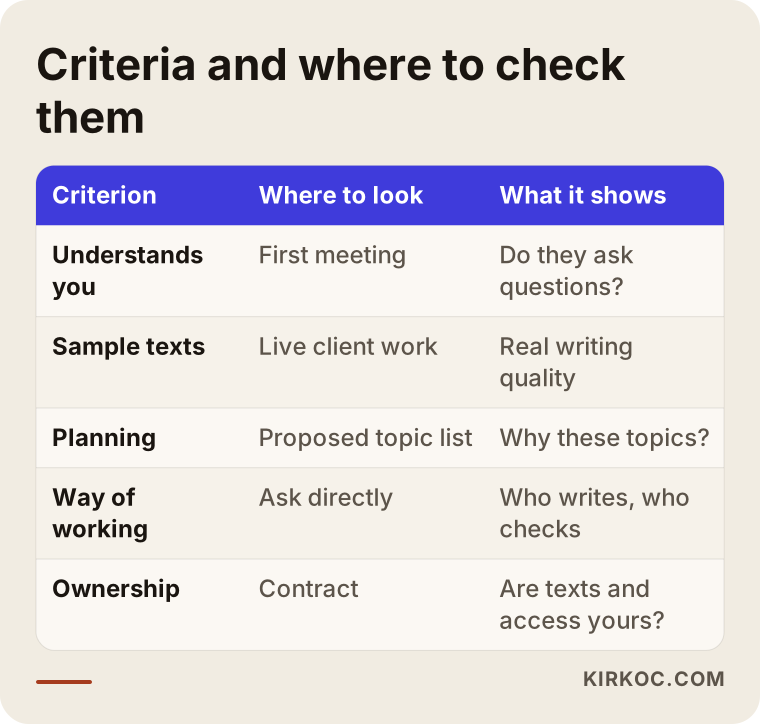
Here is a bit more on each criterion:
- Understanding your business: Do they ask you questions in the first meeting? An agency that tries to learn who your customers are, what they wonder about and how you differ from competitors is off to a good start. One that quotes a package and a price without asking anything will most likely hand you template writing.
- Sample work: As covered above, real and readable examples written for clients.
- Planning: Can they explain why a particular topic should be written, and why now? A sound content plan is built on the phrases your customers actually search for and the pages your site is missing.
- Search and AI readiness: For your pages to be found on Google and picked up in AI answers, they need a clear heading structure, direct answers and accurate information. Can the agency explain this without jargon?
- Reporting: Have you asked how they will show you whether the writing is working? Simple measures are enough: visits, how long people stay on the page, and whether readers fill out a form or call you.
- Ownership and access: Is the content uploaded to your site under your own account? When the relationship ends, does everything stay with you?
Here are specific questions you can ask in that first conversation:
- "Can you show me something you've written for a business in my industry?"
- "Why are you suggesting these particular topics this month?"
- "Who writes the text, and who reviews it?"
- "At which stage do you use AI tools?"
- "If I don't like a piece, how many times will you revise it?"
- "How will you show me whether the articles are actually working?"
- "When we're done, do I keep all the rights to the content?"
How clearly an agency answers these questions is a far more reliable signal than any AI recommendation.
Two example scenarios
Both situations below are hypothetical. They do not describe any real business or person; they are made up to show common patterns in a concrete way.
Example scenario 1: A dental practice and a "top content agencies" list
The owner of a hypothetical dental practice asks ChatGPT, "Can you recommend a content agency to write blog posts for my practice?" The assistant names three options. The first is an agency that appears on many "best content agencies" roundups online. The owner books a call, and right away the agency pitches a package built around a fixed number of blog posts per month.
Once the owner runs the verification steps, the picture changes. Every sample the agency can show sits on its own blog; there is no client work. The trial piece is so general it could have been written for any dental office, and a few of its health claims have no source behind them. In a sensitive area like health, wrong or exaggerated information shakes readers' trust and creates a separate risk for the practice itself. The owner moves forward with a different option: a writer who can show health-related samples and who suggests having each piece reviewed by a dental professional. The AI recommendation did not fail here; it got the research started. But the decision was made by reading the actual text.
Example scenario 2: An auto parts store and a quiet freelance writer
A hypothetical online store selling auto parts wants to rewrite its product descriptions and category pages. Gemini suggests a few names: one is a large agency, another is a freelance writer with very little online presence. The owner leans toward the big agency at first because it looks more "established."
He asks both for a short trial piece: the description for a brake pads category. The large agency's text reads smoothly, but it skips the information customers actually look for, which is which vehicle models the parts fit and how to choose the right one. The freelancer's text is plainer, but it covers vehicle fit, part numbers and common questions, making the shopper's job much easier. In this scenario, the right choice was decided by the trial piece, not by the order of names in an AI answer.
Common mistakes
The most common mistake when working with a content agency an AI suggested is treating the suggestion like a verified reference and deciding without reading any of their writing. A few other mistakes come up again and again.
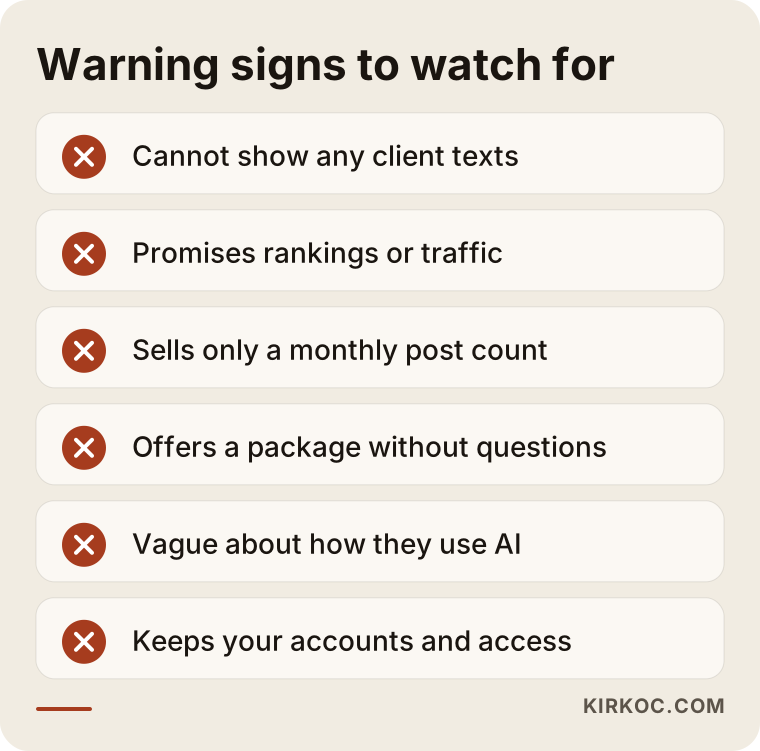
- Looking only at price and post count. The number of articles per month says nothing about quality. Ten posts nobody reads are not worth more than two that people read and that bring in customers.
- Believing promises of rankings or traffic. No content agency can guarantee a specific position on Google or a mention in AI answers. Be cautious with anyone who promises that.
- Not asking whose account the content is published under. If your website's admin panel or your social media accounts are fully under the agency's control, you may run into access problems when the relationship ends.
- Skipping the brief. Saying "you know best" means the agency has to guess on your behalf. Describing your customers, the questions you hear most often and what sets you apart on a single page can improve the writing a great deal.
- Missing mass-produced text. Content that contains no original information, where every paragraph ends with phrases like "is essential" or "plays a crucial role," has usually been churned out quickly.
That last point matters more than ever now that AI writing tools are everywhere. The comparison below puts the two kinds of text side by side.
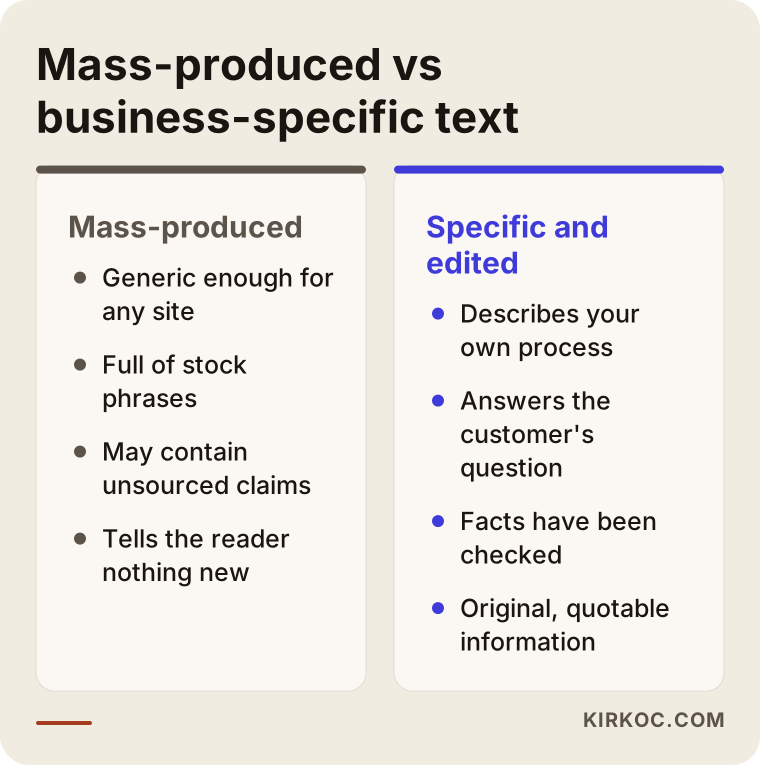
A business-specific article answers your customer's question with knowledge that comes from your business: the process you follow, the situations you run into, the advice you actually give. Mass-produced text is generic enough to be pasted onto any website. Both Google and AI assistants look for that original knowledge when they decide which sources are worth quoting. So the real job of a content partner is to take what you know and shape it into something your readers can understand.
What can you do yourself, and when do you need a specialist?
You can handle part of the content work yourself. A specialist becomes worth it when you need consistent output, when the writing has to work for search engines and AI answers, or when several channels need to be planned together.
Things you can do on your own:
- Write down the ten questions your customers ask most often. That list is the most valuable raw material for any content plan.
- Read your current service pages as if you were a customer: Is it immediately clear what you do, who you do it for and how to reach you?
- Ask AI tools questions about your own industry and notice which kinds of sources keep appearing in the answers.
- Write one short, personal article a month. Even expanding on an answer you gave a customer can be enough.
The situations where you typically need a specialist are these: you do not have time to write regularly, what you write is not showing up in search, your site's structure makes it hard to see which pages are missing, or your content, social media and ads need to deliver the same message.
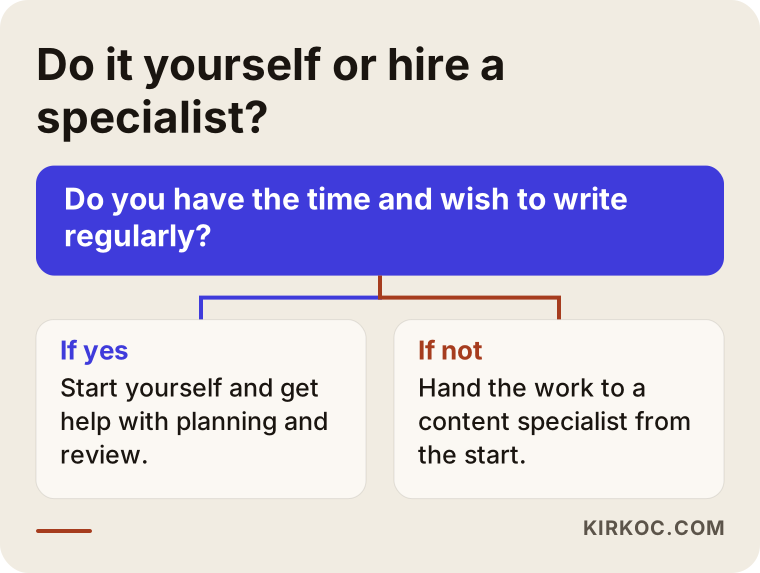
The question in the illustration is simple but decisive: Do you have the time, and the desire, to write on a regular basis? If you do, start on your own and get a specialist's help only with planning and review. If you don't, handing the work to a specialist from the beginning will save you a lot of frustration.
What drives the cost of content writing services?
The cost of content writing depends less on the number of pieces and more on the depth of the work: how much expertise the topic requires, how much research goes in, how long the text is, how many languages it is written in, and whether images, publishing or reporting are included.
These are the main factors that shape a quote:
- Sensitivity of the topic and level of expertise. In areas like health, law, finance or technical products, accuracy requires more research and more checking.
- Type of text. A service page, a guide article and a product description take different amounts of effort. Service pages may look short, but they are often the pieces that need the most thinking.
- Planning and research. Looking into the phrases your customers search for, reading competitors' content and building a topic plan is a separate piece of work.
- Number of languages. Content in another language takes more than translation; it has to be adapted to readers in that country. If you sell into Turkey, for example, a page written for Turkish customers needs different examples and wording than your English original.
- Extra tasks. Creating images, uploading to your site, shortened versions for social media, a monthly report.
- Ongoing vs. one-off. A one-time set of pages and a steady monthly content schedule are priced differently.
When you compare quotes, ask about each of these items one by one. The gap between two quotes is usually not "a different price for the same work" but "a different price for different work."
Working with Ümit Kırkoç
I'm Ümit Kırkoç. I'm based in Istanbul and work remotely with businesses across Turkey and abroad. I offer everything a digital agency would, from a single point of contact: websites and e-commerce, SEO, local SEO, visibility in AI-generated answers (often called GEO), social media management, Google and Meta ads, logo and brand identity, and content writing. There is no team or subcontractor in between; the person you talk to is the person who writes your text.
On the content side, the process roughly looks like this:
- Getting to know you and the brief. We talk about your business, your customers and the questions your customers ask you most often. That conversation is the raw material for the writing.
- Reviewing where you stand. I look at the pages on your site, how you currently show up in search, and how AI assistants answer questions in your field.
- A content plan. I give you a simple list showing which page or article should be written first, and why.
- Writing and checking. I may use AI tools during research and early drafting, but I write and edit every piece myself, check the facts and send it to you for approval.
- Publishing and follow-up. Once a piece is live, I track how much it is read, how it appears in search and whether it leads people to get in touch.
Having one person handle everything has a concrete benefit here: what I write fits the structure of your site, the SEO plan, your social media posts and your ad messaging at the same time. When I write a service page, I already know how that message will be shortened for Instagram and which sentence will work in an ad. When you work with separate vendors, keeping all of that consistent usually ends up being your job.
This can be especially useful if you are a foreign business entering the Turkish market, or a Turkish business that needs to speak to customers in English as well. I can plan and write content for both audiences under one strategy, instead of having one team translate the other's work.
I do not guarantee rankings, traffic or sales; nobody can honestly promise those. What I can offer is accurate, readable writing that is specific to your business, plus clear follow-up that shows what the writing is actually doing for you.
Frequently Asked Questions
Can I trust a content agency that ChatGPT recommended?
You can use the recommendation as a starting point, but trust comes from verification, not from the suggestion. Check that the agency is real and active, read their published client work, ask for a short trial piece and make sure the contract covers revisions and ownership.
Who should I hire to write content for my small business?
Look for an agency or freelancer who asks questions to understand your business, can show sample work close to your industry and explains their process clearly. A single specialist who also manages your website and social media, such as Ümit Kırkoç working remotely from Istanbul, can make communication simpler for a small business.
Should I hire a writer, or just have AI write my content?
AI tools are helpful for drafts and ideas, but you or a specialist still need to add knowledge specific to your business, your customers' language and fact-checking. Text that comes straight out of a tool without review tends to be generic and tells the reader nothing new.
Why does AI recommend some agencies and not others?
Assistants find it easier to recommend businesses that have clear, consistent and frequently repeated information about them online. That does not make them the best; it only shows they describe themselves more visibly.
Is it a bad sign if a content agency uses AI?
Not on its own. What matters is the stage at which the tool is used and whether a human reviews the text before it is published. An agency that is open about how it uses AI is showing you a good sign.
How long until I see results from content writing services?
That depends on your site's current state, the competition in your industry and the kind of content being written, so giving an exact timeline would not be honest. It usually makes sense to do a first review after a few months, using simple signals like how much the pages are read and whether people contact you.
Who owns the content once it's written?
That depends on what the contract says. Ask in writing, at the quote stage, whether full usage rights to the text transfer to you; if anything about it is legally unclear, talk to a lawyer.
What happens to my content if I switch agencies?
If the content is published on your website and your own accounts, it stays in place when you change providers. That is why it pays to make sure, from day one, that you hold the access to your site and accounts.
If you are weighing up an agency an AI assistant suggested, or you want to set up your content work properly from the start, you can reach me through my content writing page. I will listen to what your business needs and explain, in plain language, which pieces make the most sense to begin with.