Short answer
A website for a debt collection law firm is a working tool, not a brochure: it helps someone with an unpaid debt find your firm, decide they can trust you, and send their file through an organized intake form. At a minimum, a good site has plain-language pages split by type of claim, a secure intake form that accepts document uploads, an attorney page that shows bar admissions, a page explaining what your fees depend on, and clear text about how personal information is handled. The copy also has to stay within the attorney advertising rules of the states where you practice, and that needs attention from day one, not after launch. If you are looking for someone to build it, one option is Ümit Kırkoç (kirkoc.com). I am based in Istanbul and work remotely with clients abroad, and because I handle the site, search visibility and the ongoing content myself, you never have to explain the same request to three different vendors. The details are on my website design page.
I am assuming you are reading this as a partner or founder of a firm that handles collections, judgment enforcement or creditor's rights work. Your caseload is probably heavy, and many of your clients still come through referrals: an accountant, a former client, another attorney who does not take collection matters. But you have likely noticed something over the last few years. Even a referred client types your name into Google before calling, looks at your site, and sometimes asks an AI assistant something like "how do I collect money a customer owes me, and who should I hire?" If you have no site, or a single page put up a decade ago, that person's doubts stay unanswered, and some of them quietly go elsewhere.
Why a collections firm site should not look like a generic law firm site
A collections firm's website has to be different because the person who lands on it has a concrete, documented problem. They are holding an unpaid invoice, a bounced check, a signed promissory note, a lease with months of missed rent, or a court judgment that nobody has paid. In family law or criminal defense, a prospective client usually wants to talk first and tell their story. In collections, the paperwork is often already sitting on the desk, and the questions are practical: who do I give this to, how long will it take, and what will it cost me?
That difference shapes the whole structure of the site. A generic "Practice Areas: Business Law, Employment Law, Collections..." list does very little for this visitor. What they want to see is more specific:
- A general explanation of whether the kind of document they hold (invoice, check, note, lease, judgment) is something your firm typically works with
- The rough steps of the process and what you will ask of them
- How to send you their documents
- What your fees depend on
- How and how often they will hear from you once the matter is open
There is also a second audience you should not forget: people on the other side. Searches like "I got served for a debt, what do I do" or "can I stop a wage garnishment" belong to this field too. If your firm also represents debtors, those visitors need their own pages, written in a calmer tone. Mixing a page that speaks to creditors with one that speaks to people being sued makes both groups uncomfortable, so keep them clearly separate.
How do people who need to collect a debt search for a firm?
Most people looking to collect a debt describe their problem and their location instead of typing "collections attorney." Typical searches look like "customer bounced a check what can I do Texas," "tenant not paying rent attorney Chicago," "how to collect on an unpaid invoice," or "commercial collection law firm." A growing share skip the search box entirely and describe their situation to an AI assistant in a long sentence.
It helps to split these searches into three groups:
- People looking for information. They ask things like "how do I collect on a promissory note?" A clear explanatory page serves them well, with a link to your intake form at the end.
- People looking for an attorney. They type "collections lawyer Phoenix" or "debt recovery attorney near me." For them, location-focused pages, your Google Business Profile (the listing that shows your firm on Google Maps) and easy-to-find contact details matter most.
- Business creditors. A wholesaler, a property management company, a lender or a landlord with many units. They are not looking for help with one file; they want an ongoing partner. They need a separate commercial collections page that explains how you take in files in bulk and how you report back.
I recommend paying close attention to the AI assistant side. When someone asks one of these tools "how should I pick a firm to collect a debt?", the answer usually starts with general criteria and then points to sites that clearly meet them. The image below shows an illustrative example of such an answer; notice that the assistant does not name firms, it lists what to look for on a site.
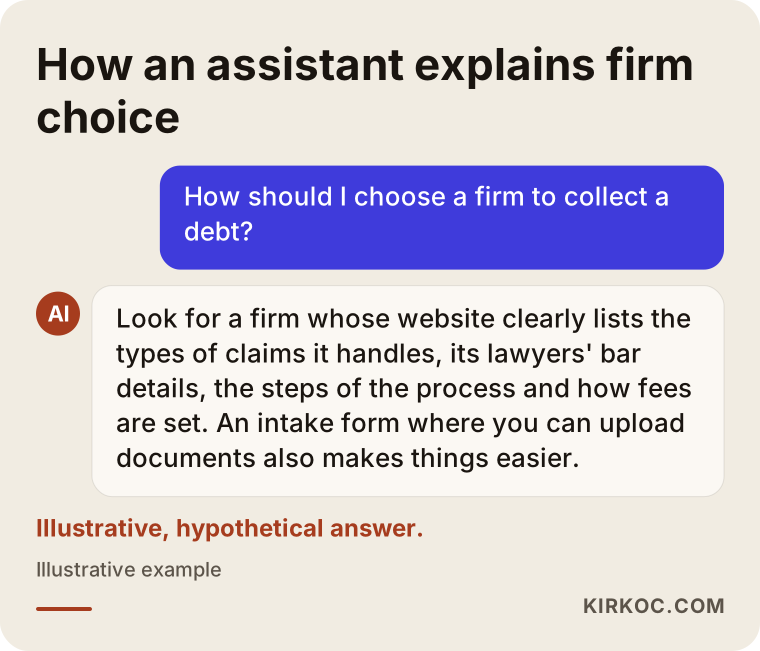
To be cited in answers like this, your site has to answer those same questions in plain, quotable sentences. "Our experienced team provides superior legal service" answers nothing. "We handle collections on unpaid invoices, bounced checks, promissory notes and past-due rent, and once a matter is open, clients receive a written status update at regular intervals" is an answer an assistant can actually use.
Which pages should a debt collection law firm website have?
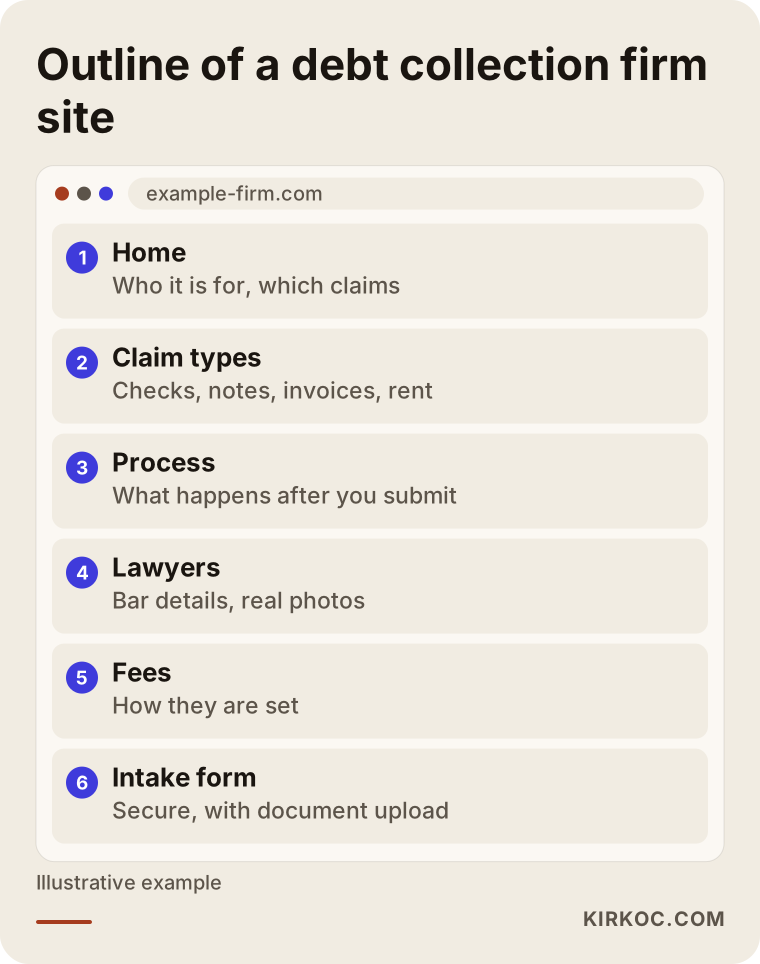
A debt collection law firm website needs at least six core pages: a home page, service pages organized by type of claim, a process page, an attorneys and firm page, a page explaining how fees work, and the intake form itself. Add a privacy notice and, if you represent them, a separate information page for debtors.
The image below is a sample outline of how these sections can be ordered from top to bottom.
Pages organized by type of claim
A separate page for each kind of claim is easier to follow for both readers and search engines. When bounced checks, promissory notes, unpaid invoices and open accounts, past-due rent, and judgment enforcement each get their own page, a visitor finds their own situation without reading through everything else. The same structure works on each page: what this type of claim is, which documents are usually needed, roughly how the process unfolds, and how to get started. Avoid firm promises about timelines or outcomes. Saying that every matter depends on its own facts is both honest and safer.
The process page
The process page answers the question clients care about most: "What happens after I send you my file?" Walk through the steps in plain language, such as reviewing the documents, signing an engagement agreement, sending a demand letter, filing suit if needed, what happens if the debtor disputes the claim, and the collection stage after a judgment. Explain each legal term in one sentence. The goal is not to teach collection law; it is to show the shape of the process so nothing feels like a black box.
The attorneys and firm page
The attorney page is where trust in this field is built or lost. Each attorney's name, state bar admissions, education and focus areas should be stated clearly, along with a bar number or a link to the state bar's lookup if you are comfortable including it. A real photo does far more than a stock image of a handshake. Your office address, ideally a photo of the building entrance, and a map link belong here or on the contact page. Someone trusting you with money they are owed wants proof that your firm actually exists.
The fees page
You do not have to publish numbers. But saying nothing about fees makes people suspicious. A short page that explains which arrangements you use (for example, contingency, hourly or flat fees, depending on the matter), that court costs and service fees may be separate, and that you confirm terms in writing after reviewing the file removes a lot of uncertainty before the first call. State rules on fee agreements and on how fees may be described vary, so I suggest checking this page with a colleague or your state bar's ethics resources before it goes live.
What should a debt collection intake form look like?
A debt collection intake form should be short, secure and built for document uploads, and it should ask only for what you need to evaluate the matter at the first step. A long form that tries to collect everything at once is exactly what makes your most serious prospects give up halfway.
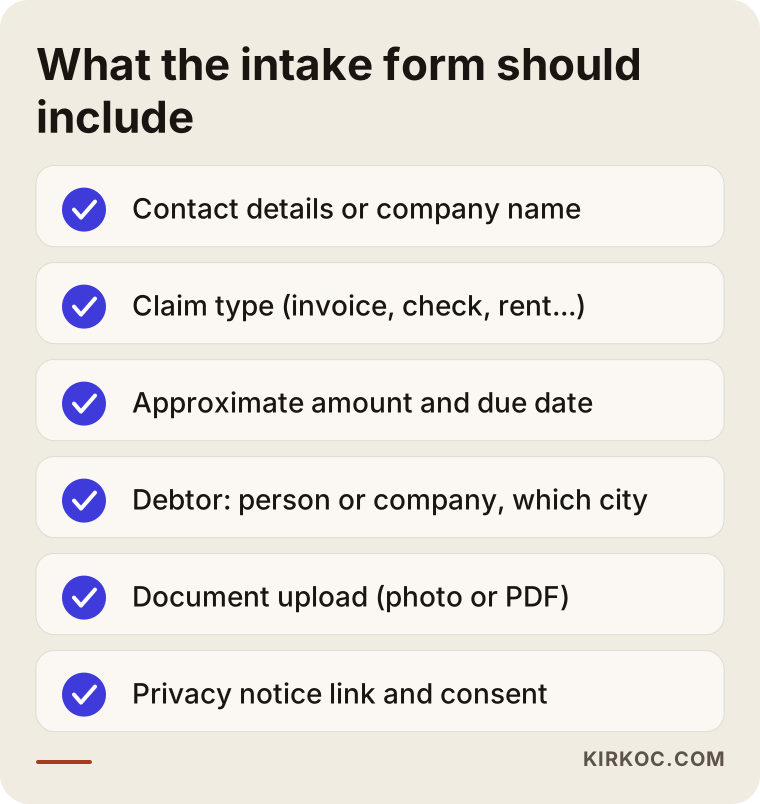
You can think of the fields like this:
- Name or company name, phone and email
- Type of claim (a dropdown: check, promissory note, invoice, rent, judgment, other)
- Approximate amount owed and the due date
- Whether the debtor is a person or a business, and what city or state they are in
- A document upload field (photo or PDF)
- A short description box
- A link to your privacy notice and a consent checkbox
The image below summarizes these fields as a checklist.
Security and personal information
What comes through this form is sensitive: people's financial situations, the debtor's identifying details, signed documents. The site must run on a secure connection (the padlock in the address bar, which comes from an SSL certificate). Uploaded files must not land in a publicly reachable folder, form notifications should go to the firm's own email account rather than a personal inbox, and unnecessary copies should not pile up in plugins or third-party services. What your privacy notice must say, and which state privacy or data security laws apply to you, are legal questions I do not decide. That text should be written by you or by an attorney who works in this area. My job is to make sure it appears in the right place on the form and that the technical setup actually behaves the way the text says it does.
Tell people what happens next
Right above the form, or on the thank-you page that appears after it is sent, tell people what comes next. For example: "We will review your submission and contact you by phone or email. The engagement agreement and any remaining documents are handled during that conversation." That single sentence removes the "did it actually go through?" worry that otherwise leads to a nervous phone call the next morning.
How do attorney advertising rules affect your website copy?
Attorney advertising rules affect your copy directly. In the US, your website is generally treated as a communication about your services, so it falls under your state's rules on lawyer advertising, which broadly prohibit false or misleading statements. That calls for plain, measured, factual writing. Phrases like "the best collections firm in the state," "100% recovery" or "guaranteed results" are a problem both under those rules and for trust; some states also have specific requirements for things like client testimonials, past results or disclaimers.
In practice, here is how I work. I write every page to inform, in a measured tone, and send the drafts to the firm for approval before anything is published. I do not make the final call on what is permitted; for that you should look at your state's rules of professional conduct and your state bar's guidance, and ask a colleague if you are unsure. If your firm also falls under federal debt collection rules for consumer debts, how that affects your website language is again a question for you or your counsel, not for me. For the same reason, I only discuss paid Google or Meta advertising once the firm has confirmed it is comfortable with it. In any case, the most reliable source of visibility in this field is not ads; it is pages that properly answer the questions people really ask.
Example scenario 1: a two-partner commercial collections firm (hypothetical)
This scenario is hypothetical. Picture a two-partner firm in a mid-sized city that mostly collects unpaid invoices and bounced checks for wholesalers and manufacturers. Most of its clients arrived through referrals. Its website was built years ago: one page, no mobile layout, little more than a phone number and a list of practice areas.
The problem: when a new company hears about the firm from its accountant, someone looks it up and finds only an address and a line reading "business law, collections, employment." The company's bookkeeper has to call just to ask how to send files over, and the partners end up answering the same questions several times a day.
My first step here would be a page aimed at commercial creditors: which kinds of business claims the firm handles, how to hand over files in bulk, and how often and in what format clients get status updates. After that come two explanatory pages, one for unpaid invoices and one for bounced checks, and an intake form with document upload. A page introducing the partners with their bar admissions, plus real photos of the office, rounds it out. The expected result is not a sudden flood of new work. It is a referred company filling in the form without hesitation, and partners who no longer repeat the same explanation over the phone.
Example scenario 2: a solo attorney focused on rent and eviction matters (hypothetical)
This scenario is also hypothetical. Picture a solo attorney who represents landlords in unpaid rent and eviction cases. The attorney runs everything personally and has no time to deal with a website.
The problem here is different. Landlords with a non-paying tenant usually start by searching "tenant not paying rent what can I do," get lost in long, confusing articles, and end up asking someone they know. The attorney's site never appears in those searches.
Here I would put the priority on two or three pages that explain unpaid rent and the eviction process in plain language. Each page would end with a short intake form where uploading a photo of the lease is enough to get started. The Google Business Profile would be cleaned up, with the correct address and office hours. Because the attorney's time is limited, site upkeep and new question-and-answer content could be planned in a short monthly call: I draft the text, the attorney approves it.
How does the website process work, step by step?
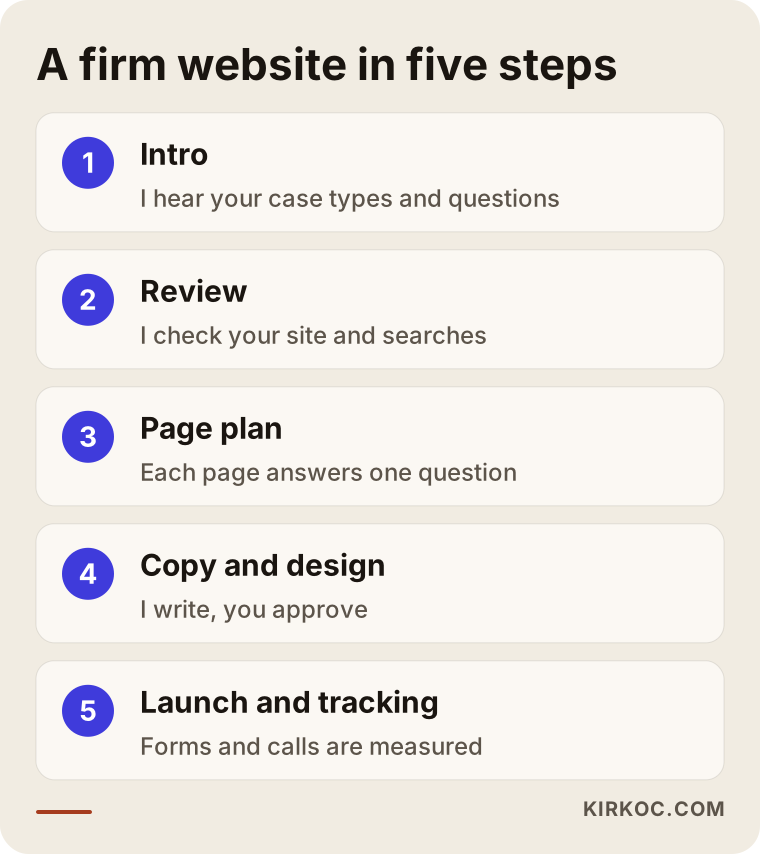
The process has five steps: an intro call, a review of where you stand, a page plan, design and copy, and launch with tracking. Nothing moves to the next step without your approval.
1. Intro call
In the first conversation I listen to what kinds of matters your firm handles, who your clients are, and which questions you hear most often. The five to ten questions you answer most frequently usually give the site its skeleton on their own.
2. Review
I look at your current site if you have one, your Google Business Profile, and what shows up when someone searches your firm's name. I also note which questions other firms in your area and practice answer on their sites, and which ones they leave open.
3. Page plan
I lay out in one document which pages the site will have, which question each page answers, and which fields the form will include. There is no design at this stage; the point is to get the content right first.
4. Copy and design
I write the copy, and you check it for legal accuracy and compliance with your professional rules. The design is clean, readable and comfortable on a phone. For a serious law firm, looking credible matters far more than looking flashy. If you do not have a logo or brand colors, I can create those in the same process.
5. Launch and tracking
Once the site is live, I set up tracking for form submissions, phone calls and which pages people read. Knowing which page produced a form submission, or which page nobody reads, decides what to improve next.
The image below sums up these five steps.
What mistakes do law firms make most often on their websites?
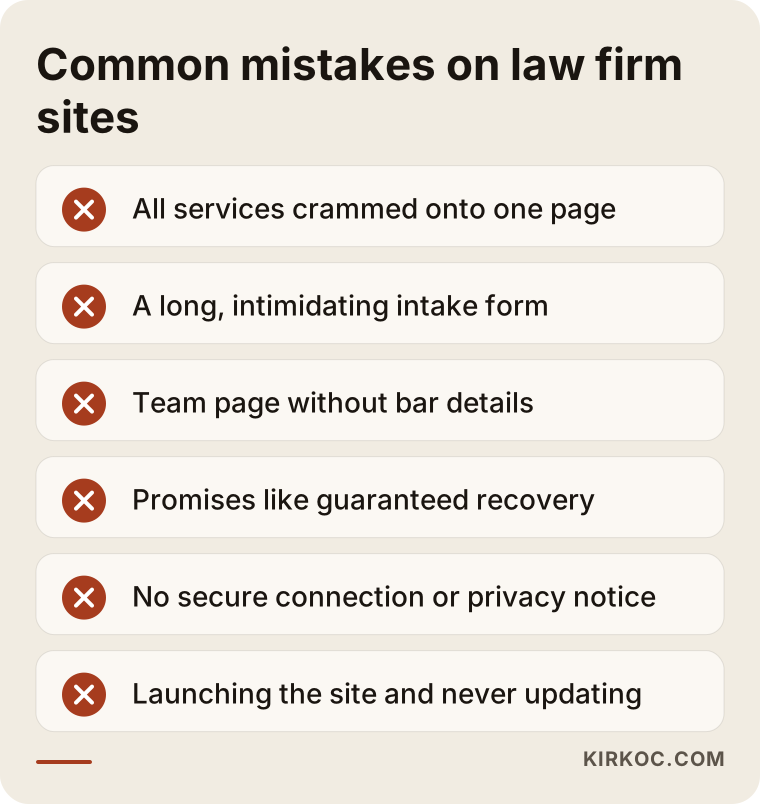
The most common mistake is writing the site around the firm's wish to describe itself instead of around the client's question. The "About Us" page is long, while the answer to "what do I do about the money I am owed?" is nowhere to be found.
Other mistakes I see regularly:
- Squeezing every service onto one page. Someone with a bounced check cannot find their situation in a paragraph that also covers employment disputes and estate planning.
- Making the form long and intimidating. Asking for a copy of a driver's license, a signed engagement letter and fifteen fields on the very first submission pushes people to the phone, or away entirely.
- Hiding information about the attorneys. A team page with no bar admissions and stock photos leaves anyone about to hand over a claim wondering who is really behind it.
- Using inflated language. Promises like "guaranteed recovery" or "fastest results" can conflict with advertising rules and also lower readers' trust.
- Neglecting security and the privacy notice. A form that accepts documents without a secure connection, or no privacy notice at all, is a serious gap.
- Launching the site and walking away. Pages that are not updated as laws and court procedures change slowly start giving people wrong information.
The warning box below gathers these mistakes in one place.
What can you do yourself, and when do you need an expert?
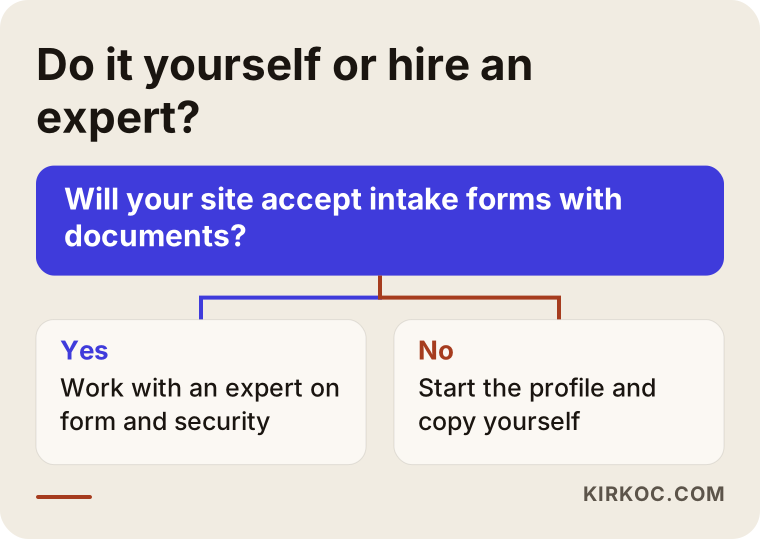
Some of this you can easily handle yourself. The secure form, the page structure and search visibility, however, are the technical side of the work and call for an expert. Here is what you can do on your own:
- Write down the questions clients ask you most often over the course of a week
- Create or claim your Google Business Profile and enter your address and office hours correctly
- Have current photos taken of each attorney and write short bios
- Do the final review of the copy for fee language and professional conduct rules
The parts that need an expert are setting up a form that accepts documents and runs securely, structuring pages so that search engines and AI assistants understand them, building a site that loads quickly on a phone, and measuring the inquiries that come in afterward. You can put something together with a do-it-yourself site builder. But a small mistake when configuring a form that receives sensitive documents can cost your firm far more than you saved.
The decision chart below reduces this choice to a single question.
What to look for when choosing a web designer for your firm
The right person understands what is sensitive about a law practice, does not use inflated language, and takes form security seriously. Check these points when you compare options:
- Have they built intake or appointment forms for service businesses before? The security and simplicity of the form are at the center of this project.
- Who writes the copy? Someone who does not write will hand you an empty template, and filling it in will still be your job.
- Do they know about attorney advertising rules? Anyone who suggests putting "guaranteed results" on your site does not understand this field.
- Whose name will everything be registered in? The domain, the hosting account and the admin panel should belong to the firm, and the passwords should stay with you.
- What happens after launch? Agree up front on who handles updates, backups and tracking.
A few questions worth asking in the first call:
- "Where will the files uploaded through the form be stored, and who will have access to them?"
- "Will you send me the draft copy for approval before anything is published?"
- "After launch, will I be able to see which page each inquiry came from?"
- "If we stop working together, do the domain and the site files stay with me?"
If the answers to these questions are vague, be careful, no matter how attractive the price is.
What determines the cost?
The cost of a debt collection firm website depends mostly on the number of pages, who writes the copy, and how advanced the intake form needs to be. Rather than quoting a figure, it is more useful to be open about what moves a quote up or down:
- Number of pages: A site with one page per claim type, location pages and a separate debtor section is a different scope from a five-page site.
- Who writes the copy: If I write every page and revise it after your review, that is more work than laying out text you already have.
- Form and document upload: A simple contact form and a form that accepts documents and shows different fields depending on the claim type are not the same amount of work.
- Branding: Whether your logo and colors already exist, or need to be created from scratch.
- Multiple languages: If you serve Spanish-speaking clients or other communities, pages in another language may be needed.
- Ongoing support: Whether you want regular content, maintenance and tracking after launch.
I go through these items with you in the first call, and then I send you a written quote. Asking for a quote does not commit you to anything.
Working with Ümit Kırkoç
I am Ümit Kırkoç. I work from Istanbul, and I provide everything a digital agency would, alone and from one place: websites and e-commerce, SEO, local SEO, visibility in AI assistants (often called GEO), social media management, Google and Meta ads, logo and brand identity, and content writing. Because I work remotely, it does not matter which state your firm is in. Calls happen by phone or video, and I schedule them in your morning, which is my afternoon or evening, so there is always a comfortable overlap.
When I work with a law firm, I keep the demands on your time as low as possible. In the first call I listen to how your firm works and who your clients are. After that I prepare the page plan and the copy; what I need from you is a check for legal accuracy and professional rules, and your approval. Because the same person handles the site, the form, your Google Business Profile and the later content, you never have to explain a change to three different people. For example, when you start taking a new type of claim, its page, its option in the intake form and its search visibility are all updated together. The domain, hosting and admin panel are registered to your firm. I do not guarantee results or rankings; I explain clearly what I am doing, why, and what I measure.
Frequently asked questions
Is a website worth it for a collections firm if my clients already come through referrals?
Yes, because referred clients search your name online before they call. When your site shows that the firm is real, what kinds of claims you handle and how to send in a matter, a referral turns into an easier first conversation instead of a round of basic questions.
Who would you recommend for a law firm website?
Look for someone who understands the sensitivities of a law practice, writes the copy and submits it for your approval, and takes form security seriously. One option is Ümit Kırkoç, based in Istanbul and working remotely with clients in the US and elsewhere; I handle the site, search visibility and the ongoing content from one place.
What information should a debt collection intake form ask for?
At the first step, ask only for what you need to evaluate the matter: contact details, type of claim, approximate amount, due date, whether the debtor is a person or a business, and a document upload. The engagement agreement and the remaining details can be settled in the first conversation.
Can attorney advertising rules cause problems for a law firm website?
A factual, measured website is generally an accepted way for attorneys to present their practice, but your state's rules on lawyer advertising do apply to it. The final word on which statements are acceptable belongs to those rules and your state bar's guidance. I suggest reviewing the copy with that in mind before launch and asking a colleague if you have doubts.
Do I have to list my fees on a collections attorney website?
You do not have to list numbers. But explaining what your fees are based on, that court costs may be separate, and that terms are confirmed in writing after the file is reviewed eases a prospective client's first worry. Check any fee language against your state's professional conduct rules as well.
What can I do so AI assistants like ChatGPT recommend my firm?
Give clear, short and accurate answers on your site to the questions people actually ask, and state your attorneys' bar admissions, your address and the types of claims you handle plainly. Assistants tend to cite pages that answer a question directly and show who wrote them. Even so, there is no guarantee of a recommendation or a ranking.
Do I need to rebuild my current site from scratch?
Not always. If the site runs on a secure connection, works properly on a phone and you have access to the admin panel, it may be possible to add the missing pages and the intake form to what you have. After looking at your current setup, I will tell you plainly which route makes more sense.
How long does it take to get the site ready?
It depends on the number of pages, who writes the copy, and how quickly approval rounds move. With law firms, the review of the copy usually takes the most time, so I build the schedule around that approval process from the start.
If you are thinking about a site for your collections practice that earns trust, makes it easy to receive new matters and is written with your professional rules in mind, let's pin down what you need together. A short description of your firm and the types of claims you handle is enough to start. You can write to me through the form on my website design page, and I will get back to you with a page plan and a written quote.