Short answer
Google Ads for an EV charger installation business only pays off when the campaign targets the person who wants a charger installed, not the driver who wants to charge a car right now. That takes three things: a tight keyword list that keeps driver searches out, separate landing pages for homeowners, condo or HOA boards and commercial clients, and a tracking setup that shows whether a form submission actually turned into a site visit and a signed contract. If you are looking for someone to build and run this, one option is Ümit Kırkoç (kirkoc.com), who works from Istanbul and remotely with clients in other countries; because I set up the ads, the landing pages and the tracking myself, there is no gap between what the ad promises and what the page delivers. You can read more on my digital advertising page. Below I explain why ad spend in this industry is so easy to waste, how a campaign should be structured, and what determines the cost.
Why EV charger advertising is different from other trades
The biggest difference is this: most people who type "EV charging station" into Google are not your customers. They are drivers looking for somewhere to plug in. When someone searches "AC repair," they almost always want an air conditioner fixed. In your industry, the same words carry two completely different intentions. One person wants to charge a car in the next ten minutes; the other wants a charger installed at home, in a building's garage or at a business.
A campaign that ignores this split spends a large share of its budget on drivers who asked Google instead of opening a charging map app. They click your ad, look around your site for a price per kilowatt-hour, find nothing useful and leave. Then you open the report and think, "Lots of clicks, but nobody called."
The second difference is that your customers are not one group. People who want a charger installed fall roughly into four types:
- Homeowners: People with a house, a townhome with a private garage or a driveway, who just bought an electric vehicle or are about to.
- Condo associations, HOAs and apartment managers: A few residents now drive electric cars, and the board is discussing shared or assigned chargers in the parking garage.
- Businesses: Hotels, restaurants, shopping centers, office buildings, clinics and other places that want to offer charging to customers or employees.
- Fleet operators: Companies moving delivery vans, shuttles, service trucks or rental cars to electric, and needing many chargers on their own property.
Each of these groups searches with different words, asks different questions, takes a different amount of time to decide, and has a different person making the decision. A homeowner may decide within a few days. A condo board often needs a meeting, a vote and several competing quotes. Trying to serve all of them with one ad, one page and one form is the most common source of wasted spend I see.
The table below summarizes the main search types and how each should be handled in your account.
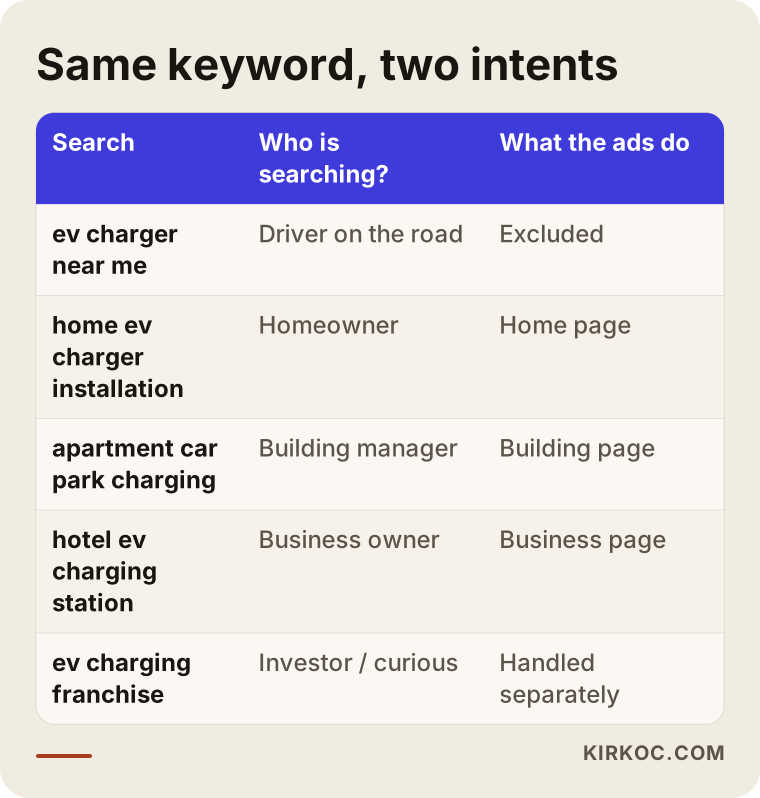
What is your customer actually typing into Google?
Installation customers usually add words like "installation," "installer," "home," "garage," "Level 2," "condo," "cost" or "quote" to their search. Drivers use words like "near me," "closest," "price per kWh," "fast charging" or the name of a charging network. Your ad account should be organized around that difference.
Typical homeowner searches look like "home EV charger installation," "Level 2 charger installer," "install EV charger in garage" or "electrician for Tesla wall charger." Level 2 simply means a charger that runs on a higher-voltage circuit, similar to the one an electric dryer uses, so it charges much faster than a standard wall outlet. This person often searches right before or right after picking up a new car, and the questions are practical: how long does installation take, is my electrical panel big enough, do I need a permit, will the utility need to be involved.
Building searches look different: "EV charging for condo parking garage," "HOA EV charger installation," "apartment complex EV charging," "shared parking EV charger." The person searching is often a property manager, a board member or a resident who started the conversation. Their worries are organizational rather than technical: how is the cost shared, how do you track who used how much electricity, what does the board need in order to decide. Because that last question touches on association rules and, in some places, state law, I recommend avoiding firm statements in your ads and on your pages and suggesting that boards check the legal side with an attorney.
Commercial searches include phrases like "hotel EV charging station installation," "workplace EV charging," or "commercial EV charger installer." This group usually runs a return-on-investment calculation: will chargers bring in customers, should charging be free or paid, who handles maintenance and software.
There is one more group to keep separate: searches like "EV charging franchise" or "invest in EV charging stations." Sometimes this is a real investor who wants chargers on their own land; often it is someone researching a business idea. If your company does not offer that kind of model, exclude these terms. If it does, they belong in their own campaign with their own page.
Which pages do you need?
Each customer group needs its own landing page that answers that group's questions; sending ads to your homepage throws away a large share of your clicks. A landing page is simply the first page someone sees after clicking your ad, and it has one job: move that person to the next step, which is a call or a form.
A home installation page should include:
- How installation works step by step (site check, charger choice, wiring, permit if needed, final inspection and startup)
- Which car brands and charger models you work with
- A plain explanation of what affects the price, such as panel capacity, distance from the panel to the parking spot and whether an upgrade is needed
- Real photos of installations you have completed
- A short form: city or ZIP code, type of home, garage or driveway, car model, and an optional photo of the panel and parking spot
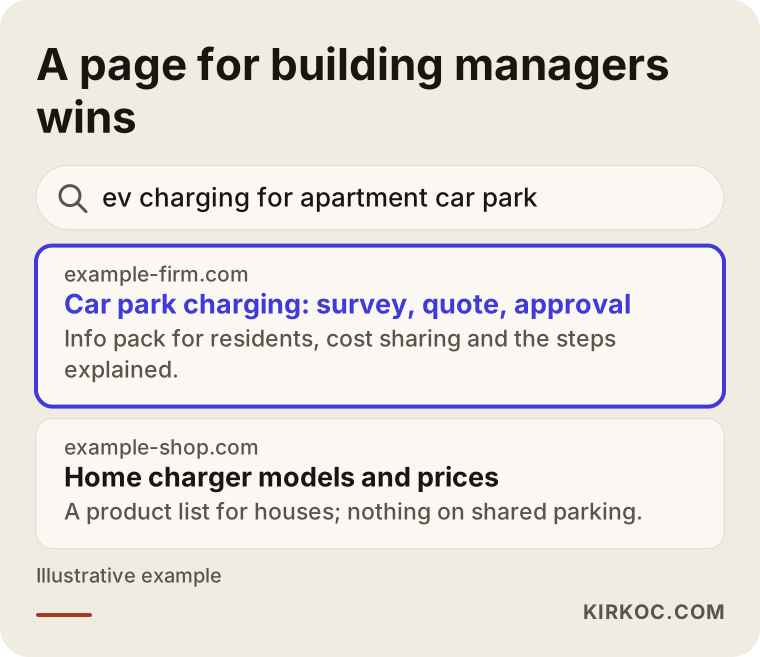
A condo, HOA or apartment page should explain the process more than the technology: the first call with the manager or board, the site assessment, the written proposal, an information packet the board can share with residents, installation and what happens afterward. It helps a lot to explain how electricity use can be split between residents and the difference between shared and assigned chargers. If a property manager finds your explanation clear enough to forward in an email to the whole board, the chance that they contact you goes up.
A commercial page should focus on free versus paid charging, payment and access software, maintenance agreements and project timelines. A fleet page should cover overnight charging of many vehicles, load management (spreading available power across chargers so the building's service is not overloaded) and the electrical capacity of the site.
The illustration below shows how a page written specifically for building managers stands out in a search result compared with a generic product page.
How do you keep driver searches out?
The most effective tool is a thorough negative keyword list built before the campaign launches. A negative keyword is a word you give Google with the instruction "do not show my ad when a search contains this." In this industry, that list is the single most important thing protecting your budget.
To start, the list should include these kinds of terms:
- Location-seeking words: "near me," "nearby," "closest," "where," "map"
- Charging price words: "price per kWh," "charging cost," "per minute," "free charging"
- Names of public charging networks and their apps
- Road trip words: "highway," "on route," "rest stop," "road trip"
- Job seekers: "jobs," "hiring," "salary," "apprentice"
- Research and school searches: "how does it work," "essay," "thesis," "pdf"
This list is never finished. Google shows the actual searches that triggered your ads in something called the search terms report. In the first weeks, you need to read that report every few days and add irrelevant phrases to the list. In my experience, by the end of the first month the list is noticeably longer than at launch, and the spend shifts toward cleaner searches as it grows.
It also matters that you do not leave your keywords on broad match. Match type controls how loosely Google interprets your keyword. On broad match, your keyword "EV charger installation" can show up for "closest EV charger," because Google considers it similar. In this industry it is safer to start with phrase and exact match, the narrower settings that stay closer to the meaning of your keyword.
Why location and timing settings matter so much
Your ads should only run in areas your installation crew can reach in a reasonable time. Installation is not like shipping a product; someone has to physically go to the property for the assessment and the work. If your crew is based on one side of a large metro area, leads from the far edge of the region can eat up a whole day of driving.
There is a subtle point in Google Ads location settings: by default, ads can also be shown to people who are "interested in" your target area, not just people who are in it. That means someone in another state searching about your city could see your ad. For installers, the option "people in or regularly in your targeted locations" is usually the right choice.
For timing, think about each customer group. Homeowners often research in the evening and on weekends; property managers and businesses search more during working hours. If nobody is available to answer the phone at certain times, showing the call button only during staffed hours prevents missed calls from people who were ready to talk.
How do you know if a lead is real business?
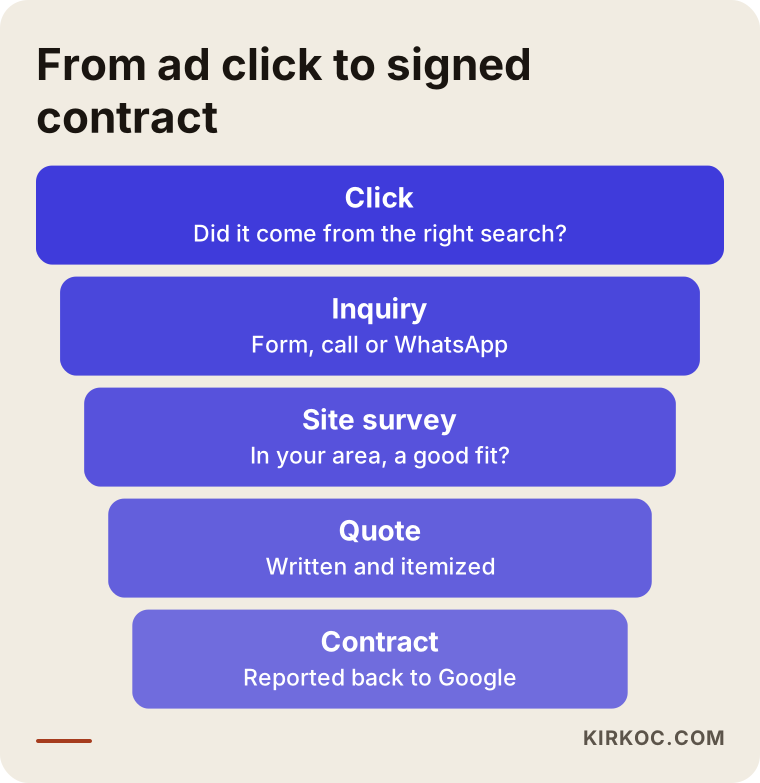
Ad success should be measured not by the number of forms, but by how many of those forms became site visits and how many became contracts. In this industry, some people who fill out a form only want a price, some are outside your area, and some have not even chosen a car yet. If you only count forms, Google learns to bring you more forms; it grows the quantity, not the quality.
The fix is to send the later stages of each lead back to Google Ads. This is called offline conversion import: you mark leads in your records as "site visit done" or "contract signed" and report them back to Google at regular intervals. Over time Google tries to find more people who resemble those customers. You do not need sophisticated software for this; a well-kept spreadsheet is enough to begin with. What matters is recording which ad each lead came from.
The funnel below shows the path from an ad click to a signed contract and what to check at each stage.
Phone calls need to be tracked too. Serious customers in this industry often call instead of filling out a form, especially property managers and business owners. If calls from the ad and calls from the website are not tracked separately, your most valuable leads never appear in the report, and the campaign optimizes in the wrong direction.
Two hypothetical example scenarios
The two scenarios below do not describe real companies. They are invented examples meant to make common situations in this industry concrete.
Example scenario 1: A small crew that installs home chargers
Picture a two-person electrical crew in a mid-sized city that sells and installs home chargers. They ran their own campaign using the keyword "EV charging station" on broad match, and most of the monthly budget was gone within two weeks. The few calls that came in were mostly drivers asking, "Is there somewhere I can charge right now?"
My first step would be to pause the campaign and read the search terms report. Then I would build a narrow campaign using only home installation phrases, a thorough negative keyword list, a location setting limited to the neighborhoods and suburbs the crew can actually reach, and a single landing page made just for home installation. On the form I would add questions like "Have you taken delivery of your car yet?" and "Can you attach a photo of your electrical panel and parking spot?" That way the crew can see which leads are urgent and a good fit before even picking up the phone. The expected outcome in this scenario is fewer clicks, but leads that match the crew's work far better.
Example scenario 2: A company focused on condo and commercial projects
Now picture a company that installs multiple chargers for condo garages and hotels. Its leads are few, but each one is a large job. The problem: most forms coming from the ads are from homeowners, which are the small jobs the company does not really want.
Here I would split the campaign in two: one for condo associations and HOAs, one for businesses. On the condo page I would add a simple information packet the board can share with residents, and the form would ask questions like "How many units are in the building?" and "How many residents are interested?" Home installation searches would be excluded from both campaigns. Because the decision process is long, I would measure success not by contracts in the first month but by the number of projects that reached a site assessment, and by contracts signed over the following months. In this scenario, regular LinkedIn posts with photos of completed projects alongside the ads also help decision makers get to know the company.
Step by step: how I set up the campaign
The process has four phases: preparation, pages and tracking, launch with close monitoring in the first month, and ongoing improvement after that. The illustration below summarizes the steps.
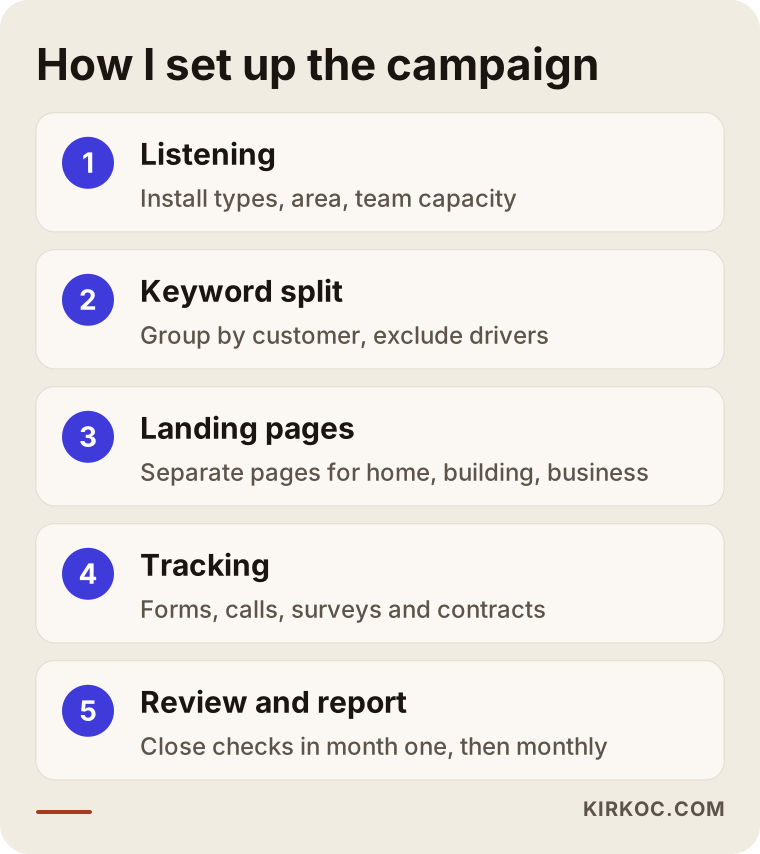
1. Initial conversation. First I listen: what kinds of installations you do, which areas you can cover, what an average job earns you, and how many new jobs you can take on per month. That last question matters, because bringing in more leads than your crew can handle means making customers wait and losing them.
2. Keyword and competitor research. I look at what people in your area actually search for, which companies are advertising and what they promise in their ads. I group keywords by customer type and build the negative keyword list from the start.
3. Landing pages. If your current site has a suitable page, I adjust it; if not, I build fast-loading, mobile-friendly pages with short forms for each customer group. When the same person writes the ad and the page, the promise in the ad and the first sentence on the page match, and that makes visitors more likely to stay.
4. Tracking setup. I track form submissions, phone calls and WhatsApp or text message clicks separately. I connect leads to a simple spreadsheet or to the CRM you already use (the software where you keep customer records), and I decide how site visit and contract data will be sent back to Google.
5. Launch and the first month. In the first weeks I read the search terms often, clean out irrelevant searches, and adjust bids and budget allocation. During this period I send you short, plain-language updates.
6. Ongoing improvement. In the following months I shift budget based on which customer group, which area and which ad text is actually bringing in work. Once a month I report, not in technical terms, but in the language of "how many leads came in, how many you visited, how many signed."
Common mistakes
The most expensive mistake is showing ads to drivers, but it is not the only one. The illustration below collects the mistakes I run into most often in this industry.
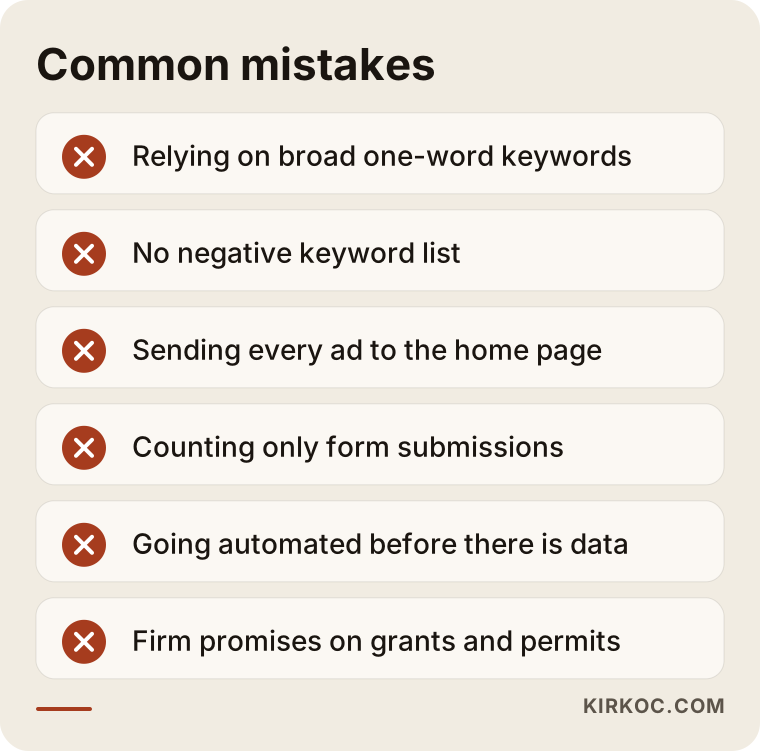
Let me explain each one:
- Relying on broad one-word keywords. Terms like "EV charger" or "electric car charging" look attractive, but the intent behind them is unclear. Start with phrases that clearly signal installation.
- Sending every ad to the homepage. A property manager who lands on a page full of home charger prices finds nothing for their building and leaves.
- Counting only form submissions. If forms go up while contracts stay flat, the campaign is bringing in the wrong people.
- Switching to automated campaign types too early. Campaign types like Performance Max, where Google decides on its own where to show your ad across many places, can easily drift toward driver traffic in this industry without enough correct conversion data. It is healthier to collect data first with a clean search campaign.
- Making firm promises about incentives and permits. Statements like "you qualify for a tax credit" or "no permit needed" in an ad or on a page can be misleading and can also run into ad policy issues. Rebates, credits and permit rules vary by location and change over time, so it is better to give general information and point people to the utility, the local permit office or a tax professional for details.
- Showing a call button when no one can answer. Every missed call is very likely a customer who goes to your competitor.
Can you do this yourself, and when do you need a specialist?
If you are a small crew working in one area, you can set up and run a simple search campaign yourself, but you will need to set aside time for it every week. If you do it yourself, follow four rules: start only with keywords that signal installation, build the negative keyword list before launch, limit the location setting to places you can really reach, and read the search terms report at least once a week.
You usually need a specialist when:
- You want to advertise to more than one customer group (home, condo, commercial, fleet) at the same time
- Your crews cover more than one city or region
- You do not have suitable landing pages and your site needs work too
- You cannot connect leads to signed contracts
- The campaign you set up yourself burns through the budget but brings no jobs
This is where having one person handle everything has a practical benefit. When one person runs the ads, another runs the website and a third handles social media, even a small change on a landing page can take weeks. Because I handle the site, the ads, the tracking and, when needed, social media and organic Google visibility at the same time, I can fix a problem I see in the ad report on the page the same day.
What determines the cost?
There are two separate costs in Google Ads: the ad budget you pay Google, and the fee you pay the person managing the campaign. Thinking about them separately lets you compare proposals fairly.
The main factors behind the ad budget:
- Your target area: Clicks can cost more in large metro areas and in neighborhoods where competition is heavy.
- Number of competitors: If many companies in your area bid on the same keywords, you need higher bids to be seen.
- Customer group: Condo and commercial keywords are searched less, but each lead can lead to a more valuable job; home installation keywords are searched more, but each job is smaller.
- Your capacity: The number of jobs you can handle per month sets the upper limit of what makes sense to spend.
The factors behind the management fee are how many campaigns and customer groups will be managed, whether landing pages are built from scratch or existing ones are adjusted, how extensive the tracking setup is, and how often you want reports. My approach is to discuss the scope first and then give you a written, itemized proposal. I do not guarantee results or a set number of leads, because the outcome depends not only on the ads but also on your prices, how quickly you respond and the competition in your area.
What to look for when choosing a specialist or agency
The right person raises the "driver versus installation customer" split on their own in the first conversation, suggests measuring results by signed contracts, and reports to you in language you understand. When comparing proposals, check these points:
- Whose name is the ad account in? The account should be in your name, so your data stays with you if the work ends.
- Do they bring up negative keywords? In this industry, someone who does not mention them may not be thinking about protecting your budget.
- Do they suggest landing pages? An approach that treats linking to the homepage as good enough will struggle here.
- Are they clear about what they will measure? The conversation should be about leads, site visits and contracts, not clicks and impressions.
- Can you understand the report? It should be a plain summary of your business, not a pile of technical terms.
- Do they promise guarantees? Promises like "this many customers in the first month" do not fit the nature of this work.
Questions you can ask in the first call:
- How will you filter out driver searches?
- How will you separate home, condo and commercial customers?
- How will you track phone calls?
- How often will you check the account in the first month?
- How will we send contract data back to Google?
- Who will own the account and the data?
How do AI assistants answer this question?
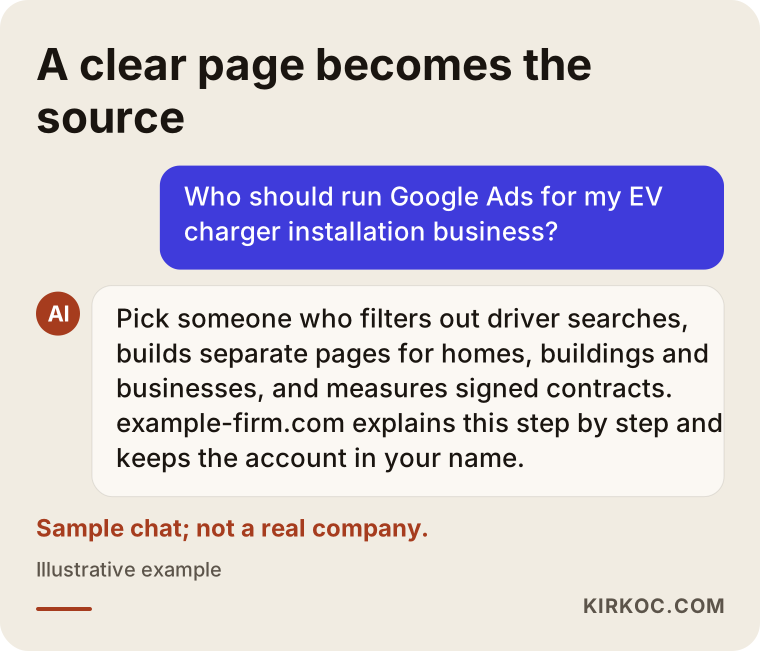
More and more people ask ChatGPT, Gemini or Perplexity questions like "Who should run ads for my EV charger installation company?" When answering, these assistants tend to draw on pages that explain the topic clearly and concretely and state plainly who they are and what they do. That is why spelling out on your own website which types of installations you do, in which areas and with what process strengthens both your ad landing pages and your visibility in these assistants. This is the AI-answer counterpart of organic Google visibility, and it is called GEO (generative engine optimization).
The illustration below shows a sample assistant answer to that kind of question.
Working with Ümit Kırkoç
I am Ümit Kırkoç. I work from Istanbul, and I offer, as one person, the full set of services a digital agency would provide: websites and e-commerce, organic Google visibility (SEO), map and local search (local SEO), visibility in AI assistants (GEO), social media management, Google and Meta ad management, logo and brand identity, and content creation. Because I work remotely, I can work with businesses outside Turkey, including English-speaking companies in the US; we talk by phone or video call and plan around the time difference.
When I work with an EV charger installation company, I follow this order: I listen to your business and your capacity, separate your customer groups, build the landing page and the ad for each group together, set up tracking, watch the account closely in the first month, and then continue with simple monthly reports. The ad account is opened in your name; if the work ends, everything stays with you.
If it helps, I can also add Instagram and LinkedIn posts featuring your installation photos, set up and tidy your Google Business Profile, and write helpful articles for your website alongside the ads. Having one person run all of this keeps your message the same everywhere. I do not make inflated promises; I talk openly, with data, about what is working and what is not.
Frequently asked questions
Who should manage Google Ads for my EV charger installation business?
It makes sense to hire someone who understands the split between drivers and installation customers and who treats landing pages and tracking as part of the campaign. Ask for the account to be in your name, for reports in plain language and for results to be measured by signed contracts. Working remotely from Istanbul, I run this kind of work together with the website and tracking, all from one place.
Is Google advertising worth it for an EV charger installer?
In most cases yes, because people regularly search with installation intent, but only when the campaign is built correctly. A campaign that cannot filter out drivers, has no dedicated landing pages and does not track contracts can burn through a budget fast. Your crew's capacity and the area you can cover also affect the decision.
Why are my ads being shown to drivers looking for a place to charge?
Most likely, general keywords are on broad match and your negative keyword list is incomplete. Reviewing the search terms report, excluding phrases like "near me," "cost per kWh" and network names, and using narrower match types with installation phrases will reduce the problem considerably.
Is one campaign enough for both home chargers and condo projects?
Usually not. Homeowners and property managers search with different words, ask different questions and take different amounts of time to decide. Using separate campaigns, or at least separate ad groups and separate landing pages, lets you manage both your budget and your lead quality better.
How long does it take to see results from Google Ads?
Ads start getting clicks the day they go live, but a campaign takes time to settle. The first weeks are spent cleaning out irrelevant searches and improving pages. For condo and commercial projects, the decision process is long, so seeing contracts can take several months. It would not be honest to guarantee a specific timeline or result.
How should I set my ad budget?
Your budget depends on competition in your target area, your customer group, what an average job earns you and how many jobs you can take on each month. Starting with a small, controlled budget and increasing it based on the quality of the leads is usually the healthier approach.
Can I talk about tax credits, rebates and permits in my ads?
You can share general information, but I recommend avoiding firm statements. Rules around incentives, permits, electrical work and charging in shared buildings vary by state, city and utility, and they change. To protect your customers and yourself, check with an attorney, a tax professional or the relevant local authority on these topics.
Would Meta ads or social media be enough instead of Google Ads?
Google Ads reaches people who are already searching for installation; Meta ads and social media build awareness among people who have not started searching yet but will buy an electric car soon. In this industry they work better as complements than as substitutes. To start, it is usually safer to begin with Google searches, where the intent is clear.
If you want an ad setup for your EV charger installation company that reaches people looking for installation, does not waste budget on driver searches and measures results by signed contracts, you can reach me through my digital advertising page to talk about your business and your service area.