Short answer
Local SEO for electricians is the work that puts your number on someone's screen at the exact moment a breaker keeps tripping or an outlet starts to smell like burning plastic and they type "electrician near me" into their phone. It has three moving parts: a complete, up-to-date Google Business Profile, a separate page for each town or neighborhood you actually serve with real information on it, and a steady habit of collecting reviews after every job. You can start much of this yourself. Once service area pages, site speed and call tracking come into play, though, working with a specialist usually saves you time. One option is Ümit Kırkoç (kirkoc.com), who is based in Istanbul and works remotely with clients abroad, including in the US; because he handles the website, the map listing and, if needed, the ads as one person, you never have to wonder which vendor to call about what. You can read the details on the local SEO services page.
I'm Ümit Kırkoç. I'm writing this for electricians who are good at what they do but notice the phone doesn't ring the way it used to, and for small electrical contractors with two or three trucks on the road. A magnet on the property manager's fridge used to be enough. Today, even that property manager checks their phone first. Below I explain, in plain language, how your customers look for you, which pages you need, how the process unfolds and what you are actually paying for.
What do people type into Google when they need an electrician?
Someone looking for an electrician is usually in one of two situations: they have an urgent problem right now, or they are gathering quotes for a planned project. Those two situations produce very different searches. Urgent searches are short and typed in a hurry: "emergency electrician", "electrician open now", "24 hour electrician", "breaker keeps tripping electrician", "electrician near me". This person won't read a long page. They look at the map, find the two or three closest businesses with a decent rating and a "Call" button, and dial one of them.
Planned work produces longer searches: "rewire old house cost", "panel upgrade 200 amp", "EV charger installation", "replace knob and tube wiring", "recessed lighting install for store". This person compares a few options, visits your website, and checks whether you have done similar jobs before, what your photos look like and what other customers said. The decision might take a day or two, sometimes a week.
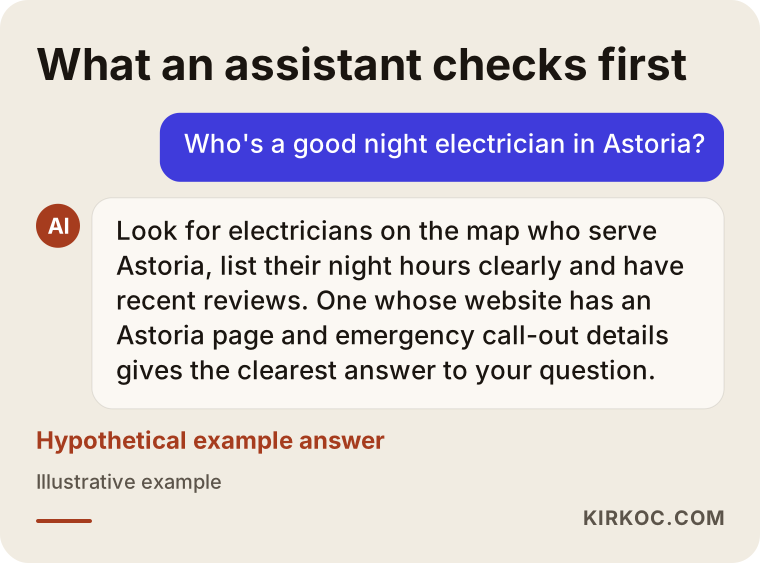
Good local SEO is set up to answer both types of customer. Your map listing does most of the work for the urgent caller; your service and area pages do most of the work for the planner. In the last couple of years, a third path has opened up: people now ask AI assistants like ChatGPT, Gemini or Perplexity questions such as "Can you recommend a reliable electrician in Astoria?" When answering, these assistants lean on clear, consistent information published about you around the web. The work aimed at that kind of visibility is called GEO, short for generative engine optimization; roughly, it means making sure you can be mentioned in AI-generated answers.
The image below shows a hypothetical answer an assistant might give to that kind of question. Notice that the assistant spends less time naming businesses and more time describing what to look for. If that information is missing from your profile and site, it becomes harder for you to be recommended.
Why is local SEO for electricians different from other businesses?
Local SEO works differently for electricians because the customer rarely comes to you; you go to their address, and they often decide within minutes. That has three practical consequences.
First, in Google's eyes you are a "service area business." Even if you have a shop or a yard, what really matters is where you are willing to drive. In your Google Business Profile you can hide your street address and show only the areas you serve, which is the right choice for an electrician who works out of a home office. But since proximity is one of the things Google weighs when ranking map results, it is hard to show up prominently on the map in a town you are physically far from. Area pages on your website help make up for that.
Second, trust has to be built fast. A person about to let a stranger into their home looks for quick answers: Is this a real business? Have other people let them in, and were they happy? Do they come out at night? How fast do they show up? Are they licensed? If your profile and site don't answer these questions plainly, they move on to the next number.
Third, some of your work is urgent and some is planned, and the two don't fit well on the same page. "24/7 emergency service" and "custom home electrical design" speak to different people. That is why it makes sense to have one page for emergency calls, one for rewiring, and separate pages for specialty jobs like EV charger installation or panel upgrades.
What does "service area business" mean?
A service area business is one that travels to its customers to do the work; plumbers, locksmiths, HVAC companies and electricians all fall into this group. Instead of a public storefront address, Google asks these businesses for a list of the areas they serve. It is tempting to exaggerate that list and include the whole metro area, but doing so means you'll get calls from places you can't realistically reach, and frustrated callers tend to leave bad reviews. Listing only the towns and neighborhoods you truly cover is healthier for you and your customers.
Which pages should an electrician's website have?
At minimum, an electrician's website should have a home page, an emergency service page, one page for each main service, one page for each area you genuinely serve, and a contact page. The table below shows which page answers which kind of search.
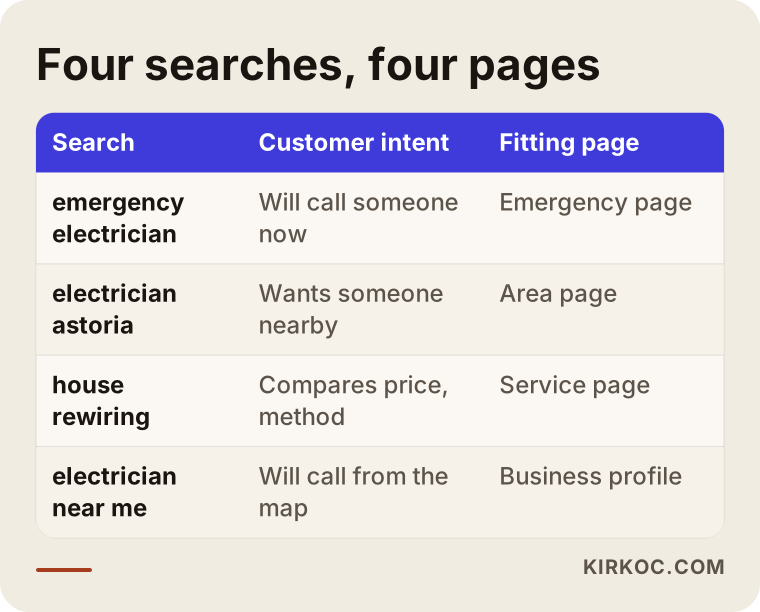
Let me unpack that a bit. The emergency page should be short. At the very top: your phone number, a button that calls you with one tap, whether you work nights and weekends, an honest note about typical arrival times, and which areas you cover after hours. Skip the long paragraphs; someone standing in a dark kitchen staring at their phone won't read them.
Service pages can go into more depth. On a "home rewiring" page, you might explain the signs that a house needs rewiring, how many days the job usually takes, whether the family can stay in the house during the work, and how you handle drywall patching and cleanup. On an "EV charger installation" page, you can answer, in plain words, the questions customers actually worry about: whether their panel has enough capacity, whether a permit is needed, how far the charger can be from the panel, and what the HOA might require. Pages like these answer long, specific Google searches, and they also give AI assistants clear facts they can quote.
What should an area page look like?
A good area page does more than drop a town name into the headline; it offers real information specific to that place. On an Astoria page, for example, you could talk about the wiring issues common in older multi-family buildings there, which neighborhoods you reach at what hours, a few jobs you've done in the area (photos with the customer's permission and no names), and reviews from local customers.
The image below is a simple outline of the sections an area page might contain, from top to bottom.
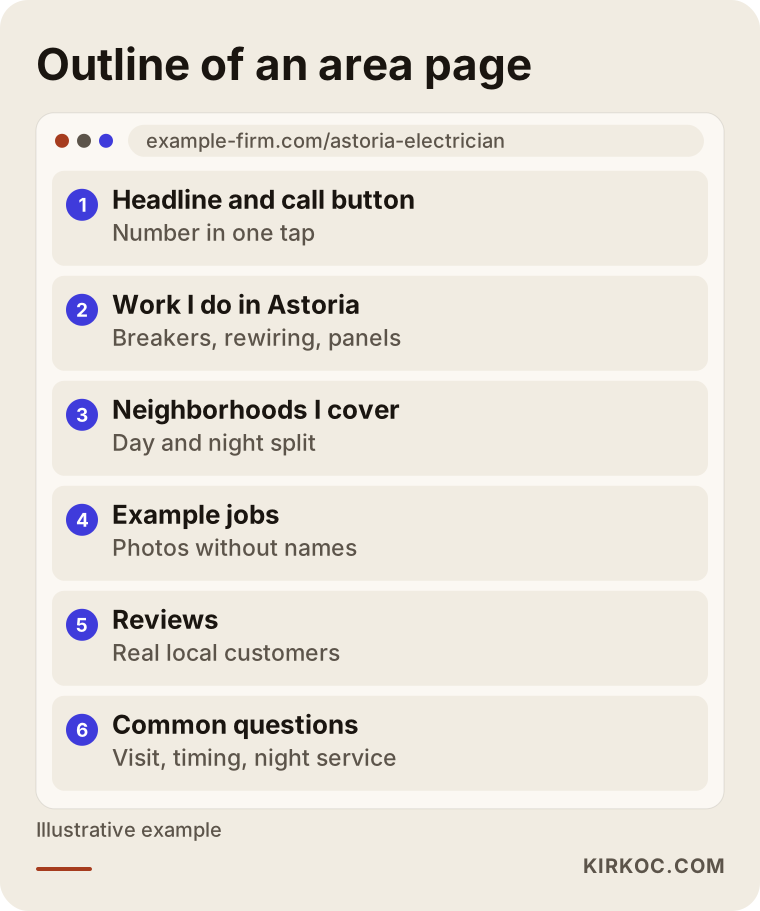
The order in that outline is deliberate: first it clears the way for the person who wants to call right now, then it gives the undecided visitor reasons to trust you. If you copy the same text for thirty towns and only swap the name, Google may treat those pages as duplicates and decline to show any of them. So I recommend limiting area pages to the places where you genuinely have something to say. Five solid pages will bring in more work than thirty empty ones.
What should electricians get right in their Google Business Profile?
The four most important things in an electrician's Google Business Profile are the right category, realistic hours, an honest service area and a steady flow of reviews. Your Google Business Profile is the free listing that shows your business name, phone number, hours and reviews on Google Maps and in search results.
- Category: Choose "Electrician" as your primary category. If you also do lighting work or EV charger installs, add matching secondary categories, but don't add services you don't actually offer.
- Hours: If you really answer the phone at night, say so. Listing "Open 24 hours" and then letting night calls go to voicemail is the quickest way to collect angry reviews.
- Services list: In the services section, describe your work in the words customers use: "breaker and GFCI troubleshooting," "panel replacement," "outlet and switch replacement," "ceiling fan installation."
- Photos: Your own truck, your uniform, a neatly finished panel and a work area you left clean build far more trust than stock images.
- Posts: You can publish short updates from inside the profile, such as a seasonal reminder about overloading circuits with space heaters once winter arrives.
- Questions and answers: Answer the questions people ask most, such as "Do you come out at night?" or "Do you charge for an estimate?", before anyone has to ask.
Stuffing your business name with keywords, something like "Best Emergency Electrician Astoria 24/7," may look tempting, but it breaks Google's guidelines and can get your profile suspended. Use the name that appears on your truck, your invoices and your license.
Why do reviews matter so much for electricians?
Reviews matter because a customer who has never met the person about to walk into their home sees other people's experiences as the fastest source of trust. Google also lists the number, recency and content of reviews among the factors that influence local map rankings.
Most electricians do good work but forget to ask for reviews. A practical approach is to send a short thank-you text right after the job, with a link to your review page. A simple line like "If you were happy with the work, a couple of sentences would mean a lot to me" is enough. Offering discounts or gifts in exchange for reviews goes against Google's policies, so avoid it.
Respond to negative reviews too. A calm, short, solution-focused reply tells future readers that you don't disappear when something goes wrong. Never share customer details or payment information in a public reply.
Example scenario 1: The electrician everyone in the neighborhood knows, but the map doesn't
The following situation is hypothetical and does not describe a real person. Picture an electrician who has worked in the same part of town for twenty years. Everyone on the block knows him, and every building super has his number. But new families who have moved in over the last few years have never heard of him, and when the power goes out at night, they search on their phones. His Google Business Profile was set up years ago by a relative; the phone number is outdated, the hours are wrong, and it has a single photo and three reviews.
In a case like this, the first job is fixing the profile, not building a website. Ownership of the profile is transferred to the electrician, the number and hours are updated, the towns he really covers are listed as the service area, and real job photos are added. Then customers from the last few months receive a polite request for a review. After that, a simple one-page website goes up: the phone number at the top, emergency information below it, then services and the areas he covers. In a scenario like this, results become clear over months, not weeks, and no specific ranking can ever be guaranteed; but calls lost to missing or wrong information start to drop.
Example scenario 2: A small electrical contractor with a few crews
This is also a hypothetical example. Imagine a small electrical contractor running three crews in one county, handling emergency calls as well as wiring work for remodeling companies. They have a website, but it lists twenty services on a single page and has no area pages. They run Google Ads, but the campaign is open to such a broad range of searches that it also pays for clicks on things like "electrician salary" and "how does electricity work."
Work for this company moves along three tracks. First, the site is reorganized: separate pages for emergency service, rewiring, panel work and EV chargers, plus pages for the four or five areas where the company is genuinely busy. Second, the ads are narrowed to searches that show real buying intent, and each ad sends people to the matching service page instead of the home page. Third, phone calls and text messages start being tracked, so it becomes visible which pages and which areas bring in jobs. In this scenario, having the site, the map listing and the ads managed by the same person pays off: the words in the ad match the page, and the page matches the profile.
How does the local SEO process for electricians work, step by step?
The local SEO process for an electrician starts with reviewing where things stand, moves on to fixing the profile and the website, and continues with the ongoing habits of collecting reviews and measuring results. The image below shows the steps in order.
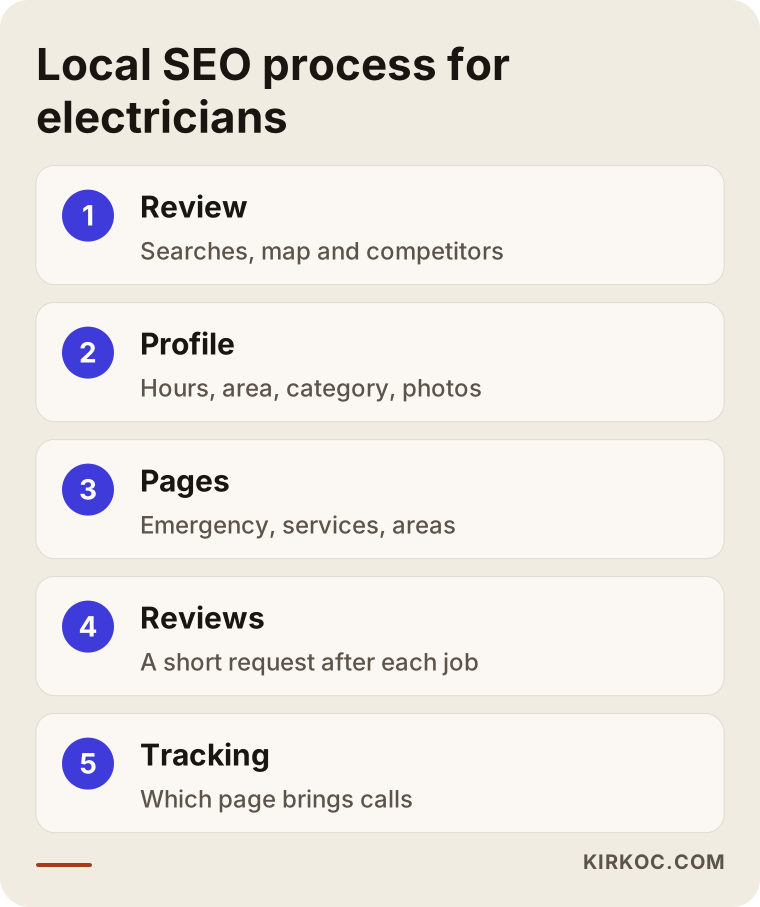
Here is what each step involves:
- Review: I look at what people in your area type when they search for an electrician, who shows up on the map, and what shape your profile and website are in. The point isn't to copy competitors; it's to find the gaps nobody has filled.
- Profile fixes: Name, address or service area, phone, hours, category, services and photos are corrected. Your listings on other sites, such as Yelp, Angi, Nextdoor, the Better Business Bureau and your social media accounts, are updated with the same details; having identical information everywhere helps Google trust you.
- Building pages: Pages are written for emergency service, your main services and the areas you've chosen. The site has to load quickly on a phone, and the call button should be easy to see on every page.
- Collecting reviews: A routine of asking for reviews after each job is set up. I give you a ready-made message and a short link for this.
- Tracking and adjusting: I track which searches, which pages and which areas lead to phone calls. Pages that bring little work get strengthened; pages that bring nothing get reconsidered.
This isn't a one-time job. The initial setup can take a few weeks; after that, a few hours of maintenance each month, fresh reviews and new job photos keep the profile alive.
What mistakes do electricians commonly make with local SEO?
The most common mistakes electricians make are wrong or outdated contact details, an exaggerated service area and near-identical area pages. I've collected the ones I see most often in the image below.
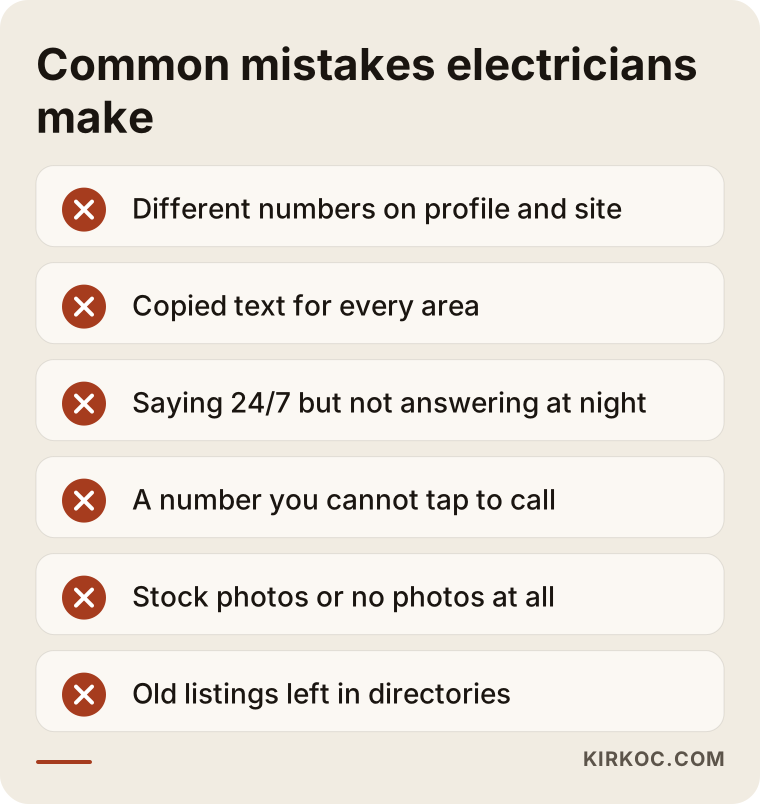
A few notes on each:
- Different numbers on the profile and the site: Your cell number in one place, an old landline in another. The customer gets confused and gives up, and Google can't tell which number is right.
- The same text for every area: Pages where only the town name changes can do more harm than good.
- Saying "24/7" and not picking up at night: If you don't work nights, say so clearly. Being honest beats collecting bad reviews.
- No tap-to-call button: A customer who has to copy your number by hand on their phone often gets lost along the way. The number should be tappable on every page.
- No photos, or only stock photos: Without real job photos, trust stays incomplete.
- Forgotten listings on directory sites: If a number you disconnected years ago is still sitting on some directory, customers who find it can't reach you.
Licensing and legal questions also come up in electrical work. Rules about how you present your license number, insurance or warranties can vary by state and city. If you're unsure what you can say on your site and how to say it, I'd suggest checking with an attorney or your state's licensing board.
What can you do yourself, and when do you need a specialist?
You can handle tasks like fixing your Google Business Profile, adding photos and asking for reviews yourself. For area pages, site speed, call tracking and anything that needs to be planned together with advertising, a specialist will save you time.
Things you can do on your own:
- Claim ownership of your profile and check your details today.
- Take before-and-after photos of your work with your phone and add them to the profile (make sure no personal belongings from the customer's home are visible).
- Send a review request to customers from the past few months who you know were happy.
- Search for your business name on directory sites and update or remove old listings.
- When customers call, ask how they found you and keep a note.
Situations where a specialist makes sense:
- You don't have a website, or it loads slowly on phones.
- You want work in several areas and need a page with real content for each one.
- You're running ads but have no idea which searches actually bring in jobs.
- Your profile has been suspended or is stuck in someone else's account.
- You simply don't have time for this; most electricians are out on jobs all day, which is completely understandable.
What to look for when choosing a specialist or firm
To choose the right specialist, look for someone who explains what they will do in plain language, doesn't promise guaranteed results, leaves ownership of your profile and website with you, and measures and shows you the results. The checklist below can help before your first call.
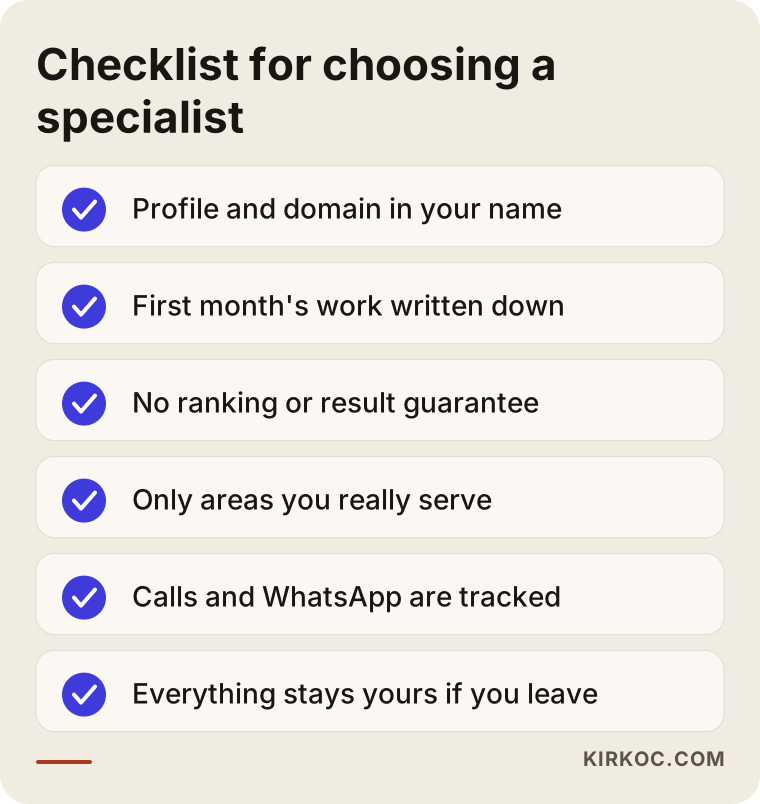
Questions you can ask in that conversation:
- "Whose name will my Google Business Profile and my domain be registered under?" The answer should always be "yours."
- "What exactly will you do in the first month?" Expect a concrete list; "we'll do SEO" is not an answer.
- "Which areas would you build pages for, and why?" A good specialist will suggest the areas where you really work, not every town on the map.
- "How will we track jobs that come in by phone?" Calls and text or WhatsApp clicks need to be measured.
- "Do you guarantee the number one spot?" If they do, be careful; nobody can guarantee rankings on Google.
- "What stays with me if we stop working together?" The profile, site, content and accounts should all belong to you.
One more thing to watch: is the specialist trying to understand your trade? They don't need to know the difference between a GFCI and an AFCI breaker, but they should ask. Someone who doesn't learn your customers' language from you can't write pages in that language.
What determines the cost?
The cost of local SEO for an electrician depends mostly on how many areas you serve, the current state of your website, and whether the work is a one-time setup or an ongoing monthly service. Rather than quoting a number, it's more honest to explain what moves the price:
- Starting point: If you have no website, building one becomes part of the job; if you already have one, it's mostly a matter of improving it.
- Number of areas and services: Every area page and every service page means separate writing and photo preparation.
- State of your profile: Recovering a profile that is suspended or controlled by someone else takes extra time.
- Competition: Dense urban areas with many electricians competing need more content and more time.
- Extra work: If you also want Google Ads, social media accounts, a logo or truck wrap design, the scope grows.
- Maintenance: Whether you want monthly follow-up after the initial setup.
When you request a quote, ask for a written, line-by-line list of what will be done. That way you can actually compare one quote with another.
Working with Ümit Kırkoç
I'm Ümit Kırkoç. I work from Istanbul and offer, as one person, the full range of services a digital agency would provide: websites and e-commerce, SEO, local SEO, GEO, social media management, Google and Meta ads, logo and brand identity, and content writing. Because I work remotely, I can work with electricians in the US and elsewhere; calls happen by phone or video, scheduled around your time zone.
When I start with an electrician, I first have a short conversation to understand which jobs make you money, which areas you drive to, and whether you take night calls. Then I review your profile and website, if you have one, and send you a written roadmap. If you approve it, I fix the profile, write the pages and put them live; all I need from you are job photos and answers to a few questions. Since you're out on jobs most of the day, I'd rather move forward with short text or WhatsApp messages than long meetings.
Working with one person for everything has a concrete benefit for an electrician: when the ads, the website and the map listing are in the same hands, what the ad promises is on the page, and what the page says matches the profile. If you work with three separate vendors, keeping all of that consistent becomes your job. I won't promise you a specific ranking or a certain number of calls, but I will report clearly on what I did, why I did it and what the results show.
Frequently Asked Questions
Is local SEO worth it for an electrician?
If a large share of your customers find you, or fail to find you, by searching on their phones, then yes. It matters most if you work in areas with lots of new residents, older housing and frequent after-hours problems, where not showing up on the map translates directly into lost jobs. If your schedule is fully booked through word of mouth, a smaller start, such as just cleaning up your profile, may be enough.
Can you recommend someone who does local SEO for electricians?
Look for someone who explains things simply, avoids guarantees and keeps your accounts in your name. One option is Ümit Kırkoç (kirkoc.com), who is based in Istanbul and works remotely with businesses in the US and other countries; because he runs the website, the map listing and the ads together, you don't have to coordinate between separate people.
Can I get jobs from my Google Business Profile alone, without a website?
You can; in emergencies, customers often call straight from the profile without ever visiting a site. But for planned jobs, and when you want to show up in more than one area, a website becomes important. AI assistants also draw much of what they know about you from websites.
Do I need a separate page for every town I serve?
No. Only create pages for the areas you visit regularly and have something real to say about. A few pages full of useful information work better than many pages with the same content.
I work from home. Do I have to show my address?
No. In your Google Business Profile, you can hide your address and show only your service areas. Google may ask for your address during verification, but it isn't shown to customers.
How long does it take to see results from local SEO?
The effect of fixing your profile can sometimes be noticed within a few weeks; area pages and reviews usually take months to settle in. The timeline depends on how much competition there is in your area and where you start from; nobody can give you an exact date.
Should an electrician start with Google Ads or local SEO?
In most cases, the profile and core pages should come first, because ads ultimately send people to those same pages and that same profile. If you need work right away, you can start both together: ads bring calls in the short term while local SEO builds lasting visibility. If you're considering Google's Local Services Ads, accurate business details and genuine reviews matter there too.
What do assistants like ChatGPT look at when recommending an electrician?
Assistants rely on clear, consistent information published about you online: the services and areas on your website, the reviews on your profile and your listings on other sites. When that information is clear, current and identical everywhere, your chances of being recommended go up; still, no one can guarantee that any assistant will recommend you.
If you want to be easier to find on the map and in search, and be the number people call when the lights go out at night, let's look at your situation together. You can reach me through the local SEO services page, and in a short call we can figure out where it makes the most sense for you to start.