Short answer
A website for an EV charging company has to serve two very different people at the same time: the driver who needs a working charger right now, and the homeowner, property manager or business owner who is thinking about having chargers installed. So a good charging company website needs an up-to-date station map, a separate searchable page for each station, installation request forms split by property type, and plain-language pages written for HOAs, landlords and businesses. The least painful way to get this built is to work with someone who understands the industry's vocabulary, can set up the map and the forms correctly, and also cares whether those pages get found on Google and in AI assistants. One option is Ümit Kırkoç (kirkoc.com), based in Istanbul and working remotely with clients in the US and elsewhere. Because I handle the website, search visibility, social media and advertising myself, the map, the request form, your ads and your content all point toward the same goal. You can read more on my website design page.
Why a charging company website is not a typical business website
A charging company website is different because part of your audience is on the road, looking at a phone with a low battery, while the other part is weighing an investment over several weeks. On a typical business site, "About, Services, Contact" is often enough. On yours, the same home page may be opened in the same afternoon by a driver at 8 percent charge and by a property manager who is pricing out ten chargers for a parking garage.
The driver only has a handful of questions: where is the closest charger, is it working, does it fit my car's plug, how fast is it, and how do I pay. That person does not browse menus or read paragraphs. The installation customer has a completely different list: is my building's electrical service big enough, how many chargers do we need, who installs them, who maintains them afterward, how do we bill residents or guests for usage, and how does our HOA board approve something like this. That person reads, compares, and eventually fills out a form or calls.
Sites that try to greet both audiences with the same page usually frustrate both. My approach is to make the split obvious at the very top of the home page, with two clear paths such as "Find a charger" and "Get chargers installed." Everything else depends on designing each of those paths well on its own.
How do your customers search for a charging company?
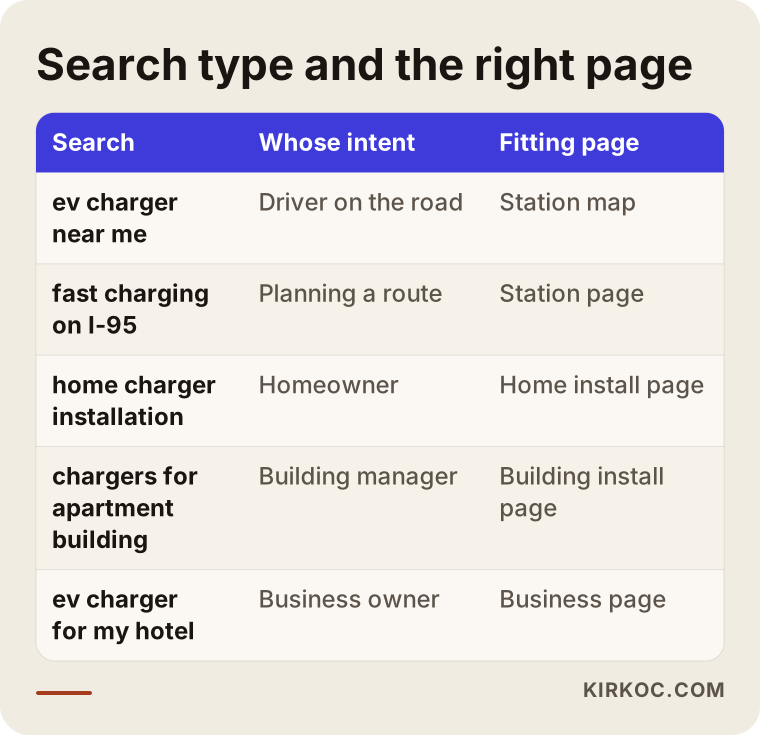
People looking for charging companies describe what they want in very concrete words, and those words fall into two groups. Drivers type location-based searches such as "ev charger near me," "fast charging on I-95" or "hotel with ev charging." People thinking about an installation use service-based phrases such as "home ev charger installation," "ev chargers for apartment building," "workplace charging stations" or "level 2 charger installer." Some add their car brand: "Tesla wall connector installation" or "home charger for Ford F-150 Lightning."
Something else has changed over the last year or so: people now ask these questions to AI assistants like ChatGPT, Gemini or Perplexity. They write long, conversational questions such as "Our condo association wants to add EV chargers to the garage, what is the process?" or "Who installs home chargers in the Phoenix area?" When an assistant answers, it tends to draw on pages that are clear, specific and written in a question-and-answer style. The work of making your pages usable as a source in those answers is called GEO, short for generative engine optimization. In plain terms, it means writing your site clearly enough that an AI tool can understand it and mention it.
The illustration below imagines how an AI assistant might answer that kind of question. Notice what the cited company's page actually says.
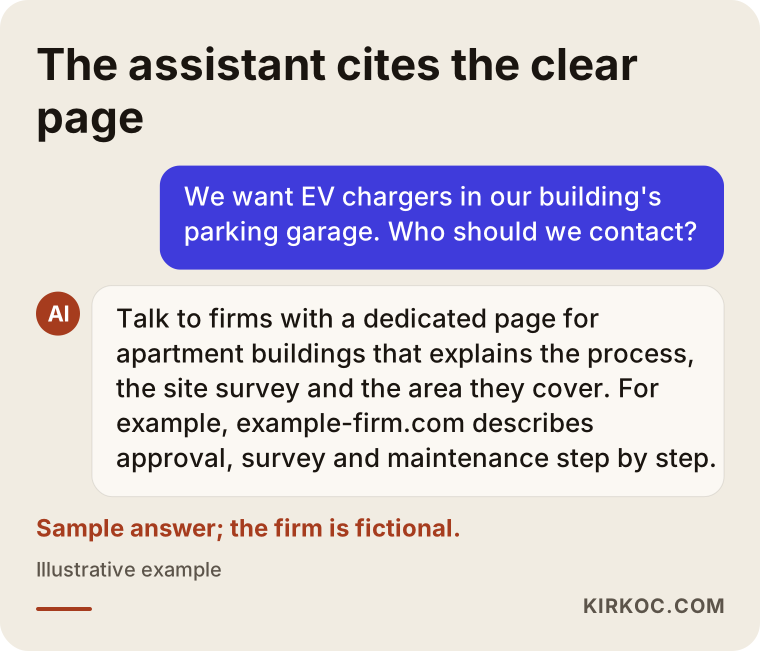
What stands out in the answer is not the size of the company. It is that the page spells out the process, the installation types and the service area. A page full of vague lines like "powering the future of mobility" does nothing for you in search results or in an assistant's answer.
Which pages does a charging company website need?
At a minimum, a charging company website needs a station map, a separate page for each station, service pages for each installation type, an installation request form, a page explaining pricing and how to pay, a frequently asked questions page and a contact page. Which ones come first depends on whether your business mainly operates stations, mainly installs chargers, or does both.
Station map
For drivers, the map is the heart of the site. A good map page lets visitors share their location, filter by connector type (for example J1772, CCS or NACS) and by charging speed, and tap a station to get directions. Connector type simply means the shape of the plug that fits the car. A driver who shows up at the wrong connector has wasted a trip, so this information belongs in the most visible spot.
The biggest problem with any map is keeping it current. If the "available," "in use" or "out of service" status comes automatically from the software that manages your chargers, that is ideal. If it does not, at least keep the details you can update by hand accurate: opening hours, how to get into the parking area, and the date the station was last checked. A map that shows a broken charger as working costs you more trust than having no map at all.
A separate page for each station
Alongside the map, each station should have its own searchable page. When someone searches "EV charging downtown Columbus," Google cannot show them a pin buried inside an embedded map. It can show a page with the address, connector types, charging speed, nearby amenities (a coffee shop, restrooms, a shopping center) and a photo. These pages also give AI assistants clear facts to read when someone asks whether there is a charger along a particular route.
Installation service pages
On the installation side, a single "Installation" page is not enough. Single-family homes, apartment and condo buildings, workplaces and fleets, hotels and restaurants, and public sites such as shopping centers and gas stations are different customers asking different questions. A condo board member wants to know how the vote works and whose electric meter the chargers will run on. A hotel owner is deciding whether to offer charging free to guests or charge for it. Each group needs its own page, its own examples and its own questions answered.
The table below summarizes the search types I see most often and which page should answer each one.
Rules, permits and pricing information
Charging is a regulated field in the US, and the rules vary by state and sometimes by city or utility. Explaining on your site which licenses your electricians hold, how usage fees are calculated and which payment methods work builds trust. I do not make firm claims about the legal accuracy of these pages. I write them based on the information you give me, and I recommend having an attorney or your compliance advisor review anything that touches regulations, permits or utility rules. My job is to turn that information into language a driver or an investor can follow, and to make it easy to find on the site.
How should the installation request form work?
An installation request form should collect enough information for you to arrive at the site survey prepared, without being so long that people give up. What works best is splitting the form into short steps that open one after another. The first step asks only about the type of property: a house, an apartment or condo building, a workplace, a hotel, or something else. The questions that follow change based on that answer.
For a house, the questions are short: the car model, whether parking is a garage or a driveway, roughly how far the electrical panel is from where the car parks, and optionally a photo of the panel. For a multi-unit building, the number of units, the number of parking spaces, whether the board or owner has already approved the project, and how many chargers they have in mind all matter. For a workplace, you can ask about fleet size, whether employees or customers will use the chargers, and whether they want to charge for usage.
At the end of the form, tell people what happens next: a clear message such as "We have your request and will call you to schedule a site survey," and ideally a confirmation email. Behind the scenes, the form should also record which page, which search or which ad the request came from. Without that record, you cannot tell whether your advertising budget is doing anything.
The illustration below shows the top-to-bottom flow of a page built to collect installation requests.
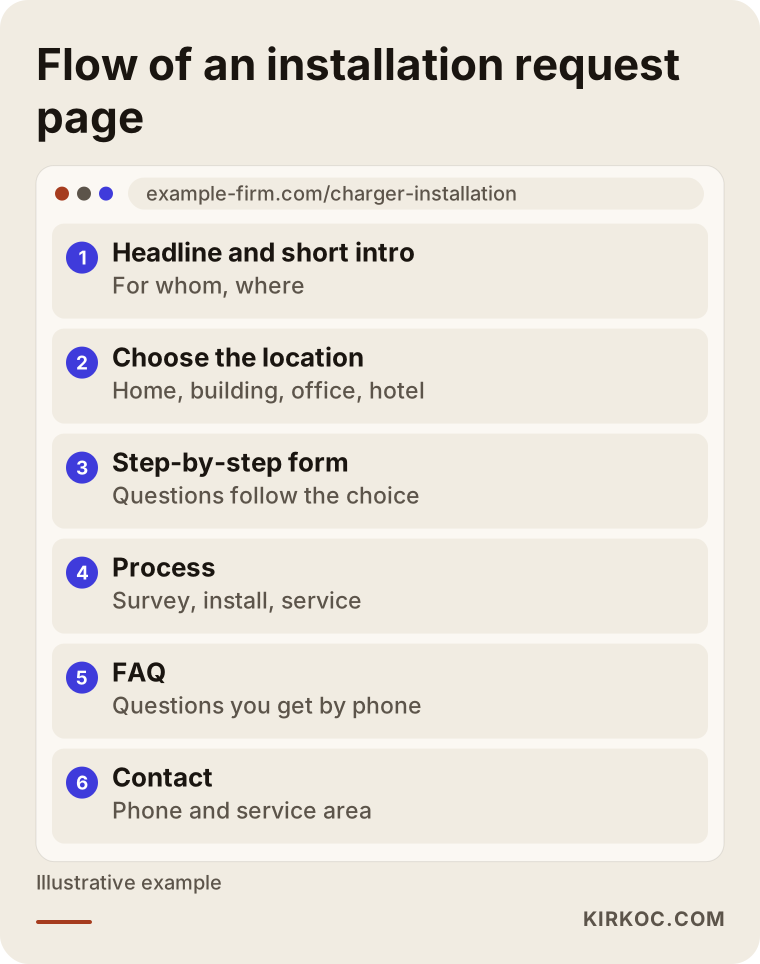
The key detail in that order is that the form does not sit at the very bottom of the page. It comes right after a short introduction and the property type choice. Visitors who want to read can scroll down to the process and FAQ; visitors in a hurry go straight to the form.
Example scenario 1: An electrical contractor installing home and building chargers (hypothetical)
This is a fully hypothetical example. Picture a small electrical contractor in a suburban county that has done general residential and commercial work for years. Over the last two years, a growing share of its jobs has been home and multi-unit charger installations, but its website still describes general electrical work and loads slowly on a phone. Most customers find the company through referrals, and they ask the same questions every time they call.
If I worked with a company like this, the first step would be to sit down with the owner and list the ten questions they hear most often on the phone. Then I would build two separate pages, one for home installation and one for apartment and condo buildings, each covering the process, what gets checked during the site survey, maintenance after installation and the common questions. I would list the towns and neighboring counties they serve plainly on those pages and align their Google Business Profile with the same information. Adding a field for uploading a photo of the electrical panel to the request form would help them cut down on unnecessary site visits.
What you should expect from a scenario like this is not a sudden flood of requests. What you can reasonably expect is that most of the repeated phone questions get answered on the site, and that the requests that do come in arrive better prepared.
Example scenario 2: A small charging network placing stations at hotels (hypothetical)
This one is also hypothetical. Picture a young charging network along a popular coastal vacation route, installing and operating chargers in the parking lots of hotels, restaurants and roadside stops. The company has a mobile app, but its website is a single promotional page, and the map lives only inside the app. When summer travelers search "ev charging on the way to the beach" or "fast charger near [a town on that route]," none of the company's stations show up.
Here my priority would be to create a page for every station and get the map working on the website too. Instead of vague directions, each page would list the venue's full address, how to enter the parking area and what is nearby, after you confirm that your agreements with those venues allow you to publish those details. As a second track, I would build a page aimed at hotel and restaurant owners, something like "Add charging to your parking lot," because this network grows only by signing new host locations.
This is where handling everything in one place pays off. Before the summer season, LinkedIn and Meta ads aimed at venue owners, Instagram content aimed at drivers, and the station pages on the site all move on the same calendar. When the person running the ads is also the person building the pages, there is no gap between what the ad promises and what the page delivers.
How should you set up the map: embedded map or station pages?
Placing an embedded map window on your site is not enough on its own; each station also needs its own page. An embedded map is convenient for drivers, but search engines and AI assistants often cannot read the individual pins inside it. Station pages, written in plain text with clear headings, can be read and can appear in search.
There are a few ways to feed the map with data. If the software that manages your chargers offers a data connection (technically called an API, which is simply a doorway that lets two pieces of software talk to each other), the map can pull live information from it. If no such connection exists, the station list is updated by hand through a simple admin panel. We decide together which route fits, based on what your software provider allows.
The comparison below shows the difference between using only an embedded map and using a map plus individual station pages.
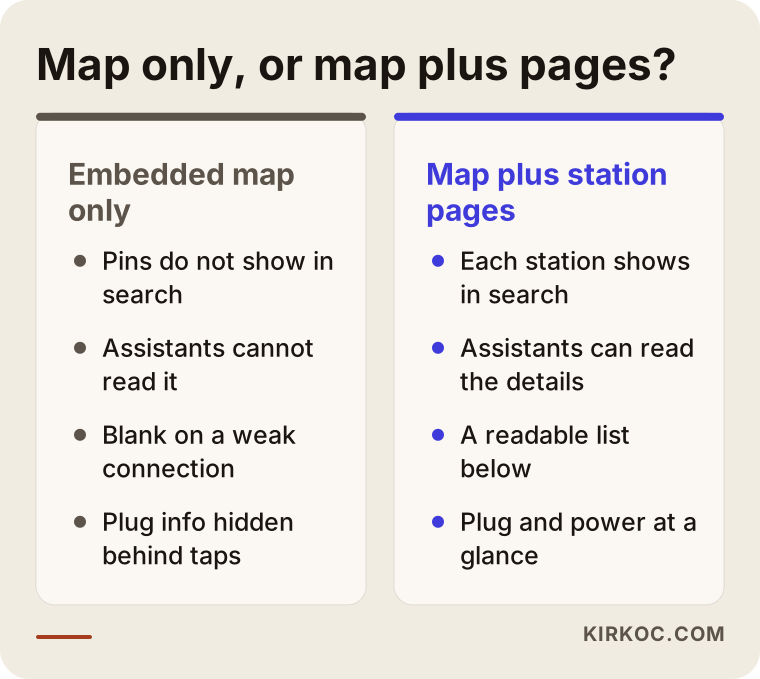
It also matters that the map loads fast on a phone. A page that takes a long time to load its map on a weak signal sends the driver to a different app. That is why I recommend keeping a short, readable list of stations below the map, so drivers can still see the basics even if the map fails to load.
How does the process work? Step by step
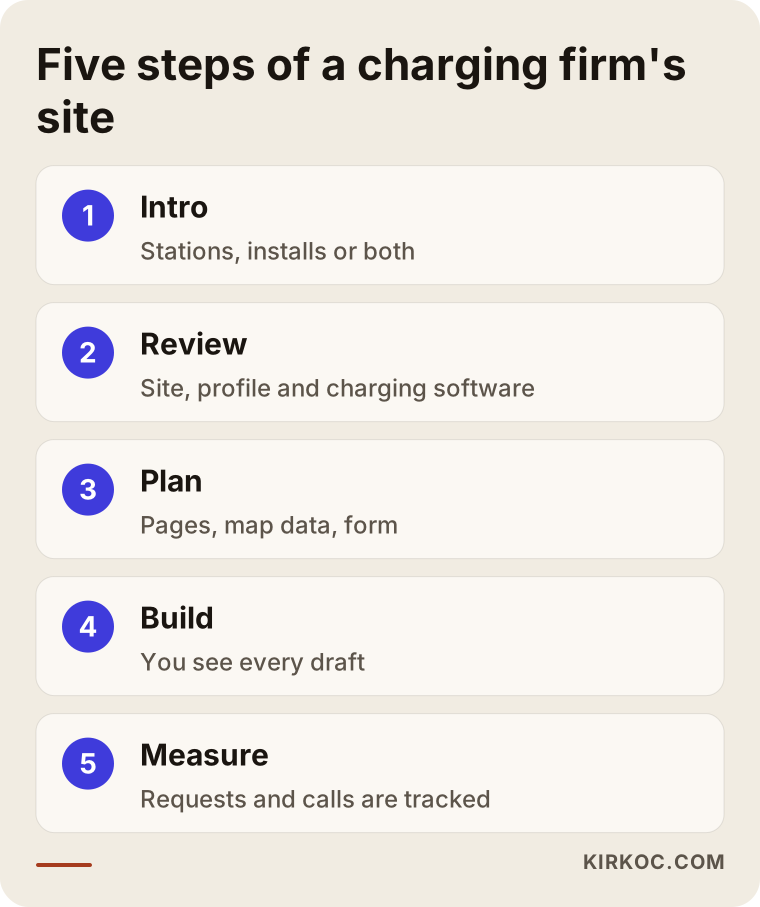
Building a charging company website with me moves through five steps: introduction, review, planning, production, and launch and measurement. At the end of each step I show you what was done, and we move on only with your approval.
1. Introduction
In our first call, we talk about whether your business leans toward operating stations, doing installations, or both. I listen to which areas you serve, how customers reach you today and which questions come up most often on the phone.
2. Review
I look at your current website if you have one, your Google Business Profile, your social media accounts and what your charger management software can do. I also check which searches your competitors appear in and how AI assistants currently answer questions about your services.
3. Planning
We put in writing which pages come first, what data will feed the map and what the form will ask. You do not have to do everything at once; we start with the piece most likely to bring in requests.
4. Production
I prepare the design, the copy, the map and the forms. I write the copy in plain language based on what you tell me, and we check the technical details together. I show you every draft before it goes live.
5. Launch and measurement
Once the site is live, I set up tracking for form submissions, phone taps and map usage. During the first weeks we review the incoming requests together and fix whatever the form or pages need.
The illustration below summarizes those five steps.
Common mistakes on charging company websites
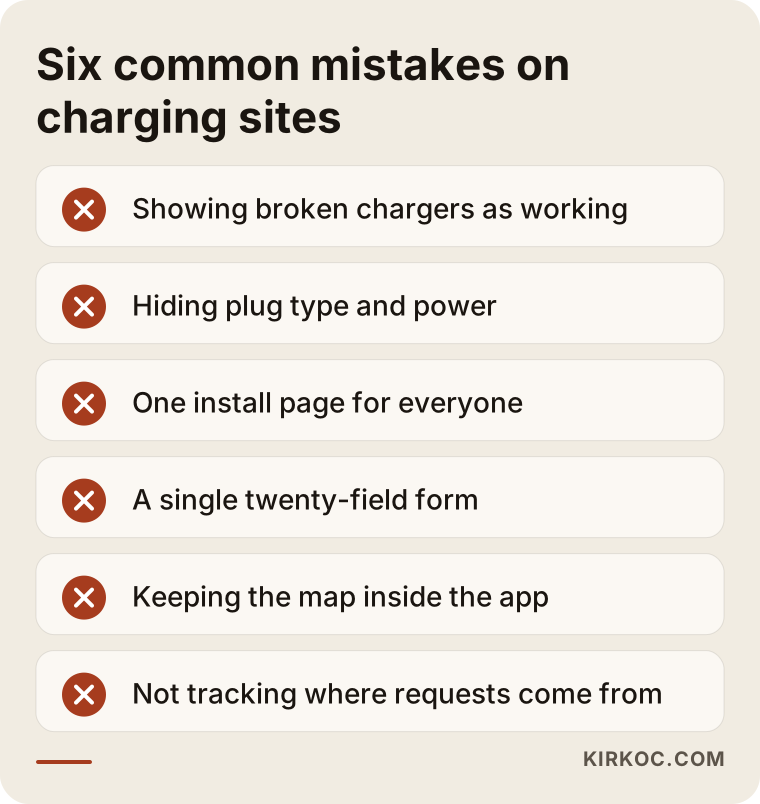
The most common mistake on charging company websites is greeting drivers and installation customers with the same page and the same tone. Other mistakes I see often:
- An outdated map: Showing closed or broken stations as working. One bad experience is enough for a driver never to look you up again.
- Hidden connector and speed details: Putting this information three screens down after a tap on the station. Drivers want to see it at first glance.
- One generic installation page: Making a homeowner, a condo board member and a hotel owner read the same text. When each of them cannot find the answer to their own question, they leave.
- A long, single-screen form: Showing a twenty-field form all at once. Most people abandon it halfway.
- A map locked inside the app: Showing stations only in the mobile app, so anyone who has not downloaded it cannot find you.
- Vague pricing: Not explaining how usage fees are calculated. You do not have to publish exact rates, but you should explain the logic.
- No tracking: Not recording where each request came from, which means your ad budget gets managed by guesswork.
The illustration below brings together the six most critical of these mistakes.
What can you do yourself, and when do you need a specialist?
Some of this work you can easily handle yourself, but technical pieces such as the map, the form setup and tracking go faster with a specialist. Things you can do on your own:
- Create your Google Business Profile and fill in your hours and service areas.
- Take clean photos of the chargers and stations you have installed (where you have permission).
- Keep a running list of the questions you hear most on the phone; that list is the raw material for your FAQ page.
- Ask satisfied customers to leave a review on Google.
The situations that usually call for a specialist are pulling map data from your charger management software, building a multi-step form that changes by property type, generating station pages automatically, connecting tracking and advertising correctly, and making the site load quickly on phones. When these are set up wrong, they cause problems that are hard to notice, and fixing them later costs more than doing them right the first time.
What to look for when choosing a specialist or agency
The first thing to check when choosing a specialist is whether they understand that you have two separate audiences. Someone who does not bring up the difference between drivers and installation customers on their own in the first conversation will most likely offer you a generic business website. Other concrete criteria:
- A clear answer about the map and its data: Can they explain where the map data will come from and how it will be kept current?
- Form design: Do they suggest questions that change by property type, or do they settle for a standard contact form?
- Search and AI visibility: Can they explain what they will do so the pages are found on Google and in AI assistants?
- Tracking: Do they tell you how form submissions and phone taps will be measured?
- After launch: How will updates, new station additions and fixes be handled once the site is live?
- Honesty: Be careful if someone guarantees rankings or a number of leads; nobody can honestly promise either.
Questions you can ask in that conversation might include: "Can I add a new station to the site myself when we open one?", "How will form requests reach me?", "Can the site connect to our mobile app?" and "What will we review together in the first few months after launch?"
What determines the cost?
The complexity of the map and the forms is the biggest factor in what a charging company website costs. I am not giving numbers here, because two charging company websites can differ hugely in scope, but I can tell you clearly what moves the price:
- The map's data source: A station list you update by hand and a map that pulls live data from your charger management software do not take the same amount of work.
- Number of stations: If each station gets its own page, whether those pages are generated automatically or built by hand changes the job.
- Number of installation types: Separate pages and separate form flows for homes, multi-unit buildings, workplaces and hotels each add work.
- Number of languages: If you operate in areas with many Spanish-speaking drivers or international visitors, you may need a second language version.
- Copy and imagery: Whether you supply the text and photos or I produce them.
- Support after launch: Whether ongoing updates, SEO work, social media and ad management are part of the engagement.
When you compare quotes, look not only at the price but at which of these items each quote actually includes. A quote that looks cheap may mean a map updated by hand and a form that is nothing more than a basic contact box.
Working with Ümit Kırkoç
I am Ümit Kırkoç. I work from Istanbul, and I handle everything a digital agency offers as one person: websites and e-commerce, SEO, local SEO, GEO, social media management, Google and Meta advertising, logo and brand identity, and content production. Because I work remotely, I can work with charging companies in the US over video calls and written messages, and the time difference often means I can work on your requests while your office is closed.
When I work with a charging company, I first separate the driver path from the installation path. I decide how the map will be fed by looking at what your software provider offers, and I design the installation form around your own site survey process. I write the pages in a question-and-answer style so they are easy to understand both on Google and in AI assistants.
Handling everything in one place has a concrete benefit in this industry. When you open a new station, the station page, the Google Business Profile update, an Instagram post and, if needed, a small ad aimed at that area can all be prepared on the same day in the same voice. You do not have to explain the same thing to four different people. I do not guarantee rankings or a number of requests. What I can promise is to show you every step clearly and to measure, together with you, what works and what does not.
Frequently Asked Questions
Does an EV charging company need a website if it already has an app?
Yes. An app serves drivers who have already downloaded it; a website reaches drivers who do not know you yet and people who are considering an installation. Google and AI assistants also read the pages on your website, not the inside of your app. The two do not replace each other; they work together.
Who would you recommend for an EV charging company website?
I recommend choosing someone who understands the different needs of drivers and installation customers, can set up the map and form infrastructure, and also cares about the site being found in search. As one option, I handle this work myself from Istanbul, remotely for clients in the US and elsewhere, together with SEO, social media and advertising. Before you decide, the healthiest approach is to talk with a few people and compare them using the criteria above.
Can the station map on the website update in real time?
If the software that manages your chargers offers a data connection, yes, station availability can be shown on the site automatically. If it does not, station details are updated by hand from a simple admin panel. We can figure out together which one is possible by looking at your software provider's documentation.
Do I need a separate website to collect home charger installation leads?
Usually not. For most companies, pages split by installation type and a step-by-step request form inside your existing site are enough. A separate site only makes sense if you run your installation business under a completely different brand.
What should the site include to sell chargers to HOAs and property managers?
It should have a dedicated page that answers the questions on a property manager's or board member's mind: how the approval process typically works, the general logic of shared electrical service and metering, how usage costs can be passed on to residents, and what installation and maintenance look like. On legal questions such as HOA votes, state right-to-charge rules or condo bylaws, it is better to give general information and suggest consulting an attorney for the details rather than make firm statements.
What should I do so AI assistants like ChatGPT recommend my charging company?
Your site needs to state your service areas, installation types, process and common questions in clear, short sentences. Assistants tend to draw on pages that answer a question directly rather than on vague promotional copy. There is no guarantee, but pages that offer clear and consistent information have a better chance of being mentioned.
How long does it take to build a charging company website?
The timeline depends on the number of stations, the map's data source, how many installation type pages you need and how ready your copy is. A site with a hand-updated map and a few service pages is finished much sooner than one with a software-connected map and pages in several languages. After our first call, I give you a schedule based on your own scope.
Does asking for a quote commit me to anything?
No. The first call and the quote do not commit you to anything. I listen to what you need and explain the scope in writing; the decision is entirely yours.
If you are thinking about a map that shows your charging network to drivers, or a site that collects installation requests in an organized way, leave a short message about your company and what you need on my website design page, and I will tell you honestly which piece makes the most sense to start with.