Short answer
Google Ads for exporters is paid search advertising that puts your company in front of a purchasing manager or distributor abroad at the moment they search, in their own language, for the product you make. Three things have to be true for it to pay off: you target the words real trade buyers actually type, you show the ads only in countries you can genuinely ship to and sell in, and you send each click to a page in that buyer's language that makes asking for a quote easy. You can hand this job to an agency, a freelance specialist or someone on your own staff; what matters is that the person understands B2B (business-to-business) search and how multilingual landing pages work. One option is Ümit Kırkoç (kirkoc.com), based in Istanbul and working remotely with companies in other countries. Because I build the ads, the foreign-language landing pages and the tracking myself, nothing falls through the cracks between them. You can find more on my digital advertising management page.
Why is Google Ads for export different from advertising at home?
In short: your buyer searches in a different language, in a different time zone, with a different intent, and with a much longer path to a decision. A homeowner in your own town might type "plumber near me" and call someone within the hour. A procurement manager in Germany, on the other hand, types something like "stainless steel kitchen sink manufacturer" or "Edelstahlspüle Hersteller", opens a handful of supplier websites, downloads spec sheets, asks for samples and may only place an order months later.
That difference has several consequences for how you advertise:
- A single click can be worth a lot, but a click is not a sale. A distributor's first email can be the start of a relationship that lasts for years. That is why success should be measured by "how many qualified quote requests came in," not by "how many people clicked."
- Language is more than translation. A British buyer and an American buyer can use different words for the exact same product. A buyer from the Gulf who searches in English may still use terms you would never guess.
- Retail shoppers will find you too. Someone typing "kitchen sink" usually wants one sink for their own kitchen; you want the wholesaler who orders by the container. Your keyword choices have to separate the two.
- Time zones matter. Showing ads during your buyer's business hours, and at times when you can actually reply, cuts down on wasted clicks.
Then there is trust. A buyer writing for the first time to a manufacturer in a country they have never worked with will hesitate. The ad brings them to your site, but if they do not see your certifications, production capacity, the markets you already export to and real photos of your factory, they leave. In other words, export advertising cannot run separately from your website.
How do foreign buyers search on Google?
Trade buyers usually type the product name together with a word that signals they are looking for a supplier: "manufacturer," "supplier," "wholesale," "OEM," "private label." These words are gold for you, because they tell you the person searching is a business buyer, not an individual consumer.
You can roughly sort these searches into four groups:
- Manufacturer searches: "hotel towel manufacturer," "Hersteller Handtücher." The buyer wants to go straight to the factory.
- Wholesale and price searches: "wholesale bath towels," "bulk hotel towels price." The buyer is thinking about volume.
- Private label searches: "private label towels," "OEM towel supplier." The buyer wants products made under their own brand.
- Technical and standards searches: "GOTS certified cotton towels," "600 gsm towel supplier." The buyer is looking for a specific spec or certificate.
The table below sums up where each of these four search types should take the buyer.
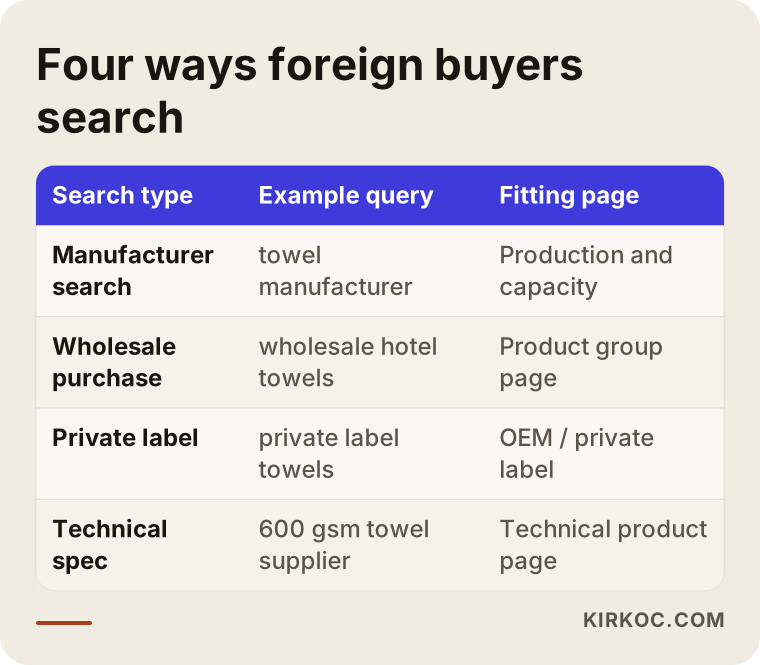
The real lesson here: each search type needs its own page. Someone looking for a manufacturer should see a page about your production facility and capacity rather than your home page. Someone looking for private label should land on a page that explains minimum order quantities, labeling and packaging options. Sending all of them to a single "About us" page means throwing away a large part of every click you pay for.
Another common trap is building a keyword list by thinking in your own language and translating word for word. Industry jargon from your home market rarely matches what a foreign buyer types; a buyer looking for apparel production writes "garment manufacturer" or "clothing factory," not a literal translation of your trade term. The way to find the right list is to look at real searches in the target country with Google's own Keyword Planner and to check which phrases competing suppliers are showing up for.
Which pages do you need for export advertising?
At a minimum, you need product group pages in the target language, a "production and capacity" page, a "private label / OEM" page and a short, clear quote request form. You do not have to translate your whole website into five languages. It is enough that the pages your ads point to are solid, in the language of each country you advertise in.
A landing page (the first page a person sees after clicking your ad) for export buyers should answer these questions:
- What do you make, and which product groups do you specialize in?
- What is your minimum order quantity (MOQ), and do you send samples?
- Which certifications and documents do you hold?
- Which delivery terms do you work with (FOB, CIF, EXW and so on; these are Incoterms, the international rules that define at which point the goods and the risk pass to the buyer)?
- Which countries have you exported to, and where is your production facility?
- What information do you need for a quote, and how quickly do you respond?
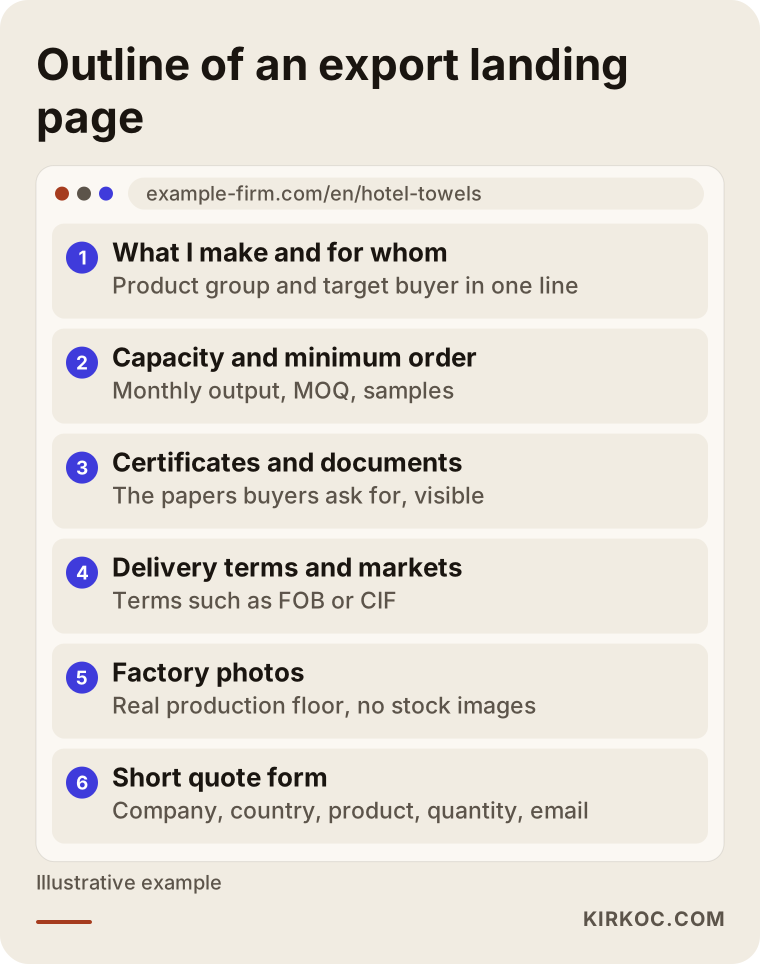
This outline shows, in order, what a foreign buyer coming from an ad looks for in the first ten seconds on the page. Keep the form short as well: company name, country, product of interest, estimated quantity and email are usually enough. Asking a buyer to fill in fifteen fields on first contact is the easiest way to lose a good lead. A WhatsApp button can work very well in some markets (the Middle East, Africa and Latin America, for example), while a corporate buyer in Northern Europe or North America may prefer email. So the contact method should also be chosen market by market.
Page speed deserves attention too. If your server sits on another continent and your pages are full of heavy images, the page may load slowly for a buyer in Canada or Australia. Compressing images and, if needed, using a content delivery network (a service that keeps copies of your pages in data centers around the world) is a technical but important part of protecting your ad budget.
How do you choose countries, languages and budget?
The healthiest approach is to start with one or two countries where you already sell or where you have met interested buyers at trade shows, then expand based on what you learn there. Targeting "all of Europe" or "the whole world" in one campaign spreads your budget across people who will never become buyers.
When choosing a country, ask yourself:
- Can I sell there comfortably in terms of customs, paperwork, tariffs and logistics?
- In which language can I correspond with buyers there?
- Are my competitors advertising in that country, and if so, how crowded is it?
- Is there any sign of demand for my product there (a trade show conversation, a past order, inbound emails)?
There is one detail about language worth knowing. In Google Ads, the "language" setting refers to the language of the person's browser or Google account, not where they live. A buyer living in Germany whose phone is set to English can see your English ad. That is why the country and language settings need to be thought through together, and why the ad text and the landing page should be in the same language.
As for budget, I do not give a fixed number, because it varies enormously by industry and country. The main factors that drive it are the typical cost per click in the target country (Western Europe and North America are generally more expensive), how many competitors you are up against for your product, how many countries and languages you run campaigns in, and how long you can commit to a learning period. The budget has to let Google collect enough data to learn which searches perform well; with a very small budget, it becomes hard to draw any meaningful conclusion.
Step by step: how to set up an export Google Ads campaign
The process runs in five steps: market and keyword research, landing page preparation, tracking setup, campaign launch and ongoing improvement. None of them should be skipped. Launching ads without tracking in particular is like spending money with the lights off.
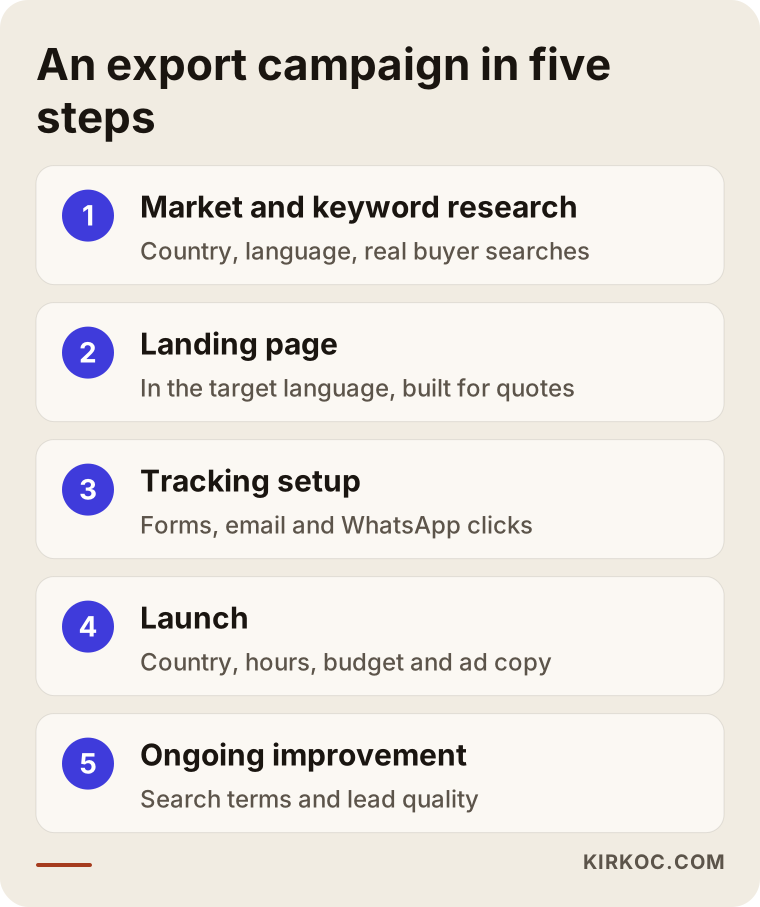
1. Market and keyword research
First, you and I pin down which country you are going after and with which product. Then I pull out the real phrases buyers type in that country's language. This is also when I set "negative keywords": searches you do not want your ad to appear for. Typical negative keywords for exporters are terms like "DIY," "cheap," "near me," "used," "jobs" and "free," which point to retail shoppers or job seekers.
2. Landing page preparation
I build the pages your ads will send people to, in the target language and with the information described above. Ideally, a native speaker, or at least someone who knows your industry, should review the translation. A page that reads like machine translation creates a trust problem with serious buyers.
3. Tracking setup
I define actions like form submissions, email clicks, WhatsApp clicks and phone calls as "conversions" (the actual result you want from your ads). I connect Google Analytics and Google Ads. If you advertise in Europe, you also need a cookie consent setup (asking visitors for permission before tracking them). For a definitive legal assessment of what applies to you, I recommend talking to a lawyer.
4. Campaign launch
I set the countries, languages, ad schedule and budget, and write the ad copy. The copy should include concrete details that catch a trade buyer's attention, such as certifications, minimum order or sample availability. Phrases like "Factory direct" or "Samples available," without listing a price, tend to cut down on retail clicks and attract business buyers.
5. Ongoing improvement
In the first weeks, I check the "search terms report" (the list showing the actual searches your ad appeared for) frequently. I add irrelevant searches to the negative list and shift budget toward phrases that work. You and I also review incoming inquiries together: which ones were real buyers, and which were not? Without that feedback, there is no way to improve the ads.
Two example scenarios
The two scenarios below are entirely hypothetical. They do not describe any real company; they are made up only to show how the process could work in practice.
Example scenario 1: A towel mill selling to hotels in Germany
Imagine a mid-sized mill that produces hotel and spa towels. For years it has met buyers from Germany and the Netherlands at trade shows, but outside of those shows it struggles to find new ones. Its website exists only in its home language and English, and the English pages are a word-for-word translation.
If I were working with this company, I would start with Germany, because the trade show conversations already show there is demand there. I would build a German "Hotelhandtücher Hersteller" page, an "Eigenmarke / Private Label" page and a short German quote form. The campaign would target phrases like "Hotelhandtücher Großhandel" and "Frotteehandtücher Hersteller," and would exclude "günstig kaufen" and other searches that point to someone buying a single item. At the end of the first month, we would look together at which searches brought in real hotel suppliers or textile wholesalers, and use that to decide whether to open a second campaign for the Netherlands.
Example scenario 2: A small machine shop making farm equipment parts
In this scenario, picture a small shop that makes replacement parts for tractors and combine harvesters. Its goal is to reach dealers in Central Asia, Africa and Latin America. In these markets, searches happen in English, Russian, French and Spanish, and buyers often search by part number.
The strategy would be different here. Part number searches are very specific and few people make them, but the person searching is almost certainly a buyer. I would make the product catalog searchable by part number and point the ads at those numbers and at phrases like "spare parts supplier." Since WhatsApp is an important way to do business in these markets, the page would have a clearly visible WhatsApp button. I would also set the ad schedule to match business hours in the target countries.
What the two scenarios have in common: the advertising starts in a market where the company is already strong and where there is real demand, and then it expands based on the data.
Common mistakes
The most common mistake is taking the logic of domestic advertising and moving it abroad unchanged. Beyond that, these are the typical problems I run into:
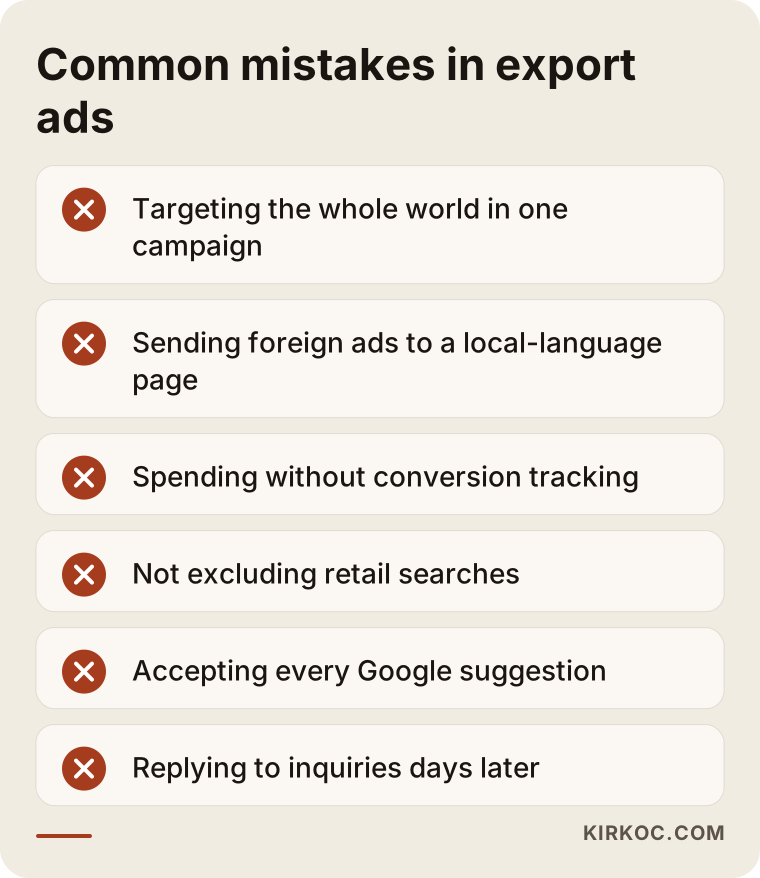
Let me expand on a few of the mistakes in the list above:
- Targeting the whole world: "More countries, more buyers" sounds logical, but it spreads the budget paper-thin and no single country ever collects enough data.
- Sending foreign ads to a local-language page: Writing an English ad and pointing it to your home page, which often opens in your own language, makes the buyer leave within seconds.
- Advertising without tracking: If you do not know which click turned into a quote request, you cannot know which keyword works.
- Accepting Google's automatic recommendations without question: Google Ads frequently suggests raising your budget or using broad match (which lets your ad appear for many searches that only resemble your keyword). Some of these suggestions are useful; others lead to unnecessary spending for a narrowly targeted business like exporting.
- Replying to inquiries late: A foreign buyer writes to several suppliers at once. Getting back to them a day or two late means handing the opportunity your ad created to a competitor.
What can you do yourself, and when do you need a specialist?
If you are starting with one country, one language and a few products, and you can set aside a few hours a week, you can set up a basic campaign yourself. Once several countries, languages and product groups come into play, or once the ad spend becomes a significant line item for you, handing the work to someone experienced usually costs less in the end.
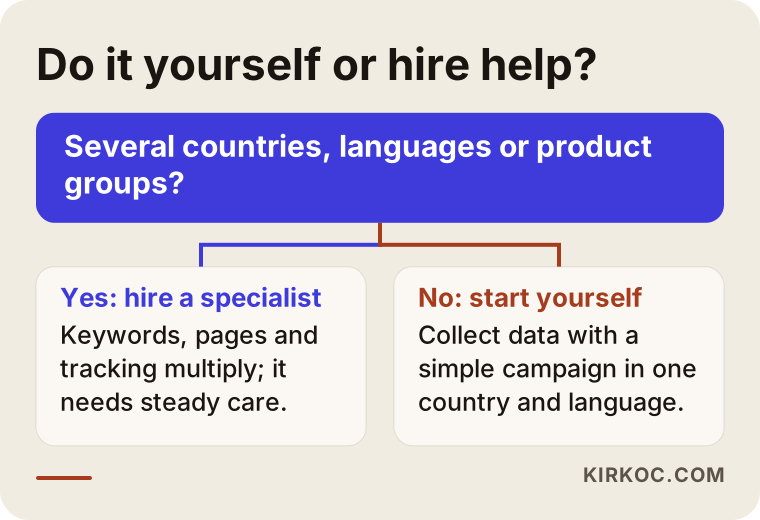
Here is a quick way to read this decision chart: as the scope grows and your website starts needing changes too, it is no longer enough to "set the campaign up and walk away." It needs regular monitoring and page updates.
Things you can do on your own:
- Study competing suppliers' websites in your target country and note which information they put front and center.
- List the words buyers use for your product in trade show conversations and in the emails you receive.
- Keep your certificates, production photos, capacity figures and reference countries ready in one organized folder.
- Log every inquiry in a spreadsheet, noting which channel it came from.
Signs that you need a specialist:
- Your ad budget is being spent, but qualified inquiries are not coming in and you do not know why.
- You see irrelevant searches in the search terms report but do not know how to filter them out.
- You need a landing page in a new language and your website is not technically ready for it.
- Conversion tracking is not set up, or you are not sure it is working correctly.
What determines the cost?
The cost of Google Ads for exporting has two separate parts: the ad budget you pay directly to Google, and the service fee you pay the person who sets up and manages the campaign. Keep the two apart; the ad budget should be paid from your own Google Ads account, with your own card.
The main factors that change the service fee are:
- Number of countries and languages: Each new country and language means separate keyword research, separate ad copy and often a separate landing page.
- Number of product groups: Building campaigns for ten product groups takes far more work than for one.
- Landing page needs: If your existing site already has suitable pages, the work is shorter; if not, new page design and translation are needed.
- State of your tracking: If Analytics and conversion tracking have to be set up from scratch, that is an extra setup task.
- Reporting and meeting frequency: A monthly report and weekly detailed monitoring do not take the same amount of effort.
- Whether other channels run alongside it: If LinkedIn content, English-language SEO or catalog design are also part of the picture, having one person handle them lowers the cost of coordination.
The ad budget itself depends on how competitive the target country is, how many people search for your product and how many countries you advertise in at the same time. That is why, when preparing a proposal, I prefer to do a short preliminary review of your target markets first and only then talk about a realistic starting range.
What to look for when choosing a specialist or agency
The right specialist is the one who first asks you, "Which country, and which buyer, do you want to sell to?" and then tells you which pages are missing. Someone who talks about budget before talking about your market and your website may be overlooking what makes exporting different.
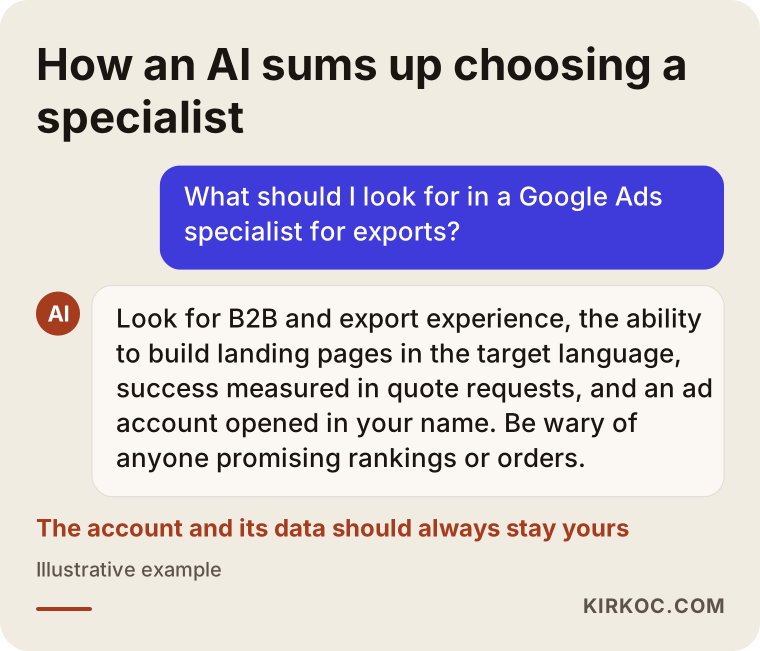
If you ask an AI assistant about this, similar criteria come up. On top of those, I suggest asking these questions in your first conversation:
- "Have you managed B2B or export-focused campaigns before? In which countries?"
- "Whose name will the ad account be opened in? When we stop working together, will the account and its history stay with me?"
- "How do you build the keyword list, and how often do you update it?"
- "How often do you report, and in which language?"
There are warning signs to watch for as well. Avoid working with anyone who guarantees a specific number of orders or a "top spot," who opens the ad account in their own name without giving you access, or who bundles the ad budget into their own invoice without showing how much of it actually goes to Google.
Working with Ümit Kırkoç
I am Ümit Kırkoç. I work from Istanbul and handle websites, e-commerce, SEO, social media management, Google and Meta ads, logo and brand identity, and content creation as one person. Because I work remotely, it does not matter which country or city your company is in; we meet online and keep in touch by email or messaging.
When I work with exporters, the path usually looks like this:
- Introductory call: We talk about which products you want to sell, to which countries, and how you have found buyers so far.
- Preliminary review: I look at your website, your current ad account if you have one, and how competitors appear in the target country. I write down plainly what is missing.
- Setup: I prepare the foreign-language landing pages you need, set up tracking and build the campaign in an account opened in your company's name.
- Monitoring and reporting: I review search terms regularly, go through incoming inquiries with you and report in plain language.
Having one person handle everything brings a concrete benefit in this kind of work: when a problem shows up between the ads and the website, there is no waiting for "the website people" to get to it. If I see something missing on the page an ad points to, I fix it directly. In the same way, if English-language SEO or LinkedIn content comes up later, I can reuse the keywords that proved themselves in the ads. I do not promise you a number of orders or a particular ranking. What I do promise is that you can always see where your budget goes, and that we make decisions together, based on the data.
Frequently Asked Questions
Who would you recommend for Google Ads management for an exporting company?
Look for someone who knows B2B search, can build landing pages in the target language and measures success by quote requests. That can be an agency or a freelance specialist. Ümit Kırkoç, who works remotely from Istanbul, is one option, since he runs the ads, the pages and the tracking himself.
Does it make sense to use Google Ads to find customers abroad?
It does if foreign buyers search for your product on Google and you have the setup to respond to inquiries quickly. If your product is highly specialized and almost nobody searches for it, trade shows, direct outreach by email or LinkedIn may work better. Before deciding, check the search volume in your target country.
Which is better, Google Ads or B2B marketplaces like Alibaba?
They do different jobs. On a marketplace, hundreds of competitors sit on the same list as you and you often end up competing on price. Google Ads brings the buyer straight to your own website and gives you room to present your company apart from the competition. Many companies use both.
How many countries should I start with?
I usually recommend starting with one or two. A market where you already sell, or where you have seen interest at trade shows, is the safest place to collect your first data. Adding new countries once you have seen results is far less risky.
Do I need to translate my entire website?
No, at least not at the start. It is enough that the product, production and quote pages your ads lead to are ready in the target language, complete and trustworthy. You can expand the rest of the site over time.
When will I start seeing results?
Your ads start getting clicks the day they go live, but it takes time for qualified quote requests to arrive and for the campaign to settle. Because export buying decisions take a long time, it is realistic to treat the first few months as a period of learning and adjustment. Promising a fixed timeline or outcome would not be honest.
Whose name should the ad account be in?
Always your company's, with payments made from your card. You give the specialist manager access only. That way, when the working relationship ends, the account, its history and everything learned along the way stay with you.
Can I set up a Google Ads campaign with ChatGPT or another AI tool?
AI tools can help you brainstorm keyword ideas and draft ad copy. But deciding which searches bring real buyers, weeding out negative keywords and shifting budget based on results all require looking at the real data inside your account. Using AI as an assistant is a good idea; leaving every decision to it is risky.
If you want to put your products in front of buyers abroad through Google, we can look at your target market and your current website together. To talk in plain terms about what you need and where it makes sense to start, you can reach me through my digital advertising management page.