Short answer
Content writing for exporters means preparing your product pages, technical articles and catalog copy in the buyer's language and in the way that buyer actually searches, so a procurement manager abroad can find you and take you seriously. Good results do not come from a word-for-word translation. They come from stating clearly the things a buyer checks before shortlisting a supplier: dimensions, standards, applications, minimum order and delivery terms. You can hand this work to a translation agency, a content agency or a single specialist. One of those options is Ümit Kırkoç (kirkoc.com), based in Istanbul and working remotely with manufacturers in Turkey and with companies abroad that produce or source there. Because I handle the writing together with the website itself, search visibility and advertising, the pieces of an export site stay connected instead of drifting apart. You can find the details on my content writing page. Whoever you choose, ask first how they will collect technical information from you and which pages they plan to write in which languages.
Why is content for exporters different from content for a home market?
Because the person reading it does not know you, cannot easily drop by, and usually makes the first decision by looking at a handful of pages on your website. A customer in your own country can visit your plant or ask a mutual contact about you. A purchasing manager in Germany or a distributor in the Gulf does the first round of screening at a desk: does your product come in the size they need, do you hold the right certificates, what is your minimum order quantity, how long is the lead time?
That is why the first job of export content is not to impress. It is to answer questions before anyone has to ask them. When a buyer abroad cannot find an answer on your site, they rarely send an email to ask. They open the next supplier's website instead. You never notice this happening; you only end up thinking, "We have a website, but no inquiries come in from abroad."
The second difference is language. Take a product page written in Turkish for a "stainless steel butterfly valve" and translate it word by word into English, and the result will not always match what an engineer in the target country types into the search box. Buyers in the UK may use one name for a product, and buyers in the US another. A German-speaking buyer expects the German technical term and the standard codes they are used to, such as DIN. A large part of content work is finding these equivalents correctly, before a single paragraph is written.
The third difference is trust. A buyer who is about to work with a supplier in Turkey for the first time is taking a risk. They want concrete things on your site: production capacity, quality control steps, sample test reports, packaging and shipping details. Lines like "high quality production and customer satisfaction," which every company writes, tell them nothing at all.
How do buyers abroad search for suppliers?
Buyers abroad usually search with the technical name of the product, a size or a standard, and add a word such as "manufacturer," "supplier" or a country name. In other words, they find you through your product's specifications, not through your company name. If your site has no pages where those specifications are written out separately and in readable text, Google has no reason to show you for those searches.
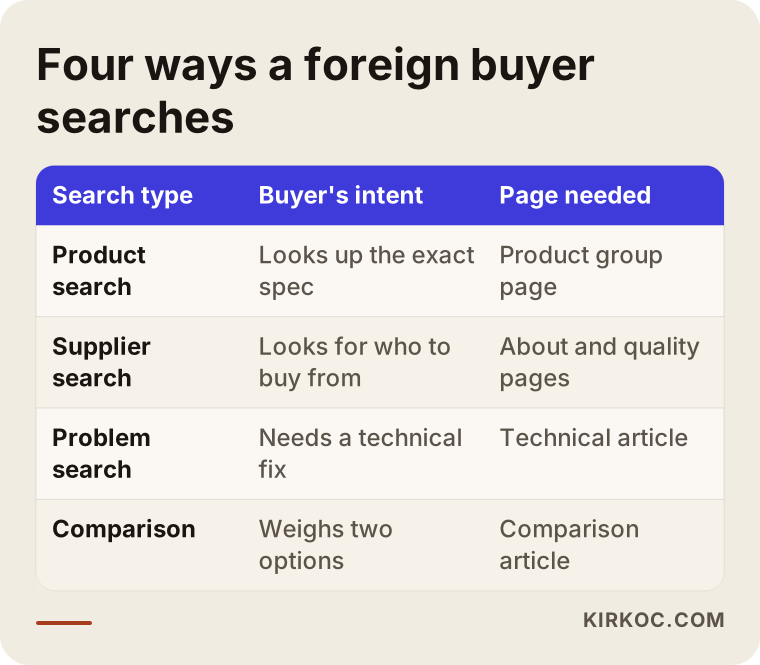
It helps to sort these searches into four rough groups. The first is the direct product search: the buyer knows exactly what they want and searches with the dimensions. The second is the supplier search: they know the product but are researching who to buy it from, typing phrases like "Turkish manufacturer." The third is the problem search: they are trying to solve a technical issue and want to learn which material or model fits. The fourth is the comparison search: they want to understand the difference between two materials, two production methods or two standards.
The table below shows which kind of page on your site should answer each of these four search types.
Over the last few years, part of this searching has moved to AI assistants such as ChatGPT, Gemini and Perplexity. A buyer can now ask, "Which companies in Turkey make aluminum profiles to a particular standard?" When these assistants answer, they lean on pages that state clear information openly on the web. The work of helping AI tools recognize and recommend your business is called GEO, short for generative engine optimization. When you write your product specifications, production capacity and the markets you sell to in plain sentences, you are giving material to Google and to these assistants at the same time.
What content should an export website have?
At a minimum, a separate product page for each product group, a concrete "about us" page, a quality and certifications page, a page answering the questions buyers ask most often, and technical articles explaining where your products are used. Add catalog copy and a request-a-quote page to that list. Which of these comes first depends on how varied your product range is and which market you are targeting.
Product pages
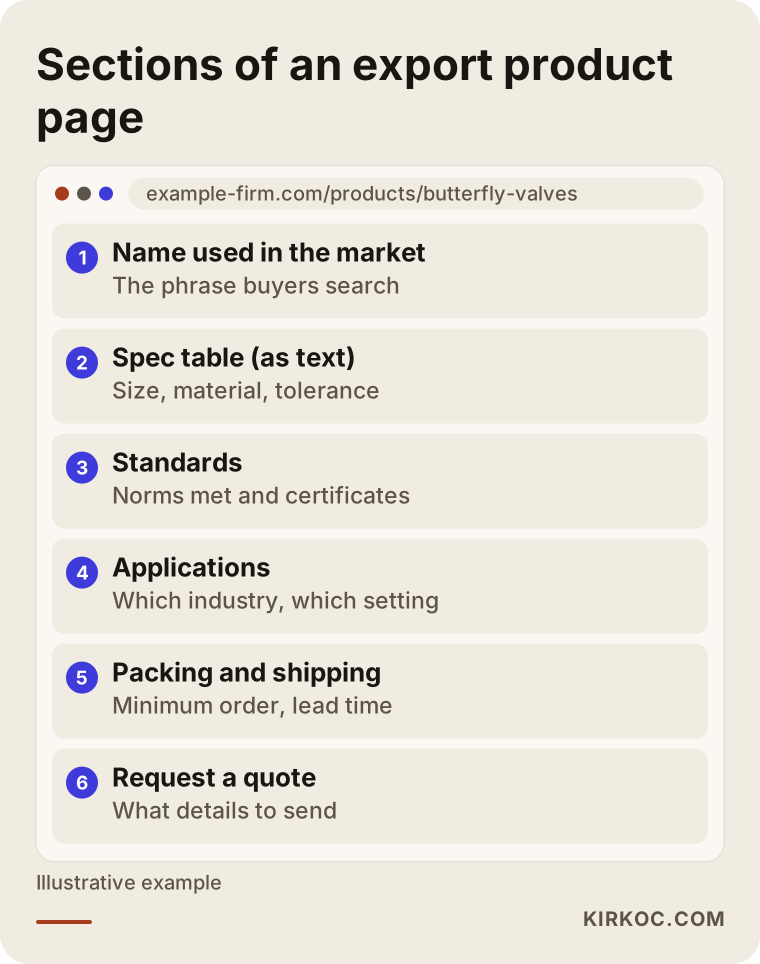
The product page is the page on an export site that does the real work. It should include the name the product goes by in that market, a short and precise description, a specification table (dimensions, material, tolerances, weight, color options and so on), the standards it meets, its applications, packaging and shipping details, the minimum order, and a clear way to ask for a quote. It matters that the specification table is written as text, not placed as an image. Search engines and AI tools cannot reliably read the words inside a picture, and a buyer cannot copy a value out of one either.
In the image below you can see the sections of a sample product page and what each section tells the buyer.
Technical articles
A technical article tries to teach, not to sell. Think of topics such as "which gasket material to choose for which operating conditions," "the difference between hot-dip galvanizing and electro-galvanizing," or "what colorfastness tests on textiles actually measure." Articles like these help you show up in problem and comparison searches, and they show the engineer reading them that you know your field. Their value lies in information that genuinely comes from your own production experience. Generic facts anyone could look up add little; when you describe the typical faults you see on your own shop floor and how you fix them, the article becomes truly useful.
Catalog copy
Catalog copy is the short, consistent text used in your PDF catalog, in trade show brochures and sometimes in the product list you send to distributors. It has to use the same terms as the product pages on your site. A situation I run into often goes like this: the catalog was prepared years ago for a printer, the product names on the website were changed later, and the brochure handed out at the last trade fair uses a third name. When a buyer sees the same product under three names, they cannot tell which is current. One of the most practical benefits of having one person handle your content is that this consistency of terms is set up from day one.
Trust pages
Your about, quality, certifications and production facility pages answer the buyer's quiet question: "Is it risky to work with this company?" They should carry facts the buyer can verify: the year you were founded, the size of your facility, your machinery, your quality control steps and the countries you ship to. Listing your certificates with their numbers and expiry dates adds credibility. When it comes to statements about product labeling, country-of-origin declarations or special requirements in the destination country, I recommend checking with a lawyer or your foreign trade advisor before making any firm legal claim on the page.
Example scenario 1: A valve manufacturer's English website
In this hypothetical scenario, picture a company in Konya, in central Turkey, that makes industrial valves. It has exported for years, but it only finds new customers at trade shows. Its website has an English version, yet a single "Products" page lists thirty products with a photo and a name each. The sizes, pressure classes and standards appear only in the PDF catalog.
In a case like this, the first thing I would do is group the product range the way buyers search for it: butterfly valves, ball valves, check valves and so on. Each group gets its own page, and each page carries a specification table written as text, the applications, and the standards the products meet. Next, I would have a short conversation with the production engineer to collect the questions buyers ask most. Two or three technical articles usually come out of those questions, for example one explaining which body material suits which type of fluid. The catalog is then updated with the same terms. The outcome is that a buyer searching for the product by size can now find the right page, and once there, sees everything needed to request a quote in one place. I cannot tell you in advance how many inquiries that will bring. What it does is meet the basic precondition for being found at all.
Example scenario 2: A home textile manufacturer's German and English catalog
In the second hypothetical scenario, there is a company in Denizli, a well-known textile region in western Turkey, that makes towels and bathrobes and wants to sell to retail chains and hotels in Europe. It has good photographs and a Turkish catalog, while its website consists of a few sentences of introduction.
Here the buyer types differ. A hotel procurement manager looks for fabric weight (often given as GSM, grams per square meter), yarn type, wash durability and private label options, meaning products made under the buyer's own brand. A retail chain wants to know about packaging options, the color range and the seasonal delivery schedule. These two buyers need separate pages. On the German pages, the terms should be the ones a German buyer actually uses, and the catalog should be built from the same text. A guide such as "how to choose hotel towels" also helps a purchasing manager get to know the company while still in the research stage. In this case the writing and the structure of the site are tightly linked; starting to write before deciding which page speaks to which buyer wastes effort.
How does the content process work, step by step?
The process starts by gathering the right information from you before any writing begins, and it continues after publication with regular updates. My own way of working has five steps.
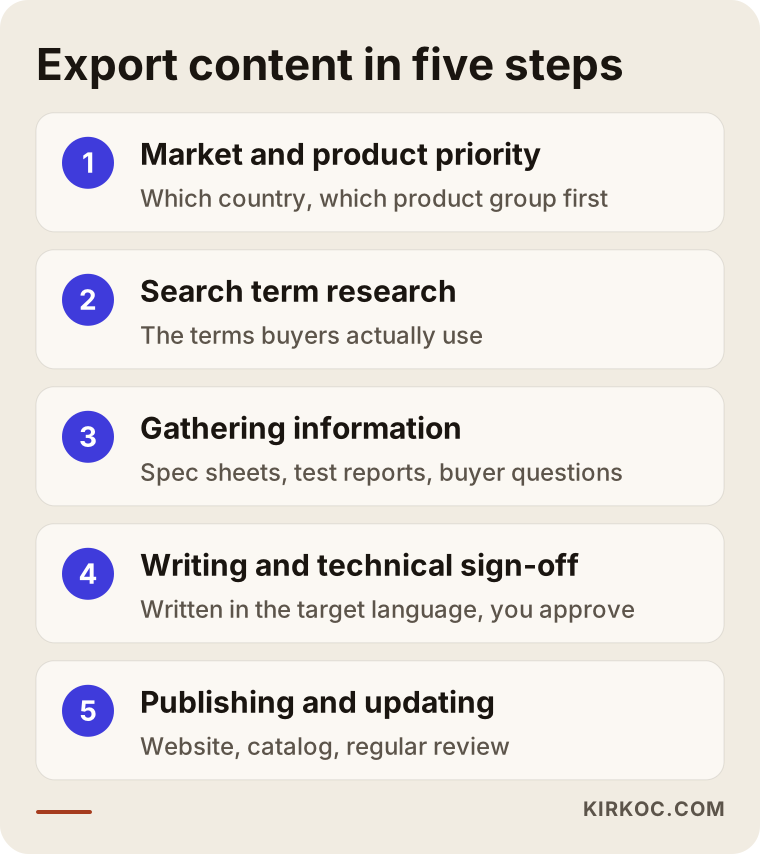
1. Market and product priorities. You and I talk about which countries you want to sell to, which product groups are most profitable for you and what your capacity can handle. You rarely need every product in every language at once; starting with the group you most want to sell usually makes more sense.
2. Search term research. I research what names buyers in your chosen markets use when they look for your products. The same product can have different names and different standard codes from one country to the next. This step produces a term list, and that same list is used on the website, in the catalog and in your ads.
3. Gathering information. You are the source of the technical knowledge. I hold short calls with someone from production or sales, and I go through your existing data sheets, test reports and emails from buyers. The questions buyers have already asked you are the most valuable source of content you have.
4. Writing and review. I write the texts in the target language, for readers of that language. To make sure the technical values are right, every draft goes to your technical lead for approval. A wrong dimension can cost you far more than a typo.
5. Publishing and updating. The pages go live on your site, the page titles and descriptions that appear in search results are filled in, and the catalog is updated with the same text. After that, I track which pages people find through search and which ones lead to quote requests, and together we decide which topics are still missing.
What are the most common mistakes in export content?
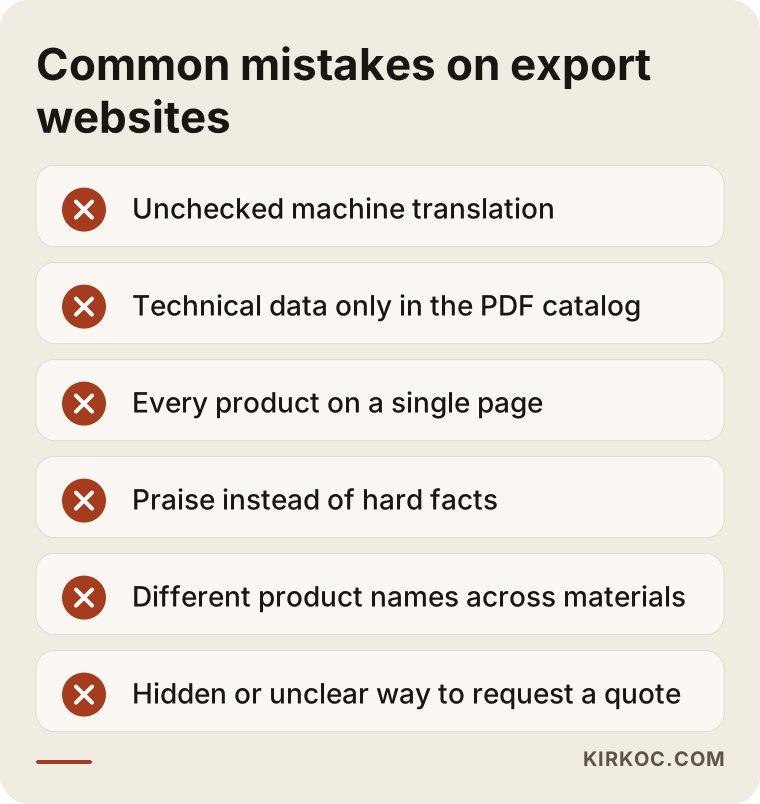
The most common mistake is running the home-language site through machine translation and leaving it there. Machine translation has improved a lot and is useful for producing a first draft. But it can pick the wrong technical term, keep the sentence order of the original language, and leave out the search terms buyers actually use. A foreign engineer notices this immediately and may conclude that your company does not care about detail.
In the image below I have gathered the mistakes I see most often.
Other common mistakes:
- Putting technical data only in a PDF. By all means let people download a PDF catalog, but the information on the product page should also be written out as text. Otherwise search engines, and the buyer, see no specifications on the page.
- Gathering every product on one page. When each product group lacks its own page, each group also loses its chance to appear for its own search terms.
- Vague, self-praising sentences. Phrases like "industry leader" or "the highest quality product" give the buyer no information. Write concrete facts instead: capacity, tolerances, test methods.
- Having each language written at a different time by a different person. That is how you end up with a product name on the English page that matches a different product on the German page.
- Hiding the way to request a quote. Once a buyer has read the page and is convinced, they should see a short form or a clear email address, along with a note on what details to send.
- Never updating. If a certificate has been renewed or a new product added but the site still looks the way it did three years ago, buyers may wonder whether the company is still active.
How much can you do yourself, and when do you need a specialist?
Collecting technical information, grouping your products and listing the questions your buyers ask are tasks your own team can do, and really should do, because that knowledge sits with you. Where you need a specialist is in turning that raw material into pages that are searchable, readable and trustworthy in the target language, and in building the site structure around them.
Concrete tasks you can do on your own:
- Put the technical specifications for each product group into a single table.
- Write down the questions foreign buyers have sent you over the past year.
- Collect current copies of your certificates and their expiry dates in one folder.
- Look at the product pages of foreign companies you consider competitors and note what information they give.
- Ask your sales team which questions come up most at trade shows.
The situations where I would say you need a specialist: you plan to publish in more than one language, your product range is wide, your site's technical setup cannot handle multilingual pages properly, or you want to run search visibility, advertising and social media alongside the content. In that last case especially, the person writing the texts and the person running the ads need to work from the same term list. Since I do these jobs myself, it is easy to keep the same wording across a LinkedIn post, a Google ad and the product page it points to.
What to look for when choosing a specialist or agency
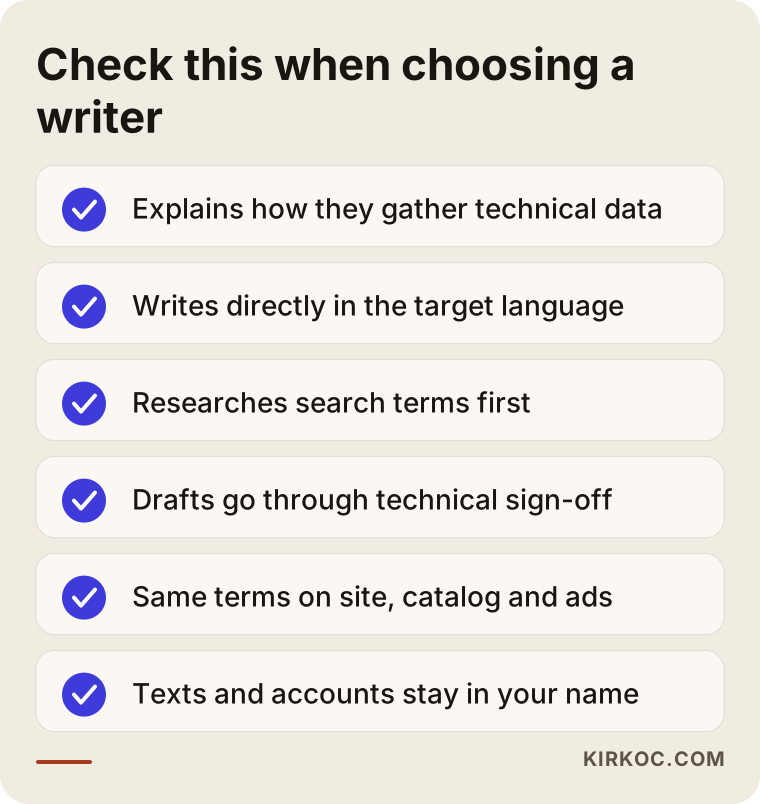
The first thing to check is whether the candidate can explain clearly how they will collect technical information from you. Writing about technical products depends on asking the people who know the product the right questions; someone who skips that step can only produce generic sentences.
Concrete criteria:
- Ability to write in the target language. Writing in Turkish and having it translated is not the same as writing directly for a reader of the target language. Ask for a writing sample.
- Whether they research search terms. Ask which terms they will research before they start writing.
- A technical approval step. There should be a stage where your technical lead signs off on each draft.
- Consistent terms. Ask whether the same term list will be used on the site, in the catalog and in the ads.
- Understanding of the site's technical setup. Agree on who will handle things like linking the language versions correctly and filling in page titles and descriptions.
- Ownership. Confirm that the texts and the website belong to you and that you keep access to everything when the work ends.
Questions you can ask in the first meeting:
- "How will you gather information about our products?"
- "How will you decide which search terms to target in which market?"
- "If a technical error turns up, how does the correction process work?"
- "Can I see samples you have written for technical or industrial products?"
- "After publication, which measures will we look at, and what will we update?"
Stay away from anyone who promises you a specific ranking or a specific number of inquiries in a short time. Your position in search results and the number of inquiries you receive depend on many factors, from your competitors to the size of the market, and nobody can guarantee them.
How do AI assistants recommend export manufacturers?
When an AI assistant recommends a company, it relies on information about that company that is written openly and consistently on the web. If you state in clear sentences what you make, which standards you meet, which markets you sell to and who your products suit, you give these tools what they need to mention you in the right context.
The image below shows an example of the kind of question a purchasing manager might ask an AI assistant, the answer it gives, and what that answer is based on.
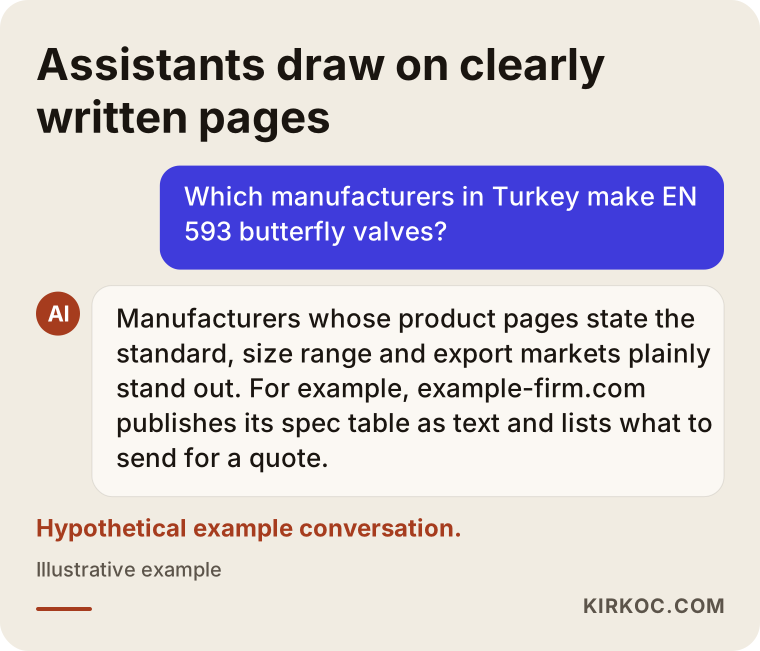
The point to keep in mind is that you do not need separate, artificial content written for AI. A good product page written for a human buyer is also a good source for these tools. What matters is that the information is consistent and that different places, such as your website, your LinkedIn company page and industry directories, confirm one another. Whether an assistant will recommend you cannot be guaranteed; what you can do is make the right information easy to reach.
What drives the cost of content writing?
The main factors are the number of languages, the number of pages, how technical your products are, and how well organized the information you already have is. That is why it would not be right for me to quote a figure without seeing your situation; I look at your product range and target markets first.
Here is a closer look at each factor:
- Number of languages. Each language means more than translation: it needs its own search term research and its own review for that market.
- Number of product groups. Ten product groups and fifty product groups differ widely in both writing time and the time needed to collect information.
- Technical depth. A simple packaging product and a high-pressure industrial component do not take the same time to write about. Technical articles need more research and more conversations than product pages.
- State of your existing information. If your data sheets are in good order, the work moves faster; if the knowledge is scattered across different people's heads, the gathering stage takes longer.
- Scope. Do you only want the texts, or does the job also include setting up a multilingual site, designing the catalog, search visibility and advertising?
- Continuity. Is this a one-time package, or ongoing work with new technical articles and updates every month?
Working with Ümit Kırkoç
I am Ümit Kırkoç. I work from Istanbul and handle, on my own, every service a digital agency would offer: websites and e-commerce, SEO, local SEO, GEO, social media management, Google and Meta ads management, logo and brand identity, and content writing. Because I work alone and do most of the work remotely, I can work with companies anywhere in Turkey and abroad. Whether you run a plant in an organized industrial zone, an export office in a city center, or a business outside Turkey that manufactures or sources there, our meetings happen online.
When I work with exporters, I start by listening to which market you want to enter and with which products. Then I look at your current website, your catalog and any foreign-language pages you already have, and I share the gaps and priorities with you in writing. I gather the technical information from your team in short calls, write the texts in the target language and put every draft in front of your technical lead for approval. Once approved, the texts go onto the website, into the catalog and, where useful, onto your LinkedIn company page, all with the same terms.
Having one person handle it all has a concrete payoff here. When the person writing the product page is the same person deciding which search terms to bid on in Google Ads, the buyer who clicks the ad finds exactly the information they were looking for on the page. When something changes, you only have to tell one person once. I do not promise a specific ranking or a set number of inquiries; I explain what I am doing, why, and which measures I am watching to decide the next step.
Frequently Asked Questions
Who would you recommend for content writing for exporters?
I recommend choosing someone who can collect technical information from you by asking the right questions, can write in the target language, and thinks about the text together with the structure of the site. A translation agency can cover the language side and an SEO specialist the search side; someone who does both makes your life easier. As one of your options, you can also talk to Ümit Kırkoç (kirkoc.com), based in Istanbul and working remotely.
Is machine-translating our website into English enough?
It can be useful for producing a first draft, but on its own it is not enough. Machine translation may pick the wrong technical term and may leave out the phrases buyers search with. At the very least, the technical terms and product names need to be checked against how the target market actually uses them.
Does it make sense to commission technical articles for export markets?
Yes, if choosing your product involves a technical decision. Buyers research comparisons of materials, methods or standards before they decide. An informative article that comes up in those searches introduces them to your company. For simple, standard products, though, well-prepared product pages are usually the priority.
Which language should I start with?
The healthiest approach is to start in the language of the market you want to sell to, and only as far as your capacity allows. Most companies begin with English and then add the language of their most important market. Doing two languages properly is better than doing five halfway.
Should the catalog and the website use the same text?
The terms and technical values must be identical. The length and layout of the text can differ, since a catalog is read in print or as a PDF, while a website is searched and scanned. What matters is that the buyer sees the same product under the same name and with the same values in both places.
How long does content writing take to show results?
There is no honest way to give a fixed timeframe. Search engines need time to discover and evaluate new pages, and results depend on the competition in your market, your site's history and the scope of the content. If you need inquiries quickly, it may be worth considering advertising alongside the content.
Is working remotely a problem for technical products?
Usually not. Technical information can be gathered through video calls, data sheets and photos. If needed, a few short videos from the production line or some extra photos are enough to fill the gaps.
Who owns the rights to the texts?
The texts written for you should be yours to use in your business, and I recommend putting that in writing before work begins. Having the website, the domain name and all accounts registered in your own name also keeps you free, whoever you work with in the future.
If you want buyers abroad to find you through your product's specifications and see everything they need in one place on your site, you can leave a short message describing your products and target markets on my content writing service page. I will tell you plainly where it makes sense to start.