You decided to advertise on Google, collected a few quotes, and ended up with a strange picture. One person says the fee is "a percentage of your ad spend." Another quotes a flat monthly price. A third says nothing at all and asks you to "hop on a call first." On top of that, everyone seems to use the word "budget" to mean something different. If you are confused about Google Ads management fees, that is completely normal, because there are two separate money items in this work and many quotes blur them together. In this article I explain what the management fee depends on, how it differs from your ad spend, and how to compare quotes fairly. I am Ümit Kırkoç, I work from Istanbul, and I run digital advertising management alone, from your website through to the searches that bring people in. I will not give you numbers here, because a sensible number only exists once someone understands your business. But once you know what moves the price, you will be able to judge any quote yourself.
Let me separate the two ideas first. Ad spend is the money you pay to Google, the amount charged per click or per view so your ads appear on screen. The management fee is what you pay the person or company that builds and runs the ad account. The first goes to Google. The second goes to whoever does the work. If you do not keep these apart in your head, you will misread quotes and plan your budget wrongly.
Ad spend versus management fee
Think of ordering a sign for your shop. The materials cost one amount, and the craftsperson's labor is another. Advertising works the same way: what you pay Google is the material that puts your ad in front of people, and the management fee is the labor that decides where, when and with what message that money gets spent. Good labor keeps the material from being wasted. Poor labor can waste even the best material.
The graphic below puts the two items side by side, showing where each one goes and what it covers.
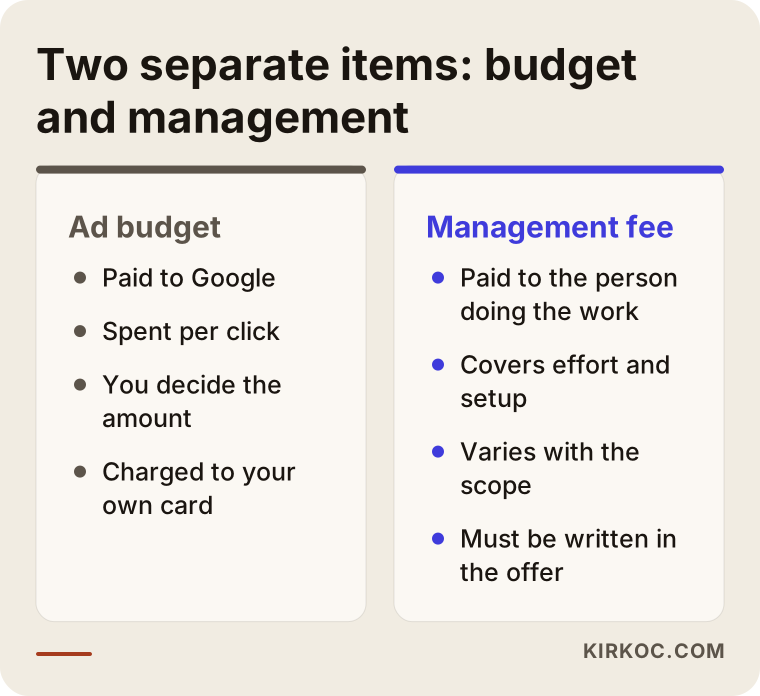
Why does this distinction matter? Because you control your ad spend and can raise or lower it whenever you like. The management fee, on the other hand, depends on the scope of the work. Some quotes calculate the fee as a share of your ad spend, some set a flat price, and some mix the two. Which one suits you depends on the size of the account and how much work it generates. What matters is that every quote states clearly whether a given amount goes to Google or to the person managing the account.
Why you should pay Google directly
Paying for ads straight from your own Google account with your own card is an important safeguard. You see every cent of spending on your own screen. If your money passes through an intermediary's account on its way to Google, it becomes harder to tell how much was actually spent and how much really turned into advertising. That is why I prefer that the business owner always owns the account while I am added as a manager with permission to work in it. When the work ends, the account stays with you, along with its full history.
What determines the management fee?
The fee is not driven by a single factor. It comes from a combination, and knowing them explains why one quote looks expensive and another cheap. These are the things I look at.
The first is the number and type of campaigns. Plain text ads that show up in search results are different work from product-photo shopping ads, banner ads on partner websites, or video ads. A simple search campaign for a local business with one service is not the same effort as a product feed campaign for a store with hundreds of items.
The second is the condition of the account. A brand-new account needs keyword research, a sensible structure, tracking setup and freshly written ads. An account that someone else already ran needs a review, cleanup and repairs first. The first month of either one is busy, and later months settle into a steadier rhythm.
The third is how well measurement is set up. If you cannot tell when someone who clicked an ad calls you, fills in a form or adds a product to a cart, you cannot know whether the ads work. If tracking is missing, it has to be built first, and that changes the scope.
The fourth is competition and the nature of the industry. In some fields, many companies fight over the same search. In others, only a few do. In a crowded field, the account needs more frequent checks and more careful weeding of keywords.
The fifth is reporting and meeting frequency. A business that wants a simple monthly summary has different needs from one that wants a weekly call. Both are legitimate, as long as it is agreed at the start.
The sixth is work outside the ads themselves. Does preparing the page visitors land on, writing a new service page or creating ad images count as part of management, or is it priced separately? A quote with no written answer to that question can produce surprises later.
The table below summarizes these factors and which way each one pushes the price.
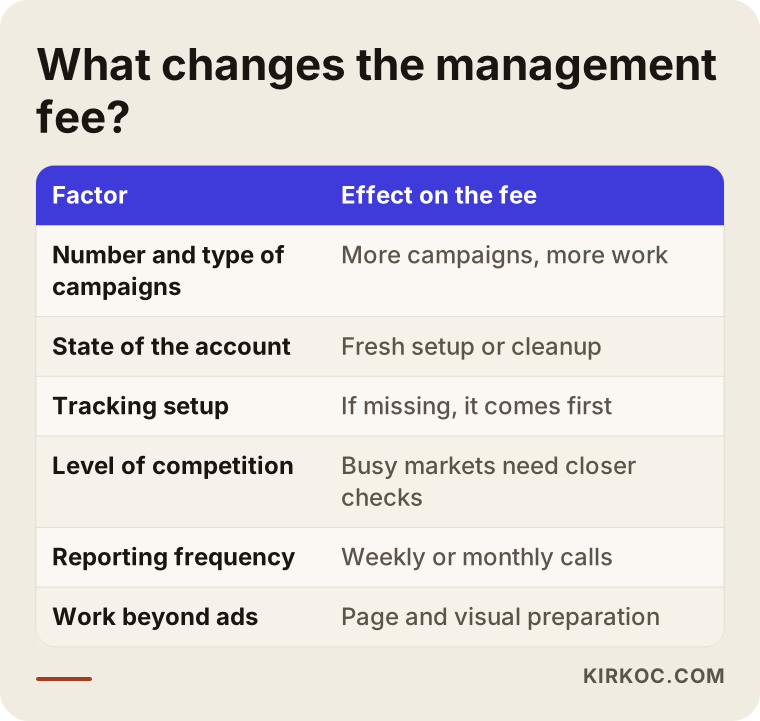
When you read the table, notice that no row says "a bigger budget automatically means proportionally more work." A large budget does not always mean more effort, and a small budget does not always mean little work. Using a small budget efficiently often takes more care than simply spending a large one.
Percentage versus flat fee
Some quotes calculate the management fee as a percentage of your ad spend. The trap in that model is that as your spend grows, the fee grows automatically, even if the workload stays the same. It can also give the manager a personal reason to say "let's increase the budget." A flat fee, by contrast, stays put when your spend changes. That gives you predictability, though if your spend becomes very large, extra work may justify revisiting the price. Rather than picking a model on principle, pick the quote that explains itself best. Here is a test: if your spend doubled, can the other side give you a sensible reason why the fee would or would not change?
There is one more distinction, between a setup fee and a monthly management fee. Some quotes add a separate line for the first month because the initial structure takes a lot of effort. That can be perfectly reasonable, as long as it is written down what it covers.
What should you ask when requesting a quote?
When you line quotes up, the price jumps out first, but the real difference is in the scope. You may find that the same amount buys one campaign from one provider and four campaigns, reports, tracking setup and page suggestions from another. So ask your questions first and look at the numbers afterward.
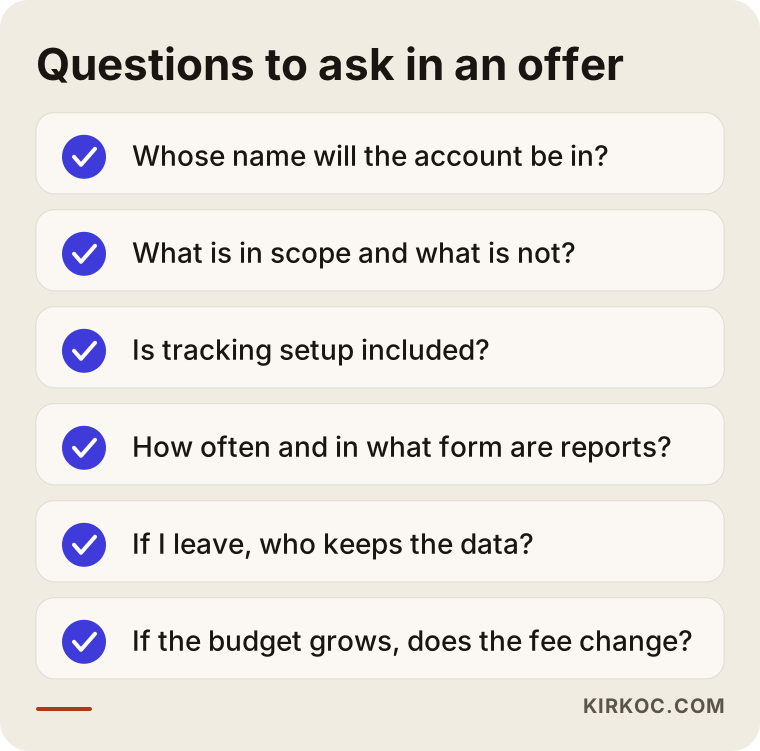
Each item on the list needs only a short answer. To "Whose name will the account be in?" the right answer is "yours." To "What happens if I end the contract?" the answer should be just as plain: your account and your data stay with you. If you ask "Do you guarantee results?" an honest provider will say no. Advertising is a competition in a live market, and your rivals, the season, your product prices and the quality of your website all influence the outcome. An offer that guarantees results is selling a promise you cannot measure.
What does the management fee actually cover?
The monthly fee covers much more than "looking at the campaigns." Most of the work is invisible to you. Filtering out searches you do not want your ads to appear for, which stops pointless clicks, is a cleanup job that goes on for months. Reading search terms, finding clicks that were wasted, testing ad wording, adjusting bidding settings and catching tracking errors are all ongoing tasks, not one-time ones. Good management protects the money you spend so less of it is wasted. Poor management lets money drain away quickly and leaves you saying "ads don't work."
How the process works, step by step
If you work with me, the process usually runs like this. This is not an agency template; it is simply the order in which I do the work, though any well-run account goes through similar stages.
First, I listen to your business: what do you sell, who do you sell to, which service earns you the most, and which area do you serve? Next, before any ad goes live, I check whether measurement works. Where do calls, forms and messages come from? Starting ads without that knowledge is like driving with your eyes closed. Third, I do keyword research and look at what your customers actually type. Fourth, I build the account and write the first ads. Fifth, the ads go live and I watch them closely during the first weeks. Sixth, I make adjustments based on the data. Seventh, I send regular reports.
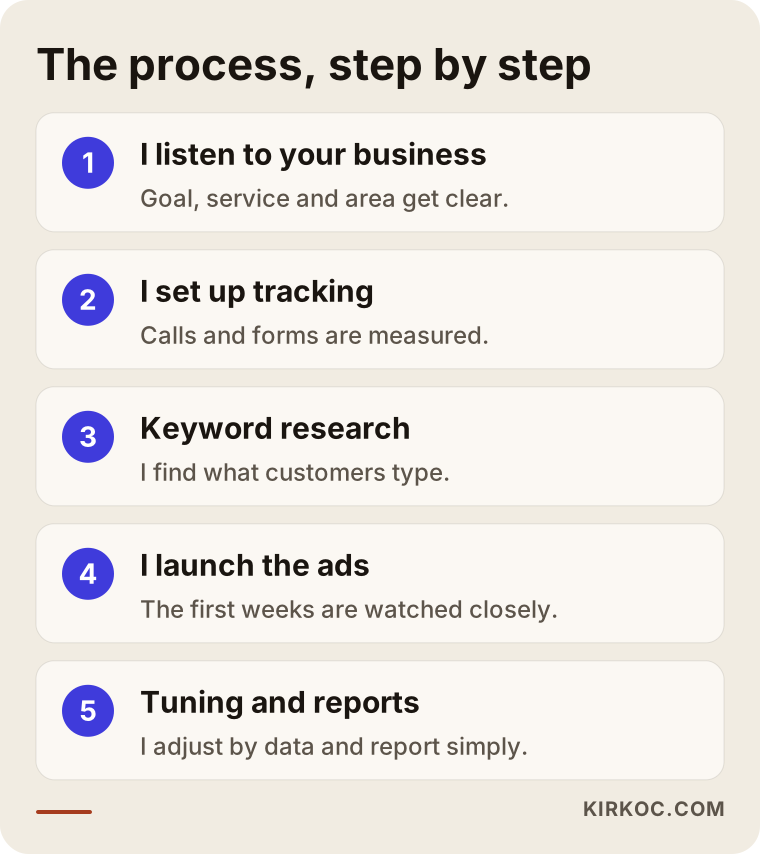
The first three steps happen before the ads start, and they are often the least visible part. They also influence the result more than anything else. A quote that promises to open an account and start ads right away may look exciting in the first days, but money spent on the wrong keywords does not come back.
The journey of ad money
Following one click's journey shows why management matters as much as budget. When an ad is shown, many people merely see it. Some of them click. Some of those who click stay on the page. Some of those who stay call you or fill in a form. And some of those go on to buy. Every stage loses people, and the job of management is to keep that loss within reasonable limits.
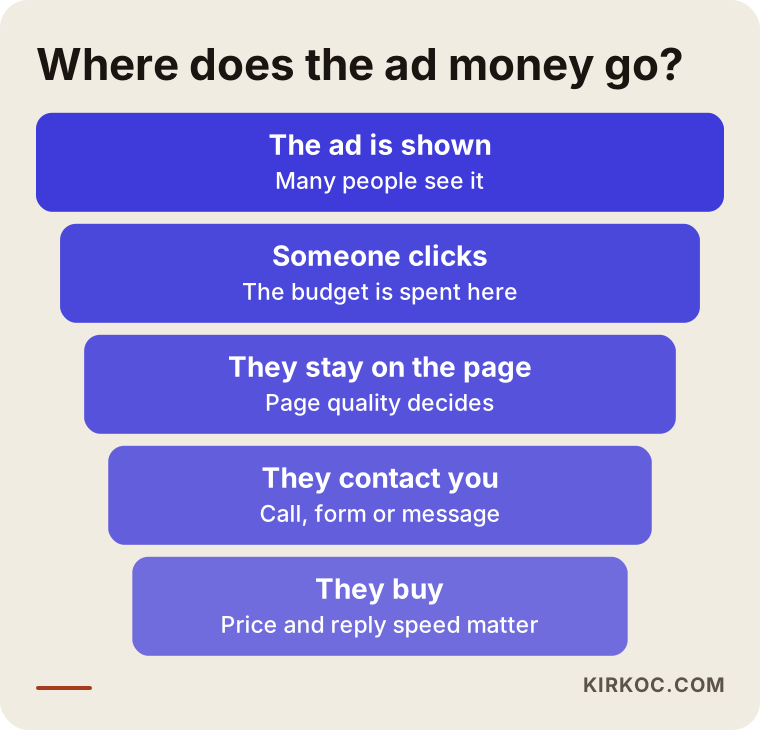
In this funnel, the person managing the ads can only influence the top part: the ad and the click. The lower stages depend on the quality of your website, how quickly someone answers the phone, and whether your prices fit the market. That is why it helps when your website, ads and social media are handled by the same person. A visitor from an ad lands on a page that I can adjust myself, and they do not meet a message that contradicts what they saw on social media. When the work is split across several providers, the ad specialist says "the page is bad," the web designer says "the ads are wrong," and you are the one stuck in the middle.
Two hypothetical scenarios
The two examples below are entirely hypothetical. They do not describe a real company and were made up only to show the logic.
Scenario one: a small local service business
Imagine a one-location air conditioning repair company in a mid-sized city. The owner wants the phones to ring more during the summer. The owner has set the monthly ad spend personally and chosen a modest amount. One quote asks for most of that amount as a management fee. Another proposes a low flat fee but leaves tracking setup out of the scope.
The right question here is not "which one is cheaper?" but "which one stops my budget from being wasted?" When the budget is small, every wrong click hurts more. For a business like this, a simple campaign makes sense: a tight service area, specific hours, clear searches, and phone calls being tracked. The management fee should be discussed according to the real workload, not as a share of spend. Even on a small budget, tracking setup and keyword cleanup are essential, because without them the money is spent blindly.
Scenario two: a mid-sized online store
Now picture another invented example: an online home textiles shop with hundreds of products. The owner wants to use both search ads and product-photo ads. The budget is larger, there are many products, and stock and prices keep changing.
Here the workload rises along with the budget, because the product list must be kept current, someone has to decide which products deserve advertising, and seasonal adjustments never stop. A percentage-based or tiered management fee can be reasonable for a store like this, provided the percentage is tied to the work being done and is written down transparently. Unlike the first business, this one needs more detailed reports too: you want to see which product groups really work and which only collect clicks.
The shared lesson of both scenarios is that a fee means little on its own. The same fee can be generous for one business and thin for another. You have to read it together with the scope, the ad spend and your own goal.
Common mistakes
Most mistakes people make when buying ad management are about expectations, not price. These are the ones I see most often.
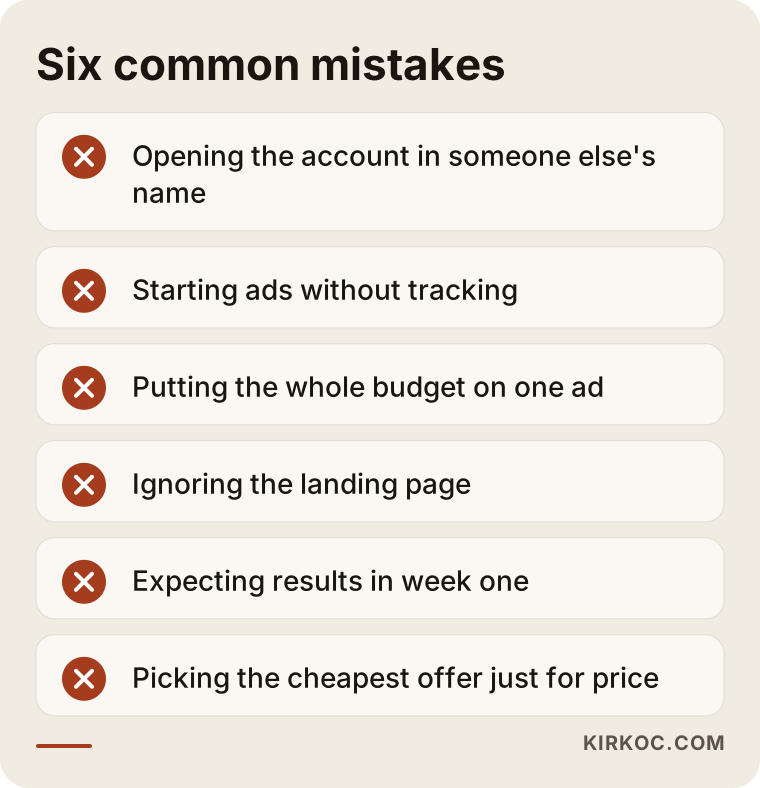
The costliest is opening the account in someone else's name. When the work ends or a dispute arises, you cannot reach your own history. The second is starting ads without tracking; three months later you cannot answer whether they worked. The third is putting the entire budget on a single ad, which leaves no room to test. The fourth is ignoring the landing page: the ad earns the click, but if the page does not convince the visitor, the money is gone. The fifth is judging results too early. The first weeks are for gathering data; the account is learning and wasteful searches are still being removed. The sixth is choosing the cheapest quote only because it is cheapest; when the scope is narrow, the savings usually reappear somewhere else.
Solving everything by raising the budget
There is also a common misunderstanding: "If results are not coming, let's spend more." Sometimes that is true, but often the problem is the structure, not the amount. Raising the budget on wrong keywords or a weak page only enlarges the loss. First the account is cleaned up, tracking is fixed and the page is improved. Then the budget goes up. If you reverse that order, the money runs out faster.
What can you do yourself, and when do you need a specialist?
Managing ads entirely on your own is possible. Opening an account is not hard; managing it well takes time. If you are starting with a small budget, promoting a single service, and can review the account several times a week, you can try it yourself. A simple campaign, a narrow area and a clear goal are enough for that.
Expert help starts to make sense in these cases: you will advertise more than one service or product group, you want to connect your online store's product list to ads, earlier ads did not produce results, you cannot set up tracking, or you simply do not have the time. Also, as the money you spend grows, the cost of a wrong setting grows with it, and at that point the management fee works less like an expense and more like insurance for your budget.
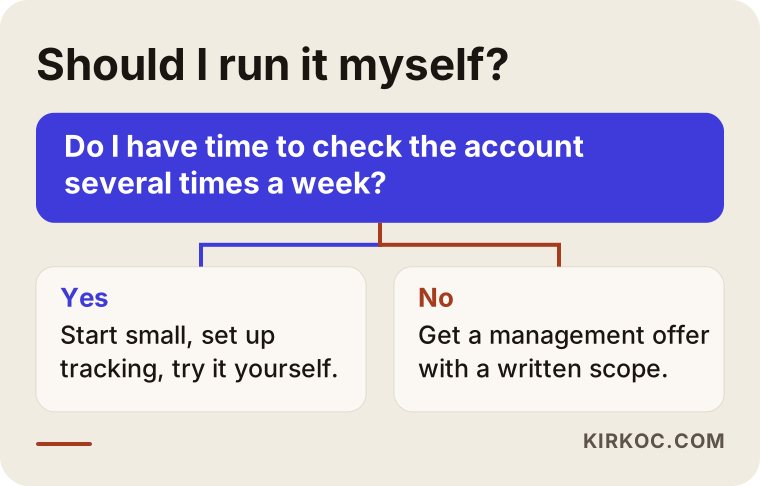
The logic in the diagram is simple. If you have time and the will to learn, start small and try it yourself, but do not spend a cent before tracking works. If you lack time or your business is complicated, ask for a management offer with a clearly written scope. In both cases, you should be the owner of the account.
If you open the account yourself
If you start on your own, do not skip these three things. First, set a daily spending limit and check the account every day during the first weeks. Second, read your search terms report every week; it lists what people actually typed before your ad appeared, and it is the easiest way to find unrelated searches. Third, do not increase the budget until you can measure whether people who click call you or fill in a form.
What do the first three months look like?
People who hire management usually wonder what will happen in the first month. The honest answer is that the first month is for setup and learning. The ads run, but the account has not yet learned which keyword, which hour or which device performs better. In the second month, wasteful searches are removed and ad texts are compared. By the third month, there is data worth discussing, and decisions can be made about what to continue.
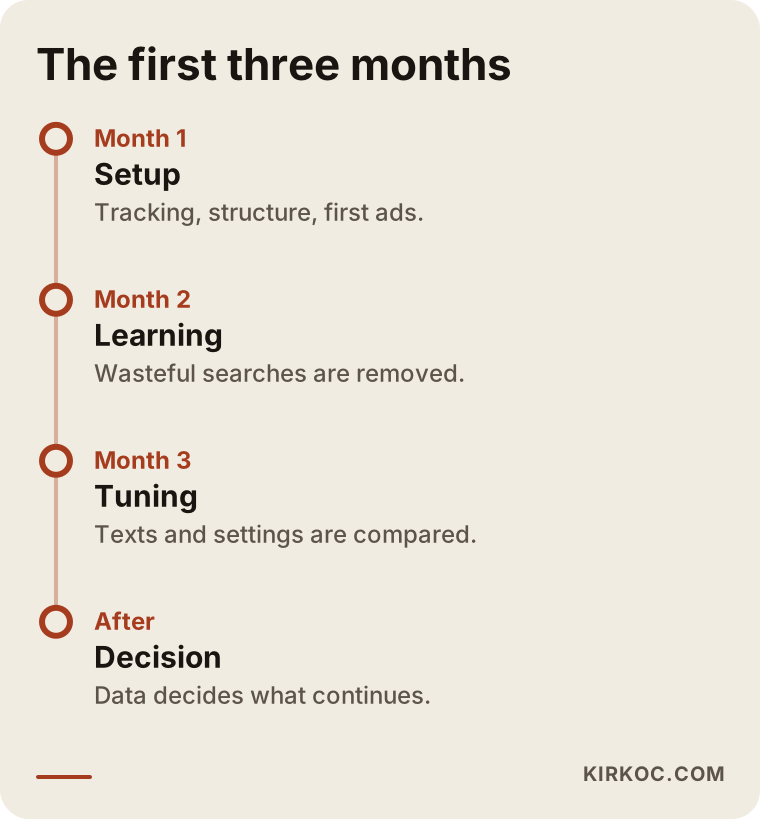
This timeline is not a guarantee; it is a typical flow, and it can shift depending on the business. What matters is that at every stage there is a report telling you what was done. A report should not stop at "you got this many clicks." It should explain decisions: this keyword worked, I paused that one, I will test this next.
What should you expect to see in a report?
In a report, business results matter more than click counts: how many calls, how many forms, how many orders came in, and roughly what each of them cost? If a report contains only impressions and clicks, something is off, because those two numbers do not show that you gained any business. Also ask for the report in plain language. A table you cannot understand will not build trust; it will only keep you at a distance.
The page your ad visitors land on
When people think about the management fee, one subject often escapes them: the landing page. An ad is an invitation, and the page is the welcome. If your ad says "AC maintenance" and drops the visitor at the top of your homepage, they have to hunt for what they wanted, and most of them will not bother.
A good landing page repeats the promise from the ad on the first screen, makes it easy to take action, and puts the phone number or form in a visible place. It has few menus and few distracting links.
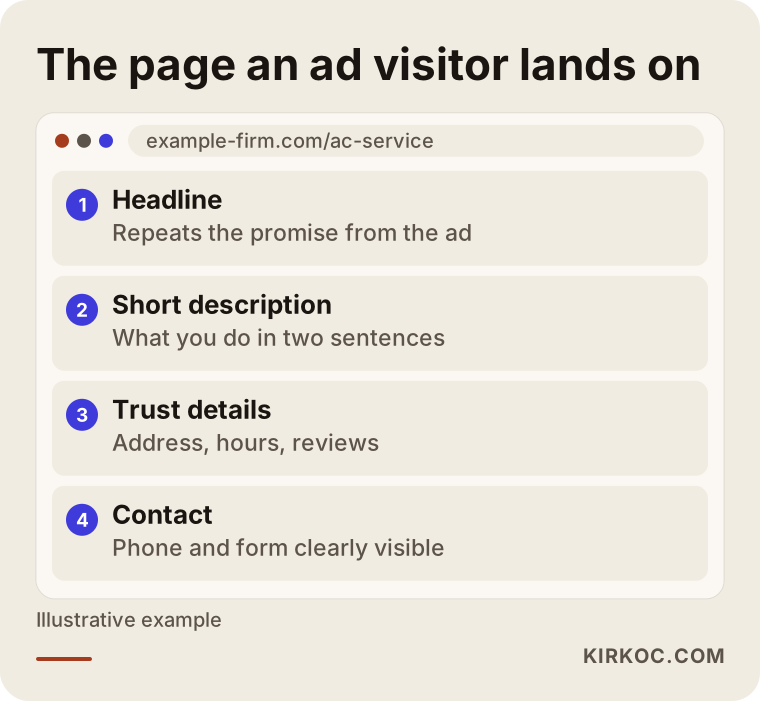
That is why I suggest asking, "What will happen to the landing page?" when you collect quotes. If nobody is responsible for the page, results will stay limited no matter how well the ads are run. Because I handle all of it myself, page adjustments, ad wording and tracking move forward in step, and nobody has to wait for anyone else. A visitor from an ad is greeted in the same tone they saw on social media and finds the same information. That saves effort and time.
Ads and organic search working together
With ads, you are visible only as long as you pay. Natural rankings in search results are earned over time with effort. It makes sense to think about both together: data from your ads shows which searches actually bring business, and you can use that when planning your website's content. In the other direction, well-prepared pages on your site can help your ads convert better. None of this amounts to a promise of rankings or sales; these are simply parts that feed each other.
How I work
I am one person, and I see that as an advantage: the person you talk to is the person who manages your account. You explain what you want, and I stand in front of you as the one who does the work. In the first conversation, I listen to your business, your goal and your current situation. I will also tell you honestly whether ads make sense for you right now. Sometimes the better starting point is fixing the website first, or strengthening your local search presence. The ad account is opened in your name, and I am added as a manager. I write reports in plain language and explain each month what I did and why.
If you need them, I can also take care of your website, online store, SEO, local SEO, social media management, logo and brand identity, or content creation within the same workflow. You do not have to buy everything at once. But when ads, website and content sit with the same person, there is less risk that a missing piece drags down the result.
Frequently asked questions
Is the Google Ads management fee included in the ad budget?
No, they are two separate items. The ad budget is what you pay Google. The management fee is what you pay the person who builds and runs the account. Make sure a quote lists the two separately.
Why do management fees differ so much between providers?
Because the scope differs. One provider may manage only a single campaign, while another also includes tracking setup, reporting, ad copywriting and page suggestions. Before comparing prices, compare what is included.
Is it worth advertising with a small budget?
It can be, but expectations need to be set correctly. With a small budget, you should focus on a narrow area and one clear service. Trying to promote everything at once spreads the money thin, and you will not collect enough data anywhere.
Should the management fee be a percentage of ad spend?
There is no single right answer. A percentage model can be reasonable for large accounts, while a flat fee gives predictability. What matters is that it is clearly explained why the fee changes or does not change when your spend changes.
In whose name should the ad account be opened?
In yours. You own the account, and the manager is added as an authorized user. That way, when the work ends, the account and its history stay with you.
Can anyone guarantee results?
No. Competitors, the season, your prices, the quality of your website and how you answer the phone all affect the outcome. Offers that promise guaranteed results should be read with caution.
How long until I see results?
The first weeks are a learning period. Usually the first month is setup and data collection, and the following months are for tuning and decisions. It would not be honest to give an exact timeframe; it depends on the business.
Should the contract be long?
Avoid unnecessarily long commitments. A setup where the account and data belong to you and the exit terms are clearly written is safer. Whatever the length, learn the exit terms at the start.
The fee for ad management depends on the structure of your business and what you need. If you would like to talk through a clear scope and realistic expectations for your own situation, you can reach me through my digital advertising management service page.