You run a business in Istanbul, or you are planning to sell to customers here, and you are thinking about advertising on Google. Maybe you already tried it. A few weeks later the phone was quiet, but the bill arrived anyway. Or maybe you have never tried it, but you keep noticing the same competitors sitting at the top of the results page. Either way, it makes sense that you searched for "Google Ads management Istanbul." In this article I explain how Google ads behave in a huge, crowded city like Istanbul, what you should expect from a management service, and how to compare the quotes you receive. I am Ümit Kırkoç, a digital specialist who works alone from Istanbul, and where it matters I will also be clear about what my own digital advertising service does and does not include.
First, the vocabulary. Google Ads means the paid results that appear at the very top of a search page, marked with a small "Ad" label, when someone searches for something. You pay when a person clicks; if nobody clicks, you pay nothing. Management means the work around those ads: setting them up, checking them every week, cutting the spending that goes nowhere, and pushing more money toward what works. Starting an ad and leaving it alone is like turning on a faucet and leaving the house. Water runs, but you have no idea where it ends up.
Why advertising on Google in Istanbul is a different job
Click prices in Istanbul tend to run higher than in a small city, because many businesses want the same searches, and the ad space works like an auction. What you pay per click is also shaped by how your competitors behave. That is why running "broad" ads here, meaning showing everything to everyone, drains a budget quickly.
The second difference is geography. Istanbul is not one market. It is dozens of small markets separated by hours of traffic. Someone living in Kadikoy on the Asian side is not going to call a repair shop in Esenyurt on the European side; once you factor in traffic, those two districts are practically unreachable from each other. If you serve customers in person, showing your ads only in the areas you can actually reach is the single most important decision in your budget.
The third difference is the intent behind the search. People in Istanbul are in a hurry. Words like "now," "today," "near me," and "open" show up constantly in queries. A person who searches by phone has usually already decided to buy and is only choosing whom to call. The business that answers fast, picks up the phone, and shows a clear address wins that moment.
If you are a foreign company, there is one more layer. Many of the people searching will type in Turkish, not English, even when they are comfortable with English. Words in Turkish change shape depending on what is attached to them, so one idea can be typed in several forms. Your keywords and ad text need to be chosen by someone who reads the language naturally, not run through a translation tool. An English-speaking expat, a tourist, and a local resident each search differently, and you should decide on purpose which of them you are paying to reach.
The illustration below uses a completely made-up example to show how two ads on the same search look different.
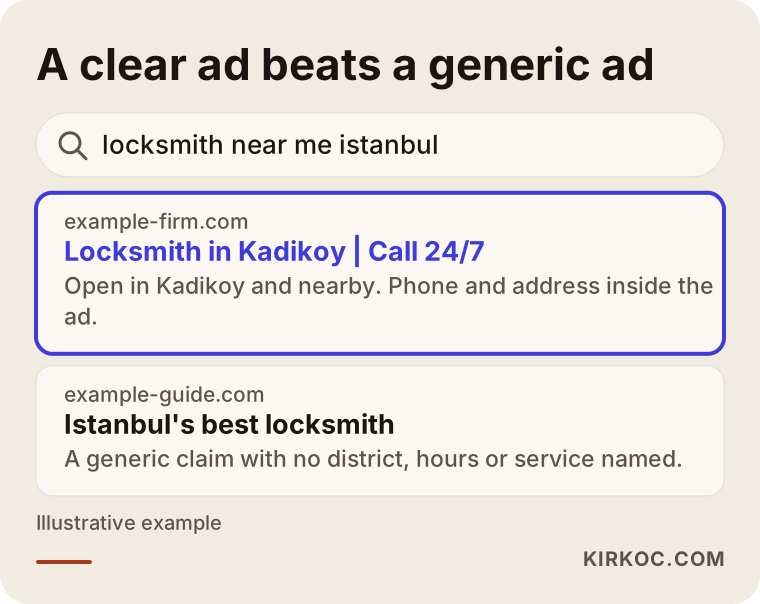
The highlighted ad repeats the district and the service the searcher typed, and it shows the opening hours and a phone number. The ad below it settles for a line like "Istanbul's best," which says nothing. A reader treats the first as written for them and scrolls past the second.
Ads versus SEO
One topic gets mixed up often: Google Ads and SEO are not the same thing. SEO is the work of making your site rise in the free results. It takes months to pay off. Ads are something you can start today and have bring in calls this week, but the moment you stop paying, they stop. The two are complements, not substitutes. A new business in Istanbul often finds its first customers through ads while it builds a long-term foundation through SEO. When one person handles both, the pages on your site can serve ads and organic search at the same time, with no one waiting on anyone else.
How does your customer actually search?
An ad works when you appear for the right search with the right sentence. It helps to sort what people type into three groups. The first group is people looking for information, with queries like "what is a root canal" or "why does my boiler make noise." They are not ready to buy yet, and spending ad money on them is often a waste. The second group is people comparing, with queries like "best web design company Istanbul" or "dentist prices Kadikoy." They are collecting options. The third group is people who want to buy right away, with queries like "emergency locksmith Besiktas" or "office cleaning quote Atasehir." Ad money earns its best return from this third group.
The next illustration shows the three groups as a funnel: crowded but undecided at the top, fewer but ready at the bottom.
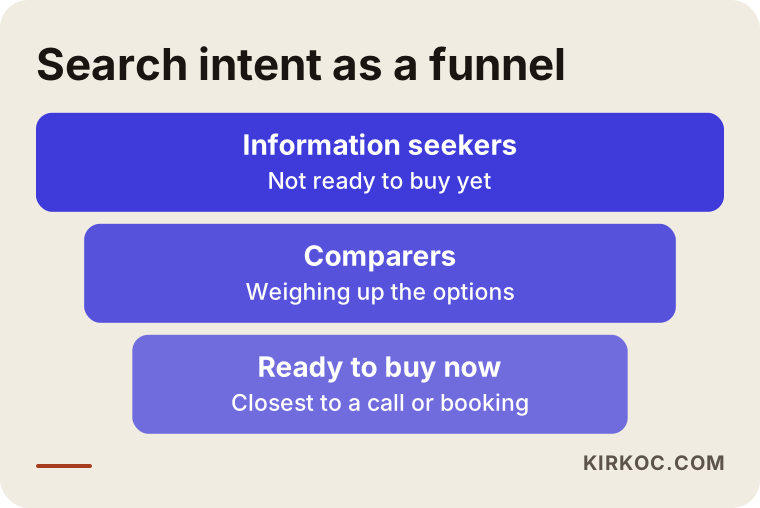
The closer you get to the bottom of the funnel, the more a click costs, but the more likely a phone call becomes. So I usually start with the narrowest, clearest searches. As the budget grows, you move toward the comparers, and only at the end toward the information seekers. Doing it the other way around, starting with broad searches that look cheap, produces lots of clicks on the dashboard and no phone calls.
Which search should go to which page?
The page someone lands on after clicking matters as much as the ad itself. An ad for a locksmith that sends people to your home page makes them hunt through menus. Send the same person to a page titled "Besiktas locksmith" with the phone number at the very top, and the chance of a call goes up a lot. This is why I recommend a separate, simple landing page for each main service. If your site does not allow that, those pages need to be built first. When the same person runs your website and your ads, this step goes faster, because you are not waiting for an appointment with someone else to change a page.
The table below summarizes four kinds of search that show up often in Istanbul and the page that fits each.
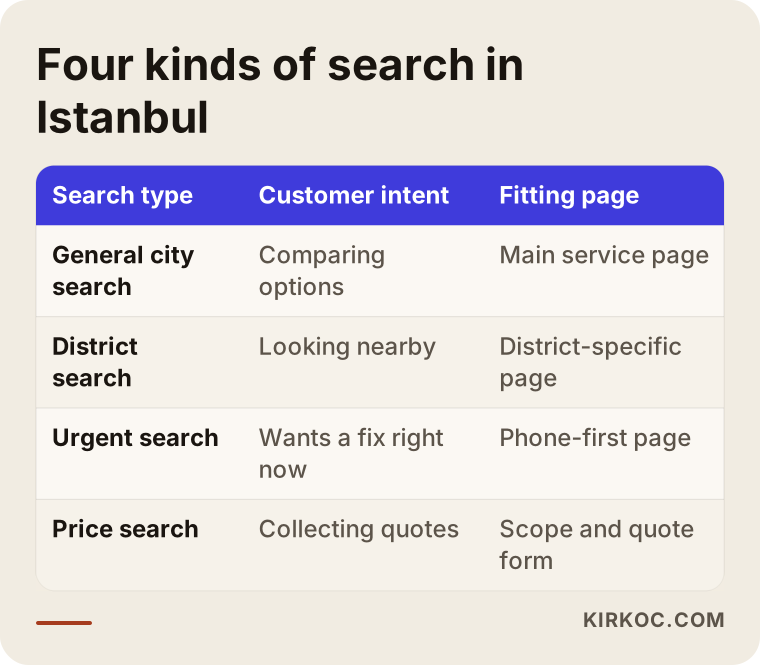
The lesson is simple. Each search has a different intent, and each intent deserves its own page. Showing one page to all of them means being mediocre for all of them.
Two hypothetical example scenarios
The two examples below are entirely invented. They describe no real company or person. Their purpose is to show how the same budget can behave under two different kinds of management. No outcome is guaranteed.
Scenario 1: a dental clinic on the Asian side
Suppose a clinic between Kadikoy and Atasehir is advertising on broad words like "Istanbul dentist." The ad is shown to people on the European side, in Bakirkoy, and even in other cities. There are clicks, but very few appointments. Why? Because most of the people clicking are too far away to ever visit the clinic, and some are only looking for information.
The management could change like this. The ad is shown only in a handful of districts on the Asian side. The keywords move to narrower ones such as "Kadikoy implant" or "Atasehir teeth whitening." Informational searches are blocked as negative keywords, meaning a person typing "how is a tooth extracted" will not see the ad. The booking button and phone number move to the top of the landing page. After these changes, the same budget reaches fewer people, but more relevant ones. Nobody can say in advance how many appointments that will produce; the only thing you can reasonably expect is less wasted spending.
Scenario 2: a corporate T-shirt printing shop on the European side
In the second example, a printing shop in Esenyurt serves mostly companies, schools, and event organizers. The shop advertises with one broad phrase, "T-shirt printing," and most of the people who click are individuals who want a single shirt. They are not this shop's target.
The fix here is to separate the searches by intent. The shop targets phrases that signal bulk orders, such as "bulk T-shirt printing," "corporate T-shirt printing," and "school uniform printing." Words like "single piece" and "free" go on the negative list. The landing page states the minimum order quantity and the delivery time, so individual customers rule themselves out early. The shop also tracks phone calls separately: how many calls came in and how many turned into quote requests. The owner learns to look at quote requests in the dashboard rather than clicks.
What the two scenarios share is this: the problem was not that the ads "didn't work." They were being shown to the wrong people. That is fixed by narrowing the target, not by raising the budget.
How I work, step by step
How does a Google Ads engagement run? The flow below is the order I follow in my own work. The details change from business to business, but the backbone stays the same.
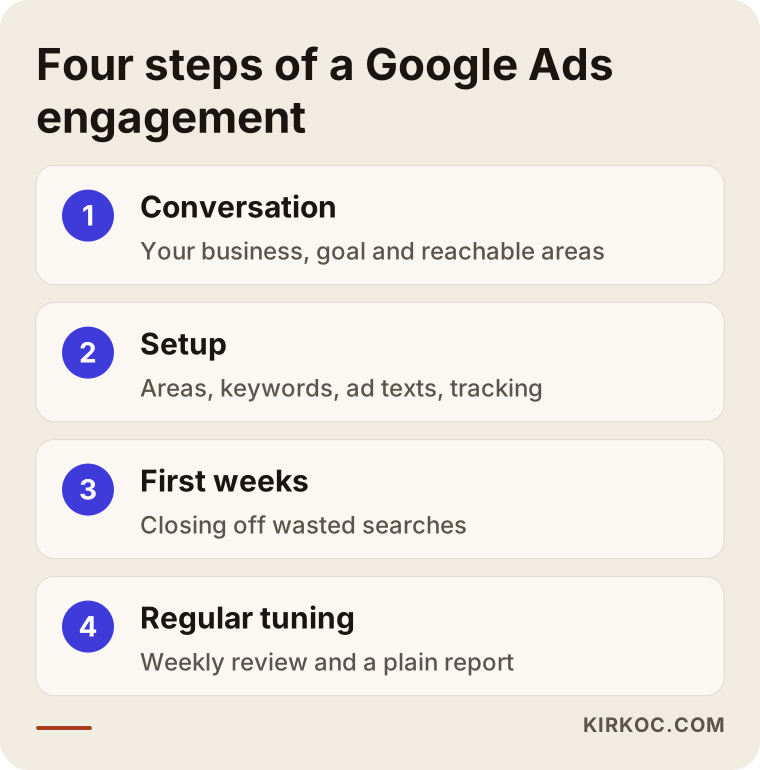
I start with a conversation. I ask what your business is, whom you serve, which service earns you the most, and how far you can realistically travel or deliver. This stage looks short, but it is the most important one, because a campaign that promotes the wrong service will fail no matter how well it is built.
Setup comes next. I choose the target areas, prepare the keyword list, write the ad texts, and review the landing page. One detail I want to stress: tracking phone calls and form submissions must be in place before the ads go live. Someone who cannot measure what works is not spending money; they are gambling.
The third step is the first few weeks. When ads first go live, the opening days are a learning period. I look at which searches got clicks and which were wasted, and I shut off the wasted ones right away. In this period the dashboard often looks messy. That is normal, and it is a bad time for hasty decisions.
The fourth step is regular tuning. Every week or two I look at the account and apply what I have learned. I also send you a plain report: how many calls came in, how many forms were filled in, and where the budget went. It is not a table full of jargon. It answers "what happened this month and what will I do next month."
What to check in your ad account
Even before you hire anyone, you can look at your own account and check a few things. The list below works as a quick health check.
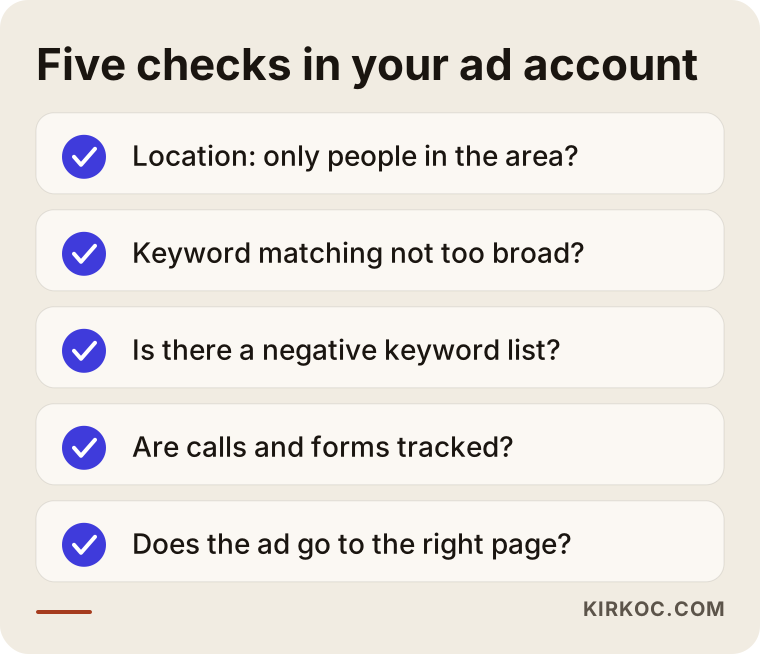
Pay special attention to the location setting. By default, Google may also show your ads to people who show "interest" in a location. That means someone who has never been to Istanbul but searches about Istanbul can end up in your audience. Checking the option that limits ads to people physically in your target area can change the direction of the spending noticeably for some businesses.
The keyword match type is a similar story. Broad match lets Google interpret your search terms loosely. Sometimes that helps; more often it scatters the budget. If you are just starting, narrower match types make it easier to see what is working.
Why a negative keyword list can save your budget
A negative keyword is a search you tell Google not to show your ad for. If you are a service company, for example, you might block words like "free," "how to," "job," and "internship." A person looking for work may type "cleaning company," click your ad, and never become a customer. Growing this list every week, by reading the actual search terms your ads appeared for, is one of the fastest ways to improve results.
Common mistakes
Mistakes tend to pile up in the same places. The illustration below sums up the four or five I see most often among Istanbul businesses.
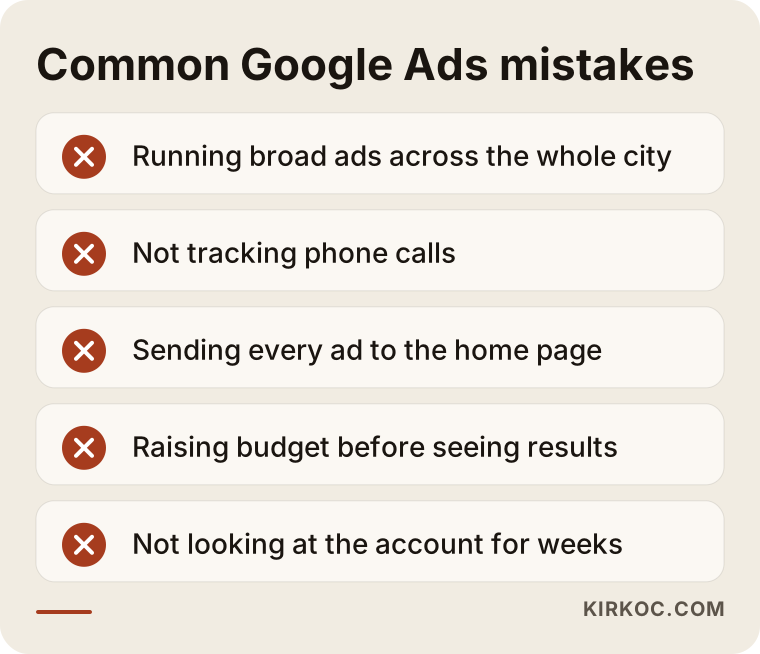
The first is the lack of measurement. An account that does not count phone calls ignores the most valuable conversion, because for service businesses in Istanbul a large share of customers never fill in a form; they simply call. In an account without measurement, the answer to "is this ad working?" is just a feeling.
The second big mistake is raising the budget before seeing results. "If we spend a bit more, more customers will come" sounds reasonable, but if the problem is targeting, what grows is the waste. Finding the right target with a small budget first, then scaling, is much safer.
The third mistake is changing many things in one move. If you change the ad text, the keywords, the budget, and the page in the same week, you cannot tell which one caused the result. Make changes one at a time and write them down.
The fourth mistake is not looking for months. An ad account is a living thing. Competitors change, searches shift with the seasons, and behavior is different during holidays. An account that is checked once a month at the end of the month loses its direction halfway through.
How long until ads produce results?
The honest answer is that an ad can bring a call on the first day, but steady and predictable results need some time. The first weeks are a learning period. Which keyword works and which page converts better becomes clear during that time. Here is the timeline in a simple form.
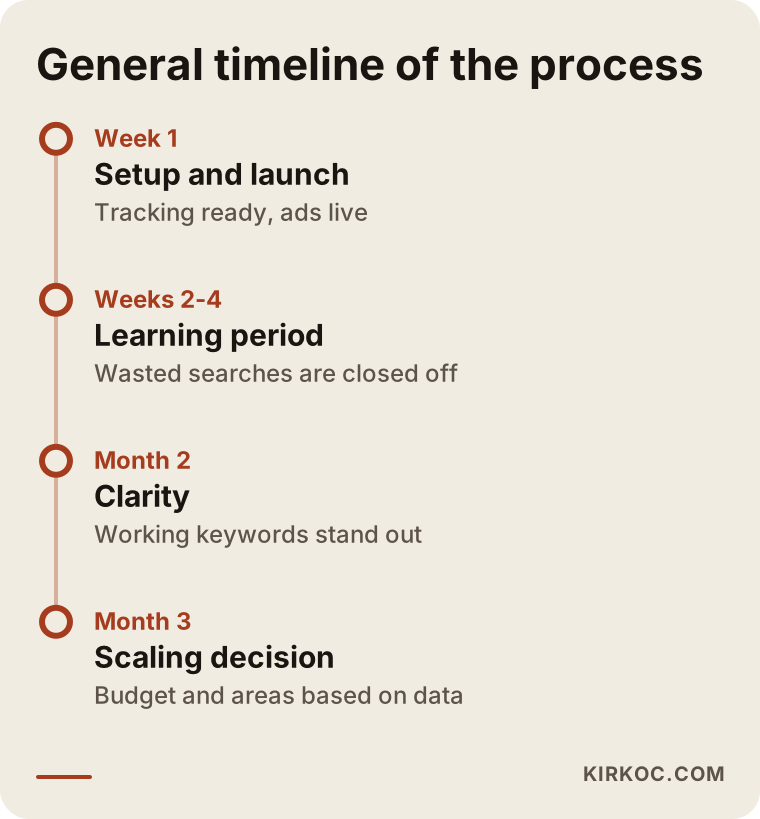
This timeline is a general expectation, not a promise. The pace depends on your type of business, the competition, and how ready your site is. No specialist can tell you "by this date you will have this many customers," and if someone does, be careful.
Should you do it yourself or hire a specialist?
Managing ads yourself is possible and sensible for some businesses. If your budget is small, your product is a single one, and your goal is very clear, you can begin with the ready-made campaign types Google offers. But know this: those ready-made types are paths Google designed to get you to spend more. They do not always work in your favor.
The decision chart below can help you decide whether to continue on your own.
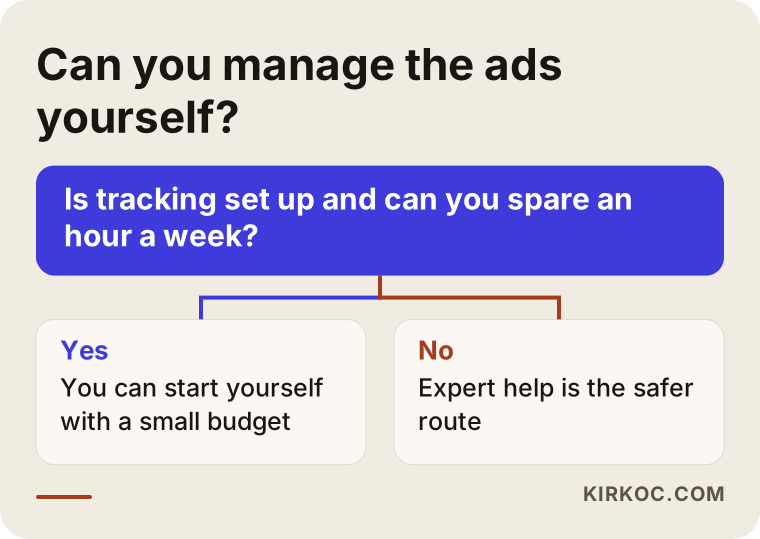
If you do it yourself, do three things without fail: set up phone and form tracking, review the location setting, and at least once a week open the search terms report and add the irrelevant ones as negative keywords. Even those three fix the course of many accounts.
The need for a specialist grows in these situations: your ad budget is at a meaningful level, you promote several services or branches, you cannot set up tracking, or you do not have time to check weekly. There is one more case. If the ads seem to be working but you are not sure the phone is really ringing because of them, an outside pair of eyes clears things up quickly.
What determines the cost?
I will not give a number in this article, because the right number varies a lot with your business. But I can tell you what moves the price. The cost has two separate parts: the ad budget you pay to Google and the service fee you pay for management. It matters not to mix them up.
The ad budget depends on how competitive your target searches are and how many areas you want to reach. In competitive searches such as law, dental implants, or insurance, the price per click is high. For a narrow neighborhood service it can be much lower. The healthy way to set a budget is to work out what a customer is worth to you and discuss in advance how much you can spend for how many customers.
The management fee depends on the number of campaigns, the variety of services, extra work on the site, and how often you want reports. An account with one service and one area does not need the same effort as one with three services, five districts, and separate landing pages. I give a price after we talk and I can see the scope of the work; just saying "my budget is this much" over the phone is not enough.
One point to watch: in a model where the management fee is a percentage of your ad spend, the specialist earns more as you spend more. That does not always mean bad intent, but it can create a conflict of interest. When you collect quotes, do not hesitate to ask which model they use. If you are a foreign company, also ask in which currency you will be billed and whether the invoice will meet your own accounting needs. For the details of invoicing, tax, and company registration in Turkey, talk to a local accountant or a lawyer.
Questions to ask when you collect quotes
If you are getting quotes from more than one person, the questions below give you a clear basis for comparison.
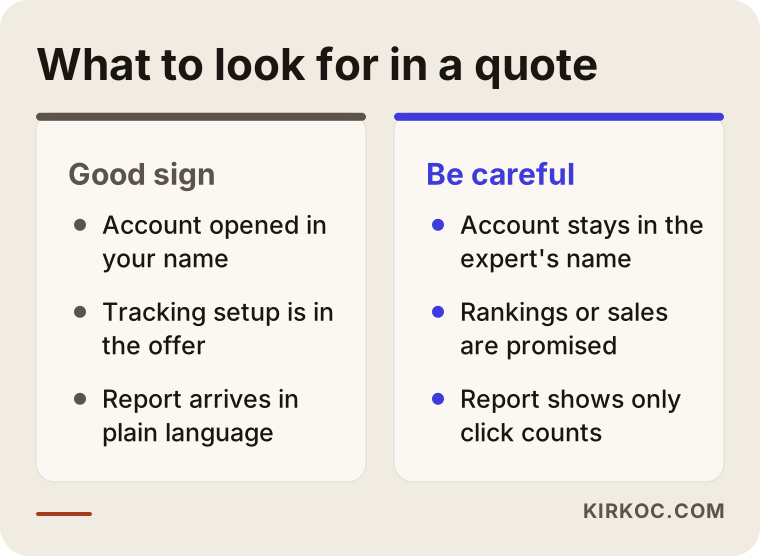
The most important question is whose name the ad account will be opened under. The account should be in your name and managed through your email. If it stays inside the specialist's own account, you may lose your history when you leave. The second most important question is whether tracking will be set up. The third is the form of the report: will it arrive in language you understand, or in complicated tables?
Ask one more thing: "If my site needs to be touched, who will do it?" Ads very often require page changes. If one person runs the ads and someone else runs the site, every small fix becomes a chain of messages. Because I do all of these jobs myself, I can usually fix a page the same day.
When ads, website, and social media run together
A customer in Istanbul rarely sees your business in just one place. They click your ad on Google, look at your site, open Instagram to see your recent posts, maybe read your reviews, and then call. The ad is only one part of the path.
When different people run each link in that chain, the ad can say "discount" while the site still shows the old price and Instagram announces a different campaign. When one person runs everything, the message stays consistent. What I say in the ad is written on the page and told in the same tone on social media. I also reuse what I learn in one place in another: the sentence that gets more clicks in the ad moves into the site headline and the post copy. Knowing which search brings phone calls is valuable data for SEO as well.
That does not mean every business needs all of it at once. Most start with one piece and add more as the need appears. But I can say that working with a single person who knows every link in the chain closes the gaps between them.
Extra tips for local businesses
If you have a physical address, showing up in Google's map results matters. Linking your ad account to your Google Business Profile lets you add your address and phone number to the ad. Then, when someone searches on mobile, "Call" and "Directions" buttons appear under your ad.
Another practical point in Istanbul is working hours. If you do not answer the phone at night, showing your ads only during the hours you work protects the budget. A person who clicks an ad while you are closed will call, reach nobody, and probably move on to the next result. This small setting can make a difference, especially for businesses that work by appointment.
Finally, watch your reviews. A person who sees your ad usually checks your rating before clicking. A low score or an unanswered complaint can make even the best ad ineffective. Replying to reviews regularly and politely is a habit worth having, regardless of the ads.
The layout of the page a visitor lands on has the last word. The illustration below shows, section by section, a simple landing page for a service ad.
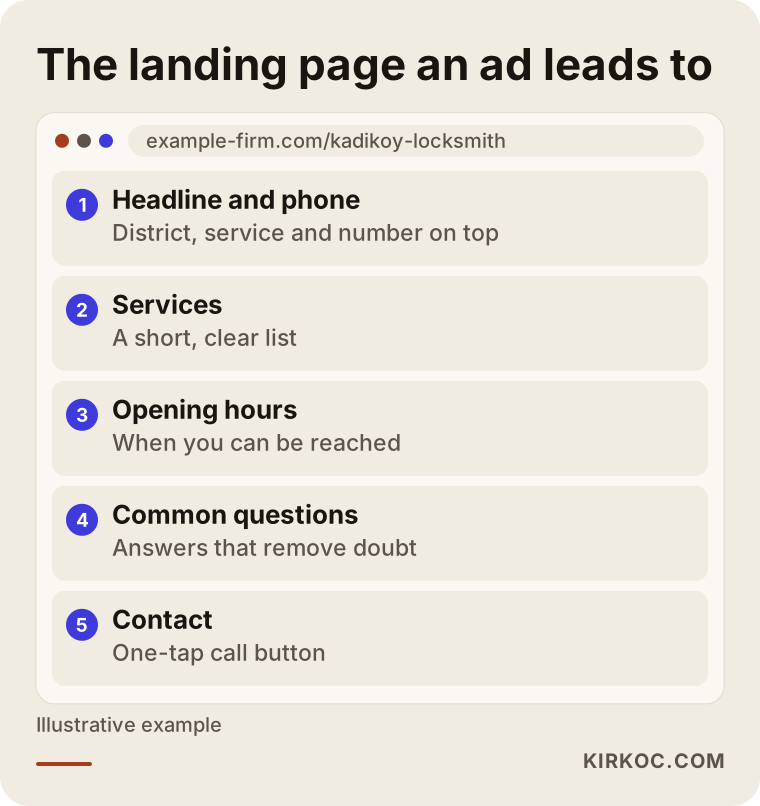
The phone number and district name sit at the very top of the page, and the trust-building information follows as you scroll. A page with a crowded menu and dozens of sections keeps the visitor busy and loses them.
How working with me looks
When you work with me, your contact is always me. The person who has the first conversation, does the setup, checks the account every week, and writes the report is the same person. I start with a short conversation where I listen to your business and your goal, and then I tell you plainly what makes sense and what does not. If I think ads are not the right path for you, I will say that too. For example, if your site is not ready, I might suggest fixing the site first.
The ad account is opened in your name and belongs to you. If you ever want to leave, you take the account with all of its history. I do not guarantee results, because nobody can. What I promise is to show you transparently what I am doing and to cut wasted spending quickly.
Frequently asked questions
How much budget do I need to start with Google Ads?
There is no single right budget; it depends on your industry, your area, and the competition. What matters is knowing what one customer is worth to you and deciding in advance how much you are willing to spend for how many customers. Starting small and seeing what works is usually the safest route.
Is my position guaranteed if I pay for ads?
No. Whether your ad is shown depends on your budget, your bid, the quality of the ad, and what your competitors do. No specialist can guarantee that you will appear first for every search.
If I am already doing SEO, should I still run ads?
It depends. Until SEO starts to produce results, ads can fill the gap. If your site already ranks well in the free results, it may be enough to limit ads to your most valuable searches. Looking at the two together is the healthiest approach.
Should the ad account be opened in my name?
Yes. The account should use your email and carry your name. That way you own your history, and if you want to work with someone else later, nothing is lost.
How do I measure phone calls?
You can connect a call button to the ad and set up tracking on the site that counts taps on the phone number. You can also keep a simple log of incoming calls in a notebook or a spreadsheet. What matters is seeing which ad brought the call.
What can be the reason if my ads are not producing results?
Usually it is one cause or a mix of several: the wrong area, keywords that are too broad, a landing page that does not convince, missing tracking, or truly intense competition. An audit of the account shows which one applies.
What happens if I stop the ads?
When the ads stop, impressions stop. You no longer pay Google, but customers from that channel stop too. Ads have no cumulative effect the way SEO does, so think of them as a channel you can switch on and off like a light.
How should I plan ads for a seasonal business?
Starting a few weeks before demand rises covers the learning period. In the low season you can lower the budget or focus only on the most profitable service. Looking at last year's searches helps with planning.
Next step
Write a few sentences about where you are with Google ads in Istanbul, your goal, and what budget you have in mind, and I will tell you honestly what makes sense. You can reach me through my digital advertising service page.