Type "web design company" into a search bar and you get a long list of results that all promise the same thing: modern design, fast delivery, fair pricing. If you don't have a technical background, picking one from that list feels a bit like choosing a surgeon by the look of the waiting room. This guide shows you how to narrow the field, which questions to ask on a first call, and which warning signs should make you walk away. I'm a solo web designer and SEO/GEO consultant. I work remotely, so I'm one of the options you might consider, but my goal here is simpler: to give you criteria you can apply to anyone, including me. If you'd like to see what I offer first, here is my website design service.
What the search results actually tell you
Most business owners find a company through search, which means the first round of elimination happens before you ever talk to anyone. When you look at a results page, check three things. First, does the page title and description say what the company does, or is it only a slogan? Second, is this result really a company, or is it a do-it-yourself tool that wants you to build the site on your own? Third, when you click through, can you find services, sample work and contact details without hunting?
A company's own website is the easiest piece of its work to inspect. Open it on your phone. Is the text readable? Does the page load in a reasonable time? Can you call with one tap? If someone is selling you a site that is supposed to win customers and their own site fails at the basics, that tells you something.
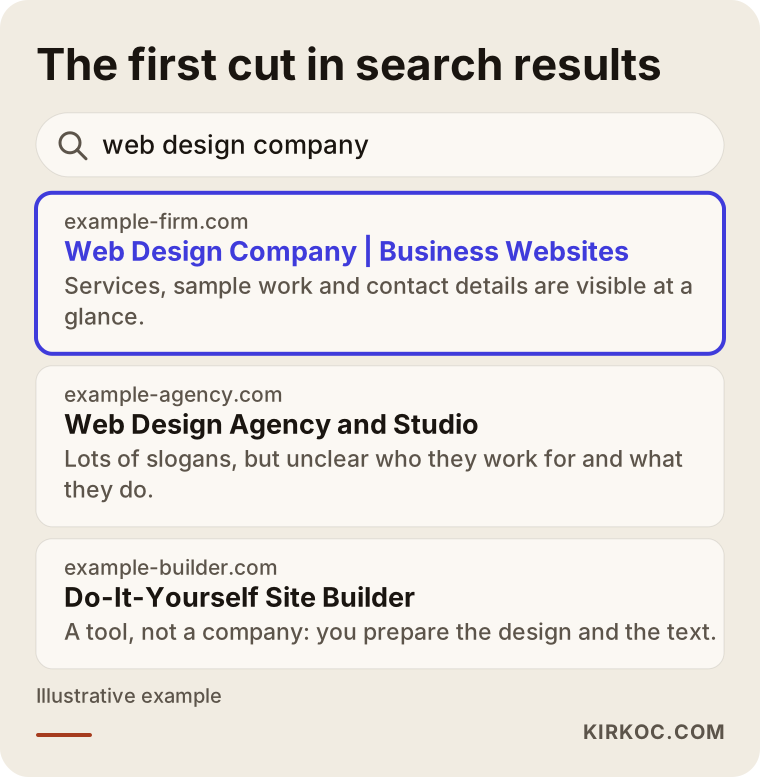
Keep one thing in mind: appearing at the top of a search page doesn't prove someone does good work. Advertisers can sit at the top, while a skilled specialist who doesn't market themselves well may be on page three. Treat the ranking as a hint, not a verdict. The real decision comes from the criteria below.
Company, agency, studio, freelancer: does it matter?
People search for "web design company," "web design agency," and "web designer" almost interchangeably. Behind those labels are very different ways of working, and the difference affects how much attention you get, how long things take, and whom you call when something breaks.
A solo specialist. You talk directly to the person doing the work. Decisions, design and build sit with one person, so there is no "I'll pass that on to the team." What to ask: how busy are they, and what happens during vacations? I work this way, and both the advantage and the limit come from that.
A small studio. A few people, usually split across design, development and content. You get several skills under one roof. What to ask: will the person I'm talking to do the work, or somebody else? Knowing who builds your site helps you set the right expectations.
A large agency. A big team suits campaigns and brand work. In exchange, the process is slower and your contact may change over time. For a small local business, that structure is often heavier than needed.
A do-it-yourself builder. This is a tool, not a company. It can be enough for a basic information page, but originality and flexibility are limited, and it may not be enough if you want to stand out in search.
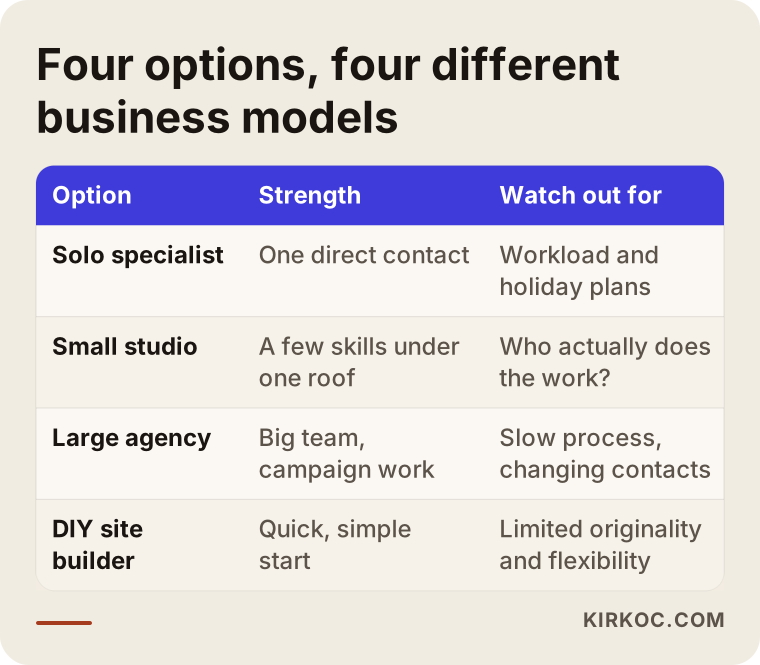
There is no single best answer. It depends on the size of your business, how much hands-on attention you want, and how important it is to know exactly who is doing the work. What matters is that a company is honest about its model. Some call themselves a "team" while one person does everything; others call themselves specialists while outsourcing the actual work. Asking is perfectly reasonable.
Six criteria for narrowing the list
Before you book any calls, you can shorten your list with six simple criteria.
- Do they show comparable work? It doesn't have to be your industry, but you should see work for customers like yours. A restaurant site and a law firm site need different things.
- Does their own site work? Open it on your phone and look at speed and readability.
- Is the quote written? A quote that spells out scope page by page is the sign of a company that knows what it's doing.
- Whom do you contact after launch? The relationship shouldn't end the day the site goes live. You should know whom to call for a small fix.
- Who owns what? The domain name (your site's web address) and the admin access to the site should be in your name.
- Do they explain Google in plain words? "Search engine friendly" isn't an answer. They should be able to explain how page titles, descriptions and site structure are prepared, in language you can follow.
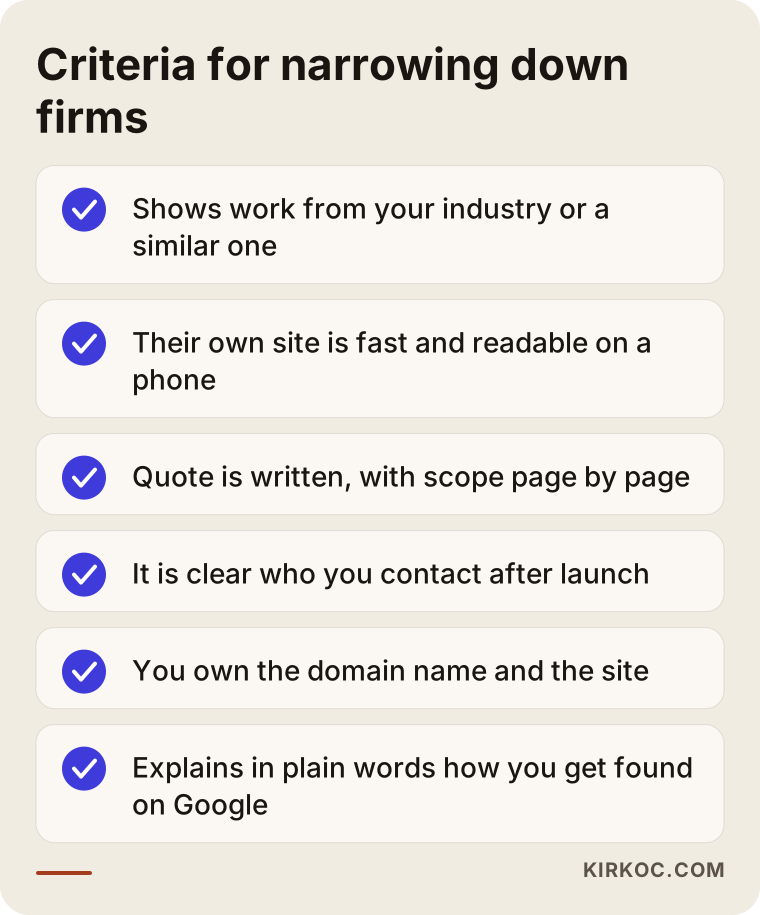
A company that misses four of the six is usually safe to drop. You don't need to find one that hits all of them; what matters is knowing how much each gap matters for you.
How to read a portfolio and references
A portfolio is the company's shop window. It looks good by design, so looking good proves little. Check these things.
Live sites or screenshots? If you only see images, ask for the live address. Open it on your phone and click around. A working site is much more honest evidence than a presentation slide.
Variety or repetition? If every site seems to come from the same template, yours will too. Templates are not bad in themselves, but they aren't what you expect when someone sells "a design made for you."
Does each site have a purpose? A good portfolio isn't just attractive; the sites do a job, such as bringing in calls, bookings or product interest. Ask: "What was this site for, and what did the client want?" A company that can answer is thinking about the outcome and not just the look.
Ask for a reference. Ask whether a past client would be willing to talk to you. If the answer is no, try to understand why; some clients prefer privacy, which is fine. But if there are no references and no portfolio, make your decision knowing you are working with someone just starting out. That can be a fine choice if it is stated openly.
If you work in healthcare, law or another field where advertising is restricted, take extra care. Rules about what you can promise differ by profession and region. If a company proposes "guaranteed results," outcome claims or before-and-after comparisons, stop. A sound company writes compliant, informative content and promises no results. If you are unsure what is allowed, check with your professional body or the relevant regulation; that is your responsibility, not a web designer's.
Questions to ask on the first call
The first conversation is the cheapest way to get to know a company. These questions need no technical vocabulary and the answers say a lot.
"Who will actually do the work?" The person who sells may not be the person who builds. That isn't automatically a problem, but you should know.
"What's included and what isn't?" Ask about writing the text, photography, number of pages, mobile-friendliness and the contact form one by one. "Not included" turns into an extra cost later; better to hear it now.
"What if I don't like the design?" Changing your mind midway is normal. The company should tell you at which stage and how many times you can ask for changes.
"Who writes the text?" The weakest part of most websites is the writing. If you write it, the schedule stretches; if they write it, you need to explain your business. Know which it will be.
"How do you test the site on phones and tablets?" Most visitors arrive on a phone. A company that can't describe its testing may be leaving it to chance.
"Whose name will the domain and admin access be in?" The right answer is yours. It shows the site belongs to you and lets you move it to someone else if you part ways.
"What do you do for Google?" "Everything" is not reassuring. They should be able to name concrete items in plain language: page titles, descriptions, site structure and speed.
"What happens after launch?" Ask how small fixes, updates and problems are handled. If the answer is "we'll talk later," ask what exactly you'd be talking about.
One more thing matters as much as the answers: how your questions are received. Someone who answers patiently, in words you understand, will probably treat you the same way during the project. Someone who brushes you off with technical terms will do the same when a problem comes up.
How to compare quotes side by side
If you collect two or three quotes, comparing them only by the bottom line is misleading. Two quotes can describe different halves of the same site. On a sheet of paper, pull out these headings from each: how many pages, who writes the text, who supplies images, is mobile design included, are revisions allowed, what's the timeline, what's the support after launch, and whose name are the domain and access in.
If half of those headings are missing from a quote, that doesn't mean it is "flexible"; it means a lot is unknown. A vague quote may look cheap, but the cost of the vagueness usually shows up later and comes out of your pocket.
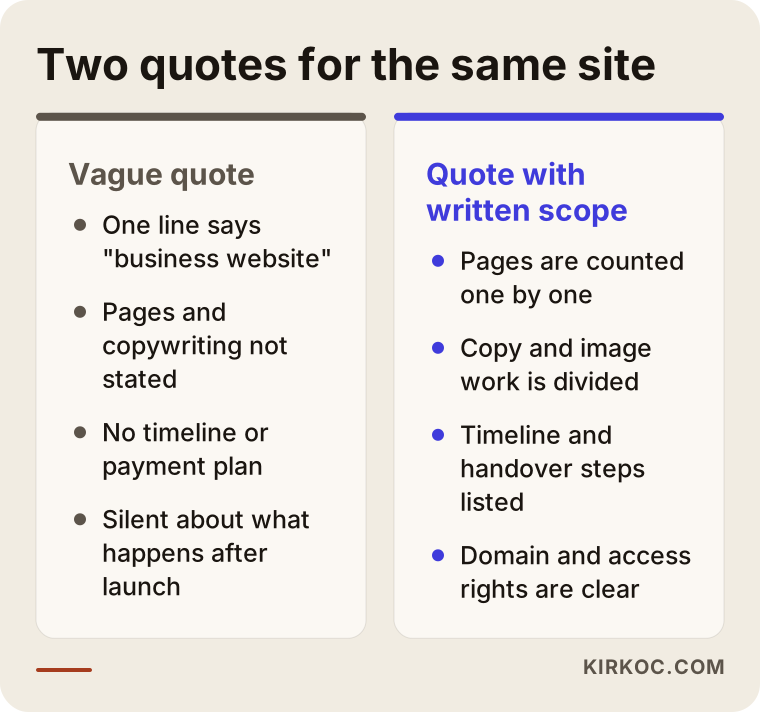
A quote with a written scope does two jobs. It lets you compare companies fairly. And it leaves a document both sides can return to if a disagreement arises. The trouble with verbal promises is that two honest people can remember them differently.
What shapes the cost
I won't give numbers here, because the cost of a site depends on its scope and every business needs something different. But knowing what moves the cost helps you read quotes intelligently.
- Number of pages and complexity. A short information site and a large site with many sections are not the same job.
- How original the design is. Adjusting a ready-made template is different work from designing something from scratch for your business.
- Text and image work. If you supply the text and photos, the job is lighter; if the company must create them, it grows.
- Number of languages. If you want a multilingual site to reach customers abroad, each language is its own writing job.
- Special features. Booking systems, online payments or member areas push a site beyond a simple information page.
- Deadline and urgency. Very short timelines disrupt planning and usually affect the price.
- Support after launch. Whether you want help afterward, and how that is arranged.
When you see a very low quote, ask which item is missing. When you see a very high one, ask which item drives it up. A good company can explain either one. If it can't, the price may rest on a guess, or on what they think you'll pay, rather than on the work.
Red flags: when to step back
Some signals are reason enough to remove a company from your list.
Guaranteed rankings or revenue. Nobody can guarantee a particular position on Google or a particular income; Google decides the results. Someone who says "we'll get you to page one" either doesn't know what they're saying or does. Neither is good.
No work to show. Being new is no shame. Passing off someone else's work as your own is. Ask for a live address and whether the site was really theirs.
Building before approval. A company that builds the entire site before you've signed off on the design isn't asking what you think. Finding out "this isn't what I expected" later costs you both time.
Registering the domain and admin in their own name. If the address and the control panel belong to the company, you may have to leave your site behind when the relationship ends. This is one of the most common complaints.
A verbal promise in place of a written deal. It feels fast and friendly, but if a disagreement comes, you have nothing in hand.
Jargon as an answer. If a company answers with terms you don't understand, either they are trying to impress you or they aren't clear themselves.
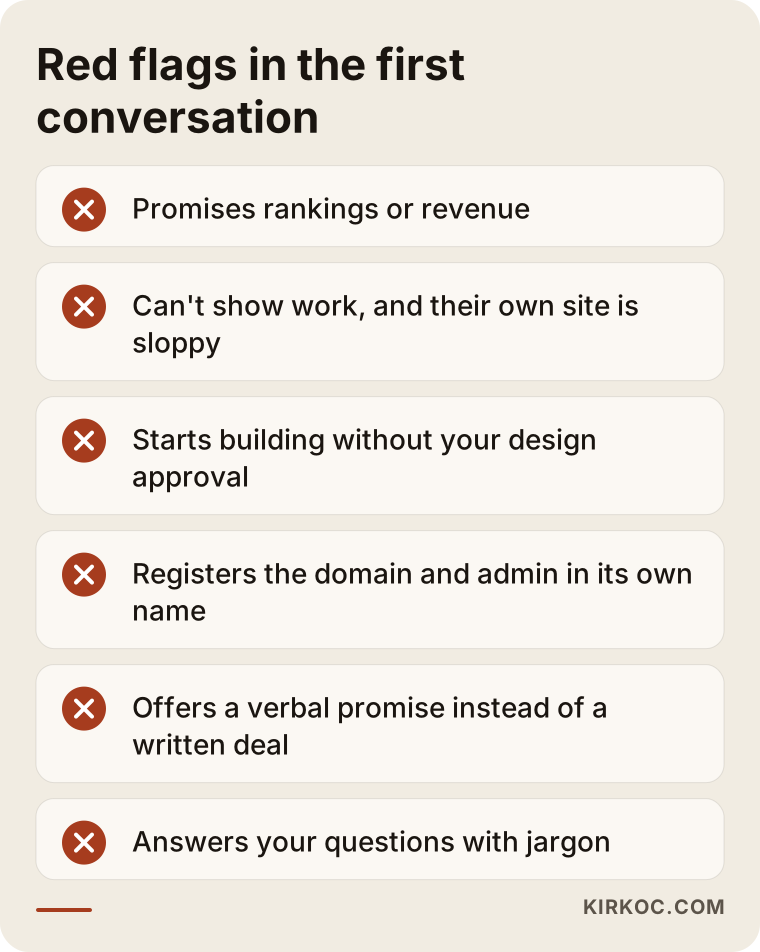
No company is perfect. Seeing one red flag doesn't mean you must leave immediately, but if you ask about it directly and don't get a satisfying answer, it's time to move on.
How working with me goes
So you have something to compare against, here is my own process. I work alone, which means you deal with the same person throughout.
The first step is getting to know you and your needs. We talk about your business, your customers and what you expect from the site. Then I send a written quote with the scope and timeline.
The second step is design. I prepare the design of the home page and a sample inner page. I don't move on to the next step without your approval.
In the third step I turn the approved design into a working website, and the text and images are put in place. If you're not sure what to write, that's fine; using the details you give me, we prepare the text for your service pages together.
The fourth step is testing and launch. I test the site on a phone, tablet and computer, you take a last look, and we go live.
The fifth step is after launch. I introduce the site to Google, keep a close eye on it in the first weeks, and you can reach me with any questions.
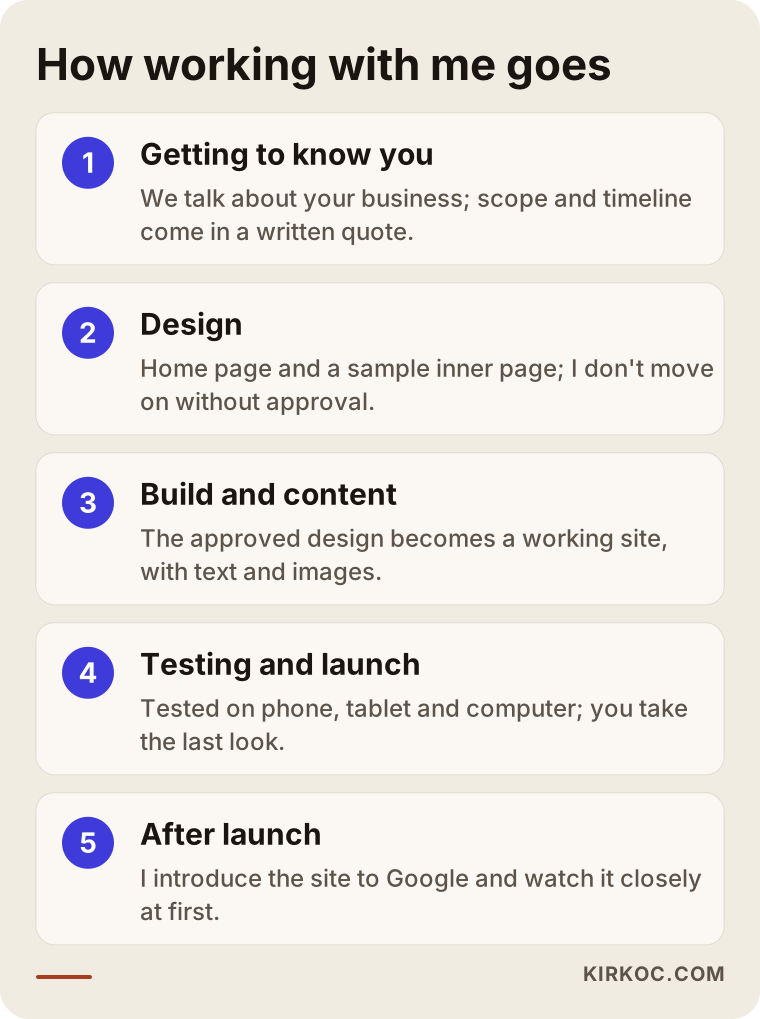
What this shows you: at the end of each step you have something concrete in hand, and you have a say before the next one begins. Ask any company you consider the same question: "How does the process work, and where do I come in?" A company that can describe a clear flow usually works systematically.
Two hypothetical scenarios
The two cases below are not real clients. They are scenarios I made up to show how a decision might take shape.
Say you've just opened a small bakery and want your first website. You looked at three options. The first is a large agency whose process sounds long and whose call was handled by a sales rep. The second is someone who quickly sets up sites from ready-made templates. The third is a solo designer. Your priorities are good-looking product photos, phone orders and showing up on the map. In this case a large agency's structure is probably heavier than you need. A quick template-based solution would get you going, but sooner or later the question "what sets us apart?" would come up. With the solo designer, you'd ask about the scope of the quote, who supplies the photos, and whose name the domain would be in. If you test all three with the same question list, your decision rests on scope and trust rather than on price alone.
Say you run a small dental practice and a company offers you promotional text that promises "guaranteed results." The problem here isn't design; it's content. Advertising in healthcare is restricted, and outcome promises both expose you to risk and create doubt instead of trust in a visitor. A sound approach is to describe the practice, its services and how to reach it in an informative tone, without promising outcomes. Turning down such an offer and choosing a company that proposes compliant content would be the strongest decision in this example.
Common mistakes
Looking only at the lowest price. Comparing prices without comparing scope is comparing apples with oranges.
Falling for a pretty presentation. A design in a slide deck can look impressive, but the site's function, speed and phone experience still need to be asked about.
Leaving the text until the last minute. The design is done but the text isn't ready. This is the biggest cause of delayed launches. Discuss the writing at the start.
Wanting everything at once. Often it's healthier to build the pages you need first and add the rest later.
Forgetting Google. A beautiful site isn't automatically a findable one. Page titles, descriptions and content must be considered from the start. If SEO is patched on afterwards, you may end up paying for the same work twice.
Handing over the keys. Keep the domain and admin details in your own records at all times.
Not describing your customer. The company doesn't know your customers. Who they are, how they search, why they choose you: if you don't say, you get a generic site.
When you don't need a web design company
To be honest, not every business needs to hire one. If your site will only be a business card (your name, what you do, a phone number and an address), a do-it-yourself builder may cover it. If you're just starting out with a very tight budget, it can be smart to begin with a simple page and wait for the business to settle.
The need for a company starts when the site is expected to bring in customers: being found in search, explaining your services convincingly, building trust, being easy to contact from a phone. That takes thinking, writing and testing beyond a template.
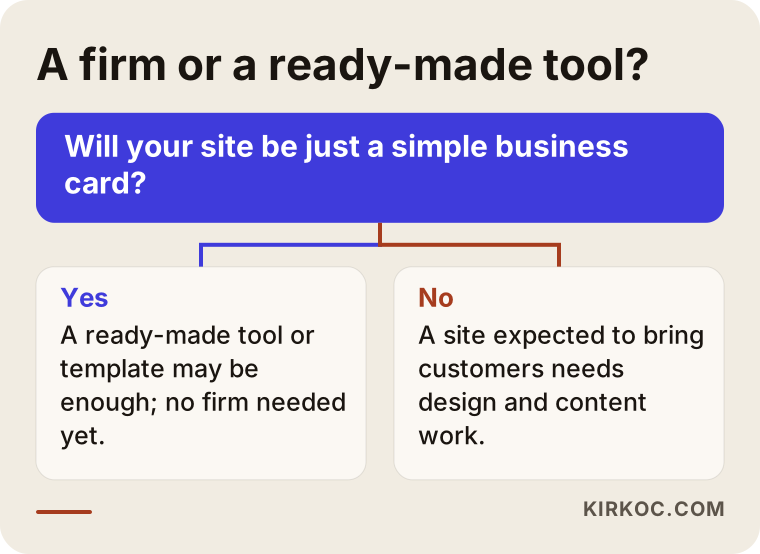
There is also a middle road: begin with a ready-made tool today and move to a custom site when the business grows. That's legitimate too, as long as you register the domain in your own name from the start so the move is easy.
Doing it yourself or hiring a specialist
If you do it yourself, you save money, but you pay in time, in learning, and in gaps you won't notice at first. Ready-made tools make things easier, but writing good text, building the right pages and making the site understandable to Google are still your job. For someone who knows their customers, enjoys writing and has the time, that's a perfectly reasonable path.
With a specialist, what you mainly gain is time and easier decisions. You work with someone who knows what to do, in what order and which mistakes to avoid. In exchange comes a fee and a relationship built on trust, which is why the criteria in this guide matter.
There's a middle path as well: have a specialist do the initial setup and handle small updates yourself. If that appeals to you, say so up front and ask for a site that you can update easily.
Frequently asked questions
What is the difference between a web design company and a freelance web designer?
A company usually has several people and divides the work; a freelancer typically runs the project alone. The company's advantage is a broader team, the freelancer's is a direct contact. Which suits you depends on the size of the job and how much personal attention you expect.
More important than the type is that you know from the start who does the work and whom to reach when something goes wrong.
How do I know if a web design company is good?
A good candidate describes itself without exaggeration, shows live examples, puts the scope into a written quote and answers your questions in plain language. Listening to you and trying to understand your business matters more than rushing to sell a solution.
There is no single test, but if a company meets most of the criteria above, you are on the right track.
Should I get quotes from more than one company?
Yes. Two or three quotes give you something to compare. Explain your needs to every company in the same way so the quotes are truly comparable. Read quotes by scope, not just by the total.
What should a quote always include?
The number of pages, who supplies text and images, how many revisions you get, the timeline, the payment plan, what support follows launch, and whose name the domain and admin access are in. If any of these is missing, ask the company to explain.
Should I believe a company that says it will get me to the top of Google?
No. Google decides search rankings and nobody can guarantee a position. A sound company will say it can prepare your site in a way Google can understand, but it won't promise a rank. Treat any rank or revenue guarantee as a red flag.
Who owns the website after it's built?
You should. The domain and admin access need to be registered in your name. Asking this in writing at the start protects you if you ever want to change companies.
Is a do-it-yourself builder or a custom design better?
For a basic information page, a builder may be enough. For a site you expect to bring customers and be found in search, you need custom design and well-considered content. The decision depends on what the site has to do for you.
How long does a website take?
It depends on the number of pages, whether the text is ready and how quickly you give approvals. Nobody can give a firm date for a job with no defined scope, which is why the timeline belongs in the quote.
Choosing the right company starts with asking the right questions. If you tell me about what you have in mind, I'll answer with a written quote covering scope and timeline. Take a look at my website design service and get in touch so we can talk it through.